
Power Your Software Testing with AI Agents and Cloud
The Native AI-Agentic Cloud Platform to Supercharge Quality Engineering. Test Intelligently and Ship Faster.

- TestMu AI (Formerly LambdaTest)
- /
- Blog
- /
- How to Test an IVR System Without Code
How to Test an IVR System Without Code (2026 Guide)
How to test IVR menus and DTMF routing over real phone calls, scored on containment and accuracy. No code, no telephony scripts, with TestMu AI.
Last Updated on:
An IVR test has to walk every DTMF and spoken path through a phone menu, confirm pressing 0 reaches the right agent queue instead of a loop, and check the retry when a caller enters nothing at all. TestMu AI does this over real phone calls scored across more than 30 metrics, including DTMF Detection and First Call Resolution. If the menu hands off to an AI agent, the voice agent testing guide picks up from there.
What IVR testing checks
A phone menu looks like a handful of options, but real coverage has to walk every branch and every way a call can fall apart. That means the main greeting and each submenu beneath it, both DTMF digits and spoken answers, the transfer a caller triggers by pressing 0, and the retry behavior when someone enters nothing at all. The full set of test types and 30 starter test cases is in the guide to IVR testing.
- Deep menu trees where changing one option can reroute every path that shares it
- DTMF and speech input together, since a digit that meant billing last quarter may point elsewhere after a redesign
- Call routing and transfers, where pressing 0 has to reach the right agent queue and never a loop
- The balance between resolving inside the menu and handing off cleanly when it cannot
- Real telephony conditions like accents, call-center noise, and weak cellular audio that change how prompts and answers are heard
- Every path has to run over an actual phone call, which is why web test tools built around a DOM do not apply here
Two approaches to testing IVR menus
Most teams reach for one of two options. This is how a scripted telephony harness and a no-code agent stack up on the work that eats your week.
| What you compare | Scripted DTMF harness | TestMu AI agent testing |
|---|---|---|
| Who can author a test | An engineer who writes telephony automation | Anyone who can describe the options a caller hears |
| When the menu is reordered | Digit assertions break and need re-pointing | You edit one plain-English line |
| DTMF button presses | Hardcoded send-digit calls | Real DTMF tones scored by a DTMF Detection metric |
| Spoken input, accents, noise | Not covered without extra tooling | 200+ voice profiles, 50+ accents, 15 noise presets |
| What a failure tells you | A stack trace at a line number | The transcript, the misrouted digit, and a verdict |
| Real production calls | Out of scope | Batch-analyzed with the same 30+ metrics |
The scripted route looks compact until a menu changes. This is what verifying a single billing-then-balance-then-agent path looks like in a typical telephony harness:
const call = await telephony.dial("+18005551234");
await call.waitForPrompt({ timeout: 10000 });
await call.sendDtmf("2");            // main menu: "For billing, press 2"
await call.waitForPrompt({ timeout: 10000 });
await call.sendDtmf("1");            // billing menu: "For your balance, press 1"
const transcript = await call.transcribe({ timeout: 15000 });
if (!transcript.toLowerCase().includes("account balance")) {
  throw new Error("Wrong branch reached: " + transcript);
}
await call.sendDtmf("0");            // request a human agent
if (!(await call.waitForTransfer({ timeout: 20000 }))) {
  throw new Error("Call never routed to an agent");
}
await call.hangup();
Every line here is a hostage to the menu. Reorder billing from 2 to 3, reword the balance prompt, and the digit assertions point at the wrong branch. Multiply that across every submenu and retry path, and the script costs more to maintain than the manual testing it replaced. It also assumes someone on the team writes telephony automation, which most support and QA groups do not. The trade-offs between scripted harnesses, open-source tools, and hosted testing are covered in this guide to IVR automation testing.
With TestMu AI IVR testing, you describe the same path the way you would brief a new teammate, and an AI testing agent places a real call to run it:
- Call the support line and wait for the main menu greeting
- Press 2 for billing
- On the billing menu, press 1 for your current balance
- Verify the balance branch is reached, not sales or another submenu
- Press 0 to request a human agent
- Verify the call is routed to the correct agent queue
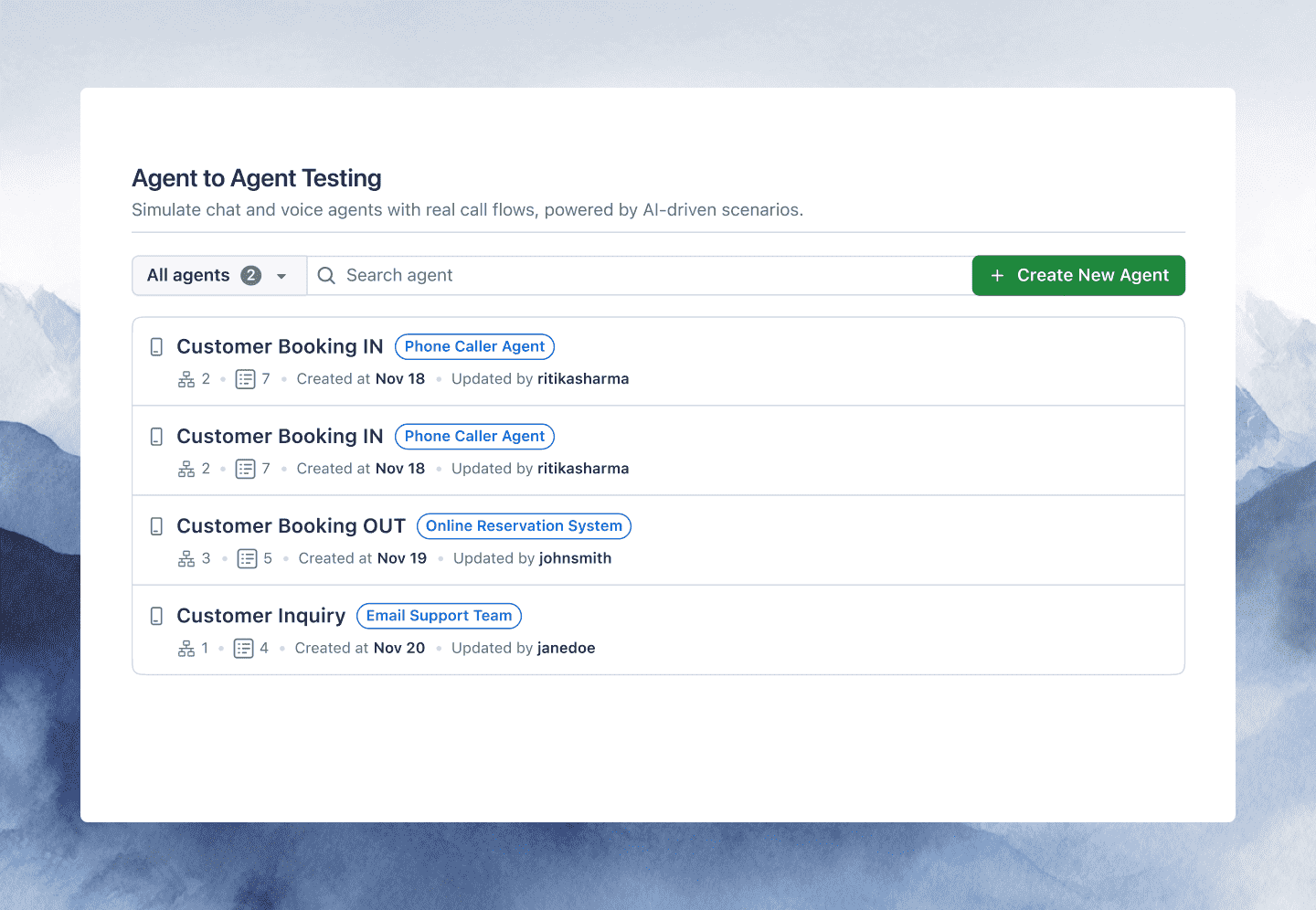
The agent dials your number over a live call, sends the real DTMF tones, and reads the speaker-identified transcript to confirm each press landed where you meant. When the menu changes, you edit one English line instead of re-pointing brittle digit checks.
IVR paths and the metrics that score them
Once the happy path passes, coverage is a matter of adding more paths and knowing which metric flags each one when it breaks. TestMu AI scores phone calls across more than 30 metrics. These are the six paths worth wiring first and the metric that catches each.
| IVR path | What can go wrong | Metric that scores it |
|---|---|---|
| Main menu DTMF routing | A digit lands on the wrong branch after a reorg | DTMF Detection |
| Deep submenu navigation | A shared option reroutes several paths at once | Intent Recognition Accuracy |
| Invalid input and retries | The menu drops the call instead of re-prompting | Instruction Following |
| Zero-out to a human | The transfer loops back to the greeting | Escalation Quality, Containment Rate |
| Spoken choice in noise | An accent or background noise breaks recognition | Speech-to-Text Accuracy, Accent Handling |
| Whole-call resolution | The caller hangs up without an answer | First Call Resolution, CSAT |
The spoken-input rows are where a menu starts blending into a conversation. Run the same choice with a non-native accent and call-center noise layered on, then compare speech-to-text accuracy across the quiet and noisy calls. When the menu eventually gives way to a talking assistant, the same scenarios carry over into voice agent testing, and the walkthrough on how to test a voice agent without code picks up where the menu leaves off.

How TestMu AI scores an IVR call
Every test call runs through the same scoring pipeline. Button presses are checked with a dedicated DTMF Detection metric, routing is graded against Intent Recognition Accuracy, and the full call rolls up into Containment Rate, First Call Resolution, and an estimated CSAT. A run returns the call transcript, the exact digit path the agent walked, and a Green, Yellow, or Red verdict on production readiness, so a failing branch points straight at the menu step that broke it.
The same 30-plus metrics also apply to calls you did not place. Upload a batch of recorded production calls and the platform scores them the way it scores live tests, which turns last week's real traffic into quality and routing data without rerunning a single scenario.
Load testing an IVR under call volume
A menu that routes cleanly on one call can still buckle when a hundred arrive at once, so IVR performance testing runs the same paths concurrently and watches whether routing, containment, and audio quality hold. TestMu AI runs 5 parallel calls per organization by default, and you can add concurrent call capacity as a top-up when you want to push real volume through the menu.
Point the load run at the paths that carry the most traffic, then read the same 30-plus metrics under pressure. Voice Quality flags audio that degrades as calls stack up, Containment Rate shows whether the menu still resolves callers instead of dumping them into a queue, and the transcript on any failing call names the step that broke. It is the same describe-a-path-in-English workflow, run wide instead of once.
Running IVR tests in a pipeline
IVR tests earn their keep when they run without anyone starting them. Schedule the suite daily, weekly, or on a custom cron expression so a Tuesday menu reorg cannot break routing unnoticed before Friday. Wire the testmu-a2a-cli into CI and the same scenarios run as a regression check on every deploy, emit JUnit XML, and return exit code 0 or 1 to gate the build. Route failures to Slack, email, or a webhook, each carrying the transcript and the DTMF path the test took.
IVR testing is one surface of the broader agent testing platform, so the same workflow extends to the chatbots and phone agents that gradually replace parts of the menu. If the menu sits on a specific contact-center stack, 8x8 testing covers that platform directly. Contact center testing tools check the rest of the call path, from routing and audio quality to agent handoff.
Setting up your first IVR test
Here is how to test an IVR system in TestMu AI from first path to verdict, in about ten minutes and with no telephony code.
- Sign up for TestMu AI free, with no credit card
- Add your IVR phone number and a short note on what each menu should do
- Describe the paths you want checked in plain English, or let TestMu AI generate scenarios from your call-flow document
- Run it and watch real calls walk each menu path, scored on routing, containment, and accuracy
Your IVR carries too many calls to test one dial at a time and too many branches to trust to brittle digit scripts. Describe the paths, run them over real calls, and read the verdict. If you are still choosing a platform, compare commercial and open-source options in this roundup of IVR testing tools.

Note: Test your IVR system without writing a line of code. Start with TestMu AI free.
Author

Chaitanya Sharma
Blogs: 21

Chaitanya Sharma is an AI Product Manager at TestMu AI, where he builds agentic AI capabilities focused on computer vision and multi-modality, moving testing beyond static script execution toward autonomous, agent-driven workflows. Before TestMu AI he shipped 135+ features at Sprinklr for a no-code community and website builder used by Fortune 500 enterprises including Dell, Samsung, and Polestar. At Policybazaar he led the zero-to-one launch of a digital lending and insurance marketplace embedded in Bahrain's dominant payments app, building a risk-intelligence engine that compressed loan-approval times by 80%. He explored machine learning and NLP through research at the University of Cambridge, and holds a B.Tech from Delhi Technological University.
Reviewer

Himanshu Sheth
Reviewer
Himanshu Sheth is the Director of Marketing (Technical Content) at TestMu AI, with over 8 years of hands-on experience in Selenium, Cypress, and other test automation frameworks. He has authored more than 130 technical blogs for TestMu AI, covering software testing, automation strategy, and CI/CD. At TestMu AI, he leads the technical content efforts across blogs, YouTube, and social media, while closely collaborating with contributors to enhance content quality and product feedback loops. He has done his graduation with a B.E. in Computer Engineering from Mumbai University. Before TestMu AI, Himanshu led engineering teams in embedded software domains at companies like Samsung Research, Motorola, and NXP Semiconductors. He is a core member of DZone and has been a speaker at several unconferences focused on technical writing and software quality.
IVR Testing FAQs
Did you find this page helpful?
More Related Blogs

TestMu AI forEnterprise
Get access to solutions built on Enterprise
grade security, privacy, & compliance
- Advanced access controls
- Advanced data retention rules
- Advanced Local Testing
- Premium Support options
- Early access to beta features
- Private Slack Channel
- Unlimited Manual Accessibility DevTools Tests