
Power Your Software Testing with AI Agents and Cloud
The Native AI-Agentic Cloud Platform to Supercharge Quality Engineering. Test Intelligently and Ship Faster.

- TestMu AI (Formerly LambdaTest)
- /
- Blog
- /
- How to Test a Vapi Voice Agent Without Code
How to Test a Vapi Voice Agent Without Code (2026 Guide)
Test a Vapi voice agent over real calls, scoring the STT-LLM-TTS pipeline across 30+ telephony and 9 conversation-quality metrics, no code required.
Last Updated on:
TestMu AI tests a Vapi voice agent by placing real phone calls that grade its speech-to-text, reasoning, and text-to-speech pipeline across more than 30 telephony metrics, all from scenarios written in plain English. This catches a mishearing of a delivery date, an order status invented outside the knowledge base, or turn-taking that talks over the caller. The reasoning behind each of those checks is in the voice agent testing guide.
The Vapi voice pipeline, stage by stage
Every Vapi call runs a full speech-to-text, LLM, text-to-speech pipeline, and each stage fails in its own way. Useful testing has to check all three, plus the seams between them. Here is what breaks at each stage and the metric that catches it.
| Pipeline stage | What goes wrong on a call | What TestMu AI scores |
|---|---|---|
| Speech to text (caller to text) | An accent, background noise, or a name spelled letter by letter is transcribed wrong before the model even sees it | Speech-to-Text Accuracy and Accent Handling across 50+ accents and 15 noise presets |
| Reasoning (the LLM) | The model invents an order status or policy, forgets an earlier turn, or answers only half the question | Hallucination Detection, Context Awareness, Completeness, Root-Cause Understanding |
| Text to speech (text to caller) | Flat delivery, clipped words, or awkward pacing makes the caller distrust the voice and hang up | Voice Quality, covering audio clarity and response latency |
| Turn taking | The assistant talks over the caller, or sits silent until the line drops | Voice Quality interruption handling and response latency |
| Squad handoff and tools | Account context is lost on a transfer, or a refund tool fires with the wrong arguments | Context Awareness across the handoff, plus custom validation on the tool call |
And that is one happy path. Real coverage means calm callers against frustrated ones, quiet rooms against noisy call centers, and every accent your customers actually have. A guide to voice AI customer service maps the failure modes real callers trigger and the signal that catches each.
In this TestMu Conf 2026 session, System Prompt Design for Voice Agents, Amanda Martin uses a live Vapi demo to show how system prompt design shapes those same stages, from pacing and hesitation handling to confirmations, interruptions, tool calling, and recovery, and how model selection changes the way an agent interprets the prompt.

Scripted call tests versus plain-English scenarios
Here is what one order-status call looks like when you script it against the Vapi API yourself. It launches a call, polls until the call ends, and matches a single string in the transcript. In the guide on how to test a Vapi voice agent, this API layer sits between Vapi's native tools and automated evaluation at scale.
import { VapiClient } from "@vapi-ai/server-sdk";

const vapi = new VapiClient({ token: process.env.VAPI_TOKEN });

const call = await vapi.calls.create({
  assistantId: "asst_order_status",
  phoneNumberId: "pn_9f21",
  customer: { number: "+15551234567" },
});

let details = await vapi.calls.get(call.id);
while (details.status !== "ended") {
  await new Promise((r) => setTimeout(r, 3000));
  details = await vapi.calls.get(call.id);
}

const transcript = details.transcript || "";
if (!transcript.includes("ships on March 14")) {
  throw new Error("Assistant never confirmed the correct ship date");
}
It is fragile and it is shallow. The moment the model rephrases the same correct answer, the assertion breaks. Worse, it verifies almost nothing that decides a call: it never checks whether the caller was understood, whether the response landed fast enough, whether the assistant invented a detail, or whether the synthesized voice was even intelligible. Scoring the full pipeline by hand would run to hundreds of lines, and it still needs an engineer who writes JavaScript in the first place.
With Vapi testing on TestMu AI, you describe the same intent the way you would brief a new teammate, and an autonomous evaluator dials your assistant as a real caller.
- Call the order-status assistant as a customer with a clear voice
- Ask for the status of order 48213
- Confirm the assistant reads the order number back before answering
- Confirm it states the real ship date and invents nothing
- Change the delivery address mid-call and check it repeats the new one accurately
- Confirm responses arrive quickly and the assistant never talks over you
One real call scores the whole pipeline from that description. On the way in, speech-to-text accuracy is measured against what you actually said. In the middle, the answer is scored for hallucination, completeness, and context awareness across turns. On the way out, the synthesized speech is scored on Voice Quality for clarity and latency. You get more than 30 telephony metrics on the call and 9 quality metrics on the conversation, with the exact turn behind any failure flagged in a speaker-labeled transcript.
A coverage matrix for real Vapi calls
Once the happy path passes, extra coverage is more plain English, not more code. Each row below pairs a scenario with a pre-built persona and the metric that catches the failure, and each takes about two minutes to describe.
| Call scenario | Persona or condition | Metric that catches the failure |
|---|---|---|
| Order status lookup with call-center noise in the background | International Caller | Speech-to-Text Accuracy, Accent Handling |
| Refund detail that is not in the knowledge base | Confused Customer | Hallucination Detection |
| Billing question, then a technical one, to force a Squad handoff | Off-Script User | Context Awareness |
| Caller barges in mid-sentence with a new question | Impatient User | Voice Quality interruption handling |
| Caller raises their voice and demands a supervisor | Angry or Upset User | Tone Consistency, Escalation Quality |
| Spelling a customer name letter by letter | Digital Novice | Speech-to-Text Accuracy |
Run every row across 200+ voice profiles, 50+ accents, and 15 background-noise presets from the same descriptions, with no per-call rewrites. The same approach powers voice agent testing whether your assistant runs on Vapi or another stack. For phone agents built on Bland AI, a separate walkthrough covers how to test a Bland AI calling agent.

From a real call to a go-live verdict
Each scenario produces a pass or fail per metric, a confidence level of High, Medium, or Low based on how many scenarios backed the score, and an evidence excerpt pulled straight from the conversation. Those metric scores roll up into a three-tier verdict: Green means cleared for production, Yellow means specific fixes are required first, and Red means the assistant is not ready to ship.
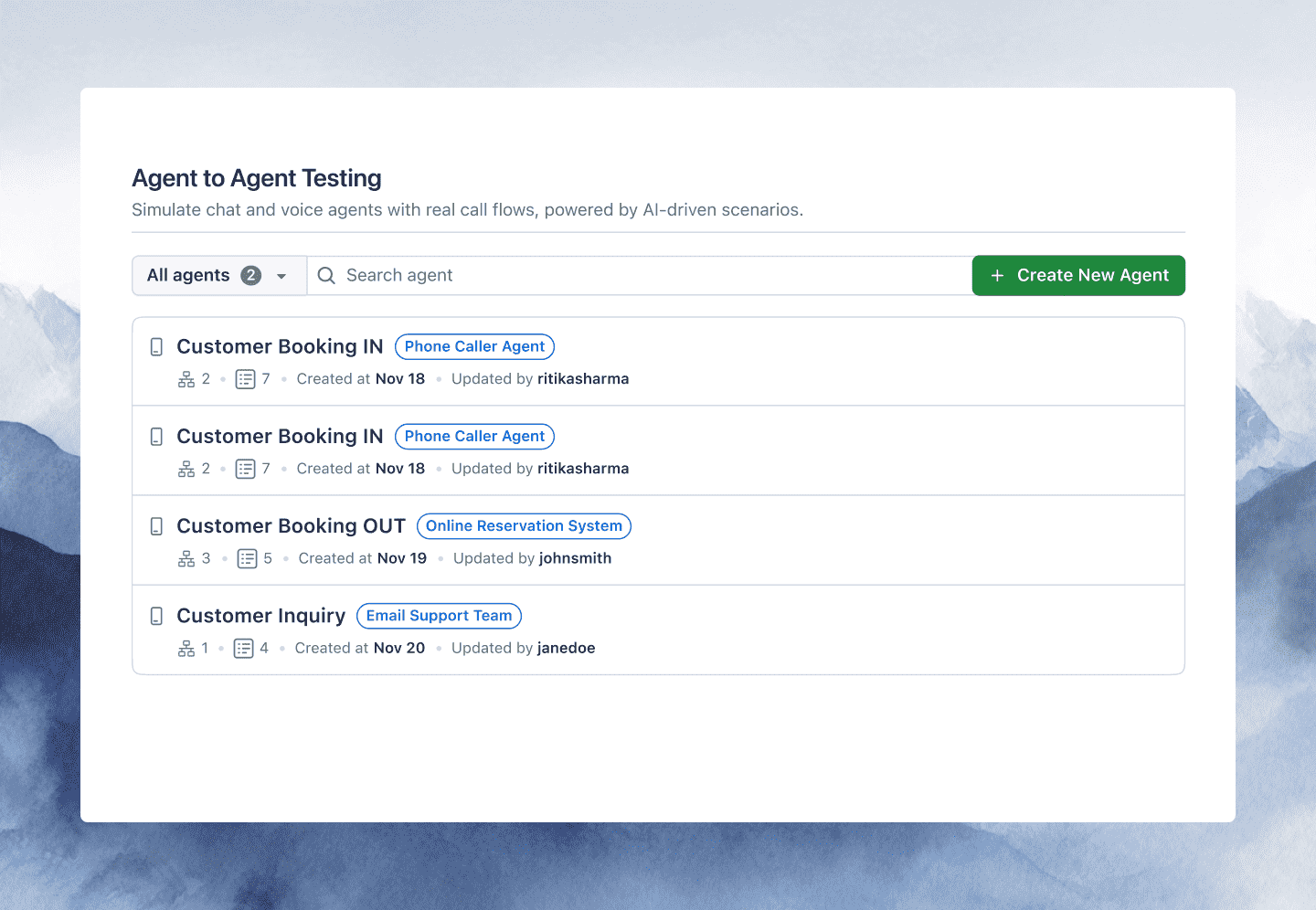
When a call fails, the report names the turn that broke, the metric behind the failure, the confidence level, and the audio clip so you can hear it for yourself. Because a scenario is a description of a phone call, a PM or a founder can read the report and adjust the test without opening an editor.
Vapi call tests in CI and on a schedule
Voice tests earn their keep when they run without anyone kicking them off. The same suite fires from your pipeline through the testmu-a2a-cli, which can place a call with a named voice and a chosen provider, Vapi included, and return JUnit output that your CI already understands. Gate the release on its exit code and a Monday prompt edit that breaks Friday's calls fails the build instead of reaching production.
- Schedule the call suite daily, weekly, monthly, or on a custom cron expression in your own timezone
- Trigger a full run on deploy so every prompt change, model swap, or knowledge update is tested on merge
- Send alerts to email, Slack, or a webhook the moment a verdict slips from Green to Yellow, with the failing transcript attached
For agents that sit behind a firewall, HyperExecute's secure tunnel connects the testing infrastructure to a private endpoint without exposing it to the public internet, so a staging Vapi assistant can be tested the same way as a public one.
Connecting your Vapi assistant
There is no library to add to your Vapi project, so getting a first scored call takes about as long as reading this article. Here is how to test a Vapi voice agent end to end.
- Sign up for TestMu AI free, with no credit card
- Point the platform at your Vapi assistant or Squad and upload a knowledge base, PRD, or short description of how it should behave
- Let the platform auto-generate 60 to 100+ scenarios, or write your first call in plain English
- Run it and watch a real call get scored across the full pipeline
A Vapi voice agent is too public to check by dialing it a handful of times, and too non-deterministic for brittle scripts. Test it the way a real caller hears it. The same plain-English workflow lets you test a Retell agent without code or check a text chatbot, and the wider agent testing platform scores chat, voice, and phone from one place.

Note: Test your Vapi voice agent over real calls without writing a line of code. Start with TestMu AI free.
Author

Poornima Pandey
Blogs: 8


Poornima is a Community Contributor at TestMu AI, bringing over 4 years of experience in marketing within the software testing domain. She holds certifications in Automation Testing, KaneAI, Selenium, Appium, Playwright, and Cypress. At TestMu AI, she contributes to content around AI-powered test automation, modern QA practices, and testing tools, across blogs, webinars, social media, and YouTube. Poornima plays a key role in scripting and strategizing YouTube content, helping grow the brand's presence among testers and developers.
Reviewer

Harshit Paul
Reviewer
Harshit Paul is Director of Product Marketing at TestMu AI, with over 8 years of experience in product and growth marketing for developer and QA tools, leading the Agentic AI in Quality Engineering space. He has authored 80+ technical articles for TestMu AI on software testing and automation, and hosted webinars on Selenium, automation testing, browser compatibility, DevOps, and continuous testing. He has led go-to-market and technical marketing initiatives across software testing products, contributing to SEO, content strategy, and developer marketing. He began his career as a certified Salesforce developer at Wipro Technologies, where he worked for 2 years before moving into marketing. Harshit holds a degree in computer programming from Vivekananda Institute of Professional Studies.


Vapi Voice Agent Testing FAQs
Did you find this page helpful?
More Related Blogs

TestMu AI forEnterprise
Get access to solutions built on Enterprise
grade security, privacy, & compliance
- Advanced access controls
- Advanced data retention rules
- Advanced Local Testing
- Premium Support options
- Early access to beta features
- Private Slack Channel
- Unlimited Manual Accessibility DevTools Tests