
Power Your Software Testing with AI Agents and Cloud
The Native AI-Agentic Cloud Platform to Supercharge Quality Engineering. Test Intelligently and Ship Faster.

- TestMu AI (Formerly LambdaTest)
- /
- Blog
- /
- How to Test AI Agents Without Code
How to Test AI Agents Without Code (2026 Guide)
How to test AI agents without code: autonomous evaluators score them for hallucination, bias, and guardrail failures, then return a go-live verdict.
Last Updated on:
A QA reviewer can manually work through 50 to 200 agent conversations a week, far short of the thousands needed for honest coverage. TestMu AI closes that gap by turning a plain-English description of the agent's job into scenarios that 15+ autonomous evaluators run and score for hallucination, bias, and guardrail failures, with no eval harness or Python to maintain.
What no-code agent testing means
To test AI agents without code, you define the agent's job and its limits in plain English, then hand the conversations to autonomous evaluators that generate and score them. The platform behaves like a review panel you configure once and rerun on demand, and every run rests on three inputs, none of which is code.
- A document that describes the agent, such as a PRD, a knowledge base, or a written brief. The platform parses it for the policies, topics, and constraints the agent operates under.
- A short prompt stating the agent's role and its hard limits, which becomes the baseline the evaluators score every reply against.
- Optional focus areas that weight the run toward billing disputes or escalation logic when one part of the agent carries more risk than the rest.
From there the evaluators take over. They accept uploads in almost any format the agent was documented in, from PDF and DOCX to spreadsheets, JIRA tickets, and Confluence pages, so most teams connect a chat agent in under 30 minutes.
Eval harness versus plain-English brief
The contrast is easiest to see in what a single check costs when you build the harness yourself. You call the model, then assert on the string it returns.
resp = client.chat.completions.create(
    model="gpt-4o",
    messages=[{"role": "user", "content": "What is my account balance?"}],
)
answer = resp.choices[0].message.content

# one hand-written assert per thing that could go wrong
assert "cannot access account balances" in answer.lower(), f"Agent invented a balance: {answer}"
assert "$" not in answer, "Agent returned a dollar figure it should not know"
assert "escalate" in answer.lower(), "Agent did not offer to hand off to a human"
Every assert guesses at one phrasing of one question. Reword a good answer and the check fails on a reply that was fine, a false positive. Let the agent invent a balance in a phrasing you never listed and the check passes, a false negative. Hallucination, bias, and tone are judgments rather than substrings, so no stack of asserts reaches them, and each one still needs an engineer to add and maintain.
With TestMu AI agent testing, the only artifact you author is the description. The same goal reads like a brief you would hand a reviewer.
- Write a paragraph describing the agent. A finance bot helps with account and billing questions, never invents a balance, fee, or policy, and hands off to a human when it cannot answer.
- Point the platform at the live chat or voice endpoint, or upload the PRD or knowledge base the agent was built from. Teams on Cognigy.AI can follow the guide on how to test a Cognigy agent for this step.
- Let it generate 60 to 100+ scenarios across happy paths, edge cases, adversarial inputs, persona variations, and compliance checks.
- Run thousands of conversations in parallel, driven by 15+ specialized evaluators for hallucination, bias, completeness, context, tone, and security.
- Open the verdict, read the per-metric scores, and click into the failing transcript behind any red result.
That description is the whole configuration. Each scenario returns pass or fail with a High, Medium, or Low confidence level and the exact conversation turn behind it. Set the two approaches side by side and they diverge on almost every line of work that eats a QA week.
| What you are on the hook for | Hand-written eval harness | TestMu AI agent testing |
|---|---|---|
| Who can author a test | An engineer who writes and maintains Python | Anyone who can describe what the agent should do |
| Adding a new check | A new assert and a code review | A line added to the plain-English brief |
| A reworded but correct answer | Fails on a good reply the string did not anticipate | Scored on meaning across many phrasings |
| A fluent hallucination | Passes if the invented answer dodges every assert | Checked against what the agent is allowed to know |
| Bias and tone | Out of reach for a substring check | Scored by Bias Detection and Tone Consistency |
| What a failure hands you | A stack trace at a line number | The transcript, the metric, and the turn that broke |
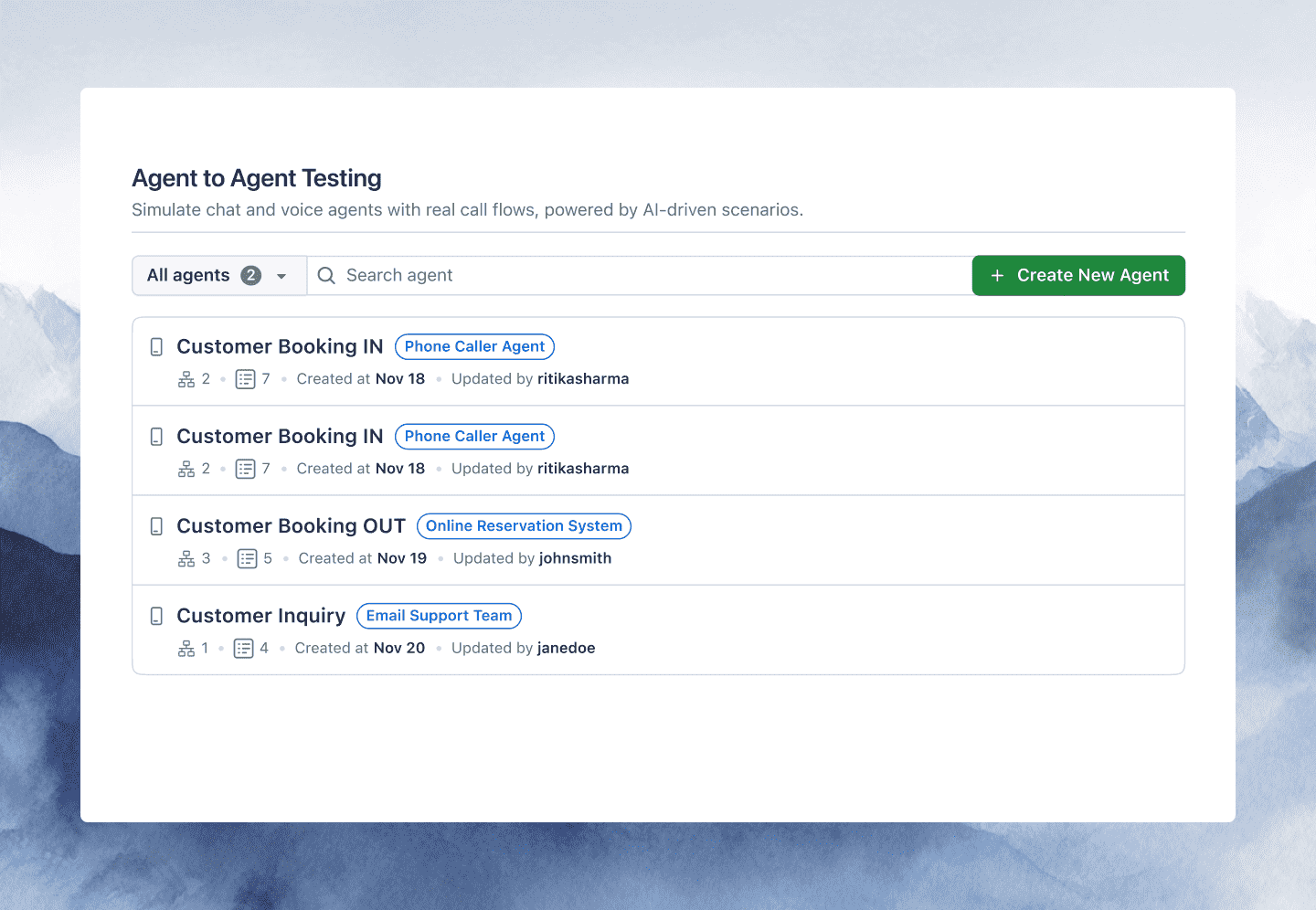
A failure-mode coverage matrix
Coverage comes down to which failure modes you probe and which evaluator flags each one. Thorough AI agent evaluation starts with the six that put a customer-facing agent at the most risk. Each row below is the failure, the shape it takes in a real reply, and the metric that scores it out of the 9 that apply to every chat and voice run.
| Failure mode | How it shows up in a reply | Evaluator that scores it |
|---|---|---|
| Hallucination | A confident refund policy that was never written | Hallucination Detection |
| Bias across personas | A thinner answer for one accent than the next | Bias Detection |
| Broken guardrails | A jailbreak or PII request the agent obeys | Security Researcher, Data Privacy Guardian |
| Lost context | An account number given in turn one, asked for again in turn four | Context Awareness |
| Incomplete answer | The cancellation policy explained, but not the steps | Completeness |
| Cold tone | Correct wording that reads as dismissive | Tone Consistency |
The four modes at the top of that table, hallucination, bias, broken guardrails, and lost context, produce the failures that read as fluent and confident, which is exactly why a human skimming transcripts tends to miss them. The platform probes each one by running the same intent as different personas, including an international caller, a first-time user, and a technical expert, then comparing accuracy and depth across them. Any answer that shifts based on name, accent, or phrasing gets flagged with the transcript as evidence.

Voice and phone agent coverage
The same plain-English setup runs against a chatbot or a voice agent, and voice adds the acoustic conditions a real call carries. The evaluators dial in with 200+ voice profiles, 50+ accents, and 15 background-noise presets, so the agent is judged on a call-center line and a poor cellular connection, not only a quiet demo. For agents built on ElevenLabs, the guide on how to test ElevenLabs agents covers the barge-in, latency and knowledge-base failures a quiet demo hides.
Phone agents pick up their own scorecard of 30+ metrics on top of the 9. First Call Resolution asks whether the call closed without a callback, Containment Rate tracks how many calls finished without a human handoff, and CSAT estimates satisfaction from the conversation itself. You can also upload batches of recorded production calls and score them against the same metrics, so quality monitoring on real traffic does not depend on rerunning live tests.
From one run to a CI quality gate
A one-off run tells you the agent is ready today. Quality drifts anyway, because the underlying model receives upstream updates and the knowledge base goes stale, so the check earns its keep when it fires without anyone asking. The testmu-a2a-cli installs from pip, authenticates through the TESTMU_USERNAME and TESTMU_ACCESS_KEY environment variables, and writes JUnit XML with a 0 or 1 exit code.
- Gate a deploy in GitHub Actions, GitLab CI, or Jenkins on the exit code, with no custom plugin to write.
- Schedule full evaluations daily, weekly, or monthly so an upstream model change cannot degrade quality between releases.
- Send an alert to Slack, email, or a webhook the moment a verdict slips from Green to Yellow or a new metric starts failing.
- Reach an agent behind a corporate firewall over a HyperExecute secure tunnel, so a private endpoint never needs a public URL. If the agent is a self-hosted Vocode pipeline, the walkthrough on how to test a Vocode agent covers this setup.
When a scenario fails, the report hands a PM or a compliance reviewer the conversation transcript, the metric that failed, and the turn that caused it, so acting on the result takes no Python.
The go-live verdict
Every run rolls up into a three-tier verdict. Green clears the agent for deployment, Yellow names the specific fixes to make first, and Red means it is not production-ready. Leadership can make the call from the verdict without reading each transcript.
Read the confidence level before you trust the color. Each metric carries a High, Medium, or Low rating based on how many scenarios backed it, so a Green built on a thin scenario set is a weaker signal than a Green with High confidence behind it. Every verdict is backed by the transcripts that produced it, which is what lets a lead sign a release or a compliance officer keep an audit trail without re-reading every conversation.
Your agent speaks for the brand when nobody is watching. A plain-English description and a live endpoint are enough to put it through thousands of conversations before a customer finds the one answer that breaks it.

Note: Put your AI agents through thousands of graded conversations before your customers do. Start free with TestMu AI.
Author

Hari Sapna Nair
Blogs: 8


Hari Sapna Nair is a Community Contributor with experience spanning software development, technical writing, and open-source collaboration. A former Technical Content Writer at TestMu AI, she has authored guides and tutorials on Selenium, testing, microservices, and emerging technologies. Sapna has contributed 60+ technical blogs for platforms like Coding Ninjas and has been an active open-source contributor in programs such as GirlScript Summer of Code and HakinCodes, securing top contributor ranks. A GHC Scholar and an engineer turned management student at IIM Indore.
Reviewer

Rajas Nawar
Reviewer
Rajas Nawar is a Community Contributor at TestMu AI, where he authors software-testing content for QA engineers and testers. His articles cover black box testing, state transition testing, CI/CD test case templates, and software-testing interview questions, giving testing teams practical guides and ready-to-use templates for their quality assurance work.


AI Agent Testing FAQs
Did you find this page helpful?
More Related Blogs

TestMu AI forEnterprise
Get access to solutions built on Enterprise
grade security, privacy, & compliance
- Advanced access controls
- Advanced data retention rules
- Advanced Local Testing
- Premium Support options
- Early access to beta features
- Private Slack Channel
- Unlimited Manual Accessibility DevTools Tests