
Power Your Software Testing with AI Agents and Cloud
The Native AI-Agentic Cloud Platform to Supercharge Quality Engineering. Test Intelligently and Ship Faster.

- TestMu AI (Formerly LambdaTest)
- /
- Blog
- /
- How to Run End-to-End Tests Without Code
How to Run End-to-End Tests Without Code (2026 Guide)
Run a full end-to-end journey across UI, API, and database in plain English, with smart assertions at every seam. No Selenium, no Playwright, no code.
Published on:
An end-to-end test mirrors what a customer actually does: sign in, find an item, pay, and see it confirmed, catching bugs like a checkout that charges a card but never writes the order to the database. These journeys traditionally required code-heavy Selenium scripts, but KaneAI lets testers write the same flow in plain English instead.
Why end-to-end tests are hard to test
A single end-to-end journey is really a chain of systems, and every join between them is a place the test has to reach across:
- Many steps in sequence, where step nineteen depends on state built by step three, so a failure early on cascades into confusing errors much later
- Multiple layers in one flow, spanning the UI, a REST or SOAP API, the database, and the network, each of which can pass on its own while the seam between them is broken
- State that has to be set up and torn down, like a fresh account, a seeded cart, or a coupon that can only be redeemed once, so replays do not poison each other
- Timing and async work, where a confirmation screen renders before a background job has finished writing, and a naive test asserts the wrong thing too early
- Third-party hops, like a payment gateway, an identity provider, or an email step, that leave your domain and have to come back with the session and context intact
- Data verification at the end, where the real proof is not a green screen but a correct row in the database and a matching API response
And that is one journey through one product. Real coverage means running the same flow for new users vs. returning users, on mobile vs. desktop, and across every browser your customers actually use.
The old way: brittle end-to-end scripts
Here is what verifying a single buy-something-and-confirm-it-was-saved journey looks like in a typical Selenium setup, clicking through the flow, asserting the API, and then checking the database landed the order:
driver.get("https://yourapp.com/login")
driver.find_element(By.ID, "email").send_keys("buyer@example.com")
driver.find_element(By.ID, "password").send_keys("SuperSecret123")
driver.find_element(By.CSS_SELECTOR, "button[type='submit']").click()
wait.until(EC.url_contains("/products"))
driver.find_element(By.CSS_SELECTOR, ".product-card .add-to-cart").click()
driver.find_element(By.ID, "checkout").click()
driver.find_element(By.ID, "place-order").click()
order_id = driver.find_element(By.CSS_SELECTOR, ".confirmation .order-id").text

api = requests.get(f"https://api.yourapp.com/orders/{order_id}", headers=auth)
assert api.status_code == 200 and api.json()["status"] == "confirmed"

row = db.execute("SELECT status FROM orders WHERE id = %s", (order_id,)).fetchone()
assert row and row["status"] == "confirmed", f"DB never recorded the order: {row}"
That is one path, and it already reaches across three systems with hardcoded selectors, an auth header, and a raw SQL query. The moment a developer renames the add-to-cart class, moves the confirmation into a new component, or changes the orders table, the test breaks somewhere in the middle and someone has to trace which link snapped. Maintenance like this is the dominant cost of a large end-to-end suite: engineers spend a large share of every sprint re-pointing selectors and repairing fixtures instead of writing new coverage. And this approach still needs someone on the team who writes Python or JavaScript, plus knows the API and the schema, before a single journey is covered. It is the core tradeoff behind code-based vs. codeless test automation.
If you are a manual QA engineer, a PM, or a founder without a dedicated automation engineer, the code wall means full journeys usually get tested by hand, slowly, inconsistently, and never on every browser before a release.
The no-code way: write the test the way you would explain it
With KaneAI, you write the same journey in plain English, seams and all:
- Go to yourapp.com and sign in as buyer@example.com
- Open the products page and add the first product to the cart
- Go to checkout and place the order
- Verify the confirmation screen shows an order ID
- Call the orders API for that order ID and verify the status is confirmed
- Check the orders table and verify the same order is saved with status confirmed
That is the entire journey. KaneAI reads each step, finds the right elements on your live site the way a human tester would, by understanding the page rather than matching brittle CSS selectors, and executes the whole flow as one connected run spanning the UI, the API, the database, and even an accessibility pass. It applies smart assertions at each seam, so the confirmation screen, the API response, and the saved row all have to agree before the test passes. When a developer renames a button or redesigns a step in the middle, the test self-heals and re-anchors instead of breaking, which significantly reduces maintenance. And when something does fail, you get video and root-cause artifacts pinpointing exactly which seam gave way.

The end-to-end tests scenarios that actually break
Once the happy path works, real coverage is just more English. Here are the end-to-end journeys worth adding, the ones that pass in pieces but fail as a whole:
UI says success, database says nothing
- Complete the checkout and read the order ID off the confirmation screen
- Query the orders table for that order ID
- Verify the row exists with the right total and a confirmed status, not just a green screen
Payment succeeds but the API disagrees
- Place an order and let the payment step complete
- Call the orders API for that order ID
- Verify the API reports paid and the amount matches what the UI charged
The multi-step form that loses state halfway
- Fill out a long multi-page form, moving forward and then back a step
- Submit on the final step and verify no earlier answer was silently dropped
- Verify the saved record contains every field exactly as entered
A 2FA login that has to hold across the whole journey
- Sign in with valid credentials and enter the current TOTP code from the secret key
- Carry that session through the full purchase without re-authenticating
- Verify the confirmed order is tied to the same authenticated account
Run all of them across Chrome, Safari, Firefox, and real mobile devices from the same plain-English steps, with no per-browser rewrites.
Putting it on autopilot
End-to-end tests are most valuable when they run without you, catching the seam that broke overnight:
- Schedule the suite nightly, so a late merge cannot quietly break the path from sign-in to saved order before your users find it
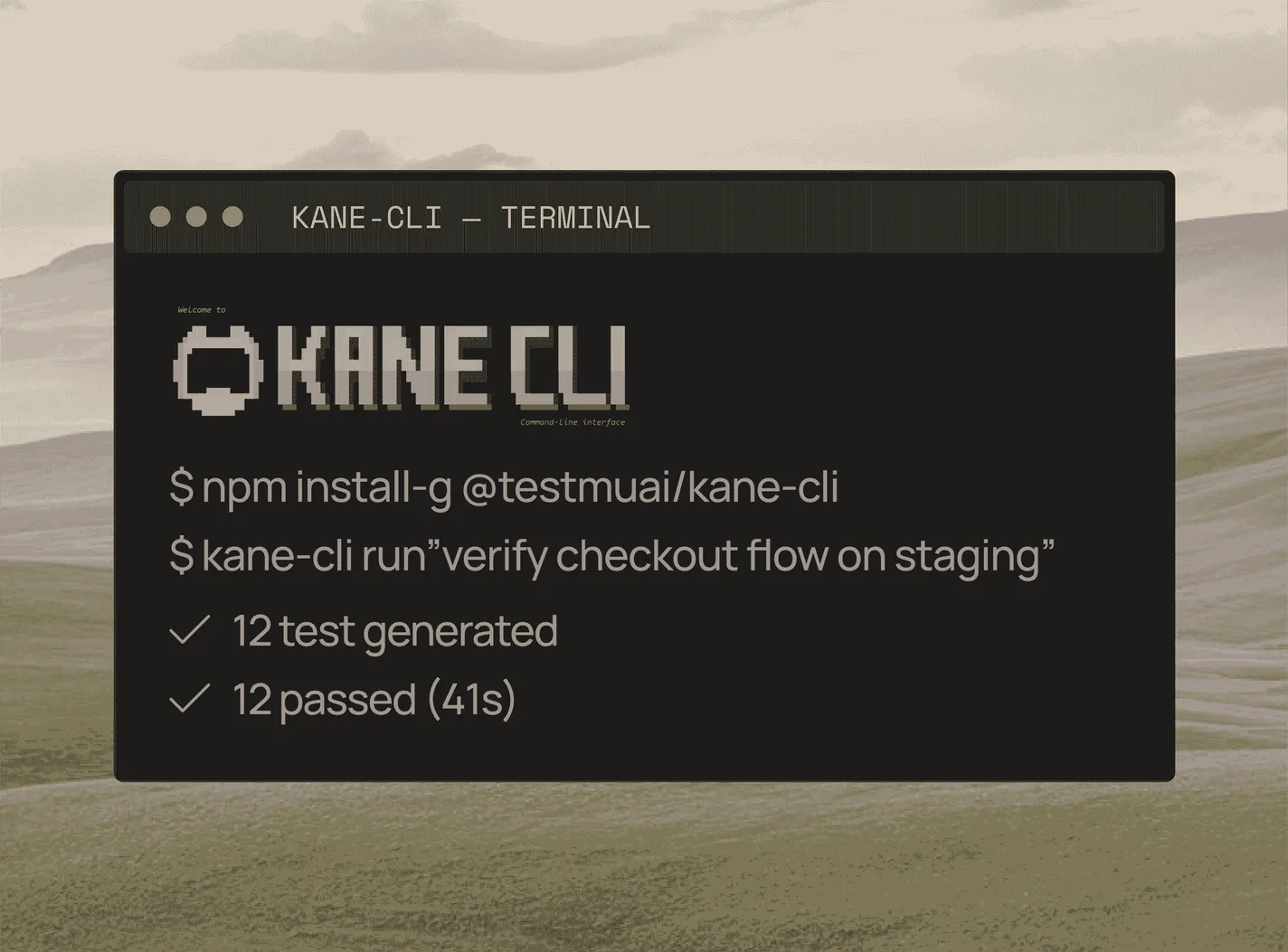
- Trigger on deploy via CI, where Kane CLI runs the same journeys headless from your pipeline, returns real exit codes, and pauses for an OTP or CAPTCHA instead of failing
- Alert on failure in Slack, with a full replay of exactly what the AI saw when the journey stopped: screenshots, video, and the reason in plain English
When a journey fails, you do not get a stack-trace exception at line 47. You get a plain-English reason for the exact step that failed. Anyone on the team can read it, and anyone can fix the test, because the test is just English.
Try it on your own app in 10 minutes
- Sign up for KaneAI free, with no credit card
- Paste your app URL
- Write your first end-to-end journey in plain English, or let KaneAI suggest one from your site
- Run it and watch the full path get tested from the first click to the saved row
Your critical journeys are too important to test by hand and too layered for brittle scripts. Test them in the language you already speak. Once the full flow is covered, read how to test the same journeys as cross-browser scenarios, and how to keep each release honest with fast smoke tests.

Note: Run your first end-to-end test without writing a line of code. Start with KaneAI free.
Author

Devansh Bhardwaj
Blogs: 80


Devansh Bhardwaj is a Community Evangelist at TestMu AI with 4+ years of experience in the tech industry. He has authored 30+ technical blogs on web development and automation testing and holds certifications in Automation Testing, KaneAI, Selenium, Appium, Playwright, and Cypress. Devansh has contributed to end-to-end testing of a major banking application, spanning UI, API, mobile, visual, and cross-browser testing, demonstrating hands-on expertise across modern testing workflows.
Reviewer

Salman Khan
Reviewer
Salman is a Test Automation Evangelist and Community Contributor at TestMu AI, with over 6 years of hands-on experience in software testing and automation. He has completed his Master of Technology in Computer Science and Engineering, demonstrating strong technical expertise in software development, testing, AI agents and LLMs. He is certified in KaneAI, Automation Testing, Selenium, Cypress, Playwright, and Appium, with deep experience in CI/CD pipelines, cross-browser testing, AI in testing, and mobile automation. Salman works closely with engineering teams to convert complex testing concepts into actionable, developer-first content. Salman has authored 120+ technical tutorials, guides, and documentation on test automation, web development, and related domains, making him a strong voice in the QA and testing community.


End-to-End Testing FAQs
Did you find this page helpful?
More Related Blogs

TestMu AI forEnterprise
Get access to solutions built on Enterprise
grade security, privacy, & compliance
- Advanced access controls
- Advanced data retention rules
- Advanced Local Testing
- Premium Support options
- Early access to beta features
- Private Slack Channel
- Unlimited Manual Accessibility DevTools Tests