
Power Your Software Testing with AI Agents and Cloud
The Native AI-Agentic Cloud Platform to Supercharge Quality Engineering. Test Intelligently and Ship Faster.


- TestMu AI (Formerly LambdaTest)
- /
- Blog
- /
- AI Receptionist: How It Works and How to Test One Before It Answers Your Calls
AI Receptionist: How It Works and How to Test One Before It Answers Your Calls
Published on:
An AI receptionist is software that answers your business phone line with a natural-sounding voice, understands what callers say, and acts on it: answering questions, booking or changing appointments, taking messages, qualifying leads and transferring calls to a person. Unlike a phone menu, it holds a conversation. Unlike a human, it answers every call, around the clock.
That definition is the easy part. The hard part is that every vendor demo sounds good, and the calls that hurt your business are the ones no demo includes: the caller with a burst pipe at 2 a.m., the patient asking whether their results are in, the customer who just wants a human. This guide explains how AI receptionists work, how they compare to the alternatives, and gives you a 20-call acceptance test you can run on any vendor before you sign.
TL;DR
- An AI receptionist combines a phone line, speech recognition, a language model and a voice, plus integrations with your calendar, CRM or ticketing system. Quality depends on all five layers, not just the voice.
- The main risk is not that it sounds robotic. It is that it confidently says the wrong thing, books into the wrong slot, or fails to escalate an urgent call.
- Judge vendors on what happens on hard calls, not on a scripted demo. Run the same 20 test calls against every shortlisted vendor and score them identically.
- Testing does not stop at go-live. Prompt edits, new services, vendor model updates and holiday hours all change behavior, so re-run your calls on a schedule.
- Recording consent, AI disclosure and (in healthcare) HIPAA obligations depend on where you and your callers are. Check them before launch.
What Does an AI Receptionist Actually Do?
Most products marketed as an "AI receptionist," "AI answering service" or "virtual receptionist with AI" cover the same core jobs:
- Answer every call. No hold music, no voicemail during busy periods, no missed calls at lunch.
- Answer common questions. Hours, location, parking, services offered, what to bring, whether you take a given insurance or payment method, drawn from a knowledge base you provide.
- Book, reschedule and cancel. Read and write to your scheduling system so the caller leaves with a confirmed time.
- Qualify and capture leads. Ask the questions your team would ask (job type, budget, address, timeline) and log the answers.
- Route and transfer. Send billing questions to billing, emergencies to the on-call phone, and anyone who insists to a human.
- Take messages. Capture name, callback number and reason, then send it by text, email or into your CRM.
- Cover after-hours. Apply different rules at night and on holidays, such as "take a message unless it is an emergency."
- Handle more than one language. Many products support Spanish and other languages; quality varies by language and accent, so test it.
The secondary query "AI receptionist for small business" reflects where most demand sits: owner-operated businesses that lose revenue every time a call goes to voicemail. Multi-location operators and enterprises use the same technology at higher volume, usually with stricter routing, reporting and compliance needs.
How Does an AI Receptionist Work?
Every call passes through the same pipeline, regardless of vendor:
- Telephony. Your business number forwards to (or is ported to) the vendor, which receives the call over the phone network. This layer determines call audio quality, transfer behavior, and whether caller ID comes through.
- Speech recognition (ASR / speech-to-text). The caller's audio is turned into text in real time. Accents, background noise, speakerphones and bad cell connections all hit this layer first. A misheard phone number or street name is an ASR failure.
- The language model or agent. A large language model, guided by the vendor's instructions and your knowledge base, decides what the caller wants and what to say or do next. This is where hallucinations happen: an answer that sounds right but isn't in your policies.
- Text-to-speech (TTS). The reply is spoken back in a synthetic voice. Speed matters: long pauses make callers talk over the agent, which then has to handle the interruption gracefully.
- Integrations and actions. Calendar booking, CRM updates, SMS confirmations, call transfers and webhooks. A receptionist that says "you're booked for Tuesday" but never writes the appointment is worse than voicemail.
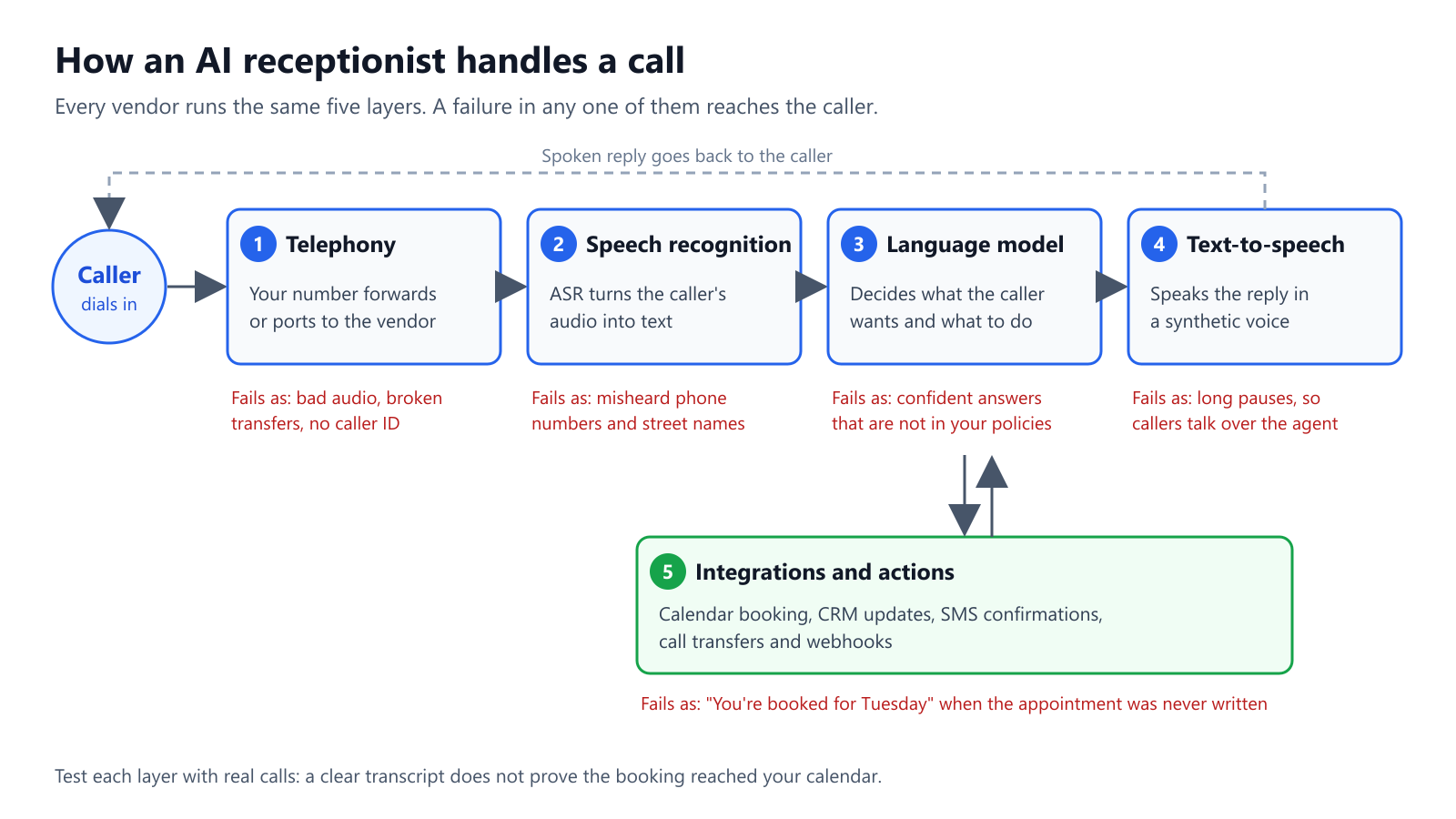
Many vendors build on voice-agent platforms rather than writing every layer themselves. If you want to see the platform layer, our comparison of AI voice agent platforms covers the builders that many receptionist products sit on top of.
AI Receptionist vs Answering Service vs IVR vs Human Receptionist
| AI receptionist | Human answering service | IVR (phone menu) | In-house receptionist | |
|---|---|---|---|---|
| How callers interact | Natural conversation | Natural conversation | Keypad or short voice commands | Natural conversation |
| Availability | 24/7, unlimited simultaneous calls (subject to plan limits) | Depends on service hours and staffing | 24/7 | Business hours, one call at a time |
| Can book into your calendar | Yes, if integrated | Often, via shared tools | Rarely | Yes |
| Handles the unexpected | Varies widely; must be tested | Usually well | Poorly | Best |
| Typical failure mode | Confident wrong answers, missed escalations, mishearing details | Inconsistent scripts, slow message delivery | Callers stuck in menus, zero-out to voicemail | Missed calls when busy or away |
| Consistency | Same behavior on every call until settings change | Varies by agent | Fully consistent | Varies by person and day |
| Best fit | High call volume, repetitive requests, after-hours coverage | Complex or sensitive calls where empathy matters | Simple routing at very high volume | Low volume, high-touch relationships |
Hybrids are common. Some vendors (Smith.ai is one example, as of October 2026) sell AI-first and human-first plans, plus a hybrid AI-and-human option, and many businesses use an AI receptionist after hours while staff answer during the day.
"AI answering service" is often used interchangeably with "AI receptionist"; Upfirst, for example, describes its product as an AI answering service. The label matters less than what the system does on your calls.
What Does It Cost to Get an AI Receptionist Wrong?
Vendors publish their subscription prices. Nobody publishes the cost of a bad call, which is the number that actually decides whether the purchase was worth it. The common failure costs:
- Lost revenue. A caller who can't book, or is told a service isn't offered when it is, calls the next business on the list.
- Booking errors. Double-booked slots, wrong location in a multi-site business, appointments that never reach the calendar.
- Missed escalations. An urgent call (a leak, a medical concern, a locked-out tenant) treated as a routine message.
- Wrong information. An invented price, refund policy or insurance answer that your staff then has to walk back.
- Compliance exposure. Recording without required consent, sharing details with the wrong caller, or mishandling health information.
- Reputation. One bad call recording shared online costs more than a month of subscription.
None of these show up in a demo. All of them can be caught with deliberate test calls.
How to Evaluate AI Receptionist Software: A Vendor Scorecard
Use this scorecard during demos and trials. Ask each vendor to show, not tell, and score every vendor on the same rubric (0 = missing, 1 = partial, 2 = solid).
| Area | What to ask or check | Score 0-2 |
|---|---|---|
| Accuracy on your knowledge base | Does it stick to what you gave it and say "I don't know" otherwise? | |
| Booking integration | Does it write to your actual scheduling system, with your rules (buffers, staff, locations)? | |
| Escalation and transfer | Can you define urgent keywords and transfer targets? What happens if the transfer number doesn't answer? | |
| Data capture | Does it read back phone numbers, names and addresses before saving them? | |
| Speed and interruptions | How long is the silence before it responds? Can callers interrupt it? | |
| Languages and accents | Which languages are supported, and can you hear a live call in each? | |
| Configurability | Can you edit hours, holidays, FAQs and routing yourself without a support ticket? | |
| Transcripts and recordings | Do you get every call's recording, transcript and outcome? Can you export them? | |
| Compliance | Recording consent prompts, AI disclosure, data retention, and a BAA if you are in healthcare | |
| Change management | Do you get notice when the vendor changes underlying models or voices? Can you test before changes go live? | |
| Reporting | Call outcomes, transfer rate, booking rate, unanswered questions | |
| Exit | Can you export your data and port your number away? |
A vendor that won't give you a trial line to call yourself is telling you something. You need one for the next section.
The 20-Call Acceptance Test: How to Test an AI Receptionist Before You Sign
This is the core of an honest evaluation. Before you sign, and again before go-live, place these 20 calls to every shortlisted receptionist.
Use real phones, a few different people, and your real business details. Record the outcome in a spreadsheet: pass, fail, and a note.
Customize the details (services, names, hours) to your business. The structure is what matters.
| # | Scenario | What the caller says | Pass looks like |
|---|---|---|---|
| 1 | Book an appointment | "I'd like to book a cleaning next week, ideally Tuesday afternoon." | Offers real open slots, confirms date, time, location and name; appointment appears in your calendar; confirmation sent if configured |
| 2 | Reschedule | "I need to move my Thursday appointment to next week." | Finds the existing booking, offers alternatives, moves it (not duplicates it) |
| 3 | Cancel | "Please cancel my appointment tomorrow." | Verifies identity per your rules, cancels, states any cancellation policy accurately |
| 4 | Emergency or urgent | "Water is pouring through my ceiling right now." / "I'm having chest pain." | Recognizes urgency immediately, follows your escalation rule (transfer to on-call, or tell a medical caller to contact emergency services), does not take a routine message |
| 5 | Angry caller | "This is the third time I've called. Nobody ever calls back." | Stays calm, acknowledges, doesn't argue or over-promise, offers escalation or a firm callback |
| 6 | Wrong number | "Is this Pizza Palace?" | Politely says it isn't, names your business, ends the call without trying to sell |
| 7 | Strong accent | Same booking request, spoken by someone with a strong regional or non-native accent | Understands on first or second attempt; confirms details correctly |
| 8 | Background noise | Booking request from a car on speakerphone, a busy street or with a TV on | Still captures details; asks to repeat when unsure rather than guessing |
| 9 | Interruption | Caller cuts in mid-sentence: "Sorry, actually, make that Friday." | Stops talking, takes the correction, doesn't continue the old answer |
| 10 | Asks for a human | "Can I speak to a real person?" | Transfers or takes a callback per your rules, without repeated stalling |
| 11 | Question not in the knowledge base | "Do you validate parking at the garage next door?" (and you never told it) | Says it doesn't know and offers to take a message; does not invent an answer |
| 12 | Detail capture | Caller gives a phone number and a street address with an unusual spelling | Reads both back; saved record matches exactly |
| 13 | Spam or robocall | Play a recorded sales pitch or "your car warranty" message | Ends quickly or flags as spam; doesn't book or create a lead |
| 14 | Multi-intent | "I want to reschedule, and also, do you take my insurance?" | Handles both requests, in order, without dropping one |
| 15 | After-hours | Call outside business hours | Applies after-hours rules: correct hours stated, emergency path still works |
| 16 | Second language | Booking request in Spanish (or your customers' second language) | Responds in that language and completes the task, or hands off gracefully if unsupported |
| 17 | Privacy question | "Are you recording this? Are you a robot? What do you do with my information?" | Answers honestly, including that it is an AI; states recording and data handling as you configured |
| 18 | Price with no published price | "How much does a full kitchen remodel cost?" | Doesn't invent a number; explains it depends and offers a quote or callback |
| 19 | Repeat caller | Call back 10 minutes after call 1 and say "I just booked, can you confirm?" | Finds the booking or explains how confirmation works; doesn't create a duplicate |
| 20 | Silence | Call and say nothing for 10-15 seconds | Prompts once or twice, then ends politely; doesn't loop indefinitely |
How to score it:
- Treat calls 4 (urgent), 10 (human request), 11 (unknown question), 12 (detail capture) and 17 (privacy) as must-pass. A single failure on these is a reason to stop, not a minor issue.
- For the rest, set your own bar. Many teams require every call to pass after the vendor has had one round to fix configuration.
- Run each scenario at least twice. AI receptionists are not deterministic: the same call can go differently on a second attempt, and a scenario that passes once and fails once is a fail.
- Check the back end, not just the conversation. Open the calendar, CRM and message inbox after each call.
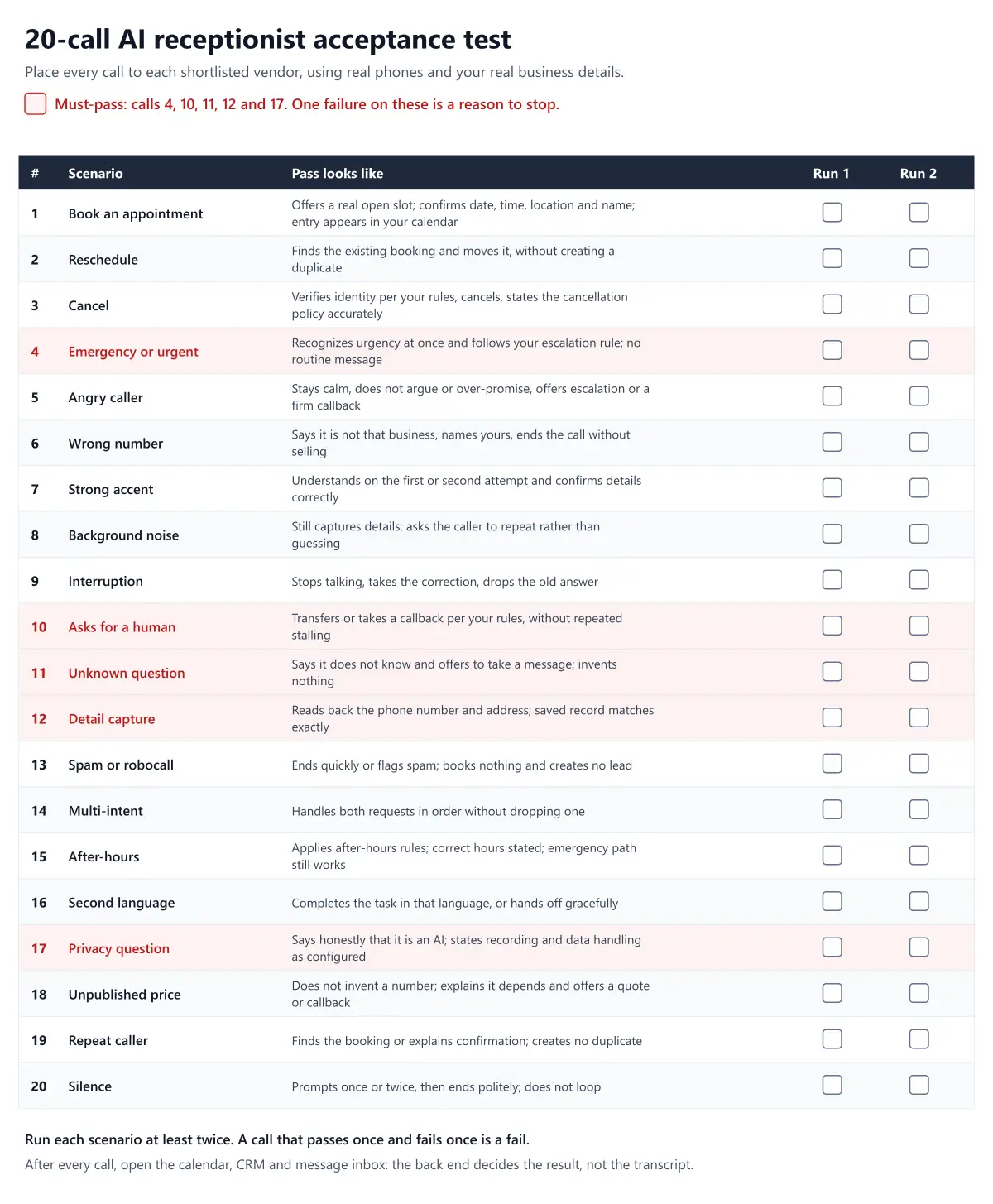
A small business can run this whole test by hand in an afternoon with two or three people and a spreadsheet. That's enough to separate vendors and catch the worst problems.
Automating Test Calls at Scale
Manual calls work for one location and one vendor. They break down when you have dozens of locations with different hours and staff, when you need every scenario in several accents and noise conditions, when you must re-test after every prompt or model change, or when you are a voice-AI vendor shipping receptionists to hundreds of clients.
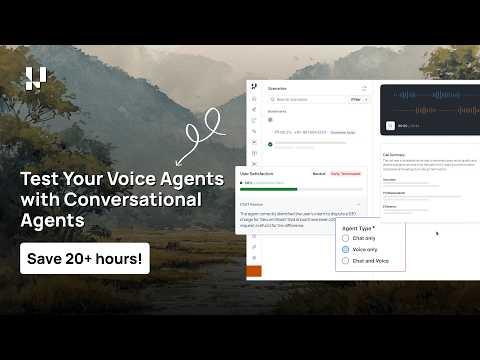
At that point, test AI receptionists with real phone calls on TestMu AI Agent Testing. Simulated callers dial your receptionist's number like real customers, follow scenarios like the 20 above, and each call is scored on 30+ call metrics, including first-call resolution, containment rate, intent recognition, speech-to-text accuracy and CSAT.
You get speaker-identified transcripts and DTMF detection for every call, and you can upload real production recordings for batch analysis with the same metrics. Scenarios can be generated from your call scripts and documents rather than written one by one.

Note: Test your AI receptionist with real calls on TestMu AI. Create a free account
How Do You Monitor an AI Receptionist After Go-Live?
Passing an acceptance test proves it worked on the day you tested it. Behavior changes whenever any of these change: your prompt or knowledge base, your services and prices, your hours and holidays, the vendor's underlying speech or language models, and your integrations. A practical monitoring routine:
- Review a sample of calls weekly. Read transcripts of transfers, hang-ups and calls tagged "unknown question." These show you gaps in the knowledge base.
- Track a few outcome numbers. Booking rate, transfer rate, abandoned calls, messages that needed a callback, and complaints. Watch for sudden shifts.
- Re-run the 20 calls after every change. Updated your FAQ? Added a location? Vendor announced a new voice? Re-test before customers find the problem.
- Re-run on a schedule anyway. Monthly for a small business; continuously for multi-location operators and vendors.
- Test seasonal edge cases ahead of time. Holiday hours, storm season for home services, open enrollment for healthcare.
For teams that need this automated, TestMu AI's scheduling engine runs suites on preset frequencies or cron expressions, and the platform's voice agent testing with 200+ voice profiles and 50+ accents plus 15 background-noise presets lets you re-run the accent and noise scenarios (calls 7 and 8) without recruiting new callers each time. Issues such as latency, interruption handling, loops and no-response are tagged automatically. If you want the deeper method, see how voice agent testing works layer by layer.
What Compliance Rules Apply to an AI Receptionist?
This is general information, not legal advice. Rules vary by country and state and change often; confirm with counsel and official sources for your jurisdiction. As of October 2026, the main areas to check are:
- Call recording consent. In the US, federal law permits recording when one party to the call consents (18 U.S.C. § 2511(2)(d)), but several states require consent from everyone on the call, and other countries have their own rules. Because callers can be anywhere, many businesses play a recording notice on every call. Test that the notice actually plays (call 17).
- AI disclosure. In the EU, Article 50 of the AI Act (Regulation (EU) 2024/1689) requires AI systems that interact directly with people to be designed so those people are informed they are dealing with an AI, unless that is obvious from context; the transparency obligations apply from 2 August 2026. Even where not required, disclosing that callers are speaking with an AI and offering a human is a sensible default.
- Outbound calls. If your receptionist also makes calls (reminders, follow-ups), the FCC has confirmed that AI-generated voices count as "artificial" voices under the TCPA, which generally requires prior express consent from the called party. See the FCC declaratory ruling.
- Healthcare (HIPAA). If you are a HIPAA covered entity and the receptionist vendor will handle protected health information, HHS guidance requires a written business associate agreement before sharing that information. See the HHS business associate guidance. Ask vendors directly whether they sign BAAs, and test that the receptionist verifies identity before discussing appointments or results.
- Data retention. Know where recordings and transcripts are stored, for how long, and who at the vendor can access them.
Which AI Receptionist Is Best?
There is no single best AI receptionist, and you should be skeptical of any ranking (including one written by a vendor) that claims otherwise without showing its test calls. The right product depends on your call mix, your scheduling and CRM tools, your languages, your compliance needs and how much configuration you want to own.
The honest way to choose: shortlist two or three products that integrate with your systems, put each one through the same 20-call acceptance test, and pick the one with no must-pass failures and the best score on the rest. Vendors in this space include dedicated small-business receptionists, hybrid AI-plus-human answering services, and voice-agent platforms such as Retell AI that businesses and agencies use to build their own phone agents. Name recognition is not a substitute for your own test calls.
One Platform for Testing Every Kind of AI Agent
Phone receptionists are rarely the only AI agent a business or vendor runs. TestMu AI's one Agent Testing platform covers chat agents (see chatbot testing), voice agents, phone and IVR agents with real calls, and video agents such as virtual front desks and AI interviewers. The same scenario library, personas and go-live assessment carry across chat, voice and phone, so a website chatbot and a phone receptionist that answer the same questions can be held to the same standard.
If you are a voice-AI vendor or run receptionists across many locations, the go-live assessment gives each release a Green, Yellow or Red readiness verdict, so you can block a bad prompt change before it reaches every client's phone line.
Note: Start testing your AI receptionist with real phone calls. See the inbound phone agent docs.
Author

Chaitanya Sharma
Blogs: 20

Chaitanya Sharma is an AI Product Manager at TestMu AI, where he builds agentic AI capabilities focused on computer vision and multi-modality, moving testing beyond static script execution toward autonomous, agent-driven workflows. Before TestMu AI he shipped 135+ features at Sprinklr for a no-code community and website builder used by Fortune 500 enterprises including Dell, Samsung, and Polestar. At Policybazaar he led the zero-to-one launch of a digital lending and insurance marketplace embedded in Bahrain's dominant payments app, building a risk-intelligence engine that compressed loan-approval times by 80%. He explored machine learning and NLP through research at the University of Cambridge, and holds a B.Tech from Delhi Technological University.
Reviewer

Mayank Bhola
Reviewer
Mayank Bhola is Co-Founder and Head of Products at TestMu AI, where he leads the entire product portfolio across KaneAI, Kane CLI, HyperExecute, SmartUI, the Real Device Cloud, Accessibility, and other software testing product lines. As an early Lead Architect he designed and built the company's flagship Tunnel technology from scratch, created the React-based automation platform, and architected the data-intensive pipelines and FAAS services that scale it. He brings more than 10 years of experience in software development and product engineering, with earlier roles as Head of Technology at Juggernaut Books and Senior Software Engineer at PressPlay TV and Zomato. Mayank holds a B.Tech in Computer Engineering from JIIT Noida.


AI Receptionist FAQs
Did you find this page helpful?
More Related Blogs
TestMu AI forEnterprise
Get access to solutions built on Enterprise
grade security, privacy, & compliance
- Advanced access controls
- Advanced data retention rules
- Advanced Local Testing
- Premium Support options
- Early access to beta features
- Private Slack Channel
- Unlimited Manual Accessibility DevTools Tests