

Power Your Software Testing with AI Agents and Cloud
The Native AI-Agentic Cloud Platform to Supercharge Quality Engineering. Test Intelligently and Ship Faster.


- TestMu AI (Formerly LambdaTest)
- /
- Learning Hub
- /
- Software Quality Management: A Comprehensive Guide With Examples and Best Practices
Software Quality Management: A Comprehensive Guide With Examples and Best Practices
How do you ensure software quality management? This hub is here to explain in detail.
Last Updated on:
On This Page
- Overview
- What is Software Quality Management
- How does Software Quality Management work
- Software Quality Attributes
- Benefits of Software Quality Management
- What are Software Quality Management metrics
- What are the needed Software Quality Management metrics
- The stages of Software Quality Assurance
- Quality Management Plan
- The 7 Principles (ISO 9001)
- Best Practices for Software Quality Management
- Conclusion
OVERVIEW
Software quality management involves keeping a close eye on software development and maintenance to ensure that it meets customer expectations and is bug-free. It includes activities like quality assurance, testing, and continuous improvement. With quality management, you can deliver software that is reliable, efficient, and easy to use.
To build an app, developers should work on many factors, such as choosing their front end framework and the limitations of app size. Testers have to ensure that they do their job with a near-perfect notion to ensure there are no bugs or defects.
They may have to conduct several tests, including UI testing and online browser testing. Nobody wants to order their dinner on an app that would freeze each time you try to order. How do you ensure your app is on the top ladder of customer satisfaction caliber? That’s where software quality management comes into play.
What is Software Quality Management?
A general definition of software quality management would be “a field of practice and study describing the needed software product attributes”. Simply put, your software should help your customers realize their needs by being defect-free and fulfilling all the quality attributes.
The software quality management process. aims at developing and managing the software quality where you can ensure that your product meets every expected quality standard set forth by your customer with concerns regarding the needed regulatory and development needs and requirements.

How does Software Quality Management work?
Software quality management rests on four pillars: Quality Planning, Quality Assurance, Quality Control, and Quality Improvement. The first three cover how you set the standard, build to it, and verify it. The fourth is what stops the other three from going stale, and it is the one most teams leave out.
- Quality Assurance (QA):
This is a systematic quality management process where you determine if a service or product would meet the needs and requirements of a customer. In quality assurance, you establish and maintain the needed requirements to manufacture products you can rely upon. With a proper quality assurance system, you can skyrocket customer confidence to the next level while you improve how you handle your work efficiently. Do you want to stay a step ahead of your competitors? Quality assurance is the key you need to unlock the doors.
No one can deny the role that ISO (International Organization for Standardization) drives the QA practices and maps the processes needed to implement quality assurance standards. For many companies, ISO 9000 is a set-standard approach to ensure they meet the quality assurance needs.
Starting from the manufacturing industry, it has slowly spread to most industries, including software development.
- Quality Planning:
How accessible is your product to different users? How about the modularity aspects- can your developers reuse the code to perform the same action at various locations? How robust is your website when multiple customers log in? Answering such questions is where quality management and planning come into the picture. You address different aspects such as the market you intend your product to outperform, the release date of new updates, addressing potential risks, possessing quality goals, and developing the needed risk management policy.
- Quality Control:
A quality control team's job is to test and review if the software adheres to quality assurance standards and processes, be it as an organization or a project. Every software development firm has to prefer agile quality management since it creates a ruckus if you don’t adapt control procedures. One example includes following up on software review to ensure you address any changes in the previous test. Another one would be releasing software testing with the proper documentation support for the testing process.
- Quality Improvement (QI):
The fourth pillar, and the one that turns quality management from a checkpoint into a loop. Quality improvement is the systematic, ongoing process of analyzing feedback, defect data, and delivery metrics to refine the development lifecycle itself, so that defects are prevented rather than merely caught. Where quality control asks whether this release met the standard, quality improvement asks why the defects reached that stage at all, and what in the process allowed them through.
In practice it means running retrospectives on escaped defects, watching whether defect count per sprint actually trends down across releases, and feeding what you learn back into planning. Maturity frameworks exist to structure exactly this loop: CMMI (Capability Maturity Model Integration) describes the levels an organization moves through, while the IDEAL method (Initiating, Diagnosing, Establishing, Acting, Learning) describes the cycle for getting there.
Practices such as shift-left testing and risk-based testing are quality improvement in action. Neither is a testing technique picked at random: shift-left is a response to data showing defects are cheapest to fix closest to where they originate, and risk-based testing is a response to data showing which areas of the product actually carry the risk. Both are process changes driven by evidence, which is what separates the fourth pillar from simply testing more.
So, what’s the way for software engineers to achieve software quality?
Every software developer must clearly understand how to carry out quality assurance through their project. Quality engineers should look at the activities they need to set when they begin the exercises. You must set suitable checkpoints at the required intervals for quality management purposes. Some practices like implementing BDD testing for quality test automation can also help.
Software Quality Attributes: Key Examples and Definitions
Quality planning only works if everyone agrees on what “quality” actually means for the system being built. That is the job of quality attributes, also known as non-functional requirements (NFRs). Functional requirements describe what the software does. Quality attributes describe how well it does it, and they are what quality planning sets targets against and quality control later measures.
These are the attributes most software projects are judged on:
- Reliability: Whether the system behaves correctly and consistently under expected conditions, and recovers cleanly when something fails. Measured through uptime, mean time between failures, and application crash rate.
- Usability: How easily a real user can learn the product and finish their task. Measured through task completion rate, user error rate, and time on task, rather than through opinion.
- Efficiency: How well the system uses time and resources. Response time, throughput, and memory or CPU consumption under a defined load.
- Maintainability: How cheaply the code can be understood, changed, and extended. This is the attribute that quietly decides your delivery speed two years from now, which is why it is the easiest one to neglect and the most expensive one to recover.
- Portability: How easily the software moves to another environment: a different operating system, browser, device, or cloud provider. This is why cross-browser and cross-device coverage is a quality attribute rather than a nice-to-have.
- Security: How well the system protects data and resists misuse, covering authentication, authorization, encryption, and resistance to known attack classes.
Fuller catalogues exist. The IEEE Computer Society Guide to the Software Engineering Body of Knowledge and the published lists of system quality attributes extend this to scalability, availability, testability, interoperability, and dozens more. Industry benchmarks such as the SIG Software Quality Management Report do something similar for maintainability at scale.
The goal is not to chase all of them, which brings up critical quality attributes: the small subset that actually decide whether your product succeeds. For a payments platform that is security and reliability. For a real-time trading tool it is performance. For an internal admin tool it may be maintainability and nothing else. The reason this matters is that attributes trade off against each other, so you cannot maximize them all at once. Encryption costs performance. Designing for scale adds complexity that costs maintainability. Identify the two or three that genuinely matter for your product, set measurable targets for those, and accept “good enough” on the rest.
Three attributes get conflated more than any others. They are distinct, they are measured differently, and they actively pull against one another:
| Parameters | Performance | Scalability | Security |
|---|---|---|---|
| Question it answers | How fast is it for one user right now? | Does it hold up as load grows? | Can it resist misuse and protect data? |
| How you measure it | Response time, throughput, resource usage | Response time held under rising concurrency | Vulnerability counts, auth coverage, penetration tests |
| Typical failure | A slow page at normal traffic | Fine at 100 users, collapses at 10,000 | A breach or data leak |
| Trade-off it creates | Tuning can add caching complexity | Scaling architecture costs simplicity and money | Encryption and checks cost performance |
| When to prioritize it | User-facing, latency-sensitive products | Growth-stage or seasonal-traffic products | Anything holding personal or payment data |
Benefits of Software Quality Management
Software quality = Software success. There is no other say in this claim. How does it help your business? Here you go
- Increase in development team productivity.
- Improvement in product quality.
- Get more favorable, up-to-date, and precise defect tracking and test statistics for your website or mobile app test strategy.
- Bring down rework costs as soon as you detect your defects in the software development lifecycle and software testing life cycle (STLC).
- Take your confidence level to the next stage when you bring product development and test management strategies.
- Save more time and budget.
- Increase software credibility and quarterly profit.
- Take your client confidence and customer satisfaction to heights.
- Help with user experience aspects.
What are Software Quality Management metrics?
In a software project, you have the freedom to build the code at a point. Then, you would need to take a short break to check if you are doing the work the right way with key performance indicators in mind. To ensure you are on track, you can take the help of metrics.
Metrics are nothing but numbers or pointers helping us realize the three P’s- product, process, and project attributes. The product attributes include size, quality, and complexity. The process attributes talk about quality improvement and development speed. The project attributes would bring the productivity, number of resources, and costs into the picture.
How important are Software Quality Management metrics?
They indicate the product, process, and project health. When you possess good metrics with data accuracy, it can help you to:
- Develop a project, process, and product strategy, directing you the right way.
- Recognize the area you need to focus on.
- Make strategic decisions.
- Drive key performance.
A test orchestration platform such as TestMu AI can help you maintain your software's quality standards.
Here is a video on how a test orchestration platform can help businesses:

Subscribe to the TestMu AI YouTube channel to get the best updates on automation testing, mobile testing, responsiveness testing, and so on.
What are the needed Software Quality Management metrics?
There are quite a handful of software quality metrics you need to consider. You need to do so for a better quality of your software product.
Meantime To Recover (MTTR)
We mention the mean time to recover based on the time taken by the developer to find a particular critical system issue, fixing and pushing the fix patch during the production stage. This is known to do more with the maintenance contract metrics, where you prefer the MTTR of 1 day with an MTTR of 2 days.
Cycle Time
Cycle time is a metric similar to lead time, where you measure lead time as per user story and cycle time as per task. The time you take to create the database would be the cycle time, whereas the time you take to get your database completely ready is known as the lead time. We can use it to estimate the delivery timelines during future sprints.
Application Crash Rate
This measures how often a website or a mobile app crash occurs in an environment. This indicates code quality, which equates to the sustainability of the app with no crashing. Recently, agile methodology has found huge traction compared to traditional methods such as waterfall models and SDLC.
Lead Time
Lead time is the time you take between the project time or sprint kick-off towards completion. When we talk about the agile development process , we would be focusing on user stories delivered when the sprint ends. Hence we can define the lead time as the time between completion and delivery of the user stories.
Team Velocity
Team Velocity is quite a vital metric when we talk about Agile/Scrum. It indicates how many user stories or tasks a team has completed during the first sprint. Without involving the items, you move to the backlog along with the incomplete things. We only include fully completed user stories to calculate product release velocity .
Defect Count Per Sprint
These metrics would count the number of defects you find in each sprint. This metric can assess the user story quality during each sprint.
First Time Pass Rate
These metrics align with the agile principle of high quality and fast delivery. This indicates how many test cases can pass during the first run. This also would indicate the development quality. This would mean null defects were found in the code you developed.
These metrics assume software behaves the same way every time it runs, which stops being true once autonomous agents enter the product. In this TestMu Conf 2026 session, Architects of Trust: Redefining Quality Leadership in an Agentic World, Sobhitha Neelanath shows why classical quality metrics crumble against non-deterministic agents, and how a report showing 94% test coverage can still mask a silent, recursive prompt loop that costs $400,000 in production before a single alert fires.

The stages of Software Quality Assurance
Quality Assurance is the first process when you start a project. This is where a team would define the functional as well as non-functional requirements of a product along with its use case. Every participant can check for compliance with all these criteria to deliver the best results.
Hence, what are the QA stages?
Broadly, we can classify them into discovery, plan, design, execution, and improvement.
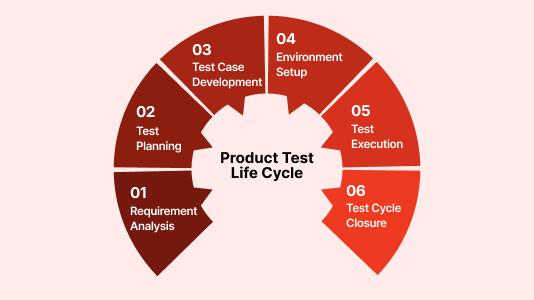
The job of a QA team would be to define every functional and non-functional software need and check for business correlation along with objectives. Creating a document that describes the product in detail is also necessary. You can use it as a reference point for testers, developers, marketing teams, and stakeholders.
- Requirement Analysis
In this, all you need to do is perform project analysis, understand the opportunities and perform a risk analysis to understand the risk hidden behind the test strategy. This is the stage where every project participant would meet product owners and stakeholders to understand their business goals and the end software scope. There are two phases: change management and casual analysis.
During change management, QA experts would identify the project areas where they expect a change to happen, analyze the benefits and impacts, and discuss further. The team would deny or validate any kind of proposal.
At the stage of casual analysis, when the project is in the active phase, a QA would analyze the performance while defining the problematic areas. The experts would understand where there was a problem and what they could’ve done to avoid any negative outcome.
- Test Planning
Through any sort of test planning, be it UI test planning or automation test planning, we can familiarize ourselves with the situation. At the same time, we focus the planning phase on ideating the right moves. This phase is quite the same as discovery since it involves a lot of research and analysis. The methods are quite different, though. The stages include noting the project requirements, creating a software-oriented document, estimating the project scope and risk involved, and developing a risk analysis and management strategy.
- Test Design
The main objective of a software development project would be to create a strong long-term strategy. A stable test design can help every tester and developer to follow good coding standards while guiding Quality Control teams and measuring the results.
- Test Artifacts in the Design Stage
With digital transformation in full stream, we characterize the QA and testing stages through specific documents and activities. The artifacts include:
- Test Case: A detailed representation of the testing procedure, conditions, results, and inputs.
- Test Scenario: The problem describing a scenario realistically and believably.
- Test Scripts: consisting of the instructions you need to perform for verifying a specific feature.
You can further break down the design stage into six steps: analysis, clarification, outline, defining test activities of software quality assurance, identification, and evaluation of the final state.
The design stage of any software quality assurance process would be ongoing. While the project is growing, the team would update the QA strategy, look for ways to reduce cost and time, and see if they can automate any processes.
- Test Execution
In this process, a QA would be implemented through audits, reports, and protocols. The major task of a QA team would be to hold consistent testing documentation and the development process, measure how efficient the team is, and look out for the compliance of results with the needed standards.
How to Create a Software Quality Management Plan
Everything above stays theoretical until it is written down and assigned to somebody. A Quality Management Plan (QMP) is the document that does that. It states what quality means for this specific project, how it will be measured, who is accountable, and what has to be true before anything ships. Without one, quality becomes whatever the team has time for in the last week of the sprint.
A usable QMP has five components:
- Quality objectives: The critical quality attributes for this project, each with a measurable target. “The app should be fast” is not an objective. “95th percentile response time under 400ms at 5,000 concurrent users” is, because it can be tested and it can fail.
- Standards and metrics: Which standards you are working to, such as ISO 9001 or a target CMMI level, and which metrics you will track against them: defect density, escaped defects, MTTR, cycle time, first time pass rate. Name the reporting cadence and who owns the report, or it will not happen.
- Roles and responsibilities: Who approves quality, who owns test strategy, what developers own (unit tests, code review), and what product owns (acceptance criteria). Quality that is everyone’s job is nobody’s job.
- QA and QC procedures: The prevention side (requirements review, definition of done, code review policy, shift-left practices) and the verification side (test levels, risk-based testing priorities, entry and exit criteria, device and browser coverage).
- Tooling and CI/CD integration: Your automation framework, your defect tracking, and specifically which gates in the CI/CD pipeline block a merge or a release. A quality standard nothing enforces is a suggestion.
Building one is a five-step process. Start from the business goal and identify which quality attributes actually carry it. Set a measurable target for each. Decide the procedures and gates that will protect those targets. Assign each one an owner. Then review the plan against real defect data every few releases, which is the fourth pillar closing the loop.
Use the outline below as a starting template. Copy it, delete what does not apply to your project, and fill in a real number wherever there is a placeholder.
QUALITY MANAGEMENT PLAN: [Project name]

1. QUALITY OBJECTIVES
   - Critical quality attributes: [e.g. reliability, security]
   - Measurable target per attribute: [e.g. 99.9% uptime, P95 < 400ms]
   - Business goal each target supports: [...]

2. STANDARDS AND METRICS
   - Standards followed: [ISO 9001 / CMMI level / internal coding standards]
   - Metrics tracked: [defect density, escaped defects, MTTR,
     cycle time, first time pass rate]
   - Reporting cadence and owner: [e.g. weekly, QA lead]

3. ROLES AND RESPONSIBILITIES
   - Quality owner / final approver: [...]
   - QA lead (test strategy, sign-off): [...]
   - Developers (unit tests, code review): [...]
   - Product (acceptance criteria): [...]

4. QA PROCEDURES (PREVENTION)
   - Requirements review and acceptance criteria
   - Code review policy: [e.g. 1 approver, no self-merge]
   - Definition of done: [...]
   - Shift-left practices: [...]

5. QC PROCEDURES (VERIFICATION)
   - Test levels: unit, integration, system, acceptance
   - Risk-based testing priorities: [highest-risk areas]
   - Entry / exit criteria per stage: [...]
   - Environment, device, and browser coverage: [...]

6. TOOLING AND CI/CD
   - Automation framework: [...]
   - Pipeline gates that block merge/release: [...]
   - Defect tracking: [...]

7. QUALITY IMPROVEMENT
   - Retrospective cadence: [...]
   - Escaped-defect analysis owner: [...]
   - Metric review and process change log: [...]
The 7 Principles of Quality Management (ISO 9001)
The pillars describe the activities and the plan records the commitments. Underneath both sits ISO 9001, the international standard for quality management systems, which is built on seven principles. They are not software-specific, which is exactly why they are useful: they explain why the practices work rather than just listing them.
- Customer focus: Quality is defined by whether the customer’s needs are met, not by whether the spec was implemented. A release that passes every test and still frustrates users has not met the standard.
- Leadership: Direction and quality culture are set from the top. If leadership consistently trades quality for a date, no process will hold, because the team will correctly read what is actually rewarded.
- Engagement of people: Quality is produced by competent, involved people, not extracted by procedure. This is the principle behind giving developers ownership of their tests rather than treating QA as a downstream inspection department.
- Process approach: Consistent results come from understanding activities as connected processes. It is why a defect gets traced back to the process that allowed it instead of the person who wrote it.
- Improvement: Improvement is a permanent objective, not a project. This is the same idea as the fourth pillar, and ISO treats it as a standing requirement rather than something to do when there is time.
- Evidence-based decision making: Decisions come from data, which is the entire reason the metrics section of your plan exists. “It feels flaky” is not evidence. A 12% escaped-defect rate is.
- Relationship management: Quality depends on your suppliers and partners too, which in software means your vendors, cloud providers, APIs, and open source dependencies. Your uptime is capped by theirs.
Best Practices for Software Quality Management
Whenever a software team struggles to complete their application testing process, the best place to get started is QA and testing strategy. The right strategy would be to look for defects and segregate them according to the category's type, severity, and priority. It’s also important to know the latest software testing trends to fast-track this process. The functional testing strategy should be planned with the entire life cycle of the defect in mind.
Other needed components would include performing non-functional testing on performance, user acceptance and application stress. Every high-performing software testing team can implement automation strategies while relying on different test management systems. People excelling would cover most of the code across different automated regression testing suites.
These are the seven practices you can apply for software quality management:
- Separate the security testing and performance testing teams
When you test the performance and security of an application, it needs two important skills as per the evolution of new application technologies and security threats. These will bring down the individual team members' capabilities.
- Use a bug tracking tool for quality management
You need to remember how the bug has impacted your app or website. For that, you need to keep track of it. A bug tracking tool is the best way to combat bugs since you can mark a bug based on severity and priority.
- Collaborate closely with your product development team
You need to be aware of what’s happening in your team. For this to happen, communication is a must. It’s always good to use test integration tools for smoother communication. For example, TestMu AI integrates with JIRA and Slack for project management purposes, especially to uplift communication within the team.
- Try to simulate the end-user environment
A tester can meet the end-user directly, internally or externally. It’s a great way to uncover different issues of the software. This can help every team member test with end-users in mind.
- Emulate the developer environment
To prevent QA teams and developers from going through undesirable application performance, the QA environment must emulate the development environment. As builds go through the development pipeline, you can test your code under different production environments while simulating customer environments.
- Check out necessary code changes
It’s impossible to test every code. Hence, you need to prioritize significant code changes to fix bugs. You can use automation testing for repetitive tasks and codes that worked in the last cycle.
- Make use of the two-tier test automation approach
It’s good to run quick sanity checks on each source code commit when you want to validate different code changes. You can easily run regression tests at night to provide immediate suggestions and feedback to your developers while focusing on the code portion.
- Run regression tests
Running a regression cycle in the final stabilization phase can give you the necessary push when you move the application into the production phase. Since there would be few development changes, it’s a must to validate the complete application.

Conclusion
Software Quality Management is essential when you want to build software which your customers love. To maintain the quality of the software, it’s essential to use the best cross browser compatibility testing tool on the market. TestMu AI is the name you need to trust in such a case.
With TestMu AI, you can test your website or app on Android emulator online , iOS Simulators and real device cloud. Ranging from Selenium to XCUITest, we support a number of frameworks to perform automation tests. What’s more? Testing would become quite simple and less time-consuming with our platform.
Happy testing!
Author

Amrita Angappa
Blogs: 4


Amrita Angappa is a Community Contributor with 6.5+ years of experience in content creation, specializing in software testing, test automation, AI, Big Data, ML, and analytics. She has authored 100+ technical blogs, with her work featured on platforms like SAP, DZone, Thrive Global, HackerNoon, YourStory, and more. A JOSH Talks speaker and former TestMu AI content lead, Amrita is also the creator of the LinkedIn series #fresherdiaries, which has crossed 10M+ views. On LinkedIn, she is followed by 35,000+ professionals, including QA engineers, software testers, AI innovators, technologists, marketers, and industry leaders.


Frequently asked questions
Did you find this page helpful?
More Related Learning Hubs
TestMu AI forEnterprise
Get access to solutions built on Enterprise
grade security, privacy, & compliance
- Advanced access controls
- Advanced data retention rules
- Advanced Local Testing
- Premium Support options
- Early access to beta features
- Private Slack Channel
- Unlimited Manual Accessibility DevTools Tests