

Power Your Software Testing with AI Agents and Cloud
The Native AI-Agentic Cloud Platform to Supercharge Quality Engineering. Test Intelligently and Ship Faster.


- TestMu AI (Formerly LambdaTest)
- /
- Blog
- /
- Quality Management - Whose Responsibility is it Anyway?
Quality Management – Whose Responsibility is it Anyway?
Quality assurance is a shared responsibility, not just a tester's job. See how developers, product managers, and testers all contribute to product quality.
Last Updated on:
Quality management is everyone's responsibility on a software team, not just the QA tester's job.
W. Edwards Deming and Joseph Juran built this into Total Quality Management after World War II, making quality a shared task for developers, testers, and product managers, not one isolated role.
This guide covers how testing responsibility evolved over the years, what makes quality everyone's job, why team communication matters, and how AI agents are changing who owns quality checks today.
Key Takeaways
- Quality management is a shared responsibility across developers, testers, and product managers, not the tester's job alone.
- Agile methodology broke down the role silos that made quality control the tester's sole task under the waterfall model.
- Quality assurance prevents defects before they happen, while testing only detects defects that already exist.
- Product owners turn user needs into user stories, developers build the features, and testers confirm the product satisfies the customer.
- Communication between QA and development, including pairing developers with testers, reduces rework and improves product quality.
- AI code review and self-healing test agents now handle repetitive defect detection, while humans still decide what quality means for the product.
Testing over the years
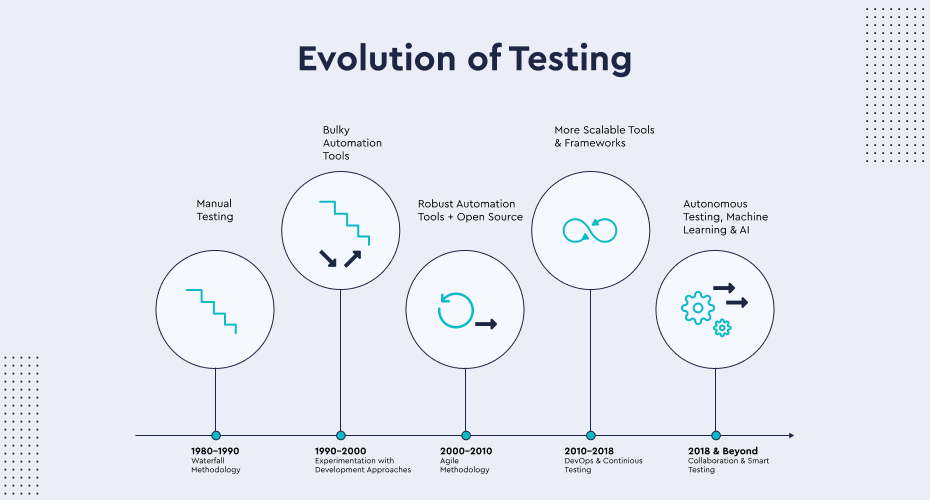
When people mainly followed the waterfall model, the business analysts wrote the requirements, the developers coded the criteria, and the Testers tested the criteria. Each of these people was responsible for different silos and did what they were expected. Quality was thought to be analogous with testing and therefore was considered the Tester’s responsibility solely.
But nowadays, when the world has moved on to agile methodology, the barriers have been broken down – quality is not just a testers’ responsibility anymore. The whole team owns quality. The best agile teams have a mindset that everyone is responsible for quality. There are multiple ways that the team maintains quality. It is supported from the very beginning and not just measured with testing. Because testing only detects defects, quality assurance prevents defects. Teams that own quality are willing to contribute to it any way they can.
Making Quality everyone’s responsibility
People usually believe that project managers and other leaders are less educated about testing. So misconceptions are usual. However, if you ask today, they would tell you quality is everyone’s responsibility. But no one will tell you how it is everyone’s responsibility.
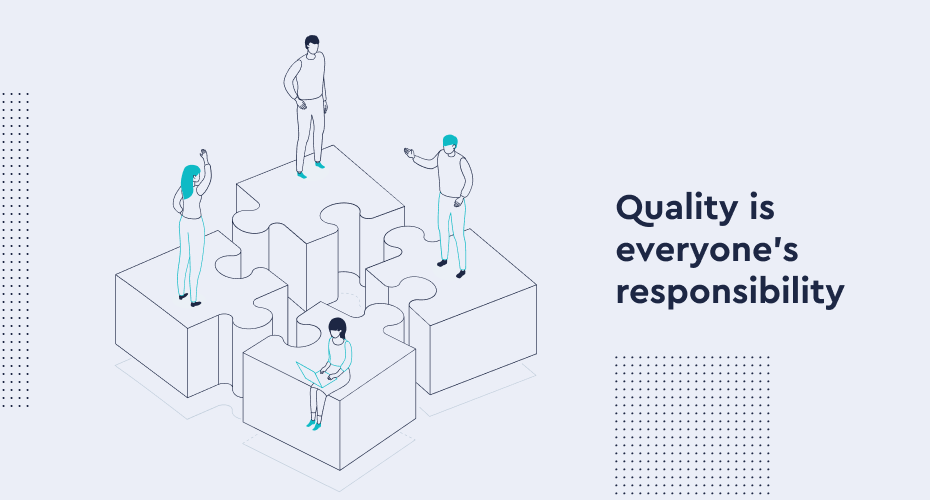
What role does everyone play in making a quality product? A product owner translates user needs to user stories and works with developers. Developers who develop these user requirements and features and make them more user-friendly. Testers understand what needs to be solved and what needs to be tested to satisfy the customer. A tester with facts can influence the decisions about a product but ideally should not be making decisions about the product. It’s not that testers cannot give their opinion, but coming up with solutions and features for the product should be left to product managers.
Although we have changed our opinions towards the roles with quality and now believe quality is everyone’s responsibility, we should recognise the necessity for engineers with a quality emphasis. Having engineers focused on product performance, user experience and customer scenarios, internal development, and security ensure that these areas prioritize the product and that any issues in those areas will have a voice.
We don’t look to these teams to handle scale, UX, security, etc.; we expect these teams to deepen their understanding in these areas. Quality is not a one-off process, and it is a continuous process. It is not the result of efforts from a single person, but it is the team’s effort. We have to make it a habit of delivering a quality product; that is how a new brand is born into the market and known for its standards. Quality is not an act! It is a habit!

Communication is the key
Good understanding between the teams is one way to ensure quality. Creating cordial relations between QA and Development, as well as incorporating Software Quality Assurance practices, will minimize the difference between the two groups. Testers can work with scrum masters for advice and input. They can collaborate with Product managers to give and receive feedback on acceptance Criteria or test cases and defects, further enhancing the overall quality in testing teams.
Opportunistic pairing is another technique for ensuring quality. The pairing could be Developer with Developer, Tester with Tester, Developer with Tester or even the Developer, Tester and Product manager. Pairing reduces post-implementation code reviews and reworks in many cases. Each person in a team will get visibility into the other person’s tasks and processes.
With good understanding and freedom within the teams comes the ability to question and even disagree. So it might mean some features need to be redesigned around testability, testers need to shift on what they think the most critical tests are, or the team takes a calculated risk around what will be validated. The crucial point is understanding the risk and discussing what tests are essential for today and the sprint. Engaging everyone in the conversation helps shift more toward the idea that quality is everyone’s responsibility.
How Are AI Agents Changing Who Owns Quality?
AI agents now share day-to-day quality work with developers and testers, flagging defects in code and self-healing broken test scripts, while humans still decide what quality means for the product.
- AI code review: Tools such as GitHub Copilot's review feature and Amazon CodeGuru scan pull requests for bugs, security flaws, and style violations before a human reviewer opens the diff.
- Self-healing test agents: LLM-based self-healing test automation rewrites a broken locator or step automatically after a UI change, a task that used to sit entirely with the tester maintaining the suite.
- MCP-connected context: MCP and AI agents work together so a suggestion pulls live application state, API responses, and logs, grounding the fix in the real product instead of a guess.
- Human judgment stays put: Deciding what counts as acceptable quality, an acceptable risk, or a good user experience remains a team call. Agents only take over the repetitive detection work.
- Shared accountability: An AI agent flags the defect, but the developer, tester, and product manager still decide together whether to fix it now, and that shared call keeps quality a team job, not an agent's.
Conclusion
When the project team correctly describes quality specifications and the organization has set up a procedure to ensure quality control and assurance measures are taken care of, the project is more likely to be delivered of better quality and hence more likely to succeed. For Instance: During the Planning Stage of a Project Life Cycle, documents are the majority component of the deliverables. Ensuring the teams submit quality documents will influence the project’s success.
Similarly, during the Execution Stage, the team should ensure appropriate quality control and influence its success.
Quality is just like security. Every person can contribute to having a safer product by identifying threats or ensuring the necessary actions are taken when they see any danger. So, every person can contribute to having a higher quality deliverable by understanding the project’s quality expectations and delivering up to its standard.

Author

Navya
Blogs: 10


Navya Manoj is a community contributor with 10+ years of experience in product marketing and go-to-market strategy within software testing and automation platforms. She has led product launches and sales enablement initiatives at TestMu AI and currently works as a Product Marketing Manager at Avo Automation, supporting automation-led quality solutions. With a technical foundation in automation and MQTT-based systems and an M.Tech in Mechatronics and Robotics, Navya bridges engineering context with product positioning to support testing-focused platforms and teams.


Quality Management FAQs
Did you find this page helpful?
More Related Blogs
TestMu AI forEnterprise
Get access to solutions built on Enterprise
grade security, privacy, & compliance
- Advanced access controls
- Advanced data retention rules
- Advanced Local Testing
- Premium Support options
- Early access to beta features
- Private Slack Channel
- Unlimited Manual Accessibility DevTools Tests