

Power Your Software Testing with AI Agents and Cloud
The Native AI-Agentic Cloud Platform to Supercharge Quality Engineering. Test Intelligently and Ship Faster.


- TestMu AI (Formerly LambdaTest)
- /
- Learning Hub
- /
- Alpha Testing Tutorial: A Comprehensive Guide With Best Practices
Alpha Testing Tutorial: A Comprehensive Guide With Best Practices
In this tutorial of Alpha testing, let’s deep dive into the objectives of Alpha testing, its advantages, disadvantages, phases, process, and best practices.
Last Updated on:
Alpha testing is a procedure that helps developers find and address faults in their software products. It is comparable to user acceptance testing, another kind of quality control. The main goal of Alpha test is to fine-tune a software product by uncovering and fixing faults that were not addressed during the initial phases of development.
While developing new software applications, many organizations overlook conducting Alpha tests. It focuses on particular product areas to detect and correct flaws missed during software development.
AI Overview
To successfully validate a software build internally before release, teams should perform alpha testing in a staging environment using white-box and black-box techniques. This first round of validation catches defects early when they are cheapest to fix, using tools like Jira for tracking and TestMu AI for cloud-based test execution.
What Does Alpha Testing Set Out to Achieve?
- Best for internal validation: Alpha testing - This phase uses white-box and black-box techniques in a staging environment to catch software defects early, ensuring the build is stable before reaching external beta testers.
Who Handles Alpha Testing Within a Team?
- Best for code-level debugging: Developers - These internal team members handle the first code-facing pass of alpha testing, using white-box techniques to debug logic and fix defects at the source.
- Best for structured test execution: QA engineers - These testing professionals execute structured test cases, log defects with reproduction steps, and track the build against exit criteria during the second pass of alpha testing.
- Best for requirement validation: Product managers - These stakeholders validate business intent during alpha testing, confirming the build meets requirements in the Software Requirement Specification and giving the final sign-off for beta.
Which Tools Support an Alpha Test Cycle?
- Best for cloud test execution: TestMu AI - This test automation cloud enables internal testers to run builds across thousands of real browsers and devices, eliminating the need to maintain a local device lab while unifying manual and automated test results.
- Best for defect tracking: Jira - This bug tracking tool allows internal alpha testers to record, track, and manage software defects with severity levels and reproduction steps, ensuring no identified issues are lost before the final release.
- Best for recording defects: Bugzilla - This tool captures and documents software bugs discovered during the alpha testing phase to facilitate systematic debugging.
How Does Alpha Testing Differ From Beta Testing?
- Best for real-user feedback: Beta testing - This external testing phase follows alpha testing and is performed by real users on their own devices using black-box methods to gather feedback before public release.
What is Alpha Testing?
Alpha testing is the way to determine whether a product meets its performance standards before it is released. It is carried out by the product developers and engineers, who are familiar with the product's expected functions. This is followed by beta testing, in which a sampling of the intended audience tries the product out.
Alpha tests is considered a type of user acceptance testing. It's designed to refine software products by finding and fixing bugs that have escaped notice during previous tests.
Alpha is the first software testing phase, which takes place very early in the development cycle. Software engineers perform it to identify any flaws in the design of a program before it enters beta testing, where other users interact with it for the first time. The term "Alpha" comes from a tradition in which code is labeled alphabetically. It is usually performed using white box testing and black box testing techniques.
Alpha testing validates the Minimum Viable Experience (MVX), the smallest usable version of a product, inside a staging environment that mirrors production. It is a form of internal User Acceptance Testing (UAT): employees act as proxy users and sign off on core workflows before the product ever reaches an external audience.
A concrete example: a SaaS company building a new analytics dashboard runs an alpha phase where its own QA engineers, product managers, and support staff use the dashboard on a staging server for two weeks. They log broken filters, slow chart loads, and confusing labels in a bug tracker. Only after those internal defects are fixed does the build move to external beta testers, cutting the number of embarrassing issues real customers would otherwise see.
Objectives of Alpha Testing
It is important to know what you are looking for and why you are looking for it when performing Alpha testing. If the data obtained from this testing is not actionable, it would be better to find out as soon as possible in the development cycle so that further time and money do not need to be spent on unnecessary tests. The following lists some objectives of Alpha test.
- It is a crucial stage in the development process, where software engineers identify and fix problems with the product before it is released to the public.
- To involve customers in the development process so that they can help shape the product.
- To verify the reliability of software products at the early stages of development.
Advantages of Alpha Testing
The advantages of Alpha tests in software engineering include:
- Provides crucial insights into the dependability of the software while also shedding light on the potential issues that could arise.
- Helps the software team gain confidence in their product before releasing the application in the market.
- It frees up your team to focus on other projects.
- Early feedback from Alpha testers helps companies to improve the quality of their products.
- It allows developers to get user feedback, which benefits the design process. This process also helps stakeholders determine which features of a new piece of software to optimize.
Disadvantages of Alpha Testing
The disadvantages of Alpha testing in software engineering include:
- If the defects stay uncovered, they will remain in the software application. The primary purpose of Alpha tests is to test users' reactions to the application, not to find defects.
- It replicates the production environment, but some defects arise because of environmental issues. These issues don't exist in the production environment, so they're not present in Alpha tests.
- When it comes to small-size projects, Alpha tests is not necessary. Time and money are proportional in an IT project. Furthermore, increasing the budget increases the project implementation period.
- For large projects that have already undergone rigorous testing, performing Alpha tests on them can be time-consuming. Due to a very high probability of bugs, a proper test plan and documentation work need to be done, which indirectly is a reason for the release delay.
Phases of Alpha Testing
Alpha testing consists of two phases:
- Phase 1: Software engineers use debugging tools in the first phase to improve the process and find all bugs as quickly as possible. The main aim is to ensure the software works according to plan.
- Phase 2: The quality assurance team conducts the second testing phase, including black box and white box testing. The primary purpose is to discover bugs that escaped previous tests.
By doing so, the quality assurance team can fix any bugs in the system just before releasing it for beta testing; this ensures the program's quality will be high when it reaches the end user.
Alpha Testing Process
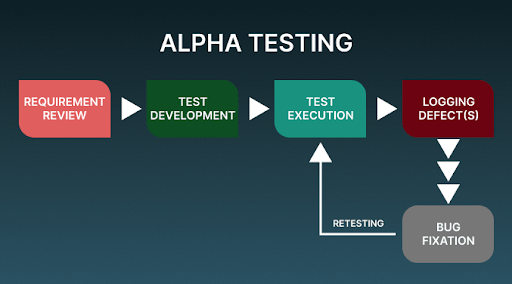
Alpha testing has the following process:
- Requirement Review: In the first stage of this process, the developers and engineers must evaluate the specification and functional requirements design and recommend changes.
- Test Development: Test development is based on the result of the required review. The test plan and test cases are created based on the review's outcome, which shows how testing will occur.
- Test Case Design: In this stage, the execution of the developed test plan and test case takes place.
- Logging Defects: As part of the debugging process, the identified bugs are logged. Logging the identified and detected bugs can help developers spot recurring bugs and suggest fixes.
- Fixing the Bugs: Once defects and bugs are identified by the testers, they are logged, and steps are taken to fix them.
- Retesting: After the identified bugs are fixed, testers retest the product to find out any unidentified or new bugs or errors.
Entry and Exit Criteria for Alpha Testing
Alpha testing does not start the moment code compiles, and it does not end when testers get bored. Both boundaries are defined by measurable criteria so the phase produces a build that is genuinely ready for external beta users.
Entry criteria (what must be true before alpha starts):
- Unit and integration testing complete: the individual modules and their interactions have already passed unit testing and integration testing.
- Stable, deployable build: a build is installed on a staging environment that mirrors production and launches without crashing on start.
- Requirements ready: the Software Requirement Specification (SRS) and functional design are approved, so testers know the expected behavior for each feature.
- Test assets in place: the test plan, test cases, and traceability matrix are written and reviewed.
- Environment provisioned: test data, accounts, and access to the alpha environment are set up for every internal tester.
Exit criteria (what must be true before alpha ends and beta begins):
- All critical and high-severity defects resolved: no open blocker or critical bug remains; agreed low-severity issues are documented and deferred.
- Test execution complete: the planned test cases have been executed to 100 percent, with pass and fail status recorded for each.
- Retesting and regression passed: fixed defects are verified, and a regression pass confirms nothing new broke.
- Sign-off recorded: QA and product leads approve the build against the SRS and confirm it is stable enough for external users.
Who Is Responsible for Alpha Testing?
Alpha testing is an internal effort, so every participant is an employee or stakeholder inside the organization. Three roles carry most of the work.
- Developers: handle the first, code-facing pass. Using white-box techniques, they debug logic, fix defects at the source, and confirm each module behaves as designed before handing the build to QA.
- QA engineers: run the structured second pass. Working mostly black-box, they execute the test cases, log defects with reproduction steps, drive retesting, and track the build against the exit criteria above.
- Product managers: validate business intent. They confirm the build satisfies the requirements in the SRS, prioritize which defects block release, and give the final sign-off to move into beta.
Support and design staff are often pulled in as additional internal users, because non-technical testers surface usability problems that engineers, who know the intended flow, tend to overlook.
Essential Alpha Testing Tools
Alpha testing needs tooling in three categories: something to record defects, something to organize test cases and coverage, and infrastructure to run the build across the environments your users have.
- Bug tracking: tools like Jira and Bugzilla capture each defect with severity, steps, and status so nothing found during alpha gets lost before the fix.
- Test management: a platform to author test cases, group them into cycles, execute them, and report coverage against requirements.
- Cloud test execution: a real device and browser cloud so internal testers can reproduce environment-specific bugs without maintaining a local device lab.
TestMu AI covers the last two in one connected workspace. Its AI-native test management platform generates structured test cases from plain-language requirements, groups them into plans and cycles, unifies manual and automated results in a single pass or fail view, and traces every requirement to its tests, runs, and defects. Two-way Jira and Azure DevOps integration means a failed alpha test logs a defect with full context, and the status syncs back automatically, so QA and developers never maintain two systems.

Note: Run your alpha builds across 10,000+ real Android and iOS devices instead of emulators, and reproduce environment-specific bugs before beta. Start testing free with TestMu AI.
Alpha Testing Template and Checklist
Use this test case template to log alpha results consistently. Copy it into your test management tool or a spreadsheet and add one row per test case.
| Field | What to record |
|---|---|
| Test Case ID | Unique identifier, for example ALPHA-001 |
| Feature / Module | The area under test, for example Login or Dashboard filters |
| Test Steps | The exact actions the tester performs |
| Expected Result | What should happen if the feature works |
| Actual Result | What actually happened during the run |
| Status | Pass or Fail |
| Severity | Critical, High, Medium, or Low |
Pair the template with this readiness checklist for the phase as a whole:
- Confirm all entry criteria are met (stable build, SRS approved, test cases written).
- Provision the staging environment and grant every internal tester access.
- Execute each test case and record Pass or Fail with an actual result.
- Log every defect with severity and reproduction steps in your bug tracker.
- Fix, retest, and run a regression pass on resolved defects.
- Verify 100 percent test execution and zero open critical defects.
- Get QA and product sign-off before promoting the build to beta.
Alpha Testing vs. Beta Testing
Here is a detailed comparison between Alpha and Beta testing.
| Alpha Testing | Beta Testing |
|---|---|
| It is the first step in ensuring the quality of a product before moving on to beta testing. | Beta testing also focuses on the product and ensures that the product is ready for real-time use. It concentrates on the quality of the product and gathers users' input on the product. |
| It allows developers to address critical issues or fixes immediately. | Beta testing is typically used to collect user feedback and issues with a product, which will be implemented in future versions. |
| It is the first stage of software testing employees perform within the organization. | Beta testing is performed by outside clients or customers who are not employees of the organization. |
| In-depth Reliability and Security Testing are not performed in this testing. | Beta testing ensures that a new product is as reliable, secure, and robust as possible. |
| It employs a combination of white and black box techniques. | Black Box Testing is typically used in Beta Testing. |
| It can take a long time because of the extensive nature of the tests, so it's essential to plan. | Only a few weeks are required to complete the beta testing phase. |
How to Perform Alpha Testing?
Testing should be considered an ongoing process that begins when the requirements for a system are first defined and continues until the system is no longer in use, even if it does not get formal testing activities every day or week. Testing can include both functional and non-functional tests, but not all types of tests can be performed at this stage.
Alpha tests should only be done after a product has passed unit and integration testing. A group of users, including end users and developers, should test the product before beta testing starts. This group of users should not be limited to one or two testers. The more testers involved in alpha test, the better chances that bugs will be found early enough to correct before they become serious problems.
Instead of trying to test your website on every device and operating system your audience uses, consider using a cloud-based testing infrastructure like TestMu AI.
TestMu AI's real device cloud offers 10,000+ real devices and 3,000+ browser and OS combinations for manual and automation testing. This extensive range allows you to check how your website or app renders and works on different browsers, devices, and OSes. Using TestMu AI's automation cloud, you can achieve faster test execution speed and developer feedback thereby reducing overall costs related to fixing problems later in the software development cycle.

With the TestMu AI automation testing platform, you can automate web testing with various automated testing tools like Selenium, Cypress, Playwright, Puppeteer, TestCafe, Appium, Espresso, etc.

Subscribe to the TestMu AI YouTube channel and stay updated with the latest tutorials around Selenium testing, Cypress testing, CI/CD, and more.
Alpha Testing Best Practices
After discussing the process of performing Alpha tests, here are a few best practices to make the most out of it:
- Recording Every Issue: It's a good idea to record everything during your Alpha test because you may want to return to these issues later, or they might be ready for post-release evaluation.
- Don’t Rely Completely on Beta Testing: Testers might find the same issues during Beta testing as during Alpha testing. But there is no certainty of finding the same problems. However, the more issues and bugs are identified and resolved during Alpha tests, the more superior the product will be perceived by public beta testers.
- Examine the Specifications: Before starting Alpha tests, It is crucial to review the operational and testing requirements. Doing this provides meaning and purpose for all the effort while providing general common knowledge.
- Monitor Full Customer’s Experience: The developed test cases should cover an actual user's complete experience of engaging with the product. A product may perform, but it may not be useful for a more extensive dealing with all the issues.
- Involve Non-technical Team Members: When it comes to testing, technical people can be more lenient with bugs and application issues compared to non-technical and daily users. Thus, involving non-technical people in Alpha tests can give a deeper look into the usability and performance issues.
Wrap Up!
Alpha testing is a vital phase in the software development lifecycle. It involves testing the functionality of a software product in a real environment and achieving confidence in its users' acceptance of the product before releasing it into the market.

Author

Devansh Bhardwaj
Blogs: 80


Devansh Bhardwaj is a Community Evangelist at TestMu AI with 4+ years of experience in the tech industry. He has authored 30+ technical blogs on web development and automation testing and holds certifications in Automation Testing, KaneAI, Selenium, Appium, Playwright, and Cypress. Devansh has contributed to end-to-end testing of a major banking application, spanning UI, API, mobile, visual, and cross-browser testing, demonstrating hands-on expertise across modern testing workflows.
Reviewer

Harish Rajora
Reviewer
Harish Rajora is a software developer at TestMu AI with over 6 years of hands-on experience in Python and cross-platform application development across Windows, macOS, and Linux. He has authored 800+ technical articles and worked on large-scale projects, including GenAI applications and core engineering features used by millions. Harish has led DevOps initiatives building CI/CD pipelines with Jenkins, AWS, GitLab, and GitHub, and holds an M.Tech in Software Engineering from IIIT Allahabad.


Alpha Testing FAQs
Did you find this page helpful?
More Related Learning Hubs
TestMu AI forEnterprise
Get access to solutions built on Enterprise
grade security, privacy, & compliance
- Advanced access controls
- Advanced data retention rules
- Advanced Local Testing
- Premium Support options
- Early access to beta features
- Private Slack Channel
- Unlimited Manual Accessibility DevTools Tests