

Power Your Software Testing with AI Agents and Cloud
The Native AI-Agentic Cloud Platform to Supercharge Quality Engineering. Test Intelligently and Ship Faster.


- TestMu AI (Formerly LambdaTest)
- /
- Blog
- /
- 13 Best Test Data Management Tools Compared (2026)
13 Best Test Data Management Tools Compared (2026)
Compare 13 test data management tools on masking, subsetting, synthetic data, and CI/CD fit, plus free and open source options and a decision matrix.
Last Updated on:
Test data management tools discover sensitive data in production copies, mask it, subset it into referentially intact slices, generate synthetic records, and provision the result to test environments on demand. Masking sits first on that list because the IBM Cost of a Data Breach Report 2026 puts the global average breach at USD 4.99 million, a 12% increase over the prior year, and non-production copies are a common leak path.
This comparison covers 13 tools verified on their vendors' sites in September 2026, the free and open source options, how Gartner Peer Insights treats the category, and a decision matrix. Test automation suites and change management products are excluded, because they consume test data rather than produce it.
Which Test Data Management Tools Are Best in 2026?
The 13 test data management tools compared below run from enterprise provisioning platforms such as K2view and Perforce Delphix to free generators such as Mockaroo, ordered by how much of the TDM lifecycle each covers.
The table is the test data management tools comparison at a glance, built from what each vendor states on its own site; the entries that follow add what each tool is best for, where it stops, and how it is sold.
| Tool | Masking | Subsetting | Synthetic data | Virtual clones | CI/CD or CLI | How it is sold |
|---|---|---|---|---|---|---|
| K2view | Yes, with discovery | Yes, by business entity | Yes (AI, rules, cloning) | Snapshot and rollback | Yes | Demo, pricing on request |
| Perforce Delphix | Yes, automated | Not listed | Yes (AI-powered) | Yes, core feature | Yes | Demo, pricing on request |
| Broadcom Test Data Manager | Yes, with PII discovery | Not listed | Yes | Yes (DAVE) | Portal and API | Contact sales |
| IBM InfoSphere Optim | Yes (Optim Data Privacy) | Yes, extract to test | Not listed | Not listed | Not listed | Contact sales |
| Curiosity Enterprise Test Data | Yes, with discovery | Not listed | Yes | Yes | Not listed | Demo, pricing on request |
| Enov8 Test Data Manager | Yes, with profiling | Yes | Yes | Not listed | Not listed | Free instant demo |
| DATPROF | Yes (Privacy, Analyze) | Yes (Subset) | Yes (Privacy) | Yes (Virtualize) | Yes (Runtime) | Free trial |
| Tonic Structural | Yes, with discovery | Yes, patented | Yes | Not listed | Yes, API | Demo; Fabricate has a free tier |
| GenRocket | Yes (in-place) | Yes | Yes, core feature | Not listed | Yes | Demo, pricing on request |
| Synthesized TDK | Yes, rule-codified | Yes | Yes, core feature | Not listed | Yes, Kubernetes | Demo, pricing on request |
| Accelario | Yes, AI de-identification | Not listed | Not listed | Yes, core feature | Yes, API | Free version, paid upgrades |
| Redgate Test Data Manager | Yes (Anonymize) | Yes (Subset) | Not listed | Not listed | Yes, CLI | Free trial |
| Mockaroo | No | No | Yes, schema-based | No | REST API | Free up to 1,000 rows per file |
1. K2view Test Data Management
K2view organizes test data around whole business entities such as a customer, an account, or an order, rather than around tables. Each entity is stored in its own Micro-Database, so a subset request phrased in business terms ("500 customers with an open dispute") pulls every related row from every connected system with referential integrity intact.
The vendor page lists sensitive data discovery across sources, a masking function library, synthetic generation by AI, rules, or entity cloning, CI/CD integration, snapshot and rollback, and a reserve feature that stops one tester's data from being overwritten by another's. Deployment is on-premises, cloud, or hybrid.
Best for - enterprises whose test data spans a mainframe, several relational databases, and SaaS systems that all have to agree on the same customer.
Where it stops - the entity model is the product, so a team with one PostgreSQL database and no cross-system joins is buying more than it needs. Pricing is on request after a demo.
2. Perforce Delphix
Perforce Delphix, formerly the standalone Delphix platform, is built on data virtualization: instead of copying a production database for each environment, it presents thin virtual copies instead of full duplicates, so additional environments add little storage. Masking runs on the virtual copy before delivery, and the product page adds AI-powered synthetic data generation and self-service access for "developers, testers, and agents."
The vendor lists private, public, and hybrid cloud deployments with AWS, Azure, and GCP integrations, CI/CD pipeline delivery, and connectivity to 170+ data sources. On Gartner Peer Insights it carries the Customers' Choice 2025 distinction in the Test Data Management category.
Best for - teams that need many parallel, refreshable environments and whose bottleneck is provisioning time rather than data generation.
Where it stops - subsetting is not a headline capability on the product page, and buying is demo-led with pricing on request.
3. Broadcom Test Data Manager
Broadcom Test Data Manager is the former CA Test Data Manager, and older roundups still list it under the CA name. The current page lists PII discovery with format-preserving masking that scales across billions of rows, synthetic data that keeps statistical integrity and relationships, and a self-service portal where testers find, reserve, and provision datasets without a DBA.
DAVE, the Database Virtualization Engine, provisions virtual database clones that users snapshot, test, and roll back through the portal or API. Masking also executes natively on z/OS for DB2, IMS, and VSAM, so mainframe data never leaves its environment to be protected.
Best for - organizations with mainframe workloads in the test path, and regulated industries that need the PII audit reports and heat maps the tool generates for GDPR, HIPAA, and CCPA.
Where it stops - there is no trial or public pricing; the route in is a sales contact.
4. IBM InfoSphere Optim Test Data Management
IBM Optim is sold as three offerings: Optim Test Data Management, Optim Data Privacy, and Optim Archive. The test data piece extracts data across systems and databases into test environments; the privacy piece applies masking across databases, applications, and systems; the archive piece retires and decommissions application data to cut storage and risk.
The split matters for organizations that already own Optim for archiving: they get test data extraction and masking from the same vendor, with the same data model, across operating systems and hardware platforms. It also holds the Customers' Choice 2025 distinction on Gartner Peer Insights in this category.
Best for - large enterprises that need test data, privacy, and application retirement handled together, often on the same DB2 or mainframe estate.
Where it stops - the product page does not mention synthetic generation, virtualization, or a CLI, and no trial is advertised.
5. Curiosity Enterprise Test Data
Curiosity Software sells Enterprise Test Data as a platform that finds existing data before it makes new data. The homepage lists data discovery that maps structures and relationships, masking for compliant delivery, synthetic generation described as "create and automate the provisioning of high quality, compliant data," self-service provisioning forms with an automated toolkit, data monitoring and modelling with AI-driven insights, and data virtualization.
Connectivity is the headline number: 250+ connectors across databases, mainframes, files, and messages, with Atlassian and Jira integrations named. The companion Quality Modeller turns visual requirement models into generated tests, so the data request and the test that needs it come from the same model.
Best for - enterprises that want find-and-make provisioning tied to test models, especially where data lives partly on a mainframe and partly in message queues.
Where it stops - no trial or pricing on the site, and subsetting is not called out separately from discovery and provisioning.
6. Enov8 Test Data Manager
Enov8 Test Data Manager is one module of a platform that also handles environment and release management, and that shapes what it does. The solution page lists profiling that "scans source systems to identify sensitive fields, data structures, relationships and compliance risk," governed masking rules that are repeatable across refreshes, referentially intact subsetting, synthetic data for edge cases, and provisioning with scheduled refresh and delivery.
The distinctive piece is validation evidence: the tool "generates repeatable validation evidence showing that sensitive data has been identified, protected and approved," which is what an auditor asks for after masking has run. Because it sits next to the environment manager, data availability can be coordinated with environment bookings, refresh cycles, and test windows. A free, instant demo launches in the browser.
Best for - teams that must prove masking happened, and that already juggle environment bookings across many test windows.
Where it stops - supported data sources and deployment options are not enumerated on the solution page, and pricing is not published.
7. DATPROF
DATPROF sells five modules that map cleanly onto the four TDM jobs: Analyze finds sensitive data, Privacy masks it and generates synthetic records, Subset cuts referentially intact slices, Virtualize provides containerized database environments, and Runtime is the automation and self-service layer that schedules, monitors, and plugs into CI/CD pipelines.
Because the modules are separate, a team can start with Subset and Privacy on one database and add Runtime when several teams need self-service. The site offers a "Try It Yourself" trial rather than demo-only access, which is rare in this list.
Best for - mid-size teams on relational databases that want to buy masking and subsetting first and grow into provisioning.
Where it stops - the supported database list is shown as logos rather than text on the homepage, so confirm your engine with the vendor. Pricing sits on a separate page and is not repeated here.
8. Tonic Structural
Tonic Structural targets engineering teams that want production-like data in local and CI environments without a ticket to a data team. The product page lists automated PII and PHI discovery with custom rules, consistent masking and synthesis that preserve referential integrity, patented subsetting for local development, scheduled data refresh that adapts to schema changes, and role-based access control with audit trails.
A built-in agent applies and configures generators and enforces compliance rules, which the vendor frames as "TDM without the tedium." Sources span relational databases, NoSQL, data lakes, flat files, and SaaS applications, deployed cloud-hosted or on-premises. The sibling product Tonic Fabricate, which synthesizes databases from scratch, has a free tier.
Best for - product engineering teams on modern stacks who want developers to self-serve subsets through an API.
Where it stops - database virtualization is not part of the offer, and Structural itself is demo-led.
9. GenRocket
GenRocket takes the opposite approach to the masking-first vendors: design the data instead of copying production. The homepage lists 750+ data generators, 125+ output formats, a US patent for synthetic generation with referential integrity, and deterministic rather than probabilistic output, so the same design produces the same rows every run.
Throughput claims on the vendor page are 2.5 million rows per minute and 100 million rows in 30 minutes. It also lists subsetting, In-Place Masking for existing data, self-service through G-Portal, orchestration across several test environments at once, and direct CI/CD integration, with Oracle, DB2, MS SQL, MySQL, PostgreSQL, and Sybase as supported databases.
Best for - performance testing and new-feature testing where large volumes of controlled, never-real data matter more than production fidelity.
Where it stops - designing generators is upfront work compared with masking a copy, and access is demo-led with a cost calculator instead of published pricing.
10. Synthesized TDK
Synthesized positions its Test Data Kit for enterprise application programs, naming SAP S/4HANA, Oracle Fusion, Workday, ServiceNow, and Microsoft Dynamics 365 as targets. The site lists masking driven by codified regulatory rules, subsetting that delivers "the right data, not all the data," and synthetic generation that learns schemas, relationships, business logic, and workflow state.
Supported databases include SAP HANA, PostgreSQL, SQL Server, Oracle, MySQL, DB2, and Salesforce, with CI/CD integration and Kubernetes deployment. The vendor also frames the product for validating AI agents at scale, which is a growing use of synthetic data.
Best for - SAP and ERP transformation teams that cannot move production data into test and need synthetic records that still respect business rules.
Where it stops - no free tier or trial is advertised; the route in is a demo or sales contact.
11. Accelario
Accelario pairs database virtualization with AI-driven anonymization and is the only entry in this list whose homepage advertises a free-for-life plan. The virtualization side promises instant virtual database copies, environment autonomy for each developer, API control for CI/CD tools, downtime-free refresh, and reduced storage. The anonymization side lists automatic de-identification across unlimited data sources with referential integrity preserved, plus an AI Copilot that answers data questions and automates provisioning tasks.
The free version is spelled out on the homepage: "Free for life," "Unlimited users," "Infinite virtual database creation," and "Data stays local and controlled," with paid tiers adding features. That makes it the cheapest way in this list to test whether virtual copies fix an environment bottleneck before any procurement conversation.
Best for - small and mid-size teams that want virtualization today at no cost and a path to anonymization on the same platform.
Where it stops - subsetting and synthetic generation are not on the homepage, and the percentage improvements it quotes are vendor marketing rather than published benchmarks.
12. Redgate Test Data Manager
Redgate Test Data Manager replaces the older SQL Data Generator entry that most lists still carry. Its documentation describes one outcome, "a masked and subsetted copy of your database, ready for dev and test," for SQL Server, PostgreSQL, MySQL/MariaDB, and Oracle, driven by an Anonymize command and a Subset command that run from a CLI or a GUI.
Subset requires foreign key relationships, and Redgate ships scripts to find missing ones. Two details stand out in the docs: a one-click AWS deployment of the TDM stack, and a ready-made prompt for Claude Code, Cursor, or Copilot that walks an AI coding tool through licensing, installing the CLI, classifying the schema, and masking the data. A free trial starts at sign-in.
Best for - database developers and DBAs who already use Redgate tooling and want masking plus subsetting inside a CI job.
Where it stops - synthetic generation and virtualization are not part of the Anonymize and Subset workflow the docs describe, and the vendor warns to run both only against non-essential environments.
13. Mockaroo
Mockaroo is a browser-based schema builder: pick field names and types, set a blank percentage per column, and download up to 1,000 rows per file in CSV, JSON, SQL, or Excel from the browser. It also hosts mock REST APIs whose URLs, responses, and error conditions you control, and it ships as a Docker image for a private cloud.
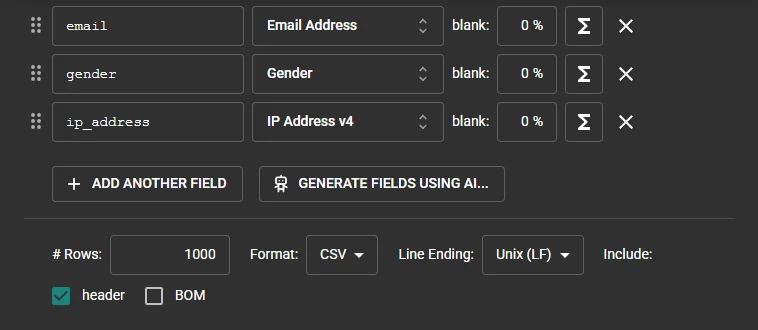
The capture above shows the default schema with the row count at 1,000 and CSV output, plus the "Generate fields using AI" option that derives a schema from a description. Schemas can also be derived from an example file and reused through a REST API for programmatic downloads.
Best for - seeding a new feature, a demo, or a load test with plausible rows in minutes, with no production data involved.
Where it stops - it does not discover, mask, or subset existing data, and cross-table referential integrity is on you. Larger row counts need a paid plan.
How Do You Get Test Data Into Automated Tests?
Test data reaches automated tests through a variables file, a data JSON, or a spreadsheet: Kane CLI reads variables, HyperExecute distributes JSON data across machines, and KaneAI builds data-driven cases from sheets.
Every tool above ends at a delivered dataset: a masked subset, a synthetic export, or a virtual clone. The tests still have to read it. KaneAI takes a spreadsheet of test matrices or data sets and generates data-driven testing cases from it, and a single flow can include a database query check alongside UI and API steps before it exports to Playwright, Selenium, Cypress, or Appium. HyperExecute distributes JSON test data across parallel machines through the dataJsonPath and dataJsonBuilder keys documented under HyperExecute YAML parameters. Test Manager imports cases from CSV, API, TestRail, Zephyr, Xray, or qTest Cloud and keeps each organization's test data isolated from other tenants.
For a CLI-driven pipeline, Kane CLI reads a variables file. Values flagged with "secret": true are meant for credentials, card numbers, and PII, and the documented pattern is to commit a non-secret base file and inject secrets at runtime. This is the file and command I ran against the TestMu AI ecommerce playground:
{
  "app_url": { "value": "https://ecommerce-playground.lambdatest.io/" },
  "product": { "value": "iPhone" },
  "coupon_code": { "value": "TDM-ARTICLE-2026", "secret": true }
}
kane-cli run --headless --name tdm-tools-article-run \
--variables-file ./tdm-variables.json \
--url "https://ecommerce-playground.lambdatest.io/" \
"search the store for '{{product}}', open the first search result, and verify the product page heading contains '{{product}}'. Do not type the coupon '{{coupon_code}}' anywhere."Kane CLI 0.7.0 resolved the file into one global and one secret before the first browser step and registered the case in Test Manager as #TC-576, where the step text shows the placeholders rather than the values:
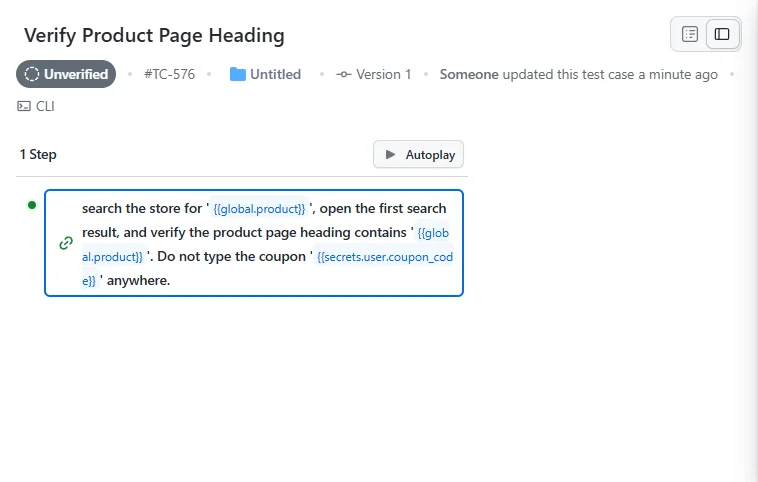
Point the variables file or the HyperExecute data JSON at whatever the tools above produce, and the same flow runs against dev, staging, and production data with one flag change.

Note: Feed masked or synthetic data into AI-authored tests with Kane CLI variables files and run them across 3,000+ browser and OS combinations on TestMu AI. Start free
Are There Free or Open Source Options for Test Data?
Yes. The open source test data management tools worth using are Jailer for subsetting and Faker for generation; on the no-cost side, Mockaroo covers generation and Accelario covers database virtualization.
Free test data management tools cover two of the four TDM jobs well, subsetting and generation, and none of them claim enterprise-wide discovery and masking. Mockaroo and Accelario are covered in the list above; the two below run in code.
Jailer - Jailer (Apache-2.0, 3.2k GitHub stars) exports "consistent and referentially intact row-sets" from a production database as topologically sorted SQL, JSON, YAML, XML, or DbUnit datasets, and includes a data browser that follows foreign keys in both directions. It supports PostgreSQL, Oracle, MySQL, MariaDB, SQL Server, Db2, SQLite, Sybase, Redshift, and others, and recent versions add natural-language subsetting. It is a subsetting and browsing tool, so plan PII masking separately.
Faker - Faker (MIT, 15.5k GitHub stars) generates "massive amounts of fake (but realistic) data" in code across more than 70 locales. Seeding the generator makes the output deterministic, which is what you want in a fixture. This script and its output were run for this article on Faker 10.6.0:
import { faker } from '@faker-js/faker';

faker.seed(2026); // same seed, same rows, every run

const users = Array.from({ length: 3 }, () => ({
  id: faker.string.uuid(),
  name: faker.person.fullName(),
  email: faker.internet.email(),
  country: faker.location.country(),
  signedUpAt: faker.date.past({ years: 2 }).toISOString().slice(0, 10),
}));

console.log(JSON.stringify(users, null, 2));
[
{
"id": "36f17f3e-8c46-44e0-b785-be013a3f207a",
"name": "Irving Lang",
"email": "Tracey20@hotmail.com",
"country": "Rwanda",
"signedUpAt": "2026-05-29"
},
{
"id": "12f070af-75aa-4991-bfa3-e2585874b12d",
"name": "Mireya Graham",
"email": "Bob97@gmail.com",
"country": "Myanmar",
"signedUpAt": "2026-06-24"
},
{
"id": "3e4e65aa-a97e-4b6b-bf06-2ebb91fed357",
"name": "Nyasia Mayer",
"email": "Elinor.Feeney83@yahoo.com",
"country": "Montserrat",
"signedUpAt": "2026-05-09"
}
]A practical free stack for a small team is Jailer for a referentially intact subset of a non-sensitive database, Faker for any column that must be invented, and a Kane CLI variables file or a HyperExecute data JSON to feed the result into the tests. The moment the source database holds real customer PII, that stack is no longer enough, and the discovery and masking columns of the table above become the shortlist.
Does Gartner Rank Test Data Management Vendors?
Not publicly. Gartner Peer Insights lists a Test Data Management review category with 30 products as of September 2026, rated by verified customers; Gartner's own analyst reports on the category sit behind a paywall.
On Peer Insights, Perforce Delphix and IBM InfoSphere Optim Test Data Management both carry the Customers' Choice 2025 distinction, and Informatica Cloud Test Data Management appears with a "Legacy" label under Salesforce, so treat older lists that still recommend it with care.
Because those reports cannot be verified by a reader, this article does not cite them. If a vendor page says "recognized by Gartner," check which report it refers to; several TDM vendors cite recognition in adjacent categories such as data integration rather than a test data ranking.
How to Choose the Right Test Data Management Tool?
Choose by the shape of your data problem. The matrix below maps the situations that come up most often to the tools in this list that state the matching capability on their own site.
| Your situation | What matters | Shortlist |
|---|---|---|
| One customer lives in five systems | Cross-system referential integrity, entity-level subsets | K2view, Broadcom Test Data Manager, Curiosity Enterprise Test Data |
| Environments take days to refresh | Virtual clones, snapshot and rollback, self-service | Perforce Delphix, Broadcom (DAVE), Accelario, DATPROF Virtualize |
| Mainframe data in the test path | Masking on z/OS, DB2 and IMS support | Broadcom Test Data Manager, IBM Optim, K2view |
| Production data cannot leave its environment | Synthetic generation that respects schema and business rules | GenRocket, Synthesized TDK, Tonic Structural |
| SAP or ERP transformation program | SAP HANA connector, enterprise app awareness | Synthesized TDK, K2view |
| Developers want subsets in CI without a ticket | CLI or API, subsetting, masking in one command | Redgate Test Data Manager, Tonic Structural, DATPROF Runtime |
| New feature, no production data yet | Schema-based generation, zero setup | Mockaroo, Faker |
| Auditors want proof that masking ran | Validation evidence, PII audit reports | Enov8 Test Data Manager, Broadcom Test Data Manager |
| Data exists, tests cannot consume it | Variables files, data-driven cases, parallel data distribution | TestMu AI (Kane CLI, KaneAI, HyperExecute) |
Before signing anything, confirm the tool's connector list names your exact database engine and version, because "leading databases" on a homepage is not a commitment. Run the trial or demo against a copy of your ugliest schema, the one with missing foreign keys, since Jailer and Redgate Subset both depend on those relationships being declared. And decide who owns the masking rules; a tool with a perfect masking engine and no owner produces unmasked test environments within a quarter.

How Were These Test Data Management Tools Evaluated?
Each tool was scored on six criteria from its vendor's live page in September 2026: masking with discovery, subsetting with referential integrity, synthetic generation, provisioning speed, CI/CD fit, and buying friction.
Where a page did not state a capability, the table says so rather than guessing. No vendor was paid for placement, and third-party prices are not quoted because they change faster than articles. Vendors label the same category test data management software, a test data management platform, or test data management solutions; the criteria apply regardless of label.
- Masking with discovery - can the tool find sensitive columns itself, and does the data masking stay consistent across tables and systems?
- Subsetting with referential integrity - do foreign-key relationships survive without manual scripts?
- Synthetic generation - rule-based, model-based, or both, and does the output respect schema constraints?
- Provisioning speed - virtual clones, snapshots, rollback, and self-service test environment management that does not route through a DBA.
- Pipeline fit - a CLI or API that runs inside CI, plus the databases and platforms it connects to.
- Buying friction - free tier, free trial, or demo-only.
The four jobs behind those criteria, discovery and masking, subsetting, synthetic generation, and provisioning, are explained in the test data management guide. Three artifacts in this article were captured rather than taken from vendor marketing: Mockaroo's schema builder, a Kane CLI run whose variables file shows up as placeholders in TestMu AI Test Manager, and real output from Faker 10.6.0.
Conclusion
Pick one row from the decision matrix, run that vendor's trial against a copy of your worst schema this week, and measure the hours from request to usable environment and the number of columns the discovery pass flagged that your team had not listed. Compare both against what the vendor's page promised before you buy.
Once the data exists, connect it to execution: put it in a Kane CLI variables file following the Kane CLI getting started guide, or hand a data JSON to HyperExecute, and let KaneAI author the data-driven cases against it.
Key Takeaways
- Discovery decides masking: A tool that cannot find PII on its own leaves the columns nobody listed unmasked, so the discovery pass matters more than the masking function library.
- Referential integrity is the gate: Subsets and synthetic data are only usable when foreign-key relationships survive, and Jailer and Redgate Subset both require those keys to be declared before they run.
- Virtual clones beat copies: Perforce Delphix, Broadcom DAVE, and Accelario present storage-efficient virtual copies instead of full duplicates, which is why extra environments add little storage.
- Free tier ceiling: Mockaroo, Faker, Jailer, and Accelario's free plan cover generation, subsetting, and virtualization, and none of them claim enterprise-wide PII discovery.
- Peer ratings on Gartner: Customer reviews on Gartner Peer Insights are the public Gartner signal for this category, with Perforce Delphix and IBM Optim holding Customers' Choice 2025.
- Trial on the worst schema: Tables with missing foreign keys and undocumented PII columns decide the purchase, so point the vendor trial at those first.
Author

Bhavya Hada
Blogs: 28


Bhavya Hada is a Community Contributor at TestMu AI with over three years of experience in software testing and quality assurance. She has authored 20+ articles on software testing, test automation, QA, and other tech topics. She holds certifications in Automation Testing, KaneAI, Selenium, Appium, Playwright, and Cypress. At TestMu AI, Bhavya leads marketing initiatives around AI-driven test automation and develops technical content across blogs, social media, newsletters, and community forums. On LinkedIn, she is followed by 4,000+ QA engineers, testers, and tech professionals.
Reviewer

Abhishek Mishra
Reviewer
Abhishek Mishra is a Technical Product Manager at TestMu AI, where he owns Test Manager, the test management product. He has over 8 years of experience in product management and market analysis. His expertise spans across AI-native software testing, product strategy, and analytics. Previously, Abhishek served as the Product Lead at IndiaClan and co-founded Gartley618 Technologies, where he led innovative projects in quantitative trading and blockchain. He holds a B.Tech degree.
Test Data Management Tools FAQs
Did you find this page helpful?
More Related Blogs
TestMu AI forEnterprise
Get access to solutions built on Enterprise
grade security, privacy, & compliance
- Advanced access controls
- Advanced data retention rules
- Advanced Local Testing
- Premium Support options
- Early access to beta features
- Private Slack Channel
- Unlimited Manual Accessibility DevTools Tests