
Fully Agentic Test Case Management Tool
Write, Track and Manage Every Manual or Automated Tests in One Agentic Test Management Platform with TestMu AI Test Manager.

9 Best QMetry Alternatives for Jira Test Management (2026)
Compare 9 QMetry alternatives for Jira test management, plus QMetry pricing, key features, user pros and cons, Jira Cloud ratings, and a migration path.
Last Updated on:
QMetry is a test management platform from SmartBear, which acquired it in December 2024. It helps QA teams that work in Jira write, run, and report on manual and automated tests, through the QMetry Test Management for Jira app or a standalone edition. This guide compares QMetry alternatives and their trade-offs.
QMetry alternatives are test management tools that replace either edition. Teams switch for licensing that covers only testers, a lighter interface, or test management and execution in one platform.
AI features now decide many of these evaluations, and adoption is uneven: the World Quality Report 2025-26 from Capgemini lists "58% cite challenges in adopting AI-powered tools" among its highlights.
The sections below cover what QMetry is, a comparison table, nine alternatives with their trade-offs and how I ranked them, then QMetry's pricing, key features, what its users like and dislike, why teams leave it, Jira Cloud ratings pulled from the Atlassian Marketplace, a migration path out of QMetry, and when to keep it.
What Is QMetry?
QMetry is a test management platform that SmartBear has owned since December 2024. Its Jira app, QMetry Test Management for Jira, manages test cases, BDD scenarios, and reports inside Jira Cloud or Data Center.
SmartBear announced the acquisition on December 3, 2024, and lists QMetry next to Zephyr, TestComplete, and Swagger. The announcement says QMetry served more than 2,500 customers, including Fortune 500 companies in financial services, healthcare, retail, media, and government. Like any test management tool, QMetry is the record of what was tested and with what result. SmartBear's QMetry product page describes the rest:
- Editions - QMetry Test Management for Jira on the Atlassian Marketplace, and the standalone QMetry Test Management, available on cloud or server, with hosting in the European Union for compliance needs.
- Compliance - e-signatures for multilevel reviews and forced approval workflows, developed in accordance with 21 CFR Part 11, with automatic tracking of approvals and reviews.
- AI features - AI-driven test authoring, AI-powered defect detection and triage, smart test suite optimization, and AI-powered flaky test detection.
- Integrations - Jira, Azure DevOps, Jenkins, CircleCI, Bitbucket, and GitHub, plus automation frameworks and device clouds, with native BDD support.
- Pricing model - the Jira app is free on Jira Cloud for up to 10 users, according to its Marketplace pricing data, and priced by Jira user tier above that.
Key Takeaways
The best QMetry alternative depends on what you want to change. TestMu AI Test Manager fits Jira teams that want AI-native test management with AI test case generation and two-way Jira sync, Xray is the closest Jira-native replacement, and TestRail suits teams moving test management out of Jira with a documented QMetry migration path.
Compare at a Glance
| Tool | Where it runs | AI | MCP server | Best for |
|---|---|---|---|---|
| 1. Test Manager | Standalone, two-way Jira and Azure DevOps sync | AI test case generation on Premium | Yes, an MCP server with 22 tools | AI-native test management with two-way Jira sync |
| 2. Xray | Inside Jira Cloud or Data Center | AI case and script generation, by Xray tier | Closed beta | A Jira-native swap |
| 3. Zephyr | Inside Jira Cloud or Data Center | SmartBear Halo AI | SmartBear MCP, some editions | Staying with SmartBear |
| 4. TestRail | Standalone, cloud or server, Jira integration | TestRail AI | Closed beta on Cloud | A documented QMetry migration |
| 5. Tricentis qTest | Standalone, synchronizes with Jira | Agentic test creation | Works with MCP-compatible assistants | Regulated enterprise programs |
| 6. PractiTest | Standalone cloud, two-way Jira sync | SmartFox AI assistant, in beta | Corporate plan | Exploratory charters |
| 7. Testmo | Standalone cloud, two-way Jira integration | Testmo AI, some features coming soon | Closed beta | One run history |
| 8. Allure TestOps | Cloud or on-premise, Jira app | No named AI generation | Public beta | Automation-heavy teams |
| 9. Testiny | EU cloud or Testiny Server, two-way Jira app | AI Support through MCP | Paid and trial plans | Smaller teams |
What Are the Best QMetry Alternatives?
The best QMetry alternatives in 2026 are TestMu AI, Xray, Zephyr, TestRail, Tricentis qTest, PractiTest, Testmo, Allure TestOps, and Testiny. Two run inside Jira; the rest sync with it.
1. TestMu AI (Formerly LambdaTest)
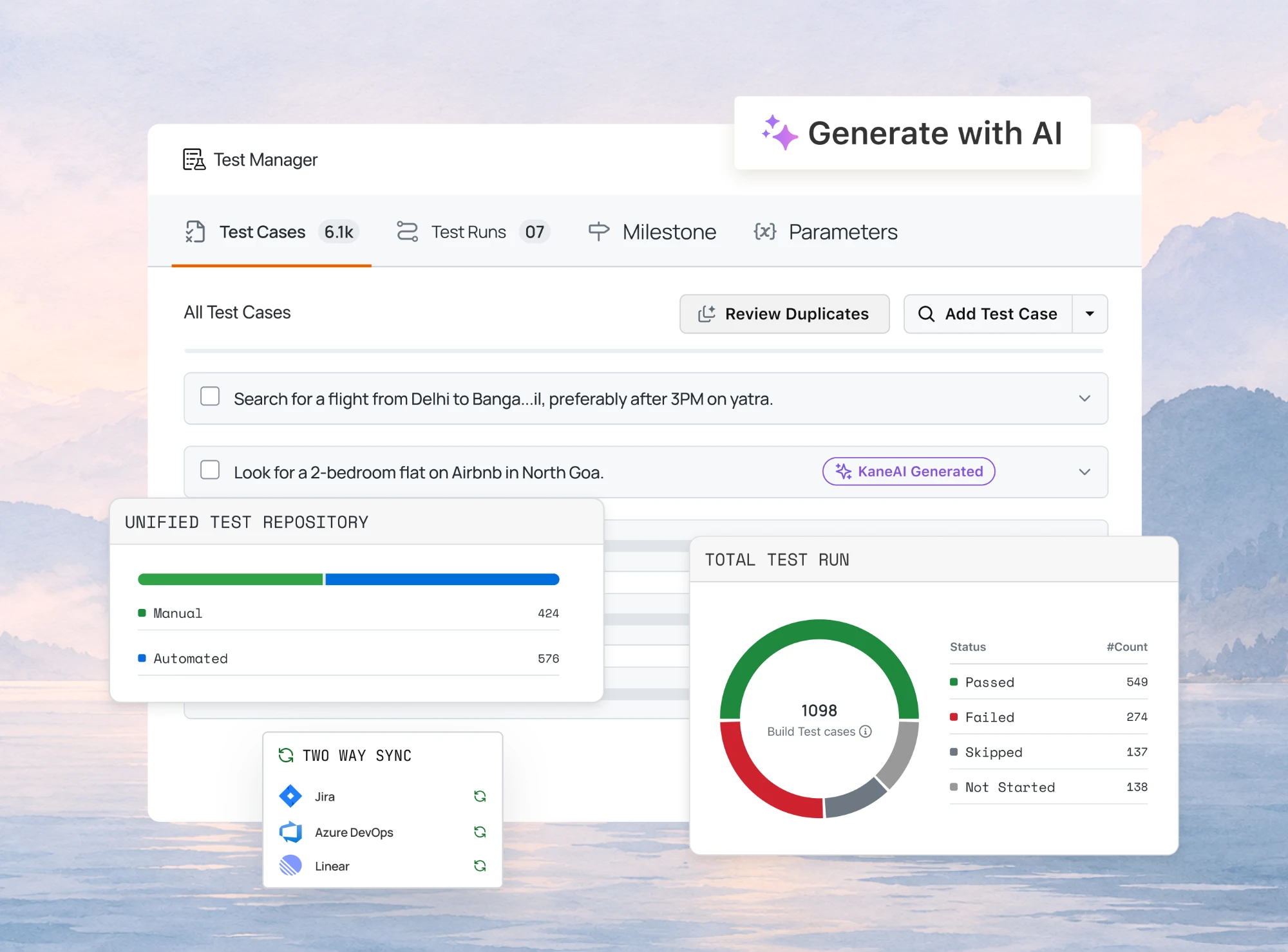
TestMu AI Test Manager is AI-native test management software that works next to Jira rather than inside it, keeping test cases, plans, runs, and requirement traceability in one workspace.
- Pricing - a Free plan with unlimited projects and test runs; Premium at $49 per seat a month billed annually, or $59 month to month, with 2,000 AI credits per user a month; Enterprise is quoted, per TestMu AI pricing.
- Two-way Jira and Azure DevOps - a failed step logs a defect with steps, environment, and attachments, status syncs back to the linked case, and QA can manage cases and view cycle status from inside Jira.
- AI test case generation - turns text, PDFs, audio, video, images, Gherkin scenarios, and Jira tickets into structured cases, with 2,000 complimentary AI credits per user per month on Test Manager Premium.
- Audit and access - an audit trail of every create, update, delete, and execution, role-based access at organization, project, and folder level, SAML and OIDC single sign-on, and SOC 2 Type II and ISO 27001 certification.
- Manual and automated in one cycle - pipeline results from Jenkins, GitHub Actions, and GitLab CI map to the same cases, and Real-Time Testing sessions launch from a case.
Best for: Jira teams that want test management, AI generation, and test execution on one platform. A Free Forever plan covers unlimited projects; AI generation needs Premium.
Limitations: there is no QMetry-specific importer, so cases arrive by CSV, and I found no e-signature approval workflow in TestMu AI's documentation, so regulated teams should confirm sign-off requirements first.
2. Xray
Xray is the closest like-for-like replacement for QMetry Test Management for Jira: a Jira-native app in which Tests, Preconditions, and Test Sets are Jira issues, next to Test Plans and Test Executions.
- Pricing - sold on the Atlassian Marketplace at $10 a month for up to 10 Jira users on Cloud, then per-user tiers that follow the Jira site's user count; Data Center lists $3,306 a year for 50 users, per the Marketplace API on October 23, 2026.
- BDD - Cucumber and Gherkin scenarios, with JUnit XML, Cucumber, and Xray JSON results imported through the REST API.
- AI - AI test case and script generation, with capabilities that depend on the Xray tier (Standard, Advanced, or Enterprise); Xray MCP is in closed beta.
- Exploratory - the Xray Exploratory App, a desktop app and web console.
- Imports - the Test Case Importer takes CSV or JSON files, so a QMetry Excel export goes in as CSV.
Best for: Jira teams that want tests stored as Jira issues and strong BDD support.
Limitations: it runs only on Jira Cloud or Data Center, and there is no free plan, only a 30-day Marketplace trial.
3. Zephyr
Zephyr is SmartBear's other Jira test management family, now consolidated from the former Zephyr Squad and Zephyr Scale into Zephyr Essential, Zephyr, and Zephyr Advanced.
- Pricing - sold on the Atlassian Marketplace and priced on every user in the Jira site: $10 a month for up to 10 users on Cloud, and $4,760 a year for 50 users on Data Center, per the Marketplace API on October 23, 2026.
- Jira-native structure - test cases, cycles, plans, and folders inside Jira Cloud or Data Center.
- Automation - Gherkin BDD cases, JUnit and Cucumber integrations, and no-code record-and-play on the Zephyr and Zephyr Advanced editions.
- AI and MCP - SmartBear Halo AI, a Zephyr Agent for Rovo, and SmartBear MCP in local and remote versions on some editions.
- Imports - the Cloud edition imports CSV, Excel through CSV, and XML from other Zephyr instances.
Best for: Jira teams that want to stay with SmartBear and its MCP tooling while changing apps.
Limitations: it rates lower on Jira Cloud than QMetry and Xray in the Marketplace data below, and there is no free plan, only a 30-day Marketplace trial.
4. TestRail
TestRail is a standalone test management tool from Gurock, now a Sembi brand, that connects to Jira Cloud, Server, and Data Center instead of running inside it.
- Pricing - no free plan; Essentials at $22 per user a month for up to 5 users (Cloud only), Professional at $38, and Enterprise at $78, all billed annually, as listed on TestRail's pricing page on October 23, 2026.
- QMetry migration guide - TestRail's help center walks through moving QMetry for Jira Cloud cases by Excel export and CSV import, mapping steps, preconditions, and folders.
- Cloud or server - TestRail Cloud with US, EU, or APAC data residency, or TestRail Server on Windows, Linux, or Docker on the Professional and Enterprise plans.
- TestRail AI - AI test case generation, test script generation, and test prioritization, plus a TestRail MCP Server in closed beta, all on TestRail Cloud; TestRail Server has none of these yet, and a local MCP server for it is planned for Q4 2026.
- Automation upload - the open-source TestRail CLI uploads JUnit, TestNG, NUnit, Cypress, and Playwright results.
Best for: teams moving test management out of Jira that want a documented path from QMetry.
Limitations: no permanent free plan, only a 30-day trial, and the QMetry guide covers QMetry for Jira Cloud only and leaves attachments and historic test runs behind.
5. Tricentis qTest
qTest is the enterprise test management platform from Tricentis, which its product page describes as AI-powered, agentic test management for teams that ship at AI speed.
- Pricing - Tricentis publishes no qTest price on its product page, which offers a free trial and a demo instead (checked October 23, 2026).
- Agentic test creation - agents generate and reuse test cases from requirements, and teams can work through AI Chat or any MCP-compatible AI assistant.
- Governance - traceable audit trails and standardized AI governance across the testing toolchain.
- Enterprise scale - reusable test steps and cross-portfolio orchestration for large, distributed programs.
- Integrations - open integrations with CI/CD, APM, and DevOps tools, including synchronization with Jira.
Best for: large regulated programs that used QMetry's standalone edition for governance.
Limitations: it is built for enterprise programs, so small teams will find it heavier than they need.

6. PractiTest
PractiTest is a cloud-only test management platform, founded in 2008, that covers requirements, scripted, BDD, and exploratory tests, test sets and runs, and issues.
- Pricing - no free plan; Team at $40 to $49 per user a month on yearly packs of 5 to 40 testers, or a flat $270 a month for up to 5 users billed monthly; Corporate is quoted, as listed on PractiTest's pricing page on October 23, 2026.
- Jira sync - two-way or one-way sync with Jira Cloud, Server, and Data Center.
- Exploratory testing - exploratory tests with charters and guide points.
- CI results - FireCracker uploads XML reports from CI.
- AI and MCP - the SmartFox AI assistant, in beta, and an official remote MCP server on the Corporate plan.
Best for: QA teams that want structured exploratory testing and two-way Jira sync without a Jira app.
Limitations: cloud only, with US, EU, and AU data centers, no free plan beyond a 14-day trial, and MCP reserved for the top plan.
7. Testmo
Testmo, branded Testmo by Sembi, keeps test case management, exploratory sessions, and automated test runs in one cloud tool.
- Pricing - no free plan; Team at $59 a month for 5 users or $99 for 10, Business from $249 a month for 15 users, and Enterprise from $599 a month for 25 users, as listed on Testmo's pricing page on October 23, 2026.
- One run history - manual cases, first-class exploratory sessions, and automated runs share milestones and reports.
- CI results - the Testmo CLI submits results in JUnit XML format.
- Jira - a Jira app, now built on Atlassian Forge, that Testmo describes as full two-way.
- Imports - CSV and Excel, TestRail XML, and the API; the Testmo MCP, in closed beta, includes a Case Importer skill.
Best for: teams that want manual, exploratory, and CI results in one place outside Jira.
Limitations: Testmo's pricing page says "We do not offer an on-premise server edition at this time", and there is no free plan, only a free trial.
8. Allure TestOps
Allure TestOps, from Qameta Software, is automation-first test management with a central repository, manual scenarios, test plans, and launches that collect CI results.
- Pricing - $39 per user a month for Cloud or On-premise, with volume pricing for larger teams, as listed on Qameta's pricing page on October 23, 2026.
- Hosting - cloud or on-premise on Kubernetes or Docker Compose.
- Results - accepts JUnit XML, Cucumber JSON, and xUnit XML next to Allure reports, through the allurectl CLI or CI plugins.
- Jira - an issue tracker integration plus the Marketplace app "Allure TestOps for Jira", which embeds panels in issues.
- MCP - a built-in MCP server with 13 tools, in public beta.
Best for: teams whose QMetry use centered on automated runs from TestNG, Cucumber, or JUnit.
Limitations: Qameta's site names no AI test generation feature, and there is no free plan, only a 14-day cloud or 30-day on-premise trial.
9. Testiny
Testiny, from Mategra GmbH, is a lightweight test management tool for manual test cases, plans, runs, and automation results, with an optional Jira app.
- Jira - a Marketplace app for a two-way integration that shows linked cases and results inside Jira Cloud and Data Center.
- Pricing - Starter at $15.42 per user a month billed yearly (up to 25 users), Business at $17.08, and Enterprise at $25.00, as listed on Testiny's pricing page on October 23, 2026.
- Free plan - up to 3 users, plus a 21-day trial of paid plans.
- Hosting - EU cloud, or Testiny Server on-premises via Docker or Kubernetes on the Enterprise tier.
- Automation and MCP - the Testiny CLI imports JUnit, TestNG, Playwright, Cypress, and Vitest results, and an MCP server comes with paid and trial plans.
Best for: smaller teams that find QMetry heavier than they need.
Limitations: its migration guides cover Qase, TestLink, TestRail, Xray, and Zephyr but not QMetry, and Testiny Server sits on the Enterprise tier.
How Did I Rank These Tools?
I ranked each tool on what QMetry users rely on today: Jira depth, audit and approval controls, BDD and automation results, AI and MCP access, a migration path out of QMetry, and hosting choices.
- Jira depth - native Jira app, two-way sync, or one-way issue linking.
- Audit and approvals - audit trails, role-based access, and sign-off workflows for regulated teams.
- BDD and automation - Gherkin support and JUnit XML, Cucumber, or TestNG results mapped to test cases.
- AI and MCP - named AI test design features and an MCP server an assistant can call.
- Migration and hosting - a documented route from a QMetry export, and cloud, data center, or self-hosted options.
I checked every claim about a named tool on that vendor's own site, documentation, or Marketplace data on October 22 and 23, 2026, and quoted prices only for QMetry and TestMu AI. TestMu AI publishes this article and ranks first on AI-native test management; Xray is the closest like-for-like swap, and each entry lists its limits. The reviewer, Abhishek Mishra, is the Technical Product Manager who owns TestMu AI Test Manager.
How Much Does QMetry Cost?
QMetry pricing depends on the edition. The Jira app is free on Jira Cloud for up to 10 users, then $4.18 per user a month for users 11 to 100 on monthly billing (about $3.48 on annual billing), while SmartBear quotes the standalone QMetry Test Management on request.
The Jira prices below are as listed on QMetry's Atlassian Marketplace pricing page on October 23, 2026. Atlassian bills a cloud app at the user tier of the whole Jira site, so every Jira user counts, not only testers. SmartBear's own QMetry pricing page shows a contact form instead of prices. I computed the per-user column from the published annual tiers:
| Jira site users | Jira Cloud, per year | Cloud cost per Jira user a year | Jira Data Center, per year |
|---|---|---|---|
| Up to 10 | $0 | $0 | No tier below 50 users |
| 25 | $1,045 | $41.80 | No tier below 50 users |
| 50 | $2,090 | $41.80 | $1,822 |
| 100 | $4,180 | $41.80 | $4,099 |
| 500 | $10,420 | $20.84 | $10,475 |
From 15 to 100 users the cloud app works out to a flat $41.80 per Jira user a year, falling to $20.84 at 500 users. For other tools with a free tier, see the guide to free test management tools.
What Are QMetry's Key Features?
QMetry's key features are AI test case generation, flaky test detection, Git-synced BDD authoring, a Chrome extension for exploratory testing, automation result imports, and traceability reports for Jira projects.
- AI test case generation - QMetry Intelligence generates functional test cases and steps from a Jira story or the Test Case module, in English, Spanish, German, or French.
- Flaky test detection - a Flaky Score calculated from each case's execution history flags tests whose next result cannot be predicted.
- BDD - a Gherkin editor on the Jira story syncs feature files both ways with GitHub, GitLab, or Bitbucket, in the cloud or self-hosted.
- Exploratory testing - a Chrome extension records every action in a session and logs a defect with screenshots in one click.
- Automation results - QMetry imports results from Cucumber, TestNG, JUnit, HP UFT, QAF, and SpecFlow, including Selenium and Appium runs reported through them.
- Traceability - traceability reports trace requirements to test cases, cycles, plans, and defects across one or more projects.
What Do Users Like and Dislike About QMetry?
Users like QMetry's responsive support, ease of use, and fit inside Jira. Their complaints center on a learning curve, reports that need refinement, and slow support replies at times, per Marketplace reviews.
These themes come from the 189 public Jira Cloud reviews on QMetry's Atlassian Marketplace reviews page, which I read on October 23, 2026. Most reviews are positive and were written between 2021 and 2023, so recent comments deserve more weight.
- Liked: support - 65 of the 189 reviews mention support, and several name the person who helped with setup or a demo.
- Liked: ease of use - more than 40 reviews use phrases such as easy to use, user friendly, or intuitive.
- Liked: Jira fit - reviewers value working inside Jira, reusable test cases, and ready-made reports.
- Disliked: learning curve - a 2023 review cites "the learning curve, limited test automation integration, and lack of advanced features", and another says the many options take time to learn.
- Disliked: reports and support speed - a 2024 review says reporting "needs some more refinement", and a January 2026 reviewer wrote that they were starting to look at other applications if they could not get support.
- Outdated complaint - a 2023 review cites an Open API cap of 2,500 calls an hour; QMetry's current API call limit page lists 10,000 an hour per Jira instance.
Which Integrations and Deployment Options Does QMetry Offer?
QMetry runs as a Jira app on Jira Cloud or Data Center, or as a standalone platform on cloud or server. It links to CI/CD tools, Git hosts for BDD, Confluence, Atlassian Rovo, and Azure DevOps pipelines.
- Jira Cloud - new installations can keep data in the US, Australia, or Germany through QMetry's data residency support.
- Jira Data Center - a self-managed edition, priced on the Marketplace from 50 users.
- Standalone - QMetry Test Management on cloud or server, with hosting in the European Union for compliance needs.
- CI/CD - CI/CD rules trigger Jenkins, Bamboo, CircleCI, GitHub Actions, GitLab, and Azure DevOps jobs from a test cycle, and results return through plugins or the REST API.
- Atlassian apps - a Confluence app embeds QMetry assets and charts in pages, and the QTM4J Agent for Rovo answers coverage, defect, and release readiness questions in plain language.
Why Do Teams Look for a QMetry Alternative?
Teams look for a QMetry alternative when Jira-wide licensing outgrows the testing team, when testers find the interface heavy, or when they want test management and test execution from a single vendor.
- Jira-wide licensing - the Jira app is licensed by the Jira site's user tier, and Atlassian's Marketplace licensing page says cloud apps "naturally match the tier of the host product", so the bill follows every Jira user, not just testers.
- Execution lives elsewhere - QMetry manages tests and connects to "various device clouds" for running them, so teams that want authoring, management, and execution from one vendor compare platforms that include a cloud grid.
- Two apps, one vendor - since December 2024, SmartBear sells both QMetry and Zephyr for Jira, so a renewal is a natural point to compare the two with independent tools.
How Do QMetry, Xray, and Zephyr Compare Inside Jira?
QMetry, Xray, and Zephyr all keep test cases and BDD scenarios inside Jira. They differ in vendor, test model, AI, and ratings: SmartBear owns QMetry and Zephyr, and QMetry rates highest on Jira Cloud.
To compare satisfaction on equal terms, I pulled the Jira Cloud ratings for the Jira-native apps straight from the public Atlassian Marketplace API on October 22, 2026:
| Jira app | Marketplace vendor | Jira Cloud rating | AI | MCP server |
|---|---|---|---|---|
| QMetry (QTM4J) | SmartBear Software | 4.65 from 189 reviews | AI-driven authoring, flaky test detection, defect triage | Not named on the product page |
| Xray | Xblend | 4.10 from 333 reviews | AI test case and script generation | Closed beta |
| Zephyr | SmartBear | 3.92 from 381 reviews | SmartBear Halo AI, Zephyr Agent for Rovo | SmartBear MCP, some editions |
QMetry has the best Jira Cloud rating of the group, so a move away from it should be driven by a specific gap, such as licensing, execution, or test management outside Jira, rather than by satisfaction scores. The guide to Jira test management tools compares more Jira apps on the same terms.
QMetry vs TestRail
TestRail runs outside Jira, with cloud or server editions, while QMetry for Jira runs inside it. TestRail also publishes a help center guide for moving QMetry for Jira Cloud cases across, by Excel export and CSV import.
QMetry vs qTest
Both target regulated enterprises: QMetry with e-signature approval workflows developed in line with 21 CFR Part 11, and Tricentis qTest with traceable audit trails and AI governance. qTest is a standalone platform that synchronizes with Jira; QMetry for Jira lives inside it.
How Does QMetry Compare With TestMu AI?
QMetry keeps tests inside Jira and is free for up to 10 Jira users. TestMu AI Test Manager, our product, is AI-native test management beside Jira, with a free plan, AI test case generation on Premium, and two-way Jira sync.
| Criteria | QMetry for Jira | TestMu AI Test Manager |
|---|---|---|
| Pricing entry point | $4.18 per user a month on monthly billing, or about $3.48 on annual billing, on Jira Cloud above 10 users, counted on every Jira user | Premium at $49 per seat a month billed annually, or $59 month to month |
| Free plan | Free on Jira Cloud for up to 10 users | Free plan with unlimited projects and test runs |
| AI generation | QMetry Intelligence generates cases and steps from Jira stories | Generates cases from text, Jira, Azure DevOps, and Linear issues, PDFs, images, audio, and video on Premium |
| Jira | Native Jira app; tests live in Jira | Two-way Jira and Azure DevOps integration, plus a free Jira Cloud app |
| Hosting and deployment | Jira Cloud, Jira Data Center, or standalone cloud or server | Cloud, with an isolated private cloud option on Enterprise |
| Test execution | Triggers CI/CD jobs and imports their results | Runs tests on TestMu AI real browsers and 50,000+ real devices, on separate execution plans |
Keep tests in QMetry when they must live inside Jira, and consider TestMu AI Test Manager when you want AI-native test management with two-way Jira sync. The guide to the best test management tools compares a wider field.
How Do You Migrate From QMetry to Another Tool?
Export QMetry test cases to Excel, save the file as CSV, map the QMetry columns to the new tool's fields, and archive execution history separately, because CSV imports carry test cases, not historic runs.
TestRail's QMetry migration guide documents the export from QMetry for Jira Cloud and the columns it produces, and the same file works for any tool with a CSV importer, TestMu AI included:
- Export - in the Test Case module, select the All Test Cases section, right-click it, and choose Export to Excel (.xlsx), then save the workbook as CSV.
- Create fields first - add custom fields for anything without a match, such as a "QMetry Key" field, before the import starts.
- Import - in TestMu AI, import test cases from CSV: files up to 10 MB, in a single-row or multi-row layout, mapped field by field as shown below.
- Check the preview - Test Manager counts the cases to be created, updated, or skipped before anything is written, and skipped rows download with a reason for each.
- Archive runs - keep a record of QMetry execution history before the subscription ends, because historic test runs and attachments do not move through a CSV import.
| QMetry export column | TestMu AI Test Manager field |
|---|---|
| Summary | Title (the one mandatory mapping) |
| Folder | Folder, with a delimiter to split nested paths |
| Priority | Priority, a system field whose values are mapped in the Map values step |
| Step Summary | Steps |
| Expected Result | Outcome |
| Precondition, Status | A matching system field or a custom field created before import |

Note: TestMu AI Test Manager previews every CSV row before it writes anything, then generates new test cases from Jira tickets with AI so the migrated suite keeps growing. Start free with TestMu AI
When Should You Keep QMetry?
Keep QMetry if your Jira team is satisfied with it, relies on its e-signature and approval workflows, or fits its free Jira Cloud tier for up to 10 users. A switch then costs a migration without a clear gain.
- Regulated sign-offs - SmartBear's acquisition announcement lists approval workflows and e-signature capabilities; confirm an equivalent in any replacement before you move a validated process.
- Small Jira teams - QMetry Test Management for Jira costs nothing on Jira Cloud up to 10 users.
- High satisfaction - its Jira Cloud rating of 4.65 is the highest of the Jira-native apps compared above.
- Cloud runs for existing scripts - teams that build automated tests in QMetry can run them on TestMu AI's cloud Selenium grid through the QMetry integration, without changing test management tools.
Which QMetry Replacement Should You Try First?
Start from what you want to change: Xray to stay Jira-native, TestRail or PractiTest to move test management out of Jira, and TestMu AI Test Manager for AI-native test management with AI test case generation and two-way Jira sync.
Then export one QMetry folder and trial-import it into your first choice among these QMetry alternatives before you commit. For TestMu AI, the Test Manager documentation covers projects, AI generation, and runs; you can start on the Free Forever plan, and TestMu AI's pricing page lists CSV import, which a QMetry move uses, under Premium.
Author

Bhavya Hada
Blogs: 30


Bhavya Hada is a Community Contributor at TestMu AI with over three years of experience in software testing and quality assurance. She has authored 20+ articles on software testing, test automation, QA, and other tech topics. She holds certifications in Automation Testing, KaneAI, Selenium, Appium, Playwright, and Cypress. At TestMu AI, Bhavya leads marketing initiatives around AI-driven test automation and develops technical content across blogs, social media, newsletters, and community forums. On LinkedIn, she is followed by 4,000+ QA engineers, testers, and tech professionals.
Reviewer

Abhishek Mishra
Reviewer
Abhishek Mishra is a Technical Product Manager at TestMu AI, where he owns Test Manager, the test management product. He has over 8 years of experience in product management and market analysis. His expertise spans across AI-native software testing, product strategy, and analytics. Previously, Abhishek served as the Product Lead at IndiaClan and co-founded Gartley618 Technologies, where he led innovative projects in quantitative trading and blockchain. He holds a B.Tech degree.
QMetry Alternatives FAQs
Did you find this page helpful?
More Related Blogs



TestMu AI forEnterprise
Get access to solutions built on Enterprise
grade security, privacy, & compliance
- Advanced access controls
- Advanced data retention rules
- Advanced Local Testing
- Premium Support options
- Early access to beta features
- Private Slack Channel
- Unlimited Manual Accessibility DevTools Tests