

Next-Gen App & Browser Testing Cloud
Trusted by 2 Mn+ QAs & Devs to accelerate their release cycles


20 Best Software Testing Tools for QA [2026]
Explore various software testing tools that consist of both functional testing tools and non-functional testing tools, offering comprehensive solutions to enhance your testing endeavors.

Supriya Singh
March 26, 2026
Software testing is the process of determining whether or not a software product fulfills the expected requirements and ensures that it is free from defects. To evaluate user-relevant attributes, software components are tested either manually or automatically. The purpose of software testing is to identify errors, gaps, or missing requirements when compared to the actual requirements of the product being tested.
In this article, we will delve into the world of software testing tools through which software testing is performed. Then, we will briefly discuss the importance of software testing. We will also explore a comprehensive list of the 20 best software testing tools available in the market, highlighting their features.
Overview
Software testing tools are applications that help automate tests, manage data, and find defects to ensure software quality. They support various testing types, improving efficiency and accuracy. These tools reduce manual effort and enable faster feedback. They’re essential for delivering reliable, high-quality software quickly.
Types of Software Testing Tools
- Functional Testing Tools
- Performance Testing Tools
- Security Testing Tools
- Test Management Tools
Best Software Testing Tool
TestMu AI is an AI-native platform for scalable manual and automated testing across 10,000+ real devices and browsers. It supports tools like Selenium, Cypress, and Appium, with real-time interactive and visual testing.
Factors to Consider While Choosing The Right Testing Tools
- Compatibility with your tech stack and platforms.
- Ease of use and learning curve for your team.
- Integration with CI/CD pipelines and other tools.
- Support for automation, reporting, and analytics.
- Licensing costs and community or vendor support.
- Scalability to handle future project needs.
Importance of Selecting the Right Software Testing Tool
- Improved Quality: Detects defects early, leading to fewer bugs and better product stability.
- Increased Efficiency: Automates repetitive tasks, saving time and effort.
- Faster Time to Market: Speeds up release cycles through streamlined testing.
- Better User Experience: Ensures a reliable product that meets user expectations.
- Reduced Costs: Lowers expenses by minimizing manual testing and post-release bug fixes.
- Adaptability: Supports evolving technologies and changing project requirements.
- Enhanced Collaboration: Facilitates teamwork between QA, developers, and stakeholders.
Future Trends in Software Testing Tools
AI and machine learning are driving intelligent automation and predictive defect analysis. Cloud platforms enhance scalability and collaboration, while continuous testing embeds seamlessly into DevOps. Support is expanding for microservices, APIs, and IoT, and visual/codeless tools are rising for faster, more accessible testing.
What are Software Testing Tools?
Software testing tools are specialized software applications or programs designed to assist in various aspects of the software testing process. They provide a structured framework and features that facilitate the creation, execution, and management of test cases and test results analysis. Software testers and quality assurance professionals use these tools to automate and enhance testing activities.
Software testing tools generally fall into two categories based on the types of testing they support, i.e., functional testing tools and non-functional testing tools. These tools help testers ensure the software is up to quality standards, has no defects and bugs, and gives users a good experience.
Why Is It Important to Select the Right Software Testing Tool?
Selecting the right tool improves efficiency, accuracy, and test coverage while reducing costs and enabling faster defect detection throughout the development lifecycle.
Selecting the right testing tools has significant importance in the software development life cycle for several key reasons:
- Efficiency and Productivity: The right software testing tool streamlines the testing process, automating repetitive tasks and reducing the manual effort required. This increases efficiency and productivity, allowing testers to focus on more complex and critical aspects of testing.
- Reliability and Consistency: When selecting suitable software testing tools, ensure accurate and reliable results. This will eliminate errors that often crop up during manual testing and enhance the dependability of your test outcomes.
- Efficient Resource Utilization: The right software testing tools can save costs by reducing testing time and resources. Automated tools, for instance, speed up test execution and catch bugs early, cutting down the expenses of fixing issues later in the development cycle.
- Time Savings: Automated testing tools drastically reduce the time needed for regression and load-testing tasks. This accelerates testing cycles, resulting in faster overall development.
- Security and Compliance: Specialized tools designed for security and compliance testing pinpoint vulnerabilities and ensure your software adheres to industry regulations.
What Are the Types of Software Testing Tools?
Software testing tools are categorized into two main types: Functional Testing Tools that verify correct functionality, and Non-Functional Testing Tools for performance and security.
QA testing tools generally fall into two categories based on the types of testing they support, i.e., Functional Testing Tools and Non-Functional Testing Tools.
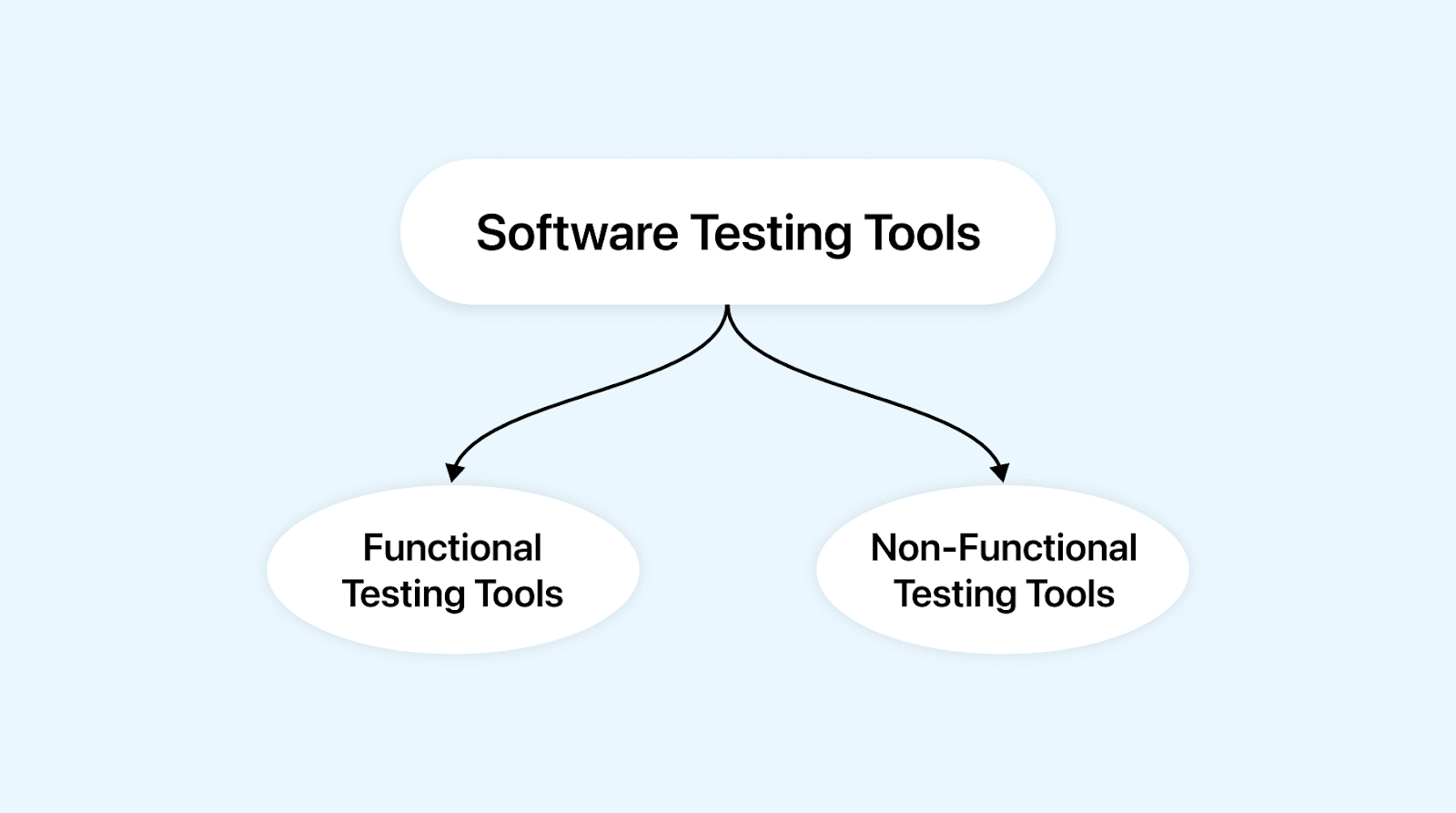
Functional Testing Tools:
Functional testing tools are specially designed software tools or programs that check whether the software performs its intended tasks correctly and accurately. These tools automate testing specific features and behaviors to ensure correct functionality.
Non-Functional Testing Tools
Non-functional testing tools are software applications designed to assess and evaluate the attributes of a software system that go beyond its specific functionalities. These tools focus on performance, security, usability, compatibility, reliability, or other non-functional characteristics that contribute to the overall user experience and software quality.
What Are the Best 20 Software Testing Tools for QA?
Top QA tools include TestMu AI, Selenium, Appium, Cypress, Playwright, Puppeteer, TestNG, JUnit, Jest, pytest, and others for web, mobile, and API testing.
With so many software testing tools available in the market, choosing the best tool can be a challenge. We have simplified things for you by putting together a list of 20 software testing tools. Each tool has unique strengths and capabilities designed to cater to diverse testing needs. Let's discuss the features of these software testing tools in detail:
- TestMu AI
- Selenium
- Appium
- Cypress
- Cucumber
- Espresso
- Nightwatch.js
- JUnit
- WebdriverIO
- Watir
- Puppeteer
- Playwright
- TestNG
- XCUITest
- PHPUnit
- Jest
- pytest
- NUnit
- Jasmine
- Mocha
1. TestMu AI
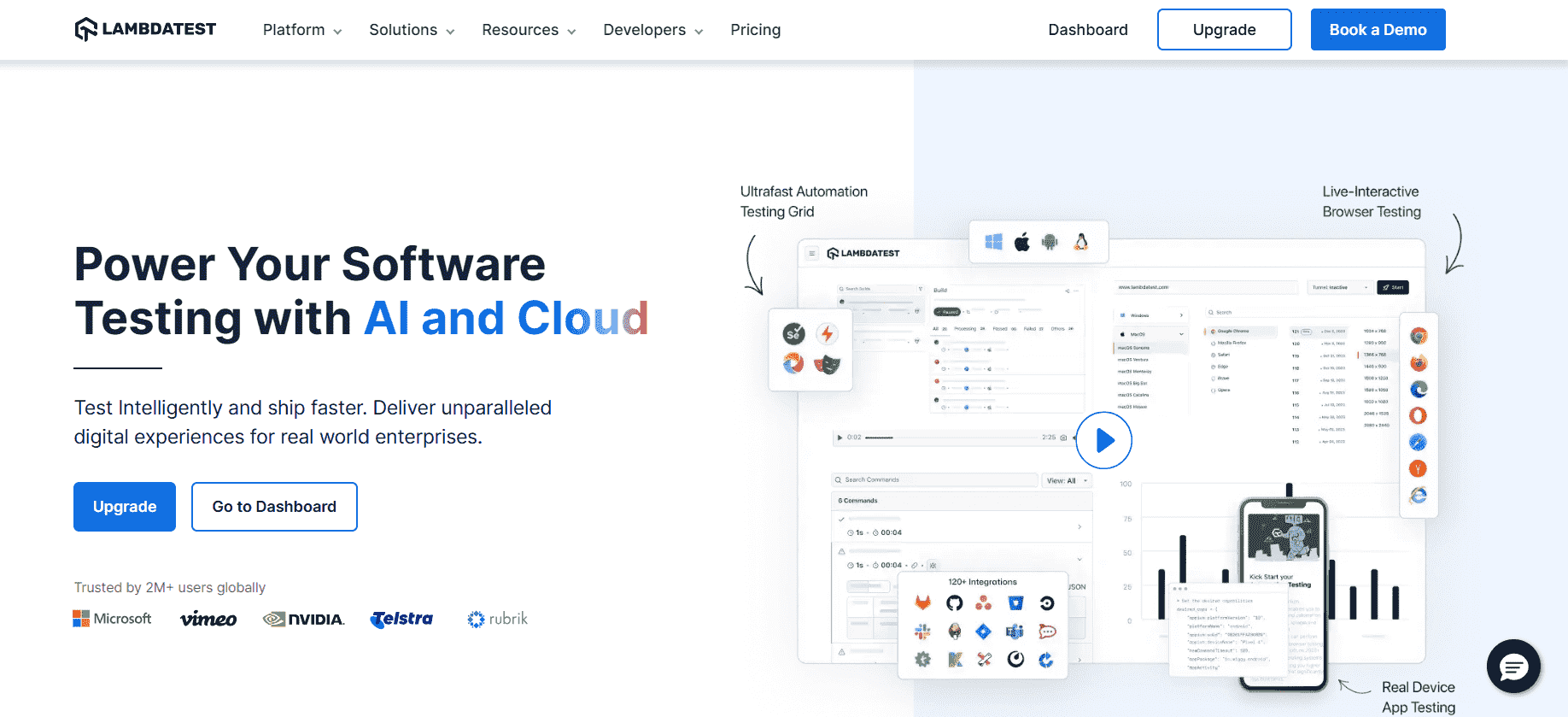
TestMu AI is an AI-native test orchestration and execution platform that lets you run manual and automated tests at scale on over 10,000 real devices, browsers, and OS combinations. TestMu AI supports a wide array of automation testing frameworks and tools for both web and mobile app testing, It integrates smoothly with Selenium, Cypress, Playwright, Puppeteer, Taiko, Appium, Espresso, XCUITest, and more.
Features of TestMu AI
- Supports real-time testing for both mobile and desktop.
- Enables users to run automated and manual tests on various browsers.
- Capture bugs and issues directly during testing.
- Testers can identify layout issues, functionality glitches, and performance variations arising from differing rendering on various platforms.
- Provides interactive testing for real-time user interaction and screenshot testing to catch visual disparities across environments.
- Adapts to fluctuating testing demands effortlessly.
- Geolocation Test with GPS and IP for location-based testing scenarios.
- Offers integration with collaboration tools for CI/CD, Project Management, Codeless Automation, and more.
2. Selenium
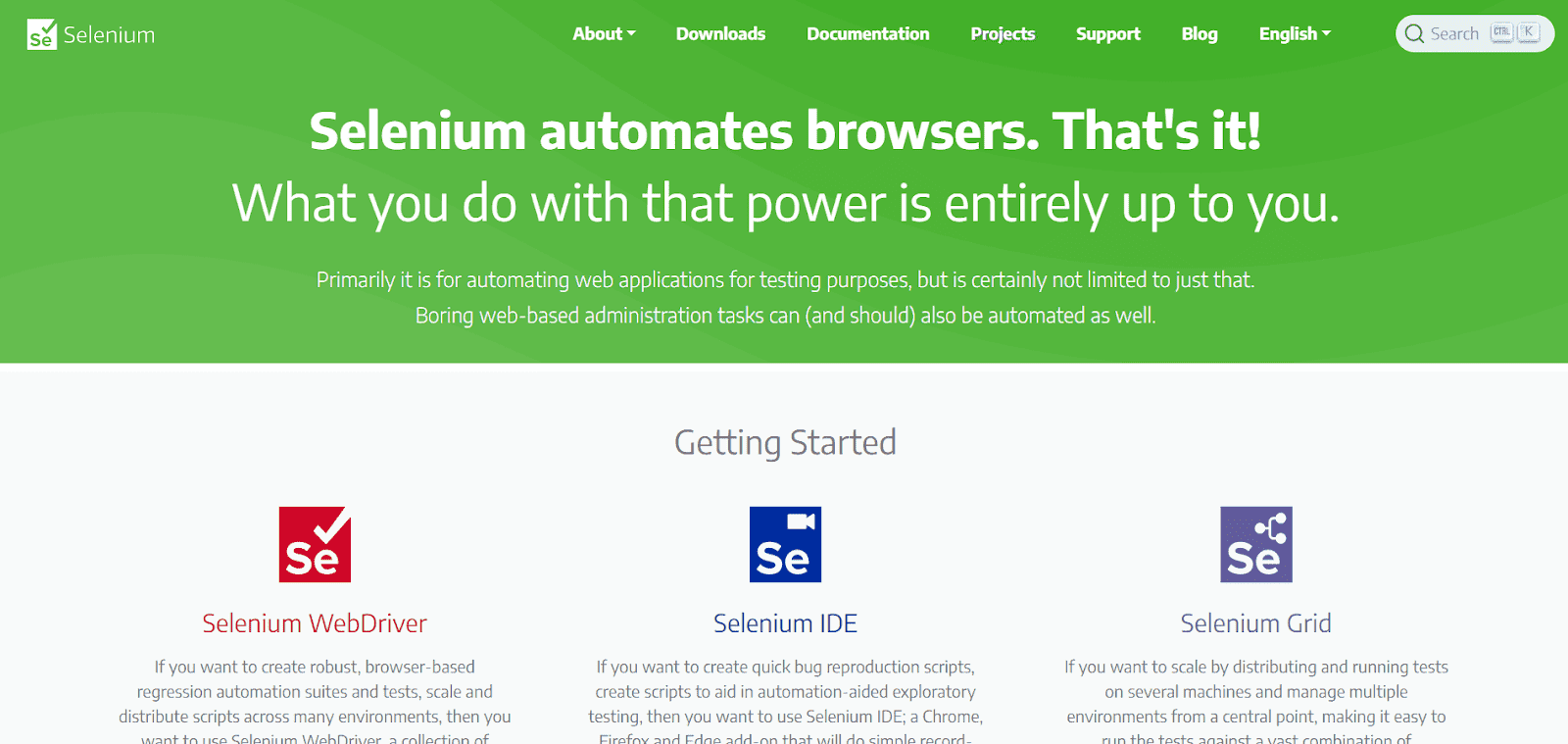
Selenium, a popular open-source suite of tools for web browser automation, has been a reliable choice since 2004. The Selenium suite consists of 3 components: Selenium IDE, Selenium WebDriver, and Selenium Grid. Selenium IDE, a browser extension, enables users to record and replay interactions. Selenium WebDriver offers a robust and adaptable API designed for automating web browsers. Selenium Grid facilitates the parallel execution of tests across multiple machines.
Features of Selenium
- Cross-browser Compatibility.
- Supports multiple platforms.
- Supports parallel testing.
- Dynamic Web Element Handling.
- Strong Community Support.
- Offers record and replay facilities.
- Relieving teams from the burden of repetitive manual testing.
- Efficiently executing recurring tests is a crucial aspect of regression suites.
- Its automation capability proves indispensable for swiftly adapting to code changes and complexities.
- Easy integration with cloud-based testing platforms like TestMu AI with the help of the RemoteWebDriver class.
3. Appium
Appium is an open-source UI automation testing framework designed to test native, hybrid, and web mobile apps for Android, iOS, and Windows platforms. Appium simplifies mobile app testing to accommodate various operating systems and devices by eliminating the need for code modification. It supports a wide range of applications, allowing seamless testing on both iOS and Android platforms using real devices.
Features of Appium
- Supports mobile app testing on both Android and iOS devices.
- Built-in support for popular mobile gestures and interactions.
- Seamlessly integrates with cloud-based testing platforms.
- Supports multiple programming languages, including Python, Java, C#, Ruby, Perl, etc.
- Simplifies mobile app element inspection via its GUI-based Appium Inspector, akin to website element inspection, enhancing testing efficiency.
4. Cypress
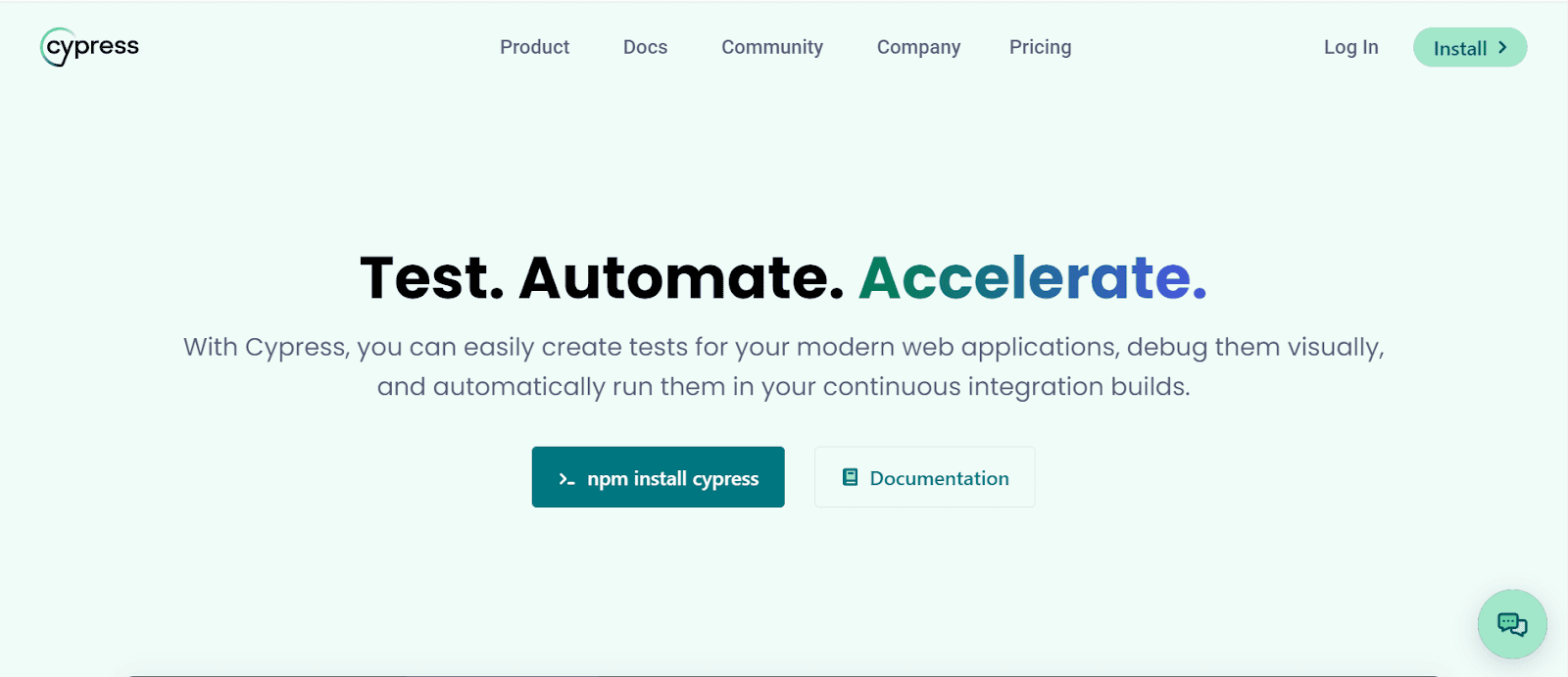
Cypress is one of the modern and popular test automation tools for front-end developers. It is written in JavaScript and built on top of Selenium WebDriver and Node.js. Cypress supports almost all modern browsers like Google Chrome, Mozilla Firefox, MS Edge, Opera, and Safari. It is considered a fast, reliable, and simple to use software testing tool. Cypress is also open source.
If you are confused between Cypress and Selenium check out our detailed comparison of Cypress vs Selenium.
Features of Cypress
- It supports snapshot testing, capturing UI component snapshots for detecting visual regressions.
- Interact and control the application in real time as it supports automatic waiting.
- Cross-browser compatibility.
- It operates directly within the browser.
- Offers easy test scripting and result visualization with its user-friendly interface.
- Helps to discover and diagnose unreliable tests with Cypress Cloud’s Flaky test management.
- Simplified debugging directly from Developer Tools, with detailed error display and stack traces.
- Captures browser window screenshots automatically on failure and records video executions via the command-line interface (C.L.I.).
- Supports JavaScript exclusively.
5. Cucumber
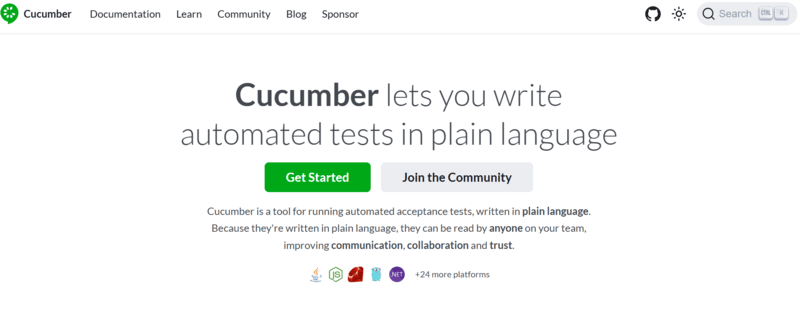
Cucumber is a popular software testing tool that promotes Behavior Driven Development (BDD). BDD allows tests to be written in a language understandable to non-technical users. With the help of BBD, product owners, and business analysts can create acceptance tests or scenarios to test real-world business interactions. This approach ensures that the software functions in alignment with business requirements and expectations.
The fusion of Selenium and Cucumber forms a robust framework, simplifying the creation of software tests. This combination offers seamless integration and facilitates the development of efficient and effective test suites with ease.
Features of Cucumber
- Utilizes Gherkin, a human-readable language, for defining test cases where each case is usually defined within a feature file with the “.feature” extension.
- Seamlessly integrates multiple application layers—front end, back end, and database.
- Supports multiple programming languages like Java, Ruby, Python, and more.
- Allows the use of data tables in test scenarios for testing with different input sets for comprehensive coverage.
- Generates a comprehensive post-execution report.
6. Espresso
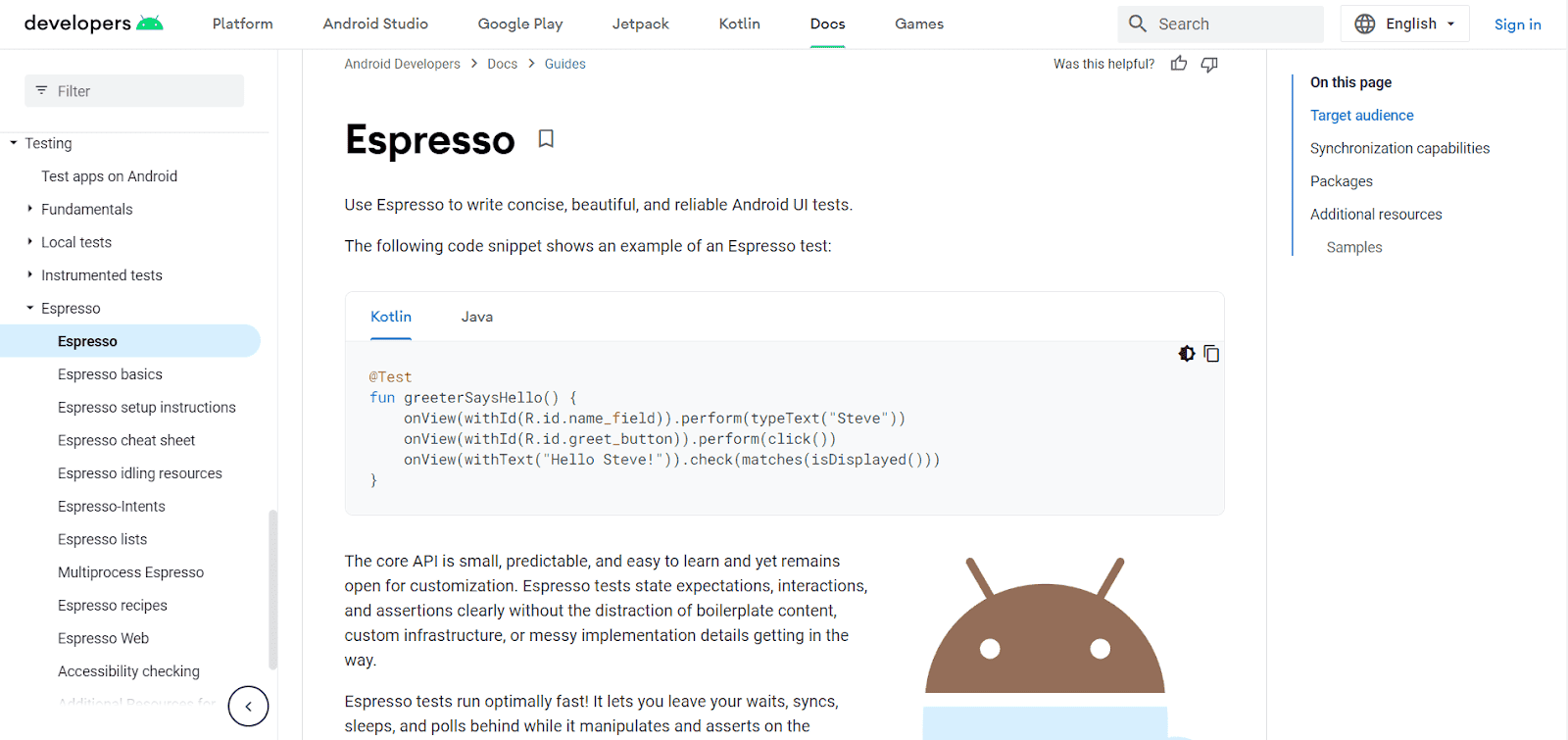
Espresso, developed by Google, is a leading Android automation testing framework popularly known for its exceptional performance. With Espresso, crafting simple tests is effortless, as it abstracts away application infrastructure complexities. Being open-source, developers can tailor Espresso to their needs, enhancing its versatility. Espresso is known for its outstanding speed and is considered one of the best software testing tools that delivers the shortest test execution time and the fewest failures.
Features of Espresso
- Offers a highly predictable, compact, and customizable core API for testing.
- Provides a diverse set of ViewMatchers and ViewActions to locate and interact with UI elements.
- Provides a different module to execute Android WebView testing of user interface components and to test and mock Android Intents.
- Allows for effortless manipulation and assertion of UI elements.
- Seamlessly integrate with Android’s UI Automator framework.
- Supports Idling Resources for managing asynchronous operations.
- Offers support for unit testing and black-box testing.
7. Nightwatch.js
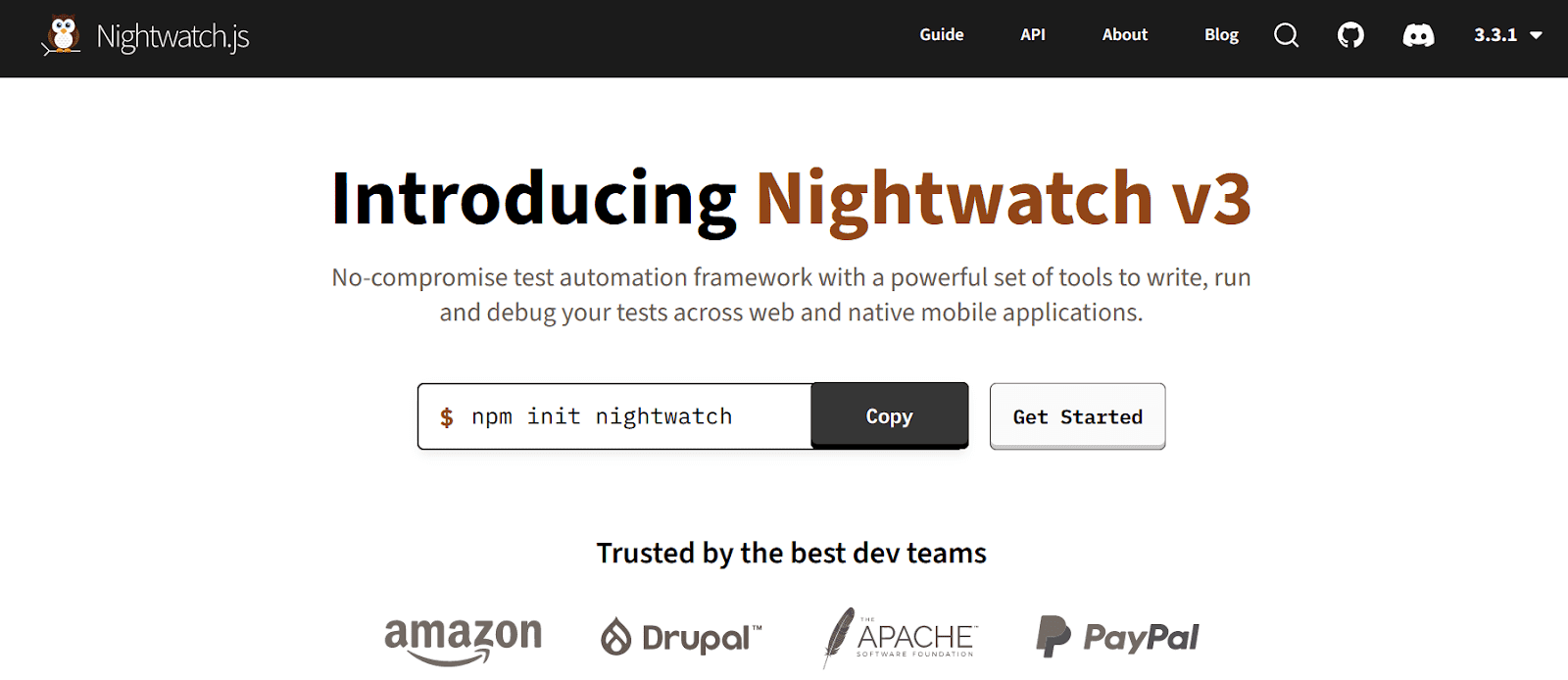
Nightwatch.js is a free, open-source automated testing framework powered by Node.js that offers complete E2E (end-to-end testing) solutions for web and native mobile apps. Nightwatch.js is built on the Selenium framework and uses the W3C WebDriver API (Selenium WebDriver). It communicates with a WebDriver server (ChromeDriver or Selenium Server) via a restful HTTP API. Its primary objective is to streamline the creation and execution of diverse test types, such as end-to-end testing, unit testing, and integration testing.
Features of Nightwatch.js
- Includes a built-in test runner that supports parallel test execution.
- Manage Selenium or multiple WebDriver (ChromeDriver, GeckoDriver, etc) servers in a dedicated child process.
- Integrates with cloud-based testing platforms like TestMu AI.
- Provides custom assertions and commands to improve the scalability of testing.
8. JUnit
JUnit is a robust software testing framework that streamlines the creation of efficient and reliable tests. Though its applicability is extended to various languages, JUnit excels in testing Java applications and enabling the development of automated tests. While Selenium and JUnit are effective independently, their synergy enhances the organization and structure of test cases, optimizing the testing process and ensuring comprehensive coverage of web functionalities.
Features of JUnit
- Provides annotations to identify test methods.
- Supports assertions to check and validate expected results during the testing phase.
- Provides immediate visual feedback on test results with the help of a color-coded progress bar.
- Allows grouping of test cases into test suites.
- Allows to define dependencies between different test cases such that test cases are executed only if their dependent test cases pass successfully.
9. WebdriverIO
WebdriverIO is an open-source Javascript-based software testing framework built on top of nodeJs. This end-to-end testing tool belongs to the OpenJS foundation and is known for its robustness, scalability, flexibility, and stability. The tests performed on WebdriverIO are concise and simple. All these reasons have made software testers adopt WebdriverIO to fulfill their browser testing needs.
Features of WebdriverIO
- Allows to run automation tests for both web applications and native mobile.
- Uses ‘Wdio setup wizard’ to make a simple and easy test setup.
- Utilizes the WebDriver protocol i.e., a standardized protocol for browser automation.
- Utilizes the Chrome DevTools Protocol for Chromium-based automation using Puppeteer.
- Seamlessly integrates with popular testing frameworks like Mocha and Jasmine.
- Integrates easily into CI/CD pipelines.
10. Watir
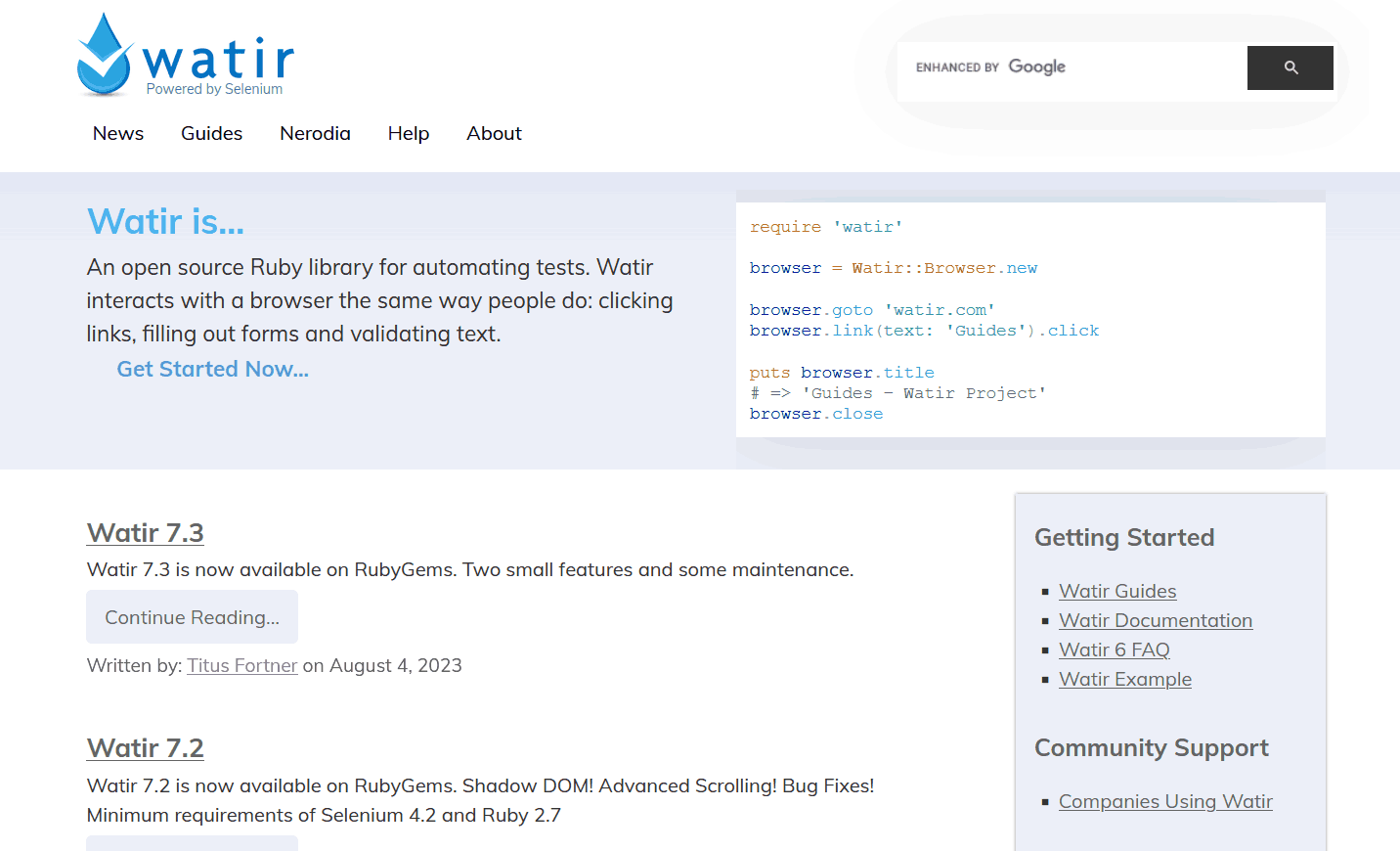
Watir, which stands for “web application testing In Ruby,” is a Ruby library designed for automating browser interactions. By leveraging Watir, developers can efficiently test their application’s performance and behavior across different scenarios. While it utilizes Selenium WebDriver as its core functionality, Watir simplifies the process of writing tests by abstracting away common boilerplate code required for browser interaction, thereby enhancing productivity and ease of use.
Features of Watir
- Allows to capture visual snapshots for detailed analysis within test reports.
- Simplifies the process of locating web elements with intuitive methods. The most used ways are id, class, tag name, custom attributes, label, etc.
- Simplifies measuring page performance using the performance object which has properties like performance.navigation and performance.timing.
11. Puppeteer
Puppeteer, a Node.js library, offers a user-friendly high-level API for managing Chromium or headless Chrome via the DevTools Protocol. With Puppeteer, testing becomes straightforward as it enables interaction with web browsers through intuitive methods like .type() or .goto(), while the Chrome DevTools team manages maintenance. In essence, Puppeteer is a browser-driven framework that simplifies web testing processes.
Features of Puppeteer
- Easy automation.
- Used as a web page crawling and scraping.
- Supports Angular and AngularJS.
- Generate automated screenshots for visual validation of web pages and PDF generation for documentation.
- .It effectively doubles as a crawler for Single-Page Applications (SPA), creating pre-rendered content via Server-Side Rendering (SSR).
- Its utility extends to browser-specific tasks like DOM API-based webpage access, automated form submissions, and emulation of keyboard inputs.
- Seamlessly integrates with the Chrome Performance Analysis tool.
12. Playwright
Playwright emerges as a leading open-source software testing tool for automating web applications. It offers cross-browser testing functionality across Google Chrome, Microsoft Edge, Mozilla Firefox, and Apple’s Safari, including support for headless testing. Additionally, Playwright facilitates test script automation through various programming languages, such as Java, Python, C#, JavaScript, and TypeScript.
Features of Playwright
- Auto waits for elements to be actionable before performing actions.
- Assertions are created specifically for handling the dynamic web.
- Enables parallel browser testing, allowing for efficient execution of test suites across multiple browsers.
- Allows users to utilize the capabilities of multiple browsers and tabs within a single test script.
- Allows users to save the authentication and other state of the context and reuse it in all the tests.
13. TestNG
TestNG is recognized as one of the premier multi-purpose automation testing tools, leveraging annotations (@) and inspired by JUnit. Its name, NG, denotes “Next Generation,” signifying advancements in testing capabilities. TestNG extends beyond UI testing to encompass end-to-end and integration testing seamlessly, simplifying the process and enhancing overall test coverage and efficiency.
Features of TestNG
- Supports parallel execution, using its testNG.xml file.
- Uses annotations to define test methods, setup and teardown methods, and test configuration.
- Supports parameterized tests using its @Parameters annotations that allow the running of the same test with different sets of data.
- Provides detailed test reports.
- Easily integrates with Maven and Jenkins.
14. XCUITest
XCUITest is a software testing framework developed and maintained by Apple, specifically for automating UI tests of iOS apps. It utilizes XCTest, Apple’s integrated test framework for Xcode. Testers and developers can create automated UI tests for native iOS mobile and desktop apps using the XCUITest framework, using Swift or Objective-C programming languages.
Features of XCUITest
- Provides APIs for interacting with UI components on iOS devices.
- Integrates seamlessly with Xcode, ensuring smooth development and testing workflows within the Xcode environment.
- Built-in support for popular iOS mobile gestures, including swiping, tapping, and scrolling.
- Enables parallel execution of tests on iOS apps and devices.
- Allows capturing screenshots and recording videos during test execution.
15. PHPUnit
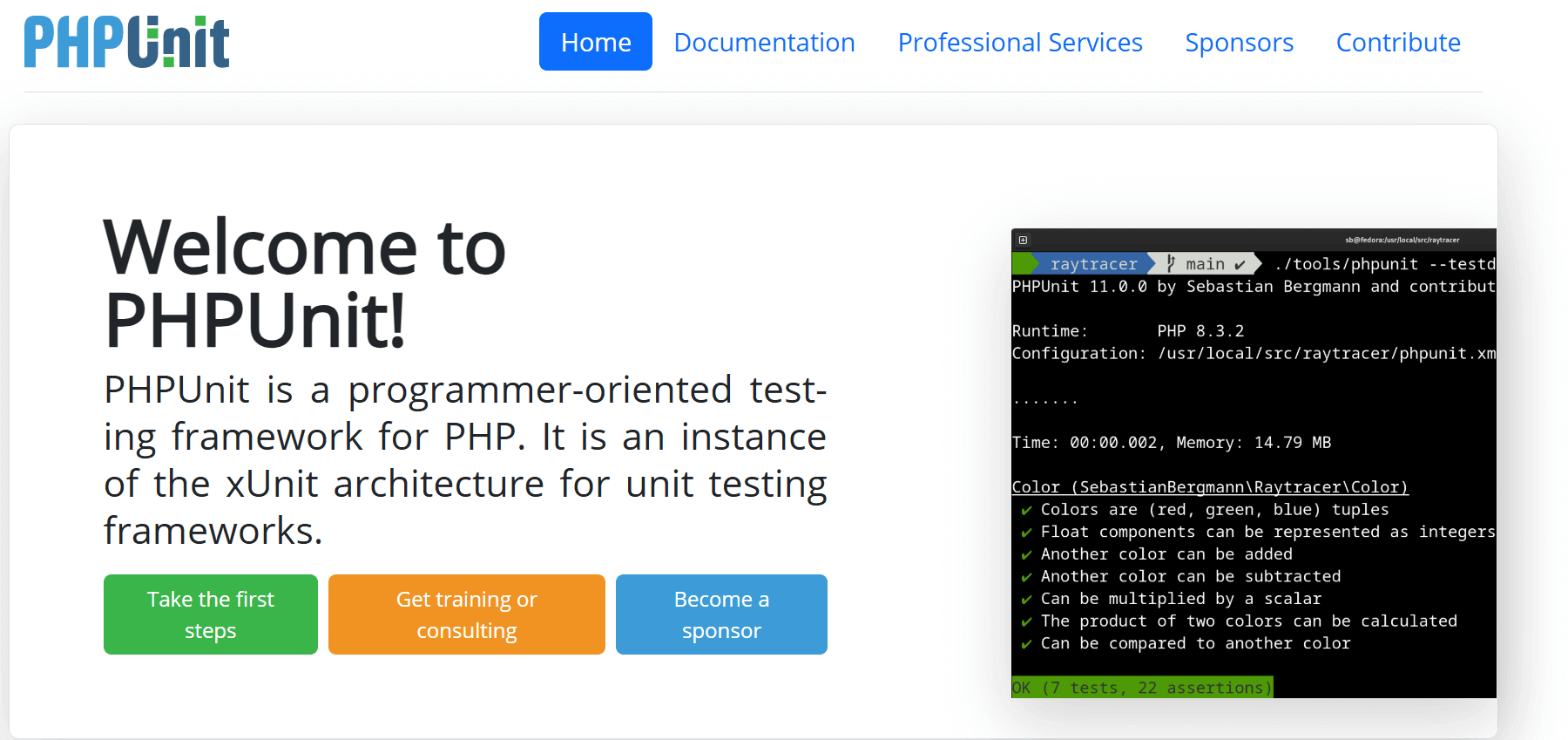
PHPUnit is the PHP community’s preferred unit testing framework. PHPUnit includes support for various programming languages and technologies, such as YAML, XML, and Markdown via the popular MarkdownTestSuite. It may load data from a variety of sources, including XML files, JSON, and databases. The fact that it includes SVN, Git, and Mercurial helps prevent tests from running on the wrong branch or against the wrong version of your code.
Features of PHPUnit
- Simple and expressive syntax.
- Maintain the accuracy and performance of code units.
- Offers a systematic framework to conduct unit testing.
- Integrates with other frameworks like Yii.
- Offers a variety of features such as assertions, mock objects, test fixtures, and test runners.
- Supports the configuration of the test suite via an XML file that can be stored under version control.
- Uses annotations to define test methods, setup and teardown methods, and test configuration.
16. Jest
Jest stands out as one of the most popular and simple-to-use automation testing tools, particularly for JavaScript-based projects. Its versatility extends to collaboration with a multitude of web and mobile app development frameworks, including Node.js, Babel, Vue, TypeScript, and React. Jest offers an all-in-one toolkit for optimized performance in testing environments. Testers can use features such as mocked imports and the comprehensive Mock Functions API to spy on various function calls with a clear and readable test syntax.
Features of Jest
- Provides a rich collection of APIs offering a lot of specific assertion types.
- Reorder test runs based on execution time.
- Allows importing tests and mocking objects outside the test scope with custom resolvers.
- Generates comprehensive code coverage reports using the –coverage flag.
- Provides detailed reports on test failures.
17. pytest
pytest is considered one of the best Python testing frameworks that offers the flexibility to write test scripts using the Python programming language. It enables developers to create reliable, straightforward, and scalable test cases for various components such as APIs, databases, or user interfaces. From basic unit tests to comprehensive functional tests, pytest accommodates a wide range of testing needs, empowering developers to ensure the quality and reliability of their Python applications.
Features of pytest
- Allows test parameterization to write a single test function that can be run with multiple input data sets to avoid code duplication.
- Detects tests automatically within the project directory.
- Provides selective test execution for developers to skip unimportant tests.
- Provides fixtures function (@pytest.fixture) that helps streamline the automation testing process.
- Contains a rich ecosystem of plugins, such as coverage.py and tox.
18. NUnit

NUnit stands out as one of the premier software testing frameworks for all .NET languages. Initially ported from JUnit, the recent version has been entirely rewritten, incorporating numerous added features and providing robust support for various .NET platforms. The NUnit Engine serves as the foundational component for the test runner, ensuring seamless execution of tests across different environments and configurations.
Features of NUnit
- Designed for all .NET languages.
- Supports test-driven development (TDD).
- Supports parallel testing and multiple platforms.
- Bugs detection.
- Catch problems early in the development process.
- Comes with features like assertions, test fixtures, test runners, and parameterized tests that support developers in creating comprehensive test suites.
- Seamlessly interacts with the NUnit Engine, ensuring smooth and efficient test execution processes.
19. Jasmine
Jasmine is widely recognized as one of the top open-source testing tools for JavaScript. Its versatility allows it to be utilized on any JavaScript-powered platform without interfering with the Integrated Development Environment (IDE) or the application being tested. This flexibility makes Jasmine a popular choice among developers for writing and executing JavaScript tests in various environments.
Features of Jasmine
- Seamlessly supports front-end code testing, making it effortless with the Jasmine-jQuery extension.
- Supports asynchronous testing.
- Uses techniques such as mocking, spying, and stubbing to isolate logic.
- Highly readable syntax similar to RSpec.
- Offers a comprehensive set of built-in matchers.
20. Mocha
Mocha is a versatile and high-performing JavaScript and TypeScript testing framework known for its simplicity and flexibility. It streamlines test creation, allowing developers to focus on writing test cases without worrying about infrastructure setup. As an open-source tool, Mocha offers extensive customization options to suit diverse project requirements. It enables the synchronization of test actions with the user interface (UI).
Features of Mocha
- Adopts the Behavior Driven Development (BDD) interface by default.
- Offers a wide range of custom interfaces to define hooks, test suites, and individual tests, including Exports, TSS, Require, and QUnit.
- Provides the parallel flag to run tests in parallel.
You can explore our detailed breakdown of the top UI Testing Tools to choose the right one for your front-end testing needs.
What Are the Factors to Consider While Choosing the Right Testing Tools?
Key factors include compatibility, ease of use, CI/CD integration, scalability, customization options, community support, reporting capabilities, and cost considerations.
Following are the several factors that should be considered while choosing the right testing tools.
- Testing Type and Purpose: Identify the specific type of testing you need. For example- unit testing, integration testing, performance testing, etc. Choose a tool that aligns with your testing goals.
- Application and Technology: Consider the nature of your application (web, mobile, etc.) and the technology stack it uses. Ensure the tool supports the platforms and technologies relevant to your project.
- Ease of Use: Choose a tool that matches your expertise or expertise of your testing team. A user-friendly interface and scripting capabilities aligning with your team’s skills can expedite testing.
- Compatibility: Ensure the tool is compatible with the environments you must test on, like browsers, devices, and operating systems.
- Integration: Check if the tool integrates well with your existing development and testing ecosystem, including CI/CD pipelines, version control systems, and bug-tracking tools.
- Scalability: Consider whether the tool can handle the scale of your testing needs.
- Customization: Evaluate the tool’s flexibility to customize test cases, reports, and other parameters according to your project’s requirements.
- Community and Support: An active and engaged user community, along with reliable support from the tool’s developers, can provide assistance and solutions when needed.
- Reporting and Analysis: Look for tools that offer comprehensive reporting features, including clear visualization of test results, trends, and actionable insights.
- Cost and Licensing: Consider the budget for testing tools and whether the chosen tool’s licensing model aligns with your organization’s needs.
- Security: For security testing tools, ensure they align with your application’s security requirements and offer features to identify vulnerabilities effectively.
What Are the Future Trends in Software Testing Tools?
Future trends include AI-powered test automation, shift-left testing practices, cloud-based testing platforms, and increased support for microservices and IoT testing.
Artificial Intelligence and Machine Learning in Testing
Artificial intelligence (AI) and machine learning (ML) are playing an increasingly important role in the software testing landscape. AI and ML algorithms are increasingly being used to automate complicated test scenarios, saving time and effort that would otherwise be spent on manual testing. Predictive analytics can predict potential issues and improve test coverage, making testing more efficient and more reliable.
Software testing tools that are AI-driven are also improving test accuracy. By learning from past test data, AI-driven tools can detect patterns and anomalies that human testers may not be able to detect. This leads to faster detection of defects, better software quality, and significantly lower overall testing costs. The flexibility that AI and ML offer in testing tools allows continuous improvement in testing strategies and methodologies.
Shift-left Testing Practices
Shift-left testing integrates testing at the earliest and most frequent stages of the software development life cycle. As a software testing tool, shift-left emphasizes the need to test from the start of the project rather than waiting until the development phase is finished.
By testing from the start, defects can be identified early and fixed at the later stages of the development lifecycle, saving time and money.
The shift-left approach uses automated testing tools that allow continuous testing across the entire development cycle. This means that every new line of code is tested immediately, maintaining the quality of the software from the start.
Not only does shift-left testing speed up the development process, but it also encourages quality culture and collaborative development and testing, resulting in stronger and more reliable software products.
Cloud-based Testing Tools
Cloud-based software testing tools are becoming increasingly popular because they are scalable, flexible, and cost-effective. They enable teams to test in a variety of environments and configurations, without the need for large-scale physical infrastructure.
Cloud-based testing tools make it easy to test applications in various environments and under different conditions, ensuring comprehensive testing coverage.
In today’s distributed work environments, collaboration and remote testing are essential. Cloud-based testing tools provide real-time availability of testing resources, allowing teams to perform tests simultaneously from different locations. Not only does this speed up the testing process, but it also ensures that your software is robust and works well across different platforms and devices.
Conclusion
This article covers the 20 best software testing tools and their importance in the Software Development Life Cycle. It is no secret that each of these tools offers several benefits, including faster testing cycles, improved detection, increased efficiency, enhanced test coverage, and reduced costs.
However, choosing the right tool for your needs is crucial to reap these benefits fully. That is why we recommend carefully considering the factors we discussed before making a decision. So, do not hesitate to explore your options and choose the best tool for your team.


Frequently asked questions
Did you find this page helpful?
More Related Hubs
TestMu AI forEnterprise
Get access to solutions built on Enterprise
grade security, privacy, & compliance
- Advanced access controls
- Advanced data retention rules
- Advanced Local Testing
- Premium Support options
- Early access to beta features
- Private Slack Channel
- Unlimited Manual Accessibility DevTools Tests