

Next-Gen App & Browser Testing Cloud
Trusted by 2 Mn+ QAs & Devs to accelerate their release cycles


Different Types of Software Testing
Discover essential insights into types of software testing – from functional to non-functional testing. Ensure robust, reliable software with our comprehensive guide.

Nazneen Ahmad
December 25, 2025
Software testing is a technique to validate websites or mobile applications, identify bugs or issues, and ensure they work as intended. This process is a critical part of the Software Development Life Cycle. However, there is not just one type of software testing to efficiently test the different components of software applications at various phases of the development process.
Based on the diverse requirements and purposes, there are different types of software testing. Each type serves a unique purpose, from unit and integration to performance and user acceptance testing. Understanding the significance of these diverse types of software testing is imperative for developers and testers.
What Is Software Testing?
Software testing is the process of ensuring that software applications are functional, reliable, and of high quality. This process involves finding errors and vulnerabilities to ensure the software application meets the user’s expectations before going live.
Testers perform software testing through manual or automation techniques to ensure the software application functions as intended. This involves careful planning, test case creation, running of test script, and debugging, etc. Following tests, testers communicate results to the development team for further modifications, aiming to deliver a high-quality software application to the users.
It is an essential part of the Software Development Life Cycle (SDLC) and provides necessary mitigation against possibly business-impacting bugs that would otherwise go undetected.
Types of Software Testing
The field of software testing is exceptionally robust and includes different categories based on other purposes and aims. Here, we will discuss various types of software testing.
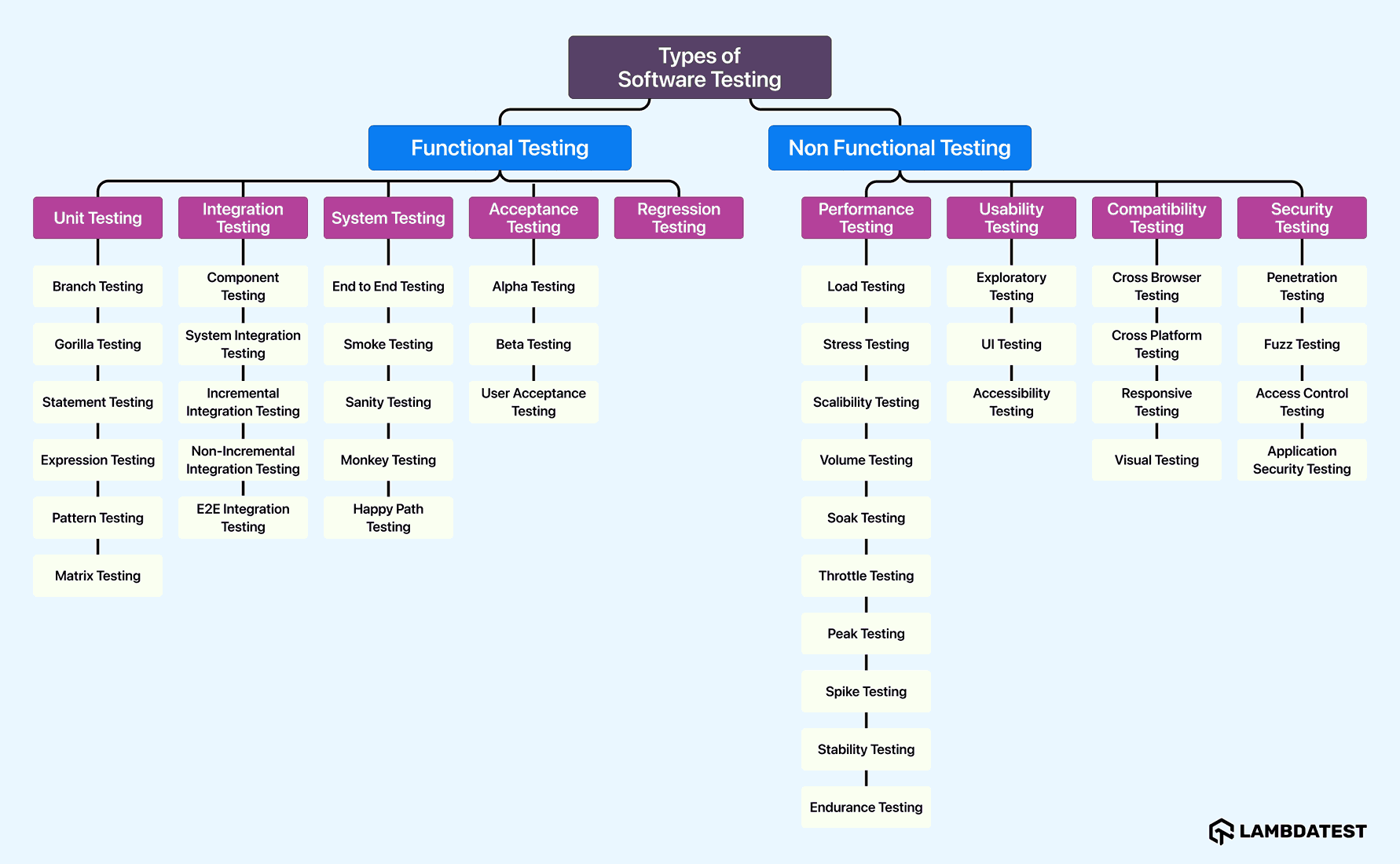
Functional Testing
Functional testing focuses on evaluating the functional aspects of a software application. This type of testing checks the various functions of the software application, such as user interfaces, client/server applications, and functionality. Functional tests can be performed manually or automated using tools. The primary concern in functional testing is understanding what the software system does and how effectively it performs its designated functions.
Functional testing offers the following advantages:
- Identifying software application functionality issues before they escalate into major issues.
- Verifying that required features work as expected and evaluating the system’s ability to handle unexpected conditions.
- Ensuring the software applications meet end users’ expectations and are bug-free.
- Testing the software applications effectively under various conditions and scenarios.
- Monitoring progress and adjusting testing plans as needed.

Note: Run functional tests across 5000+ environments. Try TestMu AI Now!
Types of Functional Testing
There are many different types of functional testing, which include the following:
- Unit testing: It evaluates the smallest functional unit of code, a crucial step in software development that ensures code quality. This test involves writing software in small, functional units and creating a corresponding unit test for each code unit. Initially, these unit tests are written as code and then automatically executed whenever changes are made in the software code. This approach quickly identifies bugs or errors within the code if a test fails.
- Branch testing: Ensures all possible branches in the code execute at least once, verifying correct behavior in all conditions.
- Gorilla testing: Focuses on stress-testing a specific module to detect bugs and assess performance under extreme conditions.
- Statement testing: Executes every statement in the code at least once to ensure complete test coverage.
- Expression testing: Checks syntax expressions to prevent errors and ensures only valid expressions are accepted.
- Pattern testing: Identifies recurring error patterns by analyzing past defects, helping prevent similar issues.
- Matrix testing: Evaluates software variables to assess technical and business risks, optimizing their usage.
- Integration testing: It take place once software modules are integrated to ensure they function as expected. Compared to unit tests, integration tests focus on aspects like evaluating database interactions and ensuring the seamless working of microservices. These tests can be relatively expensive because multiple application components need to be operational. Jasmine and Mocha are considered suitable tools for integration testing.
- Component testing: Tests individual modules separately before integrating them. It ensures each part works correctly on its own.
- System integration testing: Checks if all integrated components work well together. It helps confirm the system meets the requirements.
- Incremental integration testing: Tests one module before adding another. Each integration is verified step by step to catch issues early.
- Bottom-up integration testing: Starts testing from the lowest-level modules. Higher-level components are added gradually to build a stable system.
- Top-down integration testing: Begins testing with the main components first. Lower-level modules are integrated later to verify interactions.
- Sandwich integration testing: Uses both top-down and bottom-up testing. This approach balances component-level and system-level validation.
- Non-incremental integration testing: Merges all modules at once before testing. It can make issue detection more difficult.
- End-to-end integration testing: Validates the entire system and its connections with external tools. It ensures everything works as expected.
- System testing: System testing is the process where a complete and integrated software system is tested to verify that it meets specified requirements. It is executed within the framework of a System Requirement Specification (SRS) and a Functional Requirement Specification (FRS).
- End-to-end testing: Validates the entire software application by simulating real user interactions. Ensures smooth functionality before release.
- Smoke testing: Checks if a new build is stable enough for further testing. Runs basic tests to confirm core functionality.
- Sanity testing: Verifies that recent bug fixes or minor changes did not break the software. Focuses on key functionalities.
- Monkey testing: Feeds random inputs to test system stability. Helps identify hidden issues not covered in regular testing.
- Happy path testing: Tests the system under ideal conditions with valid inputs. Ensures expected outputs without errors.
- Acceptance testing: As your product nears completion, it’s time to consider real user feedback. This is where acceptance testing plays a role, aiming to evaluate whether the software application is ready for real-world use.
- Alpha testing: Conducted by an internal QA team in a controlled environment to find and fix bugs before release. Uses both white-box and black-box testing.
- Beta testing:Real users test the software before release to identify hidden bugs and usability issues. Their feedback helps improve the final product.
- User acceptance testing: End-users validate the software to ensure it meets their needs. It is done at the final stage before deployment.
- Regression testing: Regression testing is a type of software testing that verifies recent code changes haven’t affected existing features. It involves re-executing a selection of previously executed test cases to ensure the functioning of existing features. The testing is crucial to confirm that new code changes do not produce any impact on existing functionalities.
The following are the types of unit testing:
This testing category includes various approaches, such as the top-down, bottom-up, and sandwich approaches.
This testing phase follows integration testing and is then followed by acceptance testing, focusing on identifying issues within the integrated units of a system.
Here are different types of system testing.
The focus is confirming whether the software applications align with user expectations and efficiently execute the intended tasks. End users perform this testing to validate and approve the software application before the developer transitions it to the production environment.
Non-Functional Testing
Non-functional testing is one of the types of software testing that checks whether the software application’s non-functional aspects, such as stability, security, and usability, are functioning as anticipated. These tests occur post-functional testing and focus on enhancing software application quality. The primary objective is to evaluate a software application’s readiness based on non-functional criteria that functional testing typically overlooks.
Non-functional testing offers the following advantages:
- Providing a higher level of security safeguarding systems against online threats.
- Ensuring the system’s capability to handle concurrent user usage without performance degradation.
- Contributing to the enhancement of the system’s overall efficiency.
Types of Non-Functional Testing
Here are the different types of non-functional testing:
- Performance testing: Performance testing is one of the types of software testing to check how well a software application maintains stability, speed, scalability, and responsiveness under specific workloads. In other words, it includes different tests that check the speed, robustness, reliability, and appropriate sizing of the software application.
- Load testing: Evaluates how software performs under expected user traffic. It helps identify performance issues and improve reliability.
- Stress testing: Pushes software beyond normal limits to check its robustness. It helps detect failures under extreme conditions.
- Distributed stress testing: The testing process spans all users from the server. A stress server distributes tests to all stress users and monitors their status.
- Application stress testing: Focuses on identifying defects related to data locking and blocking, network issues, and performance bottlenecks within an application.
- Transactional stress testing: Involves stress testing one or more transactions between multiple applications to fine-tune and optimize the system.
- Systemic stress testing: Also known as integrated stress testing, it is performed across multiple systems on the same server to identify data conflicts between applications.
- Exploratory stress testing: Evaluates the system using unusual parameters or conditions that are unlikely to occur in real-world scenarios.
- Scalability testing: It is a type of non-functional testing that checks how well software applications or networks perform as the number of user requests is adjusted, either increased or decreased. The primary goal of scalability testing is to verify the system’s capability to manage anticipated rises in user traffic, data volume, transaction counts, and frequency. This testing evaluates the software application’s ability to adapt to growing demands.
- Volume testing: Volume testing is a form of software testing where the software application undergoes testing with a significant amount of data, also known as flood testing. The objective is to understand the system’s performance by increasing the volume of data in the database.
- Soak testing: Soak testing, also referred to as capacity testing or longevity testing, involves evaluating the software application to identify performance-related issues such as stability and response time by applying the intended load on the software.
- Throttle testing: Throttle testing involves simulating a load scenario where virtual users, either all of them or a specific group, connect with a restricted connection speed.
- Peak testing: This type of software testing evaluates how the software application responds to intensity peaks alongside a regular load. This test demonstrates the functionality of software applications after facing an increased load.
- Spike testing: In this test, software application is tested with extreme increases and decreases in traffic load. The primary goal of spike testing is to understand how the software application behaves when faced with sudden increases or decreases in user load and to figure out the recovery time after a spike in user load.
- Stability testing: This checks the quality and behavior of the software in different environmental parameters, evaluating the software application’s ability to continue functioning over time without failure.
- Endurance testing: This type of software testing evaluates the system’s ability to handle a sustained workload over an extended period.
- Usability testing: Usability testing, also referred to as user experience (UX) testing, involves evaluating the functionality of a website or web app by observing actual users as they engage with it to accomplish tasks.
- Exploratory testing: It also called ad-hoc testing, is a form of software testing where the tester can choose any available methodology to test the software. It represents an unscripted approach to software testing.
- User Interface (UI) testing: It is a type of software testing that concentrates on verifying the appearance, functionality, and usability of various user interfaces, including graphical user interface (GUI), command line interface (CLI), and voice user interface (VUI).
- Accessibility testing: It is described as a type of software testing carried out to ensure that the software application being tested is user-friendly for people with disabilities, such as those with hearing impairments, color blindness, elderly individuals, and other disadvantaged groups.
- Compatibility testing: It is one of the crucial non-functional tests that ensure your software application can operate seamlessly across diverse hardware, operating systems, applications, network environments, or mobile devices.
- Backward compatibility testing: It involves verifying the behavior and compatibility of the developed hardware or software with its older versions. This type of testing is more predictable since all the changes from the previous versions are known.
- Forward compatibility testing: This is a process to validate the behavior and compatibility of the developed hardware or software with the newer versions. This type of testing is somewhat challenging to predict as the specific changes in the newer versions are not known in advance.
- Cross-browser testing: Cross browser testing verifies the functioning of websites across various browsers, operating systems, and devices. It includes testing the website’s functionality, performance, and user interface on various web browsers like Google Chrome, Mozilla Firefox, Microsoft Edge, Safari, and Opera.
- Cross-platform testing: Cross-platform testing is a testing type that ensures that an application or software application works correctly across diverse platforms, operating systems, and devices. It includes testing the application’s functionality, performance, and user interface on different platforms such as Windows, macOS, Linux, Android, iOS, and others.
- Responsive testing: Responsive testing enables the evaluation of design across various screen widths, providing a genuine test of adaptivity beyond predefined screen sizes. Testing for responsiveness allows you to modify the screen’s width after entering the website’s URL, observing how the user interface adjusts in real-time.
- Visual testing: Visual testing verifies if every user perceives the software application’s interface (UI) correctly. This type of testing checks that each element on a web page has the correct shape, size, and placement. Visual testing evaluates software application’s visible output against the expected design outcomes, helping identify “visual bugs” separate from strictly functional bugs in the appearance of a page or screen.
- Security testing: It is a type of software testing that checks the vulnerability of the software application against cyber threats. This is done by evaluating its susceptibility to attacks and the impact of malicious or unexpected inputs on its functionality.
- Penetration testing: Penetration testing is one of the types of software testing that involves simulating attacks on software applications to obtain access to sensitive data, aiming to ascertain the software applications’ security status. These attacks can be executed internally or externally, giving information on the target system, pinpointing vulnerabilities, and revealing potential exploits that might impact the software applications.
- Fuzz testing: This process includes sending numerous unexpected or malformed input data to the software applications to uncover potential input validation and handling vulnerabilities. A fuzzing tool sends these inputs into the software applications and observes for exceptions like crashes or information leakage.
- Access control testing: This includes testing the access control mechanisms of the software applications to ensure that access to sensitive data is granted only to authorized users. It enables the configuration of access rules and executes a comprehensive attack to assist in identifying sections of software applications that may be accessible by unauthorized clients.
- Application security testing: Application security testing (AST) aims to enhance the resistance of software applications against security threats by pinpointing weaknesses and vulnerabilities in the source code. These approaches involve testing, analyzing, and reporting on the security status of a software application throughout the Software Development Life Cycle (SDLC). There are two primary approaches:
- API security testing: This is one of the types of software testing that has a crucial role in uncovering vulnerabilities within software application programming interfaces (APIs) and web services. This helps the developers address and fix these vulnerabilities.
It involves the evaluation of several indicators, including browser, page, and network response times, server query processing time, the capacity to handle an optimal number of concurrent users, CPU memory consumption, and the identification and categorization of errors that may occur during the application’s use.
Here are the types of performance testing:
The following are the types of stress testing:
Typically, in this testing approach, a select group of target end-users actively engages with the software application to uncover potential usability defects. Here, the primary focus of usability testing is evaluating the user interface and the overall user experience of a software application. Consequently, the testing process involves real users interacting with the software application to measure its ease of use, efficiency, and overall user satisfaction.
Here are the types of usability testing:
In this type of software testing, developers utilize their learning, knowledge, skills, and abilities to evaluate their developed software applications. This testing method checks the functionality and operations of the software while identifying functional and technical faults.
There are two categories of version checking in compatibility testing:
The following types of compatibility testing:
You can perform cross browser testing in the cloud because it provides convenient software application testing across various browsers and versions without any worry about local infrastructure.
One of the most used cloud-based platform is TestMu AI – an AI-native test execution platform that enables you to perform manual and automation testing for web and mobile applications across on-demand real browsers, devices, and operating systems on its scalable cloud grid. It offers support for automating test scripts with various testing frameworks like Selenium, Playwright, Cypress, Appium, Espresso, XCUITest, and more.
You can run automation tests with diverse programming languages and frameworks on an online browser farm comprising 5000+ real desktop and mobile environments.
It offers assurance regarding the safety and reliability of software applications and their resistance to unauthorized inputs. The primary focus of security testing lies in uncovering potential weaknesses and loopholes within software applications that could lead to loss of information or hamper the organization’s reputation.
The following are the types of security testing.
Other Types of Software Testing
In this section, we will discuss some other types of software testing. However, there are more. To explore different types of software testing in detail, we recommend you check this software testing glossary.
- Agile testing: Agile testing is one of the types of software testing that adheres to the best practices of the Agile development framework. Agile development adopts an incremental approach to development, and similarly, Agile testing involves an incremental approach to testing. In this Agile test, the features of software applications are tested as they are developed.
- Parallel testing: It is a software technique or process that leverages automation testing capabilities to execute the same tests simultaneously in multiple environments, real devices, and browser configurations. This approach significantly reduces testing time and effort.
- Geolocation testing: Geolocation testing simulates different geographical locations to test how software applications respond based on a user’s perceived location.
- Real device testing: This type of software testing involves running tests on physical devices (smartphones, tablets) rather than emulators or simulators. It can be performed on both local and cloud-based infrastructure.
- Localhost testing: It is a technique to test software applications hosted on your machine (localhost) before deploying it to a production environment.
- Localization testing: Localization testing ensures the correct functioning of the application in the local environment, including accurate text translation, appropriate use of symbols and characters, and compliance with local regulations and standards.
- Dynamic testing: Dynamic testing involves the analysis of code’s dynamic behavior within the software application. In this testing method, input is provided, and the expected output is determined by executing a test case. Test cases can be run manually or through an automation process, requiring the compilation and execution of the software code.
- Data-driven testing: This software testing methodology utilizes a table of conditions directly as test inputs and verifiable outputs. The test environment settings and control are not hardcoded in this approach.
- Keyword-driven testing: Keyword-driven framework is a testing method that involves defining test cases using keywords. Testers use predefined keywords to create test scripts that an automated testing tool executes.
- Retesting: It involves repeating a test on a specific feature that was non-functional in the previous test to verify its functionality. Typically, the same testers who identified the defect in the first place perform retesting.
- Static testing : It is performed on a software application without executing the actual code. It involves reviewing and validating the software and its supporting documents. In contrast, dynamic testing is carried out on software during code execution.
- Negative testing: This type of software testing, also known as “test to fail,” aims to show that a component or software application does not work.
- Operational testing: It refers to the evaluation of a software application before the production phase. It ensures system and component compliance in the application’s standard operating environment.
- API testing: API testing is a type of software testing that involves directly testing application programming interfaces (APIs), both independently and as part of integration testing. This test is helpful to know whether they fulfill expectations for functionality, reliability, performance, and security. As APIs lack a GUI, API testing is performed at the message layer.
- Mutation testing: It is a method of software testing that involves modifying the software application’s source code or bytecode in small ways to test sections of the code that are seldom or never accessed during normal test execution.
- Pair testing: In this testing, two team members work together on one machine to test the software application, with one performing the testing and the other analyzing or reviewing the testing.
- Active testing: Active testing is a technique where the user inputs test data and analyzes the results. Throughout active testing, a tester builds a mental model of the software under test, which continues to evolve and refine as interactions with the software progress.
- Benchmark testing: Benchmark testing is a testing method that involves evaluating the performance of the software application against established benchmarks or industry standards. It is a collaborative effort involving both application developers and database administrators (DBAs). Benchmark testing is carried out on a software application to evaluate its current performance and can be used to enhance application performance.
- Code-driven testing: Code-driven testing, also known as Test-Driven Development, begins by adding a test sufficient to make the code fail. Subsequently, a complete test suite or a subset of tests is executed to expedite testing and ensure the new test fails. The code is then modified to make it pass the new tests. Following this, the tests are executed again. If they fail, the code needs to be updated and retested. Once the test passes, the process is repeated for the next development item.
- Context-driven testing: Context-driven testing is a form of software testing developed before market launch to evaluate the software application on all parameters, including performance, UI, speed, functionalities, and other aspects, to identify and address bugs. However, many organizations may be unaware of its importance and how to perform context-driven testing effectively.
- Path testing: This involves testing all possible paths through the code to ensure the execution of each path and the achievement of expected outcomes.
- Age testing: This type of testing evaluates the software application’s ability to perform in the future. The evaluation process is executed by testing teams. This indicates that age testing tells us how the software application will behave in the future after it gets older or is used for a certain number of years.
- Assertion testing: This type of software testing involves checking specific statements or boolean expressions known as assertions, which are incorporated into the code to evaluate whether the expected conditions or outcomes hold true during program execution. These assertions help identify and identify errors or bugs in the software.
- Pairwise testing: It is alternatively known as all-pairs testing, permutations, and combinations (P&C) based type of software testing. This involves the evaluation of each pair of input parameters to ensure the proper functioning of the software application for all possible discrete combinations.
- Binary portability testing: This tests a running application for portability across software platforms and environments, usually for confirmation of an ABI specification. Testing teams are tasked with its implementation.
- Boundary value testing: In this type of software testing, tests are designed to include representatives of boundary values. In other words, it involves evaluating data by considering its boundary values, specifically its two opposite ends, such as minimums and maximums. QA testing teams typically perform this type of testing.
- Breadth testing: In this type of software testing, the full functionality of a software application is tested, but not all features are tested in detail.
- Comparison testing: This software testing type compares the strengths and weaknesses of the software application with previous versions or similar applications. It can be performed by testers, developers, product managers, or product owners.
- Condition coverage testing: This type of software testing where each condition (Boolean conditions) is executed by making it true and false in each way at least once.
- Compliance testing: This is a type of testing that checks whether the software application was developed in accordance with standards, procedures, and guidelines. It is usually performed by external companies that offer a “Certified OGC Compliant” brand.
- Concurrency testing: This type of multi-user testing aims to identify and address issues that may arise when multiple users or processes access a software application code, module, or database records. Simultaneously. It ensures the system can manage concurrent requests without crashing or causing data corruption.
- Conformance testing: This process validates that software applications work according to specified standards. For example, compilers undergo extensive testing to verify whether they meet the recognized standard for that language.
- Conversion testing: This involves testing the software application or procedures utilized to convert data from existing systems for utilization in replacement systems.
- Destructive testing: It is a method of software testing aimed at discovering points of failure within a software application. This approach intentionally induces application failure to evaluate robustness and pinpoint failure points.
- Dependency testing: This testing type evaluates the software application’s requirements for pre-existing software, initial states, and configuration to ensure proper functionality is maintained within the software application.
- Domain testing: It is a software testing technique where a minimal number of inputs are used to obtain the appropriate output of a system, ensuring the system rejects invalid input values.
- Error-handling testing: It is a type of software testing that evaluates the software application’s capability to process erroneous transactions accurately.
- Equivalence partitioning testing: It is a type of software testing that categorizes the input data of a software unit into partitions from which test cases can be derived. An ideal test case identifies classes of errors, requiring execution of multiple arbitrary test cases before general errors are observed.
- Fault injection testing: It is a component of a comprehensive test strategy that allows the tester to focus on how the application under test manages exceptions.
- Formal verification testing: This involves proving or disproving the correctness of intended algorithms underlying a system with respect to a specific formal specification or property using formal mathematical methods.
- Globalization testing: It is a testing method that verifies the proper functionality of the software application with any culture/locale settings using various international inputs.
- Hybrid integration testing: It is a testing technique combining top-down and bottom-up integration methods to leverage both benefits.
- Install/uninstall testing: It focuses on the actions customers must take to install and set up the new software successfully. This may include full, partial, or upgrade install/uninstall processes and is usually carried out by the QA engineer in collaboration with the configuration manager.
- Internationalization testing: This ensures that the functionality of the software application is not disrupted and all messages are correctly externalized when used in different languages and locales.
- Inter-software application testing: It is a testing technique that focuses on testing the application to ensure that the interconnection between applications functions correctly.
- Loop testing: Loop testing is a type of software testing performed to validate loops within a software application. It falls under the category of control structure testing.
- Manual scripted testing: This is a method in which the test cases are designed and reviewed by the team before execution.
- Model-based testing: This testing type involves the software application of model-based design for designing and executing the necessary artifacts to perform software testing.
- Modularity-driven testing: This is a software testing technique that requires the creation of small, independent scripts representing modules, sections, and functions of the application under test.
- Orthogonal array testing (OAT): It is a software testing technique that uses orthogonal arrays to create test cases, especially useful when the software application has extensive data inputs.
- Passive testing: This type of hands-off software testing involves running a test script and monitoring the results, requiring no manual interaction from the tester.
- Qualification testing: This testing is performed against the specifications of the previous release, usually done by the developer for the user to demonstrate that the software meets its specified requirements.
- Ramp testing: This type of software testing consists of continuously raising an input signal until the software application breaks down.
- Requirements testing: This is an approach where test cases, conditions, and data are derived from requirements to ensure that project requirements are fully explained and do not conflict.
- Scenario testing: It is a testing activity that uses scenarios based on a hypothetical story to help a person think through a complex problem or software application for a testing environment.
- Storage testing: This verifies that the software application stores data files in the correct directories and reserves sufficient space to prevent unexpected termination due to lack of space.
- Structural testing: This is used to test the internal design or structure of the coding for a particular software application.
- Thread testing: It is a variation of the top-down testing technique where the progressive integration of components follows the implementation of subsets of the requirements.
- Upgrade testing: This verifies if assets created with older versions can be used correctly and that users’ learning is not challenged.
- Workflow testing: It is a scripted end-to-end testing technique duplicating specific workflows expected to be utilized by end-users, usually performed by testing teams.
- Recovery testing: Recovery testing evaluates how well software applications can rebound from crashes, hardware failures, and similar issues. Intentionally breaking the software in various ways is part of the recovery testing process.
- Efficiency testing: Efficiency testing evaluates the resources used and required to construct software applications. You can use efficiency testing tools like WebLOAD and LoadNinja.
- Reliability testing: Reliability testing assumes the software application operates without error within predefined parameters. The system must run for a specific duration and process. The reliability test will also fail if the system encounters issues under predetermined circumstances, such as ensuring all web pages and links remain reliable.
- Portability testing: Portability testing evaluates the software application’s ability to run on multiple operating systems without encountering bugs. This test also evaluates the functionality of software applications under the same operating system but with different hardware configurations. Tools like SQLMap can be used for portability testing.
- Vulnerability management: Vulnerability management constitutes an ongoing process that allows an organization to identify, evaluate, report, manage, and fix security vulnerabilities across endpoints, workloads, and networks. Security teams typically use vulnerability scanning tools like Nessus, Qualys, OpenVAS, and Rapid7 to detect vulnerabilities and implement manual or automated resolution processes.
- Configuration scanning: It is also known as security scanning or configuration analysis and involves finding software, network, and computing system misconfigurations. This check typically verifies software applications against recommended practices outlined by research bodies or compliance standards. Some of these practices include adhering to secure coding principles, implementing robust access controls, regularly updating and patching software, encrypting sensitive data, and establishing strong authentication measures.
- Security audits: A security audit is a type of software testing that follows a systematic procedure to review or audit an application or software aligned with a predefined standard. Audits often involve code or architectural reviews based on security requirements, measuring security vulnerabilities, and evaluating the security gaps of hardware setups, operating systems, and organizational methodologies. It also measures adherence to regulations and compliance standards.
- Risk assessment: Risk evaluation allows the organization to recognize, dissect, and categorize security risks affecting its business-critical assets. This type of evaluation assists in understanding the primary threats to an organization’s infrastructure and prioritizing enhancing software applications. It also helps in long-term strategic planning and budget allocation for security investments.
- Security posture assessment: A security posture evaluation is a test that integrates security scans, ethical hacking, and risk assessment. This process identifies risks confronting an organization and validates and verifies the efficacy of its existing security controls. This evaluation detects any gap in the current security posture and suggests modifications or enhancements to improve the security of safeguarded assets.
Conclusion
In this tutorial, we have explored different types of software testing. Beyond the mentioned list, numerous other types of software testing and their sub-categories exist. The article has provided insights into the overall methods, approaches, and levels involved in the testing process. However, it’s crucial to discern which testing approaches are ideal for your software project. It’s worth noting that it’s not mandatory to undertake every available type of testing for each project.
Always remember that testing extends beyond merely finding bugs—it is essential for developing trust and confidence in your software application. Therefore, it is essential to approach software testing holistically throughout the entire development life cycle and utilize a diverse toolkit of complementary testing methods.
Citations
- A Study of Software Testing: Categories, Levels, Techniques, and Types: https://www.researchgate.net/publication/342579919


Frequently asked questions
Did you find this page helpful?
More Related Hubs
TestMu AI forEnterprise
Get access to solutions built on Enterprise
grade security, privacy, & compliance
- Advanced access controls
- Advanced data retention rules
- Advanced Local Testing
- Premium Support options
- Early access to beta features
- Private Slack Channel
- Unlimited Manual Accessibility DevTools Tests