

Power Your Software Testing with AI Agents and Cloud
The Native AI-Agentic Cloud Platform to Supercharge Quality Engineering. Test Intelligently and Ship Faster.


- TestMu AI (Formerly LambdaTest)
- /
- Learning Hub
- /
- Mutation Testing: Its Concepts With Best Practices
Mutation Testing: Its Concepts With Best Practices
Mutation testing checks how well your test suite catches injected faults. Learn its concepts, types, tools, metrics, and best practices in this detailed guide.
Last Updated on:
On This Page
- Understanding the concept of mutation testing
- What is mutation testing?
- Hypothesis around mutation testing
- Types of mutation testing
- Features of effective mutation testing
- Advantages of mutation testing
- Disadvantages of mutation testing
- Why is mutation testing important?
- When to perform mutation testing?
- When not to perform mutation testing?
- What aspects are tested in mutation testing?
- Metrics in mutation testing
- Mutation Testing vs. Code Coverage
- What are the phases in mutation testing?
- Mutation Testing vs. Regression Testing
- Tools for mutation testing
- How Mutation Testing Works: AST and Bytecode Manipulation
- How AI and LLMs Are Changing Mutation Testing
- Stakeholders Involved in Mutation Testing
- Techniques to change mutant program
- How to perform mutation test
- Mutation testing outcomes
- Error detected in mutation testing
- Mistakes in implementing mutation testing
- Best Practice of mutation testing
- Conclusion
Mutation testing is a software testing technique that assesses the quality and effectiveness of your test cases by making deliberate changes, or "mutations," to the code to simulate potential defects.
Rising application complexity and the demand for rapid feature development make code robustness critical. Even minor undetected bugs can trigger financial losses, security breaches, and compromised user experiences.
Traditional software testing methods focus on improving application quality but often cannot uncover every potential defect. That gap calls for advanced approaches that also assess how effective the testing process itself is.
Mutation testing answers that need. It is an active process that evaluates application integrity by intentionally introducing small, purposeful changes to the source code, which strengthens the overall testing strategy.
This guide covers mutation testing and its associated concepts, showing you when and how to apply it with best practices.
Let us begin the discussion by understanding the term “mutation” in the context of software testing.
Understanding the concept of mutation testing
A mutation is a minor modification in the source code, usually made by altering a single line. It can delete or duplicate lines, flip true or false expressions, or change variable values.
These changes stay intentionally minimal so the application's primary functionality is not affected. The mutated code then undergoes thorough testing compared against the original, unaltered code.
Now that we know what mutation does let's understand what mutation testing is and how it can be used in software development, its essential purpose, and its characteristics.
What is mutation testing?
Mutation testing is a fault-based technique that deliberately injects small changes, called mutants, into your source code, then runs your test suite to check whether the tests catch them.

Mutation testing, called code mutation analysis, is a testing approach in which specific elements of a software application's source code are altered. Subsequently, tests are performed to determine whether these modifications lead to test failures.
In simpler terms, you make minor changes to your code and run your unit tests against the modified version, expecting them to fail. If they still pass, your tests need redesigning.
Each mutant is a copy of your production code carrying one small "defect." Your test suite runs against every mutant, with changes kept minimal so functionality is preserved.
When your tests detect the injected fault, that mutant is "killed." If they miss it, the mutant "survives." The percentage of mutants killed measures how effective your tests are.
The main objective is to assess how robust your test cases are when the source code changes. This fault-based strategy falls under white box testing and is typically used for unit testing.
Because it adds small mutated snippets and tests them as unit tests, our unit testing tutorial offers valuable insight into exercising small units of code effectively.
Here are some essential characteristics and purposes of mutations in software testing:
Characteristics of code mutation analysis are as follows.
- They replicate errors within the codebase.
- Mutations are modified versions of the original code, often called "mutants."
- This process entails changing elements such as arithmetic and relational operators, adjusting constants, or modifying control structures.
The purposes of code mutation analysis are as follows.
- Detecting inadequately tested portions of code.
- Identifying concealed defects that might remain undetected by other testing methods.
- Uncovering new types of errors or bugs.
- Determining the mutation score indicates the effectiveness of your testing process.
- Investigating error propagation and state infection within the program.
- Assessing the quality of your test cases.

Note: Mutation testing exposes weak test cases that code coverage hides. Start Testing Free
Hypothesis around mutation testing
Code mutation analysis can improve developer awareness and code quality by encouraging more robust test cases, and this code mutation analysis is based on two hypotheses.
- Competent Programmer Hypothesis (CPH)
- Coupling Effect Hypothesis
This hypothesis assumes that the programmer is skilled, leading to code that approaches perfection. Any identified defects are expected to be minor syntactic errors that can be quickly resolved.
This hypothesis proposes that when simple mutants with minor errors interact, they create more complex issues. A suite that catches simple problems also catches many larger errors that grow from them.
Types of mutation testing
There are different types of mutation testing. Here, we'll focus on three primary types of mutation testing.

Value Mutation
Value mutation changes the values of constants, method parameters, or loop variables to create a modified version of the program. These edits are usually minor.
By modifying predefined values in the code, it tests how the program behaves under different conditions and surfaces potential weaknesses or improvements.
Original Code (Java):
 int originalValue = 10;
       if (originalValue > 5) {
       System. out.println("Original code: Value is greater than 5.");
       }
Mutant Code (Value Mutated):
 int originalValue = 10;
      int mutantValue = 2; // Changed from 10 to 2
      if (mutantValue > 5) {
      System.out.println("Mutant code: Value is greater than 5.");
      }
Decision Mutation
Decision mutation modifies logical and arithmetic operators, altering a program's decisions and results. For example, an if that runs when (a > b) becomes (a < b) in the mutant, flipping the logic.
Original Code (Python):
 a = 10
 b = 5
 if a > b:
    print("Original code: a is greater than b.")
Mutant Code (Decision Mutated):
a = 10
b = 5
if a < b:  # Changed from a > b
print("Mutant code: a is less than b.")  # Changed message
Statement Mutation
Statement mutation changes complete code statements to generate a mutant version. It can delete an entire statement, reorder statements, move them to different locations, or duplicate statements from the original code.
Original Code (C++):
int x = 5;
int y = 10;
int result = x + y;
Mutant Code (Statement Mutated):
int x = 5;
int y = 10; // Mutated: Statement removed
int result = x - y; // Changed operation from addition to subtraction
Features of effective mutation testing
Practical mutation analysis is essential for identifying and improving software robustness. Here are a few key features that make mutation analysis effective:
- Test coverage
- Strategic planning
- Constructive feedback
- Proactive approach
- Consistency
- Subtlety
- Collaboration
Effective tests cover every vital function of the application. Where resources allow, teams generate a mutation test per standard test case, though the exact number depends on their capacity and priorities.
Well-run mutation tests are structured to align with the team's testing objectives. Because they produce errors that resemble real-world failures, testers can anticipate and resolve such issues naturally.
Mutation tests reveal defects in the testing process itself, showing where checks need improvement. Prioritizing invalid mutants that affect functionality drives more precise testing enhancements across the project.
Acting as a validation mechanism for the test strategy, they work best during early development. Detecting quality assurance flaws at this stage leaves enough time to adjust test cases for effectiveness.
Results stay reliable across different iterations of an application, even when accommodating software changes. Subsequent runs must uphold the same attention to detail, because precision is crucial to accurate mutation tests.
Because these tests assess the team's ability to detect defects, mutants should not stand out too obviously. The goal is to evaluate how testers respond to minor code issues.
Like other testing processes, mutation analysis relies on teamwork and communication. A collaborative environment prevents isolated pockets of information and keeps every tester focused on their designated tasks.
Advantages of mutation testing
The benefits of code mutation analysis are as follows.
- It drives extensive source coverage by mimicking errors and expecting the test suite to detect them, pushing teams toward complete code coverage.
- Comprehensive testing becomes possible, exposing the suite to edge cases and issues that traditional testing methodologies might not cover.
- It sharpens error detection: a surviving mutant flags a coverage gap, feeding early fixes back to developers.
- It exposes ambiguities and a wide range of faults, including subtle logic errors, boundary conditions, and incorrect assumptions in the code.
Disadvantages of mutation testing
Conversely, Code mutation analysis has some drawbacks:
- Generating numerous mutants is costly and slow, since mutation operators make the codebase complex and expensive to work through.
- Running so many mutants creates a hard dependency on automation testing tools, which carry a learning curve and setup effort.
- Each mutant reruns the same test cases as the original program, driving up testing time and resource requirements.
- Because it modifies source code, the method suits white box testing, not black box testing.
Why is mutation testing important?
Mutation testing matters because it measures the strength of your assertions, not just line coverage, revealing tests that execute code without ever verifying that its behavior is actually correct.
Code mutation analysis serves as a critical evaluation tool for your testing procedures. At first glance, it may add complexity to development, particularly if you already implement test-driven development.
Test coverage shows how much of your code is exercised, but not whether the tests actually catch bugs. Even with high coverage, poorly designed tests can overlook security vulnerabilities.
Code mutation analysis offers developers several concrete benefits, some listed below.
- Evaluating test suite effectiveness.
- Identifying areas for test improvement
- Detecting regression causes and timing
It allows you to analyze your test suite's effectiveness in identifying faults and vulnerabilities in the software applications.
By pinpointing weaknesses in your testing strategy, mutation testing shows exactly where your test cases need enhancement.
It assists in identifying when and why regressions occur within your test suite, helping resolve issues quicker.
Despite these benefits, knowing where and when to apply mutation analysis matters. The next sections cover when to perform it and when to skip it.
When to perform mutation testing?
The main aim of mutation analysis is to validate the quality assurance process. It belongs early in the test process, so if the suite cannot kill mutants, the QA team has time to improve.
Because it suits web, mobile, and desktop software alike, adding it in the early development stages is valuable. It typically runs during the unit testing phase, checking even the smallest components.
When not to perform mutation testing?
Some scenarios make mutation analysis unnecessary for valid reasons. If your objective is limited to black box testing, focused on the front end, you can omit mutation testing.
Teams sometimes find white box testing too time-consuming and skip mutation analysis. When QA professionals have already reviewed and validated the test cases, it can also be skipped to conserve time and resources.

What aspects are tested in mutation testing?
Mutation analysis assesses code logic, variable values, statement execution, and error handling, exploring how the software reacts to changes across different areas. Below are a few key aspects it examines.
- Test cases
- Testing standards
- Individual code units
- Program updates
- Automation software
- Automation Strategy
- The Application
A test case is a complete document detailing each test and its expected outcomes. Its data is crucial in evaluating a tester's ability to detect specific defects, including those introduced by mutation.
Mutation analysis investigates existing procedures to surface even minor issues that shape user perception. It also gauges tester competence, so close attention avoids missing critical mutations in the program.
Commonly used during unit testing, these tests focus on individual components, directing testers to specific lines of code. Running early in the QA stage, they boost efficiency without compromising accuracy.
Updates usually require rerunning tests to confirm no new faults and no recurring old ones. Repeating mutation tests after major changes keeps testing standards consistent across every stage of development.
Teams use mutation analysis to check whether their automated suites catch mutated code. When third-party tools detect and correct these changes, confidence in the automation process grows.
A strong automation plan matters as much as the tool. Techniques like hyper-automation and smart mutation selection adapt to different code types and avoid conflicts that make tests incompatible with automation.
Though it mainly serves the testing team, mutation analysis still yields insight into the application. It reveals how the software handles code changes and whether it reports those issues effectively.
Manual testing handles a handful of cases on a minimal application, but an ERP system with 300+ test cases is another matter. As software grows more complex, the testing process must improve to keep pace.
Building and maintaining a digital asset for a modern business is challenging. To navigate it, watch this video on how to get started with automation testing for practical insights and strategies.

Subscribe to the TestMu AI YouTube channel for more videos on Automation testing and Cypress testing and to elevate your testing game!
Metrics in mutation testing
Assessing your code mutation analysis involves several metrics: mutation score, mutation adequacy, surviving mutants, mutation density, equivalent mutants, and mutation survivability. Together they reveal test suite quality. Let us explore each one.
- Mutation score
- Mutation Adequacy
- Surviving mutants
- Mutation density
- Equivalent mutants
- Mutation survivability
The mutation score is the ratio of killed mutants to total mutants, giving a quantitative measure of test suite quality. An ideal score is 100%, or 1, meaning the suite eliminated every mutant.
Mutation score formula:
Mutation Score = (Number of Killed Mutants / Total Number of Mutants)
Expressed as a percentage:
Mutation Score (%) = (Number of Killed Mutants / Total Number of Mutants) * 100%
A 100% score means the test cases are mutation-adequate, though generating and running every mutant is costly. In practice, equivalent mutants make a perfect score rare, so 80% or higher is considered good.
Mutation adequacy is the share of mutants killed during analysis, usually expressed as a percentage. A high value shows how many mutants were detected and flagged, confirming the suite is suited to finding code defects.
Mutation adequacy formula:
Mutation Adequacy (%) = (Number of Killed Mutants / Total Number of Mutants) * 100
Mutants the suite fails to detect are not killed and count as survivors. Expressed as a percentage, surviving mutants expose the weaknesses or limitations of the testing process.
Surviving mutants formula:
Number of Surviving Mutants = Total Number of Mutants - Number of Killed Mutants
Mutation density measures how many mutants appear in a given unit of code, relative to its size. The unit varies, so it is calculated per line, per method, or per file.
Together these figures reveal the density of potential defects across the codebase.
Mutation density formula:
Mutation Density = Total Number of Mutants / Size of the Code Unit (e.g., lines of code, methods, files)
Some code changes leave behavior unchanged, staying functionally equivalent to the original. These are equivalent mutants, calculated using the formula below.
Equivalent mutants formula:
Number of Equivalent Mutants = Total Number of Mutants - Number of Non-Equivalent Mutants
This metric of mutation analysis measures how the changes in the line of code consistently survive across different test and test environments. It gives information about the reliability and correctness of the testing strategy.
Mutation survivability formula:
Mutant Survivability (%) = (Number of Test Runs Where Mutant Survived / Total Number of Test Runs) * 100
Understanding these metrics in mutation analysis is vital to assess software effectiveness. Explore our comprehensive tutorial on software testing metrics and QA metrics to optimize your testing and enhance software quality.
Mutation Testing vs. Code Coverage
These two metrics are often confused, but they answer very different questions. Code coverage only measures which lines, branches, or statements executed when your suite ran.
A line can run without a single assertion verifying its behavior, so a high coverage number creates a false sense of safety. Mutation testing goes deeper and measures the strength of your assertions.
It injects deliberate faults, or mutants, into your code and checks whether your tests catch them, which is why it is often called a way to "test the tests."
The distinction is best summarized in the comparison below.
| Aspect | Code Coverage | Mutation Score |
|---|---|---|
| What it measures | Which lines or branches were executed by the tests. | Whether your assertions detect injected faults (mutants). |
| Question answered | Did the tests run this code? | Would the tests fail if this code were wrong? |
| Blind spot | Code can be executed without being verified. | Equivalent mutants can be hard to detect. |
| Confidence level | Indicates reach of the test suite. | Indicates the effectiveness of the test suite. |
What are the phases in mutation testing?
Code mutation analysis runs through several distinct phases that together evaluate testing robustness: mutant generation, test suite execution, and mutation score calculation. Below, each step is broken down.
- Requirement assessment
- Test planning
- Test case creation
- Test environment configuration
- Test execution
- Test cycle conclusion
- Test iteration
The first phase pinpoints the areas requiring validation and decides which part of the code gains most from these tests. It often involves discussions with developers and stakeholders.
Testers create specific tests focused on mutations that yield valuable insights. This phase sets up the overall strategy and defines the methods for introducing code mutations.
Documentation captures the mutated code and instructions for testers to resolve issues. Detailed records keep tests on track and hold the team to careful testing standards.
Testers prepare the application for code modifications and set protocols for issues that slip past other members. As part of this, they establish a dedicated test server for implementing mutations.
Once preparations are complete, testers modify code across components and await detection and resolution by other testers. Both parties document the process thoroughly for complete record-keeping.
Note: Run your mutation test suite across real browsers and devices at scale. Create Free Account
At the close of the phase, testers confirm that every modification they introduced was addressed. The cycle is then closed and results analyzed, reviewing how testers responded to and rectified each error.
After the cycle closes, it may reopen when future updates arrive. Every change affects functionality to some degree, introducing new issues the team must weigh to keep testing thorough.
Regression testing also plays a pivotal role, confirming the software still works correctly after code modifications and updates, and ensuring previously fixed issues do not reappear.
In the following sections, we will see the difference between regression testing and code mutation analysis.
Mutation Testing vs. Regression Testing
Regression Testing aims to catch regressions, while code mutation analysis targets specific code mutations. Knowing the scope of each method helps in effectively identifying and addressing different types of issues.
| Aspect | Mutation Testing | Regression Testing |
|---|---|---|
| Definition | It involves inserting minor faults (mutations) into the program to check if the test suite detects them. | A test suite designed to cover as much of the application's functionality as possible. |
| Focus | It evaluates the effectiveness of the test suite. | It examines the application under test. |
| Purpose | dentifies weaknesses in the test suite and areas that require additional test cases. | Ensures that modifications to the application do not introduce unexpected issues (regressions) |
| Test Content | Introduces minor, deliberate faults (mutations) into the code to assess whether the test suite catches them. | Executes a complete set of test cases covering various aspects of the application's functionality. |
| Detection of Issues | Detects issues in the test suite when mutations go undetected. | Detects issues in the application when changes cause regressions. |
| Relationship to Changes | It does not require specific application changes; it focuses solely on the test suite. | Triggered by application changes, such as bug fixes or feature additions. |
| Application Modification | It does not involve modifying the application's code. | Requires application code changes and aims to ensure that previous issues do not reappear. |
| Primary Goal | Assess the reliability and completeness of the test suite. | Ensure the stability and integrity of the application's existing features. |
| Testing Phase | Typically conducted during the quality assurance phase. | Ongoing testing throughout the development life cycle, especially after code changes. |
Tools for mutation testing
Code mutation analysis is essential for assessing the robustness of your code and the effectiveness of your test suites. These tools play a vital role in identifying potential weaknesses in your software.
Below, we will learn some mutation analysis tools to understand their features better.
Stryker:
Stryker provides intelligible reports that help identify surviving mutants, improving test suite effectiveness.
Stryker’s features:
- Mutation Variety: Supports over 30 mutation types.
- Efficiency: Utilizes code analysis and parallel test runners for speed.
- Test Runner Compatibility: Works with a range of test runners.
- Open Source: Maintained by the open-source community on GitHub.
- Multilingual Support: Compatible with JavaScript, TypeScript, C#, and Scala.
PIT:
PIT Mutation Testing (PITest) is an open-source Java tool that assesses test suite quality by injecting artificial defects into the code and checking whether the tests detect them.
PIT’s features:
- Speed: Analyze code in minutes.
- Ease of Use: Integrates with popular build and test tools.
- Active Development: Continuously developed and supported.
- Informative Reports: Presents quickly readable reports with coverage data.
Jumble:
Jumble is a mutation testing tool for Java, operating at the bytecode level.
Jumble’s features:
- Unit Testing: Run unit tests and categorize mutations.
- Mutation Outcomes: Identifies "Passed Mutations" and "Failed Mutations."
MutPy:
MutPy is a mutation testing tool for Python applications.
MutPy’s features:
- Comprehensive Mutation Tests: Supports high-order mutations.
- User-Friendly Interface: Easy-to-use output analysis.
- Customization Options: Tailorable to specific testing requirements.
- Abstract Syntax Trees: Enhances tester confidence with structured source code views.
Because mutation testing operates directly on source or compiled code, most tools are tied to a specific language ecosystem. It helps to group the popular open-source options by the language they target:
- Java: PIT (PITest) is the de facto standard for JVM projects and integrates with common build tools.
- JavaScript and TypeScript: Stryker mutates front-end and Node.js code and works with popular test runners.
- Python: mutmut offers a simple command-line workflow for Python test suites.
- PHP: Infection is the widely adopted mutation testing framework for PHP applications.
Pick the tool that best matches your language and workflow, such as Stryker for JavaScript. From there, build a complete test suite and confirm it covers every relevant part of the codebase.
You can also verify the application across browsers and devices on a cloud-based platform such as TestMu AI, complementing your mutation testing runs.

TestMu AI is an AI-Native test orchestration and execution platform for running manual and automation testing across 3,000+ browsers, versions, and OS combinations, backed by 10,000+ real devices.
Its focus on functional and cross-browser compatibility testing pairs well with mutation testing, helping you ship high-quality, bug-free web applications.
How Mutation Testing Works: AST and Bytecode Manipulation
A common misconception is that these tools perform find-and-replace on raw source text. Editing source strings would be fragile and slow, so modern tools avoid it.
Instead, they parse the program into an Abstract Syntax Tree (AST), a structured representation of the code, and apply mutation operators to specific nodes, such as swapping a relational operator or negating a condition.
Other tools work at the compiled level. PIT manipulates Java bytecode directly, generating mutants without recompiling each time, which makes it far faster on large codebases.
Because both approaches depend on a language's syntax and compilation model, mutation testing is inherently language-specific, which is why each ecosystem needs its own dedicated tooling.
How AI and LLMs Are Changing Mutation Testing
Two long-standing problems have limited mutation testing at scale: it generates an enormous number of mutants, and many are equivalent mutants that can never be killed, wasting compute.
Large language models now address both. Rather than relying only on fixed operators, they generate realistic, bug-like mutants that resemble real developer mistakes and filter out low-value or equivalent ones before tests run.
Meta's Automated Compliance Hardening (ACH) framework is a notable example, using LLMs to generate targeted faults and then produce tests that catch them.
Paired with just-in-time generation, where mutants are created on demand for changed code, these techniques fit fast-moving pipelines. The compute they demand is where a cloud grid like TestMu AI HyperExecute cuts run time sharply.
Stakeholders Involved in Mutation Testing
In code mutation analysis, different stakeholders are involved in mutation testing, each with a specific role. Some of them are as follows:
- Mutation testers
- Application testers
- Application developers
- Project managers
Intentionally introduce minor defects to confirm proper testing procedures. They are typically part of the quality assurance team.
Regularly inspect the code, identify and fix mutations, and perform white-box testing and other techniques.
Create program features, write initial code, and address issues testers identify for software stability.
Guide application development and maintain high standards at all stages.
The roles mentioned above in code mutation analysis involve incorporating mutants in the software application and performing mutation tests. Let us learn this in detail from the below-given section.
Techniques to change mutant program
Changing the mutant program is central to mutation testing, using several techniques to alter code. The techniques for modifying the mutant program follow below.
- Operand replacement operators:
- Expression modification operators:
- Statement modification operators:
You change the operands, the variables and constants in an expression. For example, the condition If (x > y) can become If (5 > y), testing how the application responds to different input values.
You change or insert operators in a statement. For instance, If ( x==y ) becomes If ( x>=y ), or an increment gives If ( x==++y ), probing behavior in logic and arithmetic operations.
You edit the programmatic statements themselves. You can delete part of a statement or a complete statement to observe how the application behaves.
For example, dropping the else branch of an if-else, or removing the whole statement, tests how the application handles different control-flow paths without that condition.
Along with some traditional techniques, code mutation analysis offers some bonus techniques.
- GOTO label replacement
- Return statement replacement
Here, you simply change the GOTO statement.
This modifies the value a function returns. Consider a simple function that calculates the square of a number in Python:
def calculate_square(x):
       return x * x.
In this case, the function takes a number 'x' as input and returns its square. Now, change the condition inside this function for mutation testing. You can modify it like this:
def calculate_square(x):
   return x + x  # Changed from x * x to x + x.
You have altered the condition from multiplication (x * x) to addition (x + x). This change is part of the mutation testing process to see how the function behaves with this modification.
In the source code, any specific line is deleted from the application and evaluated for functionality. Here is an example:
# Original Code
   def add_numbers(a, b):
       result = a + b
       return result


# Mutated Code (Deletion of 'result' assignment)
   def add_numbers(a, b):
   return a + b
Unary operators such as negation or increment and decrement (“++”) can be inserted into a line of code to check how the application then functions.
# Original Code
   def negate_number(x):
   return -x


# Mutated Code (Insertion of the unary operator '++')
   def increment_number(x):
return ++xYou swap a logical connector, such as "&&" (AND) for "||" (OR), in conditional statements. This tests whether the program still makes the correct decision when conditions change.
You replace one array with another and compare results in the program. This checks how the application handles the renamed or swapped array, surfacing array-related bugs quickly.
In this technique, you remove the else part in the code line from an if-else statement. You can check your software application’s functionality when it is removed from the code.
In this, you change the arithmetic and logical operators in the expression of the code. For example, you replace “+” with “*” or “&” with “I”.
You replace a data value or expression with a different one. Constants, or combinations of values, operators, and variables, are swapped to evaluate how the application responds to changed input data.
You can change the code values linked with variables. It tests ways the program can handle different data scenarios, revealing potential bugs related to variable handling.
In this technique, you change the data type from an integer to a string in the program's code for specific functions of software applications.
Now, let us understand how we perform mutation tests.
How to perform mutation test
Steps vary by test objective and application features. Mutation testing differs from other methods because it makes a slight change to the source code, then runs the evaluating test. The steps follow below.
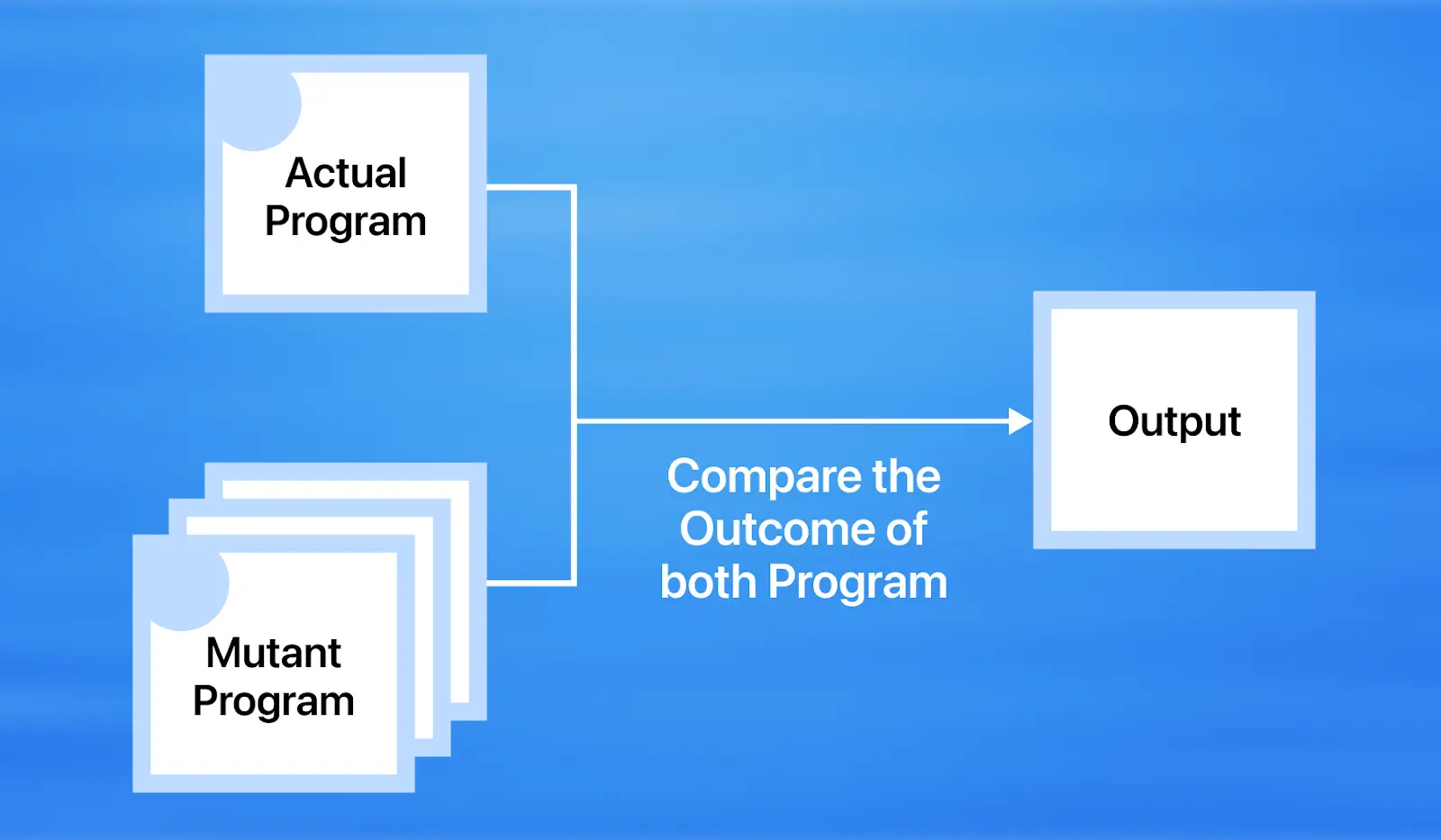
- Create test cases
- Create mutants
- Running of test cases
- Comparison of results
- Repetition
A specific test case needs to be created for the functionality of software applications requiring mutation testing. You can run the test case against this software application.
Next, introduce small faults into the source code by creating many versions called mutants, each carrying a single fault. Every mutant is expected to fail, revealing how effective the test cases are.
Run the test cases against both the original and each mutant. The cases must be thorough enough to detect the injected errors.
Compare the original and mutant results. If they differ, the test cases caught the fault, so the mutant is killed.
If the results match, the test cases missed the fault, and the mutant stays alive.
You can repeat the same procedure for the remaining test cases of the test suite.
Knowing the outcomes of the test process matters. The next section covers the outcomes of mutation testing in brief.
Mutation testing outcomes
Mutation tests yield several distinct outcomes, including
- Mutant Program
- Alive or Dead Mutant
- Mutation Test Case
- Mutation Score
Each mutation run produces mutant programs that mirror the flaws your test cases can uncover. They stay close to the original but carry subtle, important differences.
Working through those differences helps you find and fix small issues, improving the reliability of the software under development.
After the run, each mutation is classified as killed or alive, showing whether the tester or tooling caught the coding issue. A mutant left alive points to shortcomings in the test cases.
The QA team uses dedicated mutation-specific test cases to log details about their mutant programs. Each one documents the mutation thoroughly, including its impact on the program.
The ideal objective is a mutation score of 100%, meaning the testing procedures located and eliminated every mutant. A high score is the best outcome of mutation testing.
With the above outcome, a mutation test can also uncover errors and bugs in the program code of the software applications.
Error detected in mutation testing
Mutation tests primarily bring to light issues within the testing procedure itself. With this in mind, here is a spectrum of problems that these evaluations can assist in identifying:
- Ambiguous test cases
- Inexperienced testing team
- Inadequate testing software
- Unoptimized code
A low mutation score signals that the team's test cases may not cover every potential error. They likely need more specificity, and should include every practical scenario the team meets during testing.
Mutation tests also gauge team capability. When testers cannot detect mutants despite clear, detailed test cases, the gap often lies in how they apply those cases.
In this way, mutant programs surface issues across the process, including signs of unskilled or untrained testers.
When a company checks its testing tools this way, it may find they fail to identify or eliminate mutant code. The team then explores alternatives until one fits their test cases.
A tool that cannot detect mutated code will likely struggle with other issues in the software too.
Mutation testing can expose pre-existing issues. While mutating the code, testers may spot critical defects themselves, revealing flaws beyond the testing process.
The more thoroughly they exercise the code, the more issues the team uncovers and fixes during the testing phase.
Mistakes in implementing mutation testing
Code mutation analysis is a procedure that necessitates careful implementation to prevent significant issues or oversights. Here, we outline seven pitfalls that testers should avoid when performing mutation tests:
- Incorrect scaling of mutations
- Invalid or functional mutations
- Incompatibility of test cases
- Adherence to deadlines and schedules
- Insufficient test coverage
- Appropriate use of mutants
- Excessive mutations
Scale matters. The process should help testers find real errors, so mutations that are too obvious fail to evaluate their ability to detect or address issues.
Even when scaled well, some mutations offer limited value, for instance when they trigger no fault. Testers should watch how each alteration affects the whole application.
Test cases and mutations must align. Whether choosing mutations or designing initial cases, the QA team should confirm compatibility for a smoother testing process.
Phases vary in duration but must respect internal deadlines. Teams that fail to schedule mutation tests well may miss them, so set a full testing schedule before the testing stage.
Even with random mutations, broad coverage stays essential. To ensure testers and software catch varied mutants, tests should include at least value, decision, and statement mutations.
Mutation testing offers a fresh perspective, but it should only evaluate the testing process. Teams must understand its precise capabilities and limits, using it to complement other software checks.
Broad coverage matters, but too many mutations hurt. Each demands significant compute, capping how many run simultaneously, and overloading can also jeopardize testing deadlines.
Best Practice of mutation testing
Several best practices strengthen mutation testing: thorough test case creation, mutation score tracking, and regular integration into your process. The key ones are below.
- Maximize the mutation score
- Randomly select mutants
- Keep changes incremental
- Limit mutations to one per program
- Carefully consider automation software
- Using test-driven development (TDD)
The mutation score is the percentage of mutants a team detects and kills. If a round involves 40 mutants and testers catch 36, the score is 90%. The goal is always 100%.
Under tight deadlines, testers benefit from choosing mutants at random while still prioritizing key components. As long as the selection spans significant mutation types, the QA team can validate overall strategy effectiveness.
Mutated code should differ only slightly from the original. This shows how readily testers spot specific errors and how sensitive the software is to minor coding issues. Balance keeps every small change detectable.
Mutation analysis assesses each test case in isolation, so each mutant should introduce just one change. Multiple mutations can conflict and align poorly with test cases.
Many teams use code mutation to confirm their automation software catches errors as well as a human tester. Choosing the right platform, and weighing robotic process automation, becomes a critical decision.
Test-driven development integrates testing into every development stage. Using TDD keeps test cases compatible with the application and helps them pass the mutation test.
Conclusion
Mutation testing is a fault-driven approach that modifies source code and runs it against your test suites to uncover faults. Once seen as slow and costly, it has gained ground thanks to new automation tools.
Like any method, it has limits, so implement it carefully using the best practices covered here.
These mutations let teams assess their methodology and measure how well it identifies and fixes source-code errors. Because it fits automation well, teams can validate the platforms they rely on for testing.
Adopt mutation testing in your projects to validate their efficiency and accuracy.
Author

Nazneen Ahmad
Blogs: 41


Nazneen Ahmad is a freelance Technical Content SEO Writer with over 6 years of experience in crafting high ranking content on software testing, web development, and medical case studies. She has written 60+ technical blogs, including 50+ top-ranking articles focused on software testing and web development. Certified in Automation Basic and Advanced Training - XO 10, she blends subject knowledge with SEO strategies to create user focused, authoritative content. Over time, she has shifted from quick, keyword-heavy drafts to producing content that prioritizes user intent, readability, and topical authority to deliver lasting value.


Frequently asked questions
Did you find this page helpful?
More Related Blogs
TestMu AI forEnterprise
Get access to solutions built on Enterprise
grade security, privacy, & compliance
- Advanced access controls
- Advanced data retention rules
- Advanced Local Testing
- Premium Support options
- Early access to beta features
- Private Slack Channel
- Unlimited Manual Accessibility DevTools Tests