

Power Your Software Testing with AI Agents and Cloud
The Native AI-Agentic Cloud Platform to Supercharge Quality Engineering. Test Intelligently and Ship Faster.


- TestMu AI (Formerly LambdaTest)
- /
- Learning Hub
- /
- QA Engineer: Skills, Salary, and How to Become One in 2026
QA Engineer: Skills, Salary, and How to Become One in 2026
What a QA engineer actually does day to day, the skills and salary to expect in 2026, the route in from other roles, and how the AI QA engineer role differs from the conventional one.
Last Updated on:
On This Page
- What is a QA Engineer?
- What Does a QA Engineer Do?
- QA Engineer vs SDET vs QA Analyst
- Essential Skills in 2026
- How to Become a QA Engineer?
- QA Engineer Career Path
- How Much Does a QA Engineer Make?
- Will AI Replace QA Engineers?
- What Is an AI QA Engineer?
- Tools and Technologies
- Key Metrics to Track
- Challenges Faced by QA Engineers
- Future Outlook and Career Planning
- Sources
- Conclusion
QA engineering is one of the few software roles where the title stayed the same for a decade while the work underneath it changed almost completely.
Someone who once wrote test cases in a spreadsheet now maintains automation suites, wires tests into CI/CD pipelines, and reviews what an AI agent generated.
This guide covers what the role involves in 2026, what it pays, how to get into it, and whether AI is about to make it obsolete.
TL;DR
A QA engineer is a software professional who verifies that an application works correctly before it reaches users. They decide what needs testing, run manual and automated checks, report defects to developers, and confirm fixes hold. The goal is preventing defects, not only catching them late.
What Should You Know Before Choosing This Career?
- Median US pay: $102,610 a year for QA analysts and testers as of May 2024, according to the U.S. Bureau of Labor Statistics.
- Median India pay: Rs 6,91,500 average on Glassdoor as of May 2026, with a typical band of Rs 4,50,000 to Rs 10,00,000.
- Coding expectation: Most 2026 openings assume working knowledge of one automation language, usually Java, Python, or JavaScript.
- Common entry route: Manual testing first, then automation, then either an SDET track or quality engineering leadership.
- Best-known certification: ISTQB Foundation Level works as a hiring signal but does not substitute for a portfolio of real test work.
- AI impact: Specific tasks such as drafting cases and repairing selectors are being automated. Deciding what is worth testing is not.
What Separates a Senior QA Engineer?
Judgment about risk rather than volume of tests: knowing what not to test, pushing checks down to the cheapest level that catches the defect, and explaining that reasoning to people outside QA. Day to day the work runs on shared infrastructure, and TestMu AI provides the cloud grid of 3,000+ browser and OS combinations and 10,000+ real devices that those suites execute on.
What is a QA Engineer?
A QA engineer is a software professional who verifies that an application works correctly before it reaches users, deciding what to test, running manual and automated checks, and reporting defects.
The word "quality" in the title does a lot of work, because a QA engineer is not only a bug finder.
Preventing defects is the stronger half of the job: questioning requirements before code is written, spotting edge cases nobody considered, and building infrastructure that catches regressions automatically.
That is the difference between testing and quality assurance as a discipline. Testing is an activity. Quality assurance is ownership of whether the product is safe to ship.
What Does a QA Engineer Do?
A QA engineer plans what to test, executes manual and automated checks, reports defects with reproducible detail, and confirms new changes have not broken functionality that already worked.
Those four responsibilities repeat every release cycle, regardless of company size or industry.
- Test planning and design - deciding what to test, at which layer, and what counts as a pass
- Test execution - running manual, exploratory, and automated checks across browsers, devices, and environments to find where behavior diverges from expectation.
- Defect reporting - documenting failures so a developer can reproduce them without a conversation, then tracking them to resolution.
- Regression and release safety - confirming new changes broke nothing, and giving an honest read on release risk.
In practice, little of a QA engineer's week looks like clicking through an app. Here is how the time typically distributes on a team running two-week sprints.
| Activity | What it involves | Rough share of the week |
|---|---|---|
| Automation development and maintenance | Writing new test scripts, fixing brittle selectors, updating suites after UI changes | Largest single block |
| Exploratory and manual testing | Unscripted investigation of new features, edge cases, and usability problems | Substantial, concentrated near release |
| Triage and defect reporting | Reproducing failures, isolating root cause, filing and re-verifying bugs | Steady daily overhead |
| Requirement and design review | Reading specs before implementation and raising testability gaps early | Front-loaded in the sprint |
| Pipeline and environment work | Keeping tests running in CI/CD, managing test data and environments | Bursty, often the hidden time sink |
Most career guides omit that last row. On the teams I have worked with, environment and pipeline upkeep quietly outgrew every other line item on the list.
It surprises people who enter QA expecting to test all day. Much of the role is keeping the testing machinery itself alive.

Note: Job titles lag the work by years. Before applying anywhere, read the responsibilities section of the posting and ignore the title, because the same title covers substantially different jobs at different companies.
What Is the Difference Between a QA Engineer, an SDET, and a QA Analyst?
The difference is how much code each role writes. A QA analyst designs and runs test cases, a QA engineer mixes manual testing with automation, and an SDET builds the frameworks both of them use.
Companies apply these titles inconsistently, which is what makes job hunting confusing. The table below shows where each role actually sits.
| Parameters | QA Analyst | QA Engineer | SDET |
|---|---|---|---|
| Primary focus | Test case design and manual execution | Mix of manual testing and automation | Building test frameworks and tooling |
| Coding expectation | Little to none | Working knowledge of one language | Developer-level proficiency |
| Typical output | Test plans, defect reports, sign-off | Automated suites plus exploratory coverage | Frameworks, harnesses, CI/CD test infrastructure |
| Sits closest to | Product and business analysis | The delivery team | The engineering org |
| Common next step | QA engineer | SDET or QA lead | Senior engineering or platform roles |
A posting that asks for framework design, API-level testing, and CI/CD ownership is an SDET role regardless of its title.
One emphasizing test case coverage and release sign-off with no automation requirement sits closer to a manual QA tester role. Read the responsibilities, not the title.
What Skills Do QA Engineers Need in 2026?
QA engineers need testing fundamentals, one programming language, an automation framework, and defect tracking. API testing, CI/CD literacy, and AI-assisted testing separate the senior engineers.
Job descriptions list far more than anyone actually has, so it helps to separate what gets you hired from what gets you promoted.
| Tier | Skill | Why it matters |
|---|---|---|
| Required | Testing fundamentals | Test design techniques, defect lifecycle, and knowing which testing type addresses which risk |
| Required | One programming language | Java, Python, or JavaScript. Depth in one beats surface familiarity with three |
| Required | An automation framework | Selenium, Playwright, or Cypress, including how to keep suites stable as the UI changes |
| Required | Defect tracking and version control | Jira and Git are assumed knowledge on nearly every team |
| Differentiating | API and database testing | Postman and SQL. Many defects are invisible from the interface, and this is a common interview filter |
| Differentiating | CI/CD pipeline literacy | Tests that do not run automatically on every change deliver a fraction of their value |
| Differentiating | Performance testing | JMeter or k6. Load behavior is where quality problems become revenue problems |
| Differentiating | AI-assisted testing | Using AI to generate and maintain tests, and knowing when to distrust what it produces |
| Underrated | Written communication | A defect report that cannot be reproduced is worth nothing. This is the skill that most limits careers in practice |
| Underrated | Risk judgment | Deciding what not to test, and being able to defend that call to a product manager before a release |
The two rows at the bottom rarely appear in job descriptions and consistently separate engineers who plateau from engineers who get promoted.
Skip the setup and install the Selenium Skill for Claude Code, Copilot & Cursor with one command.

How to Become a QA Engineer?
Becoming a QA engineer takes eight steps: learn development basics, testing methods, QA tools, and a programming language, then add a certification, hands-on projects, and communication skills.
No single degree or fixed entry route exists, which is both the appeal and the confusion of this career.
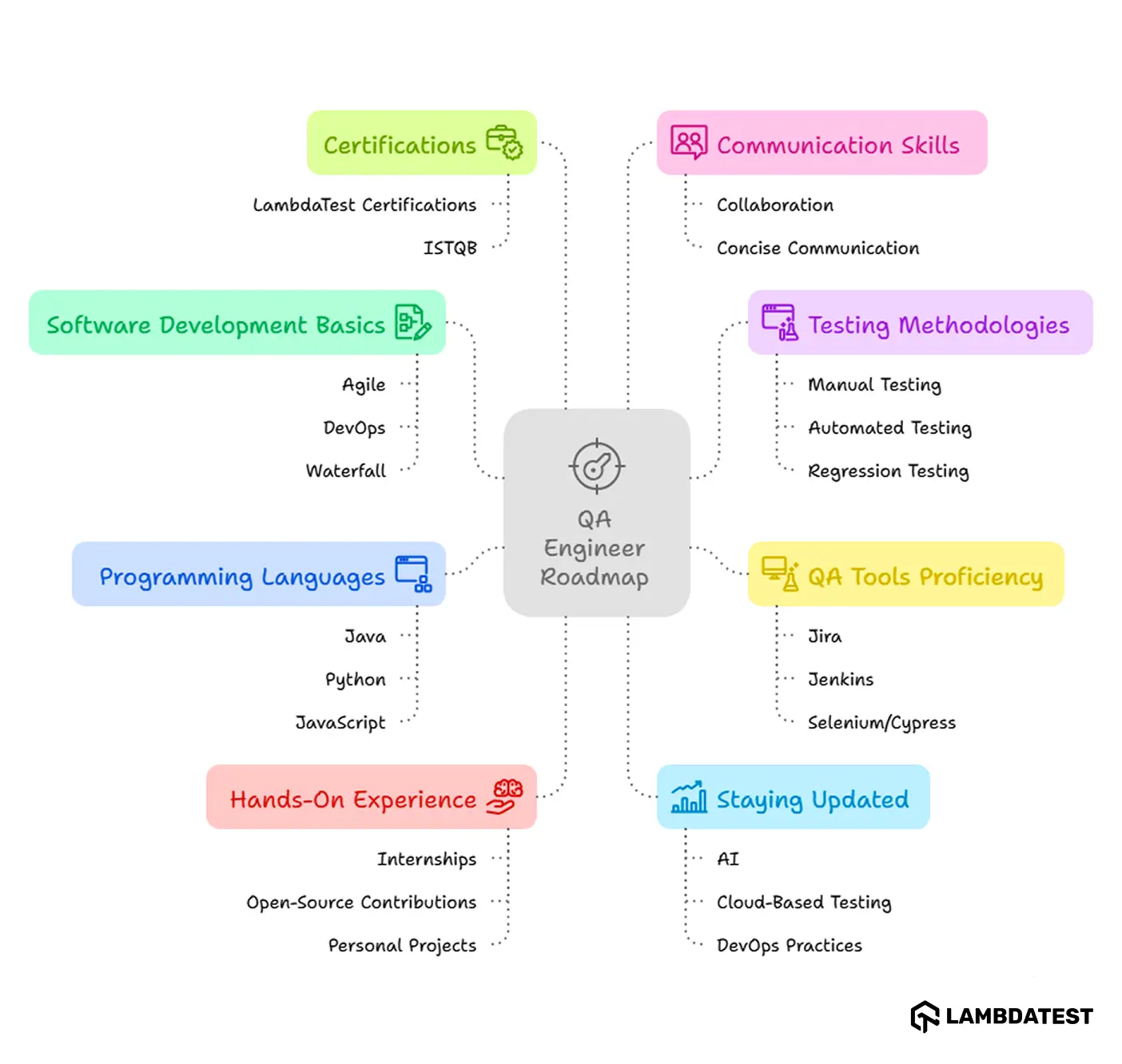
1. Understand Software Development Basics
Learn how Agile, DevOps, and Waterfall teams actually run, because the delivery model dictates when testing happens and how much time you get.
Reading live job descriptions is the fastest way to calibrate what employers currently expect. These careers pages stay current as roles open and close:
- Amazon quality assurance engineer openings
- Microsoft software quality assurance openings
- Google test engineer openings
2. Learn Testing Methodologies
Four techniques cover most of what you will be asked to do in an entry-level role:
- Manual testing - exploring the application by hand to find what scripted checks miss
- Automation testing - using frameworks like Selenium and Playwright to run repeatable checks at speed
- Regression testing - confirming new changes do not break functionality that already worked
- API testing - validating request and response behavior below the interface, where many defects actually live
3. Gain Proficiency in QA Tools
Learn essential QA tools such as:
- Jira - defect tracking and test case management
- Jenkins or GitHub Actions - running tests continuously on every code change
- Selenium, Playwright, or Cypress - browser automation
- Postman - API request testing and validation
Depth in two of these beats shallow familiarity with all of them. Interviewers probe for the failure modes you have personally debugged, not the tool names on your resume.
4. Learn Programming Languages
Pick one language and go deep. Python is the gentlest entry, Java dominates existing enterprise Selenium suites, and JavaScript fits teams running Playwright or Cypress.
You need enough fluency to debug someone else's test code, not only write your own. That is the level interviews probe.
5. Take Certifications
ISTQB certification at Foundation Level is the most widely recognized entry credential and appears by name in many job descriptions, particularly across Europe and India.
It validates vocabulary and process knowledge rather than hands-on skill, so treat it as a filter-passing signal, not proof of competence.
Credentials vary a lot in what they actually signal to a hiring manager. For a fuller comparison of what each one is worth, see our guide to QA certifications.
Whichever route you pick, pair it with work you can show. A credential opens the screening call; the portfolio decides the rest.
If cost is the blocker, TestMu AI runs free testing certifications covering Selenium, Playwright, and automation fundamentals.
6. Get Hands-On Experience
Interviews turn on this step. Build a small automation framework against a public site, put it on GitHub, and be able to explain every design choice in it.
Contributing to TestMu AI public projects works too, and gives you code review feedback from working engineers.
The TestMu AI Open Source program adds a few benefits on top:
- Unlimited open-source testing - run tests across 10,000+ real browsers and devices for free
- Financial sponsorship - support for scaling, infrastructure, and new feature development
- Visibility - coverage through TestMu AI blog features and social channels
- Mentorship - expert guidance on growing your open-source project
- Community - a global network of testers and contributors to collaborate with
7. Develop Communication Skills
The practical test is whether a developer can reproduce your defect without asking you a single question. Write the report so the answer is yes.
Harder still is arguing for a delayed release without sounding obstructive, which is what gets QA engineers taken seriously.
8. Stay Updated
Testing tooling turns over quickly, so track AI-assisted testing, cloud execution, and CI/CD practice rather than memorising any single tool.
What Is the Career Path for a QA Engineer?
The path runs from manual tester to automation-capable QA engineer, then to SDET or senior engineer, and on to QA lead or quality engineering manager, with specialist tracks branching off it.
QA has an unusually wide ceiling for a role people often enter without a computer science degree. Titles vary, and plenty of engineers skip or repeat stages.
| Stage | Typical experience | What changes at this stage |
|---|---|---|
| Manual or exploratory tester | 0 to 2 years | You learn the product and the craft of finding defects. Coding is optional, which is why this is the common entry point and also why it is the stage most exposed to automation. |
| QA engineer with automation | 2 to 5 years | You start writing and maintaining test code. This is the transition that unlocks most of the salary growth in the field. |
| SDET or senior QA engineer | 5 to 8 years | You build the frameworks other testers use, own CI/CD test infrastructure, and make architectural calls about testability. |
| QA lead or quality engineering manager | 8 years and beyond | You own release risk across teams, set quality strategy, and are measured on escaped defects rather than tests written. |
| AI-augmented QA and specialist tracks | Varies | Performance, security, or AI-assisted testing specialisms. These pay well because the supply of engineers who genuinely understand them is still thin. |
Row two is the most consequential move on this path. Engineers who stay purely manual find their options narrowing, while those who automate keep both tracks open.
If you are weighing that jump, the manual QA tester guide linked earlier covers where the boundary between the two roles sits today.
Note: Salary aggregators vary widely because they mix job titles. Compare like for like before using any figure in a negotiation, and check whether the number covers QA analysts, QA engineers, or SDETs, since the gap between them is large.
How Much Does a QA Engineer Make?
QA engineers earned a median of $102,610 a year in the United States as of May 2024, according to the U.S. Bureau of Labor Statistics, which reports that median for software quality assurance analysts and testers and projects the combined developer and QA occupation group to grow 15 percent from 2024 to 2034, with about 129,200 openings a year.
That median is roughly double the median across all occupations.
Worth knowing if you have seen lower figures quoted on bootcamp and training sites, which tend to report entry-level bands as though they were the whole market.
The India figures come from Glassdoor self-reported QA engineer salary data as of May 2026. Glassdoor requires a sign-in to view the underlying spread, so treat these as indicative rather than audited. Full breakdown below.
| Market | Figure | Source and date |
|---|---|---|
| United States, median | $102,610 a year | U.S. Bureau of Labor Statistics, May 2024 |
| India, average | Rs 6,91,500 a year | Glassdoor, May 2026 |
| India, 25th percentile | Rs 4,50,000 a year | Glassdoor, May 2026 |
| India, 75th percentile | Rs 10,00,000 a year | Glassdoor, May 2026 |
| India, 90th percentile | Rs 16,95,000 a year | Glassdoor, May 2026 |
Three factors move these numbers more than years of experience alone.
Automation capability is the largest, since engineers who write test code are compensated closer to developers than to testers. Domain specialism in fintech and healthcare adds a premium.
Location still matters, though the gap has narrowed as remote hiring became normal.
Because the growth projection cited above covers the whole developer and QA occupation group rather than QA in isolation, read it as a direction of travel, not a precise forecast for QA alone.
Will AI Replace QA Engineers?
AI is replacing specific QA tasks rather than the role. Test generation, script maintenance, and visual diffing are automating fast, while deciding what to test and owning release risk are not.
Most career guides avoid answering this directly, so it is worth being specific about which tasks fall on which side of the line.
| Task | How exposed it is to AI |
|---|---|
| Writing boilerplate test scripts | Highly exposed. Generation from a description is already routine |
| Maintaining brittle selectors after UI changes | Highly exposed. Self-healing locators handle much of this today |
| Visual regression comparison | Highly exposed. Automated diffing outperforms manual comparison |
| Generating test data and edge case permutations | Substantially exposed, though the output still needs review |
| Deciding what is worth testing given limited time | Barely exposed. Requires product and business context AI does not hold |
| Judging whether a failure actually matters | Barely exposed. Distinguishing a real defect from noise is a judgment call |
| Owning release risk and defending a no-ship call | Not exposed. This is accountability, and accountability does not transfer to a tool |
| Exploratory testing driven by suspicion | Lightly exposed. Noticing that something feels wrong remains a human strength |
That split carries an uncomfortable implication worth stating plainly. The roles most at risk are entry-level manual testing positions, exactly where most people have historically entered the field.
Avoiding AI tooling is not the answer. Moving up the value chain faster than the tooling advances is.
Engineers who specify what should be tested, review generated suites critically, and own the quality decision are becoming more valuable, because more generated output now needs someone accountable to check it.
In this TestMu Conf 2026 session, Impu Chunchegowda, Senthil Kannan, and Todd Lemmonds put senior QE leaders on the record about the org chart of 2027, including the roles they are hiring for that did not exist two years ago: QE at Enterprise Scale - What Will a QE Org Look Like in 2027?

For a wider view of how teams are adopting these tools, see our coverage of AI in QA.
What Is an AI QA Engineer?
An AI QA engineer is a QA engineer whose work includes testing AI-powered features and using AI tooling to test everything else. The title covers two distinct jobs that job descriptions often blur: validating non-deterministic systems, and operating AI test tooling against conventional software.
The distinction matters when you read a job posting. One version asks you to test a chatbot, a recommendation engine, or a retrieval system whose output changes between identical runs. The other asks you to use AI app testing tools for authoring and triage on an ordinary web application. The skills overlap only partly.
| Dimension | QA engineer | AI QA engineer |
|---|---|---|
| What is under test | Deterministic software, where the same input yields the same output. | Often a probabilistic system, where identical inputs can yield different valid outputs. |
| What a pass means | An assertion matched an expected value. | An output met a defined quality bar, often scored rather than matched exactly. |
| Core added skill | Automation frameworks, CI, and defect analysis. | Evaluation design: building datasets, choosing metrics, and deciding what counts as good enough. |
| Main failure mode | A brittle test that fails when nothing is broken. | A check that passes while the behaviour is wrong, because nothing meaningful was asserted. |
The demand signal behind the title is about skills turning over rather than headcount shifting.
PwC's 2025 Global AI Jobs Barometer found that the skills sought by employers are changing 66% faster in occupations most exposed to AI, up from 25% the previous year.
That figure covers AI-exposed occupations generally rather than QA specifically. Read it as a job description that keeps moving rather than one that disappears.
Four capabilities separate the role from a conventional QA post, and none of them require abandoning what you already do:
- Evaluation design - Assembling a dataset of inputs with defined expectations, then scoring outputs against it. This replaces the exact-match assertion when the output is free text, and it is the single most transferable skill in the role.
- Non-determinism handling - Knowing when a difference between two runs is a defect and when it is normal variance. Rerunning a pinned input rather than the latest build is the practical technique.
- Prompt and model change control - Treating a prompt as a versioned artifact with a baseline, so a wording change cannot silently degrade behaviour. Our guide to prompt evaluation covers versioning and drift in detail.
- AI-assisted authoring and triage - Using AI tooling to generate coverage and localize failures, then reviewing what it produced. The review is the job; the generation is the tool.
The transition is usually additive rather than a career change. A QA engineer who already owns a suite and understands release risk needs the evaluation half, which is learnable on the job by starting with one AI feature and building a small scored dataset for it. The AI in QA guide linked earlier covers the practice side of that shift.

Which Tools Do QA Engineers Use?
QA engineers use Jira for defects, Jenkins or GitHub Actions for continuous runs, Selenium or Playwright for browser automation, Postman for APIs, and Docker for reproducible environments.
Tool lists date quickly, but the categories do not. Here is what each one is actually for:
- Jenkins or GitHub Actions - running the suite on every code push, so failures surface in minutes
- Jira - logging defects, tracking status, and managing test cases. Central to the workflow, not only a bug tracker
- Postman - sending API requests, validating responses, and automating API-level checks that run far faster than UI tests
- Cucumber - writing acceptance tests in Gherkin, a plain-language syntax that non-technical stakeholders can read and confirm
- Docker - running tests in isolated, reproducible environments so a failure means a real defect rather than a machine difference
- Cloud testing platforms - executing tests across browser and device combinations you cannot maintain locally
Which Metrics Should QA Engineers Track?
Track escaped defects, defect density, test coverage, defect resolution time, and suite stability. Escaped defects matter most, since they measure what testing missed rather than what it did.
Most QA dashboards measure activity rather than outcomes, which is why they get ignored. These five tell you whether testing is working:
- Escaped defects - what users found after release. The most honest measure of whether testing worked
- Defect density - defects relative to the size of the application, useful for comparing quality across modules
- Test coverage - the share of code exercised by tests. A floor, not a target, since trivial-path coverage proves little
- Defect resolution time - how long fixes take once reported, which exposes bottlenecks between QA and development
- Test suite stability - how often tests fail for reasons unrelated to a defect. Ignored suites have no value
Test case counts belong on none of these lists. I have yet to see that number change a single release decision.
For a deeper treatment of how to choose and report these, see our guide to QA metrics.
What Challenges Do QA Engineers Face?
The recurring challenges are compressed timelines, flaky test suites, constant tooling churn, system complexity that makes defects hard to reproduce, and the politics of raising risk late.
None of these are solved by testing harder, which is why they persist on nearly every team:
- Compressed timelines - testing absorbs the slippage from every stage before it, so the time available shrinks as the deadline approaches
- Flaky test suites - automation that fails intermittently erodes trust fast, and rebuilding that trust costs more than writing the tests did
- Tooling churn - frameworks and platforms change constantly, and keeping suites current competes directly with writing new coverage
- System complexity - modern applications span services, integrations, and environments, which makes reproducing a defect harder than finding it
- Being the bearer of bad news - raising risk late is politically uncomfortable, and doing it well is a real skill
Flakiness is the one I have watched sink more automation programmes than any technical limitation. Once a team re-runs failures by reflex, the suite has stopped being a signal.
Interviewers probe these deliberately, because how a candidate handles them reveals more than any technical answer. Our guide to QA interview questions covers how to answer them well.
What Is the Future of QA Engineering?
QA is shifting from finding defects to preventing them. AI-assisted testing, shift-left practices, CI/CD ownership, performance and security depth, and domain specialism are reshaping the role.
Demand for quality skills is steady, but the shape of the work is moving faster than the job title suggests. Five trends are worth planning around:
- AI-assisted testing - generation and self-healing locators are becoming default, raising the bar on reviewing output rather than producing it
- Shift-left and DevOps integration - QA is expected to contribute to CI/CD pipelines, not receive builds at the end
- From QA to quality engineering - teams are measured on defects prevented, not defects found
- Performance and security depth - JMeter, k6, and OWASP ZAP skills command a premium as these become explicit release criteria
- Domain specialism - fintech, healthcare, and other regulated fields pay more because compliance context cannot be picked up quickly
All five reward engineers who move toward decisions and away from execution. Choosing one specialism and going deep beats staying broad and shallow.
Sources
Salary and employment figures on this page come from the following primary sources:
- U.S. Bureau of Labor Statistics - median wage $102,610 (May 2024), 15 percent projected group growth to 2034
- Glassdoor India, QA engineer salaries - average of Rs 6,91,500 a year from 7,744 reported salaries, May 2026
Conclusion
QA engineering in 2026 is a healthy career with a moving entry bar. Pay sits well above the median for all occupations, and the progression runs further than most people expect.
What has changed is that the manual-only entry route is narrowing.
Engineers doing well learned to automate early, then kept moving toward the decisions AI cannot make: what to test, what a failure means, and whether the release ships.
For anyone starting now, treat automation as the baseline and judgment as the goal.
To keep going, the natural next step is our guide to the QA process, which covers how quality work fits into a delivery cycle.
Author

Kavita Joshi
Blogs: 14


Kavita Joshi is a Senior Marketing Specialist at TestMu AI, with over 6 years of experience in B2B SaaS marketing and content strategy. She specializes in creating in-depth, accessible content around test automation, covering tools and frameworks like Selenium, Cypress, Playwright, Nightwatch, WebdriverIO, and programming languages with Java and JavaScript. She has completed her masters in Journalism and Mass Communication. Kavita’s work also explores key topics like CSS, web automation, and cross-browser testing. Her deep domain knowledge and storytelling skills have earned her a place on TestMu AI’s Wall of Fame, recognizing her contributions to both marketing and the QA community.
Reviewer

Shahzeb Hoda
Reviewer
Shahzeb Hoda is the Associate Director of Marketing and a Community Contributor at TestMu AI, leading strategic initiatives in developer marketing, content, and community growth. With 10+ years of experience in quality engineering, software testing, automation testing, and e-learning, he has authored and reviewed 70+ technical articles on software testing and automation. Shahzeb holds an M.Tech in Computer Science from BIT, Mesra, and is certified in Selenium, Cypress, Playwright, Appium, and KaneAI. He brings deep expertise in CI/CD pipeline automation, cross-browser testing, AI-driven testing practices, and framework documentation. On LinkedIn, he is followed by 3,700+ engineers, developers, DevOps professionals, tech leaders, and enthusiasts.


QA Engineer FAQs
Did you find this page helpful?
More Related Learning Hubs
TestMu AI forEnterprise
Get access to solutions built on Enterprise
grade security, privacy, & compliance
- Advanced access controls
- Advanced data retention rules
- Advanced Local Testing
- Premium Support options
- Early access to beta features
- Private Slack Channel
- Unlimited Manual Accessibility DevTools Tests