

Power Your Software Testing with AI Agents and Cloud
The Native AI-Agentic Cloud Platform to Supercharge Quality Engineering. Test Intelligently and Ship Faster.


- TestMu AI (Formerly LambdaTest)
- /
- Learning Hub
- /
- What is Digital Quality Assurance? Detailed Digital QA Guide
What is Digital Quality Assurance? Detailed Digital QA Guide
Learn what digital quality assurance (DQA) is, its process, and key challenges. Explore digital assurance testing frameworks, domains, and digital QA services.
Last Updated on:
On This Page
- What is Digital Quality Assurance
- Importance of Digital Quality Assurance
- The Evolution of Digital Assurance in the Modern Era
- Implementing the Digital Quality Assurance Process for Modern Enterprises
- Key Components of Digital Quality Assurance
- The Digital Assurance Framework (DAF)
- Specialized Digital QA Domains: IoT, AR/VR, and Blockchain Testing
- Digital Quality Assurance v/s Traditional QA
- Digital Quality Assurance v/s Digital Assurance
- Digital Assurance and Quality Engineering (DQE)
- Digital QA in Action: Industry Use Cases
- Challenge of Digital Quality Assurance
- Up and Coming Future Trends of Digital Quality Assurance
- Conclusion
Digital Quality Assurance delivers reliable, secure, and scalable digital experiences by covering functional testing, performance, security, usability, and compliance, all aligned with business outcomes.
Every business today is digital-first. Customers expect frictionless experiences across web, mobile, and connected platforms. If an app crashes, a payment fails, or a site loads too slowly, customers churn instantly.
Traditional QA methods are not enough. That is why digital quality assurance (DQA) is a must for 2025.
A McKinsey survey shows 89% of large enterprises are pursuing digital and AI transformation.
Yet they have realized only 31% of revenue gains and 25% of cost savings, which underlines the role of Digital QA in delivering business value.
Overview
Digital quality assurance (DQA) is the practice of validating end-to-end digital experiences across applications, devices, APIs, and platforms to ensure speed, security, accessibility, and reliability. Unlike traditional QA, DQA is outcome-driven, focusing on customer experience, regulatory compliance, and business outcomes.
Importance of Digital Quality Assurance
- Customer Experience: Digital quality assurance ensures consistent, frictionless user journeys across all devices, browsers, and geographies to prevent customer churn and build long-term brand trust.
- Safe Innovation: Integrating automated testing into CI/CD pipelines allows teams to accelerate software releases safely using shift-left and shift-right methodologies.
- Risk Mitigation: Real-device testing and observability-driven assurance validate interoperability and system resilience across complex, hybrid cloud ecosystems and third-party APIs.
- Compliance and Trust: Continuous security testing and automated vulnerability scans ensure compliance with strict regulatory frameworks like GDPR, HIPAA, and PCI-DSS.
Key Components of Digital QA
- Functional Assurance: Functional assurance validates that applications perform core workflows, business logic, and user journeys exactly as intended without errors.
- Performance Assurance: Performance assurance validates system speed, reliability, and resilience under load to prevent application slowdowns, crashes, and operational disruptions.
- Security Assurance: Security assurance embeds continuous vulnerability scans, penetration tests, and static or dynamic code analysis into the development lifecycle.
- Cross-Device and Cross-Browser Testing: Cross-device and cross-browser testing validates application behavior across thousands of real devices, operating systems, and browsers using cloud-based labs.
Implementing the Digital Quality Assurance Process
- Define Quality Goals: Defining quality goals involves aligning quality metrics directly with business outcomes, tracking experience-focused KPIs like page load times, application uptime, and conversion rates.
- Build a Quality-First Culture: Building a quality-first culture requires training teams in automation, AI-driven assurance, and security practices while encouraging developers to own early-stage quality.
- Set Up Scalable Environments: Setting up scalable environments involves using cloud-based digital labs like TestMu AI to test applications on over 10,000 real browsers, devices, and operating system versions.
- Prioritize Automation and Orchestration: Prioritizing automation and orchestration involves deploying AI-powered orchestration platforms like TestMu AI HyperExecute to auto-prioritize high-risk scenarios and run self-healing automation frameworks.
What is Digital Quality Assurance
Digital quality assurance (DQA) is the practice of validating end-to-end digital experiences across apps, devices, APIs, and platforms for speed, security, accessibility, and reliability.
Unlike traditional quality assurance, which focuses only on defect detection, digital QA confirms that every customer interaction meets its target across each device and channel.
By definition, digital quality assurance means making sure your platforms do not just work but work well: fast, secure, and consistent for customers everywhere.

SMAC Testing Callout
Note: Modern digital QA validates the four pillars of the SMAC stack: Social (community, sharing, and login integrations), Mobile (cross-device and network-condition coverage), Analytics (event tracking and data accuracy), and Cloud (elastic scale and resilience). Validate all four across real browsers and devices. Start testing free.
Importance of Digital Quality Assurance
Digital transformation is essential for modern enterprises, but without Digital Quality Assurance (DQA), even the best initiatives risk failure. Here is why it is important:
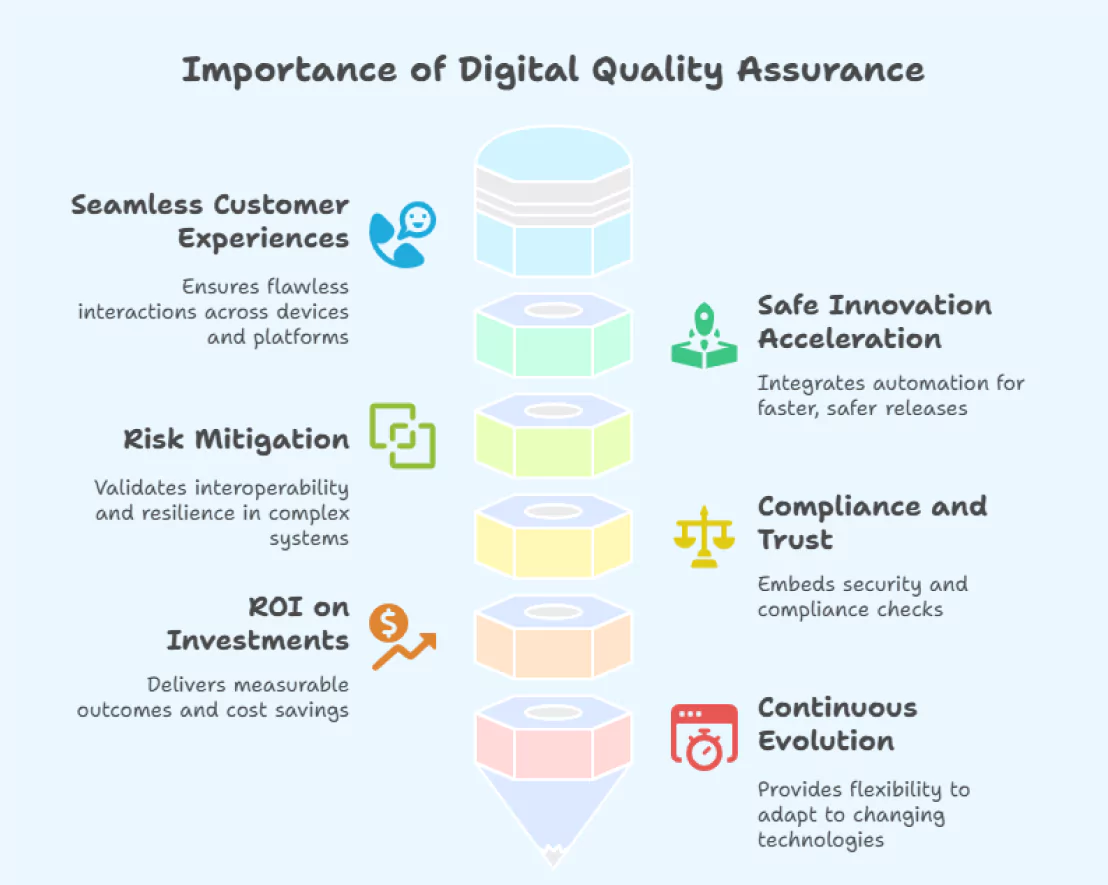
1. Enabling Consistent Customer Experiences
Digital transformation is meant to improve how customers interact with a brand. But a buggy app, a slow website, or an inaccessible service can undo years of innovation investment.
Digital quality assurance ensures every touchpoint, from login flows to checkout journeys, works flawlessly, regardless of device, browser, or geography.
- Without DQA: Inconsistencies, crashes, or slowdowns quickly erode customer trust.
- With DQA: Applications are validated across devices, browsers, and platforms, ensuring smooth, inclusive, and reliable digital journeys.
Every transformation initiative ultimately succeeds or fails based on customer adoption. DQA ensures that the digital promise translates into real-world satisfaction.
2. Accelerating Innovation Safely
One of the biggest goals of digital transformation is speed, releasing digital builds and features faster, responding to feedback quickly, and scaling on demand.
However, speed without assurance introduces risk, defects, downtime, or security breaches.
- Digital QA integrates automation and AI-driven testing into CI/CD pipelines, enabling teams to release faster while maintaining confidence in quality.
- By combining Shift-Left (early testing) and Shift-Right (production monitoring), DQA ensures speed and safety coexist.
3. Mitigating Risks in Complex Ecosystems
Digital transformation introduces complexity: hybrid cloud systems, third-party APIs, and globally distributed architectures. Each new component adds complexity.
- DQA validates interoperability across systems and ensures resilience under load.
- Real-device testing and observability-driven assurance make sure distributed systems behave as expected in real-world conditions.
Without DQA, complexity leads to chaos. With it, complexity becomes controlled innovation.

4. Ensuring Compliance and Trust
As digital footprints grow, so do risks. Businesses must also comply with strict regulatory frameworks like GDPR, HIPAA, and PCI-DSS. Data breaches or compliance failures can cause massive financial and reputational damage.
DQA embeds security assurance and compliance checks into the transformation lifecycle. It integrates security testing and compliance checks into the development lifecycle, ensuring transformation doesn’t come at the cost of trust.
Automated vulnerability scans, penetration tests, and audit-ready validation ensure compliance is continuous, not reactive.
5. Driving ROI on Transformation Investments
Digital transformation initiatives often involve millions of dollars in cloud migration, AI adoption, and process re-engineering. Without strong assurance, the ROI from these investments is uncertain.
Digital quality assurance ensures that every transformation project delivers measurable outcomes, improved uptime, reduced defects, and better customer satisfaction.
Some of the most impactful business benefits include:
- Faster Time-to-Market: Automation and continuous testing reduce release cycles by up to 80%, enabling quicker response to customer and market needs.
- Higher Release Confidence: Early defect detection lowers production issues by up to 70%, ensuring stable, reliable releases.
- Reduced Downtime Costs: Proactive assurance minimizes outages, saving enterprises millions in lost revenue and operational disruption.
- Optimized QA Costs: AI-driven test prioritization and automation cut manual testing effort, reducing overall QA spend.
- Increased Developer Productivity: With faster feedback loops, engineering teams spend less time fixing bugs and more time building features, improving productivity.
- Compliance & Risk Reduction: Continuous security and compliance testing help avoid penalties and reputational damage, safeguarding brand trust.
6. Supporting Continuous Evolution
Digital transformation is not a one-time event; it is a continuous journey as technologies evolve, customer expectations rise, and markets shift.
To keep pace, Digital QA provides the agility to adapt to new device ecosystems, operating systems, and user demands.
With AI and automation, assurance becomes adaptive, evolving in sync with digital strategies.
The Evolution of Digital Assurance in the Modern Era
Digital assurance has matured from simple post-release testing into a continuous, business-critical discipline.
Today, it uses intelligence, scalable infrastructure, and real-time validation to keep pace with rapid development cycles and complex digital ecosystems.
Here are few ways digital assurance adapts to this new reality:
1. Shift-Left & Shift-Right Testing
The old approach of testing only after development is too slow for today’s release cycles. Digital assurance embraces both Shift-Left and Shift-Right testing:
- Shift-Left: Testing earlier in the development cycle, integrating QA with design, coding, and unit testing to catch defects at the source.
- Shift-Right: Extending QA into production with real-user monitoring, canary releases, and continuous feedback loops.
2. AI Native QA
AI is shifting QA from a reactive, defect-finding role to a predictive, proactive discipline. Instead of waiting for issues to surface, AI-driven assurance uses data, intelligence, and automation to prevent failures and accelerate releases.
Key capabilities of AI-Native QA include:
- NLP-Based Test Authoring: Teams write test cases in plain English, and AI app testing tools like KaneAI convert them into executable scripts.
- Intelligent Test Planning: AI analyzes code changes, historical defects, and user behavior to automatically design test strategies that focus on high-risk areas.
- Smart Test Case Prioritization: By learning from past execution data, AI ranks test cases based on business impact and likelihood of failure.
- Anomaly & Flakiness Detection: AI identifies unusual patterns, unstable tests, or environment-related failures without human intervention.
- Predictive Risk Analytics: AI forecasts where defects are most likely to occur, enabling proactive fixes before they affect production.
- Self-Healing Automation: When applications change (e.g., UI updates), AI dynamically adapts test scripts to keep automation running smoothly.
Reduced manual effort, higher accuracy, and the ability to release at speed with confidence and resilience. Bundled into one system, those six capabilities describe an AI QA agent: it turns a customer journey described in natural language into a test plan, authors and runs the scripts across browsers and real devices, and repairs steps that break when the UI shifts, while your QA team signs off on each plan and each heal.
3. Cloud-Based Digital Labs
Maintaining physical device farms is expensive and inflexible. Cloud-based digital labs provide instant access to thousands of real devices, operating systems, and browsers. Coverage stays consistent while environments scale for large regression cycles.
With platforms like TestMu AI, teams can test new OS or browser releases on day zero, eliminating delays and ensuring market readiness.
4. Continuous Quality Engineering
Digital assurance goes beyond defect detection; it’s about embedding quality into every stage of the lifecycle. This continuous quality engineering mindset ensures that quality is:
- Designed into systems from the start
- Validated at every build and deployment
- Measured continuously against business outcomes
Implementing the Digital Quality Assurance Process for Modern Enterprises
Implementing digital quality assurance (DQA) is not about running more tests or adopting automation alone. It means building a culture, process, and technology ecosystem where quality becomes a continuous, measurable driver of digital success.
Below is a comprehensive roadmap for implementing digital QA effectively:
1. Define Quality Goals Linked to Business Outcomes
The first step is to reframe how you measure quality. Traditional QA tracks technical metrics like defect counts or test coverage.
Important as those are, they miss the full picture in the digital era. Align QA with business outcomes and customer expectations instead:
- Define experience-focused KPIs, such as page load times under xx seconds, xx% application uptime, or <x% error rates during peak traffic.
- Tie quality metrics directly to business metrics, conversion rates, retention, NPS, churn, and compliance posture.
- Set baselines and measure improvements continuously, not just at release milestones.
2. Build a Quality-First Culture and Upskill Teams
Technology alone cannot deliver quality; people and culture play the biggest role. Digital assurance thrives when every stakeholder, from developers to product managers, takes responsibility for quality.
- Train teams in automation, AI/ML-driven assurance, security practices, and compliance testing.
- Encourage a shift-left mindset where developers write tests and own early-stage quality.
3. Set Up Scalable Digital Testing Environments
In a fragmented digital world, customers may use your product on thousands of device/browser/OS combinations. Maintaining physical device labs is expensive, time-consuming, and quickly outdated.
- Use cloud-based digital labs (e.g., TestMu AI) to test on 10,000+ real browsers, devices, and OS versions.
- Mirror production conditions in test environments to avoid surprises after release.
- Scale environments elastically for regression suites or high-volume parallel testing.
4. Prioritize Test Automation and Intelligent Orchestration
At this stage, test scenarios are designed based on business priorities and risks. Automation plays a key role in ensuring speed and repeatability. AI-driven test selection and prioritization
- AI automates regression, API, integration, and cross-browser/device testing for speed and repeatability.
- Use AI-powered orchestration platforms like TestMu AI HyperExecute to auto-prioritize high-risk scenarios.
- Implement self-healing automation frameworks that adapt to UI or code changes without manual rework.
- Integrate continuous testing into CI/CD pipelines so that every code commit, build, or deployment triggers automated validations.
5. Integrate Security and Compliance by Design
In the digital age, a single security flaw or compliance violation can undo years of customer trust. Security and compliance must be baked into assurance, not added later.
- Automate vulnerability scans, penetration tests, and static/dynamic code analysis.
- Build compliance validation into CI/CD pipelines for GDPR, HIPAA, PCI-DSS, or ISO standards.
- Apply data masking, anonymization, and encryption in both test and production-like environments.
6. Use Analytics and Continuous Feedback Loops
Digital quality assurance is not a one-off; it’s a feedback-driven cycle. Insights from testing, monitoring, and customer usage must flow back into the QA strategy.
- Set up real-time AI-native test dashboards tracking test health, defect trends, and customer-impacting KPIs.
- Use observability tools (logs, metrics, traces) to detect hidden performance or reliability issues.
- Incorporate customer feedback (support tickets, surveys, usability testing) into QA planning.
7. Build a Unified Toolchain and Ecosystem
The success of digital QA depends on a well-integrated tool ecosystem. Disconnected tools create blind spots and inefficiencies.
Action Points:- Use modern frameworks (Selenium, Cypress, Playwright) for automation.
- Orchestrate execution with AI-native platforms like TestMu AI HyperExecute.
- Monitor system health with tools like Grafana, Prometheus, or New Relic.
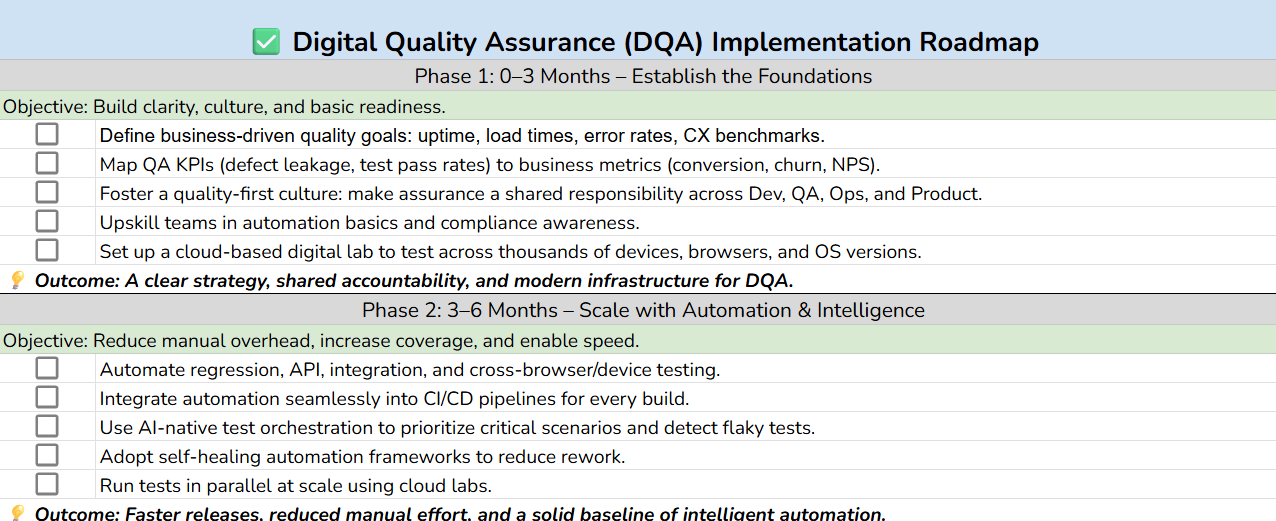
Note: A step-by-step checklist to help you implement Digital Quality Assurance and accelerate your journey toward faster, safer, and more reliable releases. Download the Digital QA Roadmap Checklist!
Key Components of Digital Quality Assurance
Modern digital quality assurance testing spans multiple dimensions, including functionality, performance, security, accessibility, and integration:
- Functional Assurance: Validates that applications perform core workflows, business logic, and user journeys exactly as intended without errors.
- Performance Assurance: Ensures digital platforms remain fast, stable, and scalable even under peak loads or unexpected traffic spikes.
- Security Assurance: Protects sensitive data, prevents unauthorized access, and maintains compliance with industry regulations and security standards.
- Cross-Device & Cross-Browser Testing: Delivers consistent, reliable, and user-friendly experiences across devices, operating systems, and different web browsers.
- Accessibility & Usability Testing: Ensures digital platforms are inclusive, easy to navigate, and compliant with accessibility standards like WCAG/ADA.
- API & Integration Assurance: Validates smooth communication between microservices, APIs, and third-party integrations for system reliability and stability.
7. Data Quality Assurance: Maintains accuracy, integrity, privacy, and compliance of business-critical data across storage, migration, and reporting processes.
The Digital Assurance Framework (DAF)
A Digital Assurance Framework (DAF) turns ad-hoc testing into a repeatable, business-aligned model. It structures assurance across four connected layers so quality scales with the digital ecosystem rather than lagging behind it.
- Strategy: Ties quality goals to business KPIs, risk appetite, and customer experience targets.
- Governance: Defines ownership, standards, tooling, and compliance guardrails across teams.
- Core Testing Pillars: Cover functional, performance, security, and accessibility assurance, with the SMAC stack (Social, Mobile, Analytics, Cloud) validated as connected layers.
- Continuous Feedback Loops: Feed production telemetry, defect trends, and user signals back into planning so assurance keeps improving.
Digital Testing vs. Digital Assurance: Digital testing is a task, executing cases to find defects in a build.
Digital assurance is the wider discipline governing strategy, governance, and outcomes, using a DAF to keep quality continuous and measurable.
Specialized Digital QA Domains: IoT, AR/VR, and Blockchain Testing
As digital ecosystems expand, digital QA increasingly reaches into specialized domains with testing needs that standard web and mobile assurance cannot fully cover.
- IoT Device Ecosystems: Test interoperability across firmware, sensors, gateways, and cloud back ends under intermittent connectivity, low power, and diverse hardware.
- AR/VR Immersive Experiences: Immersive apps need assurance of frame rates, latency, spatial tracking, rendering accuracy, usability, and motion comfort across headsets.
- Decentralized Blockchain Ledgers: Blockchain testing verifies smart-contract logic, consensus, transaction immutability, gas limits, and security of wallets and on-chain data.
Digital Quality Assurance v/s Traditional QA
Traditional QA focused on finding defects after development, while Digital Quality Assurance ensures quality is built in across the entire ecosystem.
| Aspect | Traditional QA | Digital Quality Assurance (DQA) |
|---|---|---|
| Focus | Detecting defects in applications after development | Delivering reliable digital experiences and business outcomes |
| Scope | Limited to software functionality | Covers apps, APIs, devices, browsers, cloud, and customer journeys |
| Approach | Reactive, testing at the end | Proactive: continuous, predictive, and outcome-driven |
| Speed | Slows down releases due to late testing | Accelerates time-to-market with automation and continuous validation |
| Tools | Manual testing + basic automation frameworks | AI, automation, cloud-based labs, observability, and analytics |
| User Experience | Not a priority, focus mainly on features | Central to assurance: performance, accessibility, and usability matter |
| Business Alignment | Technical metrics (defects, pass/fail rates) | Business-driven KPIs (conversion, uptime, NPS, compliance) |
| Scalability | Limited by in-house device labs and manual effort | Elastic, cloud-native infrastructure scales on demand |
Digital Quality Assurance v/s Digital Assurance
Though often used interchangeably, Digital Quality Assurance (DQA) and Digital Assurance (DA) serve slightly different purposes in the digital landscape.
| Aspect | Digital Quality Assurance (DQA) | Digital Assurance (DA) |
|---|---|---|
| Primary Focus | Ensures applications, data, and systems meet defined quality standards across functionality, performance, security, and usability. | Validates the entire digital ecosystem, including business processes, customer journeys, and outcomes. |
| Scope | Technical: testing apps, APIs, devices, browsers, and integrations. | Broader: covers technology plus business alignment, compliance, CX, and resilience. |
| Approach | QA-driven with emphasis on automation, AI, and real-device testing. | Business-driven with emphasis on value assurance and risk management. |
| Business Alignment | Links quality metrics (uptime, load time, error %). | Links digital transformation to business outcomes (customer trust, ROI, competitiveness). |
| Who Uses It | QA and engineering teams ensuring systems work as intended. | Business + IT leaders ensuring transformation initiatives deliver expected results. |
Digital Assurance and Quality Engineering (DQE)
Quality Assurance (QA) was once seen mainly as a gatekeeper activity: its role was to find defects after the software was built.
As businesses moved toward faster releases and digital-first strategies, this reactive model became insufficient.
That’s where Quality Engineering (QE) and Digital Quality Assurance (DA) come together to reshape the quality landscape.
- QA → Detecting Defects
Traditional QA ensures that software works by identifying bugs and reporting them. While necessary, this approach often comes late in the cycle and slows down delivery.
- QE → Preventing Defects
Quality Engineering takes a proactive approach. It embeds quality practices throughout development, from design to deployment. The goal is not just to test software but to build it right the first time.
- Digital Quality Assurance → Ensuring Experiences & Outcomes
Digital Assurance extends beyond defect detection or prevention. It validates whether the product delivers the intended customer experience, business outcomes, and resilience across devices, platforms, and digital ecosystems.
In simple terms:
- QA checks if the code works.
- QE ensures quality is built in.
- Digital Assurance ensures the entire digital journey, from app performance to security, usability, and compliance, is trustworthy and consistent.
Digital QA in Action: Industry Use Cases
Digital QA looks different across industries because the risks and journeys differ. A few concrete examples show how assurance maps to real business outcomes.
- E-commerce: Omnichannel carts must stay consistent across web, app, and store pickup. QA validates cart persistence, payment gateways, inventory sync, and checkout.
- Banking & Fintech: Transaction security is the priority. Assurance covers fraud checks, multi-factor authentication, encryption, and compliance so every transfer stays secure.
- SaaS: Continuous multi-tenant releases mean testing must confirm one tenant's change never leaks into another, while regression and performance suites keep pace.
To run digital QA at this scale across every device and browser, teams can validate these journeys on the TestMu AI automation cloud.
Challenge of Digital Quality Assurance
Even with its benefits, Digital Quality Assurance (DQA) comes with challenges that organizations must address strategically. Here are the key hurdles, and their solutions:
- Complex Ecosystems: Applications must work across countless devices, operating systems, browsers, and third-party integrations.
- Rapid Release: Continuous integration and deployment (CI/CD) pipelines reduce the time available for testing.
- Data Privacy & Compliance: Regulations like GDPR, HIPAA, and PCI-DSS add complexity to digital assurance.
- Evolving Technologies: Emerging tech like AI, IoT, and blockchain introduces new testing requirements.
- Skill Gaps: Teams may lack expertise in automation, AI, and specialized assurance domains.
Solution: Use cloud-based digital labs and automated cross-browser/device testing to ensure broad coverage without infrastructure overhead.
Solution: Adopt test automation, risk-based testing, and Shift-Left practices to detect defects early and keep pace with rapid releases.
Solution: Integrate compliance checks into QA processes and enforce data masking, encryption, and audit trails in test environments.
Solution: Use AI-driven testing tools, service virtualization, and domain-specific test frameworks to validate emerging systems effectively.
Solution: Invest in continuous training, upskilling, and partnerships with digital assurance service providers to bridge capability gaps.
Up and Coming Future Trends of Digital Quality Assurance
As digital ecosystems grow more complex, the scope of Digital Quality Assurance (DQA) will keep expanding beyond traditional testing into a strategic driver of resilience, trust, and innovation. Three key trends will define its future:
1. AI-Powered Agents and Chatbots in Digital Transformation
AI-powered chatbots and autonomous agents increasingly replace traditional workflows across customer support, sales assistance, and IT helpdesks. As these agents become business-critical, digital quality assurance must validate their accuracy, reliability, and ethical behavior.
- Testing AI chatbots for consistency in responses and compliance with policies.
- Ensuring AI agents deliver fair, bias-free customer experiences.
- Validating integrations with CRM, payment systems, and knowledge bases.
- Monitoring agent-to-agent workflows where multiple AI agents collaborate, such as one handling customer queries while another processes backend transactions, for coordinated outcomes.
In this future, DQA will not just test software code but will assure the trustworthiness of conversational AI and agentic automation that power digital-first enterprises.
Testing these agents and agentic workflows is now possible with TestMu AI Agent Testing.
TestMu AI introduced the Agent Testing platform which enables comprehensive testing for chatbots, voice assistants, and autonomous systems, ensuring accuracy, reliability, and faster releases.
By using AI agents to test other AI agents, you can validate complex real-world scenarios that traditional methods simply cannot handle.

2. Agentic AI in QA
The rise of agentic AI will reshape how quality is managed. Instead of relying only on human-driven automation, autonomous AI agents will:
- Execute test suites without manual intervention
- Detect anomalies in real time
- Auto-heal flaky tests and misconfigured environments
This means QA will shift from “automation at scale” to intelligence at scale, making testing faster, smarter, and more adaptive.
3. Observability-Driven Assurance
Quality won’t just be validated in test environments, it will be continuously monitored in production. By combining observability tools (logs, metrics, traces) with testing practices, teams will:
- Gain full visibility into system health
- Detect performance degradations before customers notice
- Correlate technical issues directly with business KPIs
This proactive approach will ensure always-on reliability across distributed systems and microservices.
4. End-to-End Ecosystem Validation
In the future, assurance won’t stop at applications. It will validate the entire digital value chain, including supply chains, APIs, third-party services, and business workflows. For example:
- Ensuring a retail platform syncs reliably with inventory systems and logistics providers
- Validating fintech apps across banking APIs and compliance frameworks
- Guaranteeing healthcare platforms integrate securely with wearables and patient portals
This broader lens will elevate digital assurance from testing software to safeguarding digital business ecosystems.
5. Hyper-Personalized Quality Assurance
As AI and data-driven personalization become mainstream, applications will behave differently for different users. Digital quality assurance will evolve to:
- Validate personalized recommendations and AI-driven user journeys
- Assure fairness and ethical use of customer data
- Guarantee inclusivity across demographics and accessibility needs
For instance, a streaming app must ensure that AI-curated recommendations remain relevant, unbiased, and responsive across geographies, languages, and user profiles.
Conclusion
Digital Quality Assurance is more than a testing strategy, it’s a business strategy for the digital age. It ensures reliability, resilience, and customer trust across every channel.
Organizations that adopt digital QA not only prevent failures but also deliver innovation faster, scale confidently, and maintain a competitive edge.
In short: Digital Quality Assurance = trust in the digital-first world.
Author

Bhavya Hada
Blogs: 29


Bhavya Hada is a Community Contributor at TestMu AI with over three years of experience in software testing and quality assurance. She has authored 20+ articles on software testing, test automation, QA, and other tech topics. She holds certifications in Automation Testing, KaneAI, Selenium, Appium, Playwright, and Cypress. At TestMu AI, Bhavya leads marketing initiatives around AI-driven test automation and develops technical content across blogs, social media, newsletters, and community forums. On LinkedIn, she is followed by 4,000+ QA engineers, testers, and tech professionals.


Frequently asked questions
Did you find this page helpful?
More Related Learning Hubs
TestMu AI forEnterprise
Get access to solutions built on Enterprise
grade security, privacy, & compliance
- Advanced access controls
- Advanced data retention rules
- Advanced Local Testing
- Premium Support options
- Early access to beta features
- Private Slack Channel
- Unlimited Manual Accessibility DevTools Tests