

Power Your Software Testing with AI Agents and Cloud
The Native AI-Agentic Cloud Platform to Supercharge Quality Engineering. Test Intelligently and Ship Faster.


- TestMu AI (Formerly LambdaTest)
- /
- Learning Hub
- /
- What is Database Testing
Database Testing: Step-by-Step Tutorial With Examples
Database testing checks data integrity, schemas, queries, and performance behind an app. Learn the process, types, test cases, tools, and best practices.
Last Updated on:
On This Page
- What Are Data and a Database?
- What Is Database Testing?
- How Does UI Testing Differ From Database Testing?
- What Is the Database Testing Process Step by Step?
- What Are the Advantages of Database Testing?
- What Are the Disadvantages of Database Testing?
- What Activities Does Database Testing Include?
- How Do You Test Across Multiple Database Types?
- What Aspects Should You Analyze in Database Testing?
- What Does a Database Testing Example Look Like?
- What Are Real-Time Examples of Database Testing?
- What Are the Types of Database Testing?
- What Is Metadata Testing in Databases?
- What Are Common Misconceptions About Database Testing?
- How Do You Write Test Cases for Database Testing?
- How Do You Test a Database?
- Which Tools Are Used for Database Testing?
- What Threats Do Database Systems Face?
- What Is Database Security Testing?
- What Are the Challenges in Database Testing?
- What Are the Best Practices for Database Testing?
- How Is AI Changing Database Testing?
- Why Does Database Testing Matter?
Database testing is the process where developers and testers ensure the quality, accuracy, and security of the data stored in a database. In simple terms, it involves verifying the data within a database by assessing the components of the software applications or systems that influence the data and its associated functionalities.
It is the most important part of the testing phase, which cannot be overlooked. This is because every software application being developed has a large amount of stored data like personal information, financial records, user preferences, and transaction histories of websites or web applications. Ensuring the integrity of this data is critical for maintaining the trust and functionality of the software, and this is accomplished by performing database testing.
The database storing the information or data of the software application requires regular testing to check how seamless data management can be done. In addition, database testing can evaluate any data loss or breach; it ensures optimal performance of the software applications and checks for the performance of a Database Management System (DBMS) and the data it contains. Noting its significance pertaining to software applications and development, it is important to know more about database testing.
Key Takeaways
- Database testing validates what the application wrote underneath the screen, covering stored values, schema, constraints, triggers, and transactions. It is also called back-end testing.
- A UI test can pass while the database silently truncates a value or writes a duplicate row, which is why front-end and back-end testing are complementary rather than substitutes.
- SQL is the core skill, not a tool you install. Most database testing is expressed as SELECT, JOIN, and GROUP BY queries against the rows an action should have changed.
- It splits into three types, namely structural (schema, keys, indexes), functional (what end users trigger), and non-functional (load, stress, security).
- Transaction testing proves the ACID properties hold: Atomicity, Consistency, Isolation, and Durability.
- Metadata testing catches environment mismatches, such as a column defined VARCHAR(50) in staging and VARCHAR(20) in production, before the data is corrupted rather than after.
What Are Data and a Database?
Data is the facts and information a software application processes, manages, and stores: user inputs, files and documents, configuration, and the records, tables, columns, and indexes that hold them. It comes in two forms:
- Unstructured data has no defined format and lives in files rather than tables. Text documents, images, audio, and video are typical, and they are common in applications built around text processing and user-generated content.
- Structured data has a defined format and lives in labeled tables and fields, such as names, addresses, and financial transaction details. Relational Database Management Systems (RDBMS) like MySQL, PostgreSQL, and Oracle store it, and it is what database testing mostly targets.
A database is that data organized into tables, rows, columns, and indexes so it can be stored and retrieved quickly. It retains data in tables, changes it through functions and triggers, and presents it through views. Those three mechanisms are what database testing exercises. MySQL, Oracle, dBASE, and FileMaker are common examples.
What Is Database Testing?
Database Management System allows for effective organization, retrieving, and storing of the data, but there are cases where data gets duplicated or unnecessarily added. Testers need to validate the stored data, and for this database testing is performed. It is an approach that checks the database and ensures it functions accurately.
It evaluates aspects like schema, tables, or triggers and tests the data integrity and consistency. To address this, testers create complex queries to perform load or stress tests for the database. In turn, it helps test the system's functionality and ensure responsiveness to scenarios like hardware failure, security incidents, software updates, etc.
Some of the common tests that are done during database testing are:
- Data validity checks
- Data integrity test
- Test for process
- Triggers and database functions
- Performance checks
Here are some key points on database testing:
- It involves a layered approach encompassing data access, User Interface (UI), the business, and database layers.
- The test is performed in a controlled testing environment.
- Also referred to as back-end testing and data testing.
- The process involves subjecting the database to various stressors, which may entail running intricate queries to comprehensively evaluate its functionality and responsiveness.
- It involves testing Database Management Systems (DBMS) like Oracle and SQL Server.
- Examples of the tests performed during database testing encompass assessments for data validity, data integrity, procedures, triggers, performance, and database functions.

Note: Validate the data behind the screen, not just the screen. TestMu AI's KaneAI performs real-time query verification in the same run as your UI and API steps. Try TestMu AI for free!
How Does UI Testing Differ From Database Testing?
These two are frequently confused because both can be triggered by the same click. The difference is what you assert afterwards. UI testing checks what the user sees on screen. Database testing checks what the application wrote underneath, which is why database testing is also called back-end testing.
The gap between them is where defects hide. A registration form can show "Success" while the database stored the name truncated to 20 characters, wrote the timestamp in the wrong timezone, or created two rows because the submit button fired twice. Every one of those passes a UI test and fails a database test.
| Factor | UI (front-end) testing | Database (back-end) testing |
|---|---|---|
| What is validated | Layout, controls, navigation, workflows, and messages presented to the user. | Stored values, schema, constraints, triggers, stored procedures, and transaction behavior. |
| Where the defect appears | Visible immediately on screen. | Often invisible until a report, migration, or downstream system reads the bad data. |
| Skills required | Locators, DOM structure, and interaction patterns; SQL is rarely needed. | SQL fluency, schema literacy, and an understanding of ACID properties and referential integrity. |
| Typical tooling | Selenium, Cypress, Playwright, and the browser developer tools. | SQL clients and query analyzers, plus frameworks such as tSQLt, DbUnit, and DBFit. |
| Execution speed | Slower, since each check waits on rendering and page interaction. | Faster, since a query returns without rendering anything. |
| Testing category | Usually black box testing, driven purely from the outside. | Usually grey box testing, since it needs the UI and internal schema knowledge together. |
The practical takeaway is that neither replaces the other. Run the UI action, then assert the resulting row. That is precisely what TestMu AI's KaneAI is built to do in a single connected flow: a test can perform a UI step, validate the backing API response, and run real-time query verification against the database to confirm the action produced the correct data state, without stitching three separate tools together.
What Is the Database Testing Process Step by Step?
Database testing follows a repeatable lifecycle. Skipping the early steps is what produces the most common failure mode in this discipline: a suite that runs green against test data which does not resemble production, and therefore proves nothing.
- Prepare the test environment. Stand up a database that mirrors production in schema, constraints, and indexes. Version differences here invalidate the results, since an index missing in test changes the performance profile entirely.
- Understand the schema and requirements. Read the tables, keys, triggers, and stored procedures involved, and map which front-end action is supposed to change which rows. You cannot assert a correct data state you have not defined.
- Generate the test data. Cover valid values, boundary values, nulls, and deliberately invalid input. Data that only exercises the happy path will never surface a constraint that was never enforced.
- Write the test cases and the SQL that validates them. Each case pairs an action with the query that proves it worked, such as a SELECT confirming the inserted row or a GROUP BY confirming no duplicates were created.
- Execute the tests. Run the operation through the application or directly against the database, depending on whether you are validating the integration or the object itself.
- Validate the results against expectations. Compare the returned rows with the expected data state, and check the log files for deadlocks, memory failures, and data corruption that the query result alone will not reveal.
- Report and retest. Document each defect with the query that reproduces it, then re-run the affected cases after the fix to confirm the data state is correct and nothing adjacent regressed.
Steps 4 through 7 are the loop you repeat on every release. Steps 1 through 3 are the ones teams skip under deadline pressure and pay for later, because a defect in the environment or the test data invalidates every result the loop produces.
What Are the Advantages of Database Testing?
Database testing, being a crucial approach to ensure the reliability of data of the software application, holds several advantages. For better allocation of testing resources, planning tests, and ensuring complete test coverage, knowing the advantages of database testing is essential. Here are some advantages of database testing:
- Database testing permits the detection of any error or issue during the initial phases of the development of software applications, which could potentially lead to unnecessary expenses if addressed later in the development process.
- It enhances test coverage within the system or software application.
- It safeguards user data by inspecting the test scenarios that avert unauthorized entry and data leakage, among other security issues.
- It ensures both software quality and security.
- It simplifies the intricacies of the database backend, enabling developers to utilize views and stored procedures more extensively.
- It strengthens data durability by regularly validating data integrity and uniformity.
- It aids in averting issues such as deadlocks, data deterioration, and data breaches.
What Are the Disadvantages of Database Testing?
Database testing also has some disadvantages, like other testing types. Understanding this will allow testers to identify any risks, issues, and challenges associated with database testing, thus helping them to have more targeted efforts by addressing those. Here are some important disadvantages of database testing:
- Manual testing can be highly intricate, especially when dealing with factors like expanding data volumes, multiple relational databases, and data intricacies, making testing challenging.
- The use of automation tools may escalate project costs.
- Testers must possess a profound understanding of the database and the application's functionality and requirements related to data.
- Continuous updates to the test plan are necessary to accommodate database changes.
- Identifying critical testing areas within large databases can pose a significant challenge.
What Activities Does Database Testing Include?
Database testing includes two main activities that highlight its need for testing purposes. Those are
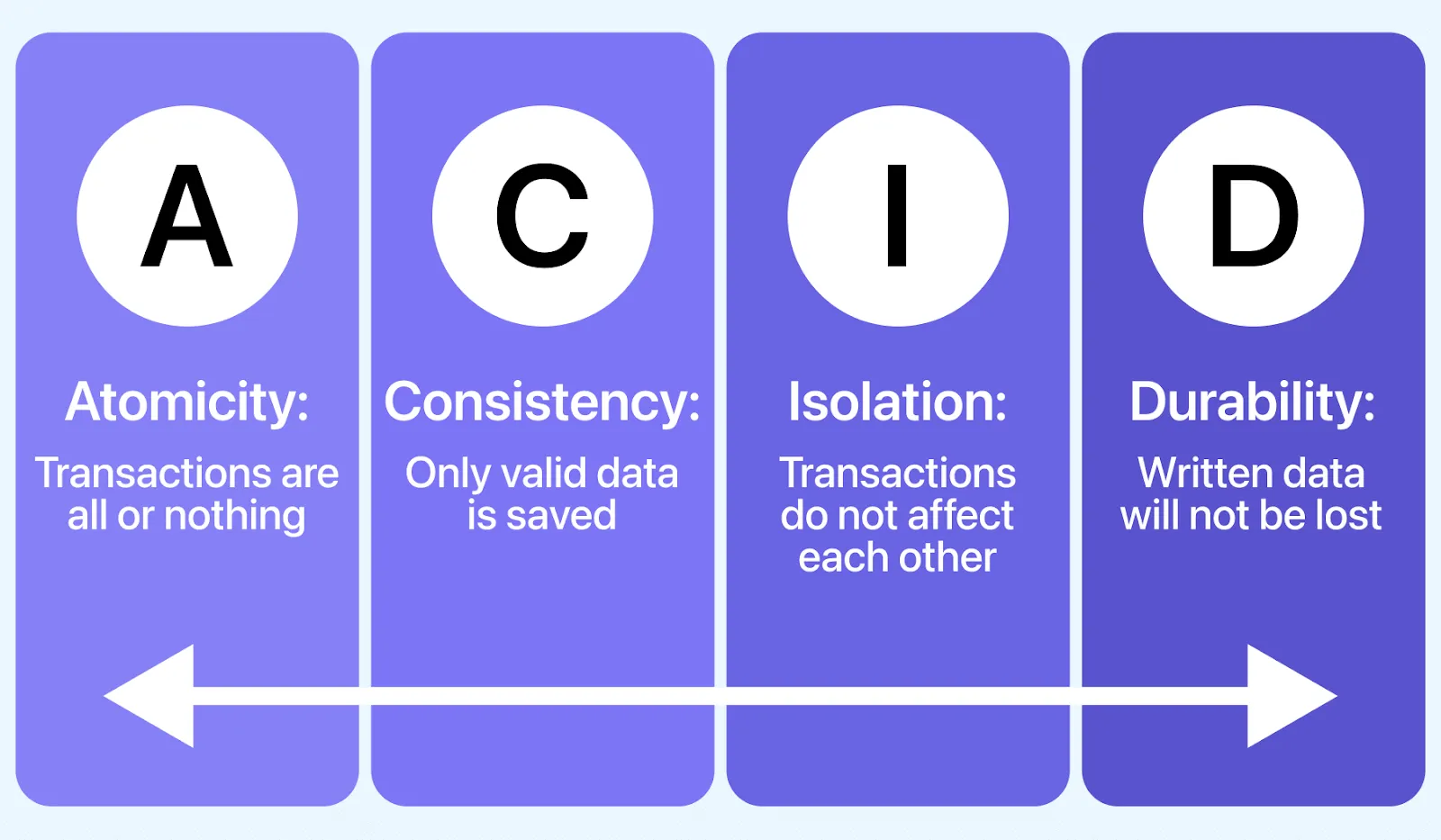
- To make sure that each transaction adheres to the properties of ACID (Atomicity, Consistency, Isolation, and Durability).
- To ensure data integrity.
ACID Properties
Database Management System needs to enforce ACID properties to be appropriately designed and managed. To this, database testing is crucial to verify that the Database Management System correctly applies the ACID properties for transactions. Those properties are as follows:
- Atomicity - The terminology "atomicity" in transactions refers to atomic data. It signifies that in case any operation is performed on the data, like inserting a new record, updating an existing record, or other, it has to be performed entirely or shall not be implemented. All the actions that could change the data within the transaction should be regarded as a single unit and should not be partially executed. Testing the database ensures that the database is in a consistent state, and in case any operation in the transaction fails, the data is returned and assures that the data is not in an incomplete state.
- Consistency - When the transaction is completed within the database, the data has to be correct, consistent, and intact. For example, if a transaction is supposed to transfer an amount between two accounts, it should do so accurately, ensuring that the balance of each account remains consistent with the actual transfer.
- Isolation - The term "isolation" is meant to be separation. In concurrent multiple transactions within the database, the data are independent and separated. In other words, the transactions can run together, and this does not interfere with each other; the database remains consistent.
- Durability - The concepts of durability signify the long-term permanence and reliability of modified data. This implies that once the transaction is committed, it will retain the changes done to the database without any failure and impact of external factors like system crashes, power outages, and others.
Data Integrity
Data integrity is the method that ensures and verifies that all the most recent data is consistently updated across all locations. It relies on four distinct components to validate data integrity. To achieve a superior level of data integrity, a tester must ascertain that:
- The data is verifiable.
- The data is accessible.
- The data is accurate.
- The data is complete.
If the data fails to satisfy the above four criteria, it falls short of the integrity standard. While data management tools can assist, the ultimate responsibility for upholding the highest data quality rests with QAs.
For maintaining data integrity, database testing ensures that updated and most recent values are consistently reflected across all forms and user interfaces. This verification also confirms data dependencies, foreign key relationships, uniqueness constraints, and referential integrity, aligning with the specifications outlined in the project documents.
The aim of validating data integrity is to:
- Ensure all triggers are well positioned for updating reference table records.
- Check the existence of any incorrect or invalid data in the table.
- Insert incorrect data in the table and test if a failure outcome occurs.
- Check sync of replicated servers and databases.
The concepts mentioned above are particular database testing, and it is performed to ensure ACID properties and data integrity. However, do you know there are different databases where you can perform database testing? Let us learn about this from the below section.
How Do You Test Across Multiple Database Types?
Various types of databases support testing, and these are elucidated as follows:
- Production database - This database contains live data, rendering it unsuitable for testing. It has most of the critical information continuously used by the application. Thus, any testing done in this can compromise the main working of the application.
- Local development database - Most testing activities are performed within this environment. It is the database that has data required for testing and development of software applications. Testers and developers mainly use this database for debugging code, ensuring the performance of the software applications.
- Populated development database - All developers share this database when running an application. It is utilized to ascertain that an application functions seamlessly with a substantial volume of data rather than exclusively testing a limited set of records in a test environment. This guarantees the application's ability to handle large data loads.
- Deployment database - Tests are executed in this stage before deployment to ensure that all local database modifications have been successfully applied. Performing tests in the deployment database validates the successful implementation of modification done to the local development database.
What Aspects Should You Analyze in Database Testing?
Database testing analyzes transactions, triggers, stored procedures, CRUD operations, and field constraints, which together decide whether stored data stays correct and consistent.
When it comes to testing the database, it is important to have information on what needs to be tested. It will help to ensure the inclusion of all test cases for a complete test of the database of the software application. Some attributes that require testing include the following:
Testing Transactions
When evaluating transactions, it's crucial to ensure they adhere to the ACID properties. The following statements are typically employed:
- Start a transaction - BEGIN TRANSACTION TRANSACTION#
- End a transaction - END TRANSACTION TRANSACTION#
The ROLLBACK statement ensures database consistency: ROLLBACK TRANSACTION#. After executing these statements, employ a SELECT query to confirm that the changes have been correctly applied to the tables involved in the transactions.
Testers must be well-acquainted with the database schema, which serves as the blueprint for the database structure. To confirm that it aligns with the application's expectations, testers utilize SQL describe (DESC) commands. Additionally, they use regular expressions to validate table field names and verify that values conform to the expected data types.
Triggers
You can understand triggers as the event handlers in the code. In a table, if any operation, for example, the row is added, a piece of code is auto-instructed to be executed by setting up a trigger. For instance, if a user is deleted from the database, its related information will also be deleted. Testers ensure that such operation functions appropriately and does not impact other user data.
Testers can initiate the triggering operation by running an SQL query or performing the operation through the application's interface to examine its impact on the database records. These aspects are assessed in both the black box and white box testing phases.
- White box testing - Stubs and Drivers manipulate data, invoking the trigger even before integrating with the front-end (UI).
- Black box testing - With the UI and database integration available, data can be Inserted/Deleted/Updated from the front end to invoke the trigger. Subsequently, SELECT statements are used to retrieve database data to verify if the trigger successfully performed its intended operation. Another approach is to directly load data that would invoke the trigger and assess if it functions as intended.
Stored Procedures
Stored procedures are similar to user-defined functions and can be invoked using Call Procedure/Execute Procedure statements, typically yielding the output in the form of result sets. These procedures are stored in the RDBMS and are accessible for applications.
During testing:
- In white box testing, Stubs invoke the stored procedures, and the results are compared to expected values.
- In black box testing, operations are performed through the application's front end (UI), and the execution of stored procedures and their results are checked.
CRUD
The primary set of test cases is for CRUD operations, which stands for Create, Read, Update, and Delete, performed by the software application.
- C - When a user clicks 'Save' for a new transaction, the 'Create' operation is executed.
- R - When a user chooses to 'Search' or 'View' a saved transaction, the 'Retrieve' operation is carried out.
- U - When a user opts to 'Edit' or 'Modify' an existing record, the database performs the 'Update' operation.
- D - When a user selects to 'Remove' any record from the system, the database executes the 'Delete' operation.
CRUD operations are tested to ensure data storage and retrieval are executed, assuring data integrity. Testers mainly perform this test from a Database Management System or software application's interface to execute queries using SQL data manipulation language commands. Further, to test the protection of the database from SQL injection attacks, testers often run malicious SQL commands.
Field Constraints
Evaluating field constraints related to Default values, Unique values, and Foreign keys involves the following steps:
- Perform a front-end operation that exercises the conditions associated with the database object.
- Validate the results using an SQL Query.
- Checking a field's default value is a straightforward process, often part of business rule validation. It can be done manually or through an automated suite. In manual testing, an action that introduces a value other than the field's default is performed from the front end to determine if it triggers an error.
What Does a Database Testing Example Look Like?
To have clear concepts of testing the database, one can better understand this with an example. Let us take a scenario and explain the involvement of database testing.
Scenario: Testers are testing a SaaS application that manages an organization's hardware and software assets. This application tracks and monitors IT assets like software licenses, servers, and database-related information.
Test objective: To verify that the database accurately stores and retrieves IT asset information for the end-users.
Test Steps:
- Setup - Prepare a test environment with a representative database.
- Data - Create test cases for asset creation, updates, and retrieval.
- Execution -
- Create and update assets to ensure they are stored accurately. This can be done by including details like asset name, associated user, and others. Testers also choose an existing IT asset from the application and include some of its details, like changing the location. It is important to confirm that the changes done are reflected in the application.
- Retrieve assets by name or other specified criteria within an application and check if they match the expected results.
- Ensure the system prevents duplicate assets from being created.
- Validation - Review test results and check if the database matches actions taken in the application.
- Cleanup - Remove test data and reset the application.
- Reporting - Document results and report any issues to the development team.
What Are Real-Time Examples of Database Testing?
Real-time database testing examples include SQL queries that fetch the most recent records from an employee table and find duplicate employee entries that break data integrity.
Here are some real-time examples of database testing. SQL queries are employed to demonstrate real-time examples of database testing, and in the below section, let us see how SQL queries are used to execute this test.
- To get recent data on the employee database
SQL Query: SELECT TOP 1* FROM EMPLOYEE ORDER BY JOINING_DATE DESC
The above query is employed to have data on the employee record from the table, organized based on the JOINING_DATE column in descending order. So, selecting the first data of the row will be the most recent record.
Purpose in database testing: In database testing, you might use this query to verify that the application correctly inserts employee records with the latest JOINING_DATE.
- To check for duplicate records.
SQL Query: SELECT * FROM EMPLOYEE GROUP BY E_ID HAVING COUNT(*) > 1
This SQL query identifies duplicate employee records in the EMPLOYEE table based on the E_ID (Employee ID) column. It groups the records by E_ID and then filters for groups with a COUNT(*) greater than 1, indicating duplicate records.
Purpose in database testing: You can use this query to ensure the database enforces data integrity rules. It helps identify situations where multiple records with the same Employee ID exist, which may indicate a problem with data entry or database constraints. Fixing duplicates can prevent issues like incorrect reporting or overcounting employees.
They help ensure that the application behaves as expected by checking for recent data and identifying duplicate records, which are common scenarios in testing the database to guarantee data quality and consistency. From the above example, you now understand that database testing can be performed on different types of scenarios. Hence, for various purposes, different types of testing for databases are needed. Continue reading the below section to have more information on this.

Subscribe to our TestMu AI YouTube Channel for the latest updates on tutorials around Selenium, Cypress testing, and more.
What Are the Types of Database Testing?
Database testing is divided into three main types based on the structure and function of the database. Those include the following:
Structural Testing
Structural database testing is a crucial technique employed to verify all elements within the data repository, primarily utilized for data storage and inaccessible for direct end-user operations. To achieve a successful outcome in this testing method, it is imperative to possess a comprehensive grasp of SQL commands. Within structural testing, examination of database components that remain concealed from end-users is possible. Structural testing finds its primary use in the validation of the database.
Common database scenarios for structured database testing:
- Verify the database name.
- Check data device, log device, and dump device.
- Ensure sufficient allocated space for each database.
- Validate database option settings.
- Check the names of all tables in the database.
- Verify column names for each table.
- Check column types for each table.
- Check for null values.
- Verify the primary keys for each table.
- Confirm foreign keys for each table.
- Validate data types between foreign key columns and columns in other tables.
- Check indices (clustered or non-clustered) for uniqueness.
Here are the common components that are tested under structural testing.
Schema/Mapping Testing
This process involves verifying front-end application components by comparing them with the mapping of database objects.
In the context of schema testing:
- There are instances where the objects within the end-user application may not be accurately linked or compatible with the database objects. Consequently, it becomes necessary to assess the validation of diverse schema formats associated with the databases.
- Identifying unmapped entities in the database, such as tables, views, and columns, is essential.
- Various tools are available in the market to facilitate object mapping within schemas.
For instance, within Microsoft SQL Server, a tester can create simple queries to analyze and authenticate schemas within the database. If a tester wishes to modify the structure of a table, they must ensure that all the stored procedures associated with that table remain compatible with the proposed changes.
Following are the checklists:
- Validate the database name.
- Confirm the data device, log device, and dump device.
- Ensure adequate space allocation for each database.
- Verify database option settings.
Stored Procedures and Views Testing
In this form of testing, a tester ensures that the manual execution of stored processes and views yields the desired outcome.
The tester verifies the following:
- If it successfully triggers the required actions as anticipated.
- If the development team has comprehensively addressed all loops and conditions by supplying input to applications within the procedures.
- Whether there exist any unused stored procedures within the database.
- Adequate application of TRIM operations when retrieving data from the necessary database tables.
- Confirmation of the overall integration of the stored procedure modules in accordance with the application's test requirements.
- Adherence to exception and error handling mechanisms.
Commonly utilized tools for storing procedure testing include LINQ, SP Test tool, and others.
Following are the checklists:
- Validate the stored procedure name.
- Confirm parameter names and types.
- Verify output for multiple records, zero rows, or few records.
- Understand the function of a stored procedure and what it should not do.
- Test with sample input queries to ensure correct data extraction.
- Test stored procedure parameters with boundary and valid data.
- Check return values; failures should return non zero values.
- Validate error messages, including unpredictable error scenarios.
Trigger Testing
This form of testing involves evaluating the functionality of triggers, specifically checking whether data is updated successfully after trigger execution. Additionally, it encompasses the evaluation of naming and coding conventions.
In trigger testing, the tester must verify the following:
- Whether coding conventions were adhered to during the trigger's coding phase.
- Confirmation that the executed triggers satisfy the stipulated conditions.
- Validation of whether the triggers accurately update data after their execution.
- Examination of the functionality of Update/Insert/Delete triggers in relation to the application being tested.
Following are the checklists:
- Verify the correct trigger name.
- Validate if the trigger is linked to a specific table column.
- Test trigger updates with valid data
- Test trigger updates with invalid data, covering all error scenarios.
- Check updates when a record is referenced by another table.
- Ensure proper transaction rollback on failure.
- Identify cases where the trigger should not roll back transactions.
Tables and Column Testing
The checks below cover database table and column testing.
- Is the alignment of the database fields and columns in the backend consistent with the mappings in the front-end?
- Reviewing the length and naming convention of the database fields and columns as defined by the requirements.
- Confirming the presence of any unused or unmapped database tables/columns. Ensuring the compatibility of
- Data types
- Field lengths between the back-end database columns and those in the front-end of the application.
- Scrutinizing database table and column naming conventions to verify compliance with business requirements.
- Evaluating whether the database fields permit users to input the necessary information as outlined in the business requirement specification documents.
Following are the checklists:
- Verify the names of all tables in the database.
- Validate column names for each table.
- Verify column types for each table.
- Check for NULL values.
- Validate default values bound to the correct table columns.
- Verify rule definitions for table names and access privileges.
Database Server Check
Performing database server verification involves assessing whether the database server can accommodate the anticipated volume of transactions in alignment with the business stipulations. This process determines whether the database servers' configuration particulars align with the business's prerequisites.
Keys and Indexes Testing
To ensure the proper functioning of your database, it is crucial to perform the following verification procedures:
- Confirm that the required primary and foreign key constraints have been defined on the designated tables.
- Validate the references for foreign keys to ensure their accuracy and relevance.
- Verify that data types for the primary key and corresponding foreign keys are consistent across both tables.
- Ensure that all keys and indexes adhere to the prescribed naming conventions.
- Evaluate the dimensions and lengths of the mandatory fields and indexes.
- Determine whether the necessary clustered and non-clustered indexes have been created on the specified tables in accordance with business requirements.
Following are the checklists:
- Validate primary keys for each table.
- Confirm foreign keys for each table.
- Check data types between foreign key columns and columns in other tables.
- Verify indices, whether clustered or non-clustered, unique or not.
Functional Testing
The foremost database test approach is functional testing, which validates a database's functional requirements as perceived by end-users. Functional testing of databases primarily assesses whether end-user transactions and operations involving the database perform as expected.
Common Database Scenarios for Functional Database Testing:
- Identify relevant schema, triggers, and stored procedures for a specific function.
- Group-related functions for testing.
- Test data flow starting from the front-end.
This testing category can be further divided into:
- Black box testing - Within this testing category, the focus is assessing interfaces and database integration. It encompasses the evaluation of data mapping and incoming and outgoing data interactions. This approach employs diverse techniques like equivalence partitioning, boundary value analysis, and cause-effect graphing.
- White box testing - In this testing type, the scrutiny is directed towards the internal structure of the database. This encompasses the evaluation of triggers, views, tables, columns, schemas, and similar components. White box testing employs various techniques, including cyclomatic complexity, condition coverage, decision coverage, and statement coverage. In this approach, the intricate internal specifications remain hidden from the end user.
Non-Functional Testing
Non-functional testing encompasses activities such as load testing, stress testing, validation of minimum system requirements to align with business specifications, identification of risks, and optimization of database performance. It is performed to assess non-functional aspects of the database, including performance (load and stress handling), recovery, security, and more.
Common Database Scenarios for Non-Functional Database Testing:
- Write test scripts to exercise major functions.
- Ensure comprehensive testing of all functions over a full cycle.
- Verify log files for deadlocks, memory failures, data corruption, etc.
- Test data modification scenarios:
- Update records (involving UPDATE statements or update stored procedures and triggers).
- Insert new records (involving INSERT statements or insertion stored procedures and triggers).
- Delete records (involving DELETE statements or deletion stored procedures and triggers).
- Repeat test cases with invalid data to assess database response.
Following are the tests included under the non-functional testing type:
- Load testing - Load testing evaluates the system's capacity to handle concurrent transactions effectively. During this testing, evaluators assess the response time of the database system. Load testing within various testing types includes:
- Iteratively executing the most frequently used transactions to assess the performance of the database system.
- Initiating downloading a sequence of large files from the Internet to evaluate system responsiveness.
- Simultaneously operating multiple applications on a computer or server to measure system efficiency.
- Stress testing - Stress testing measures the system's resilience and durability. It involves imposing a substantial load by introducing multiple users and transactions until the database system reaches its breaking point or experiences failure.

What Is Metadata Testing in Databases?
Metadata is the data that describes your data: the data types, field lengths, indexes, constraints, keys, and naming conventions that define how a column behaves. Metadata testing validates those definitions rather than the values stored in them, which makes it the one form of database testing that catches defects before any data is corrupted.
The failure it exists to prevent is an environment mismatch. If an email column is VARCHAR(50) in staging and VARCHAR(20) in production, every test passes in staging and every long address is silently truncated after release. No value-level test finds that, because the values were correct when they were written.
Four checks cover most of the risk:
- Data type validation confirms each column stores the type the application expects. A numeric ID held as VARCHAR sorts lexically, so 10 orders before 9, and every range query built on it is quietly wrong.
- Field length validation confirms declared lengths match the front-end limits and the source-system limits. This is where truncation defects originate, and comparing lengths across environments is the check that finds them.
- Index and constraint validation confirms that primary keys, foreign keys, unique constraints, and the expected clustered and non-clustered indexes actually exist in the target environment. A unique constraint present in test and missing in production is how duplicate rows reach a live system.
- Naming standard validation confirms tables, columns, keys, and indexes follow the agreed convention. This reads as cosmetic and is not: automated pipelines, ORMs, and reporting layers commonly resolve objects by name pattern, so a deviation breaks them at runtime.
Run these as an automated comparison between environments rather than a manual review. Most database engines expose their metadata through system catalog views, so the check is itself a query: read the column definitions from each environment and diff them. Schema-comparison features in tools such as dbForge and assertion frameworks such as tSQLt automate the same comparison as part of a suite, which is what turns metadata testing from a pre-release checklist into a gate that runs on every change.
What Are Common Misconceptions About Database Testing?
There are certain misconceptions associated with database tests that need to be clarified so that testers can avoid any incorrect assumptions in the test process. This will encourage unbiased and thorough testing. Some of those misconceptions about reality are given below:
- Database testing demands considerable expertise and is known for its meticulous nature - In truth, database testing within software testing ensures enduring functional stability upon the entire application. Therefore, dedicating diligent effort to this endeavor is imperative.
- There's a misconception that database testing introduces an additional bottleneck to the workflow - However, the reality is quite the opposite. Testing databases contributes substantial value to the project by unearthing latent issues, thus proactively enhancing the overall application's quality.
- It's often assumed that database testing hinders the overall development process - In reality, a substantial investment in database testing improves the overall quality of the database application.
- Some may perceive database testing as excessively expensive - Yet, in reality, any expenses on testing the database serve as a long-term investment that ensures the durability and robustness of the application.
Next, we will discuss approaches and methods of testing the database.
How Do You Write Test Cases for Database Testing?
Write database test cases by naming the table or procedure under test, the input data, the SQL or action performed, and the exact expected rows, values, or errors.
When it comes to software applications, the priority step is to create test cases so that there is a miss of testing any key features or aspects. Among different testing types, database testing is a form of grey box testing since it necessitates validating the backend and the user interface responsible for retrieving data within the application.
The majority of software applications employ numerous databases, necessitating an understanding of their interrelationships. The fundamental principles for creating test cases for database testing are as follows:
- Initially, understand the application's prerequisites.
- Gather information regarding all tables, including their usage of joins, cursors, triggers, stored procedures, and input and output parameters.
- Initiate the composition of test cases for these tables, ensuring coverage of all possible paths with various input values.
Some examples of test cases:
- Verify the retrievability of database-related information, such as database name, device details, and device log, and include device details, as well as storage space, using queries.
- Validate that data entered via the application's user interface is stored in the database upon clicking the submit button.
- Verify that neither the primary nor foreign keys accept null values.
- Ensure the end-to-end data flow is functional within the system, spanning from the front end to the back end.
- Authenticate for the absence of issues like deadlocks, memory failures, data corruption, and so forth by scrutinizing the log files.
Now, let us learn about different approaches and steps to testing the database.
How Do You Test a Database?
Database testing can be performed using two different approaches:
- Manual approach
- Automation approach
Both manual and automated testing approaches are significant in terms of evaluating the functionality and performance of the database with respect to software applications. This, in turn, allows the testers and developers to ensure data integrity and security. It is important that testers should be aware of both approaches so that they can select the most suitable one as per their requirement and software project.
Manual Approach to Database Testing
The manual approach of testing the database involves the execution of test cases and SQL queries manually by the testers without any involvement of the automation tool. The advantage associated with this approach is easy verifying of data integrity, functionality, and quality. In this approach, the testers manually input the data, manipulate the database if needed, and validate the test outcome based on the comparison. It gives hands-on data inspection and is appropriate for complex scenarios and exploratory testing.
Below are the mentioned steps that need to be followed to perform manual database testing:
- To initiate the process, testers have to launch the SQL server on their local system.
- Subsequently, they access the query analyzer to compose commands and retrieve data.
- Upon obtaining the specified data, they will measure it against the anticipated results.
- They can then perform data updates or deletions to evaluate the software application's performance.
- The general procedure for testing the database shares similarities with testing other applications.
To execute the test, we can adhere to the following steps:
- Configure the test environment - Initially, it's essential to prepare the test environment for assessing the software application. For example, testers prepare the database server and configure the required hardware and software components and others. This is an important step because it ensures that the testing environment is similar to the production environment.
- Execute the test - Testers will execute specific test cases once the test environment is set up. Here, different types of tests can be executed by the testers, like data retrieval tests and data modification tests.
- Verify the results - After the successful execution of the test case without any issues, testers verify the designated test case results. This is done by checking the data, the response of the system, and any error message detected in the test process.
- Validate the output against the expected one - After verifying test case results, testers validate the obtained output against the expected outcome. If they align, the test case will be deemed a pass; otherwise, it will be categorized as a failure.
- Report findings to stakeholders - Finally, the testers share the test results with the stakeholders of the specific software application. This may include developers, project managers, and quality assurance teams to provide them with insights into the software's quality and any areas that require attention or correction.
Furthermore, the testing process may involve running these queries and assessing data integrity, ensuring the resulting data is truthful, precise, comprehensive, retrievable, and verifiable. Additionally, the evaluation may encompass monitoring data mapping, the various ACID properties, and verifying the accuracy of implemented business rules.
Automation Approach to Database Testing
Database testing may become intricate as data volumes expand, environments diversify, and data intricacy escalates. Manually ensuring comprehensive coverage can become laborious. To this, a test automation approach of database testing involves automated testing tools.
During testing, attention can be directed toward essential facets such as data schema, data integrity, and fundamental user interface functionalities through automation. When automating database testing, the following fundamental procedures should be adhered to, regardless of the chosen tools and methodologies:
- Determine the testing scope - In this step, testers first define the key area of the database that requires testing.
- Develop test scripts - Test script is an important component of database testing. Testers then create automated scripts with information on the interaction with the database, execute test cases, and validate the expected outcome.
- Identify high-priority test cases - There might be different test cases when performing database testing. Testers prioritize the critical test cases to execute first and require automation.
- Execute the tests - The prepared test scripts are then executed by the tester to perform testing like data retrieval, validation, and modification.
- Document the outcomes - After performing testing, testers record and document the outcome and the error if detected.
- Continuously monitor test results - Testers regularly monitor and analyze the test outcome to find any pattern (Performance Stability, Consistent Data Retrieval), trends (Gradual Performance Degradation), and issues (Spikes in Response Time) that require more validation.
- Validate the results by cross-referencing them with the UI test report - Testers finally cross-check the database test outcome by comparing it with the user interface test report.
Scenario for Automation Testing
In software testing, automation testing reduces repetitive manual tasks, enabling test engineers to concentrate more on crucial aspects, which applies similarly to database testing.
Automation pays off most in these scenarios:
- Alterations in the database schema - When there are modifications to the database schema, extensive testing becomes necessary to verify that everything functions as intended. The scope of testing can be extensive, depending on the database's size, making manual execution a time-consuming process.
- Monitoring for data integrity issues - There may arise situations where a subset of data becomes corrupted due to recovery procedures or other factors, often stemming from human errors or unforeseen glitches. By employing automated monitoring procedures, detecting such discrepancies becomes more streamlined, facilitating prompt resolution.
- New or frequently changing applications - In the era of Agile methodology, where frequent production releases occur at the end of each sprint (typically every 2-3 weeks), automation plays a pivotal role. By automating stable and unchanging features from previous sprints, testers can allocate more attention to validating newly modified requirements, thereby enhancing testing efficiency.

Which Tools Are Used for Database Testing?
Pick a database testing tool by the job you need done, not by brand familiarity. The four categories below cover the work, and most teams end up running one tool from two or three of them rather than searching for a single tool that does everything.
| Tool | Category | Best suited to |
|---|---|---|
| tSQLt | Unit testing framework | SQL Server teams who want tests written in T-SQL and run as part of the database build. |
| DbUnit | Unit testing framework | Java teams putting the database into a known state between runs so tests stay repeatable. |
| DBFit | Unit testing framework | Teams that want database tests written as readable tables rather than code. |
| NoSQLUnit | Unit testing framework | The same state-control problem on NoSQL stores rather than relational engines. |
| QuerySurge | Data comparison / ETL validation | Reconciling source and target datasets at volume in data warehouse and ETL pipelines. |
| ETL Validator | Data comparison / ETL validation | Testing transformation rules and source-to-target mapping in a warehouse load. |
| dbForge | IDE suite (comparison, unit testing, data generation) | Teams who want schema comparison, unit testing, and test data generation in one environment. |
| HammerDB | Load and benchmark | Measuring how the database behaves under concurrency across several engines. |
Two of these are worth knowing in more detail because they anchor opposite ends of the workload. tSQLt describes itself as "the open source database unit testing framework for SQL Server" and supports all editions of SQL Server from the 2005 Service Pack 2 edition onwards, with tests written directly in T-SQL so they live alongside the objects they cover. HammerDB calls itself "the industry standard open-source database benchmark" and runs the same workloads across SQL Server, Db2, Oracle, PostgreSQL, MariaDB, and MySQL, which is what makes it useful for comparing engines rather than only stressing one.
Beyond these four categories sit test data generation and data security tools, which create realistic datasets at volume and enforce privacy rules on the data used in non-production environments. Verify current capabilities and licensing on each vendor's own site before committing, since this category consolidates through acquisition regularly and product names change with it.
Where these tools stop is the seam between the database and the application. They validate the database in isolation; they do not tell you whether the button a user clicked wrote the right row. TestMu AI's KaneAI closes that seam by generating database-connected tests from live queries and verifying the resulting data state in the same run as the UI and API steps that caused it.
What Threats Do Database Systems Face?
Database testing requires considering some of the threats associated with the database. This is because the threat could complicate the test process and render security errors in the software application. Hence, when learning about database testing, it is equally important to know about database threats to optimize the test process.
- SQL injection is the most prevalent form of attack on a database system, inserting malicious SQL statements that the system then executes to extract critical data. OWASP defines it as an attack that inserts a SQL query via the input data from the client to the application, and notes that a successful exploit can read sensitive data, modify it, execute administration operations, and in some cases issue commands to the operating system. The defense is parameterized queries and strict handling of user input fields rather than filtering for suspicious characters.
- Privilege escalation in databases - In this type of attack, a user who already possesses some level of access within the database system attempts to raise their access privileges to a higher level, enabling them to carry out unauthorized activities within the database system.
- Service denial - Service denial attacks make a database system or application resource inaccessible to legitimate users. These attacks can also target applications in ways that render them, and occasionally the entire machine, inoperable.
- Unauthorized data access - Another attack category entails gaining unauthorized access to data within an application or database system. This includes
- Unauthorized data access through user-based applications.
- Unauthorized access by monitoring the activities of others.
- Unauthorized access to reusable client authentication information.
- Identity impersonation - Identity impersonation occurs when a hacker uses a user's or device's credentials to launch attacks against network hosts, steal data, or bypass access controls to gain entry to a database system. Preventing this type of attack necessitates IT infrastructure and network-level countermeasures.
- Data tampering - In a data tampering attack, a hacker manipulates data to gain an advantage or affect the reputation of database owners.
What Is Database Security Testing?
Database security testing identifies vulnerabilities in security measures and uncovers potential weaknesses within the database system. The primary objective of conducting database security testing is to unearth system vulnerabilities and ascertain whether the data and resources are shielded from potential unauthorized access. Regularly performed security testing establishes an effective means of consistently recognizing potential vulnerabilities.
Techniques for testing database security:
- Penetration testing - Penetration testing involves initiating an attack on a computer system with the aim of discovering security vulnerabilities, which may grant access to its functionality and stored data.
- Risk assessment - Risk assessment is a procedure for evaluating and determining the risks associated with various losses and the likelihood of vulnerability occurrences. This assessment is carried out within the organization through various methods, including interviews, discussions, and analytical processes.
- SQL injection analysis - SQL injection analysis inspects user inputs within application fields. For example, inputting special characters such as ',' or ';' in any text box within a user application should be prohibited. To identify potential SQL injection vulnerabilities in your web application, review the code in which direct MySQL queries are executed on the database while accepting user inputs. SQL injection testing should encompass checks for brackets, commas, and quotation marks.
- Password decryption - Conducting password decryption checks is a critical aspect of database system testing. Hackers may attempt to access crucial information by utilizing password-decryption tools or attempting to guess common username/password combinations, which are readily accessible on the Internet. Numerous password-cracking tools are freely available.
- Database system security audit - A security audit entails the periodic evaluation of an organization's security policies to determine whether the necessary standards and protocols are being adhered to.
What Are the Challenges in Database Testing?
The main database testing challenges are a wide testing scope, changes in database structure, parallel testing conflicts, and reusing or generating realistic test data.
To execute database testing effectively, testers must gather information on requirements from various sources, including technical (related to how the database is built) and functional specifications (related to what the database is supposed to do) about what the database should do and how it should work.
Some requirements may be high-level, necessitating their breakdown into smaller parts. In this process, testers encounter several difficulties. The most common challenges in database testing with their solutions are:
- Testing scope is extensive - Having incomplete or least information on the testing requirements is a crucial challenge. This is because testers without a clear understanding of the testing scope, which may be extensive, may end up testing uncritical database cases.
Solution: Testers must identify the list of aspects to be tested so that they can be prioritized based on criticality. With this, estimating the time and effort needed to design the tests becomes easy.
- Changes in database structure - The sudden change in the database structure is another main challenge of database testing. It may impact the testing process and render it ineffective.
Solution: Testers must be aware of the change done to the database during the test process. When they identify the changes, it becomes easy to analyze their impact, and based on this modification, the test process can be done.
- Parallel testing pitfalls - Running multiple tests simultaneously is another challenge in database testing, especially when it comes to performance tests. This is because of several reasons:
- When multiple tests run concurrently, they may compete for the same system resources, such as CPU, memory, and disk I/O.
- One test may insert or modify data that another relies on, leading to unexpected behavior or errors.
- Finding the root cause of problems can become more complex.
Solution: It is preferred to run one test at a time, particularly for performance testing, to avoid resource conflicts and ensure accurate results.
- Data reusability and test data generation - Efficiently reusing data for testing and generating test data poses challenges because they demand careful management to prevent data interference between tests.
Solution: To address the above issue, testers need to have a better strategy to generate important data, especially for repeated test scenarios. This will help to make better use of data. Further, isolating the commands from each other can also be done to ensure that the input or output of the command does not affect their outcome.
- Managing data acquisition costs and timelines - Obtaining data from a vast database incurs both time and financial overheads.
Solution: It becomes crucial to strike a balance between project timelines, desired data quality, and the volume of data to be acquired.
- Unauthorized data modification - Any unintended or unauthorized changes done in the database are a crucial challenge in database testing as they may disrupt the complete test process. Those modifications could be like alterations to data values, configuration, and others.
Solution: Testers must have access control to the database. Access can only be given to a limited number of people and should be restricted to DELETE and EDIT options.
- Complex test planning - Database structures are typically complex, involving vast amounts of data, which can lead to the risk of running incomplete or repetitive tests.
Solution: It's essential to create a detailed test plan and follow it diligently while regularly monitoring progress.
What Are the Best Practices for Database Testing?
To improve the database test, the following are some of the best practices that can implemented:
- Thoroughly validate all data, encompassing both metadata and functional data, in accordance with their mapping as specified in the requirement documentation.
- Ensure validation of test data collaboratively generated with the development team.
- Employ a combination of manual and automated procedures to validate output data.
- Utilize diverse techniques such as cause-effect graphing, equivalence partitioning, and boundary-value analysis to generate essential test data conditions.
- Verify the referential integrity rules for the requisite database tables.
- Proficiency in SQL queries and adeptness with essential database management tools are prerequisites for successful database testing.
- Enhance coverage by integrating graphical user interface (GUI) and data verification techniques within relevant tables. If employing an SQL server, leverage the SQL Query Analyzer to craft, execute, and retrieve query results.
- Execute CRUD operations via the GUI and evaluate their effects by running corresponding SQL queries provided by the developer. This approach doesn't mandate in-depth SQL knowledge or familiarity with the application's database structure but should be employed cautiously.
How Is AI Changing Database Testing?
AI is changing database testing by writing SQL test queries from plain-English checks, generating realistic synthetic test data, and spotting anomalies in data that rule-based checks miss.
Synthetic data generators trained on a schema can produce privacy-safe datasets that keep the relationships and edge cases of production data, which removes one of the biggest blockers in database testing: getting realistic data without exposing real customers.
AI-written SQL still needs review, because a query that looks right can join the wrong keys or miss null handling. Our guide to ai in test automation covers how to fit these tools into a test suite.
Why Does Database Testing Matter?
Start with one query rather than a tool evaluation. Take the single most important write path in your application, perform it through the front end, then run a SELECT that proves the row landed with the right values, the right types, and no duplicate. That one check is a complete database test, and it will usually find something.
From there, widen in the order the risk sits: add metadata comparison between environments to catch truncation before release, add a unit testing framework such as tSQLt or DbUnit so those checks run on every build rather than by hand, then add load and security coverage once correctness is locked down.
The step most teams postpone is connecting those database assertions to the UI and API actions that trigger them, because it normally means maintaining three toolchains. TestMu AI's KaneAI generates database-connected tests from live queries and validates the data state in the same run as the UI and API steps, so one flow proves the click and the row agree. The KaneAI documentation covers how to author those checks, and you can run them across the wider suite on TestMu AI's test automation cloud.
Author

Nazneen Ahmad
Blogs: 39


Nazneen Ahmad is a freelance Technical Content SEO Writer with over 6 years of experience in crafting high ranking content on software testing, web development, and medical case studies. She has written 60+ technical blogs, including 50+ top-ranking articles focused on software testing and web development. Certified in Automation Basic and Advanced Training - XO 10, she blends subject knowledge with SEO strategies to create user focused, authoritative content. Over time, she has shifted from quick, keyword-heavy drafts to producing content that prioritizes user intent, readability, and topical authority to deliver lasting value.
Reviewer

Harish Rajora
Reviewer
Harish Rajora is a software developer at TestMu AI with over 6 years of hands-on experience in Python and cross-platform application development across Windows, macOS, and Linux. He has authored 800+ technical articles and worked on large-scale projects, including GenAI applications and core engineering features used by millions. Harish has led DevOps initiatives building CI/CD pipelines with Jenkins, AWS, GitLab, and GitHub, and holds an M.Tech in Software Engineering from IIIT Allahabad.


Database Testing FAQs
Did you find this page helpful?
More Related Learning Hubs
TestMu AI forEnterprise
Get access to solutions built on Enterprise
grade security, privacy, & compliance
- Advanced access controls
- Advanced data retention rules
- Advanced Local Testing
- Premium Support options
- Early access to beta features
- Private Slack Channel
- Unlimited Manual Accessibility DevTools Tests