
Run End-to-End Tests from Your Terminal with Kane CLI
Author and Run Tests Right from the Terminal in Natural Language, with an Evidence-Backed Pass or Fail from a Real Browser.
npm install -g @testmuai/kane-cli
- TestMu AI (Formerly LambdaTest)
- /
- Blog
- /
- AI in Quality Engineering: What the 2026 Data Says to Fix First
AI in Quality Engineering: What the 2026 Data Says to Fix First
TestMu AI's 2026 survey found 81% of teams merged AI code they didn't fully understand. See what the AI in quality engineering data says to fix first, and why.
Published on:
81% of teams have merged AI-written code or tests they didn't fully understand, and 44% report more escaped defects as AI-generated code grew. Both figures come from TestMu AI's State of AI in Quality Engineering 2026 report, a survey of testers, developers and QA leaders on AI in quality engineering.
The report runs to 11 chapters. Read together, its cross-tabs show which habits go with fewer escaped defects and which only feel safe, so this post ranks the fixes for a QA or engineering lead with one quarter to spend.
TL;DR
To get value from AI in quality engineering, fix verification first: add execution checks before merge, pair model scores with real runs, measure ROI in defects, and gate agent releases on evals. In TestMu AI's 2026 survey, only 41% of teams run any automated check on AI-written code before merge.
What Should QA Leaders Fix First?
- Pre-merge execution checks: Add a check that runs the application before merge. In TestMu AI's survey, teams whose coding agent ran the app reported rising defects about half as often, 24% against 47%, in a small group. Kane CLI by TestMu AI runs this check from the terminal or CI.
- Model scores plus execution: Pair LLM-as-a-judge with a check of what the software does. Teams using LLM-as-a-judge regularly merge AI output they don't fully understand twice as often as other teams, 29% against 15%.
- Outcome-based ROI: Report defects and incidents beside time saved. 73% of surveyed teams report a positive return from AI in testing, and 47% of those teams also report rising escaped defects.
- Agent release gates: Re-run evals on every model or prompt change, then gate CI on them. Among agent builders, 27% re-run evals after a change and 15% gate CI on evals.
How the AI in Quality Engineering Survey Was Run
TestMu AI fielded the survey online from late July to early October 2026 through its community channels. Respondents are community members rather than a sample of TestMu AI customers.
- Who answered - 58% are QA practitioners (SDETs, QA leads and testers), 29% are developers and engineers, and 7% are leaders.
- Company size - 43% work at companies of up to 100 people, 22% at 101 to 1,000 and 35% at more than 1,000.
- Sample lean - 43% of organizations are based in India and 23% in the United States, and 58% are in SaaS, software and IT services. The figures describe the teams surveyed rather than the whole industry.
- What "teams" means - Each response is one person describing their own team, and each percentage is a share of the people who answered that question.
- Subgroups - QA, developer and cross-tab groups are smaller than the full sample. The report reads several of those gaps as directional, and an association in this data does not prove cause.
How Much Code AI Writes, and Who Checks It Before Merge
In TestMu AI's survey, 40% of teams say AI writes more than half of their production code, and only 3% say none of it is AI-generated. Claude Code is the main coding agent for 36% of teams and GitHub Copilot for 26%.
Checks have not kept pace. TestMu AI found that only 41% of teams run any automated check on AI-written code before merge, either separate tests in CI or the coding agent checking its work in the running app.
| How AI-written code is verified before merge | All teams | QA practitioners | Developers |
|---|---|---|---|
| A person reviews and manually tests it | 55.1% | 50% | 69% |
| QA team builds and runs tests after hand-off | 51.4% | 59.1% | 43.1% |
| Separate automated tests run in CI | 34.1% | 36.4% | 29.3% |
| Coding agent verifies its own work in the app | 14.1% | 8.2% | 20.7% |
| Only compile, type or unit checks | 12.4% | 7.3% | 22.4% |
| No check beyond the agent saying it works | 5.4% | 3.6% | 6.9% |
- Human approval - 64% of teams have a person approve every AI-generated test, and 81% of those teams have still merged AI output they did not fully understand.
- QA hand-off - For 32% of teams the hand-off is the main safeguard, with no separate automated tests in CI.
- Developers - 93% of developers have merged AI output they did not fully understand, against 76% of QA practitioners. Developers also lean on lighter checks, as the table shows.
Count a reviewer reading a diff as one check, then ask what executed the change before merge. The guides on AI code verification and AI-generated code bugs cover how to set that check up and what it should catch.
Escaped Defects Track Verification More Than AI Volume
The amount of code AI writes does not predict escaped defects on its own. In TestMu AI's survey, teams where AI writes more than half of the code report rising defects less often than teams where AI writes half or less: 38% against 49%.
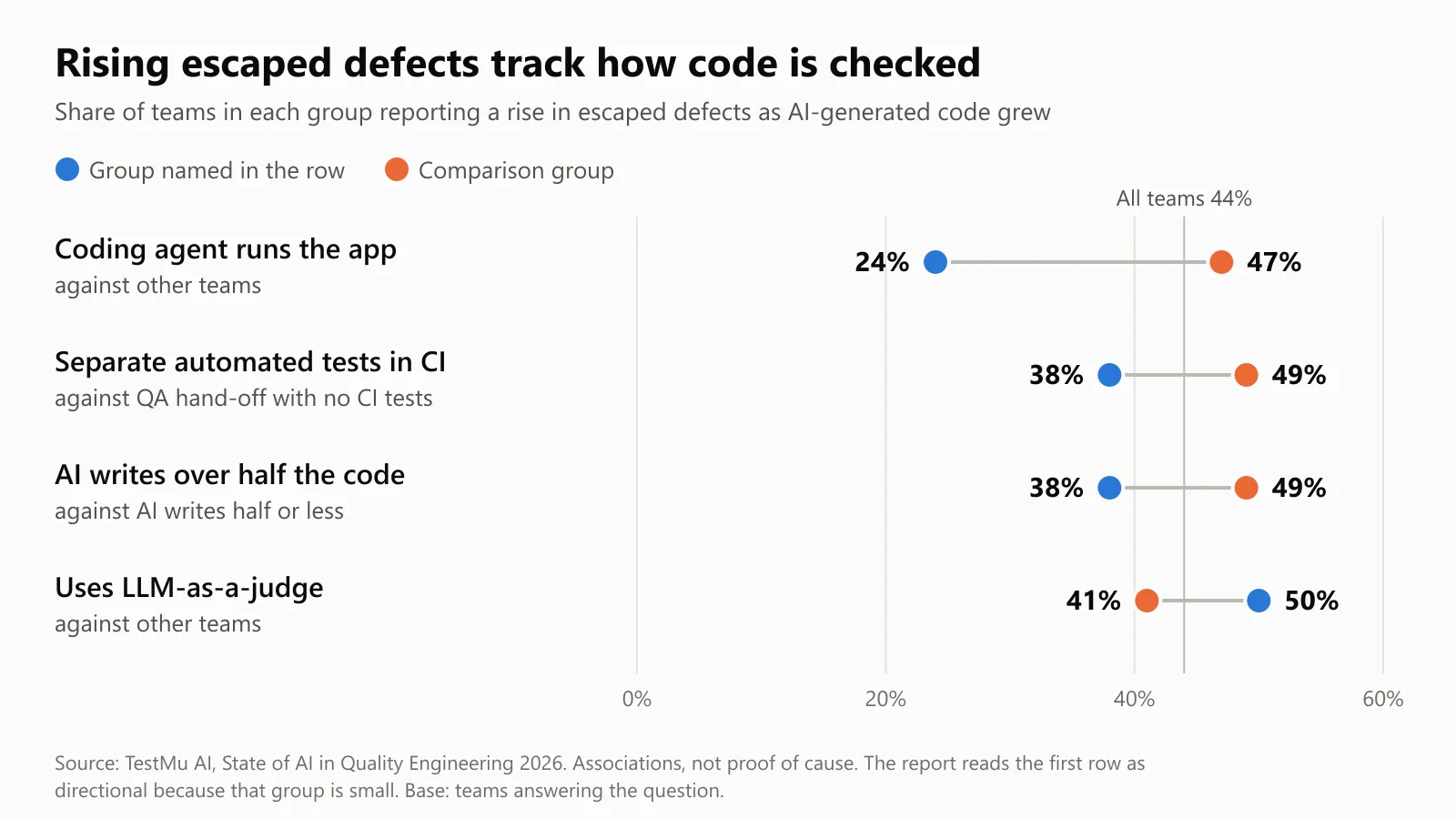
- Coding agent runs the application - 24% report any rise in escaped defects, against 47% of other teams. The group is small, so the report reads this gap as directional.
- Separate automated tests in CI - 38% see escaped defects rise, against 49% of teams relying on a QA hand-off with no CI tests.
- LLM-as-a-judge - 50% see escaped defects rise, against 41% of other teams. The report calls this an association, since teams that adopt model grading may also be the teams moving fastest with AI.
The pattern favors checks that execute the software. A model's score is a second opinion on the output, so pair LLM-as-a-judge with a run of the application.
Kane CLI by TestMu AI runs that execution check from the terminal or CI. It validates the change in real Chrome and returns an evidence-backed pass or fail with exit codes your pipeline can gate on, and coding agents such as Claude Code, Cursor or Codex can call it to verify their own changes.
Trust Scores Rise With the Almost-Right Rate
TestMu AI's survey puts median trust in AI-generated test artifacts at 54 out of 100, and teams say that output is "almost right, but not quite" a median 65% of the time. Split by oversight, the two numbers rise together.
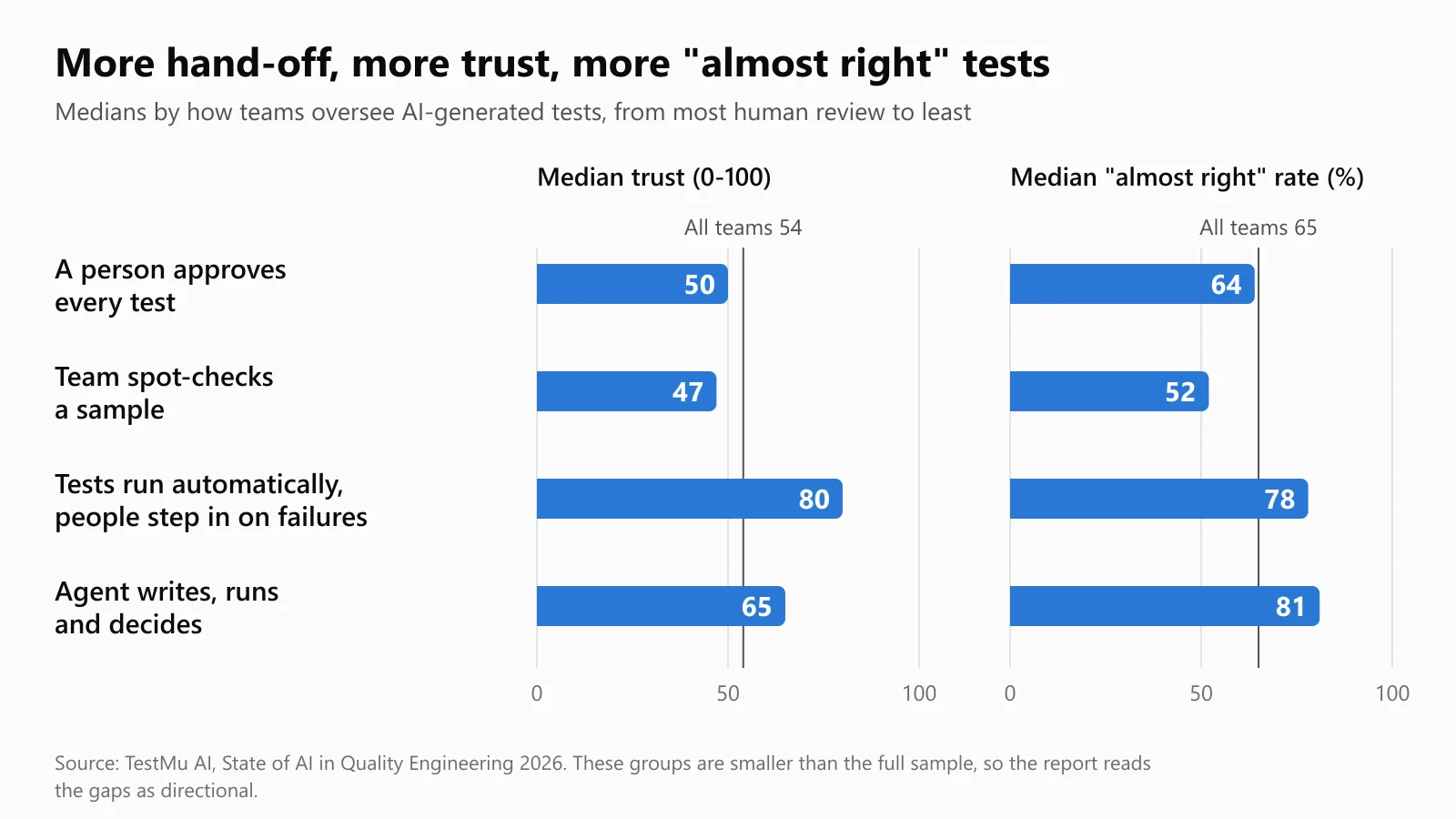
- Trust follows hand-off - Teams that step in only on failures score trust at 80 and find output almost right 78% of the time. The report's reading is that the more a team lets AI check AI, the more it tends to trust the output and the more often it finds the output almost right.
- Sampling looks different - Teams that spot-check a sample report the lowest trust (47) and the lowest almost-right rate (52%). These groups are smaller than the full sample, so read the gaps as directional.
- Track the rate directly - Count how many AI-generated tests need edits before merge each sprint, and report that count beside any trust score.
- Check what the tests prove - A green run can still assert the wrong thing, which is how AI-generated tests pass a broken app.
Positive ROI Can Sit Beside Rising Defects
In TestMu AI's survey, 73% of teams report a positive return from AI in testing, and 47% of those teams also report rising escaped defects. Both can hold at once because most teams count the return in effort.
- What teams measure - Time saved on manual testing (52%), productivity (46%) and faster releases (40%) lead. Fewer production incidents (21%) and lower cost of quality (11%) trail.
- Release speed - Teams where AI generates more than half of production code are no more likely to deploy daily or faster than teams with less AI-written code: 29% against 28%.
- Budget - 50% of teams spend most of their AI testing budget on generating output, against 17% on verifying it, and 40% have no separate budget for AI in testing or do not know it.
- QA time - Reviewing AI-generated output (17.6%) now sits beside test maintenance (19.3%) and flaky tests (18.7%) as a top drain on QA time.
- LLM-as-a-judge teams - 90% report a positive return, against 66% of other teams, while also reporting more rising defects.
Add escaped defects and incidents per release to the ROI report you already send. On TestMu AI, Test Insights adds the trend view beside them, with pass and fail trends and consistently failing tests across builds.
AI Agent Testing Still Leans on Human Review
In TestMu AI's survey, 77% of teams build AI agents they need to test, and human review is the only evaluation method a majority of those agent builders use.
| Practice | Share of agent builders |
|---|---|
| Evaluate agent output by human review | 63% |
| Use LLM-as-judge (one model scores another) | 41% |
| Test long multi-turn conversations | 35% |
| Test against users who try to break the agent | 28% |
| Re-run evals after model or prompt changes | 27% |
| Gate CI on eval suites | 15% |
- No systematic evaluation - 37% of agent builders have no regression evals, consistency runs, similarity scoring or evaluation platform.
- Ship decisions - 24% of agent builders call an agent ready on a demo or nothing formal.
- Tooling - 21% of agent builders say they use a dedicated eval platform, yet 6% named a dedicated evaluation tool when asked which one.
- Voice and phone agents - 45% of teams building them do not test with background noise or a poor line, and 39% do not test accents, dialects or other languages.
Pick the next step by what the agent does, and use AI agent evaluation as the starting point for the suite. Agents that act need a check of what the run changed, which is the job of Agent Assurance: it invokes the agent for real and checks each criterion against what the run changed rather than what the agent reported. AI agent testing statistics by TestMu AI go deeper on these practices.

Note: Agents that talk to people need coverage of real conditions. TestMu AI's Agent Testing generates 60-100+ scenarios across happy paths, edge cases and adversarial inputs, and simulates 50+ accents and 15 background-noise environments for voice agents. To test your own agent, start free.
The Autonomy Gap Between Plans and Pipelines
In TestMu AI's survey, 79% of teams say most of their testing already runs autonomously or will within two years, while 10% let an agent write, run and decide on tests today.
- Current pipelines - 44% still trigger tests by hand or run scripted CI with no AI. Among teams that expect autonomy within a year, or say they have it already, the share is still 49%.
- Evaluation gates - 12% of teams use evaluation suites as quality gates in CI.
- Defect signal - Where an agent writes, runs and decides on tests, 24% saw escaped defects rise significantly as AI code grew, against 9% of other teams. That group is small, so read the gap as directional.
- Recovery plans - 13% of teams have an incident-response plan for AI mistakes and 37% keep an audit trail of what the AI did. Among teams that have seen escaped defects rise, 86% have no AI incident-response plan.
- Main brake - 55% name data privacy, security or IP exposure as a barrier, ahead of output they can't trust (50%). The skill gap fell to 27% from 54% in the 2023 survey.
Build the recovery path before you add autonomy. An audit trail shows what the agent did, and an incident plan says who acts when it is wrong.
How AI in Quality Engineering Compares Across Other Surveys
These surveys used different samples and questions, so use them to check direction, since the numbers do not compare one to one.
- The World Quality Report 2025 found nearly 90% of organizations pursuing generative AI in quality engineering, with only 15% at enterprise-scale deployment.
- The Stack Overflow 2026 survey found 48% trust AI when they can easily validate the answers, and only 16% extend that trust to most tasks that are not important work decisions.
- The Stack Overflow 2025 survey found more developers actively distrust the accuracy of AI tools (46%) than trust it (33%).
- The DORA 2025 report describes AI's primary role as an amplifier, magnifying an organization's existing strengths and weaknesses.
- LangChain's State of Agent Engineering survey found 29.5% of respondents not evaluating their agents yet, across 1,340 responses.
Data privacy leads the barriers in both the World Quality Report (67%) and TestMu AI's survey (55%). The skill gap differs: the World Quality Report surveyed more than 2,000 senior executives and found 50% lacking AI and ML expertise, while TestMu AI's mostly practitioner sample puts it at 27%.
Benchmark Your Team Against the Survey
Answer each row yes or no for your team, working from the top, and treat the first no as your next fix. The order starts with the practices tied to fewer rising defects, then moves to measurement, agents and recovery.
| Check | Survey baseline | First fix if the answer is no |
|---|---|---|
| AI-written code gets an automated check before merge | 41% of teams | Add a required CI job on the flows AI changes most. |
| That check runs the application | 14.1% of teams have the coding agent verify in the app | Run a verifier against a preview build of each pull request. |
| Model scores are paired with an execution check | Not measured directly; 32% of teams that evaluate AI output use LLM-as-judge | Require a passing run beside every model score. |
| The ROI report counts production incidents | 21% of teams | Add escaped defects and incidents per release. |
| Verification gets most of the AI testing budget | 17% of teams | Split spend into generating and verifying, then set a target share. |
| Agent evals re-run on each model or prompt change | 27% of agent builders | Trigger the suite from the change that updates the prompt or model. |
| Agent evals gate CI | 15% of agent builders | Write pass criteria and block the release when the suite misses them. |
| Agents are tested against users who try to break them | 28% of agent builders | Add adversarial scenarios to the regression suite. |
| You keep an audit trail of what the AI did | 37% of teams | Log the prompt, the actions and the result for each AI run. |
| You have an incident-response plan for AI mistakes | 13% of teams | Name an owner, a rollback path and a review step. |
Conclusion
Start with the first row of the benchmark: pick the flow AI changes most often and require a check that runs the application before merge. The Kane CLI exploration docs show how to map your app and design tests from it.
Then add escaped defects to your next ROI report, so the return on AI in quality engineering is measured in outcomes as well as hours.
If you test from the terminal, or want the whole testing cycle in your CLI, Kane CLI by TestMu AI lets SDETs and developers plan, write, run and debug tests from the command line.
Author

Mudit Singh
Blogs: 2

Mudit Singh is Co-Founder and Head of Growth at TestMu AI, and a member of the founding team that has grown the platform to 2.8M+ users across 132 countries. He drives growth and go-to-market across the full product portfolio, including KaneAI, Kane CLI, the Real Device Cloud, SmartUI, accessibility testing, and HyperExecute. Over more than eight years on the founding team he has helped build and bring these testing products to market from scratch, scaling the company from cross-browser testing into a full-stack agentic AI quality engineering cloud backed by Sequoia, Qualcomm Ventures, and Premji Invest. He brings over 15 years of experience building and marketing software products and holds a B.Tech in Computer Science from Jaypee Institute of Information Technology.
Reviewer

Mayank Bhola
Reviewer
Mayank Bhola is Co-Founder and Head of Products at TestMu AI, where he leads the entire product portfolio across KaneAI, Kane CLI, HyperExecute, SmartUI, the Real Device Cloud, Accessibility, and other software testing product lines. As an early Lead Architect he designed and built the company's flagship Tunnel technology from scratch, created the React-based automation platform, and architected the data-intensive pipelines and FAAS services that scale it. He brings more than 10 years of experience in software development and product engineering, with earlier roles as Head of Technology at Juggernaut Books and Senior Software Engineer at PressPlay TV and Zomato. Mayank holds a B.Tech in Computer Engineering from JIIT Noida.


AI in Quality Engineering FAQs
Did you find this page helpful?
More Related Blogs

TestMu AI forEnterprise
Get access to solutions built on Enterprise
grade security, privacy, & compliance
- Advanced access controls
- Advanced data retention rules
- Advanced Local Testing
- Premium Support options
- Early access to beta features
- Private Slack Channel
- Unlimited Manual Accessibility DevTools Tests