

Power Your Software Testing with AI Agents and Cloud
The Native AI-Agentic Cloud Platform to Supercharge Quality Engineering. Test Intelligently and Ship Faster.


- TestMu AI (Formerly LambdaTest)
- /
- Blog
- /
- 35 Web Development Trends in 2026 Developers Should Know
35 Web Development Trends in 2026 Developers Should Know
35 web development trends in 2026, from AI coding assistants, INP, and View Transitions to PWAs and serverless, with browser support tested on real browsers.
Last Updated on:
On This Page
- What Are Web Dev Trends?
- History of Web Development
- 35 Web Development Trends
- 1. AI Coding Assistants and Agents
- 2. Mobile-First Development
- 3. Dark Mode User Experience
- 4. Voice UI and Accessibility
- 5. Progressive Web Applications (PWAs)
- 6. Push Notifications
- 7. AR and VR Experiences
- 8. Use of AI-Powered Chatbots
- 9. Single Page App Frameworks
- 10. Accelerated Mobile Pages (AMP)
- 11. Content Personalization with Machine Learning
- 12. Static Website Generators
- 13. Automation Testing on Cloud
- 14. More Focus on Cybersecurity
- 15. More Focus on Data Compliance
- 16. Cloud Computing
- 17. No-Code and Low-Code Development
- 18. Motion UI
- 19. API-First Development
- 20. Mainstream 3D Elements
- 21. WebAssembly for Faster Web Apps
- 22. Blockchain Technology
- 23. Core Web Vitals
- 24. Serverless Architecture
- 25. Headless CMS Architecture
- 26. Internet of Things (IoT)
- 27. Server-Side Rendering
- 28. Meta-Frameworks
- 29. Micro Frontends
- 30. Multi-Experience
- 31. WordPress Development
- 32. TypeScript Adoption
- 33. Which Framework Will Stay at the Top?
- 34. Modern CSS Features
- 35. Mandatory 2FA and Passkeys on GitHub
- Conclusion
Web development trends in 2026 are led by AI coding assistants, faster pages measured by Interaction to Next Paint (INP), and browser features such as View Transitions and CSS anchor positioning that now ship in every major engine. This guide covers 35 trends, what changed in each one, and how to test them across browsers.
The list runs from front-end practices such as progressive web apps and voice interfaces to accessibility, cybersecurity, and data compliance.
According to a recent survey by SWEOR, 85% of users believe that a website should be mobile-friendly, while 38% will stop engaging with a website if the layout is unattractive. Additionally, research shows that websites with faster loading times have a higher conversion rate, potentially increasing by 7% for every second saved.
TL;DR
- Web development trends in 2026 are led by AI coding assistants, faster pages measured by INP, and CSS and browser APIs that now work across engines.
- 84% of Stack Overflow 2025 respondents use or plan to use AI tools, so automated tests matter more as generated code grows.
- INP replaced First Input Delay as a Core Web Vital on March 12, 2024, and a good INP is under 200 milliseconds.
- React is still the most used front-end framework, and 43.6% of developers in the same survey use TypeScript.
- View Transitions, the Popover API, container queries, and :has() worked in Chrome, Edge, Firefox, and WebKit in a September 2026 cloud test.
- AMP is no longer required for Google Top Stories, so speed work now targets Core Web Vitals on regular pages.
What Are Web Development Trends?
Web development trends are the latest practices, techniques, and technologies shaping how websites are designed, developed, and optimized for users.
Web development trends are the latest practices, techniques, and technologies that shape how websites and web applications are designed, developed, and optimized. These trends emerge as a response to evolving user expectations, technological advancements, and industry demands.
One of the key aspects of web development trends is responsive design, which ensures that websites adapt seamlessly to different devices and screen sizes. With the increasing use of smartphones and tablets, users expect websites to be easily accessible and functional on any device.
Another web development trend is adopting a mobile-first design approach, where websites are designed and optimized for mobile devices first and then scaled up to larger screens. This approach recognizes the growing dominance of mobile browsing and the need to prioritize the mobile user experience.
Modern web development frameworks and libraries, such as React, Angular, and VueJS, have gained popularity due to their ability to speed up development and improve website performance. These frameworks provide developers with efficient tools and structures to build dynamic and interactive web applications.
Optimizing website speed and performance is also a significant trend. Studies have shown that users have little patience for slow-loading websites, making performance optimization crucial for a positive user experience and higher conversion rates. Techniques like code minification, caching, and content delivery networks (CDNs) are employed to improve website speed.
Following these trends helps developers pick the tools and techniques that meet current user expectations.

Note: Perform cross browser compatibility testing over 3,000+ browser and OS combinations. Try TestMu AI Now!
What Is the History Behind Web Development Trends?
Web development evolved from static HTML pages in the early 1990s to dynamic applications today, driven by technology advancements and changing user needs.
Web development has come a long way since the first websites went online in the early 1990s. It has changed to meet the requirements of users and businesses, from static HTML pages to the dynamic and interactive web applications of today.
Early Stage of Web Development (1991 to 2006)
In the early stages of web development, from 1991 to 2006, the web was a new concept, and websites were simple and static. The focus was primarily on text-based content and basic HTML coding. Websites were mainly used for sharing information and had limited interactivity. Web development during this period was a niche field, with developers relying on manual coding and minimal tools.
With the emergence of CSS and JavaScript, which enabled developers to create more complex and interactive websites, web development trends and technologies continued to advance in the 1990s and early 2000s. The emergence of databases like MySQL and server-side programming languages like PHP during this period contributed to creation of dynamic websites.
Growth Stage of Web Development (2007 to Today)
The growth stage of web development started around 2007 and continues today. Web 2.0 brought interactive and user-generated content, so users began to take part in the online space instead of only reading it.
The rise of social media platforms like Facebook, Twitter, and YouTube revolutionized how people interacted online, leading to a surge in web application development. Content Management Systems (CMS) such as WordPress and Drupal made website creation more accessible, allowing non-technical users to build and manage their websites.
The advent of mobile devices, particularly smartphones, brought about a significant transformation in web development. With the growing use of mobile browsing, websites must be optimized for mobile devices. This gave rise to responsive design, which ensures that websites adapt to different screen sizes and resolutions and provide an optimal user experience.
Web development will experience more advancements as technology develops, including expanding Progressive Web Apps (PWA), adopting new programming languages, and incorporating virtual and augmented reality. Developers must keep up with these most recent web development trends and tools due to the quick evolution of web development to build creative, user-friendly websites that satisfy the constantly evolving needs of online users.
What Are the 35 Web Development Trends to Keep an Eye on in 2026?
Key trends include AI coding assistants, mobile-first development, PWAs, INP and Core Web Vitals, serverless architecture, micro frontends, and modern CSS such as anchor positioning.
Each trend below covers what it is, what changed recently, and, where it matters, how to test it across browsers.
1. AI Coding Assistants and Agents
AI coding assistants now write, explain, and review a large share of web code. According to the Stack Overflow Developer Survey 2025, 84% of respondents use or plan to use AI tools in their development process, up from 76% a year earlier, and 50.6% of professional developers use them daily.
Assistants inside the editor complete functions and generate components, while coding agents take a task description, change several files, and run the tests themselves. The practice of building apps mostly by prompting is known as vibe coding.
The catch is verification. Generated code can look correct and still break layouts, accessibility, or edge cases, so teams that adopt AI assistants also need automated tests that run on every change and on the browsers their users actually have.
2. Mobile-First Development
User experience decides whether customers stay, and most of that experience now happens on phones. According to Zippia, 82% of the US customers make purchases on their mobile devices.
Mobile-first development designs for the smallest screen first and then scales up. Testing mobile websites across many devices and platforms is a challenge, so a test strategy that covers real screen sizes matters as much as the design approach.
LT Browser is a dev-friendly browser that lets you achieve a consistent user experience across different screen sizes. It is built on the Chromium engine and made for developers by TestMu AI. With LT Browser, you can perform responsive testing using 50+ pre-installed device viewports for devices like mobiles, tablets, desktops, and laptops.
LT Browser also offers side-by-side view, scroll sync, debugging, network throttling, and hot reloading. It generates Lighthouse reports for performance, accessibility, and SEO, and lets you share responsive bug reports with project management and messaging tools.
To know more about LT Browser, refer to our LT Browser tutorial.
3. Dark Mode User Experience
Dark mode is one of the recent web development trends that has gained popularity globally and is here to stay. Having a dark-themed site makes it easier for the user to enjoy the web, irrespective of any device.
Accessing dark-mode websites on mobile is easy on your eyes. Even in low light conditions, dark-themed websites need little brightness, thus lightening the battery consumption. Developers implement it with the prefers-color-scheme media query, so the site follows the theme the user picked in their operating system.
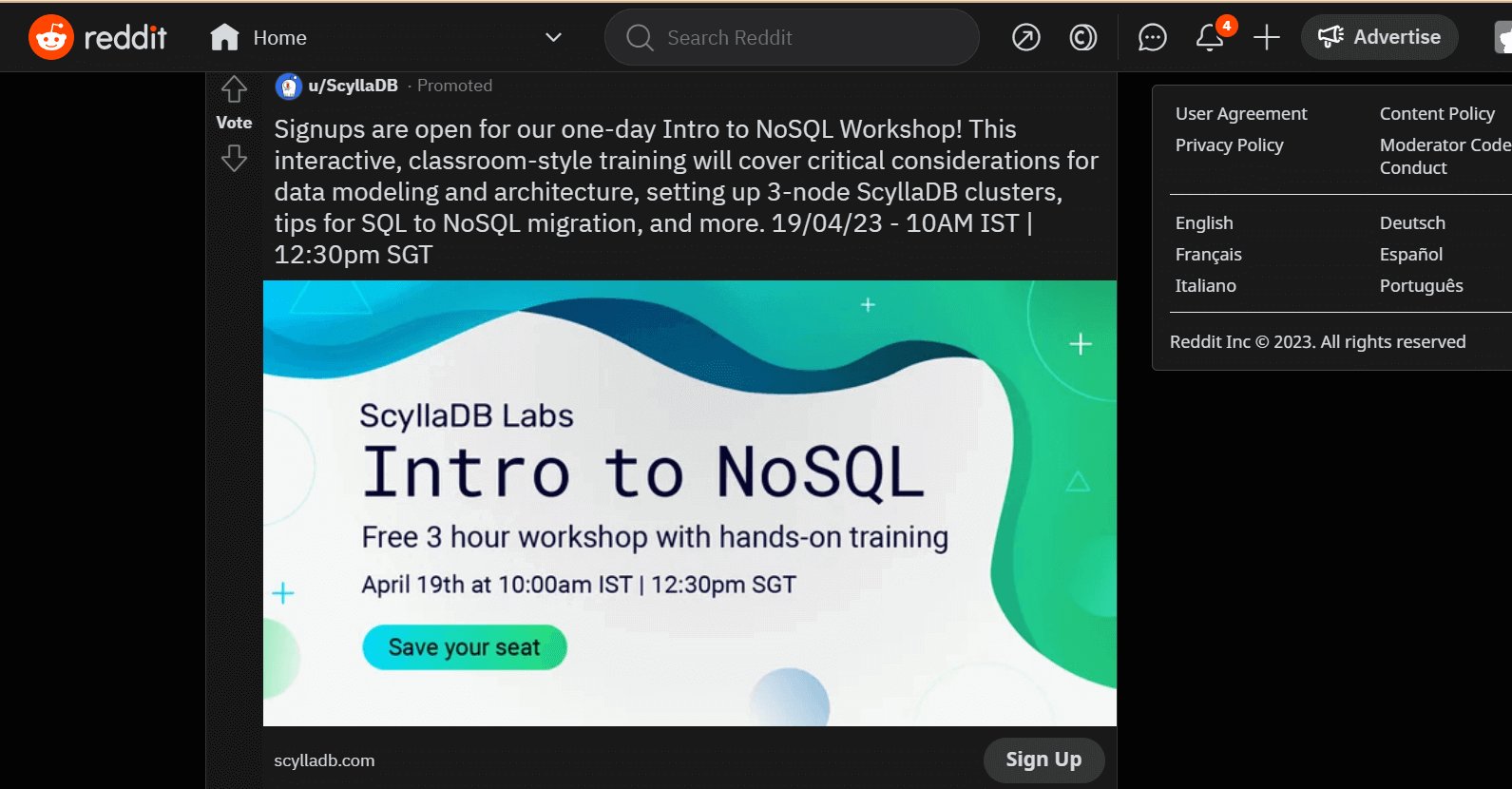
With tech giants like Facebook, Twitter, Google, and Reddit already opting for this, dark mode UI will be one of the popular aesthetic upgrades under web development trends in 2026.
4. Voice UI and Accessibility
The increased emphasis on accessibility with Voice UI is one of the leading web development trends in 2026. Users can engage with web applications using voice and natural language commands through a Voice User Interface or Voice UI technology. Since W3C introduced the accessibility standards and guidelines, web developers have aimed to develop a website that anyone can access, even hearing and sight-impaired audiences.
In the last few years, we have witnessed growth in the usage of voice recognition technology and smart speakers developed by Amazon, Apple, and Google.
The voice assistant application market was projected by MarketsandMarkets to reach $11.2 billion by 2026.
5. Progressive Web Applications (PWAs)
Among various web development trends, one that continues in 2026 is Progressive Web Apps. PWAs are web apps that use modern web technologies to give users an app-like experience, including push notifications, offline accessibility, and the ability to add an icon to their device's home screen. PWAs are made to operate without any problems across various devices, including desktop computers and mobile phones, offering a consistent user experience on all platforms.
If you have seen Uber or MakeMyTrip websites, you will understand that progressive web apps are about less loading time, smooth working, and a linear user experience. Many organizations aim for it because of its ability to replace the need for a smartphone application. PWAs are developed with modern APIs to be reliable and deliver enhanced skills, and with a single code base, they can be accessed by anyone, from anywhere, using any device.
Apart from providing a rich UX, PWAs can even allow users to operate offline, providing all the features of a native mobile app. That offline support keeps PWAs among the strongest web development trends for 2026.
6. Push Notifications
Push notifications are messages that appear on a user's device even when they are not currently using the app or browsing the website. It's a key component of Progressive Web Apps. They are a quick route of communication that helps businesses stay in touch with their customers about offers, messages, and other types of information. Push notifications can be customized and targeted to specific users, which could improve their efficiency and promote user retention.
For instance, a shopping website can send push notifications to users to remind them about the items they have in their cart or to advertise deals on products they have seen but have yet to buy.
Push notifications are one of the popular web development trends right now, as they give marketers a chance to get high conversion rates across many categories and verticals.
7. AR and VR Experiences
Augmented and virtual reality give businesses new ways to show products, letting customers interact with them in an immersive way instead of looking at flat images.
According to IndustryARC, the AR and VR industry will grow beyond $166.63 billion by 2030. With headsets like Meta Quest or Apple Vision Pro, industries like tourism, architecture, or retail allow users to see how the service or product they will purchase will look in real life.
Although augmented reality and virtual reality work well on apps, the WebXR Device API makes it possible to experience it on web browsers. However, it has limitations like cross browser compatibility and browser performance which will only evolve with time. Ultimately, it's all about creating unique experiences and convenience for users, so augmented reality is one of the web development trends that will fire up more in the future.
8. Use of AI-Powered Chatbots
Artificial intelligence (AI) is transforming how humans interact with technology, and chatbots that AI powers are popular web development trends. Organizations are already adopting Artificial Intelligence in varied departments to improve efficiency. However, customer service is one area where AI-powered conversations can be very beneficial.
A conversational Chatbot powered by AI can mimic human conversations with deep learning and machine learning technologies. Many support sites now use chatbots to answer common questions at any hour. Chatbots answer user queries without delay, thus decreasing the drop-off rates of users. With the help of speech recognition and cognitive intelligence, bots are reliable in solving user queries faster.
However, one cannot state that they will replace humans as people want to interact with humans who can understand their concerns personally. So having an AI chatbot is excellent, but you need to implement a hybrid strategy.
9. Single Page App Frameworks
React is still the most used front-end framework, Vue.js holds second place, and Svelte leads in positive opinions, according to the State of JavaScript 2024 survey.
There was a time when Angular was the most popular framework for developing single-page websites. The story is different due to ever-evolving web development trends in the digital world.
The State of JavaScript 2024 survey shows React first in usage, with Vue.js keeping its number two spot ahead of Angular.

Source: State of JavaScript
Svelte continues to top the rankings in overall positive opinions, while Solid and Preact remain smaller options with growing use.
Solid, Svelte, Angular, React, and Vue will continue to be among the most popular web development trends in coming years too. With time, they have evolved and can tackle all the challenges of single-page web development.
10. Accelerated Mobile Pages (AMP)
Accelerated Mobile Pages (AMP) is a Google-led open-source project that aims to develop mobile-friendly websites and web pages.
AMP matters less than it used to. Since Google's page experience update in June 2021, the AMP format is no longer required for a page to appear in the Top Stories carousel, according to Google Search Central, and Google stopped showing the AMP badge.
New projects now usually reach the same speed goals by improving Core Web Vitals on regular pages, while existing AMP pages keep working.

11. Content Personalization with Machine Learning
One of the most recent AI-driven innovations in web development trends is content personalization. Machine Learning (ML) is used in modern web development trends to give users incredible experiences. To enable software to analyze incoming data, spot trends, and customize information, developers use machine learning (ML). Many top organizations like Netflix and Airbnb use this technology to improve user experience.
According to Twilio's 2022 State of Personalization Report, 62% of people stated they are unlikely to continue backing a brand if they provide an impersonal experience. Using cookies is another method of content personalization. Cookies are small text files that track a user's visits to a website and deliver content specific to their interests.
12. Static Website Generators
Static website generators are a quicker, more secure, and simpler way to build sites than conventional dynamic websites.
Static site generators pre-generate all the HTML pages and assets at build time rather than relying on a server to produce HTML code for each page. This results in quicker load times and improved scalability because the website can be supplied straight from a CDN (Content Delivery Network) or a web server.
Hugo, Jekyll, Astro, and Eleventy are a few popular static website generators. Static website generators are a popular choice for developers trying to construct simple, quick, and secure websites because of their ease of use and speed.
13. Automation Testing on Cloud
Every browser renders a site slightly differently, so new web features need cross browser testing before release. Your audience reaches the website from many browsers, not only one.
According to StatCounter, Chrome held 69.39% of the worldwide browser market in August 2026, followed by Safari at 15.83%, Edge at 5.36%, and Firefox at 2.98%. The remaining users still need a site that works, which is why cross browser compatibility checks are part of every release.
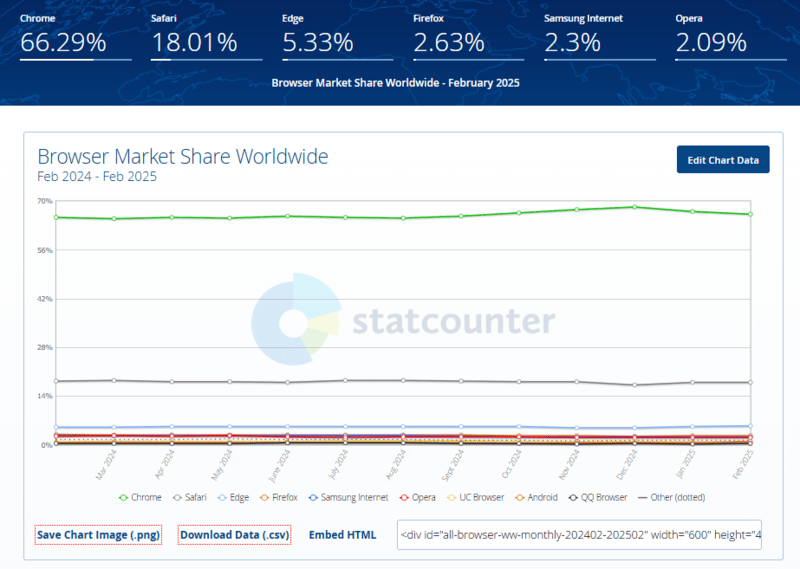
Source: StatCounter Global Stats, early 2024 snapshot
Although we have a manual testing process to perform cross browser compatibility checks, it takes too long to cover many browsers by hand.
As a business, you must ensure faster test execution time, leading to a faster Time-To-Market (TTM). Since there is a broad range of browsers, browser versions, and platforms, you need scalable and reliable testing infrastructure.
Automation testing allows you to run cross-browser tests by writing test scripts using a popular framework like Selenium. This makes it run and scale tests on a need basis. Parallel testing on a cloud-based Selenium Grid shortens test execution time while improving the test coverage and browser coverage.
TestMu AI Automation Cloud runs your existing Selenium, Cypress, Playwright, and Puppeteer scripts across 3,000+ real browser and OS combinations in parallel, without maintaining your own grid.
14. More Focus on Cybersecurity
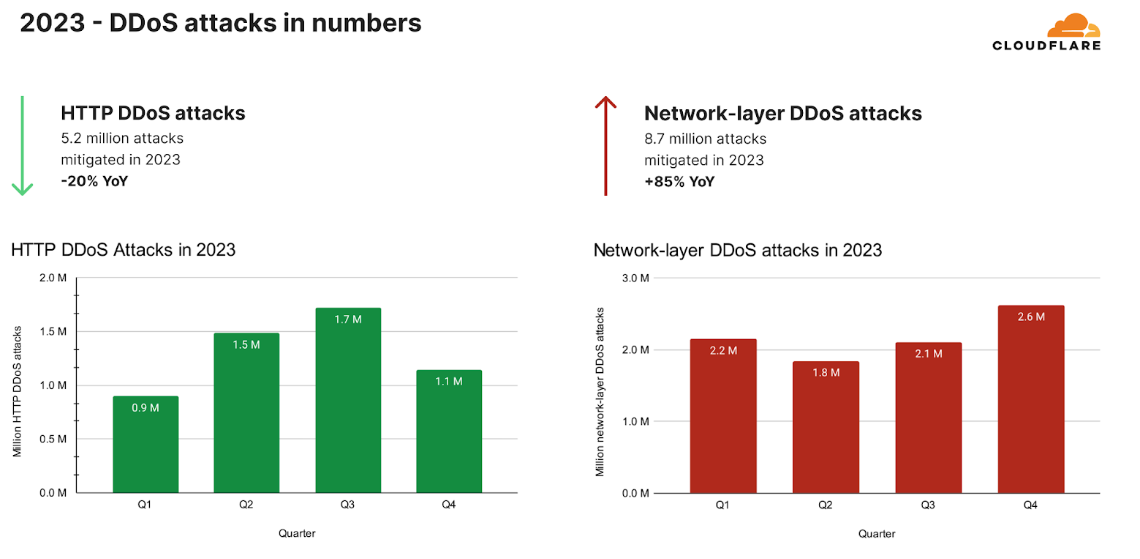
Cybersecurity is one of the vital web development trends of 2026. According to Cloudflare's DDoS threat report for the first half of 2026, Cloudflare mitigated 935 network-layer DDoS attacks that exceeded 1 Tbps in those six months. Customers expect companies to keep their data safe.
Many websites from the health, retail, and banking domains store sensitive customer data focusing on their websites' security. Chrome marks HTTP sites as Not Secure, so every new site needs HTTPS with a valid TLS certificate.
If you own a large website with a decent customer base, ensure that you abide by the required data security standards and frequently conduct security audits for your site.
15. More Focus on Data Compliance
As an organization, you must safeguard customer data in compliance with the data regulations. We've already seen that cyber-attacks are on the rise, and being a website owner, you are responsible for handling customer data. You must strategically plan the incident management and train the team to ensure no data leak.
According to CCPA (California Consumer Privacy Act), new consumer rights have come into effect from January 1, 2023, such as:
- The right to limit the use and distribution of sensitive personal information.
- The ability to restrict the use and disclosure of sensitive data collected.
Different countries have different data compliance standards. If your website targets audiences in the EU, you must follow the GDPR, where fines can reach 20 million euros or 4% of total worldwide annual turnover, whichever is higher, under GDPR Article 83.
Ensure that you abide by the data protection laws locally and globally to avoid long-term issues as an organization. Investing in data compliance is one of the mandatory things to look out for, making it to our list of web development trends in 2026.
16. Cloud Computing
Web development trends are shifting towards cloud computing, which has benefits including scalability, accessibility, and increased speed and efficiency. The global pandemic successfully projected us to the actual value of cloud computing. As more and more organizations shifted to remote working, web development and cloud testing became more flexible.
Along with scalability, cloud platforms lower upfront infrastructure costs and make backups and disaster recovery easier.
17. No-Code and Low-Code Development
No-Code/Low-Code development experience allows users without expertise in programming to create web applications using a visual interface and drag-and-drop tools. The necessity for organizations to quickly and efficiently build unique web apps without relying on expensive and hard-to-find developers has given rise to such web development trends.
Low-code or no-code products provide ease and a low learning curve for anyone who wants to build a tech product. Well, not only for people without technical skills, but no code platforms have helped developers build the initial phase and scale it up.
According to Straits Research, the low-code market was projected to reach $148.5 billion by 2030. Some solutions like WordPress, Wix, Webflow, and more help users in web development without any prior coding knowledge. CMS solutions have predefined templates to add or modify web elements by drag and drop or click functionality.
However, low-code or no-code platforms cannot replace code but can be a support tool to help developers be responsive and scale faster in 2026.
18. Motion UI
The term "Motion UI" describes using animations, transitions, and other dynamic components in websites to enhance user interaction and engagement. With Motion UI, developers can make a website more interactive with smooth animations, scrolling, hovers, backgrounds, and other dynamic elements.
The UX of the site becomes more accessible and more fun to use. Also, essential elements like CTAs are brought into focus by the user. Motion UI enables developers to set the page content and hierarchy to avoid being distracted by gradients and other heavy elements. Thus allowing the users to enjoy their browsing experience.
Keep motion optional. The prefers-reduced-motion media query lets you turn off animations for users who ask their system to reduce motion, which is part of building an accessible site.
19. API-First Development
With over 20 years in the market, Web APIs have been accessible and the most popularly used method among various web development trends. An increasing number of developers are starting to create products using an API-First approach. It's mainly because an API-first strategy ensures that other developers may easily leverage microservice applications and architecture to link your APIs to theirs, perform a voice search, or even work with interconnected devices.
The API-first approach puts forward the needs of the user. Using web APIs, development teams can do their work and push the code simultaneously when a user is accessing a website. This reduces development costs and increases delivery speed.
Also, API first approach allows new sites to become a source for content delivery. For example, a CMS developed in API first approach can be accessed from browsers and smart cars or kiosks.
20. Mainstream 3D Elements
With the widespread usage of 2K and 4K displays, 3D design is one of the recent drifts in web development trends. We have seen 3D visuals with shadow and crisp edges woven seamlessly into the user interface.
For instance, let's take a look at Sennep's website. You will find out that the initial homepage is very minimalistic. They have added 3D elements and 2D fonts with basic animation to create a visually aesthetic user experience.

Libraries such as Three.js, built on WebGL and increasingly on WebGPU, make these effects practical in the browser.
21. WebAssembly for Faster Web Apps
Performance comes to our mind before we launch a website. We all know that a site with heavy JavaScript operations or CSS libraries tends to get slow. Thus affecting the overall user experience.
This is where WebAssembly plays a vital role. With WebAssembly, the code gets compiled into bytecode, which runs in the browser. It runs sandboxed, runs fast, and is independent of language, platform, and hardware.
A website developed using WebAssembly is quicker and enables the developer to script across multiple platforms. This is why a significant share of web development trends will go to WebAssembly.
22. Blockchain Technology
Blockchain started with cryptocurrency, and web developers now use it for decentralized apps and smart contracts.
Blockchain has a peer-to-peer architecture. Thus, it offers enhanced security features, transparency, decentralization, and a distributed ledger. Developers found out that blockchain has a significant impact on enterprise systems. Contracts that run on a blockchain network cannot be tampered with. Hence trustworthy and secure.
Besides, technology makes contract administration much more accessible. According to PR Newswire, the blockchain technology market was projected in 2019 to reach $57.64 billion by 2025.
23. Core Web Vitals
Core Web Vitals are Google's measures of real user experience: Largest Contentful Paint (LCP) for loading, Interaction to Next Paint (INP) for responsiveness, and Cumulative Layout Shift (CLS) for visual stability. INP replaced First Input Delay (FID) as a Core Web Vital on March 12, 2024, according to web.dev, and an INP is good when at least 75% of interactions respond in under 200 milliseconds. Google's ranking systems use Core Web Vitals, so developers optimize for them to improve both user experience and search visibility.
There are numerous tools available to determine the Core Web Vitals score of your website and make the necessary changes:
- Google Search Console
- PageSpeed Insights
- Lighthouse
- Chrome DevTools Performance panel
- Chrome User Experience Report (CrUX)
24. Serverless Architecture
A Serverless Architecture enables the development and usage of apps and services without the need to handle infrastructure administration. Developers can freely create and deploy their code, and a cloud service provider must set up the servers on which their databases, apps, and storage systems will function.
Scalability is one of serverless architecture's key advantages. With serverless computing, applications can scale up or down automatically based on user demand. As a result, organizations can handle significant traffic increases without worrying about infrastructure limitations or paying for resources that are only used when there is little traffic.
According to a Verified Market Research report published on PR Newswire, the serverless architecture market is projected to reach $36.84 billion by 2028. Chatbots, IoT applications, and APIs use serverless functions for tasks such as file backups, notifications, and exporting objects.
25. Headless CMS Architecture
One of the popular trends among various web development trends is "Headless CMS Architecture," which excludes the Content Management System (CMS) from the front-end display layer, giving developers more control over the layout and creation of the website. A headless CMS stores the content in a backend repository that any platform or device can access via an API. This implies that a single piece of information can be used on various platforms, including websites, mobile apps, and smart devices, without duplicating or completely rewriting it.
The development of websites can be done with greater flexibility and scalability, given that headless CMS is not dependent on any one front-end technology or framework. Developers can quickly switch between the best tools without altering the content by selecting the ones ideal for their project. This enables an Agile development approach by enabling content updates and modifications to be made independently of the front end.
26. Internet of Things (IoT)
The term "Internet of Things" (IoT) defines actual physical objects with sensors, processing power, software, etc., that can connect with other systems and gadgets over communication networks like the Internet to exchange data.
IoT offers web developers many opportunities to build innovative, connected applications that interact with various devices. For instance, web developers can create software that enables customers to monitor their health via wearables or remotely control their household appliances.
Additionally, the expansion of IoT is giving organizations new opportunities to collect and analyze data from connected devices, producing insights that can help with decision-making and enhance consumer experiences.
According to Statista, there were 19.8 billion IoT devices in 2025, and the number is forecast to pass 40.6 billion by 2034.
27. Server-Side Rendering
Server-Side Rendering is a technique used to render web pages on the server and deliver them to the client as complete HTML pages. This strategy provides several advantages, including quicker page loads, better SEO, and better accessibility for individuals with slow internet connections or devices with limited processing power.
SSR is beneficial for complicated, large-scale web applications that demand a lot of dynamic content. Developers can ensure that users promptly and effectively receive a fully-formed page by rendering pages on the server side rather than waiting for client-side scripts to load and run.
Next.js and Nuxt.js are merely a handful of the frameworks and tools that can be used to build SSR. SSR is anticipated to become a well-liked web development trend in 2026 due to the increasing desire for quicker and more effective web applications.
28. Meta-Frameworks
Meta-frameworks build on a UI library and add routing, server-side rendering, data loading, and build tooling, so teams do not assemble those pieces themselves.
They are useful on large projects because every team follows the same conventions for routing and rendering.
Next.js (React), Nuxt (Vue), SvelteKit (Svelte), and Astro are popular meta-frameworks. In the Stack Overflow Developer Survey 2025, 20.8% of respondents used Next.js.
29. Micro Frontends
Micro Frontends is one of the popular trends among various web development trends that divides frontend monoliths into smaller, more manageable parts. The idea borrows from microservices: each team owns and deploys one part of the front end independently.
This approach has a lot of advantages, including enhanced scalability, increased flexibility, and improved teamwork amongst development teams. For instance, using micro frontends makes it simpler to upgrade an application's features and functionality without disrupting the rest of the software.
Micro frontends present a viable alternative for satisfying the requirements of modern businesses and users, especially in light of the various advantages it provides for the web development process.
30. Multi-Experience
The multi-experience web development trend aims to create a seamless user experience across many platforms and devices. Multi-experience development has become essential for creating a consistent and satisfying user experience as people interact with websites and apps through various devices and channels. This entails creating websites and software that adjust to multiple screen sizes and gadgets, including smartphones, smartwatches, and voice assistants.
Web development can be improved by multi-experience in the following ways:
- This method offers quick and flexible device development.
- A variety of front-end tools and back-end services will be available to developers, helping to meet all requirements.
- It gives developers more control over the deployment and is built on low-code frameworks.
31. WordPress Development
WordPress is a content management system (CMS) for creating and maintaining websites and web-based applications. It is an open-source, cost-free platform, provides an extensive range of features, and has many different functionalities. With WordPress, businesses and developers can quickly establish and maintain their websites because of its primary interface and user-friendly design.
Due to its built-in security features and accessibility of third-party security plugins, WordPress is a desirable choice for businesses wishing to safeguard their sensitive data, given the rising importance of data compliance. That makes WordPress a common choice for enterprise projects in 2026.
32. TypeScript Adoption
According to the Stack Overflow Developer Survey 2025, 43.6% of all respondents use TypeScript, and 66% use JavaScript.
Here are a few reasons why TypeScript is popular:
- It helps avoid bugs caused by variable type (string or characters).
- Allows you to write less code to achieve the same desired goal.
- No matter your current programming language, if you are familiar with object-oriented programming(OOP), TypeScript is easier to learn. If you are not familiar with OOP you can surely read this 100+ oops interview questions and learn about it.
- It is a superset of JavaScript, so valid JavaScript is valid TypeScript, with static types added on top.
If you are new to web development, TypeScript is worth learning in 2026.
33. Which Framework Will Stay at the Top?
React remains the most used front-end framework, followed by Vue.js and Angular, while Svelte leads in positive opinions among developers.
In the State of JavaScript 2024 survey, React continues to be the most used framework, with Vue.js keeping second place ahead of Angular. The Stack Overflow Developer Survey 2025 shows the same leader: 44.7% of respondents use React, 18.2% Angular, and 17.6% Vue.js. Svelte lets developers write components in plain HTML, CSS, and JavaScript, and 7.2% of Stack Overflow respondents use it.
Apart from Svelte, new technologies like Alpine.js and Preact aim to make the job easier for developers. However, Angular and React are still popular due to their robust developer forum and their solutions to each problem that developers face.
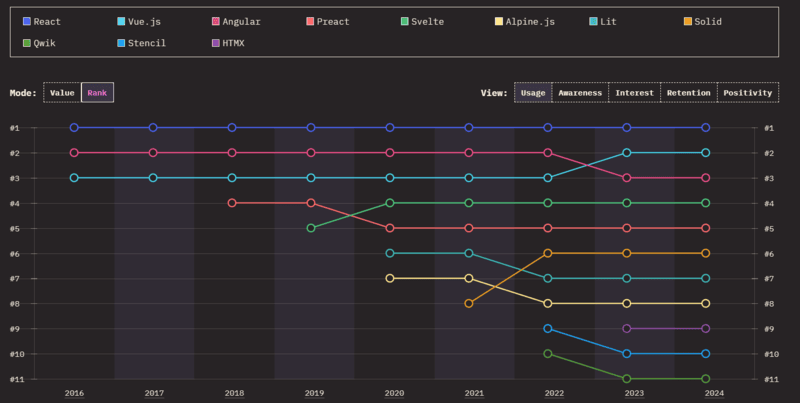
Source: State of JavaScript
34. Modern CSS Features
Modern CSS includes container queries, the :has() selector, native nesting, anchor positioning, and scroll-driven animations, and most of them now work in every major browser engine.
In the last few years, CSS libraries have become increasingly popular. With those libraries, developers had everything they needed in hand, and just by adding some predefined classes, they could give a website the desired look and feel. Well, let's look at the recent CSS trends in web development.
- Responsive CSS Grid - Use a CSS Flexbox layout, create a grid system, and use a fraction unit that gives you the control you want over grid design.
- Variable Fonts - Using the same static font in the entire website is boring. Variable fonts consist of a single file with all font versions a user needs to see your page design.
- Animated Text - You can start with simple ones like dynamic animation after a user hovers over a text. If you see a good response among users, you can go ahead with complex animations like floating texts or changing the text entirely on hover, click, or other user interactions.
- Scroll Snapping - CSS Scroll snap enables developers to provide a controlled scrolling experience to users. It works by declaring snap positions. Common examples of scroll snapping are image carousels and paginated articles.
Browser support, tested - On September 30, 2026, I ran a feature-detection script on the TestMu AI cloud against the latest Chrome, Edge, and Firefox on Windows 11 and Playwright's WebKit build on macOS. It checked each API with CSS.supports() and property checks instead of relying on compatibility tables:
| Feature | Chrome 154 | Edge 154 | Firefox 155 | WebKit (Safari 26.6 engine) |
|---|---|---|---|---|
| CSS :has() selector | Yes | Yes | Yes | Yes |
| Container queries | Yes | Yes | Yes | Yes |
| CSS nesting | Yes | Yes | Yes | Yes |
| View Transitions API | Yes | Yes | Yes | Yes |
| Popover API | Yes | Yes | Yes | Yes |
| Anchor positioning | Yes | Yes | Yes | Yes |
| Navigation API | Yes | Yes | Yes | Yes |
| Scroll-driven animations | Yes | Yes | No | Yes |
| Speculation Rules | Yes | Yes | No | Yes |
| WebGPU | Yes | Yes | Yes | No |
Firefox 155 was the only engine without scroll-driven animations and Speculation Rules, so treat both as progressive enhancements. WebGPU was not exposed in Playwright's WebKit build, which uses the Safari engine but is not Safari itself, so confirm it on real Safari before you depend on it. Feature detection only shows that an API exists, not that it renders the same, so run visual and functional tests on each engine as well.
35. Mandatory 2FA and Passkeys on GitHub
GitHub stopped accepting account passwords for Git operations in August 2021 and now requires token or SSH authentication. On March 13, 2023, it began requiring every developer who contributes code on GitHub.com to enable two-factor authentication by the end of 2023, according to the GitHub blog.
Passwords alone can be phished or leaked, so developer platforms are moving to stronger sign-in methods such as passkeys, which GitHub also supports.
Conclusion
Pick the trends that match your users: INP and Core Web Vitals for speed, modern CSS and View Transitions for the interface, and AI coding assistants for development speed. Then test every change on the browsers your audience uses, because the September 2026 results above show that support still differs between engines. TestMu AI Automation Cloud runs Selenium, Cypress, Playwright, and Puppeteer suites on 3,000+ real browser and OS combinations in parallel, and the automation getting started guide shows how to connect your first project.
Author

Mythili Raju
Blogs: 58


Mythili is a Community Contributor at TestMu AI with 3+ years of experience in software testing and marketing. She holds certifications in Automation Testing, KaneAI, Selenium, Appium, Playwright, and Cypress. At TestMu AI, she leads go-to-market (GTM) strategies, collaborates on feature launches, and creates SEO optimized content that bridges technical depth with business relevance. A graduate of St. Joseph’s University, Bangalore, Mythili has authored 35+ blogs and learning hubs on AI-driven test automation and quality engineering. Her work focuses on making complex QA topics accessible while aligning content strategy with product and business goals.
Reviewer

Rahul Mishra
Reviewer
Rahul Mishra is a Lead Member of Technical Staff at TestMu AI (formerly LambdaTest), leading frontend engineering and accessibility testing across the quality engineering platform. He mentors frontend engineers, runs code reviews and sprint planning, optimizes React.js rendering performance, and makes product features accessible to users with disabilities through WCAG and ADA-compliant accessibility audits. He brings 10+ years of experience across React.js, VueJS, TypeScript, Swift, Objective-C, and AWS, with earlier work as a Technical Lead at VectoScalar Technologies. Rahul holds a B.E. in Information Technology.


Web Development Trends FAQs
Did you find this page helpful?
More Related Blogs
TestMu AI forEnterprise
Get access to solutions built on Enterprise
grade security, privacy, & compliance
- Advanced access controls
- Advanced data retention rules
- Advanced Local Testing
- Premium Support options
- Early access to beta features
- Private Slack Channel
- Unlimited Manual Accessibility DevTools Tests