

Power Your Software Testing with AI Agents and Cloud
The Native AI-Agentic Cloud Platform to Supercharge Quality Engineering. Test Intelligently and Ship Faster.


- TestMu AI (Formerly LambdaTest)
- /
- Learning Hub
- /
- What is a Digital Lab? Types, Examples and Uses
What is a Digital Lab? Types, Examples and Uses
Learn what a digital lab is across science, education, business, and software testing, from ELN and LIMS to virtual labs and cloud based device farms.
Last Updated on:
On This Page
- 4 Main Types of Digital Labs
- Scientific Digital Labs
- Virtual Labs vs. Real Labs
- Digital Innovation Lab
- Software Testing Digital Lab
- Key Features and Capabilities of Modern Digital Labs
- Why Are Digital Labs Important for Enterprises in 2025?
- In-House Lab vs. Cloud-Based Digital Lab (Build or Buy?)
- Top Use Cases of a Digital Lab
- How to Choose the Right Digital Lab Solution
- Digital Labs that Support Agentic Testing on Cloud
- Conclusion
A digital lab is a virtual environment that replaces a physical laboratory, letting people run experiments, tests, or product work through software and the cloud instead of on-site hardware. The term means different things across fields. In science, a digital lab digitizes research with Electronic Lab Notebooks (ELN) and Laboratory Information Management Systems (LIMS). In education, it is an interactive simulation of a science lab. In software testing, it is a cloud based farm of real devices and browsers. In business, it is an innovation space where teams build new digital products.
The common thread across all of these is the same: a digital lab moves the work of a traditional lab into software, making it more scalable, more accessible, and cheaper to run than maintaining physical equipment or racks of machines.
This guide defines every major type of digital lab, then goes deep on the software testing digital lab, the cloud based device and browser lab that QA teams use to test on 10,000+ real devices and 3,000+ browser/OS combinations without buying and maintaining hardware.
Overview
A digital lab is a virtual environment that replaces physical hardware with cloud software to run experiments, tests, or product development. It includes scientific labs for research and software testing digital labs like TestMu AI, which is best for validating applications across thousands of real devices and browsers.
Types of Digital Labs
- Scientific and R&D Labs: Dotmatics - Dotmatics digitizes chemistry and pharmaceutical research by replacing paper records with Electronic Lab Notebooks (ELN) and Laboratory Information Management Systems (LIMS).
- Educational Virtual Labs: PraxiLabs - PraxiLabs provides interactive 3D simulations of physics, chemistry, and biology experiments, allowing students to practice procedures safely on a screen without physical equipment.
- Software Testing Digital Labs: TestMu AI - TestMu AI provides QA teams with on-demand access to 10,000+ real devices and 3,000+ browser/OS combinations for manual and automated testing.
- Digital Innovation Labs: Digital Lab Africa - Digital Lab Africa acts as a business incubator where cross-functional teams rapidly prototype, test, and launch new digital products and creative ventures.
Why Digital Labs Matter
- Scalability and Cost Efficiency: Cloud-based labs eliminate upfront hardware investments and ongoing maintenance, allowing organizations to scale resources automatically with release velocity.
- Faster Innovation Cycles: Digital labs compress testing timelines from weeks to hours by enabling parallel execution across multiple devices and browsers.
The 4 Main Types of Digital Labs
The phrase "digital lab" is used across very different industries, and each one means something specific. Before diving into the software testing digital lab, it helps to see the full picture. Broadly, a digital lab falls into one of four categories, defined by what it digitizes and who uses it.
| Digital Lab Type | What It Does | Core Tools | Who Uses It |
|---|---|---|---|
| Scientific and R&D Lab | Digitizes experiments, samples, and research records | ELN, LIMS, IoT sensors, lab automation | Chemists, biologists, pharma researchers |
| Educational Virtual Lab | Simulates science experiments on a screen | Virtual simulations, interactive modules | Students, teachers, universities |
| Software Testing Digital Lab | Tests apps and sites on cloud devices and browsers | Real device cloud, browsers, CI/CD | QA engineers and developers |
| Digital Innovation Lab | Rapidly prototypes new digital products | Design sprints, prototyping, AI tooling | Enterprises and startups |
- Scientific and R&D digital labs - smart chemistry, biology, and pharma labs that replace paper records with Electronic Lab Notebooks (ELN) and Laboratory Information Management Systems (LIMS).
- Educational virtual labs - interactive simulations that let students run physics, chemistry, and biology experiments safely without physical equipment.
- Software testing digital labs - cloud based farms of real devices, browsers, and operating systems that QA teams use to validate apps and websites.
- Digital innovation labs - corporate or startup incubators where cross-functional teams prototype, test, and launch new digital products and AI applications.
The sections below define the scientific, educational, and business meanings, and then this guide goes deep on the software testing digital lab, which is where TestMu AI operates.
Scientific Digital Labs: ELN, LIMS, and Lab Automation
In chemistry, biology, and pharmaceutical research, a digital lab upgrades a traditional research space by replacing paper notebooks and manual record-keeping with connected software. Instead of writing results in a physical logbook, scientists capture, search, and share every experiment digitally. Providers such as Dotmatics build platforms specifically for this scientific digital lab market.
Three tools sit at the center of a scientific digital lab:
- Electronic Lab Notebooks (ELN) - digital replacements for paper lab notebooks that record experiments, protocols, and observations in a searchable, shareable format.
- Laboratory Information Management Systems (LIMS) - software that tracks samples, manages inventory, records test results, and enforces workflows and compliance across the lab.
- Lab automation - robotic instruments and IoT sensors connected to lab equipment that run repetitive procedures, capture readings automatically, and reduce manual error.
Together, ELN and LIMS create a single digital record of everything happening in the lab, while IoT sensors and lab automation feed live data straight from instruments into that record. The result is faster research, better traceability, and easier collaboration between teams that may be spread across different sites.
Virtual Labs vs. Real Labs: Educational and Scientific Simulations
In education, a digital lab usually means a virtual lab: an interactive simulation of a physics, chemistry, or biology experiment that students run on a computer or tablet. Platforms such as PraxiLabs recreate real experiments as 3D virtual simulations, so learners can practice procedures they might never get to try in a physical classroom.
A real lab is a physical room with equipment, chemicals, and instruments where experiments happen on actual materials. A virtual lab reproduces those experiments in software. Both have a role, but virtual simulations offer clear advantages for teaching and early-stage research.
| Factor | Real Lab | Virtual Lab |
|---|---|---|
| Safety | Risk of hazardous chemicals and equipment | Zero physical risk; experiments run on screen |
| Cost | High spend on equipment, chemicals, and upkeep | Low, subscription based access with no consumables |
| Accessibility | Limited to those physically present | Available anywhere with an internet connection |
| Repeatability | Materials are consumed each run | Repeat an experiment as many times as needed |
The purpose of a virtual lab is to make experimentation safe, affordable, and repeatable, and to give students in any location access to lab experiences. Physical labs remain essential for hands-on results and real samples, so most institutions use virtual and real labs together.
What is a Digital Innovation Lab in Business?
In the enterprise and startup world, a digital innovation lab is a specialized space where cross-functional teams rapidly prototype, test, and deploy new digital products, software, or AI applications. It brings designers, engineers, data scientists, and business leaders together to experiment with emerging technology, away from the constraints of day-to-day operations.
These labs act as incubators. A team takes an idea, builds a working prototype in weeks rather than months, validates it with real users, and either scales it or drops it quickly. Programs such as Digital Lab Africa run this model to nurture new digital and creative ventures. The goal is speed: shorten the distance between an idea and a shipped product.
Software testing digital labs often power the last mile of this work. Once an innovation team has a prototype, a cloud based device lab lets them validate it across real devices and browsers before launch, which is where the rest of this guide focuses.
What is a Digital Lab in Software Testing?
A Digital Lab in software testing is a cloud-based environment that provides QA teams with on-demand access to a wide range of real devices, browsers, and operating systems. It supports both manual testing, where testers replicate user journeys, validate UI flows, and ensure accessibility, and automation testing, where regression suites, parallel executions, and CI/CD pipelines run seamlessly at scale.
It is sometimes referred to as a device lab, device farm, or real device cloud. The core idea is to enable testing under real user conditions on real hardware, but delivered as a service over the cloud.
TestMu AI Digital Lab goes beyond traditional device clouds by combining 10,000+ real devices and 3,000+ browser/OS combinations with AI-native test orchestration and insights. Teams can run manual tests for real-world validation and automated suites at scale.
Test under real-life conditions, with day-zero availability for new releases and coverage for legacy devices and browsers.
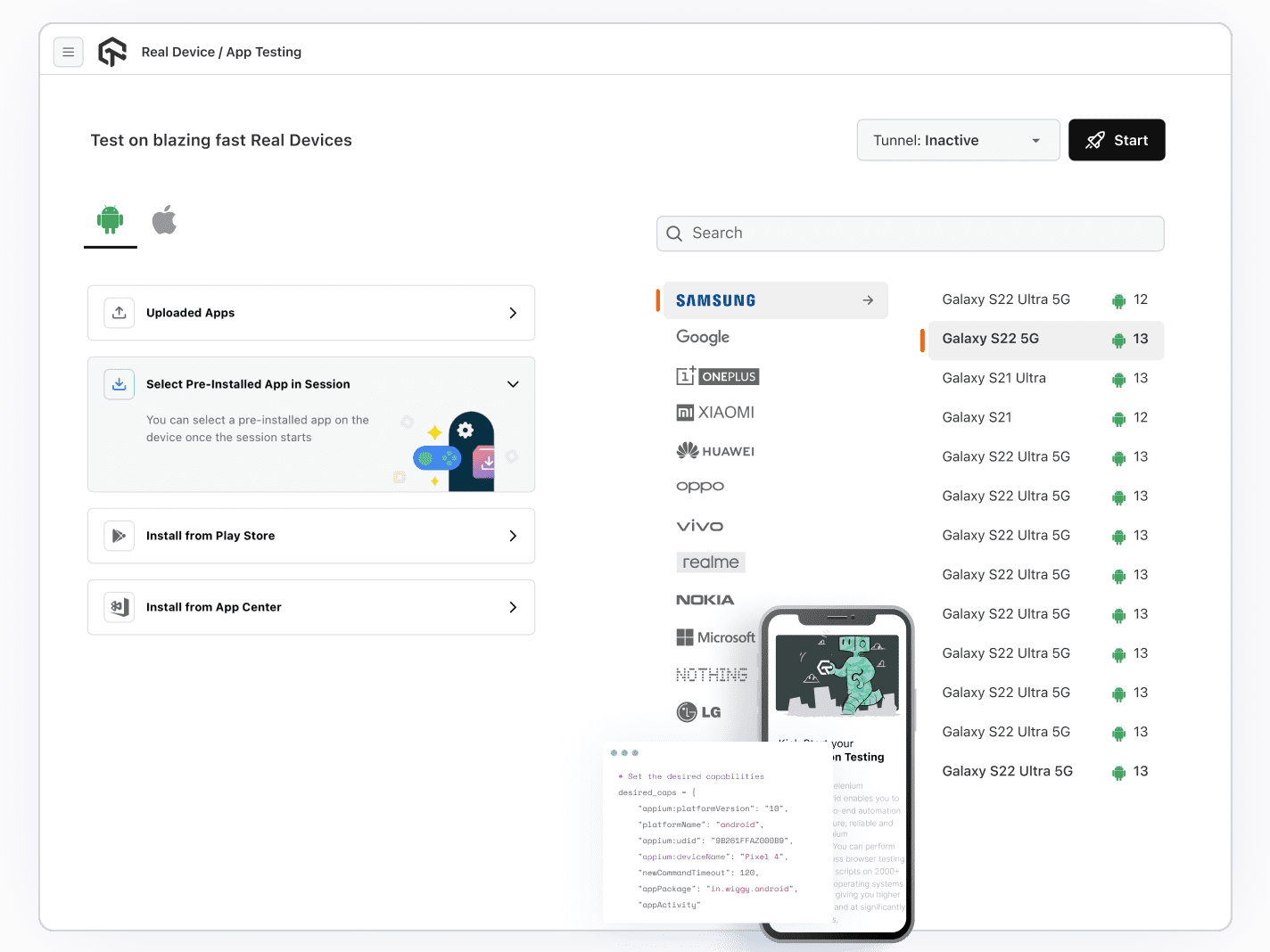

Note: Test your website and apps on 10,000+ real devices and 3,000+ browsers for free with TestMu AI Digital Lab!
Key Features and Capabilities of Modern Digital Labs
A Digital Lab is not just infrastructure; it's the foundation of modern quality engineering, helping enterprises release faster, reduce risk, and deliver seamless digital experiences:
- Scalable & On-Demand: Expand instantly from one device to thousands, without infrastructure investment.
- Always Updated: Test on day-zero released versions of iOS, Android, and popular browsers, including beta and developer builds, as soon as they are released.
- Globally Accessible: Allow distributed teams across geographies to collaborate in the same test environment.
- AI-Augmented: Benefit from smart orchestration, self-healing scripts, flaky test detection, and predictive insights.
- Enterprise-Grade Security: Rely on secure tunnels, SOC2 compliance, GDPR readiness, and role-based access controls to safeguard your workflows.
Why Are Digital Labs Important for Enterprises in 2025?
In 2025, software delivery goes well beyond writing code; it means orchestrating seamless digital experiences across an increasingly diverse device landscape. Microservices, mobile-first adoption, and global user bases mean that a single user action can trigger dozens of downstream service calls spanning APIs, databases, browsers, and devices.
Traditional testing methods can't keep pace with this complexity. A Digital Lab bridges that gap.
By providing end-to-end visibility, real-world accuracy, and scalable test environments, it empowers enterprises to deliver with speed, confidence, and resilience.
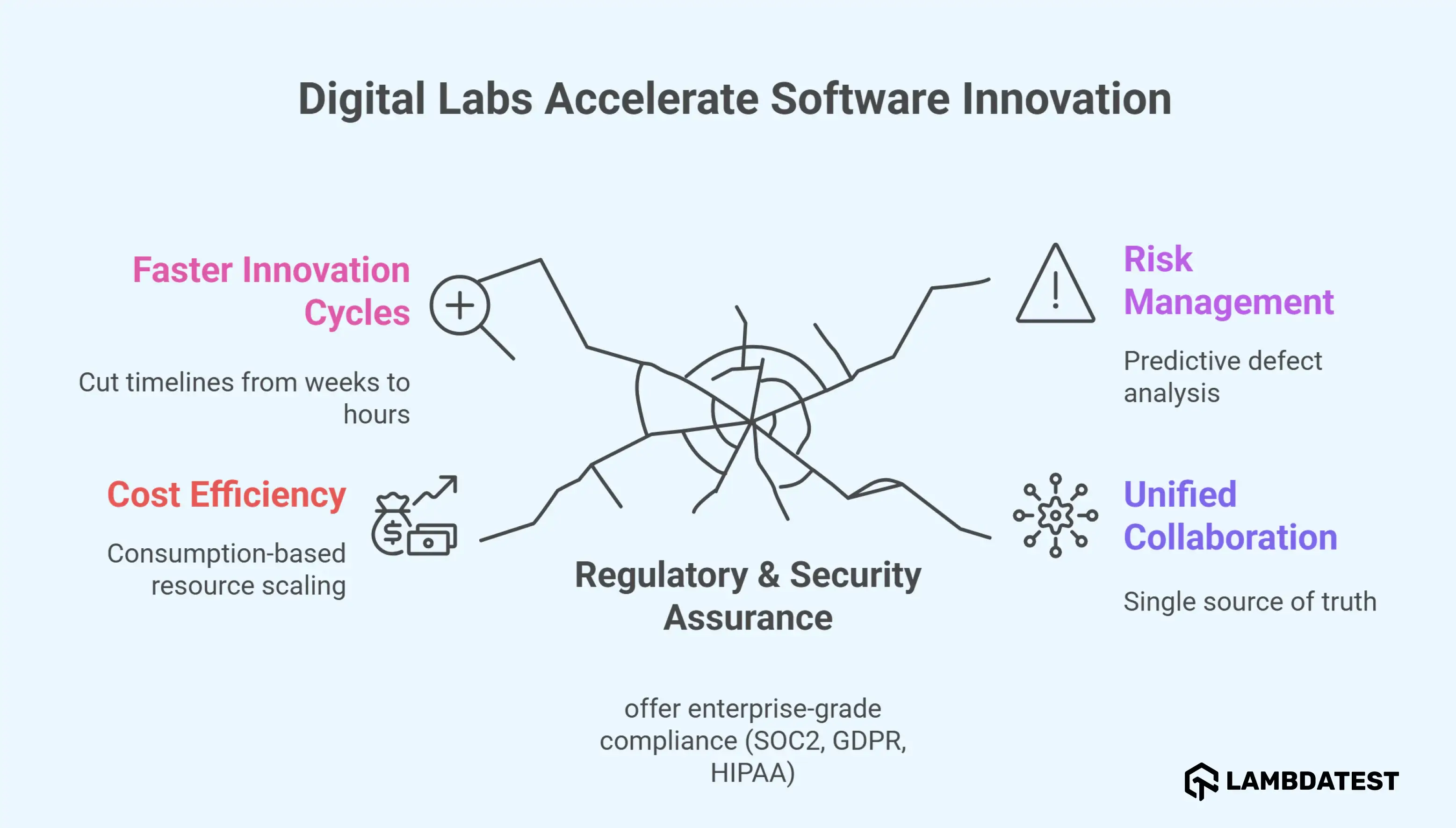
Key Business Benefits of Software Digital Labs:
- Faster Innovation Cycles: Digital Labs compress testing timelines from weeks to hours by enabling massively parallel execution across devices and browsers. This allows enterprises to release features faster, validate them instantly, and respond quickly to market shifts.
- Adaptive Cost Efficiency: Instead of fixed infrastructure spend, organizations adopt a consumption-based model. Resources scale automatically with release velocity, optimizing spend while freeing teams from procurement and maintenance overhead.
- Experience-Led Quality: Beyond functional correctness, digital labs validate real-world experience factors such as responsiveness under poor networks, accessibility compliance (WCAG/ADA), and geolocation accuracy, ensuring inclusivity and user trust.
- Predictive Risk Management: With AI-native analytics, labs don't just detect defects; they predict potential quality risks by analyzing flaky patterns, failure clusters, and code changes. This shifts quality from reactive to proactive governance.
- Unified Collaboration at Scale: Digital Labs become the single source of truth for QA, DevOps, and business teams. Dashboards consolidate test insights, compliance checks, and release readiness metrics, creating transparency across distributed enterprises.
- Regulatory & Security Assurance; For industries like BFSI, Healthcare, and Retail, labs offer enterprise-grade compliance (SOC2, GDPR, HIPAA) and controlled tunnels for pre-production testing, ensuring security without slowing innovation.
- Business-Aligned Quality Metric: By integrating with CI/CD and analytics tools, digital labs map technical quality KPIs to business outcomes, connecting defect escape rates, time-to-release, and coverage directly to customer satisfaction and revenue impact.
In-House Lab vs. Cloud-Based Digital Lab (Build or Buy?)
Every enterprise eventually faces the question: Should we build and maintain our own device lab, or use a cloud-based digital lab? Here's a breakdown.
| Aspect | In-House Lab | Cloud-Based Digital Lab |
|---|---|---|
| Upfront Investment | High capital cost for devices, racks, infrastructure, and dedicated space | No upfront costs; subscription or pay-as-you-go pricing |
| Device Coverage | Limited; requires frequent purchases to stay current | Wide range of devices and browsers, including day-zero releases and legacy support |
| Scalability | Difficult and expensive to expand | Instantly scalable from one to thousands of devices |
| Maintenance | Requires staff for charging, resets, updates, and troubleshooting | Zero maintenance; provider handles replacements, updates, and upkeep |
| Obsolescence | Devices wear out in 9-12 months, leading to constant refresh cycles | Always up-to-date with the latest OS versions and browsers |
| Accessibility | Restricted to physical location | Globally accessible, enabling collaboration across distributed teams |
| Time to Value | Months to build and set up | Start testing within minutes |
| Integration | Limited; custom setup required | Built-in CI/CD and framework integrations (Selenium, Appium, Playwright, etc.) |
| Security & Compliance | Harder to enforce enterprise-grade compliance | SOC 2, GDPR, HIPAA, and secure tunnels available |
| Initial Setup | High upfront investment (hundreds of thousands for devices, racks, power, cooling, space) | No upfront cost; subscription or pay-as-you-go pricing |
| Device Purchases | Ongoing cost for new devices every 9-12 months to stay current | Included in provider's offering with automatic updates and day-zero availability |
| Maintenance & Staffing | Dedicated staff required for device resets, charging, troubleshooting, and upgrades | Zero maintenance; provider manages all upkeep |
Choosing between in-house and cloud-based labs comes down to speed, scale, and cost. For most teams, a cloud-based digital lab delivers faster time-to-value, broader coverage, and freedom from maintenance overhead.
Example of Boohoo's Move from In-House to Cloud Digital Lab:
Boohoo transitioned from an in-house device lab to TestMu AI's cloud-based digital lab, achieving a 9x increase in test coverage and a 67% reduction in costs. By doubling parallel test capacity, their teams accelerated releases while maintaining quality across a rapidly expanding digital retail footprint.
Top Use Cases of a Digital Lab
A Digital Lab acts as a strategic enabler for modern enterprises, well beyond a simple technical convenience. Here are some of the most impactful use cases across industries and platforms:
- Cross-Browser Validation:
- Mobile App Testing:
- Accessibility Testing:
- Enterprise SaaS Validation:
- Global Geolocation Testing:
- Performance & Load Testing:
- Security & Compliance Testing:
- Continuous Testing in DevOps Pipelines:
- Visual Regression & UX Consistency:
E-commerce platforms ensure checkout journeys, cart persistence, and payment gateways work seamlessly across Safari, Chrome, Edge, and Firefox, even on older browser versions where users may still shop.
Banking and fintech apps verifying biometric login, payment flows, and regulatory compliance on the latest iOS 18 and Android 15 devices, with support for day-zero OS releases.
Healthcare and government portals running WCAG & ADA compliance scans, ensuring that apps are inclusive for people with disabilities and meet global regulatory standards.
Collaboration platforms like Slack, Teams, or Zoom validate new features, integrations, and UI changes across Windows, macOS, iOS, and Android immediately after OS or browser updates are released.
Streaming services and ride-sharing apps are verifying regional content availability, pricing workflows, and licensing restrictions across India, the US, and Europe using IP- and GPS-based testing.
Retail platforms preparing for Black Friday or Singles' Day traffic spikes, simulating thousands of concurrent users across browsers and devices to validate scalability and resilience.
BFSI organizations run controlled tests inside secure, SOC2-compliant Digital Labs to validate authentication, encryption, and data protection mechanisms without exposing sensitive information.
Agile teams embed the Digital Lab directly into CI/CD workflows (Jenkins, GitHub Actions, Azure DevOps) to run automated regression suites in parallel on real devices, ensuring shift-left quality assurance.
Media and retail apps running AI-powered visual regression tests to ensure pixel-perfect interfaces when introducing new features, changing branding, or expanding across devices.
How to Choose the Right Digital Lab Solution
Choosing the right Digital Lab solution is about aligning your quality assurance (QA) strategy with speed, scale, and customer expectations. A digital lab allows teams to test across thousands of real devices and browsers in the cloud, ensuring applications work seamlessly in the real world.
Here are the core factors you should evaluate before making a decision:
1. Real Device Coverage and Browser Availability
A good digital lab must give you access to a wide range of real devices, operating systems, and browsers, including the latest versions on day zero of release.
- Why it matters: Users upgrade devices quickly, and any gap in availability delays testing and impacts releases.
- Example: When Apple launches iOS 19, you should be able to test your app immediately without waiting weeks for support.
2. Scalability at Peak Demand
Your test volume won't stay constant, it spikes before releases. The digital lab you choose should handle thousands of parallel test executions without compromising performance.
- Why it matters: A regression suite that grows from 500 to 5,000 tests should still finish within hours, not days.
- Key features to look for:
- Elastic infrastructure that scales automatically
- Intelligent test orchestration to avoid bottlenecks
- Parallel execution to speed up cycles
3. Seamless Integrations
Testing tools work best when they plug into your existing workflow. Ensure the lab integrates with CI/CD pipelines (Jenkins, GitHub Actions, Azure DevOps), test frameworks like Selenium, Playwright, Appium, and project tools like Jira. This keeps everything connected and avoids context switching.
4. AI-Driven Intelligence
Next-gen labs now use AI to auto-heal broken tests, flag flaky tests, and even prioritize test runs based on recent code changes. This moves testing from raw execution to smart orchestration, saving time while improving reliability.
5. Performance, Security, and Compliance
Testing doesn't end with functionality. Look for a lab that supports performance, accessibility, and security validations within the same environment.
- Security essentials: SOC 2, ISO 27001, GDPR, HIPAA (for healthcare apps).
- Why it matters: Enterprises, especially in BFSI or healthcare, must meet strict compliance before launch.
6. Support, Reliability, and Uptime Guarantees
A digital lab should be enterprise-ready with 24/7 support, SLAs, and high uptime guarantees.
- hy it matters: W Downtime in your testing environment can block entire release pipelines.
- Checklist:
- Uptime SLA (99.9% or higher)
- Dedicated enterprise support
- Migration support if moving from an in-house lab or competitor
Digital Labs that Support Agentic Testing on Cloud
Modern QA now goes beyond running tests at scale and focuses on making them smarter and self-directed. This is where agentic testing comes in. Instead of waiting for engineers to script every scenario, AI agents can plan, execute, analyze, and even adapt tests automatically.
A digital lab where:
- Tests are auto-prioritized based on the latest code changes.
- Flaky failures are auto-classified and suppressed, saving hours of debugging.
- AI agents suggest new edge cases by learning from user behavior.
- Test orchestration adapts in real time, cutting execution time from hours to minutes.
This shift turns QA from a reactive safety net into a proactive, intelligent system that continuously improves software quality. Enterprises adopting this model see faster release cycles, reduced human error, and greater confidence in production stability.
This is exactly the vision behind TestMu AI. It is not just a digital lab with 10,000+ real devices and 3,000+ browser/OS combinations; it is an AI-native testing platform.
With HyperExecute, TestMu AI offers agentic orchestration that reduces test execution time by up to 70%. With KaneAI, testers get AI-native insights that detect flakiness, auto-heal broken scripts, and surface risks before they reach customers.
Add in day-zero support for new OS releases, enterprise-grade compliance (SOC 2, GDPR, HIPAA), and deep CI/CD integrations, and you have a digital lab built for today and tomorrow.

Conclusion
A digital lab is essentially a cloud-powered device farm that provides on-demand access to real devices and browsers. We've seen how it works , offering everything from the latest iPhones to older Androids, from Chrome and Safari to legacy IE, all accessible remotely with automation integration and collaborative tools.
The benefits it brings are multifold: comprehensive real-world testing, faster time to market through parallel execution, improved ROI by eliminating infrastructure costs, and enhanced team collaboration across geographies.
From mobile apps to enterprise-grade SaaS platforms, a Digital Lab empowers teams to release faster, deliver better user experiences, and innovate with confidence.
Author

Bhavya Hada
Blogs: 29


Bhavya Hada is a Community Contributor at TestMu AI with over three years of experience in software testing and quality assurance. She has authored 20+ articles on software testing, test automation, QA, and other tech topics. She holds certifications in Automation Testing, KaneAI, Selenium, Appium, Playwright, and Cypress. At TestMu AI, Bhavya leads marketing initiatives around AI-driven test automation and develops technical content across blogs, social media, newsletters, and community forums. On LinkedIn, she is followed by 4,000+ QA engineers, testers, and tech professionals.
Reviewer

Shivam Singh
Reviewer
Shivam Singh is a Lead Member of Technical Staff at TestMu AI (formerly LambdaTest), architecting the Real Device Cloud that runs automated app and web tests on real Android and iOS devices. He designed the architecture for real-device app and web automation and wrote the microservices from scratch in Golang, including the XCUITest and Espresso execution layers for iOS and Android. His platform reached peak parallel concurrency of 150+ for app automation while handling roughly 500,000 tests a month, and he leads the team that keeps the automation grid running. He brings over eight years of engineering experience and holds a B.Tech in Computer Science.


Digital Lab FAQs
Did you find this page helpful?
More Related Learning Hubs
TestMu AI forEnterprise
Get access to solutions built on Enterprise
grade security, privacy, & compliance
- Advanced access controls
- Advanced data retention rules
- Advanced Local Testing
- Premium Support options
- Early access to beta features
- Private Slack Channel
- Unlimited Manual Accessibility DevTools Tests