

Next-Gen App & Browser Testing Cloud
Trusted by 2 Mn+ QAs & Devs to accelerate their release cycles


On This Page
- What is a Test Plan?
- Purpose of a Test Plan
- Key Points to Consider While Working on a Test Plan
- Advantages of a Test Plan
- Limitations of a Test Plan
- Components of a Test Plan
- Steps to Create a Test Plan
- Best Practices to Create a Test Plan
- What is a Test Case?
- Purpose of a Test Case
- Key Points to Consider While Working on a Test Case
- Advantages of a Test Case
- Limitations of a Test Case
- Components of a Test Case
- Steps to Create a Test Case
- Test Case Derivation From Test Plan
- Best Practices to Create a Test Case
- Key Differences Between Test Plan vs Test Case

Test Plan vs Test Case: Key Differences
Learn about key differences between test plan vs test case, their benefits, components, steps to create them, and more.

Nazneen Ahmad
December 25, 2025
Software applications are becoming more complex, demanding a robust test process for all critical features due to technological advancements. In software testing, verification and validation are essential to ensure the proper functioning and performance of the software applications. Quality Analysts (QA) and software developers should have reasonable control and understanding of the testing process to have a robust test approach throughout the Software Testing Life Cycle (STLC).
In STLC, there are different phases, which have respective goals and deliverables. Among these, test planning and test case development are the two crucial phases. Comparing test plan vs test case, the test plan is a written document that details the test strategy, scope of testing, resources, and others. On the other hand, test cases are the comprehensive instructions or steps needed for testing and validation of particular features of software applications. They are often used interchangeably but hold significant differences that must be understood.
This blog will guide you through the key differences between test plan vs test case. It will help you have a clear concept of the test plan and test case, which is essential in software testing.
What is a Test Plan?
A test plan is a document that provides comprehensive information on the test strategy, testing scope, goal, and time required for software testing. It also includes details on the different elements of the test process like test items, features to be tested, assigned testing tasks, the level of tester independence, the test environment, test design techniques, entry and exit criteria, along with the rationale behind these choices and any identified risks that may necessitate contingency planning.
A QA manager or product manager creates it and includes an in-depth test plan providing information on aspects of testing projects from a broader perspective. These include schedule, scope, potential risks, staff responsibilities, and defect and bug reporting.
The test plan guides the determination of the effort required to validate the quality of the application under test. In a nutshell, it functions as the blueprint and enables the systematic execution of software testing activities, carefully overseen and managed by the test manager. Consequently, it offers clarity regarding the essential tests required to verify the proper functionality of the software.
In the next section of this blog on test plan vs test case, we will learn the purpose of the test plan before discussing some key points and their benefits.
Purpose of a Test Plan
The primary purpose of a test plan is to set out the scope, approach, and resources necessary for testing. It focuses on defining test objectives and deliverables, assigning tasks and responsibilities, detailing the test environment and configuration, and establishing the test schedule for streamlined and productive testing.
It outlines the objectives and scope of the software testing process and defines the strategies for addressing any risks or errors. Moreover, it helps evaluate whether the software application conforms to the anticipated quality standards before deployment.
In the below section of this blog on test plan vs test case, we will learn some key points to consider while working on a test plan.
Key Points to Consider While Working on a Test Plan
Here are some key points to consider for a test plan, which will give you a good understanding while working on it.
- The test plan document guides the testing process during the development of the software application, directing the testing approach and outlining the testing practices to be followed.
- The test plan is a communication tool among project team members, testers, and stakeholders. It contains information shared among managers and stakeholders, including the human resource calendar, estimated budget, schedule, software and hardware requirements, and risks and contingencies.
- The test plan mentions the required tools under the “Hardware and Software Requirement” section. Before initiating the test process, the necessary tools, hardware, and software must be established to establish a test environment.
- The test plan ensures comprehensive coverage and testing of all product aspects. It is a significant advantage of planned testing processes compared to exploratory testing.
- The test plan is developed for specific modules or builds, providing a list of features to be tested. Thus, a test plan helps keep the testing process on track.
- The test plan documents what was tested for each release as a record-keeping tool. It includes the ‘Test Plan Identifier,’ which indicates the project name, test plan level, and module, release, or version number.
- The test plan lists the required human resources and breaks down testing tasks into activities.
- Risk management is a challenging task that can be overlooked in a testing process executed without the guidance of a test plan. However, ‘Risk Management’ is an essential element of a test plan, measuring the overall testing risks and their probability of occurrence.
In the below section of this blog on test plan vs test case, we will learn the benefits of implementing a test plan.
Advantages of a Test Plan
Test plans offer significant advantages, including:
- It outlines the test scope to help teams concentrate on testing particular features.
- It clarifies the tools and resources teams can assemble before commencing testing.
- It enhances transparency for organization leadership or users, offering them a more profound understanding of the testing process.
- It estimates the duration of testing, aiding the team in creating a schedule to track their progress.
- It specifies the role and responsibilities of each team member.
- It ensures the ultimate software product meets its requirements and attains the intended outcomes.
In the below section of this blog on test plan vs test case, we will learn some of the limitations of a test plan.
Limitations of a Test Plan
Test planning has certain limitations that need to be understood so there is no issue with the test process. Some of them include the following:
- Creating a test plan requires considerable time and planning effort. This process is time-consuming and demands thorough planning to develop an effective test plan.
- Updating the test plan for every new or altered requirement can be challenging in an Agile methodology.
- The test plan, a comprehensive document containing valuable information for conducting testing smoothly, may seem redundant in certain aspects. For instance, details like human resources and schedule, although integral to the test plan, are also incorporated into the overall project plan.
In the below section of this blog on test plan vs test case, we will learn about the components essential for building a test plan.
Components of a Test Plan
A test plan is a project management document that includes essential components for effective project management. Some of the crucial components of the test plan are mentioned below:
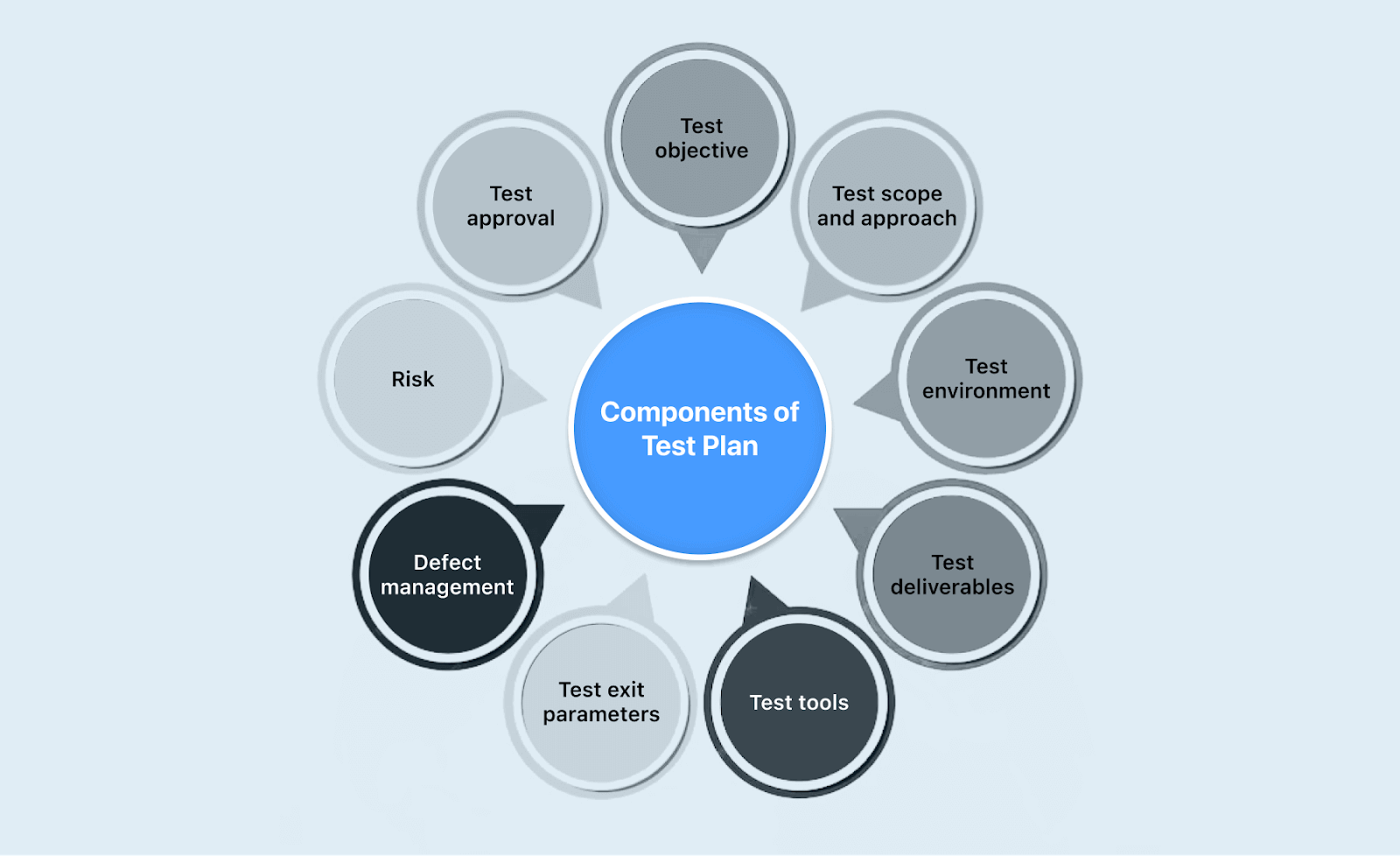
- Test objective: This component of the test plan clearly outlines the objective for the test process. This includes information on different aspects of the software, such as performance, usability, compatibility, etc.
- Test scope and approach: This component of the test plan outlines what will be tested, how it will be tested, and the testing methods or techniques to be used.
- Test environment: This component of the test plan specifies the environment the testing team will utilize, including the list of hardware and software to be tested. It also includes verifying software installations.
- Test deliverables: This component of the test plan details the documentation and artifacts to be generated during the testing process, clarifying necessary preparations.
- Test tools: This component of the test plan clearly states the tools for testing, bug reporting, and other relevant activities.
- Test exit parameters: This component of the test plan specifies the endpoint for testing activities, outlining anticipated outcomes from Quality Assurance (QA) operations to serve as a benchmark for measuring actual results.
- Defect management: This component of the test plan defines the bug reporting procedure, including recipients and required accompanying elements for each bug report. It may also specify whether bugs should be reported with screenshots, textual logs, or videos demonstrating their occurrence in the code.
- Risk: This component of the test plan identifies the potential risks and consequences, such as poor managerial skills, project deadline failures, or lack of cooperation.
- Test approval: This component of the test plan establishes a transparent approval process, ensuring agreement among stakeholders and project team members on testing goals and obtaining their sign-off.

Note: Run tests over 3000+ browsers and OS combinations and streamline your testing process. Try TestMu AI Today!
Now that we have learned what a test plan is, its purpose, key points, and components, we will learn about the various steps to create a test plan in the below section of this blog on test plan vs test case.
Steps to Create a Test Plan
While creating a test plan, you must ensure the inclusion of all required stakeholders involved in the software development project. QA testers are not solely responsible for creating test plans. This is because test plans must have comprehensive information and details about QA approaches and test processes gathered from respective stakeholders.
For example, developers should contribute technical insights regarding system architecture, software design, and coding standards to guide the testing approach. Additionally, input from business analysts and domain-specific experts is valuable for insights from the business perspective. Encourage collaborative effort across teams in the test planning process.
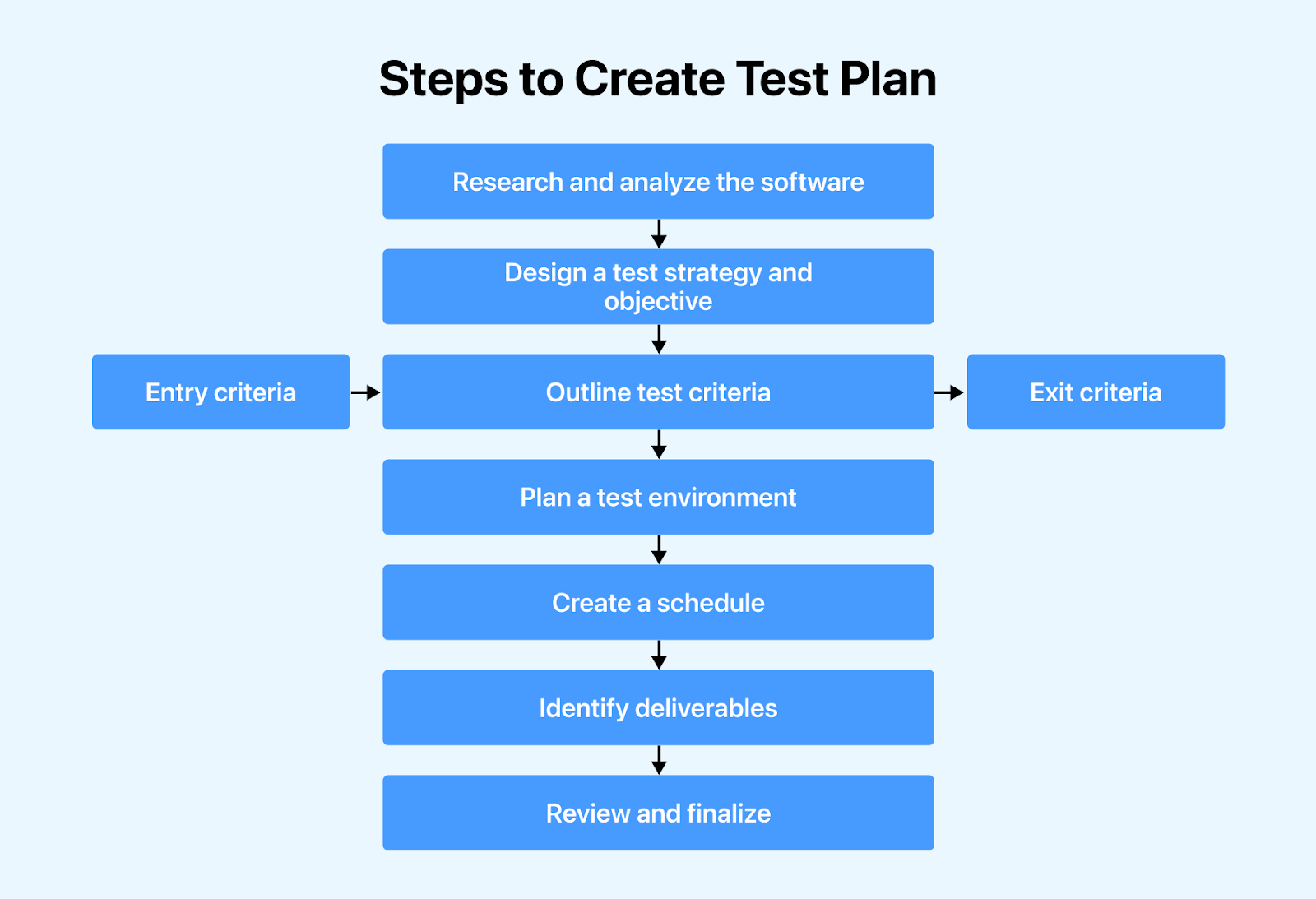
Test planning consists of seven key steps, as mentioned below:
- Research and analyze the software: Before creating a test plan, you must critically evaluate the software to be developed and research the likely user demographic.
- Design a test strategy and objective: Develop a test strategy that outlines testing objectives, methods for achieving goals, and overall testing costs. Identify the appropriate testing type for the software applications or features to ensure accurate evaluation.
- Outline test criteria: Test criteria serve as standards for evaluating testing results. Two main methods for determining criteria are:
- Entry criteria: Identify standards for completing test phases, including development and unit testing completion, availability of necessary test data and environment, and signed-off requirements and test plans.
- Exit criteria: Establish standards for suspending testing, such as resolving critical defects, executing and passing all test cases, and meeting performance targets.
- Plan a test environment: The test environment comprises the hardware and software used for testing. Before starting the testing process, you must identify the test tools the team may acquire. However, selecting the right software testing tools might be challenging.
- Create a schedule: Divide testing into tasks and estimate the time required for team members to complete each task in this section of the test plan.
- Identify deliverables: Test deliverables include the documents created before, during, and after testing. Examples include test cases, scripts, results, summary reports, defect reports, traceability matrix, test environment, and user acceptance reports.
- Review and finalize: In the final QA step, review and finalize the QA plan. Set key requirements and features to be tested, consider potential risks affecting the testing process, and ensure strategies to mitigate them are included in the test plan.
While performing automation testing, some popular automation testing tools include Selenium, Cypress, Playwright, and Appium. You can leverage their true capabilities by performing tests on a cloud-based platform. One such platform is TestMu AI.
It is an AI-powered test orchestration and execution platform that allows manual and automation testing across 3000+ real devices, browsers, versions, and combinations.
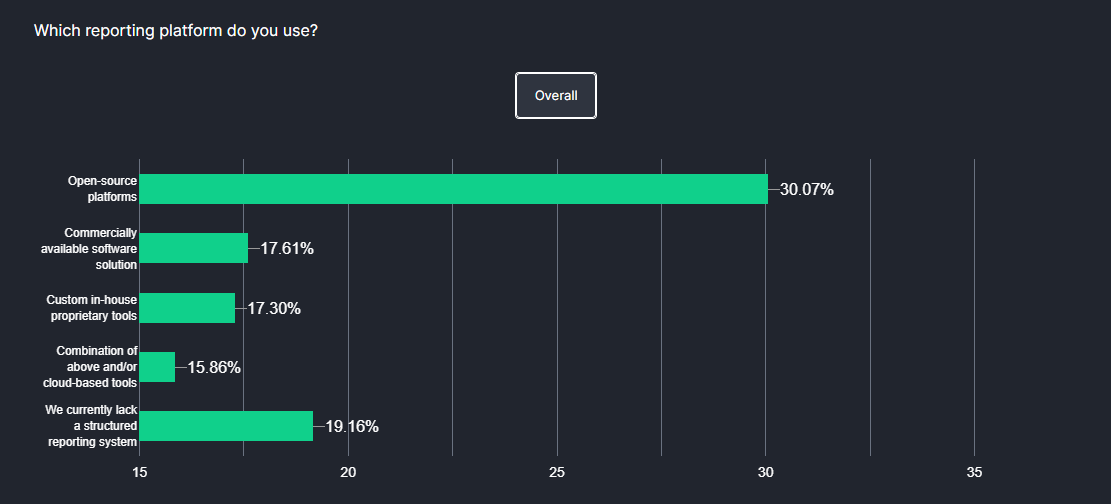
According to the Future Of Quality Assurance Survey, 30.07% of organizations prefer open-source platforms for generating and managing test reports, and 19.16% do not have a structured reporting system in place or do not use any tool for reporting, indicating a need for improvement in test reporting practices.
To gain better insights into your test execution and summary report, you can leverage TestMu AI Analytics to manage test execution and analyze test deliverables for web, API, desktop, and mobile applications across various environments.
TestMu AI Test Analytics is an AI-powered test observability platform that provides vital information on tests, including test inconsistencies, the number of tests, and tests categorized by their status and environments. It also offers AI-infused test intelligence to help you identify the issues using root cause analysis techniques for quick resolution and better problem-solving.
It allows you to access detailed test reports indicating the status of your test cases, whether they passed or failed. Using different test logs, you can also debug failed test cases to identify issues.
This platform offers test analytics for deeper insights into your passed and failed test suites. It includes test summary, browser categorization, test trends, test status ratio, and more.
In the section below, we will learn the best practices for creating a test plan before delving into the key differences between test plan vs test case.
Best Practices to Create a Test Plan
Creating an effective test plan involves adhering to certain best practices. Here are some key recommendations:
- You must understand the requirements of the software project very nicely and must align with a respective test case.
- You must clearly define the test objectives of the testing efforts.
- You must outline the scope of testing by specifying which features and functionalities will undergo testing.
- You must document the anticipated test deliverables.
- You must define the test environment, providing detailed information on hardware, software, and network configurations.
- You must identify potential risks associated with the testing process and complete the project.
- You must develop a comprehensive testing schedule incorporating milestones and deadlines.
- You must ensure the testing schedule is both realistic and achievable.
Now that we have learned and understood everything about the test plan, we will learn about the test case in detail in the section of this blog on test plan vs test case.
What is a Test Case?
A test case is a set of actions required to test a specific functionality of a software application. This helps verify the test case alignment with software requirements and correct functioning. In addition, the test case identifies and fixes bugs and vulnerabilities before the final release.
The test case is written by QA testers and provides step-by-step instructions for each test iteration. It details the necessary inputs, actions, and expected responses to classify a feature as satisfactory. Test cases often include two variations: one with valid input data and another with invalid input data. The testing phase starts once the development team completes a software application feature or a set of features, and a sequence or collection of test cases is referred to as a test suite.
In the next section of this blog on test case vs test plan, we will learn the purpose of a test case before discussing some key points and their benefits.
Purpose of a Test Case
The primary purpose of a test case is to evaluate the performance of different features within software applications and ensure they adhere to relevant standards, guidelines, and user requirements. Writing a test case can also help detect errors or defects within the software applications. The test case specifies the setup and execution details for the test and the expected ideal result.
Objectives include the following:
- Validate specific features and functions of the software application.
- Guide testers in their day-to-day hands-on activities.
- Record a detailed set of steps taken, accessible for reference in case of a bug.
- Provide a blueprint for future software projects and testers, eliminating the need to start from scratch.
In the below section of this blog on test plan vs test case, we will learn some key points to consider while working on a test case.
Key Points to Consider While Working on a Test Case
Here are some key points to consider for a test case, which will give you a good understanding while working on it.
- Test cases can be generated manually or through an automated approach.
- Manual test cases, written by testers, involve verifying and validating the software application’s functionality manually.
- Automated test cases, executed using automation testing frameworks and tools, adhere to the Software Requirement Specification (SRS).
- Test cases offer a structured method for confirming the functionality of software applications.
- Test cases operate independently, ensuring that the outcome of one test case does not affect another.
- Test cases can be executed in a controlled environment, guaranteeing the availability of all necessary resources without impacting the software production environment.
In the below section of this blog on test plan vs test case, we will learn some of the advantages of test cases.
Advantages of a Test Case
Testing of software applications starts with a test case that gives all information and details on the required conditions and steps to verify its accuracy and functionality. It outlines the input values needed for triggering the feature of the software application and gives a corresponding output.
Some of the advantages of writing test cases include the following:
- It ensures comprehensive test coverage.
- It provides structure and thoroughness to the software testing process for writing test cases.
- It minimizes maintenance and software support expenses.
- It keeps track of designed tests, executed tests, and the pass/fail ratio.
- It facilitates the reusability of test cases.
- It confirms that the software aligns with end-user requirements.
- It highlights any untested features that, if released into production, could disrupt the user experience.
- It enhances the overall quality of software and user experience.
In the below section of this blog on test plan vs test case, we will learn some of the limitations of a test case besides providing essential benefits.
Limitations of a Test Case
Besides the advantages, test cases also have certain limitations, which are important to know. Knowing these will help address the challenges and improve the test process.
- Test cases can fail to cover all test scenarios and user interactions. This can lead to undetected defects and poor software quality.
- Test cases are predefined and static, not subject to change. Thus, if changes in the software applications are needed, creating new test cases can be time-consuming.
- Test cases are mainly dependent on documentation that is prone to error. Incomplete or inaccurate documentation can cause failure in test coverage.
- Test cases with negative scenarios, such as error handling and boundary conditions, are often overlooked in test cases.
- Test cases are highly time-consuming, and resources to maintain and update many test suites.
In the below section of this blog on test plan vs test case, we will learn about the various components of a test case that are essential to know when creating a test case.
Components of a Test Case
Test cases should be formulated to accurately depict the features and functionality of the software application under test. QA engineers are advised to write test cases focusing on testing one unit/feature at a time. The language used in test case creation should be simple and easily understandable, and an active rather than passive voice should be utilized. Precision and consistency are crucial when naming elements. . The essential components of a test case include:
- Prerequisites: Any necessary conditions for the tester or QA engineer to conduct the test.
- Test setup: Identifies the requirements for correct test case execution, such as app version, operating system, date and time specifications, and security requirements.
- Test ID: A numeric or alphanumeric identifier QA engineers and testers use to group test cases into test suites.
- Test name: A title describing the functionality or feature is verified by the test.
- Test case description: A detailed explanation of the function to be tested.
- Test scenario: A brief description of the actions to be executed by the testers.
- Test objective: A crucial component outlines what the test seeks to verify in one to two sentences.
- Test steps: A comprehensive description of the sequential actions required to complete the test.
- Test data: It refers to the input data or values needed to execute the test case, such as usernames and passwords for testing email login.
- Test parameters: A parameter assigned to a specific test case.
- Test references: Reference links to user stories, design specifications, or requirements expected to be validated by the test.
- Expected results: An outline of how the system should respond to each test step.
- Actual result: The observed output or behavior during the execution of the test case.
Below are the sample test cases covering the basic login functionality of a web application to demonstrate how to write a test case based on the components defined.
Sample Test Case for a Login Functionality (Valid)
Prerequisites: Web application installed, valid user credentials available.
Test setup: Web application version 2.0, Chrome browser version 90.0, OS: Windows 10.
Test ID: WEBAPP-001
Test name: Login Functionality Verification
Test case description: This test case verifies login functionality by indicating valid user credentials and confirming successful login.
Test scenario: Validate the login functionality of the web application.
Test objective: To ensure users can log in to the web application using valid credentials.
Test steps:
- Open the web application.
- Navigate to the login page.
- Enter a valid username and password.
- Click the “Login” button.
Test data:
- Valid username: user123
- Valid password: Passw0rd!
Test parameters: N/A
Test references: User Stories #US123, Design Specification v1.2, Requirement Document
Expected results: The system should log in the user successfully and redirect them to the homepage with personalized content displayed.
Actual result: TBD (To be filled in during test execution)
Sample Test Cases for a Login Functionality (Invalid)
Prerequisites: Web application installed, login page accessible
Test setup: Web application version 2.0, Firefox browser version 87.0, OS: macOS 10.15.
Test ID: LOGIN-001
Test name: Invalid Username or Password Handling
Test scenario: Verify that the system handles invalid usernames or passwords appropriately.
Test case description: This test case checks the system’s response to invalid username or password inputs during the login process.
Test objective: To ensure the system denies access for invalid login attempts and provides proper error messaging.
Test steps:
- Open the web application.
- Navigate to the login page.
- Enter an invalid username or password.
- Click the “Login” button.
Test data:
- Invalid username: invalidUser
- Invalid password: wrongPassword
Test parameters: N/A
Test references: Design Specification v1.2, Requirement Document
Expected results: The system should display an appropriate error message and prevent login for invalid credentials.
Actual result: TBD (To be filled in during test execution)
In the below section of this blog on test plan vs test case, we will learn the steps involved in creating a test case.
Steps to Create a Test Case
A test case is mainly written during the test planning phase of STLC, where the team shares SRS and business requirements, and the developer starts the software development process.
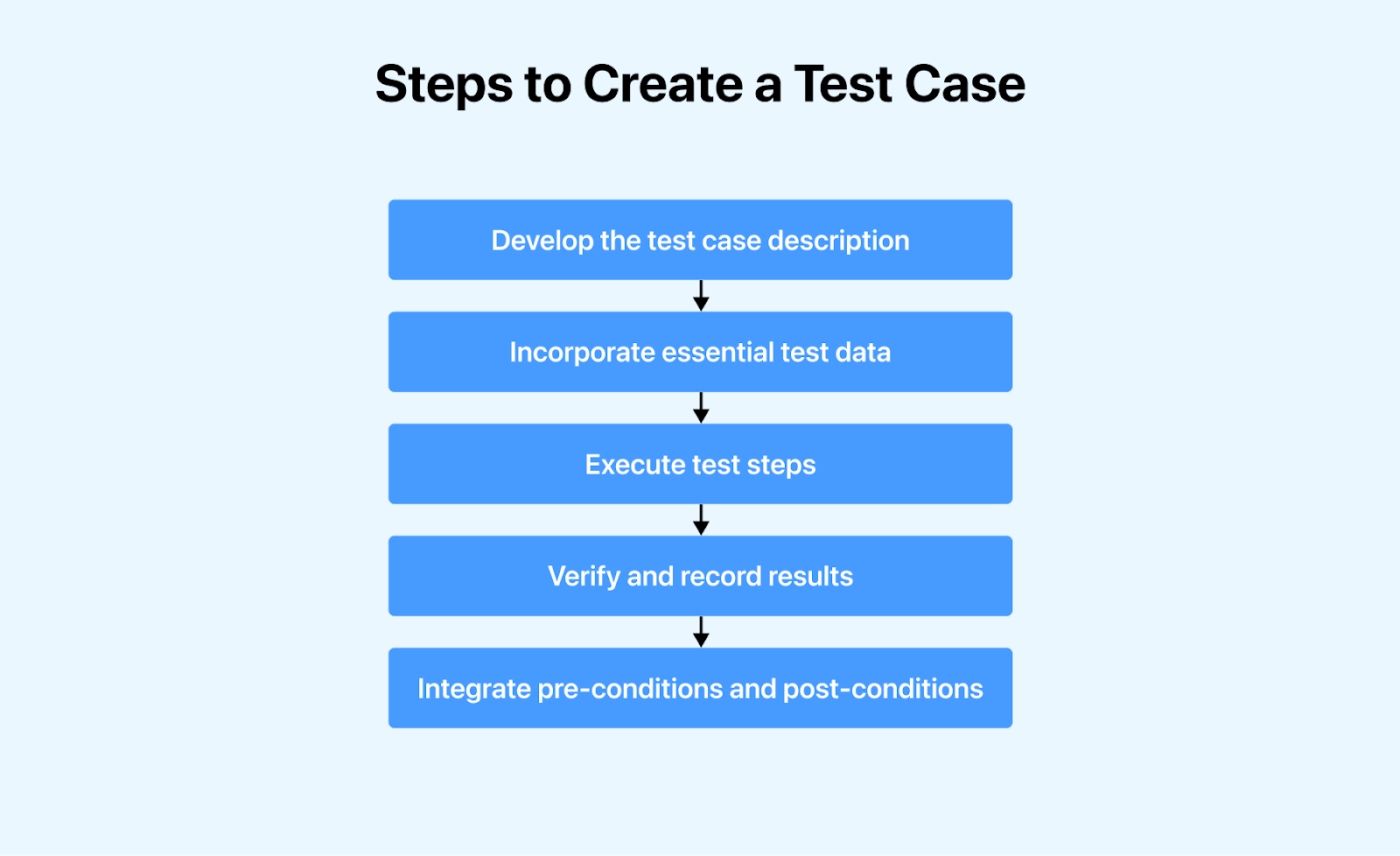
Here are the basic steps to write a test case.
- Develop the test case description: This step outlines the application’s response under specific conditions. For instance, a sign-in page test case description might state, “Examine fields when the user clicks the sign-in button.”
- Incorporate essential test data: This step validates an application and includes relevant test data. Test data may include details such as emails, passwords, and usernames.
- Execute test steps: This step activates scenario actions using testing software to perform a test. Since test cases typically verify multiple data sets and circumstances, preparing all information beforehand can save time.
- Verify and record results: This step verifies and documents various results to evaluate the application’s behavior. Creating a result section for each test aids in tracking how actual outcomes compare to optimal outcomes.
- Integrate pre-conditions and post-conditions: This step validates the basic test version, including any required pre-conditions or post-conditions. Conditions may involve a specific browser, internet extension, captcha, or ad-blocker check.
Test case prioritization is significant in software testing. Testing the entire suite for every build becomes impractical with an increasing number of software applications’ features. According to the Future of Quality Assurance, 52.5% of organizations prioritize their testing based on the criticality of the feature/functionality, and hardly 5.5% prioritize test cases based on past test runs and customer feedback.
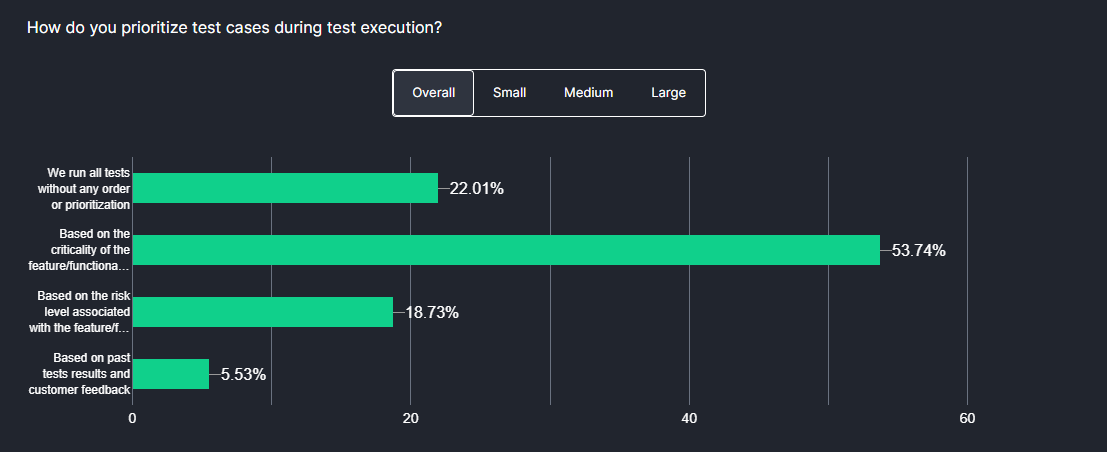
Some organizations, with 21.5%, conduct tests without prioritization, indicating the potential for optimizing test execution.
This highlights the need for more organizations to add insights from past testing experiences and direct customer feedback into their testing prioritization for faster results and more effective developer feedback.
Note: Enhance your testing skills by prioritizing the test cases and running them effectively on over 3000+ browsers and OS combinations. Try TestMu AI Today!
Test Case Derivation From Test Plan
A test plan, once written, functions as a guide to creating a strategic framework for software testing. The next step involves deriving test cases from the test plan. This means that test cases specify the practical application of the test plan’s theoretical foundation. Hence, it highlights the difference between test plans and test cases.
Here are some of the key points on this which will help clarify this in more detail:
- The features of the software application that need to be tested are focused while writing its specific test cases.
- The written test case meets the objective of the test plan. This shows that when you address the written test case, you ensure that the software application meets the intended criteria structured in the test plan.
- Test cases derived from the test plan specify the test data required for execution.
Creating test cases based on the test plan is like turning a big picture into detailed steps. It’s a careful and planned process that requires a good understanding of the software’s workings. The test plan gives broad instructions, and test case derivation involves breaking those instructions into smaller, detailed tasks.
In the next section of this blog on test plan vs test case, we will learn the best practices to follow when creating a test case.
Best Practices to Create a Test Case
Writing test cases is one of the most significant tasks in software testing. You can follow the mentioned best practices, which can help you in writing effective test cases:
- You must ensure each test case has a precise and distinct objective, clearly stating what is being tested and the desired outcome.
- You must include crucial scenarios in your test cases, covering various inputs, conditions, and edge cases.
- You must simplify test cases, concentrating on testing a specific aspect or scenario to maintain clarity.
- You must verify that the test suite meets all the requirements in the specification document.
- You must define preconditions that must be satisfied before executing a test case to ensure consistent results.
- You must draft test cases in a manner that is easy to understand, including new team members unfamiliar with the application.
- You must break down test case steps into the smallest possible segments to prevent confusion during execution.
In addition to all the best practices mentioned above, running the test cases on real browsers, operating systems, and devices is always preferable to ensure seamless functioning of your websites and web apps across various browser and OS combinations.
As discussed above, you can leverage cloud testing platforms like TestMu AI, which allows you to perform manual and automated testing for web and mobile applications.
Some of the ways in which you can leverage TestMu AI include:
- Conduct live interactive cross-browser testing in diverse environments.
- Conduct mobile app testing on a real device cloud.
- Achieve a 70% faster test execution with HyperExecute.
- Address test flakiness, reduce job times, and receive quicker feedback on code changes.
- Implement smart visual regression testing on the cloud.
- Utilize LT Browser for responsive testing across 50+ pre-installed mobile, tablet, desktop, and laptop viewports.
- Capture automated full-page screenshots across multiple browsers with a single click.
- Test your locally hosted web and mobile apps using the TestMu AI tunnel.
- Perform online accessibility testing.
- Conduct testing across multiple geographies with the geolocation testing feature.
- Benefit from 120+ third-party integrations with your preferred tools for CI/CD, project management, codeless automation, and more.
To get started with the TestMu AI platform, watch the video tutorial below.
You can Subscribe to the TestMu AI YouTube Channel for more updates and tutorials on automation testing, real-time testing, and more.
Now that we have discussed the test plan and test case in detail. Let us outline the key differences between test plan vs test case below.
Key Differences Between Test Plan vs Test Case
The key differences between the test plan and test cases are mentioned below:
| Attributes | Test Plan | Test Case |
|---|---|---|
| Definition | A detailed document outlining project objectives, test strategy, schedule, estimates, timelines, and necessary resources for project completion. | A set of specific actions designed to be executed on a system to verify its adherence to functional or behavioral requirements. |
| Aspects | An extensive document covering both managerial and testing aspects within the project. | A focused and succinct document tailored for a specific testing feature, concentrating solely on testing aspects. |
| Focus | Broad and strategic, including the entire testing process for the software development project. | Specific and detailed, focusing on verifying one aspect or functionality of the software. |
| Scope | Considers the entire testing process, covering multiple test cases, scenarios, and testing phases. | Limits to a particular test scenario or functionality. |
| Intended for | Testers, test managers, and any stakeholders requiring updates on the ongoing testing process. | Members of the test team responsible for executing the test cases. |
| Duration | From the initiation until the completion of the testing project. | Throughout a particular testing process until completion. |
| Sections | Includes testing and project management aspects, including scope, schedule, risks, approach, entry and exit criteria, defect reporting, roles and responsibilities, and more. | Concentrates exclusively on testing aspects, such as test case name, test steps, test data, test environment, expected test result, actual test result, test status, etc. |
| Dependency | Independent but should align with the higher-level goals and guidelines set in the Test Plan | Often dependent on the overarching Test Plan for context and alignment with project goals. |
| Uses | A current document utilized throughout the entire project lifecycle. | Controls and guides the entire testing process, ensuring alignment among stakeholders. Equips testers with step-by-step processes and details essential for testing the intended functionality. Identifies unexpected bugs during the testing phase. |
| Frequency of Use | Developed and referenced at the beginning of the testing project and updated as needed throughout the SDLC. | Used frequently during the execution phase of testing. |
| Changes Over Time | Updated less frequently, primarily when there are significant changes in project scope, objectives, or testing strategies. | Subject to frequent changes as software requirements evolve. |
| Documentation Level | Comprehensive documentation guiding the overall testing effort. | Detailed documentation for a specific test scenario. |

Conclusion
In this blog, we have discussed the key difference between a test plan and a test case. They are both crucial parts of software testing and understanding these differences is vital for effective test planning and execution and for ensuring thorough and efficient software testing.
Test plans define the testing process for team members, clients, and stakeholders, offering insights into various project-related components, including the target market, user requirements, and necessary resources. A test case outlines the actions needed to verify a specific feature or functionality in software testing. It details the steps, data, prerequisites, and postconditions required for feature verification. Conversely, a test plan is a comprehensive document encompassing all future testing activities. Prepared at the project level, it outlines the work products to be tested, the testing approach, and the distribution of test types among testers.
In conclusion, to enhance communication within the testing team and with other essential stakeholders and streamline the testing process, preparing these two documents – test plan and test case – is critical.


Frequently asked questions
Did you find this page helpful?
More Related Hubs
TestMu AI forEnterprise
Get access to solutions built on Enterprise
grade security, privacy, & compliance
- Advanced access controls
- Advanced data retention rules
- Advanced Local Testing
- Premium Support options
- Early access to beta features
- Private Slack Channel
- Unlimited Manual Accessibility DevTools Tests