

Power Your Software Testing with AI Agents and Cloud
The Native AI-Agentic Cloud Platform to Supercharge Quality Engineering. Test Intelligently and Ship Faster.


- TestMu AI (Formerly LambdaTest)
- /
- Blog
- /
- Differences Between Functional and Non-Functional Testing
Differences Between Functional and Non-Functional Testing
Learn the key differences between functional and non-functional testing, ensuring your software meets both functional requirements and performance standards.
Last Updated on:
Functional and non-functional testing differ in what they check: functional testing verifies what the software does against its requirements, while non-functional testing measures how well it performs. Functional tests return a pass or fail result for each requirement, while non-functional tests compare measurements such as response time against a set threshold.
This guide covers what functional testing is, what non-functional testing is, the differences between them, and how AI agents now handle both.
Key Takeaways
- Functional testing verifies that each software feature produces the expected output for a given input, as defined in the requirements.
- Non-functional testing measures quality attributes such as performance, scalability, usability, security, compatibility and reliability against set thresholds.
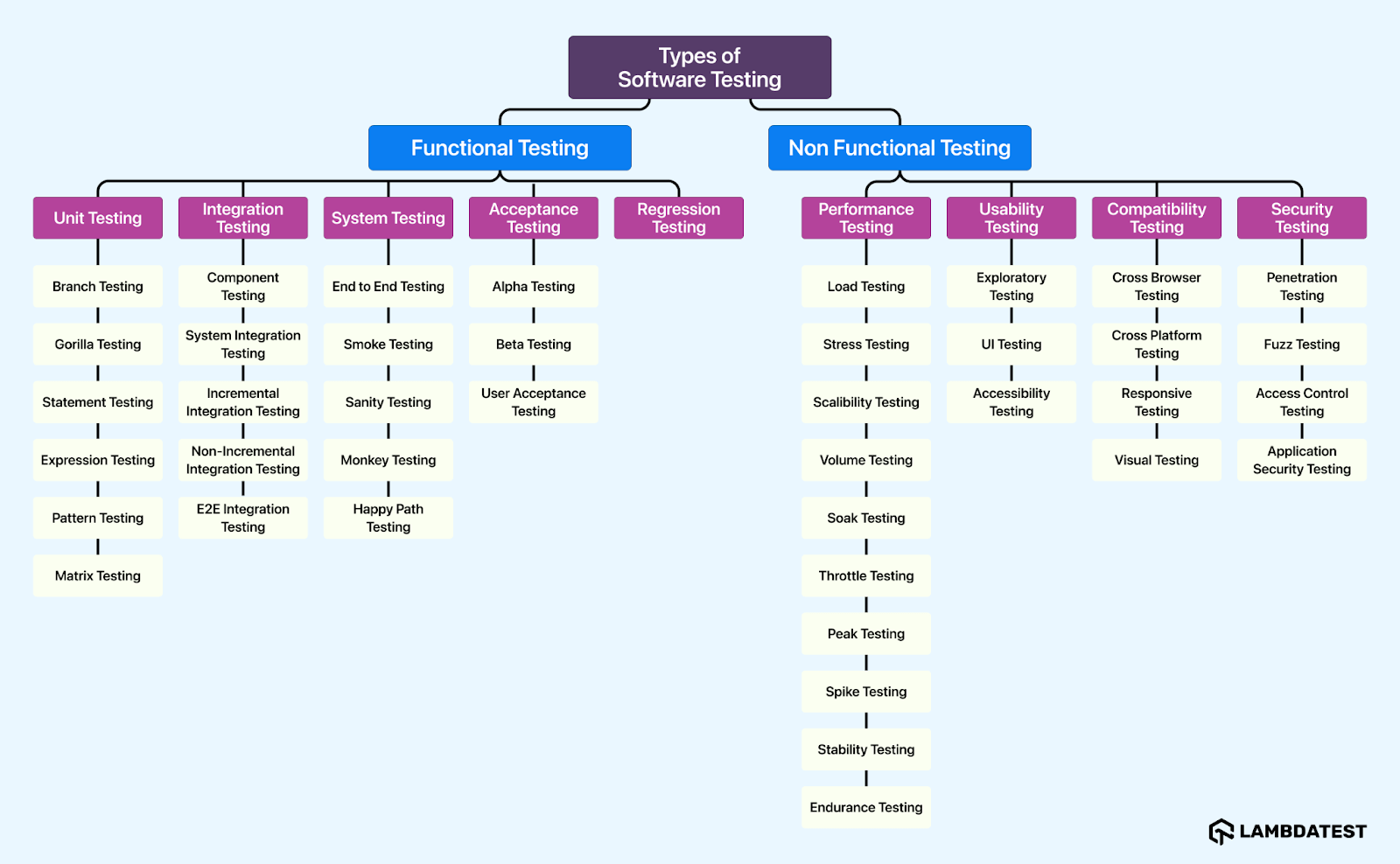
- Unit, integration, system, acceptance and regression testing are the common types of functional testing.
- Load, stress, usability and security testing are common types of non-functional testing.
- Functional test results are pass or fail, while non-functional test results are measurements such as response time, transaction success rate and resource utilization.
- AI agents can now generate and repair functional browser tests and record performance traces, but people still set the requirements and thresholds that decide a pass.
What Is Functional Testing?
Functional testing is a type of software testing that verifies whether the application behaves according to the defined specifications or requirements. It focuses on testing the features and functionality of the software by providing inputs and comparing the output to the expected results.
Key aspects of functional testing include:
- User interactions: Tests how users interact with the application (e.g., clicking buttons, entering data).
- Validation: Checks if the system performs tasks like calculations, database updates, or notifications correctly.
- Interaction: Ensures communication between different software components or systems functions properly.
Types of Functional Testing
To simplify functional testing, it is divided into several types. Covering each can enhance the robustness of your application. Here are the most common types:
- Unit Testing: It involves testing the most minute units of the code to make sure each unit functions as expected.
- Integration Testing: It validates how two or more components of a system that have been unit-tested interact.
- System Testing: It validates an integrated system against different predefined requirements. Testers perform system testing in environments as close to real-life scenarios and in accordance with real-life usage as possible.
- Acceptance Testing: It focuses on verifying whether a system adheres to both user and business requirements before it’s released.
- Regression Testing: After developers are done fixing the code or making enhancements, running a regression test suite ensures that there hasn’t been an impact on existing functionalities due to changes. Testers also use regression testing to make sure that changes don’t introduce any new defects.

Note: Run automated functional tests across 3,000+ browser and operating system combinations. Try TestMu AI Today!
What Is Non-Functional Testing?
Non-functional testing is a specific type of testing that evaluates the dependability, usability, performance, and some more non-functional characteristics of the software application. It intends to check how ready software is in accordance with a set of non-functional criteria.
The attributes it grades are performance, scalability, usability, security, compatibility, and reliability. Each is measured against a threshold rather than a pass or fail result, and the metric, threshold, and tooling for every core type are covered in the non-functional testing guide linked above.
AI-driven cloud testing platforms such as TestMu AI let developers and testers run both functional and non-functional checks on a remote test lab of 3,000+ browser and operating system combinations, alongside 10,000+ real devices. This keeps both sides of the comparison covered in one place while reducing infrastructure cost.
Differences: Functional and Non-Functional Testing
Here are the core differences between functional and non-functional testing:
| Criteria | Functional Testing | Non-Functional Testing |
|---|---|---|
| Purpose | Tests software application functionality and makes sure that it adheres to specified requirements. | Checks non-functional software aspects like reliability, security, usability, and performance. |
| Testing Techniques | Includes black box testing, unit testing, white box testing, system testing, integration testing, and acceptance testing. | Includes load testing, usability testing, stress testing, and security testing. |
| Metrics | Covers metrics for the number of features tested and the rate for passed and failed. | Covers metrics for the success rate of a transaction, response time, and rate of resource utilization. |
| Execution | Runs during and after development, from unit tests on new code to system and acceptance tests on the finished build. | Takes place throughout the entire SDLC, starting from as early as gathering requirements and spanning to the final deployment and testing stages. |
| Focus area | Focuses on the overall functionality of the software. In other words, emphasizes whether it meets set requirements. | Focuses on aspects that are strictly non-functional such as scalability, performance, security, usability, and reliability. |
| Requirement | Sets on the basis of what software should be doing, aka functional requirements. | Sets on the basis of non-functional requirements that cater to software performance. |
| Usage | Ensures that the software works as per expectation and adheres to functional requirements. | Ensures that the software works as expected in terms of non-functional requirements and meets scalability, performance, security, usability, and reliability standards. |
| Approach | Lets you execute functional tests manually. However, automation has become a lot more common as it saves time and resources. | Allows testers to use automation testing tools for certain types of testing, such as load and performance testing. |
| Example Test Case | Verifying that users can easily add new customers. | Verifying that the system won’t crash and will robustly handle hundreds of concurrent end users. |
How Do AI Agents Handle Functional and Non-Functional Testing?
AI agents now plan, write and repair functional browser tests, and they record performance traces for non-functional checks. People still define the requirements and thresholds that decide a pass.
Here is what agents do on each side today:
- Test planning: The Playwright planner agent explores an app and produces a Markdown test plan that lists the user flows to verify.
- Test generation: The Playwright generator agent turns the Markdown plan into Playwright Test files that cover functional checks such as login and checkout.
- Self-healing tests: The Playwright healer agent runs the suite and repairs failing tests, for example by updating a locator after a UI change.
- Performance traces: The Chrome DevTools MCP server lets a coding agent open a site in Chrome, record a performance trace and investigate a high Largest Contentful Paint (LCP) value.
Agent output still needs human review. An agent can assert the wrong expected result, so a tester should read each generated test before it joins a regression testing suite.
Load and stress checks still run in dedicated performance testing tools such as Apache JMeter or Grafana k6. An agent can write and start the test script, but the tool generates the concurrent virtual users.
Conclusion
When testing applications, there’s no one-size-fits-all approach. Prioritizing functional or non-functional testing exclusively isn’t ideal. Both functional and non-functional testing are equally important. However, many teams give non-functional testing less attention since its benefits seem less immediate. For example, users might tolerate slow performance but not broken functionality.
Because functional testing is faster and cheaper, it’s often the foundation of testing processes. Still, it’s unwise to downplay non-functional testing. Teams should include it, as it’s crucial for software’s overall quality, covering aspects like usability, performance, and more. A well-rounded test suite ensures both are validated effectively.
Author

Veethee Dixit
Blogs: 9


Veethee Dixit is a seasoned content strategist and freelance technical writer specializing in SaaS platforms and AI-driven testing technologies. She has over 8 years of hands-on experience writing SEO focused technical content, simplifying complex topics in software testing, and collaborating with product marketing teams to develop high converting blogs, documentation, whitepapers, and tutorials. She holds a Bachelor of Engineering in Computer Science and has authored 50+ learning hub articles in the software testing domain. Her work has been featured in leading software testing newsletters and cited by top technology publications. Veethee has played a key role in translating complex testing workflows into actionable guides, helping audiences implement automation strategies with clarity and confidence.


Functional and Non-Functional Testing FAQs
Did you find this page helpful?
More Related Blogs
TestMu AI forEnterprise
Get access to solutions built on Enterprise
grade security, privacy, & compliance
- Advanced access controls
- Advanced data retention rules
- Advanced Local Testing
- Premium Support options
- Early access to beta features
- Private Slack Channel
- Unlimited Manual Accessibility DevTools Tests