

Power Your Software Testing with AI Agents and Cloud
The Native AI-Agentic Cloud Platform to Supercharge Quality Engineering. Test Intelligently and Ship Faster.


- TestMu AI (Formerly LambdaTest)
- /
- Blog
- /
- Which Browsers Are Important To You For Cross Browser Testing?
Which Browsers Are Important For Your Cross Browser Testing?
We will share critical statistics to figure out the most important browsers on the basis of continents, devices, and peculiarities for your cross browser testing strategy.
Last Updated on:
This article is a part of our Content Hub. For more in-depth resources, check out our content hub on Cross Browser Testing Tutorial.
Did you know?
Every website on the internet communicates in a unique manner with every browser. A browser interprets web elements in a separate manner as compared to other browser and renders the website accordingly. This means the look and feel of a website are not only dependent on the front-end development team but also on the browsers being used to access the website.
The practice to ensure the avoidance of browser difference is termed as Cross Browser Testing, also known as Browser Compatibility Testing.
Making sure that your website delivers a consistent user experience to every visitor is imperative for big enterprises and startups alike. A little carelessness from your testing team may end up leaving your customer’s with a red-faced moment. It is precisely why one cannot afford to miss out on performing cross browser testing. However, performing browser compatibility testing is easier said than done.
Think about how many browsers your visitors may have used to access the internet. If asked by your manager or the board members, would you be able to confirm the most important browsers which are fully responsible for bringing you every last dime of your web traffic? or the majority of it? If you are receiving traffic from 50 browsers, would it be okay to neglect the remaining of hundreds of browser versions?
The number of browsers used by your customers may vary from hundreds to thousands, depending upon which browser version they are using, which device they are using it from? Are you getting majority traffic from mobile browsers or desktop ones? Are you targeting the right browser with respect to geographic locations of your targeted audience?
You may or may not have the answers to these questions now but don't worry! By the end of this article, you will be having critical statistics for defining & refining your cross browser testing strategy.
Let’s Begin!
Google Chrome has been the most used web browser worldwide from a while now but that doesn’t mean you can turn a blind eye towards its competitors Mozilla Firefox, and Safari is equally trending across different devices. Opera is the second most important browser in Africa and UC browser in Asia. Researching and analyzing market shares of various important web browsers and web browser versions, geographically and cross platform, can help to strategize cross browser testing of an application.
Market Share of Web Browsers Worldwide
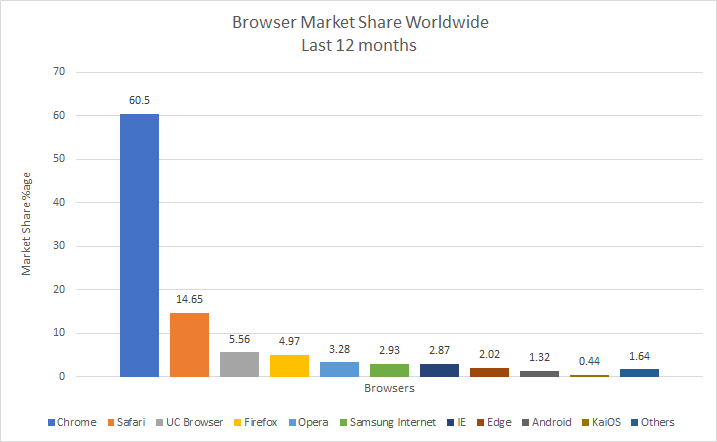
According to the data fetched from Statcounter, we can interpret that, in the past 12 months Google Chrome, undoubtedly has the highest market share with approximately 60% worldwide. Followed by Safari with approximately 15% Firefox with 6%, and so on. So it’s only natural to develop your website in a manner that they are compatible across these web browsers, as they are the trending ones. Also, make sure you test on Safari and other browsers. However, this data is still too vague and it is necessary to delve deeper by filtering out a few details that would help to prioritize and strategize cross browser testing process for your websites or web-app.
To illustrate my point, I’d like you to take a look at below two stats:
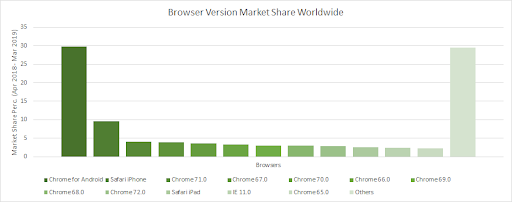
Important Browser Versions Observation
As of 2026, the five most important browsers for cross browser testing are Google Chrome, Safari, Microsoft Edge, Mozilla Firefox, and Samsung Internet, based on current global usage share. Chrome leads with about 68% of global usage, Safari follows at around 16%, and Edge, Firefox, and Samsung Internet make up most of the rest.
Internet Explorer no longer belongs on that list. Microsoft has retired Internet Explorer, so that time is better spent on cross browser testing for Edge, which now draws more global traffic than Firefox.
Browsers Other Than Chrome
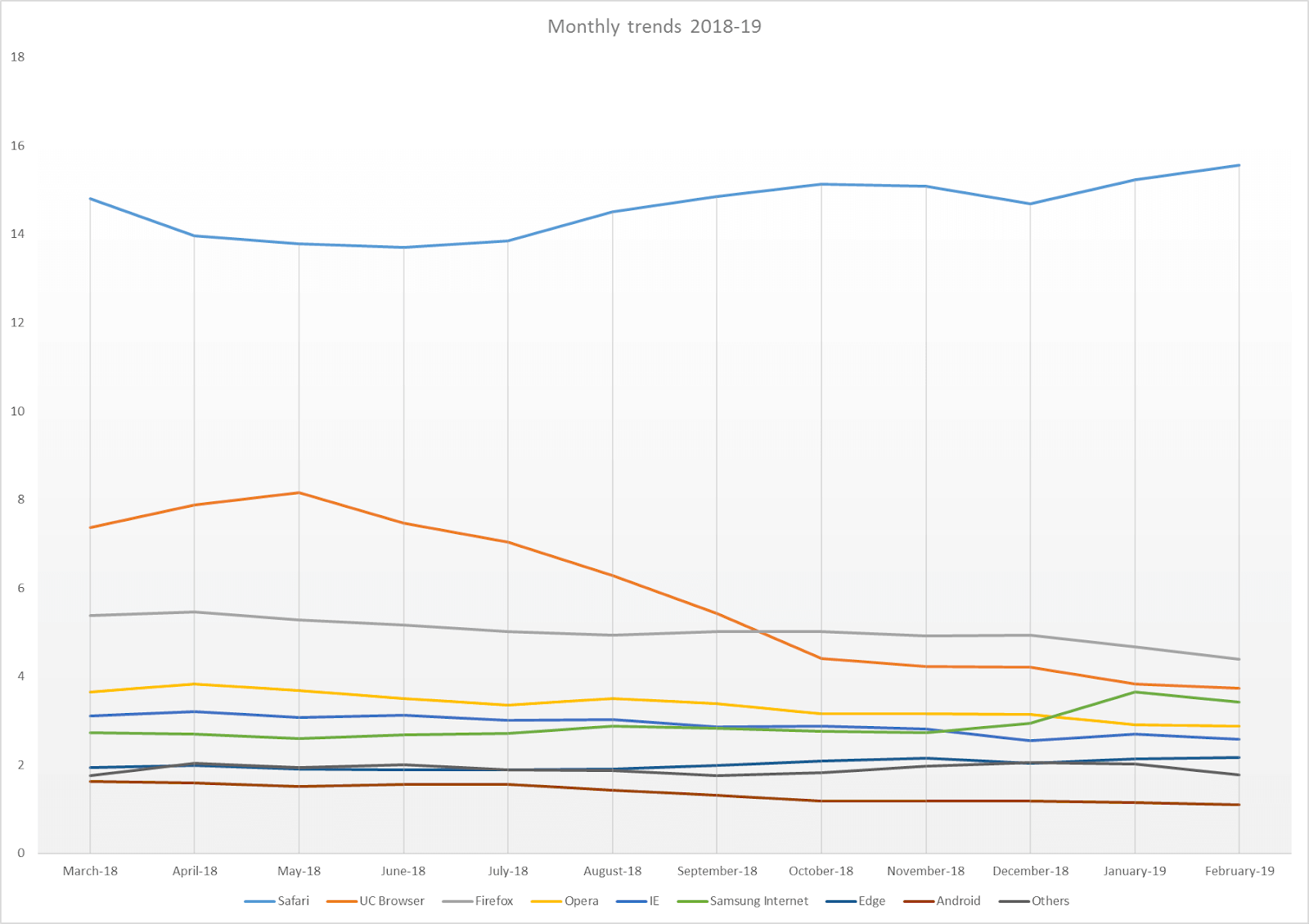
The above graph indicates monthly trends of important browser market shares for the past year. If we closely analyze the graph for the past 12 months, we can also see, there has been a rapid hike in the market share of Samsung Internet in the last 6 months, along with the fall of UC Browser.
Do AI Browsers Like Perplexity Comet Change Cross Browser Testing in 2026?
In 2026, most consumer AI browsing agents, such as Perplexity Comet and the Claude and Gemini extensions for Chrome, run on the same Chromium engine as Chrome itself, so your existing Chrome test coverage already handles most of what they render.
- Chromium under the hood: Perplexity Comet, Claude for Chrome, and Gemini in Chrome all sit on top of the Chromium engine, so a page that renders correctly in Chrome renders correctly for most of these agents too.
- Agent mode navigation: these tools include an agent mode that clicks links, fills forms, and completes multi-step tasks without a person at the keyboard, so a test pass should confirm your forms and buttons still respond when driven by a script instead of a mouse.
- Keep the list short: AI browsers appear and disappear quickly, so pin your matrix to the engines rather than the brands. A browser built on Chromium inherits Blink rendering, which means your existing Chromium coverage already tells you most of what you need.
- Real limitation: none of these agents replace cross browser testing on Safari or Firefox, since an agent's Chromium engine will not catch a rendering bug that only shows up in Safari's WebKit engine.
Automation frameworks such as the open source browser-use tool drive these same Chromium and WebKit engines through Playwright, so the browser matrix a tester has to cover has not actually grown, it has just gained a new kind of visitor.
Targeting Second Most Important Browsers On The Basis Of Different Continents
We know it by now, that Chrome is the most preferable browser option for a majority of internet users. But which is the next one? Knowing the second most preferred option is pivotal for targeting a global audience towards your website or web-app. And the competition for the second spot varies differently across different continents. Let’s analyze the second most important browsers on the basis of different continents.
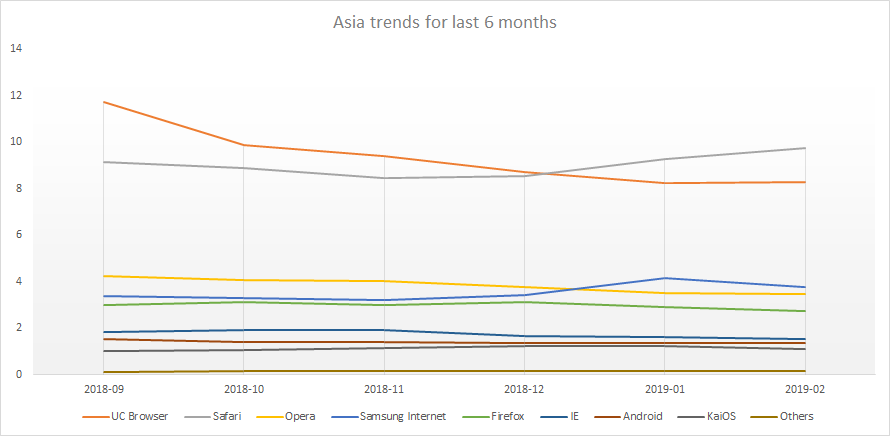
Asia
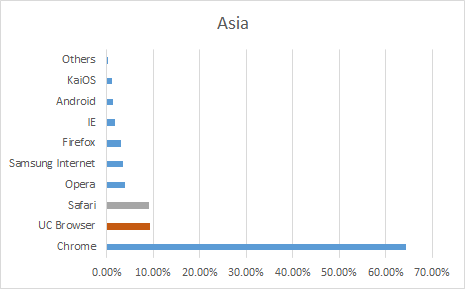
After Chrome, UC Browser is the most important browser in the continent of Asia. Also, It can be concluded that Safari has also taken a hike in the first quarter of 2019. So, both the browsers are matching each other neck to neck in the race for the second spot within Asia.
Africa
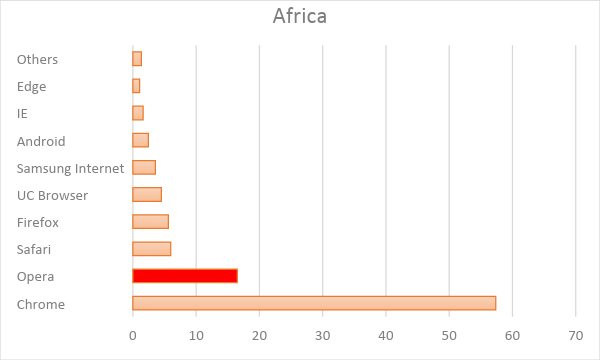
When it comes to Africa, then Opera is dominating in the second position, after Google Chrome of course.
Europe
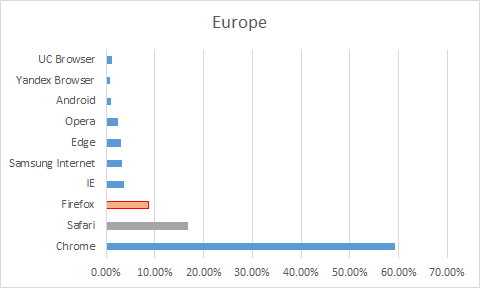
In Europe, Safari is considered the second-best option, after Google Chrome. Although, Mozilla Firefox has also got a considerable fair share in the market of Europe. So the 3 most important browsers for Europe market would Google Chrome, Safari, Firefox.
North America
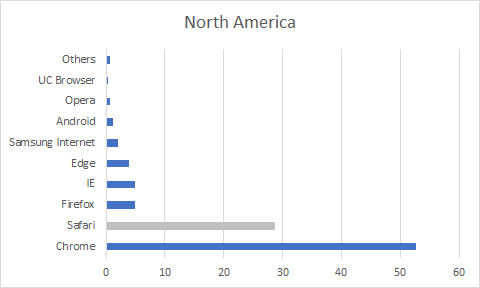
Similar to Europe the spot for first and second most important browser go to Google Chrome & Safari respectively. The spot for 3rd place now goes to Microsoft Edge, since it ships by default on Windows; Internet Explorer is retired and no longer part of the ranking.
South America
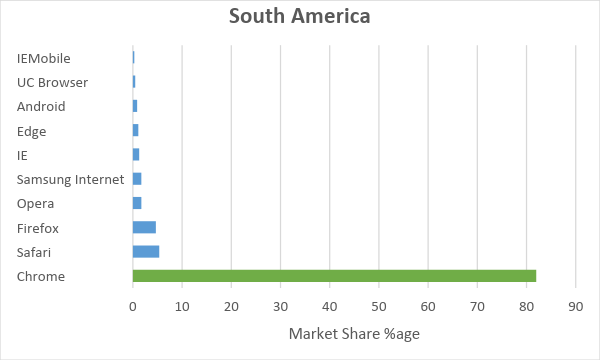
Chrome has dominated this continent in unequivocally. Far from the number 1 position, Safari is being the second most choice, but only just, as Mozilla Firefox is considerably close as the third preference.
Australia
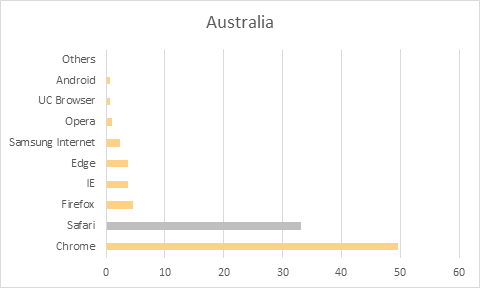
Just like North America, Safari outruns other browsers for number 2 spot.
Antarctica
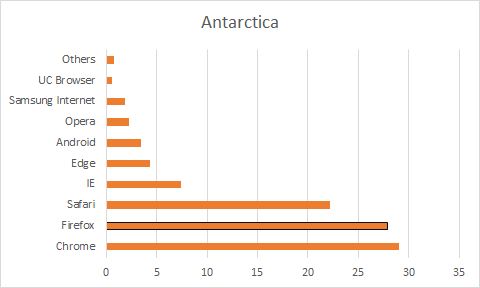
Not one of the continents that most of us would be concerned about considering the population on it. However, according to Wikipedia, about 5,000 people reside in the science stations temporarily, throughout a year.
Interestingly, Mozilla Firefox is considerably near to being the first most preference in Antarctica’s market share.
Targeting Most Important Browsers On The Basis Of Different Devices
Now that we are aware of which browsers to target for different continents. We now will look into the most important browsers based on the devices being used.
Desktops
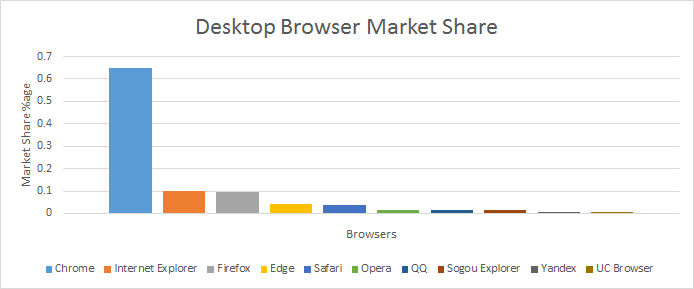
Chrome stands tall again on desktop, at roughly 71% of usage, with Microsoft Edge in second place at around 11%, since it ships by default on Windows. Microsoft has retired Internet Explorer, so it no longer needs a place in your desktop test matrix.
Mobiles
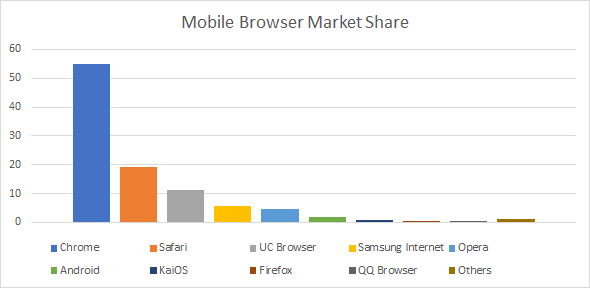
A majority of users prefer Google Chrome to surf the internet through mobile devices. Surprisingly to many of us, Mozilla Firefox has a hardly noticeable market share. Safari and UC browsers are holding the second and third favorable spot respectively.
Tablets
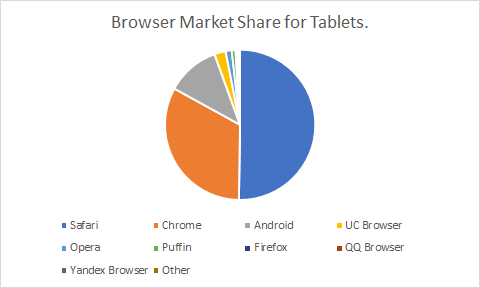
Safari beats Chrome. As seen from the chart below, it can be concluded that more than half of the browser market share lies with Safari in case of tablets. I believe, the primary reason for that lies with the dominance of iPads from Apple.
Considering Android
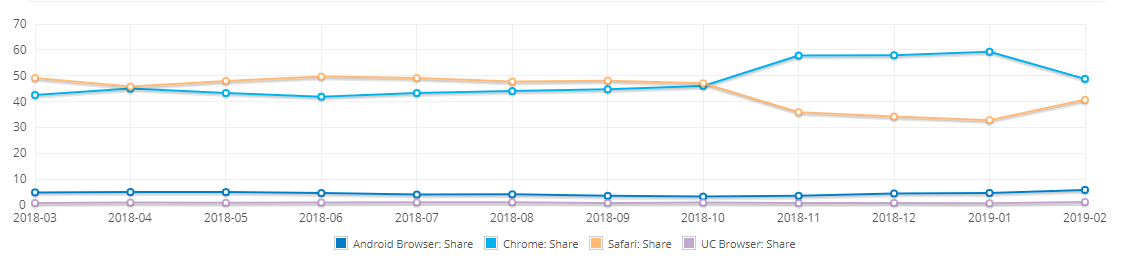
When we look into the market share of Android browsers then we can notice a very dramatic shift between Chrome and Safari in recent months.
Peculiarities
There are also a few browsers that although, are not globally renowned but are most important browsers after Google Chrome in some countries. I will be talking about two such peculiarities.
Russia and Yandex
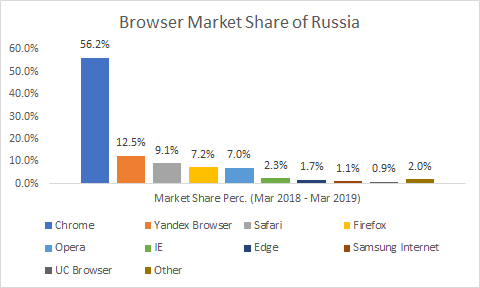
If you are targeting users from Europe & Asia then Russia comes as a major consideration for many enterprises. An interesting thing to notice in Russia is that after Google Chrome the second most important browser is Yandex. You may or may not have heard of it. The statistics of Yandex are not noticeable on a global scale. However, if you are targeting Russia, then it is one browser that you should not miss out on.
China – Sogou and QQ
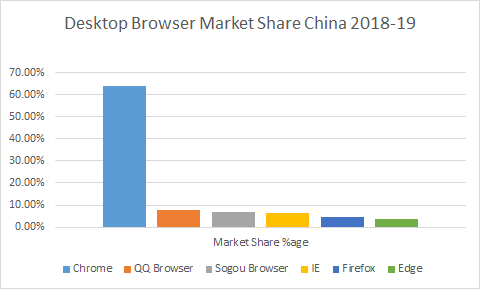
After Chrome, Native Browsers of China like QQ Browser and Sogou Browser are used fairly on Desktops. Both QQ & Sogou browsers are based on Google Chrome as a wrapper. In case, you don’t have access to these browsers and there is a fairly good chance that you don’t, then don’t worry! You can test your web-app or website on the latest 5 versions of Google Chrome and be pretty certain about the cross browser compatibility of your website or web app across China.
This certification is for anyone who wants to stay ahead among professionals who are growing their career in Selenium automation testing.
Here’s a short glimpse of the Selenium 101 certification from TestMu AI:

How Would You Go About Testing So Many Browsers?
Cross browser testing could be a nightmare for many enterprises or even freelancer web developers, web testers. The problem arises with the combinations of hundreds of browsers running on dozens of OS. Downloading every browser in your machine will be a pain, opting for emulator and then installing and maintaining a library of different Windows, Linux, & macOS would be time-consuming and challenging. You could go for device labs but they certainly don’t come cheap, which is why they aren’t considered a feasible option for many of us. How would you cover a sufficient test coverage?
Now test Safari on Linux online & start your free testing!!!
This is where TestMu AI comes in which provides you with a cloud-based cross browser testing platform. You can test across 2000+ real browsers running on numerous operating systems, without worrying about any download and installation. TestMu AI provides a VM hosted on their cloud servers, based on your test configurations. All you would need is a simple, free sign-up with TestMu AI. And you can perform manual + automated cross browser testing to fasten your test cycles and delivery to market. You could also test your locally hosted web pages, that way, you can be sure of your development changes, even before you push them to the production environment. Other than cross browser testing, TestMu AI also offers responsive testing, automated screenshot testing to help you capture bulk screenshots of your website across different screen sizes and browser + OS combination.
Conclusion
In order to create an effective cross browser strategy, you would need to break your test coverage for different browser depending upon the areas you are targeting. You should also consider testing your website or web app on peculiar browsers such as Yandex, QQ, Sogou, etc. Another thing to note is the selection of the right tool can help you paddle the release a lot faster. TestMu AI is a cross browser testing tool which addresses all your testing requirements.
I hope the above-mentioned statistics will help you devise a sound focus on the browsers you need to prioritize over the others. Happy Testing!
Author

Priyal Mangla
Blogs: 2


Priyal Mangla is a Senior Software Engineer with over 6 years of experience in software engineering and automation testing. Currently working at Nagarro, Priyal has previously contributed to GSPANN Technologies and Jio Platforms, specializing in Python, Selenium WebDriver, Flask, and big data tools like AWS, Hive, and Snowflake. Priyal developed in-house frameworks to streamline automation testing, reducing manual testing efforts. He holds a B.Tech in Engineering from Delhi University and certifications in Core Java and Python.


Did you find this page helpful?
More Related Blogs
TestMu AI forEnterprise
Get access to solutions built on Enterprise
grade security, privacy, & compliance
- Advanced access controls
- Advanced data retention rules
- Advanced Local Testing
- Premium Support options
- Early access to beta features
- Private Slack Channel
- Unlimited Manual Accessibility DevTools Tests