
Agent Assurance for your AI Deployment
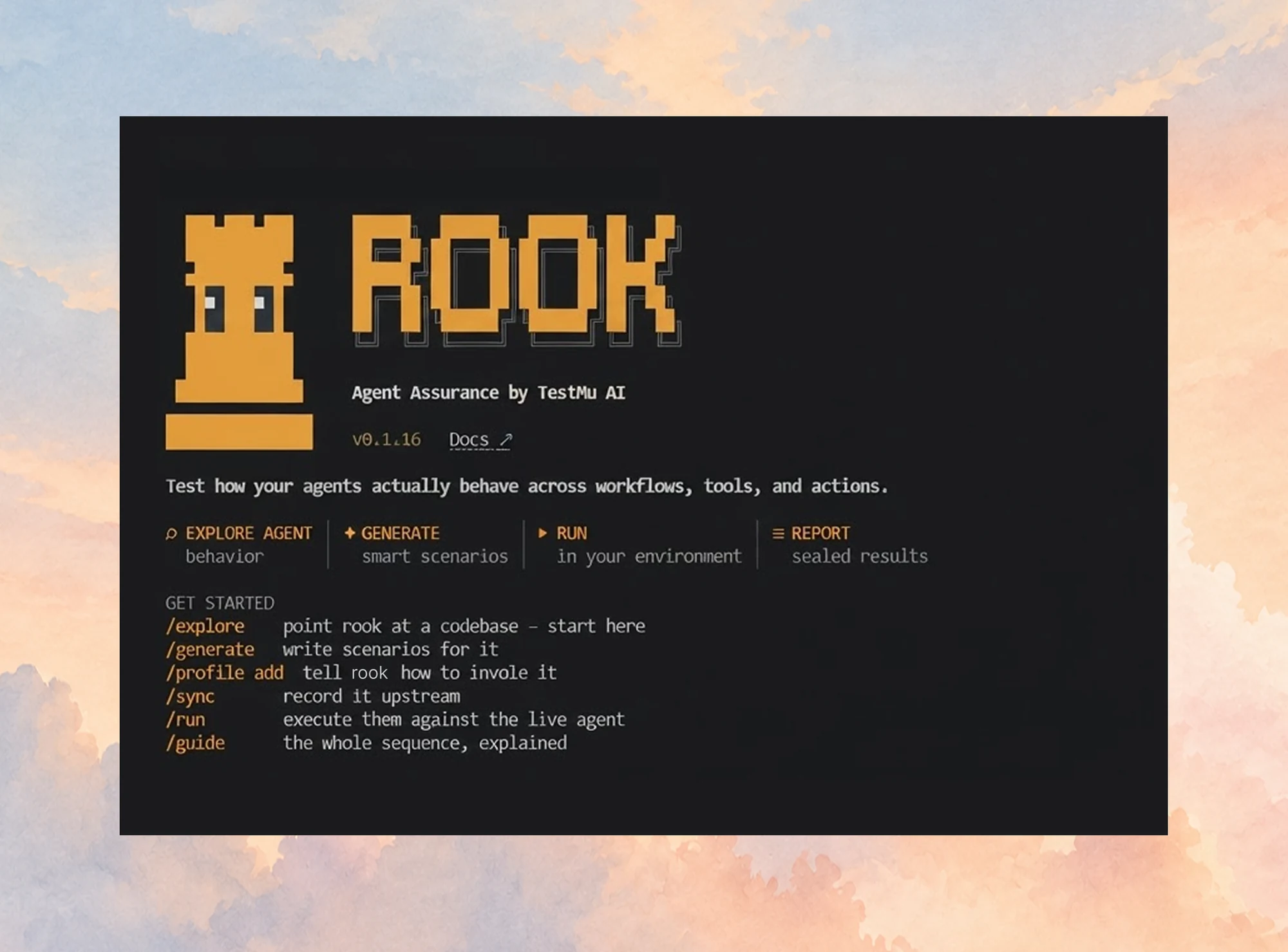
Test how your agents actually behave across workflows, tools, and actions. Catch failures and vulnerabilities before they ship.
npm install -g @testmuai/rook@latest
On This Page
A refund agent passes its tests on Friday. On Monday someone shortens its system prompt, and the agent starts issuing refunds without checking the refund policy first. No model was retrained and no unit test failed, because no application code changed.
LLMOps is the discipline that catches that kind of change before it reaches a customer. It treats prompts, model versions, tool definitions and retrieval indexes as releasable artifacts, tests each change to them, and watches the result in production.
Overview
LLMOps (large language model operations) is the set of practices and tools for building, testing, releasing and running applications built on large language models. It covers prompt and model versioning, evaluation, release checks, deployment, monitoring, cost control and feedback loops, and for AI agents it adds tests of which tools the agent called and in what order.
What Is the Difference Between LLMOps and MLOps?
- Main artifact: MLOps manages a model your team trained on its own data. LLMOps manages an application built on a foundation model you call, together with the prompts, tool definitions, retrieval indexes and agent graphs around that model.
- Change frequency: In MLOps, behavior changes when a team retrains a model. In LLMOps, a one-line prompt edit or a provider's model update can change behavior the same day, so each of those changes needs a regression test before release.
- Evaluation method: MLOps scores a held-out test set with metrics such as accuracy and F1. LLMOps judges open-ended output with rubrics, judge models and reference trajectories, because one prompt can have many correct answers.
What Does LLMOps Test Before a Release?
- Trajectory test: A trajectory test compares the tool calls an agent made, with their arguments and order, against a reference run. The comparison needs no judge model, so it is cheap enough to run on every commit.
- Effect check: An effect check confirms what an agent's run changed, such as a file, a record or an API call, instead of trusting the agent's own summary. TestMu AI's Agent Assurance grades agents that act this way and reports what it could not verify.
What Is LLMOps?
LLMOps is the operational discipline for software built on large language models. The Databricks LLMOps glossary defines it as the practices, techniques and tools used for the operational management of large language models in production environments.
In practice, LLMOps manages these sources of change, each of which can alter behavior without a code change:
- Prompts and system messages - the instructions the model receives, including few-shot examples and output format rules.
- Model and provider versions - the model ID you call, which a provider can update or retire on its own schedule.
- Tool definitions - the names, schemas and descriptions of the functions an agent may call. The guide to agent tools covers how schemas shape tool calls.
- Retrieval indexes - the documents and embeddings a RAG pipeline searches, which change every time content is added.
- Agent graphs - the nodes, routing and handoffs between steps or between agents.
Definitions like that one fit a chatbot or a single prompt chain well. Many teams now ship agents that plan, call tools and hand work to other agents, so LLMOps also has to answer whether a change altered what the agent did, as well as what it said.
Agents are improving fast and still miss often. Stanford HAI's 2026 AI Index Report says AI agents rose from about 12% to roughly 66% task success on OSWorld, a benchmark of real computer tasks, and still fail about one in three attempts on structured benchmarks.
What Is the Difference Between LLMOps and MLOps?
LLMOps sits inside MLOps. IBM's LLMOps explainer places it within the scope of machine learning operations and says it should be considered separately because it is focused on LLM development specifically. The Databricks glossary lists where the two differ: computational resources, transfer learning from foundation models, human feedback, hyperparameter tuning, performance metrics, prompt engineering and LLM chains or pipelines.
| Dimension | MLOps | LLMOps |
|---|---|---|
| Main artifact | A model you trained | A foundation model you call, plus prompts, tools, retrieval and agent graphs |
| What changes most often | Training data and model weights | Prompts, tool schemas, retrieval indexes and provider model versions |
| Evaluation | Accuracy, AUC or F1 on a held-out set | Output quality, groundedness, safety, tool-call correctness and trajectory checks |
| Feedback | Labels | Human feedback, judge-model scores and user ratings |
| Cost driver | Training compute | Inference tokens and model calls per task |
| Release risk | Data and model drift | Behavior change from a prompt edit or a provider model update |
| Typical release check | A metric threshold on a test set | A scenario suite with a pass or fail per criterion, adversarial cases included |
The difference you feel day to day is change frequency. A prompt edit ships in minutes and can change behavior as much as a retrained model did, so LLMOps runs regression tests on prompt, tool and model changes as well as on code changes. For how MLOps itself extends software delivery, see MLOps vs DevOps.
What Are the Stages of the LLMOps Lifecycle?
An LLMOps lifecycle runs as a loop, and the version for agents has these stages:
- Design - write the task, the tools the agent may call and the rules it must never break as statements a test can check.
- Build - keep prompts, tool schemas, model IDs, retrieval code and agent graphs in version control, in the same commit as the code that uses them.
- Evaluate - score single outputs for quality and groundedness, and compare tool-call sequences against reference trajectories. LLM evaluation covers metric choice for this stage.
- Release check - have CI block a merge or a release when a critical test fails.
- Pre-production verification - run end-to-end tests over the real channel against staging systems, adversarial cases included.
- Deploy - roll out versioned prompts and models with a way to roll either back as quickly as code.
- Monitor - collect traces, latency, token cost, user feedback and online scores in production; LLM observability covers what to trace.
- Improve - turn each production failure into a new test case, then start the loop again.
Stages 3 to 5 run before users see a change, so a regression caught there costs a red build rather than a support ticket. The same loop, applied to agents from planning through production monitoring, is the agent development lifecycle.
Which LLMOps Tools Cover Each Stage?
No single tool covers the whole lifecycle. Most stacks combine open-source libraries, a CI system and one or more hosted platforms, and this table maps each job to the kind of tool that does it:
| Stage | What you need | Example tools |
|---|---|---|
| Prompt and config versioning | Prompts, tool schemas and model IDs versioned and promoted by environment | Git, with prompt files committed beside the code |
| Model gateway | One API across providers, retries, fallbacks and cost tracking | LiteLLM (open source) |
| Serving | Open-weight models hosted behind an API | vLLM (open source), or your cloud provider's managed endpoints |
| Guardrails | Rails on inputs, outputs and tool calls | Guardrail libraries and policy checks; see AI guardrails |
| Tracing | Spans for prompts, tool calls and graph steps | OpenTelemetry instrumentation; see the OpenTelemetry LLM metrics taxonomy |
| Output evals | Metrics on single outputs and RAG answers | Open-source eval libraries; see AI agent evaluation tools |
| Trajectory tests | Tool-call sequences compared with a reference | A pytest helper like the one below, or the open-source agentevals package |
| Framework tests | Node-level and crew-level checks | pytest for LangGraph graphs, the crewai test command |
| CI | A failed build on a regression | GitHub Actions, Jenkins, Argo CD |
| Pre-production verification | End-to-end runs over the real channel and effect checks on tool calls | TestMu AI Agent Testing, TestMu AI Agent Assurance |
| Production monitoring | Online scores, drift and token cost per task | Observability platforms; see AI observability tools |
LiteLLM's documentation describes one interface for calling 100+ LLMs in the OpenAI format, with retry and fallback logic across deployments and cost tracking in its self-hosted proxy. vLLM's documentation describes a library for LLM inference and serving with an OpenAI-compatible API server.
Production monitoring scores what already happened, while pre-production verification runs before release and decides whether the release should happen. A team needs both, and TestMu AI's Agent Testing and Agent Assurance sit mainly in the pre-production row, next to the eval libraries a team already uses.

Note: TestMu AI Agent Testing scores chat, voice, phone, video and image agents before release, with 9 quality metrics for chat and voice, 30+ for phone calls and a 0 to 100 quality score for image agents. See how Agent Testing scores an agent
What Are the Benefits and Challenges of LLMOps?
The benefits come from treating prompt and model changes like code changes:
- Faster, safer changes - versioned prompts and automated evals let you ship a prompt edit the same day and see its effect in the test results first.
- Cost visibility - a gateway with per-key cost tracking shows which features and agents drive token spend.
- Fewer production surprises - regression suites catch behavior changes in CI instead of in support tickets.
- Evidence for buyers and auditors - stored results of every release check answer how agent changes are tested before they ship.
The challenges come from how models behave:
- Provider model changes - a model update you did not choose can change your app's behavior; model drift in LLM agents covers what tends to break.
- Open-ended output - there is rarely one correct answer, so evaluation needs judge models, rubrics or reference trajectories.
- Variable agent behavior - the same input can take a different path on the next run, so tests need repeats and clear pass criteria. pass@k vs pass^k shows how the chance that every one of k runs succeeds falls as k grows.
- Data privacy - prompts, traces and test sets can hold personal data and need the same access controls as production data.
How Do You Regression-Test an AI Agent Before Every Merge?
Split the tests into layers ordered by cost, and run the cheap ones most often:
- Deterministic and trajectory checks - on every commit: tool schemas, required fields, whether cited sources exist, and trajectory match against a reference. None of them needs a judge model, so they are fast, and run against recorded model responses they give the same answer every time.
- Judge-based evals on a fixed set - on every pull request that touches prompts, models, tools or retrieval: groundedness, correctness and policy adherence, scored against a golden dataset by a judge model. LLM as a judge explains how to write and calibrate that judge.
- End-to-end verification before release - the real channel, staging tools, adversarial scenarios and checks of what each run changed.
For baselines and run-over-run diffs between releases, see the guide to agent regression testing.
A Trajectory Regression Test in pytest
The test below compares an agent's tool calls with a reference trajectory in two modes. Strict mode requires the same calls, with the same arguments, in the same order. Subset mode only checks that every call used a tool the reference allows. It needs nothing but Python and pytest:
# tests/test_trajectory.py
import json

# The refund agent must look up the order, check the
# refund policy, then issue the refund, in that order.
REFERENCE = [
    ("get_order", {"order_id": "1042"}),
    ("check_refund_policy", {"order_id": "1042"}),
    ("issue_refund", {"order_id": "1042", "amount": 40.0}),
]


def call(name, **args):
    """One assistant message with one tool call."""
    fn = {"name": name, "arguments": json.dumps(args)}
    return {"role": "assistant", "tool_calls": [{"function": fn}]}


def tool_calls(messages):
    """Extract (name, args) pairs from chat messages."""
    calls = []
    for m in messages:
        for c in m.get("tool_calls", []):
            fn = c["function"]
            calls.append((fn["name"], json.loads(fn["arguments"])))
    return calls


def strict_match(actual, reference):
    """Same calls, same arguments, same order."""
    return actual == reference


def subset_match(actual, reference):
    """Every call uses a tool the reference allows."""
    allowed = {name for name, _ in reference}
    return all(name in allowed for name, _ in actual)


def run_agent(prompt):
    # Replace with your LangGraph, CrewAI or Agent
    # Framework call. Simulated regression: the new
    # prompt skips the refund policy check.
    return [
        {"role": "user", "content": prompt},
        call("get_order", order_id="1042"),
        call("issue_refund", order_id="1042", amount=40.0),
        {"role": "assistant", "content": "Refund issued."},
    ]


def test_trajectory_unchanged():
    actual = tool_calls(run_agent("Refund order 1042"))
    ok = strict_match(actual, REFERENCE)
    assert ok, [name for name, _ in actual]


def test_stays_in_tool_scope():
    actual = tool_calls(run_agent("Refund order 1042"))
    ok = subset_match(actual, REFERENCE)
    assert ok, [name for name, _ in actual]
Run on November 20, 2026 with Python 3.14.6 and pytest 9.2.0 on Windows, the simulated regression fails strict mode and passes subset mode:
$ pytest tests/test_trajectory.py -q --tb=short
F.                                                 [100%]
======================= FAILURES ========================
_______________ test_trajectory_unchanged _______________
tests\test_trajectory.py:55: in test_trajectory_unchanged
    assert ok, [name for name, _ in actual]
E   AssertionError: ['get_order', 'issue_refund']
E   assert False
================ short test summary info ================
FAILED tests/test_trajectory.py::test_trajectory_unchanged
1 failed, 1 passed in 0.21s
The two modes catch different regressions, so keep both. Changing the refund amount from 40.0 to 400.0 fails strict mode and passes subset mode, while adding a call to a tool outside the reference, such as delete_order, fails both. In a real suite, run_agent calls your graph or crew and converts its messages to this format; the open-source agentevals package (MIT license) offers strict and subset modes like these, plus unordered and superset modes, if you prefer a library.
Which Tests Should Each Change Trigger?
Not every change needs every layer. This matrix keeps pull-request checks fast while still testing every change that can alter agent behavior:
| Change in the pull request | Deterministic checks | Trajectory tests | Judge-based evals | End-to-end before release |
|---|---|---|---|---|
| Prompt or system message edit | Yes | Yes | Yes | Yes |
| Model or provider version change | Yes | Yes | Yes, with repeats | Yes, full suite |
| Tool added, removed or schema changed | Yes | Yes | Affected scenarios | Yes, with effect checks |
| Retrieval index rebuild or new documents | Yes | Affected scenarios | Groundedness set | Yes |
| Agent graph or crew structure change | Yes | Yes | Yes | Yes |
| UI or copy change outside the agent | Yes | No | No | No |
How Do LangGraph, CrewAI and AutoGen Fit Into LLMOps?
LangGraph and CrewAI document their own test tooling, and teams on AutoGen face a migration. Use framework tooling for the deterministic and trajectory layers, and keep end-to-end checks outside the framework so they test what a user sees.
Testing LangGraph Graphs With pytest
The LangGraph testing guide uses pytest and says to create the graph before each test and compile it with a new checkpointer instance. Compiled graphs expose each node through graph.nodes, so compiled_graph.nodes["node1"].invoke(...) tests one node, bypassing any checkpointer.
To test a middle section of a graph, call update_state with as_node set to the node before the section, then invoke with the same thread ID and interrupt_after set to the node where the test should stop. Put node tests in the deterministic layer and full-graph trajectory tests in the trajectory layer; LangGraph agent testing goes deeper on both.
CrewAI Evaluation With the crewai test Command
The CrewAI testing docs describe a built-in command, crewai test, that runs a crew for a set number of iterations (--n-iterations or -n, default 3) with a judge model chosen by --model or -m. It prints a table of task scores on a 1 to 10 scale, a crew score and the execution time of each run.
Use those scores to compare crew versions. For tasks that call tools, add trajectory and effect tests too, because a high task score does not prove that the right records changed.
AutoGen Debugging and Migration to Microsoft Agent Framework
The README of the AutoGen repository says the project has been archived and is no longer actively maintained by Microsoft, which provides no bug fixes, security fixes, new features or support for it, and it points new users to Microsoft Agent Framework. Microsoft's Agent Framework overview calls the framework the direct successor to Semantic Kernel and AutoGen, created by the same teams.
For AutoGen agents in production, the most useful LLMOps step is a frozen regression suite. Record reference trajectories for the current AutoGen behavior, then run the same suite against the Agent Framework version during the migration, so agents that loop, hand off to the wrong agent or repeat tool calls show up as trajectory mismatches.
What Should an LLMOps CI Pipeline Look Like for Agents?
Run the cheap layers on every pull request and the expensive layer on demand or on a release branch. This GitHub Actions workflow runs layers 1 and 2 on pull requests to main, and adds a Phone Caller suite on TestMu AI when someone starts it by hand:
# .github/workflows/agent-checks.yml
name: Agent checks
on:
  pull_request:
    branches: [main]
  workflow_dispatch:
jobs:
  agent-checks:
    runs-on: ubuntu-latest
    steps:
      - uses: actions/checkout@v7
      - uses: actions/setup-python@v7
        with:
          python-version: "3.12"
      - run: pip install pytest agent-testing-cli
      # Layer 1: deterministic and trajectory checks
      - run: pytest tests/deterministic tests/trajectory -q
      # Layer 2: judge-based evals on the golden set
      - run: pytest tests/evals -q
        env:
          JUDGE_API_KEY: ${{ secrets.JUDGE_API_KEY }}
      # Layer 3: a Phone Caller suite, started by hand
      - if: github.event_name == 'workflow_dispatch'
        run: >
          agent-testing-cli --project "$TESTMU_PROJECT_ID"
          run --suite "$TESTMU_SUITE_ID"
          --yes --wait --poll 5 --timeout 1800
        env:
          LT_USERNAME: ${{ secrets.LT_USERNAME }}
          LT_ACCESS_KEY: ${{ secrets.LT_ACCESS_KEY }}
          TESTMU_PROJECT_ID: ${{ vars.TESTMU_PROJECT_ID }}
          TESTMU_SUITE_ID: ${{ vars.TESTMU_SUITE_ID }}
pytest fails the job when any test fails. The commands and the LT_USERNAME and LT_ACCESS_KEY variables come from the Agent Testing CLI documentation, which lists exit code 1 for a completed test that failed and exit code 5 for polling that reached the timeout, so a failed Phone Caller run started with --wait turns the job red.
Layer 3 runs only when started by hand because a Phone Caller suite can place real calls. Chat evaluations work differently: they are asynchronous and the docs say not to use --wait with them, so a chat run started in CI does not block the job on its own. Start it, then read its results with agent-testing-cli results --suite SUITE_ID before you release.
Release Checks for Agents That Act With Agent Assurance
Agents that call tools, write files or hit APIs can report work that never happened, so their release check has to look at effects. Agent Assurance is TestMu AI's product for these agents: it tests how your agents actually behave across workflows, tools, and actions, and catches failures and vulnerabilities before they ship.
It is self-serve, with a 14-day free trial and plans on the Agent Assurance pricing page, and its command-line tool, Rook CLI, installs from npm:
npm install -g @testmuai/rook@latestThe npm install needs Node.js 20 or newer and runs on macOS and Linux, and on 64-bit Windows through npm or WSL. A run then works like this:
- Scenarios from your code or spec - Rook CLI derives functional and adversarial scenarios from the agent's code, PRD or spec, so nobody writes the suite by hand.
- A real invocation - it calls the agent the way a user would, through a command, an HTTP endpoint or an MCP server, pointed at staging.
- Effects as evidence - each acceptance criterion is graded against what the run changed: files on disk, artifacts, tool calls checked against the agent's own tool surface, and records confirmed through a read-only check you approve.
- Pass, Fail or Unable to Verify - every criterion is Pass, Fail or Unable to Verify. Unable to Verify is reported beside the pass rate and left out of it, so a check the run could not make never counts as a pass or a fail.
- Run-over-run change - from the second run on, the report shows the pass-rate change and which scenarios newly fail or were fixed.
The exit code tells you whether the command worked, and the report tells you what the agent did. A finished run exits 0 whether its scenarios passed or failed, so the release check reads the verdict totals from rook report --json; the walkthrough on gating GitHub Actions on Rook CLI verdicts builds that step.
TestMu AI's published GitHub Actions recipe runs a reviewed suite from a manually triggered workflow on the reviewed default branch, which keeps credentials away from untrusted pull-request code, and its strict policy fails closed on missing fields, malformed JSON, a mismatched run ID or an unexpected scenario count. The Argo CD recipe runs Rook CLI as a PostSync Job after deployment instead; a failed check marks the sync failed but does not roll the deployment back, so treat it as a post-deployment check.

What Are LLMOps Best Practices?
- Version everything that changes behavior - prompts, tool schemas, model IDs and retrieval index versions belong in the same commit as the code that uses them.
- Turn every production incident into a test - add the failing conversation to the test set before you ship the fix.
- Separate deterministic and judge-based checks - deterministic checks should give the same answer on every run, while judge-based checks need repeats and calibrated thresholds.
- Keep the judge independent - do not let the model under test grade its own output; AI evaluation grader independence explains why.
- Track cost per task, not per call - an agent that doubles its tool calls per task can pass every quality check and still erase your margin; LLM cost tracking covers how to measure it.
- Rerun the full suite on provider model updates - a model version you did not choose to change can still change your agent.
Where Should You Start With LLMOps?
Pick the agent whose prompt changes most often, record the tool calls that ten real requests should produce as reference trajectories, and add the pytest check above to your pull-request workflow. Add judge-based evals for prompt and model changes next, then an end-to-end check before each release.
For agents that act, the Agent Assurance CI/CD guide sets out the release policy and the platform recipes.
npm install -g @testmuai/rook@latest, or for a full walkthrough of the product.Author

Salman Khan
Blogs: 137


Salman is a Test Automation Evangelist and Community Contributor at TestMu AI, with over 6 years of hands-on experience in software testing and automation. He has completed his Master of Technology in Computer Science and Engineering, demonstrating strong technical expertise in software development, testing, AI agents and LLMs. He is certified in KaneAI, Automation Testing, Selenium, Cypress, Playwright, and Appium, with deep experience in CI/CD pipelines, cross-browser testing, AI in testing, and mobile automation. Salman works closely with engineering teams to convert complex testing concepts into actionable, developer-first content. Salman has authored 120+ technical tutorials, guides, and documentation on test automation, web development, and related domains, making him a strong voice in the QA and testing community.
Reviewer

Srinivasan Sekar
Reviewer
Srinivasan Sekar is Director of Engineering at TestMu AI, where he leads engineering and open-source initiatives behind the Selenium and Appium automation grid and owns TestMu AI's MCP Server. A committer to Appium and a contributor to Selenium, WebdriverIO, Taiko, and AppiumTestDistribution, he brings over 15 years of experience in quality engineering and open-source technologies. He is the author of the Apress book 'The MCP Standard: A Developer's Guide to Building Universal AI Tools with the Model Context Protocol,' a Certified Kubernetes and Cloud Native Associate, and an international conference speaker. Before TestMu AI he spent over eight years at Thoughtworks as a Principal Consultant and Quality Architect. Srinivasan holds a B.Tech in Information Technology from Anna University.


LLMOps FAQs
Did you find this page helpful?
More Related Blogs

TestMu AI forEnterprise
Get access to solutions built on Enterprise
grade security, privacy, & compliance
- Advanced access controls
- Advanced data retention rules
- Advanced Local Testing
- Premium Support options
- Early access to beta features
- Private Slack Channel
- Unlimited Manual Accessibility DevTools Tests