

Power Your Software Testing with AI Agents and Cloud
The Native AI-Agentic Cloud Platform to Supercharge Quality Engineering. Test Intelligently and Ship Faster.


- TestMu AI (Formerly LambdaTest)
- /
- Blog
- /
- MLOps vs DevOps: Key Differences and How They Work Together
A team with a working DevOps pipeline ships its first machine learning model. CI passes, the container deploys, and the prediction API answers every request, yet weeks later the predictions get worse while every dashboard stays green, because the data reaching the model has changed and nothing in the pipeline checks it.
DevOps automates how application code is built, tested, and released. MLOps extends that pipeline to machine learning by versioning data and models, testing data and model quality, retraining models automatically, and monitoring prediction quality in production. Most ML-powered products need both: DevOps for the application and the model-serving service, MLOps for the model itself.
Overview
DevOps automates how application code is built, tested, and released. MLOps applies the same CI/CD practices to machine learning systems and adds what code pipelines lack: versioning data and models, validating data and model quality, and retraining models when production data drifts. An ML-powered product needs both, DevOps for the application and MLOps for the model.
Core Differences
- Versioned artifacts: DevOps versions source code, configuration, and infrastructure definitions. MLOps also versions training datasets, features, and trained models, because the same code trained on different data produces a different model.
- Pipeline triggers: A DevOps pipeline runs when code or configuration changes. An MLOps pipeline also runs on new training data, on a schedule, or when model performance drops, all of which Google Cloud's MLOps guide lists as retraining triggers.
- Continuous training: Automatically retraining and redeploying a model is a pipeline stage that DevOps pipelines do not have. Google Cloud's MLOps guide calls it a property unique to ML systems.
- Testing scope: DevOps pipelines run unit, integration, end-to-end, and performance tests with pass or fail assertions. MLOps pipelines add data validation, model quality evaluation against thresholds, and model validation before a new model version ships.
- Production monitoring: DevOps teams watch errors, latency, and DORA delivery metrics such as deployment frequency and change fail rate. MLOps adds prediction quality and input-data distribution, because a model can decay while the service stays healthy.
- Team roles: DevOps pipelines are run by developers, QA engineers, and operations or platform engineers. MLOps adds data scientists, data engineers, and ML engineers, who own experiments, training runs, and the model registry.
Shared Release Gate
Both pipelines meet in CI: the model-serving API ships like any other service, so data and model checks written in PyTest can run next to application regression suites. TestMu AI's HyperExecute runs both kinds of suite from one hyperexecute.yaml file in GitHub Actions, GitLab, Jenkins, or any CI system that can run a CLI command.
What Is MLOps?
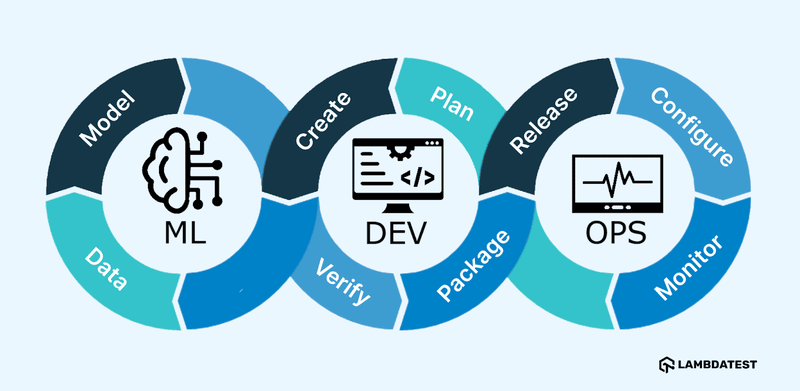
MLOps (machine learning operations) is the practice of automating and monitoring every stage of a machine learning system: data preparation, model training, evaluation, deployment, monitoring, and retraining. Kreuzberger, Kühl, and Hirschl's MLOps study describes it as an engineering practice that draws on three disciplines: machine learning, software engineering (especially DevOps), and data engineering.
The model code is the smaller part of that system. Google Cloud's MLOps architecture guide notes that "only a small fraction of a real-world ML system is composed of the ML code", and the data collection, validation, serving, and monitoring around it are what MLOps automates.
The core components of an MLOps setup are:
- Data management - collecting, validating, and versioning the datasets and features a model is trained on.
- Experiment tracking - recording the code version, data version, hyperparameters, and metrics of every training run so any result can be reproduced.
- Model registry - a central store of trained models and their metadata, including which version is serving production traffic.
- Model serving - exposing a model for online predictions through an API or for batch predictions on a schedule.
- Model monitoring - tracking prediction quality and input-data statistics after deployment.
- Continuous training - retraining and redeploying a model automatically when new data arrives, on a schedule, or when monitoring detects a drop in performance.
What Is DevOps?
DevOps is a set of practices that joins software development and IT operations so teams can build, test, and release code frequently and reliably. It rests on a handful of DevOps best practices:
- Source control - every change to code and configuration goes through a versioned repository.
- Continuous integration (CI) - each commit is built and tested automatically.
- Continuous delivery (CD) - tested builds move to staging and production through an automated pipeline.
- Infrastructure as code (IaC) - servers, networks, and environments are defined in files and provisioned automatically.
- Monitoring - errors, latency, and availability are tracked in production so incidents surface quickly.
The DORA research program measures delivery performance with five software delivery metrics: change lead time, deployment frequency, change fail rate, failed deployment recovery time, and deployment rework rate. All of them describe how code changes flow to production, and none of them tells you whether a deployed model's predictions are still accurate.
Key Differences Between MLOps and DevOps
The core difference is what can change a system's behavior in production. In DevOps, only a code or configuration change alters how an application behaves; in MLOps, a model's behavior also shifts when the data it receives drifts away from the data it was trained on.
A login handler that passes its tests today returns the same result for the same input next year. A fraud-detection model trained on last year's transactions can miss fraud patterns that emerged after training, with no code change at all; Google's MLOps guide says models "can decay in more ways than conventional software systems".
That difference carries through every stage of a DevOps pipeline:
| Aspect | DevOps | MLOps |
|---|---|---|
| What is versioned | Source code, configuration, and infrastructure definitions | Code plus training datasets, features, and trained model artifacts |
| Pipeline trigger | A code or configuration change | A code change, new training data, a schedule, a drop in model performance, or a shift in the data distribution |
| What CD deploys | A build or container for the application or service | A training pipeline that retrains the model and serves it as a prediction service |
| Testing | Unit, integration, end-to-end, regression, performance, and security tests with pass or fail assertions | The same software tests, plus data validation, trained model quality evaluation, and model validation |
| Continuous training | Not applicable | Automatic retraining and redeployment when a trigger fires |
| Production monitoring | Errors, latency, availability, and DORA delivery metrics | Service health plus prediction quality and input-data statistics |
| Typical failure | A crash, error spike, or failed deployment that alerts catch | Silent accuracy loss while the service reports healthy |
| Roles | Developers, QA engineers, and operations or platform engineers | Adds data scientists, data engineers, and ML engineers |
| Typical tools | Git, Jenkins or GitHub Actions, Terraform, Docker, Kubernetes, Prometheus | The same stack plus tools such as DVC for data versioning, MLflow for experiment tracking and model registry, and Kubeflow for ML pipelines |
How Testing Differs in DevOps and MLOps Pipelines
A DevOps test is a binary assertion: the same input must produce the same output on every run. An ML pipeline keeps those tests for the code around the model and adds checks that pass or fail against statistical thresholds, because the input data and the model's measured quality both vary.
Google's MLOps guide lists the additions: "In addition to typical unit and integration tests, you need data validation, trained model quality evaluation, and model validation." In a working pipeline they become these test layers:
- Data validation - checks the schema, value ranges, and null rates of training and serving data, and stops the pipeline before a bad batch reaches training.
- Model quality evaluation - scores the trained model on a held-out dataset and fails the run when a metric such as precision or recall drops below its threshold.
- Model validation - compares the candidate model with the version in production before promotion, so a retrained model does not replace a better one.
- Training-serving skew checks - confirm that features computed at serving time match the features the model was trained on, a failure mode Google's MLOps guide names explicitly.
- Drift checks - compare production inputs with the training distribution on a schedule and trigger retraining when the two diverge.
- Application tests - the UI or API that calls the model still needs end-to-end regression tests whenever a new model version ships.
The AI model testing guide goes deeper on designing tests for the model quality layer.
A Drift Check Next to a Unit Test
The script below puts both kinds of gate side by side in plain Node.js with no dependencies. The unit test checks a pricing function; the drift check compares one model input, such as a transaction amount, between the training data and two production batches using the Population Stability Index (PSI) and a two-sample Kolmogorov-Smirnov (KS) test.
The data is synthetic and generated from fixed seeds, so every run prints the same numbers.
// drift-check.mjs - a DevOps gate vs an MLOps gate in plain Node (no dependencies).
// All data is SYNTHETIC, generated from fixed seeds, so every run prints the same numbers.

// DevOps gate: a deterministic unit test. Same code in, same verdict out.
const applyDiscount = (price, code) => (code === 'SAVE10' ? +(price * 0.9).toFixed(2) : price);
for (let run = 1; run <= 3; run++) {
  const got = applyDiscount(120, 'SAVE10');
  console.log(`unit test run ${run}: applyDiscount(120,'SAVE10') = ${got} -> ${got === 108 ? 'PASS' : 'FAIL'}`);
}

// MLOps gate: is production data still shaped like the data the model was trained on?
function rng(seed) { // mulberry32, a small seeded PRNG
  return () => {
    seed = (seed + 0x6d2b79f5) | 0;
    let t = Math.imul(seed ^ (seed >>> 15), 1 | seed);
    t = (t + Math.imul(t ^ (t >>> 7), 61 | t)) ^ t;
    return ((t ^ (t >>> 14)) >>> 0) / 4294967296;
  };
}
function normal(n, mean, sd, seed) { // Box-Muller transform
  const r = rng(seed);
  return Array.from({ length: n }, () =>
    mean + sd * Math.sqrt(-2 * Math.log(1 - r())) * Math.cos(2 * Math.PI * r()));
}
function psi(expected, actual, bins = 10) { // Population Stability Index, training-decile bins
  const s = [...expected].sort((a, b) => a - b);
  const edges = Array.from({ length: bins - 1 }, (_, i) => s[Math.floor(((i + 1) * s.length) / bins)]);
  const share = (xs) => {
    const c = new Array(bins).fill(0);
    for (const x of xs) { let b = 0; while (b < edges.length && x >= edges[b]) b++; c[b]++; }
    return c.map((v) => Math.max(v / xs.length, 1e-4));
  };
  const e = share(expected), a = share(actual);
  return e.reduce((sum, ei, i) => sum + (a[i] - ei) * Math.log(a[i] / ei), 0);
}
function ks(x, y) { // two-sample Kolmogorov-Smirnov statistic D
  const a = [...x].sort((p, q) => p - q), b = [...y].sort((p, q) => p - q);
  let i = 0, j = 0, d = 0;
  while (i < a.length && j < b.length) {
    const v = Math.min(a[i], b[j]);
    while (i < a.length && a[i] <= v) i++;
    while (j < b.length && b[j] <= v) j++;
    d = Math.max(d, Math.abs(i / a.length - j / b.length));
  }
  return d;
}
const train = normal(5000, 50, 10, 42); // one model input (e.g. transaction amount)
const batches = {
  'prod batch 1 (same population)': normal(2000, 50, 10, 7),
  'prod batch 2 (shifted population)': normal(2000, 57, 13, 11),
};
const dCrit = (n, m) => 1.358 * Math.sqrt((n + m) / (n * m)); // KS critical value, alpha 0.05
for (const [label, prod] of Object.entries(batches)) {
  const p = psi(train, prod), d = ks(train, prod), c = dCrit(train.length, prod.length);
  const verdict = p >= 0.25 || d > c ? 'DRIFT -> trigger retraining' : 'OK';
  console.log(`${label}: PSI=${p.toFixed(3)}  KS D=${d.toFixed(3)} (crit ${c.toFixed(3)})  -> ${verdict}`);
}
Running node drift-check.mjs prints:
unit test run 1: applyDiscount(120,'SAVE10') = 108 -> PASS
unit test run 2: applyDiscount(120,'SAVE10') = 108 -> PASS
unit test run 3: applyDiscount(120,'SAVE10') = 108 -> PASS
prod batch 1 (same population): PSI=0.008  KS D=0.031 (crit 0.036)  -> OK
prod batch 2 (shifted population): PSI=0.389  KS D=0.262 (crit 0.036)  -> DRIFT -> trigger retraining
The unit test returns the same verdict on every run, and the first production batch passes both drift checks. Every value in the second batch is well-formed, so no DevOps health check would flag it, yet its PSI and KS scores show that the input population has moved far enough to retrain the model.
The thresholds in the verdict line are starting points for this demo. Tune them on your own data, then run the check as a CI step that fails the build when drift is detected.

Note: Statistical model checks can pass on one run and fail on the next when a metric sits close to its threshold. TestMu AI's Test Insights ranks tests by how often they fail across runs, so chronically unstable checks surface for a fix instead of being rerun until green. Try TestMu AI free!
How Do MLOps and DevOps Work Together?
In a production ML system the two pipelines share one release path. The ML pipeline trains, validates, and registers a model, and the model-serving service then ships through the same CI/CD pipeline as the rest of the application. Each DevOps stage gets an ML-specific addition:
- Source control - the repository holds application code, training code, and pipeline definitions, with pointers to versioned datasets and models.
- Continuous integration - the CI job that runs unit tests also runs data validation and model quality tests.
- Continuous delivery - a model version is released like any other service change, often behind a canary or shadow deployment that compares it with the current model on live traffic.
- Continuous training - a schedule, new data, or a drift alert starts the training pipeline, and the resulting model re-enters CI as a release candidate.
- Monitoring - service metrics and model metrics feed the same alerting and on-call process.
Adding ML suites to CI lengthens the test stage that every merge waits on. HyperExecute, TestMu AI's AI-native test orchestration cloud, runs any test command described in a hyperexecute.yaml file, lists PyTest among its documented frameworks, and runs test suites up to 70% faster than traditional grids, with the actual gain depending on the suite.
Its matrix mode fans one command out across custom key-value lists, so the same evaluation suite can run against several model versions or dataset slices in parallel. When a run fails, AI root cause analysis separates the primary cause from cascading symptoms and lists steps to fix it.

How to Add MLOps to an Existing DevOps Pipeline
Teams without automated builds, tests, and deployments should set those up first; the DevOps lifecycle and DevOps automation guides cover that foundation. MLOps becomes worth the effort once at least one of these is true:
- A model serves production traffic rather than offline reports.
- Production data changes faster than the team can retrain by hand.
- The team must trace a prediction back to the model version and training data behind it, for audits or incident reviews.
- Several models or teams share the same training and deployment infrastructure.
Google's MLOps guide describes three maturity levels. At level 0, training and deployment are manual and "a new model version is deployed only a couple of times per year"; level 1 automates the ML pipeline to retrain models continuously, and level 2 adds CI/CD automation for the pipeline itself.
A practical order for moving from level 0 to level 1:
- Version training data and model artifacts next to the code that produced them.
- Add data validation and model quality tests to the existing CI job, and fail the build when a threshold is missed.
- Register every trained model with its metrics, data version, and deployment stage.
- Automate retraining so a schedule, new data, or a drop in performance starts a new training run.
- Monitor prediction quality and input drift in production, and route alerts into the on-call process the application already uses.
Engineers moving from DevOps into ML work can test their readiness with these machine learning interview questions, which include a question on the QA role in MLOps.
How DataOps, AIOps, and LLMOps Relate to MLOps
DataOps, AIOps, and LLMOps often appear next to MLOps and DevOps, but each one targets a different artifact:
- DataOps - applies DevOps practices to data pipelines: automated data quality tests, lineage tracking, and faster delivery of analytics data. MLOps relies on it for clean training data.
- AIOps - uses machine learning to run IT operations, such as correlating alerts, detecting anomalies, and triaging incidents. It consumes models rather than managing their lifecycle; the DevOps AI tools guide compares AIOps and MLOps in more detail.
- LLMOps - MLOps adapted to large language models, where teams version prompts as well as models and evaluate outputs against reference datasets for accuracy, hallucination, and safety. LLM testing covers those evaluation methods.
For chat, voice, and phone agents built on LLMs, TestMu AI's Agent Testing evaluates responses for hallucination, bias, completeness, and context awareness before and after deployment.
Conclusion
Start with one gate: add a data validation test and a model quality threshold to the CI job that already builds your application, and fail the build when either check breaks. To run that suite next to your existing tests from any CI system, follow the HyperExecute guided walkthrough to set up your first hyperexecute.yaml.
Author

Samyak Goyal
Blogs: 30

Samyak Goyal is a Senior Member of Technical Staff at TestMu AI engineering Kane CLI, the command-line tool that runs browser automation from the terminal, where a flow described in natural language executes in a real Chrome browser and returns pass or fail with shareable proof. He is a backend engineer with 4+ years of experience, previously an SDE at Innovaccer, where he built APIs, introduced Kafka, and cut deployment from weeks to hours. Samyak also builds multi-agent systems, skill-orchestration frameworks, and a personal copilot that indexes 200+ microservice repositories.
Reviewer

Japneet Singh Chawla
Reviewer
Japneet Singh Chawla is an Engineering Manager at TestMu AI (formerly LambdaTest), where he leads a team driving HyperExecute, the AI-native Test Orchestration Cloud Platform, and integrations with Cypress, Provar, Tosca, and Selenium, improving test execution efficiency and driving adoption across 500+ enterprise clients. He also spearheaded zero-downtime deployments that cut release-related downtime by 90%, and mentors new engineers into productive contributors. He brings 9+ years of experience building and scaling distributed systems, SaaS platforms, and developer tools, with deep hands-on backend engineering across Golang, Python, Node.js, Kafka, and Redis. Earlier at Sumo Logic he built award-winning developer tools, including a VS Code Parser Linter, and at Indus Valley Partners he was a founding member of the Sentiment Analyzer team, building ML-powered solutions for financial clients. Japneet holds an MCA in Computer Science from GGSIPU.


MLOps vs DevOps FAQs
Did you find this page helpful?
More Related Blogs
TestMu AI forEnterprise
Get access to solutions built on Enterprise
grade security, privacy, & compliance
- Advanced access controls
- Advanced data retention rules
- Advanced Local Testing
- Premium Support options
- Early access to beta features
- Private Slack Channel
- Unlimited Manual Accessibility DevTools Tests