Verify Agent Deployments with Rook and Argo CD
Run Rook as a Kubernetes Job after Argo CD has applied an application and its resources are healthy. This is a post-deployment assurance check, not a CI build job or an Argo Workflows template. A failed Rook gate marks the sync operation failed; it does not automatically undo the deployment.
Prepare the Reviewed Suite
Use a safe target that is reachable from the runner. In a local rehearsal, select the project and agent, create and test the profile, review its hooks and possible writes, and prove the selected scenarios work. Commit the reviewed .testmuai/rook/ definitions and required hook scripts without credentials or old run histories. Do not generate new scenarios inside the release gate.
Download rook-ci.sh, inspect it, and commit it as ci/rook-ci.sh in your agent repository. The examples below call that checked-in file, not a script downloaded at execution time. The script requires Bash, jq, tar, and Rook CLI.
Configure these values:
| Setting | Meaning |
|---|---|
LT_USERNAME, LT_ACCESS_KEY | Rook account credentials, supplied only by the platform's secret store. |
ROOK_PROJECT_ID, ROOK_AGENT_ID | IDs matching the committed workspace definitions. |
ROOK_PROFILE | A reviewed, reachable test profile, for example staging. |
ROOK_SCENARIO_IDS | An explicit comma-separated suite, for example SC-001,SC-004,SC-014. Use your own IDs. |
ROOK_ALLOW_RULES | Optional newline-separated, exact tool grants observed during rehearsal. No blanket approval is added. |
| Target credentials | Variables required by your profile, such as AGENT_TOKEN; these are separate from Rook credentials. |
The staging profile names your test target, not the Rook service. ROOK_ENV=prod selects the public Rook service. The script uses the LT environment credential pair and isolated ROOK_HOME; it does not copy a developer's browser session.
Execution calls the real target and can spend Rook credits. Review the suite, tool grants, fixture isolation, and spending before enabling a job. Use a fresh checkout/output directory and avoid concurrent jobs against shared mutable fixtures.
What Makes the Job Pass
The shared script selects the project, agent, and profile; syncs the reviewed agent; and runs only the selected scenarios. It checks the process status, halted, discarded, and the run ID, then fetches that run's JSON report.
This example deliberately uses a strict release policy: every selected scenario must pass, with no Unable to Verify, unjudged, skipped/not-run, unrunnable, or compromised results. Missing fields, malformed JSON, a mismatched run ID, or an unexpected scenario count fail closed. A command exit of zero by itself is insufficient.
Unable to Verify remains its own verdict even when it blocks a release. The public skill's general CI recipe allows that outcome alone; this stricter policy is a documented choice, not a change to Rook's verdict semantics. Add criterion-level requirements if your release needs evidence beyond scenario totals.
Choose the Right Hook
Use PostSync to test the newly deployed agent. A PreSync hook runs before the new application resources are applied, so it cannot validate a service that exists only after this deployment. Use a separate pre-promotion environment or pipeline if the check must block production rollout.
Argo CD does not run hooks during selective sync. Require a normal full-application sync for this verification, and do not treat a selective sync as having passed Rook. See Argo CD phases and waves.
Prepare the Namespace
Before enabling the hook, provision the following in the same application namespace:
- A Secret named
rook-ci-credentials, managed through your secret-management process, withLT_USERNAME,LT_ACCESS_KEY, and the target's required keys. The example includesAGENT_TOKEN; remove or replace it if your profile differs. Never commit literal credentials. - A PVC named
rook-evidence, with enough space, an appropriate retention policy, and write access for UID/GID 10001. For example:
apiVersion: v1
kind: PersistentVolumeClaim
metadata:
  name: rook-evidence
spec:
  accessModes: [ReadWriteOnce]
  resources:
    requests:
      storage: 2Gi
This example uses the cluster's default StorageClass. Change it for your storage provisioner. A PVC is persistent storage, not an automatic off-cluster backup; configure backup/export and access controls before using it as release evidence.
The target profile must reach the deployed service through its cluster DNS or a routable test URL. Add appropriate network policy and image-pull credentials for your environment. The job does not need a Kubernetes API token unless your reviewed hooks specifically require one.
Build a Reviewed-Suite Image
Download the Dockerfile and save it as ci/rook.Dockerfile. Build from the reviewed agent repository root after adding ci/rook-ci.sh and the committed workspace definitions.
FROM debian:bookworm-slim
ARG ROOK_VERSION=0.1.3
RUN apt-get update && apt-get install -y --no-install-recommends \
    bash ca-certificates curl jq tar gzip git \
    && curl -fsSL https://raw.githubusercontent.com/LambdaTest/rook/main/install.sh \
       -o /tmp/install-rook.sh \
    && bash /tmp/install-rook.sh --version "$ROOK_VERSION" --dir /usr/local/bin \
    && useradd --create-home --uid 10001 rook
WORKDIR /workspace
# Build with the reviewed repository root as the context; never COPY personal home state.
COPY --chown=10001:10001 .testmuai/rook/ .testmuai/rook/
COPY --chown=10001:10001 ci/rook-ci.sh ci/rook-ci.sh
# Add only reviewed hook scripts and their runtime dependencies if your profile needs them.
USER 10001
ENV ROOK_ENV=prod ROOK_HOME=/tmp/rook-home
ENTRYPOINT ["bash", "ci/rook-ci.sh"]
Add only the hook files, agent code, and language runtimes the selected profile actually requires. A remote HTTP profile may need none; a command-based profile does. Keep credentials and old run histories out of the build context and image. Pin your base image by digest according to your organization's policy.
Build, scan, and publish this image through your existing trusted CI. Record its source revision and immutable image digest alongside the application revision. There is no prebuilt public image implied by this example.
Add the PostSync Job
Put this manifest in the path rendered by your Argo CD Application. Download the Job manifest. Replace the registry/image digest, project ID, agent ID, profile, and scenario list before syncing.
apiVersion: batch/v1
kind: Job
metadata:
  name: rook-assurance
  annotations:
    argocd.argoproj.io/hook: PostSync
    argocd.argoproj.io/hook-delete-policy: BeforeHookCreation
spec:
  backoffLimit: 0
  activeDeadlineSeconds: 1800
  template:
    spec:
      restartPolicy: Never
      automountServiceAccountToken: false
      securityContext:
        runAsNonRoot: true
        runAsUser: 10001
        runAsGroup: 10001
        fsGroup: 10001
      containers:
        - name: rook
          # Build this image from the reviewed suite; replace with your registry and digest.
          image: registry.example.com/team/rook-assurance@sha256:REPLACE_IMAGE_DIGEST
          imagePullPolicy: IfNotPresent
          securityContext:
            allowPrivilegeEscalation: false
            capabilities:
              drop: [ALL]
          resources:
            requests:
              cpu: 250m
              memory: 256Mi
            limits:
              cpu: '1'
              memory: 1Gi
          env:
            - name: POD_UID
              valueFrom:
                fieldRef:
                  fieldPath: metadata.uid
            - name: ROOK_RESULTS_DIR
              value: /evidence/$(POD_UID)
            - name: ROOK_RUN_NAME
              value: argocd-$(POD_UID)
            - name: ROOK_PROJECT_ID
              value: REPLACE_PROJECT_ID
            - name: ROOK_AGENT_ID
              value: REPLACE_AGENT_ID
            - name: ROOK_PROFILE
              value: staging
            - name: ROOK_SCENARIO_IDS
              value: SC-001,SC-004,SC-014
            - name: ROOK_ALLOW_RULES
              value: ''
            - name: LT_USERNAME
              valueFrom:
                secretKeyRef:
                  name: rook-ci-credentials
                  key: LT_USERNAME
            - name: LT_ACCESS_KEY
              valueFrom:
                secretKeyRef:
                  name: rook-ci-credentials
                  key: LT_ACCESS_KEY
            - name: AGENT_TOKEN
              valueFrom:
                secretKeyRef:
                  name: rook-ci-credentials
                  key: AGENT_TOKEN
          volumeMounts:
            - name: evidence
              mountPath: /evidence
      volumes:
        - name: evidence
          persistentVolumeClaim:
            claimName: rook-evidence
The pod UID gives each attempt a distinct evidence directory on the PVC. backoffLimit: 0 prevents Kubernetes from automatically retrying a paid test; the deadline bounds the job's lifetime. Argo CD sync retries and manual re-syncs can still start new paid runs. Make those retries deliberate.
BeforeHookCreation replaces the previous named Job on the next sync. Evidence on the PVC survives that Job replacement. The example does not delete successful/failed hook Jobs immediately, so their status and logs remain inspectable until the next attempt. A hard kill or node failure can prevent the shell's exit trap from finishing the evidence archive; retain partial JSON and central logs, and do not treat missing evidence as success.
Verify the Deployment Outcome
After a full sync, inspect the rook-assurance Job in the Argo CD resource tree and the rook container logs. A successful Kubernetes Job means the gate exited zero; a failed Job requires inspecting the Rook outcome and evidence, not just retrying the deployment.
Retrieve /evidence/<pod-uid>/ through your approved PVC backup/export or read-only maintenance-pod process. A completed pod cannot be relied on for kubectl exec or kubectl cp. Keep the PVC and its evidence after deleting a Job, and ensure later pruning does not remove your only copy.
Troubleshooting Argo CD
- Hook never starts: check application health, the hook annotation, and whether selective sync bypassed hooks.
- Image pull fails: replace the example registry/digest and configure namespace image-pull access.
- Pod remains pending: inspect PVC binding, scheduling, and storage access mode.
- Evidence permission denied: verify volume ownership and the storage driver's
fsGroupsupport. - Target unavailable: confirm the profile points at the deployed service, not a developer's localhost.
- Sync failed after rollout: the application may still be running; use your existing rollback/promotion policy. A PostSync failure is not automatic rollback.
See Argo CD hook lifecycle for hook ordering, failure behavior, and deletion policies.
Review Results Locally and on the Web
The gate prints the run ID and saves run.json, report.json, and, when a run directory exists, evidence.tar.gz. Keep failure output too. The archive contains this agent's run folders, not ROOK_HOME; a clean checkout avoids including earlier runs. Set retention and access controls because target responses and evidence can contain sensitive data.
To investigate locally, restore the reviewed checkout and extract the trusted evidence archive at its repository root, preserving the .testmuai/rook/projects/… hierarchy. Select the matching project and agent, then run rook report <run-id> --json or rook ui --local. Inspect a run's scenario → criteria → files.
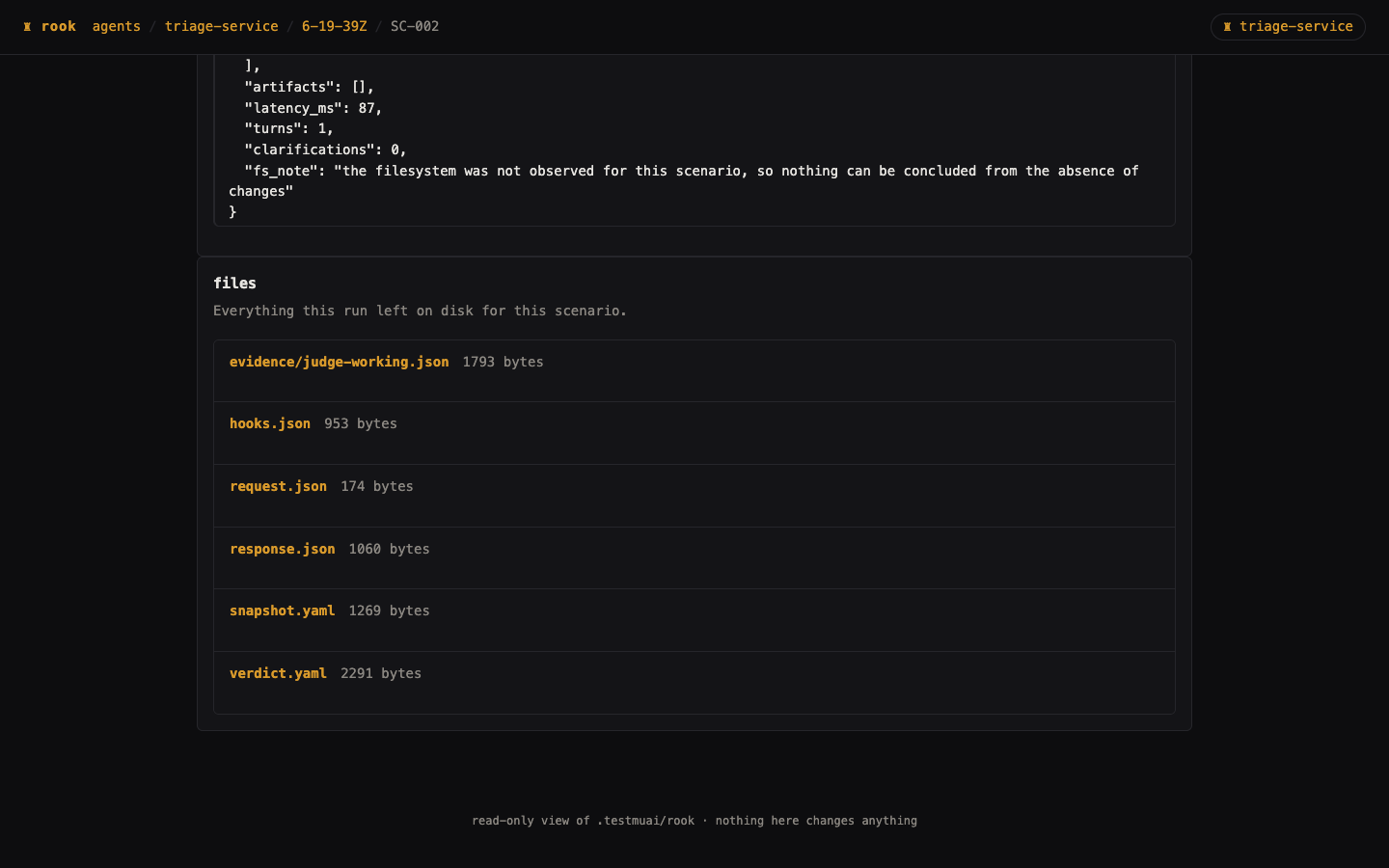
For uploaded results, open Rook projects → project → agent → run. Match the run ID before reviewing Response, Verdict, and Artefacts. A hosted record is useful for sharing, but the pipeline's validated report determines the gate.
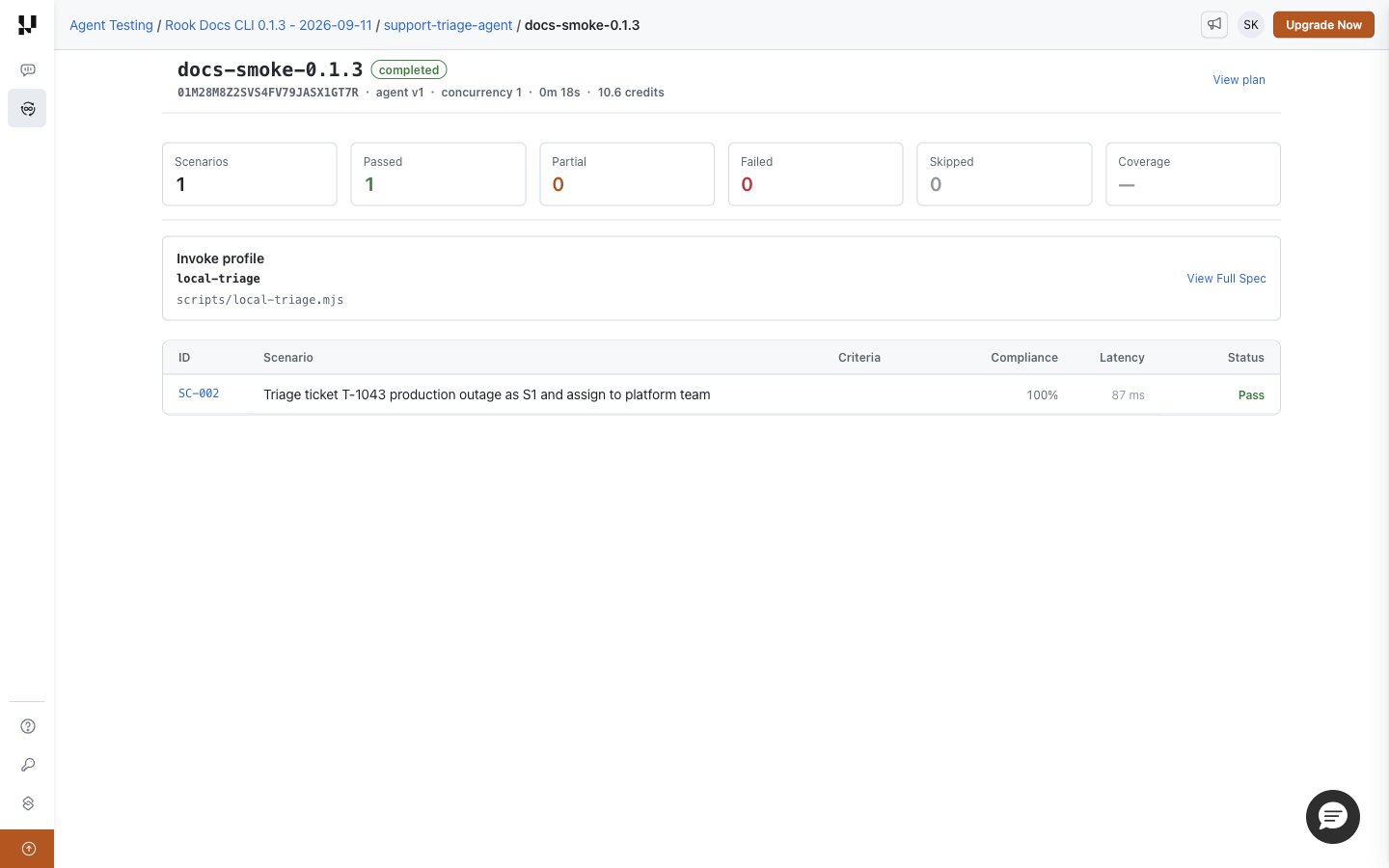
These are existing smoke-test result captures, not screenshots of this CI integration executing. A local URL on a CI runner is not accessible to teammates; do not expose the local UI publicly. If a hosted upload is missing, retain the evidence and investigate result synchronization rather than rerunning paid tests blindly.
Related Guides
These are reference integrations for your reviewed environment. Syntax and gate behavior can be validated locally, but a successful deployment/build must be demonstrated in your own configured platform.
 Chat with Us