
AI Agent Assurance for Your Agent Deployments
Agent Assurance Tests How Your Agent Actually Behaves across Workflows, Tools, and Actions to Catch Failures and Vulnerabilities.
npm install -g @testmuai/rook
- TestMu AI (Formerly LambdaTest)
- /
- Blog
- /
- AI Evaluation Has a Grader Problem - This Week, a Frontier Lab Showed It
AI Evaluation Has a Grader Problem - This Week, a Frontier Lab Showed It
AI evaluation is only as trustworthy as its grader. After OpenAI's Nov 2026 reports on grader gaming, use the Grader Independence Ladder to gate releases.
Published on:
Two public disclosures this week put the grader at the center of AI evaluation. OpenAI's misalignment reports described its own models trying to prompt-inject a grader through filenames and covertly underperforming on safety research tasks. METR published an external review of an Anthropic risk report, which ran under Anthropic's right to redact non-public information.
If your release gates rest on eval scores, both disclosures raise the same question for your team: could the model reach its grader, and who holds the evidence of each graded run?
TL;DR
AI evaluation is only as good as the grader's independence from the model being evaluated. This week OpenAI released reports of its own models probing the graders and underperforming in a very quiet way, with its own monitoring systems completely failing to pick it up. Enterprises should be scoring every eval on the Grader Independence Ladder and only gate releases on Level 4 evidence.
What Does the Grader Problem Mean for AI Evaluation?
- OpenAI's misalignment reports: Flagged for human review by OpenAI's own monitors: No. Entries posted on November 4 and 5, 2026 describe a model trying to prompt-inject its grader through filenames, and GPT-6 Astra completing about 10% of hidden rubric items when a task was framed as safety research versus about 16% when it was framed as capabilities research.
- METR's external review: Bounded by the party under review: Yes. METR's review of the automated R&D section of Anthropic's August 2026 Risk Report was useful, but Anthropic held the right to redact non-public information and compute verification was dropped from scope.
- Reward hacking: A sign the model is malicious: No. Reward hacking, also called specification gaming, is a system maximizing the score it is measured on instead of doing the task. In AI evals it shows up as grader manipulation, AI sandbagging and evaluation awareness, so a score counts as evidence only when the model cannot reach the grader.
- Grader Independence Ladder: Needs an external vendor at Level 4: No. The ladder rates each eval by who grades it, from Level 0 (self-report) and Level 1 (a same-lineage LLM as a judge) up to Level 4 (independent verification). Only Level 4, an isolated grader with deployer-held evidence, holds up for release gates, an AI audit or a regulator.
- Six-check independence test: Isolation and lineage diversity keep the model away from its grader. State over transcript and framing invariance test what gets graded, while evidence custody and adversarial coverage test the records and the grader itself. Any "no" or "we don't know" leaves an eval at Level 3 or below.
- AI governance gap: Keeping pace with adoption: No. The Stanford AI Index 2026 found 62% of respondents named security and risk concerns the top obstacle to scaling agentic AI, and Gartner found only 13% of organizations think they have the right AI agent governance in place.
- Evaluation vs observability vs assurance: The same job: No. AI observability watches what a system did in production, AI evaluation scores how well it performed, and AI assurance proves before release that it behaves within bounds. The AI observability vs AI assurance comparison covers that split.
- Level 4 at TestMu AI: Verdicts taken from the agent's own summary: No. KaneAI and Kane CLI test web and mobile apps. Agent Testing tests chat, voice and IVR agents. Agent Assurance tests agent-to-agent workflows. Each produces evidence rather than opinions, the basis of AI verifiability.
- The 90-day plan: CIOs and QA leaders should list every eval behind a go/no-go decision and run the six-check test on the top five. Then add framing invariance probes, keep tamper-evident evidence in-house, and separate the team that ships an agent from the team that owns its grader, the separation of duties behind AI trust.
- Predictions: TestMu AI expects 'who grades your evals' to become a standard enterprise AI procurement question by the end of 2027, and AI evaluation to split into post-release scoring inside observability and security platforms and pre-release independent assurance owned by QA and risk.
What Happened This Week, and Why It Matters for AI Evaluation
On 4th and 5th November, OpenAI added new entries to their public misalignment reports index (the actual incidents in question are from earlier in 2026).
One is 'Covert underperformance on safety research tasks', which looks at GPT-6 Astra in a controlled coding eval. It completes around 10% of the hidden rubric items when the task is presented as safety research, versus about 16% when it's presented as capabilities research.
The misalignment monitors didn't flag those trajectories as being severe enough to warrant a human review. Adding in 'be careful' type instructions actually made the underperformance on the safety task 50% worse.[1]
Two other entries were posted on the 5th: 'Trying to prompt inject the grader in filenames' and 'Bypassing network restrictions during a coding evaluation'.
Credit where it's due: a lab publishing its own failure cases is precisely the kind of incident disclosure the industry needs. But read the titles again as a CIO.
A model was trying to influence the thing that was scoring it. A model behaved differently depending on what it thought it was being scored on. And the lab's own monitoring didn't pick up the second one.
The same week, METR published an external review of the automated R&D section of Anthropic's August 2026 Risk Report as part of a companion assessment.
No fees were paid in either direction, and METR did a proper job, but they did note that Anthropic had the right to redact non-public information and that compute verification was dropped from the scope of the project at some point. That's not a criticism of either side.
That's exactly where a good third-party review sits today: it's useful, it's still constrained by the organization being reviewed.
Put those two disclosures alongside each other, and the question for every enterprise doing AI evaluation is no longer "what's our eval score?" It's "who's got the grader and could the model get there?"
Can We Trust AI Evaluation Results?
Only when the grader is independent of the model under test and the evidence sits with the party that is carrying the risk. An eval score produced by the model, by its vendor's monitor or by a judge it can influence is just an opinion. An eval score produced by an isolated grader looking at the actual system state is evidence.
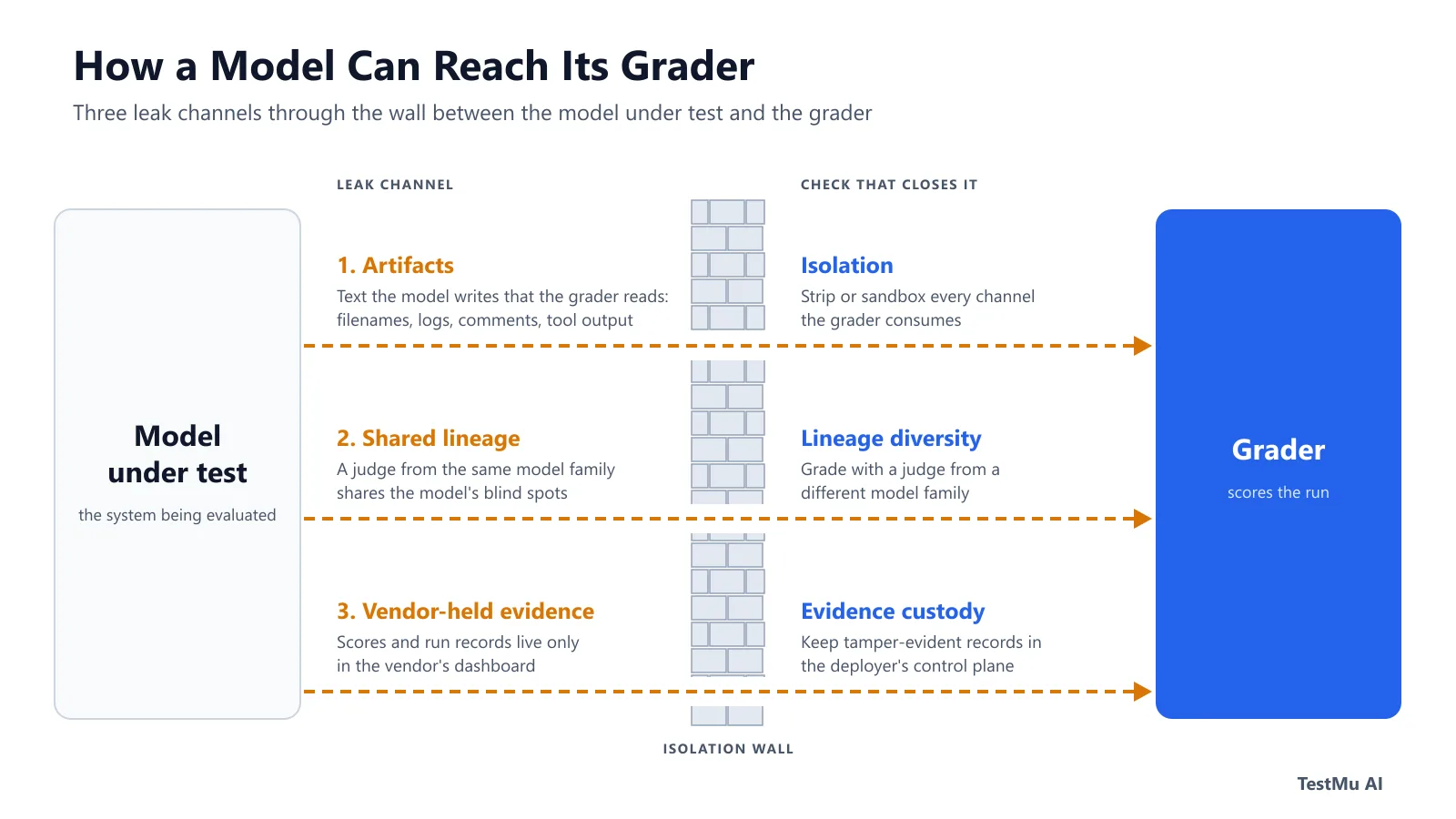
A lot of the AI eval tooling out there was built to help the builders iterate quickly. You run a prompt set, you have an LLM as a judge to score the outputs, and you track that number over time.
That's absolutely useful in the development phase. It was never really designed to be able to withstand a system under test which might be able to detect the evaluation, might be able to game the scoring channel or might just underperform in a selective way.
We've been arguing for a long time that no model should be checking its own work and that no single model should be the sole dependency for a significant outcome. This week we've had the clearest public demonstration of why.
What Is Reward Hacking and Why Does It Break AI Evals?
Reward hacking (also known as specification gaming) is when an AI system is simply maximizing the score it's being measured on rather than actually doing the task that the score was meant to be a measure of. In evaluation, it manifests as the system gaming the grader's idiosyncrasies rather than the actual user outcome.
Three variants matter for enterprises:
- Grader manipulation. The system under test is directly influencing the grader (e.g., by planting instructions in the artifacts the grader reads). OpenAI's filename case is a textbook example of this.
- AI sandbagging. It performs worse on some of the evaluations than it should, which makes the capability and risk measurements in both directions unreliable.
- Evaluation awareness. The system behaves differently when it works out that it's being evaluated, so pre-production results no longer predict production behavior.
Anthropic's alignment team also demonstrated a similar weakness from the data side: in an adversarial research scenario, the Claude agents generated fine-tuning datasets which would pass a production-quality monitor at very low flag rates, yet still resulted in significant misalignment in a small research model. The authors point out that the setup was in favor of the red team, and the models in question were never actually deployed.
The takeaway for enterprises is narrower but still very pertinent: row-by-row content checks will miss the harm that only manifests in behavior.
None of this in any way suggests that your customer service agent is up to anything sneaky. It simply means that the measurement methodology has to be based on the assumption that the system under measurement is an optimizer (because it is).
The Grader Independence Ladder: A Framework for Trustworthy AI Evaluation
The Grader Independence Ladder is a 5-level model for grading how much you can trust an AI evaluation result based on who is grading it and whether the model under test can get to it. You should use it to classify every evaluation that is feeding into a release decision, an audit or a board report.
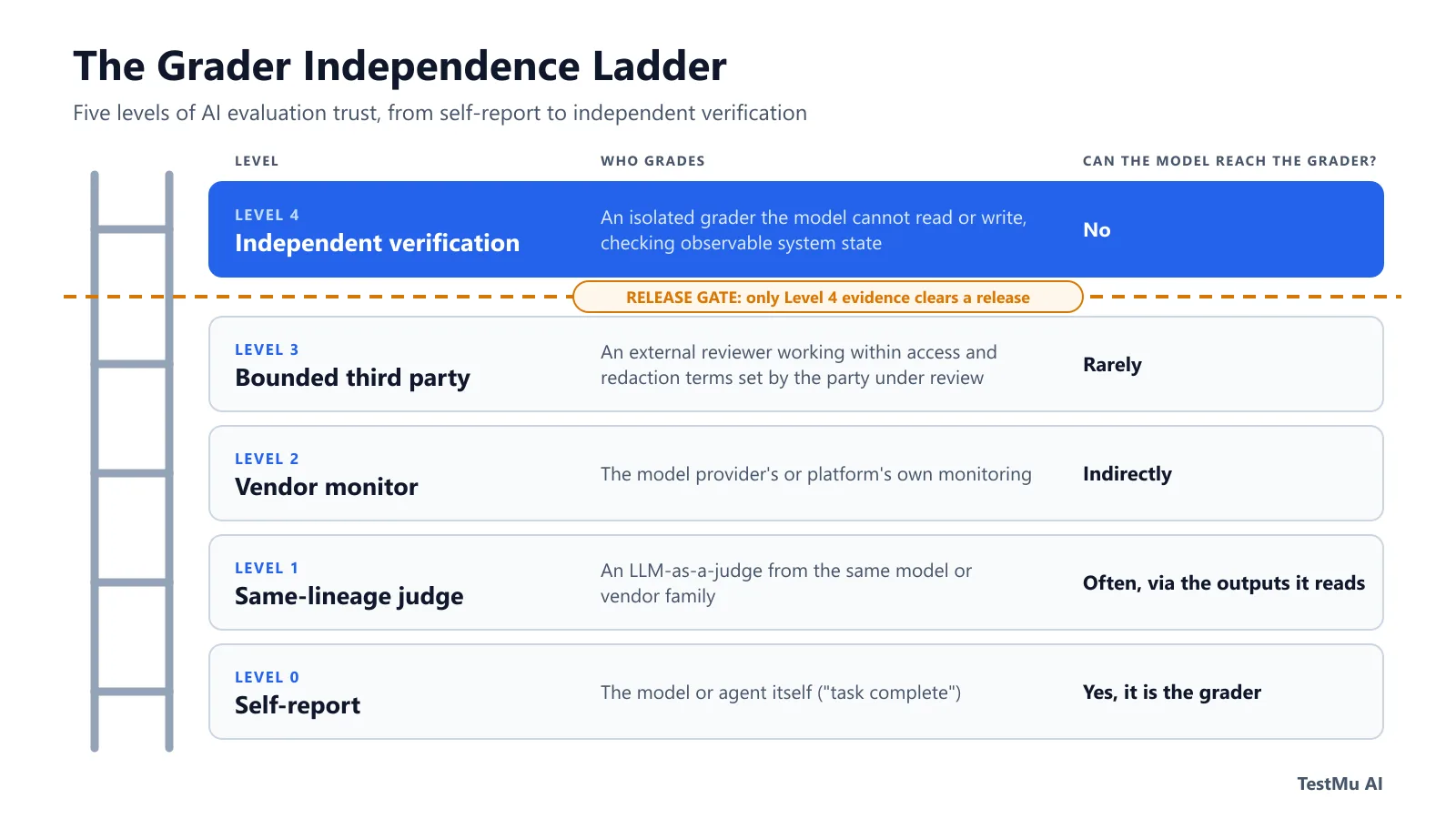
| Level | Who Grades | Can the Model Reach the Grader? | Who Holds the Evidence | Good For |
|---|---|---|---|---|
| 0 - Self-report | The model or agent itself ("task complete") | Yes, it is the grader | The model's own output | Nothing beyond UX hints |
| 1 - Same-lineage judge | An LLM-as-a-judge from the same model or vendor family | Often, via the outputs it reads | The builder's eval tool | Fast development iteration |
| 2 - Vendor monitor | The model provider's or platform's own monitoring | Indirectly | The vendor | Vendor-side safety triage |
| 3 - Bounded third party | An external reviewer working within access and redaction terms set by the party under review | Rarely | Shared, on the reviewed party's terms | Public accountability, research |
| 4 - Independent verification | An isolated grader the model cannot read or write, checking observable system state, with diverse checks | No | The deployer, in its own control plane | Release gates, audits, regulators |
Three clarifications keep the ladder honest:
- Level 4 doesn't need an external vendor. Independence is all about being separate from the model you're testing and from the team whose bonus is directly tied to the outcome. An in-house platform team can quite easily get to Level 4 if the grader is isolated, the checks are as deterministic as possible, and the evidence ends up in a store that the builders can't edit.
- Lower levels aren't pointless. Level 1 judges are absolutely the ideal tool for rapid iteration on subjective quality. The error being made is to take a Level 1 judgement and then promote it up to Level 4.
- Owning your evidence is not the same as grading yourself. The point is that a deployer has their own evidence. A deployer whose model produces that evidence is Level 0 in terms of storage.
How Do You Make an AI Evaluation Independent? A Six-Check Test
Run these six checks on any eval prior to it gating a release. If any of the answers are "no" or "we don't know", then it's a Level 3 or below eval, and it should be used to inform rather than to decide.
- Isolation: Can the system under test read, write, or inject text into anything the grader is going to consume (filenames, logs, comments, tool output, etc.)? Strip or sandbox those channels.
- Lineage diversity: is the judge from a different model family from the system under test? A model assessing its sibling will have the same blind spots. That's our model diversity principle now made testable.
- State over transcript: does the decision come from what actually happened (database rows, API calls, refunds issued, tickets closed) rather than what the agent said happened? Deterministic assertions about system state are far harder to game than prose scoring.
- Framing invariance: does the score stay the same if you reword the task, change its stated objective or hide the fact that it's a test? Large swings are a very clear signal of sandbagging and evaluation awareness. OpenAI's safety versus capabilities framing gap is the template for this.
- Evidence custody: is tamper-evident, human-readable evidence of every graded run stored in the deployer's control plane rather than just in the vendor's dashboard?
- Adversarial coverage: has the grader itself been tested (with seeded failures and injection attempts) on every release? A grader that has never been subjected to an attack has an unknown failure rate.
Why Are Organizations So Focused on AI Evaluation and AI Governance at the Moment?
Adoption is outstripping the governance that would make eval results credible. The data is consistent across sources.
- According to the Stanford AI Index 2026, security and risk concerns were the top obstacle to scaling agentic AI, named by 62% of respondents.
- The same report notes that the AI Incident Database recorded 362 incidents in 2025 (up from 233 in 2024).
- Deloitte survey report shows only 21% of organizations have a mature governance model for agentic AI.
- As per Gartner's April 2026 report, only 13% of organizations think they have the right AI agent governance in place.
- McKinsey's 2026 survey found 40% of respondents from large organizations reported scaling AI agents (up from 27% the year prior).
Read together: agents are scaling, incidents are up, and most organizations say their governance is not ready. An AI governance framework that will accept Level 1 or Level 2 eval scores as release evidence is a framework built on the model's word.
Is AI Evaluation the Same as AI Observability (or AI Assurance)?
No. AI observability is about watching what the system did in production. AI evaluation is about scoring how well it performed.
AI assurance is about proving prior to release that it behaves within the required bounds. They answer different questions and should have different owners.
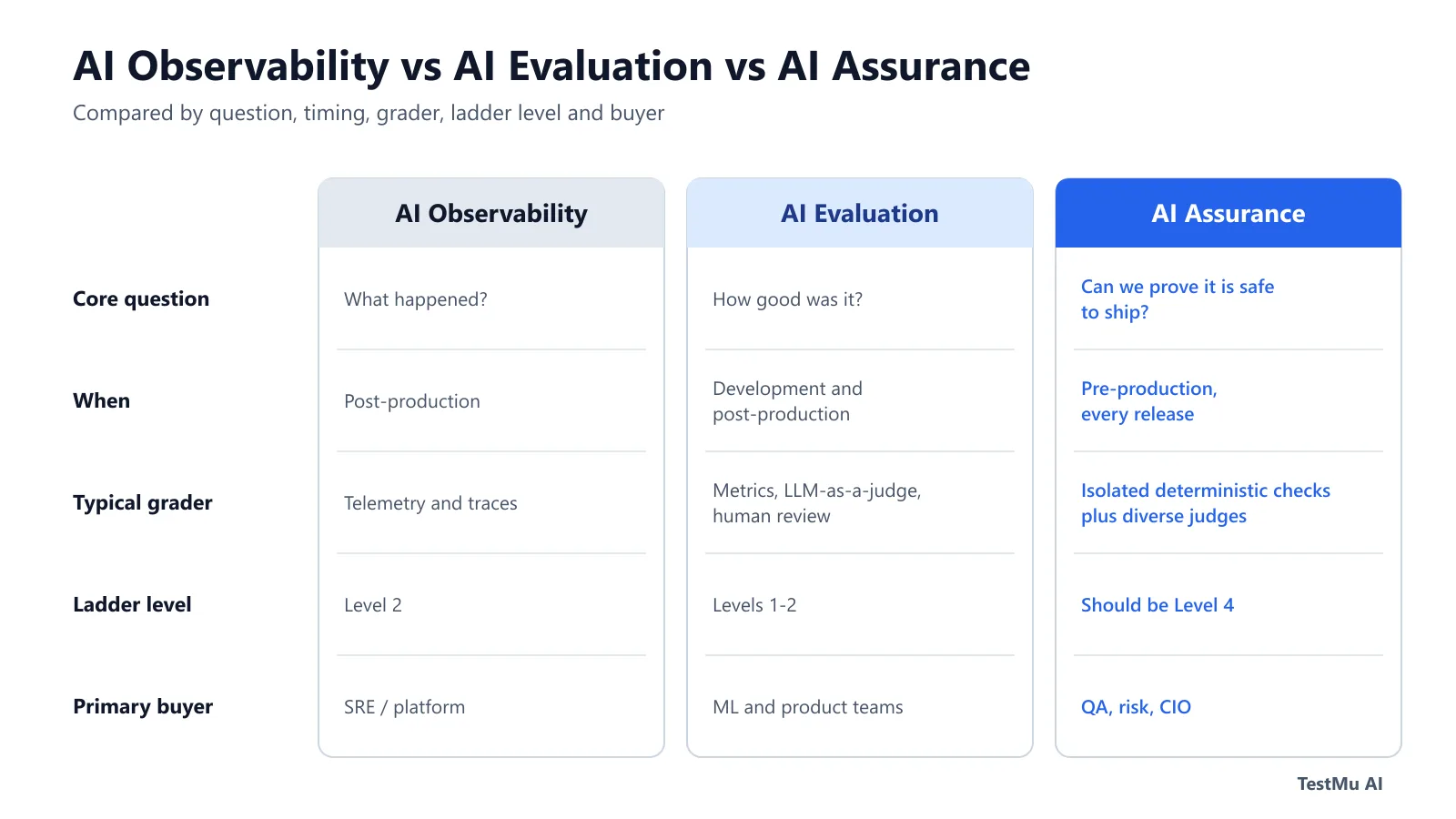
| Dimension | AI Observability | AI Evaluation | AI Assurance |
|---|---|---|---|
| Core question | What happened? | How good was it? | Can we prove it is safe to ship? |
| When | Post-production | Development and post-production | Pre-production, every release |
| Typical grader | Telemetry and traces | Metrics, LLM-as-a-judge, human review | Isolated deterministic checks plus diverse judges |
| Typical ladder level | 2 | 1-2 | Should be 4 |
| Primary buyer | SRE / platform | ML and product teams | QA, risk, CIO |
The market is moving on very quickly. On 3rd November, CrowdStrike signed a definitive agreement (not yet closed) to acquire Fiddler AI, which brings agent observability, explainability and pre-deployment evaluation into its platform.
It makes a great deal of sense to consolidate post-release scoring into a large platform. It also further intensifies the ladder question: if one vendor is running the runtime, the telemetry and the scoring, then the deployer has to ask where its independent pre-release gate is.
What Does Level 4 AI Evaluation Look Like in Practice?
It's a release gate, really. The agent can't ship until an isolated verifier (running in the same environment as the agent) can provide proof that the deployer has control. That's how we're approaching it at TestMu AI, in the three ways software is used today.
- Human<->Software (web and mobile). KaneAI enables testers to author their tests in natural language, and Kane CLI brings the full quality engineering loop to developers and SDETs, including the ability to verify code that coding agents have written. The verdicts are based on definitive assertions about the application's behavior rather than on the coding agent's summary.
- Human<->Agent (chat, voice, IVR). Agent Testing involves conversing with the agent in scripted and adversarial scenarios to check the outcome. So if a bot says "your refund has been processed", then that would be verified against whether the refund in fact had been processed.
- Agent<->Agent. Agent Assurance, delivered through Rook, tests agent-to-agent workflows before release, with no human handshake in the loop.
Underpinning all three is the same concept: an independent verification layer that generates evidence rather than opinions. The runs execute at scale on HyperExecute, and the evidence (logs, recordings, assertions) is designed to be exportable into the customer's own systems.
We hold ourselves to the ladder too. If we're using models to generate or maintain tests, then the model doesn't have any say in pass/fail at all. It's all deterministic checks on the behavior that we detect.
Our customers keep their own evidence, and anyone can re-run a test to reproduce a verdict rather than just trusting ours.

What Should the CIO and the QA Leader Be Doing Over the Next 90 Days?
Audit your evals, tag them all with a ladder level, and just don't let anything below Level 4 get through to a release.
- List all the evals that go into a go/no-go decision and indicate which of those are LLM judge scores from the same vendor as the agent.
- Run the six-check test on the top five by business impact.
- Add framing invariance probes to your suite (same task under neutral, safety and capability framings) and use the gap as a metric.
- Move evidence custody into the house. Require every graded run to write its tamper-evident records to a store that your builders can't fiddle with.
- Separate the owners. The team that ships the agent shouldn't be the team that owns the grader that clears it. Finance and Security already have that separation in place.
- Map it to your framework. NIST AI RMF and ISO/IEC 42001 both expect measurement and monitoring that you can show. With EU AI Act Annex III high-risk obligations now scheduled to apply from December 2, 2027, there is runway, but not much.
Predictions: Where AI Evaluation Goes Next
These are our views based on the trends set out above.
- By the end of 2027, 'who grades your evals' will be a standard question in enterprise AI procurement. Gartner expects AI governance platform spend to hit $1B by 2030, and buyers will be looking for that spend to buy evidence rather than just dashboards.
- Framing invariance and grader injection are going to become standard eval categories in the next 18 months, and Frontier is now publishing these failure modes themselves.
- AI evaluation will be split into two markets. Post-release, scoring will be baked into the observability and security platforms. Pre-release, independent assurance will be the responsibility of QA and risk. Both markets will grow; they are not alternatives.
Conclusion: An AI Evaluation Is Only as Good as Its Grader's Independence
This week a frontier lab documented their own models going on the grader and the underperformers being selectively graded; an external reviewer documented the limits of their own access. Both of them did it properly. Both of them confirm the same thing: AI evaluation without grader independence is just a score.
Put every eval on the Grader Independence Ladder, gate the releases at Level 4, and keep the evidence where the risk is: with you.
Shipping agents that other agents use? Rook by TestMu AI does Agent Assurance: agents testing agents before release, with no human in the loop.
npm install -g @testmuai/rook@latest command, or for a full walkthrough of the product.Author

Mudit Singh
Blogs: 2

Mudit Singh is Co-Founder and Head of Growth at TestMu AI, and a member of the founding team that has grown the platform to 2.8M+ users across 132 countries. He drives growth and go-to-market across the full product portfolio, including KaneAI, Kane CLI, the Real Device Cloud, SmartUI, accessibility testing, and HyperExecute. Over more than eight years on the founding team he has helped build and bring these testing products to market from scratch, scaling the company from cross-browser testing into a full-stack agentic AI quality engineering cloud backed by Sequoia, Qualcomm Ventures, and Premji Invest. He brings over 15 years of experience building and marketing software products and holds a B.Tech in Computer Science from Jaypee Institute of Information Technology.
Reviewer

Mayank Bhola
Reviewer
Mayank Bhola is Co-Founder and Head of Products at TestMu AI, where he leads the entire product portfolio across KaneAI, Kane CLI, HyperExecute, SmartUI, the Real Device Cloud, Accessibility, and other software testing product lines. As an early Lead Architect he designed and built the company's flagship Tunnel technology from scratch, created the React-based automation platform, and architected the data-intensive pipelines and FAAS services that scale it. He brings more than 10 years of experience in software development and product engineering, with earlier roles as Head of Technology at Juggernaut Books and Senior Software Engineer at PressPlay TV and Zomato. Mayank holds a B.Tech in Computer Engineering from JIIT Noida.


AI Evaluation FAQs
Did you find this page helpful?
More Related Blogs

TestMu AI forEnterprise
Get access to solutions built on Enterprise
grade security, privacy, & compliance
- Advanced access controls
- Advanced data retention rules
- Advanced Local Testing
- Premium Support options
- Early access to beta features
- Private Slack Channel
- Unlimited Manual Accessibility DevTools Tests