
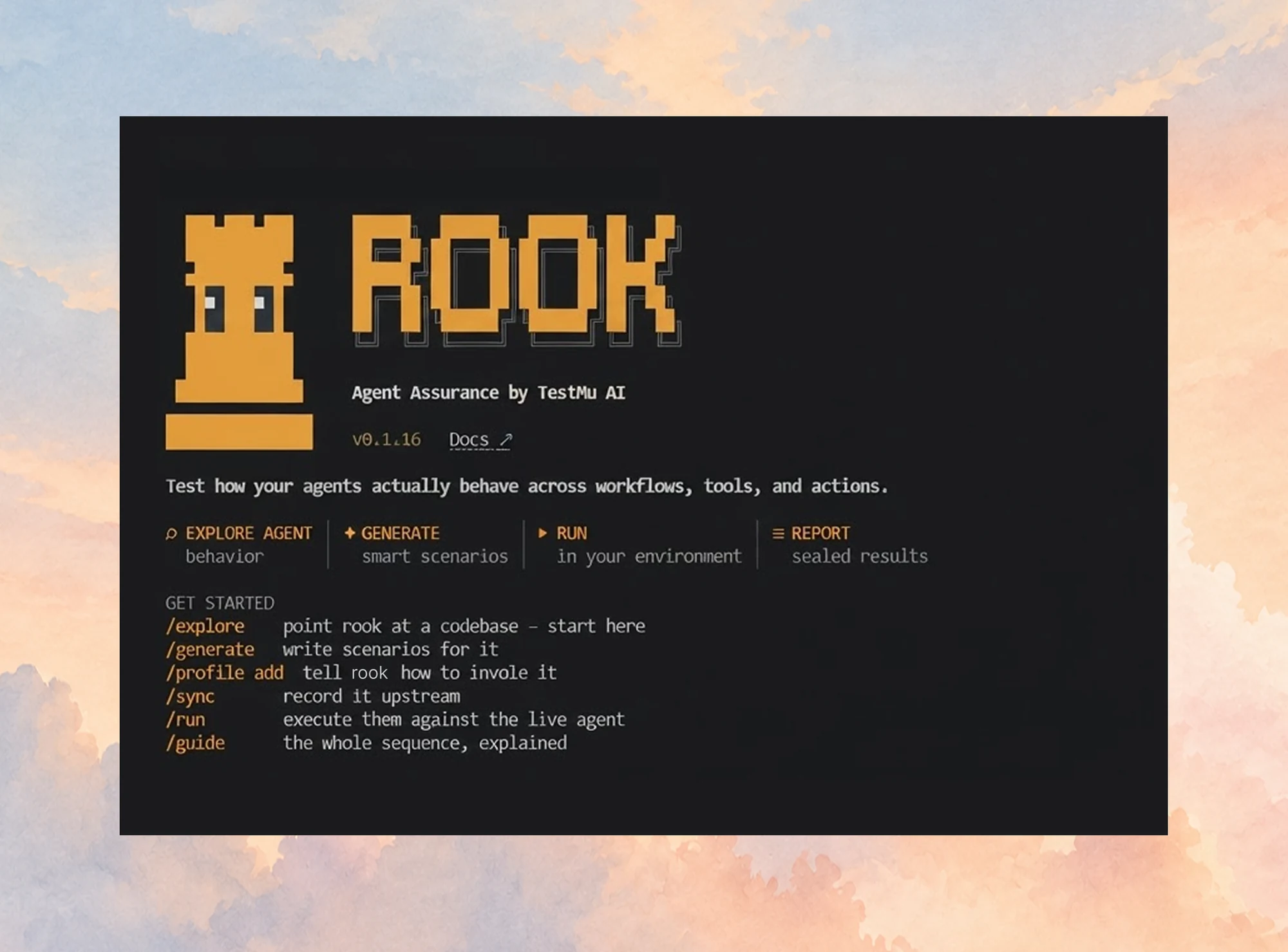
Agent Assurance for your AI Deployment
Test how your agents actually behave across workflows, tools, and actions. Catch failures and vulnerabilities before they ship.
npm install -g @testmuai/rook@latest
What Is Sovereign AI? Definition, Layers, Examples and How to Verify It
Sovereign AI is control over the compute, data, models and operations an AI system depends on. See the five layers, examples, companies and how to verify it.
Published on:
Suppose a bank moves its credit model into its own cloud account in Frankfurt, on open weights it holds, while the transcripts from every test run still go to an evaluation service hosted in another jurisdiction. The model now runs under the bank's control; the record of how it behaves does not.
Sovereign AI is a country's or an organization's ability to build, run and govern AI under its own control: where compute and data sit, who holds the model weights, who can switch systems on or off, and whose law applies. This guide adds a fifth layer to that list, verification: who tests the AI, where the tests run and who keeps the evidence.
TestMu AI, which publishes this guide, builds testing and verification software for applications and AI agents. Its products come up only in the last third of the article.
Overview
Sovereign AI is a country's or an organization's ability to develop, run and govern AI under its own control: where compute and data sit, who holds the models, who can switch the systems off and which law applies. A complete program also controls verification, meaning who tests the AI, where the tests run and who keeps the evidence.
The Five Layers of Sovereign AI
- Compute layer: Where an AI system's training and inference run, and whether a vendor can revoke, reprice or throttle them. Sovereign compute means capacity in your jurisdiction, such as your own cloud region, a private cloud or on-premises hardware, plus a fallback you have tested.
- Data layer: Who can read an AI system's training data, prompts, inference logs and backups. Sovereign data control means a data-flow map, residency settings and encryption keys held by your organization rather than by the provider.
- Model layer: Whether an organization can keep the model weights, run inference without the original vendor, fine-tune and switch models. Open or licensed weights and a tested switch to a second model show that the model layer is under its control.
- Operations layer: Who can run, pause, update or shut down the AI system, and under which law the operating entity sits. McKinsey calls this the operational dimension of sovereign AI.
- Verification layer: Who tests the AI system, where the tests run and who keeps the evidence. TestMu AI treats this as the fifth layer: test suites and release gates you own, run inside your boundary, with evidence stored where you control it.
How Sovereign AI Differs From Related Terms
- Sovereign cloud vs sovereign AI: Sovereign cloud controls where workloads and data run and which jurisdiction applies, the first two layers of sovereign AI. An organization can run a sovereign cloud and still send its data to a foreign model API for processing.
- Data sovereignty vs sovereign AI: Data sovereignty covers where data is stored and processed and which law applies to it. McKinsey's explainer on sovereign AI notes that an organization can have data sovereignty without having sovereign AI.
- On-premises requirement: Not required. Sovereign AI can run in an organization's own cloud account, a dedicated region, a private cloud, on-premises or in a disconnected environment, as long as the organization controls that boundary.
What Is Sovereign AI?
Sovereign AI is the capacity of a country or an organization to build, run and govern the AI systems it depends on without needing permission from a foreign provider. In McKinsey's explainer What is sovereign AI? (6 March 2026), senior partner Ali Ustun defines it as "a country's or an organization's capacity to independently develop, deploy, and govern artificial intelligence using its own infrastructure, its own data, its own models, and its own talent."
The same explainer separates it from data sovereignty, which covers where data is stored and processed and which jurisdiction it falls under. In Ustun's words, "you can actually have data sovereignty, but you may not have sovereign AI", and "If you rely on a foreign model to process your data, then it is not a true sovereign AI."
The term covers two different buyers:
- National sovereign AI - a government builds domestic capability so public services and the economy do not depend on foreign providers. The World Economic Forum's 2024 article on sovereign AI groups that work into six strategic pillars: digital infrastructure; workforce development; research, development and innovation; a regulatory and ethical framework; stimulating the AI industry; and international cooperation.
- Enterprise sovereign AI - a bank, insurer, hospital group or defense supplier keeps its AI workloads inside a boundary it controls. Mistral AI's sovereign AI page lists dedicated infrastructure, a customer's own VPC, a private cloud, on-premises infrastructure or a disconnected environment as options, and states that "Sovereign AI does not mean everything needs to run on-premises."
McKinsey associate partner Melanie Krawina describes sovereignty as "more of a spectrum", where the level you need depends on the context. A marketing copy assistant can call a shared public API, while a model that sets credit limits or reads patient records usually needs far more control.
Why Is Sovereign AI a Priority Now?
Liability, geopolitics, economics and public procurement are pushing sovereign AI up the agenda. The first three are the reasons Ali Ustun gives in the McKinsey explainer; the fourth comes from the European Commission:
- Liability - courts increasingly hold the organizations that deploy AI liable for failures such as bias or hallucinations, while vendors cap their own liability. Ustun calls this the "liability squeeze", and says sovereign AI lets organizations build a "liability firewall" with audit and control mechanisms in place.
- Geopolitical resilience - depending on a few global providers creates exposure to what Ustun calls "kill switches": service denials or geopolitical conflicts that cut access.
- Economic value - a country that relies entirely on foreign API-based models sends the economic value of that data flow abroad. McKinsey's experts put the impact of sovereign AI solutions and hosters at roughly EUR 480 billion in annual GDP for Europe by the end of the decade, and estimate that roughly 40 percent of the value of AI is underpinned by "sovereign or sovereign-enough solutions".
- Procurement - in April 2026 the European Commission awarded an EUR 180 million contract for sovereign cloud for EU institutions to four providers, and on 1 June 2026 it published Sovereign cloud framework explained, a clarification of the Cloud Sovereignty Framework included in that tender.
Not everyone agrees that sovereignty removes the dependency. In Sovereign AI addresses the wrong dependency (7 July 2026), Thoughtworks' Matt Kamelman argues that a domestically hosted model answers the geopolitical risk but not resilience: "You can satisfy every assurance level and still have a single point of failure."
Kamelman also separates control from accountability: building sovereign AI "is not the same as building AI that's accountable to the people it serves."
What Are the Layers of Sovereign AI?
Two widely cited definitions split control into four parts. McKinsey partner Luca Bennici lists a territorial dimension (where the data and compute sit), an operational one (who can operate and switch the systems on and off), technological and IP ownership, and a legal one (whose jurisdiction applies); Mistral AI's page names data, intelligence, compute and operations.
The table merges those lists into four layers and adds a fifth, verification, which neither list names as a layer of its own:
| Layer | The control question | Evidence that you have control |
|---|---|---|
| 1. Compute | Where do training and inference run, and can a vendor revoke, reprice or throttle them? | Capacity in your jurisdiction (your own region, a private cloud or on-premises) and a fallback that has been tested |
| 2. Data | Who can read training data, prompts, inference logs and backups? | A data-flow map, residency controls and encryption keys you hold |
| 3. Models | Can you keep the weights, run inference without the vendor, fine-tune and switch models? | Open or licensed weights, a portability test and a license review |
| 4. Operations | Who can run, pause, update or shut down the system, and under which law? | Named operators, a shutdown procedure and the jurisdiction of the operating entity |
| 5. Verification | Who tests the system, where do the tests run, and who keeps the evidence? | Test suites and release gates you own, run inside your boundary, with evidence in storage you control |
Layers 1 to 4 combine McKinsey's four dimensions with Mistral AI's four layers of control. Layer 5 is TestMu AI's addition and the argument of the rest of this guide; the wider idea of AI whose claims can be checked by someone other than its maker is covered in the guide to AI verifiability.
Sovereign AI vs Sovereign Cloud
McKinsey's explainer draws the line in one sentence: sovereign AI addresses control, governance and dependence, "as distinguished from sovereign cloud, which is mostly about where data is stored." The two terms are often used as synonyms, but they cover different layers:
| Attribute | Sovereign cloud | Sovereign AI |
|---|---|---|
| What it controls | Where workloads and data run, and which law applies (layers 1 and 2) | Compute and data, plus the models, their operation and how the AI is tested (layers 1 to 5) |
| The question it answers | Is our data stored and processed in our jurisdiction? | If our model vendor cut access tomorrow, could we keep serving this use case and show it still behaves correctly? |
| Can you have one without the other? | Yes: a sovereign cloud can still call a foreign model API | No: sovereign compute and data are the first two layers of sovereign AI |
Choosing the infrastructure side, from single-tenant platforms to on-premises stacks, is covered in the comparison of private cloud providers.
Why Is Sovereign AI Incomplete Without Sovereign Verification?
Sovereign AI is incomplete without sovereign verification because control over where a model runs does not show what the model does. If the only party able to say a system behaves correctly is the model vendor, or the model itself, the organization has handed its most important judgment to someone outside its boundary.
Bennici's list of what a sovereign AI ecosystem needs goes beyond infrastructure: "certifications, controls, monitoring, and incident response mechanisms." In practice, verification tends to break in one of these places:
- The model grades its own work - a team asks an LLM to judge another LLM's output, often from the same vendor. That gives useful scores, but the judgment is neither independent nor sovereign; the guide to LLM-as-a-judge covers where judges fail.
- Evidence leaves the boundary - a deployment kept in-country can still send prompts, transcripts, screenshots and traces to an evaluation service in another jurisdiction. The model stayed home, and the record of its behavior did not.
- Testing starts after release - production monitoring and AI observability explain what went wrong after users saw it. Both are needed, but neither can stop a change before it ships.
Public buyers already score more than location. In the Commission's Cloud Sovereignty Framework, the overall sovereignty score uses 48 criteria grouped into eight categories: strategic, legal and jurisdictional, data and AI, operational, supply chain, technological, security and compliance, and environmental sustainability. A separate Sovereignty Effectiveness Assurance Level (SEAL) checks thresholds, and the Commission's explainer names data sovereignty (SEAL-2), technological autonomy (SEAL-3) and full sovereignty (SEAL-4) as the highest levels.
Buyers are starting to ask the verification question directly. Stream's guide How to Evaluate Sovereign AI (12 November 2026) lists it among its auditability checks: "Can you run a full eval suite on your own hardware locally/offline?" Where a system falls under the EU AI Act's high-risk rules, the testing Article 9 requires has to produce evidence too, which EU AI Act conformity testing covers, and an AI audit is where that evidence gets read.
What Are the Five Tests for Sovereign Verification?
The five tests below check whether your verification layer is as sovereign as your compute. Each is a yes-or-no question that fits in a procurement questionnaire, for a vendor or for your own platform team:
- Runs inside the boundary - can test execution happen in the same boundary as the model, such as your cloud account, your region or your private network? If every run has to call a vendor's shared cloud, the answer is no.
- Evidence you hold - does every run leave an artifact (steps, screenshots, network and console logs, tool calls, verdicts) in a location you control, readable without the vendor's service?
- Independent of the model under test - is pass or fail decided by criteria your people wrote, checked against effects such as files changed, records written, API calls made or values on screen, instead of the model's own account of what it did?
- Repeatable verdicts - when nothing changed, does a rerun reach the same verdict, and when something changed, is the change recorded for review? A release gate means little if the same build passes on Monday and fails on Tuesday.
- Blocks a release - does the verification output plug into CI/CD as a gate that stops a deployment, rather than a dashboard someone reads later?
Add one question the tests do not cover on their own: when a test step uses a model, to generate scenarios or to judge a result, which model is it and where does it run? An evaluation that calls a foreign model API sends the run data with the call.
A "no" on any of the five means the AI may be sovereign in where it runs but not in how it is judged.
What Are Examples of Sovereign AI?
Sovereign AI shows up as public procurement, national programs and model companies that sell deployment inside a customer's boundary. Each example below was checked against its source in November 2026:
- European Union institutions - the Commission's EUR 180 million sovereign cloud contract of April 2026 went to four providers through a tender under the Cloud III Dynamic Purchasing System that included the Cloud Sovereignty Framework.
- France and Mistral AI - McKinsey's Krawina describes a national strategy in which the public sector goes first, switching cloud and software providers so core systems are built with European players. Paris-based Mistral AI sells deployment in a customer's VPC, a private cloud, on-premises infrastructure or a disconnected environment; its Mistral Large 4 model is reviewed separately.
- Canada and Germany - Cohere and Aleph Alpha formed a transatlantic alliance, and Schwarz Group, a major Aleph Alpha shareholder, committed USD 600 million in future financing and will lead Cohere's upcoming Series E, Fortune reported on 24 April 2026. Aleph Alpha's open-weight Kolibri-1 model is built for regulated work in public administration.
- India and Sarvam - Sarvam delivers multilingual AI models and voice agents for the country's 22 official languages, "powered by NVIDIA GPUs and built entirely on domestic infrastructure", according to NVIDIA's blog post How Nations Are Deploying AI for Strategic Priorities (6 July 2026).
- Enterprises - McKinsey's explainer describes a Middle East telecom operator that first ran its own network workloads on a sovereign cloud platform and later opened it to enterprise customers, and a European car manufacturer that keeps decades of production data out of AI because it will not hand that data to third-party providers.
Which Countries Fund Sovereign AI Programs?
National programs show where public money for sovereign AI goes first. These four publish their budgets at a primary source, and each figure below was read there in November 2026:
| Country or bloc | Program | What it funds | Headline figures and source |
|---|---|---|---|
| India | IndiaAI Mission, approved on 7 March 2024 with an outlay of Rs 10,371.92 crore over five years | Shared GPU compute for startups and academia, indigenous foundation models, datasets, startup financing and Safe and Trusted AI projects | More than 38,000 GPUs onboarded through the AI compute portal by March 2026; by August 2026, 237 projects approved for subsidized compute, with about 9.3 million (93.18 lakh) GPU hours sanctioned. Source: PIB, the Lok Sabha reply of 25 March 2026 and the Lok Sabha reply of 5 August 2026 |
| European Union | AI Gigafactories call of the EuroHPC Joint Undertaking, opened on 30 July 2026 | Large AI compute facilities for training, inference and fine-tuning of advanced models, open to startups, SMEs, industry, academia and public authorities | Up to EUR 10 billion in EU and national funding, expected to bring in at least EUR 20 billion of private investment, according to the European Commission. On 5 November 2026 the Lot 1 deadline moved to 4 February 2027 so member states can finish their budget procedures; Lot 2 stays due on 3 December 2026, and all tenders must be resubmitted (EuroHPC call page) |
| Canada | Canadian Sovereign AI Compute Strategy, announced by ISED on 5 December 2024 | Data centre investments that grow Canadian AI companies, public supercomputing infrastructure, and affordable compute for small and medium-sized enterprises | Up to CAD 2 billion: up to CAD 700 million for the AI Compute Challenge, up to CAD 1 billion for public supercomputing infrastructure and up to CAD 300 million for the AI Compute Access Fund (ISED news release) |
| United Kingdom | Sovereign AI Unit, which announced its first investments on 16 April 2026 | Equity investment in UK AI startups, plus supercomputer access, fast-track visas and research and development funding for the companies it backs | GBP 500 million at launch, with up to 1 million GPU hours per backed startup on the AI Research Resource supercomputers (DSIT press release). The fund's own FAQ now says it is backed by over GBP 600 million |
The headline money in all four goes to compute, models and the companies that build them. Verification shows up only at the edges: India's mission has selected 13 Safe and Trusted AI projects on topics such as bias mitigation and algorithm auditing, according to the August 2026 Lok Sabha reply, and the UK fund names AI trust, safety and assurance as one of its six priority areas and lists independent product validation among the support it gives backed startups. None of the four headline figures is a budget set aside for testing the AI that runs on this compute, which leaves that work to the organizations that deploy it, the gap described under sovereign verification.
Which Companies Offer Sovereign AI?
Companies that offer sovereign AI fall into four groups, and the one you need depends on the layer you are trying to control. The examples are the ones this guide could confirm in public sources in November 2026, not a ranking:
| Group | What they sell | Examples | What to ask them |
|---|---|---|---|
| Model providers with sovereign deployment | Models you can run inside your own boundary | Mistral AI; Cohere, with its Aleph Alpha alliance | Can we keep the weights? What happens to access if the contract ends? |
| Sovereign cloud and compute | Infrastructure and regions inside a jurisdiction | Providers scored under the EU Cloud Sovereignty Framework | Which SEAL level? Who operates the region, and under which law? |
| Hardware and national AI infrastructure | GPUs and platforms for national AI programs | NVIDIA, whose GPUs power Sarvam in India | Is supply guaranteed in the contract? |
| Verification and testing | Independent tests, release gates and evidence | TestMu AI (Agent Assurance, Kane CLI, HyperExecute) | Can tests run in our account? Where is the evidence stored? Who decides pass or fail, and which model judges? |
Other vendors in each group may fit a given workload better. Run the five tests against any of them, TestMu AI included.
How Does TestMu AI Support Sovereign Verification?
TestMu AI's Agent Assurance tests AI agents that act: agents that call tools, write files, hit APIs and change records. Its command-line tool is the Rook CLI (the command is rook), and it checks each acceptance criterion against what the run changed rather than what the agent reported, with criteria it could not check reported as Unable to Verify and kept out of the pass rate.

Against the five tests, here is what TestMu AI provides today and what still leaves your boundary:
| Test | What TestMu AI provides today | What still leaves your boundary |
|---|---|---|
| Runs inside the boundary | HyperExecute can run test execution in your own AWS or Azure account on its Enterprise plan; the HyperExecute Private Cloud docs list six AWS regions, including eu-central-1 (Frankfurt), ap-south-1 (Mumbai) and ap-southeast-2 (Sydney). The Rook CLI runs on your machine or CI runner. | Private-cloud automation is documented for Linux and Windows only, and only AWS and Azure have setup docs. The Rook CLI's model-backed steps call TestMu AI's model controller. |
| Evidence you hold | Kane CLI writes each run to a .evidence pack on your machine. The Rook CLI keeps scenarios and results as plain files in .testmuai/rook/, and a --test run keeps its results, evidence and report locally. | Kane CLI runs upload to TestMu AI Test Manager by default. A normal Rook CLI run records to the hosted timeline, a --test run of a synced agent still sends a one-row summary (result counts, pass rate, duration) to the Runs page, and rook sync uploads project files. |
| Independent of the model under test | Kane CLI does not take the agent's own claim of a pass as the result: a pass has to be backed by evidence such as DOM state, screenshots or network responses. The Rook CLI never counts an action the agent only claims as proof. | The Rook CLI uses model judges for some criteria, and Kane CLI uses a model for perception and reasoning. The Rook CLI's model providers are OpenAI and Google Gemini, reached through TestMu AI's controller. |
| Repeatable verdicts | Kane CLI replays unchanged steps from cache with no LLM cost and records any re-authored step for review. | An agent under test can take a different path on each run, so compare verdicts across runs rather than expecting identical traces. |
| Blocks a release | The Rook CLI runs headless in CI; its docs gate on the totals from rook run --json and give recipes for GitHub Actions, Jenkins and Argo CD. Kane CLI exits 0 on a pass and 1 on an assertion failure, with separate codes for environment errors and timeouts. | For the Rook CLI, exit code 0 alone does not mean the scenarios passed, so the gate reads the report. |
The second test is the easiest to check on a laptop. Below, a sealed pack from a Kane CLI 0.9.0 run of a mobile menu navigation test (18 November 2026) is validated with kane-cli evidence validate and read with a standard zip tool:
$ kane-cli evidence validate a38a1f7f.evidence
evidence: valid (L1, status finalized)

$ unzip -Z1 a38a1f7f.evidence | grep -c .
65

$ unzip -Z1 a38a1f7f.evidence | grep -c screenshot.jpg
18

$ unzip -p a38a1f7f.evidence run.yaml | tail -6
totals:
  tests: 1
  passed: 1
  failed: 0
  broken: 0
  skipped: 0
The pack's 65 files include 18 step screenshots, two HAR network logs, console logs in NDJSON and the test definition with its SHA-256 hash, which is what the docs on Kane CLI evidence packs describe. The same pack's result file also carries a Test Manager share link, because the run uploaded by default.
Run the five tests against TestMu AI too. Test execution on HyperExecute Private Cloud and the evidence files Kane CLI and the Rook CLI write can stay inside your boundary today; model-assisted authoring and judging, Kane CLI's default Test Manager upload and a normal Rook CLI run's hosted timeline go through TestMu AI's service.
The Agent Assurance technical and security overview lists every host the Rook CLI contacts and each class of data that leaves the machine. On the Agent Assurance pricing page, private deployment and bring your own LLM are listed as coming soon on the Enterprise plan.
Agent Assurance is self-serve, with a 14-day free trial. Install the Rook CLI from npm (Node.js 20 or newer) and confirm the version:
npm install -g @testmuai/rook@latest
rook --version
How Do You Start a Sovereign AI Program?
Start a sovereign AI program by deciding what must be sovereign, then testing that you have it:
- Classify workloads - list your AI use cases and mark each by data sensitivity, decision impact and regulatory exposure. McKinsey's Ustun advises using public models for generic tasks and reserving sovereign infrastructure for high-value IP and sensitive data.
- Map the five layers per workload - for each high-impact use case, write down who controls compute, data, models, operations and verification today, and record the decisions in your AI governance framework.
- Run a cutoff and switch test - simulate losing your primary model provider and measure how long it takes to serve the use case from a second model or environment. Stream's guide lists skipping the cutoff and switching tests as a common mistake.
- Build the verification suite before you migrate - write acceptance criteria for each workload in plain language, generate scenarios that include adversarial ones such as prompt injection and tool misuse, and run them against the current system to get a baseline.
- Gate every change - model swaps, prompt changes and new tools all go through the same release gate, and the evidence from each run goes to storage you own.
Conclusion
Pick the AI workload that would stop first if your model provider cut access. Write down who controls each of the five layers for it today, then run the five verification tests against the tools you use to test it.
For agents that act, the setup for a release gate on Rook CLI verdicts is in Run Agent Assurance in CI/CD. To ask which steps can run in your private cloud, Book a Demo.
Author

Samyak Goyal
Blogs: 36

Samyak Goyal is a Senior Member of Technical Staff at TestMu AI engineering Kane CLI, the command-line tool that runs browser automation from the terminal, where a flow described in natural language executes in a real Chrome browser and returns pass or fail with shareable proof. He is a backend engineer with 4+ years of experience, previously an SDE at Innovaccer, where he built APIs, introduced Kafka, and cut deployment from weeks to hours. Samyak also builds multi-agent systems, skill-orchestration frameworks, and a personal copilot that indexes 200+ microservice repositories.
Reviewer

Sirajuddin Khan
Reviewer
Sirajuddin Khan is Vice President of Product Management at TestMu AI, where he drives the company's agentic AI product strategy, building a suite of autonomous agents that includes Agentic Browsers and Agentic Visual Testing and shifting the unit of work from test execution to autonomous outcomes. One of the company's earliest product leaders, he has owned the roadmap for the high-performance execution cloud and grew the cross-browser testing products from early adoption to market leadership. He brings over a decade of experience across SaaS, B2B, and eCommerce, with earlier product roles at Wydr and ShopClues, where his catalog and search work cut delivery SLAs and lifted seller activity. Sirajuddin holds an MBA in Information Technology from Sikkim Manipal University and a B.Tech in Computer Science Engineering from Maharshi Dayanand University.


Sovereign AI FAQs
Did you find this page helpful?
More Related Blogs

TestMu AI forEnterprise
Get access to solutions built on Enterprise
grade security, privacy, & compliance
- Advanced access controls
- Advanced data retention rules
- Advanced Local Testing
- Premium Support options
- Early access to beta features
- Private Slack Channel
- Unlimited Manual Accessibility DevTools Tests