

Power Your Software Testing with AI Agents and Cloud
The Native AI-Agentic Cloud Platform to Supercharge Quality Engineering. Test Intelligently and Ship Faster.


- TestMu AI (Formerly LambdaTest)
- /
- Blog
- /
- Fintech QA: Ensuring Quality in Financial Technology Applications
Fintech QA: Ensuring Quality in Financial Technology Applications
Learn how to test fintech applications with real examples: business scenarios, functional, database, security and UAT testing, plus how AI changes fintech QA.
Last Updated on:
Testing a fintech application means verifying that every transaction, integration and data record works correctly, stays secure and meets business requirements.
Fintech systems handle high volumes of concurrent transactions, connect to third-party payment gateways and store confidential financial data, so one defect can move real money or expose customer records.
This guide covers the fintech domain and its characteristics, the testing workflow from requirement review and business scenarios to functional, database, security and user acceptance testing, and how AI changes fintech testing.
Key Takeaways
- Fintech applications handle high transaction volumes, many third-party integrations and confidential financial data, so fintech software needs end-to-end testing.
- QA engineers derive high-level business scenarios from requirement documents, because business analysts review high-level scenarios more easily than detailed test cases.
- Database testing for a fintech application covers data integrity, data loading, database migration, triggers and rules.
- Fintech teams cannot copy production data for testing, so simulated or synthetic accounts replace real customer records in test environments.
- Multi-factor authentication strengthens fintech security but adds test cases for every login and verification path.
- The EU AI Act classifies AI systems that assess creditworthiness as high-risk, so credit scoring models need tests for accuracy, bias and human oversight.
The Domain And The Application
Before understanding how one can test a fintech application, it is necessary to understand how the sector works so as to get detailed knowledge on how one can test and what all need to be tested.
Characteristics of a Fintech application:
- Multi-tier functionality: On a fintech application, thousands of concurrent sessions are being run at a particular instant hence it supports multi-tier functionality.
- Large-scale integration: A fintech application usually integrates with numerous other applications including third party vendors for transactions, user accounts, bill pay utility, etc.
- Multiple transactions are happening at an instant on a fintech application thus having a high rate of transactions per second.
- Huge transactions are being made every second and that needs to secure hence, security becomes a major characteristic in any fintech software.
- Huge data calls for the need of massive storage system.
- Data being highly confidential and important is equipped with disaster management.
- Day to day transactions’ track is kept in a recording section.
- Real time processing
- Batch processing
- Solid troubleshooting for customer issues.
- Various users from various locations access the same application hence, it should support multilingual users.
- Fast and secure transactions
As a fintech application possess numerous characteristics so it requires a solid end to end testing methodology to ensure that your fintech application works flawlessly.

How Testers See The Workflow Of A Basic Fintech Application?
Like any software testing process, fintech companies also follow the standard 7 step process of testing.
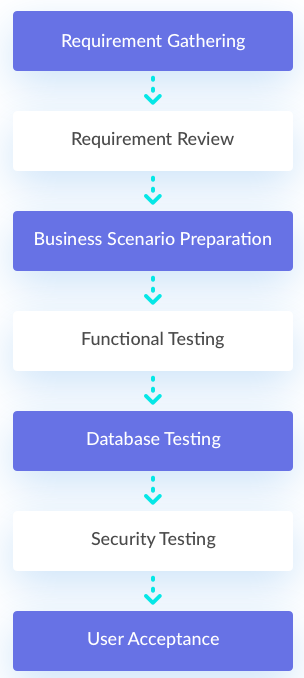
Basic Workflow of a FinTech Application
We will not go into detail on generic process right now, just special considerations related to Fintech organizations.
Requirement Gathering and Review
This is the initial phase in any fintech application involving the basic documentation of requirements. This documentation is done either as functional requirements gathering or as use cases.
This requirement gathering is followed by requirements review where the QA engineers cross check if any of the business workflows is violated.
Business Scenarios In Fintech Operations
On the basis of business requirements, QA engineers derive the business scenarios from the requirement documentation. The challenge here is to not miss any scenario and figuring out High Level and Low level scenarios. Usually high level scenarios are preferred over low level detailed test cases because it is easier for business analysts to review them.
Knowledge of the business domain plays a major role while preparing business scenarios and fintech test cases.
In a single bank with multiple products around insurance, banking, and investment, there are multiple different business scenarios, as shown in the image below.
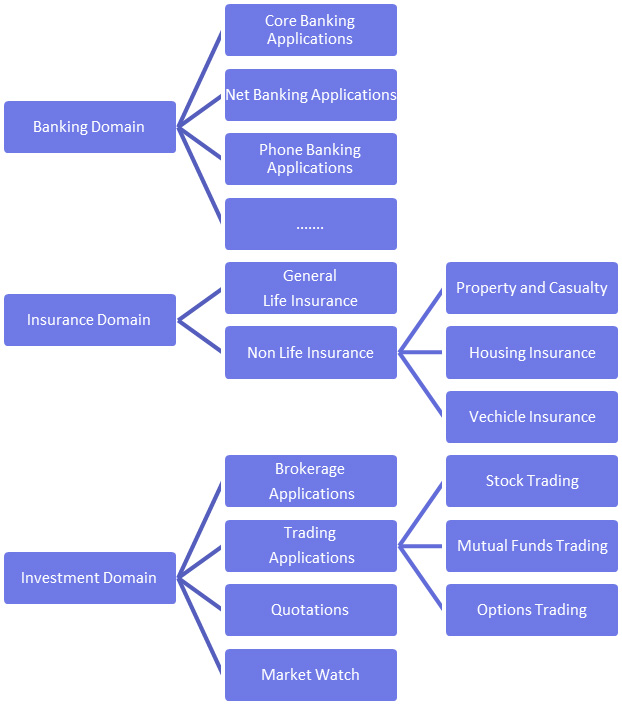
Business Scenarios in FinTech Domain
From the image above you can easily figure out that there can be many permutations and combinations to create business scenarios.
For example: A simple use case of opening a Fixed Deposit account in a bank will have various business workflows like opening an account, depositing the amount, transfers, monitoring, interests, etc.
Hence testing every possible business scenario becomes important.
Functional Testing
Functional testing of a fintech application is a major challenge in itself, that is worthy of its own independent post. Simple cross browser testing in fintech application is a major issue.
The process of functional testing of the fintech application is very much different from the usual software testing scenarios as it involves monetary transactions and sensitive data hence every possible test case should be taken into consideration.
It becomes important for the testers to test for interactions among different components and at the same time anticipate the risks in any unknown territory like for example in a new cloud deployment or a new on-premise deployment.
Multiplatform Testing: As fintechs run on multiple different environments hence it becomes important for them to test for cross browser compatibility. As there may be some systems that can have components that may be spanning over some other OSes still there may arise the need to test the whole system again. Be it any OS like Unix, Linux, Windows, Mac, android and iOS mobile apps, you need to ensure compatibility for all.
You can use TestMu AI to ensure cross browser compatibility of your fintech application.
Database Testing
Testing the integrity of databases is as important as it is to test for functions since fintech applications involves complex transactions at database level. Testing for database in a fintech software includes:
- Testing data integrity
- Data loading testing
- Database migration testing
- Testing for various triggers
- Testing for rules
Well, if you talk about creating a realistic dataset in any e-commerce website, it’s quite simple to copy the database but in case of fintech applications it’s a whole new game!
You can not just copy-paste the dataset as it is highly confidential and security comes as a major concern. Moreover, there are so many dependencies in a fintech application that creating realistic data requires cross-checking and therefore it limits the system.
The only way that comes to rescue is to create specialized robots which can simulate account creation with all the detailed steps.
Security Testing
Now we get to the biggest concern of a Fintech application, Security.
Since fintech applications deals with money transfers, sensitive financial data, third party payment gateways, etc and are highly prone to hackers stealing sensitive data so Security testing in a fintech domain holds an enormous value.

If you have read our post on blockchains, you’d know how we discussed simple bank transaction process.
Technologies and techniques like cloud deployment, 2-factor authentication, microservice architecture, etc, make the process of Security a little bit easier. However these same tech idea introduce their own set of issues and precautions.
Multiple-factor authentications: The demands for such security concerns give rise to multiple factor authentications. These authentications makes the security process more complex.
Say, you replace a simple username/password entry by fingerprint verification or text or email verification or some card verification don’t you think that it’s gonna add complexity to the testing process?
Of course, YES! This may give rise to huge complexities in the testing process and complicate the testing process further with more and more test cases.
- API Security: I would suggest you to track dependencies and vulnerabilities in the underlying components of a fintech application. So always make sure that whenever you have any of the vulnerable library in that case always keep an alternative tested solution for that vulnerability.
Note: Learn why Software Quality Assurance matters and how it can benefit your projects.
User Acceptance Testing
User acceptance testing comes as the final testing stage in every development cycle.
In user acceptance testing, the application is tested for its proper functioning as per the requirements defined by the customer. From its proper functioning to security, everything is tested considering every possible scenario from a user’s point of view.
MUST READ: Blog post on Acceptance Testing
This is the basic fintech application as seen from tester’s point of view. Majorly software testing plays an important role at every stage in the application’s development life cycle be it functional, user acceptance, or security testing.
How Does AI Change Fintech Application Testing?
AI helps testers build fintech test data and test scenarios faster, and it adds new features, such as credit scoring models and support chatbots, that need their own tests.
- Synthetic test data: Generators such as the Synthetic Data Vault (SDV) Python library learn the structure of a dataset and produce realistic accounts and transactions that contain no real customer records.
- Scenarios from requirements: LLM assistants read requirement documents and user stories and draft high-level business scenarios, such as the steps to open a fixed deposit account. QA engineers review every draft, because a model can miss a business rule or invent one.
- Self-healing UI tests: AI-based test tools re-locate a button or field after a UI change instead of failing the run, which reduces regression test maintenance across browsers and devices.
- Credit scoring models: The EU AI Act (Annex III, point 5(b)) classifies AI systems that evaluate a person's creditworthiness as high-risk and requires testing, risk management and human oversight for them. Testers check these models for accuracy, bias across customer groups and consistent output for the same input.
- Customer data limits: Sending real customer or card data to an external LLM service can break GDPR or PCI DSS rules, so teams give AI tools masked or synthetic data only.
AI does not replace domain knowledge. A tester who knows the business rules still decides whether a generated scenario or a model output is correct.
Author

Deeksha Agarwal
Blogs: 34


Deeksha is a Senior Product Manager at The Economic Times and a Community Evangelist with 8+ years of experience. She is followed by 6,000+ QA professionals, software testers, tech leaders, and enthusiasts across global communities. Deeksha has authored 40+ expert bios for TestMu AI, focusing on cross-browser testing, mobile app testing, regression testing, usability testing, and automation. Previously at TestMu AI, she drove product growth in native app testing and responsive browser features, combining product leadership with deep QA expertise.


Fintech Application Testing FAQs
Did you find this page helpful?
More Related Blogs
TestMu AI forEnterprise
Get access to solutions built on Enterprise
grade security, privacy, & compliance
- Advanced access controls
- Advanced data retention rules
- Advanced Local Testing
- Premium Support options
- Early access to beta features
- Private Slack Channel
- Unlimited Manual Accessibility DevTools Tests