

Power Your Software Testing with AI Agents and Cloud
The Native AI-Agentic Cloud Platform to Supercharge Quality Engineering. Test Intelligently and Ship Faster.


- TestMu AI (Formerly LambdaTest)
- /
- Learning Hub
- /
- What Is TMMI?: With Examples And Best Practices
What Is TMMI?: With Examples And Best Practices
Learn What is TMMi, its core concepts, and its implementation strategy in the software testing process.
Last Updated on:
On This Page
- What is TMMi?
- Why Need Test Maturity Model Integration?
- Key Components of TMMi
- Different Levels of TMMi
- Assessment & Certification
- TMMi vs. CMMI
- Benefits of Test Maturity Model Integration
- How TMMi Enhances Software Testing?
- Challenges in TMMi Implementation
- Best Practices of Test Maturity Model Integration
- Conclusion
Test Maturity Model Integration (TMMi) is a framework that gives organizations a structured way to assess and improve their software testing process. It uses five staged maturity levels so a team can see where its testing stands today and what to improve next.
In practice, it works as a roadmap: evaluate your current testing against the model, identify the gaps, and improve toward the next level. That focus on the Software Testing Life Cycle specifically is what sets TMMi apart from broader process models, which is the theme of the rest of this guide.
What is TMMi?
TMMi (Test Maturity Model Integration) is a comprehensive model that aims to assess the software testing process to improve and optimize it. Mainly, it is based on the Capability Maturity Model (CMM) and helps the organization surge its IT standards.
The Illinois Institute of Technology developed TMM, whereas Test Maturity Model Integration was brought into the industry by the TMMi Foundation. The main motive behind this was to establish guidelines and reference frameworks for the test process to improve the functionality of the software applications. These guidelines allow the organization to address the complexity of software testing with better efficiency.
Here are some points of Test Maturity Model Integration:
- It comprises the five-level model that provides a framework to measure the maturity of the testing processes.
- It has a certain maturity level where each level shows the particular stage of testing ability and maturity of the testing organization.
- Starting at the initial level in Test Maturity Model Integration, there is progress made through the different levels by showing any test loopholes and taking action to improve by adopting software testing methodologies.
- It also focuses on the significance of integrating the software test process with business goals and end-user satisfaction.
Why Need Test Maturity Model Integration?
Test Maturity Model Integration is steadily making its way into the testing processes of different software organizations. However, many wonder why the Test Maturity Model Integration is necessary. Here are some points to persuade you about the importance of TMMi:
- Despite numerous efforts to improve the testing process, achieving zero defects in the software industry remains elusive. Therefore, Test Maturity Model Integration represents another endeavor to attain this goal.
- Existing software process improvement models like CMM/CMMI provide limited focus on testing, necessitating a dedicated process explicitly tailored for testing.
- Test Maturity Model Integration serves as a test process improvement model that can seamlessly integrate with other process improvement models or function independently as a standalone model.
- Test Maturity Model Integration facilitates the evaluation and enhancement of the testing process.
- By enhancing the test process and improving software quality, test engineering productivity, and cycle-time work, Test Maturity Model Integration contributes to overall improvements in the Software Development Life Cycle.
Now let us understand the key components of Test Maturity Model Integration.

Note: Test your web and mobile applications on real devices. Try TestMu AI Now!
Key Components of TMMi
To understand the concept of Test Maturity Model Integration, it is important that you are well aware of its components. What does this component mean? They are the fundamental elements that structure the Test Maturity Model Integration framework. Such components provide essential guidelines and criteria for enhancing the test maturity level of the organization.
Here are the main components of the Test Maturity Model Integration:
- Process area: Test Maturity Model Integration explains the set of processes that include different aspects of the testing, for example, test planning, test design, test execution, test automation, and test measurement.
- Maturity levels: It categorizes the organization into different maturity levels ranging from level 1 to level 5 based on test process capabilities. The levels show various degrees of maturity aligned with the defined process and continuous improvement.
- Capability levels: The concepts of Test Maturity Model Integration includes capability levels for each process area. This provides a detailed assessment of the organization to execute test practices in different process areas.
- Appraisal method: It provides an appraisal method to assess the test maturity level of the organization and capability level.
- Key practice: Test Maturity Model Integration identifies key practices for each process area and maturity level.

Different Levels of TMMi
TMMi has five maturity levels. Every organization starts at Level 1 and climbs as its testing moves from ad hoc to managed, defined, measured, and finally optimized. Each step up is a concrete improvement in how testing is run, which is what raises product quality and lowers the defect rate.
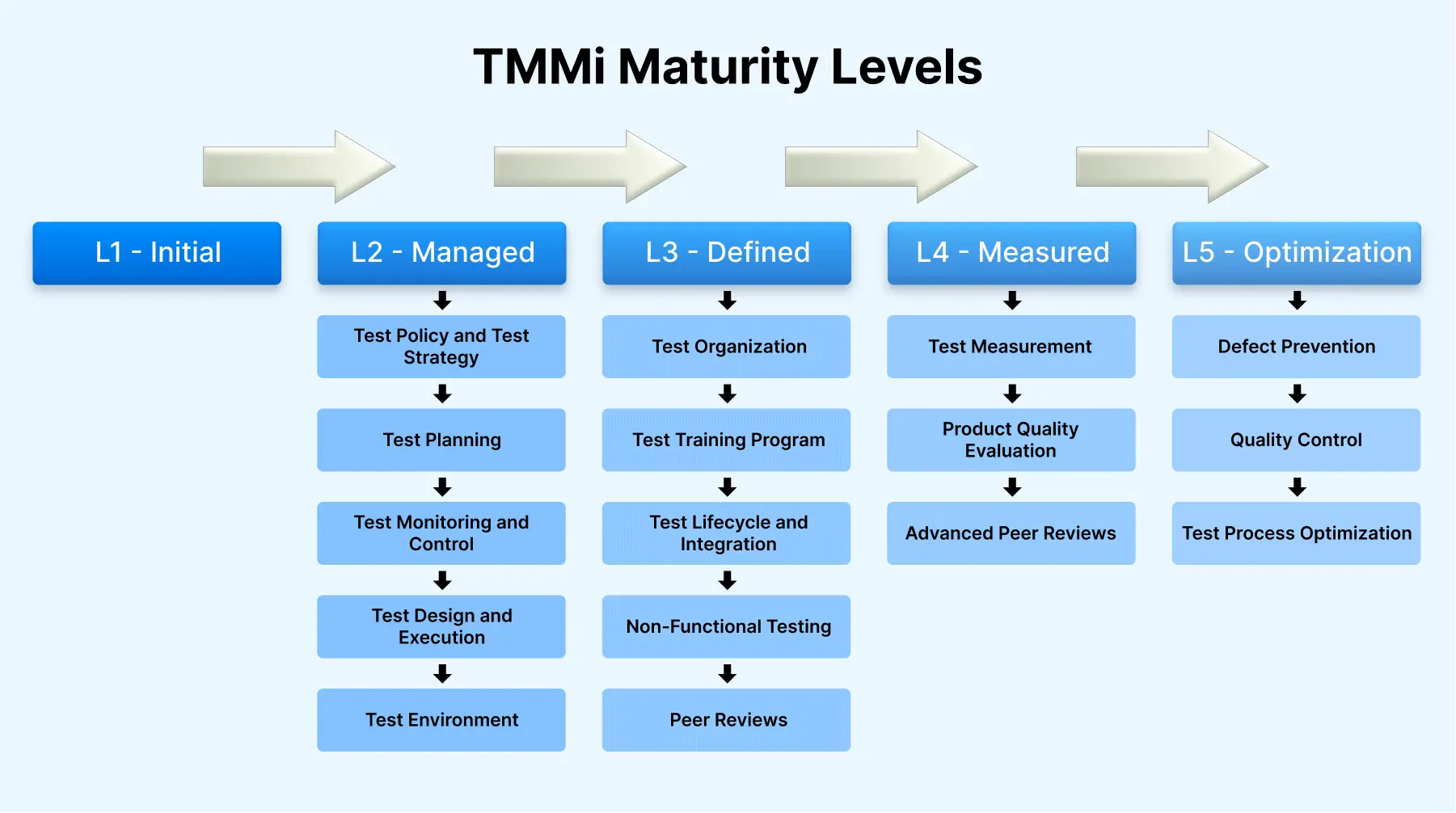
Here are the different maturity levels of Test Maturity Model Integration:
Level 1 - Initial
Testing has no defined process and is treated as part of debugging. Teams overcommit, drop planned steps under schedule pressure, and do not learn from past projects. It is the baseline TMMi pushes organizations to move beyond.
Level 2 - Managed
Testing is established and managed with a defined test policy and strategy that guide planning, monitoring, and control. Projects apply defined test design techniques, control their own test execution, and run against dedicated test environments.
Level 3 - Defined
The Level 2 practices now apply organization-wide under shared standards. Testing is integrated into the development life cycle from the early stages rather than bolted on at the end, test training programs are in place, reviews become routine, and non-functional testing is planned and executed across all projects.
Level 4 - Measured
In this stage, the measurement of activities and outcomes is extensively applied early on in all projects. The goal is to ensure that the projects are as free from defects at every stage of development. Advanced review techniques are utilized throughout all projects, building upon the review practices introduced at Level 3.
Level 5 - Optimization
At this highest level, all activities and outcomes are thoroughly assessed, and measures are put in place to achieve continuous improvement in defect prevention and overall quality optimization. The focus is on optimizing testing processes and activities to enhance the quality of the end product.
TMMi Assessment Method and Certification
Knowing the five levels raises the obvious next question: how does an organization prove which level it is at? That is what the TMMi Assessment Method (TAM) is for. It is the formal procedure the TMMi Foundation licenses to accredited assessors, and it is what turns "we think we are around Level 3" into a defensible rating against the model.
Assessments come in two forms. An informal assessment is a lighter, internal gap analysis a team runs to see where it stands and what to fix next. A formal assessment is conducted by an accredited assessor using the TAM, and it is the one that results in an official TMMi level rating that can be shared with clients or auditors.
On the people side, the TMMi Foundation offers four credentials, and they build on each other:
- TMMi Professional confirms a working understanding of the model. The exam is 40 multiple-choice questions in 60 minutes, and you need 65% to pass. It is also the prerequisite for the assessor track.
- TMMi Test Process Improver goes a level up, for someone who will actually run a test process improvement project and implement TMMi-based changes across a team or organization.
- TMMi Assessor is the accredited qualification for conducting informal and formal assessments using the TAM.
- TMMi Lead Assessor is the senior accreditation, for experienced assessors who oversee formal assessments.
The practical takeaway: you do not need to be certified to use TMMi as an internal improvement roadmap, which is how most teams start. Certification and a formal assessment matter when the rating itself has to be credible to someone outside the team.
TMMi vs. CMMI: What Is the Difference?
TMMi is often confused with CMMI, partly because it borrows CMMI's staged, five-level structure on purpose. The difference is scope. CMMI (Capability Maturity Model Integration) measures the maturity of software engineering and development processes as a whole. TMMi narrows that lens to one thing: the testing process.
They are complementary rather than competing. CMMI treats testing as one activity inside a much larger picture, so it never goes deep on it. TMMi was created to fill exactly that gap, which is why teams that already use CMMI often adopt TMMi alongside it to give testing the same rigor the rest of their process already has.
| TMMi | CMMI | |
|---|---|---|
| Focus | The test process specifically | Software engineering and development processes as a whole |
| Scope | Specialized, testing only | Broad, spanning the full development lifecycle |
| Structure | Five staged maturity levels | Five staged maturity levels (plus a continuous representation) |
| Relationship | Complements CMMI by adding testing depth | Covers testing only lightly, as one activity among many |
| Best when | Testing quality is the specific thing you want to raise | You are maturing the whole engineering organization |
Benefits of Test Maturity Model Integration
Test Maturity Model Integration in software testing has various crucial roles. Some of them are as follows:
- The TMM process clearly defines levels and successful completion of all deliverables related to software testing. This means the software application development is ensured at different Test Maturity Model Integration levels. Thus ensuring software quality.
- Level 4 demonstrates the thoroughness of the process, as all codes undergo review and test plans are diligently executed. This approach eliminates contradictions and promotes precise requirements.
- The primary objective of this model is to minimize defects. By identifying and addressing a maximum number of defects, the final product is rendered free of defects, thus emphasizing its commitment to defect prevention.
- The software quality is guaranteed as the testing procedures are seamlessly integrated into every software life cycle phase.
- Significant reduction in risks and time-saving are additional benefits achieved through implementing Test Maturity Model Integration.
How TMMi Enhances Software Testing?
Test Maturity Model Integration is a set of standards organizations adopt to improve their testing processes and standards. It serves as a complementary practice to CMMi, providing maturity levels and standards that contribute to enhancing the maturity levels within the SEI CMMi framework.
Let's discuss the steps through which Test Maturity Model Integration assists organizations in improving their testing processes:
- Assessing the current testing maturity level: Determining the organization's existing maturity level is crucial and is the initial step in the TMMi process. Test Maturity Model Integration aids IT organizations in evaluating their current maturity level and identifying whether their testing processes are reactive or proactive. It calculates the organization's current maturity level and outlines the necessary efforts to progress to the next level.
- Structuring the process step-by-step: Once the organization identifies the gap between the current and desired maturity levels, it systematically breaks down the steps required to achieve its ultimate goal. Breaking down the efforts into manageable steps facilitates goal achievement and allows organizations to progress steadily.
- Continuous review, feedback, solution, and iteration: Organizations at any maturity level in the Test Maturity Model Integration framework require ongoing review, feedback, solution implementation, and iteration. This iterative process helps improve the testing process and enables the organization to reach higher maturity levels. It also facilitates the review and refinement of industry standards and processes.
Implementing Test Maturity Model Integration undoubtedly helps organizations enhance their testing practices and brings numerous benefits to the organization. As Test Maturity Model Integration maturity levels improve, IT organizations also experience enhanced maturity levels in the Software Development Life Cycle, particularly in the planning and development phases. TMMi contributes to overall project efficiency enhancement and benefits investors, customers, compliance, and employees.
Note: Automate your browser testing on the cloud. Try TestMu AI Now!
Challenges in TMMi Implementation
In the implementation of Test Maturity Model Integration, the challenges encountered can pose a threat to the implementation process. Let us learn about those challenges:
- The key challenges the stakeholders face in implementing Test Maturity Model Integration include a poor understanding of the process. This interferes with the process and leads to inadequate implementation of TMMi.
- The implementation process of Test Maturity Model Integration requires frequent changes in its practice and organizational culture. In this, the team's resistance to the change generally impedes the progress of TMMi initiatives.
- Limited availability of resources like time, budget, and skilled personnel impacts the process of execution of assessment and improvement initiatives.
- Organizations with complex structures, distributed teams, or multiple projects may find implementing Test Maturity Model Integration consistently across different areas challenging.
Best Practices of Test Maturity Model Integration
To overcome the challenges and ensure successful Test Maturity Model Integrationadoption, organizations can follow these best practices:
- To implement Test Maturity Model Integration, you should educate the stakeholders and other team members on the importance of the TMMi and how to align the organization's objective.
- You should develop a comprehensive plan highlighting the scope and timeline of implementing the Test Maturity Model Integration.
- You should adapt the Test Maturity Model Integration to suit the organization's size, structure, and industry domain.
- It is important to invest in skill development programs to build competencies in testing practices and Test Maturity Model Integration implementation.
- You should continuously assess the software testing steps and practices against specific standards like predefined quality metrics.
The Test Maturity Model Integration is a valuable framework for the software testing process, allowing you to assess the QA process and optimize them. However, teams can further enhance the efficiency of their testing process by harnessing the potential of cloud-based testing platforms to ensure a quality experience across different browsers and devices.
AI-native test orchestration and execution platform like TestMu AI provides a secure and reliable cloud grid that scales as your testing requirement grows. It allows developers and testers to perform manual and automation testing at scale on an online browser farm of 3000+ real browsers, devices, and platform combinations.
You can run automated tests using Selenium, Cypress, Appium across desktop and mobile environments.

Subscribe to our TestMu AI YouTube Channel to catch up with the latest tutorials around Selenium testing, Cypress testing, and more.

Conclusion
In this tutorial on What is TMMi, we have discussed the Test Maturity Model Integration comprehensively in software testing, which stands as an all-encompassing framework and approach within the software testing domain. Its primary objective is to carefully test and augment an organization's testing process. Within its structured roadmap, Test Maturity Model Integration meticulously guides the expedition toward refining the testing process.
TMMi mainly focuses on test strategy, planning, execution, and defect management. It aims to evaluate the organization's maturity in software testing by its five maturity levels. Here each level shows the stage of improvement and serves as the point to analyze the progress and find any area for development. When you adopt Test Maturity Model Integration, an organization can have many advantages, like enhanced testing efficiency, fewer defects, and better collaboration with the team.
However, it is essential to acknowledge that implementing Test Maturity Model Integration is not a quick-fix solution but a long-term commitment that requires dedicated effort, resources, and support from all stakeholders. Organizations should carefully assess their current testing maturity, set realistic goals, and gradually progress through the maturity levels to derive maximum value from the model.
Author

Nazneen Ahmad
Blogs: 39


Nazneen Ahmad is a freelance Technical Content SEO Writer with over 6 years of experience in crafting high ranking content on software testing, web development, and medical case studies. She has written 60+ technical blogs, including 50+ top-ranking articles focused on software testing and web development. Certified in Automation Basic and Advanced Training - XO 10, she blends subject knowledge with SEO strategies to create user focused, authoritative content. Over time, she has shifted from quick, keyword-heavy drafts to producing content that prioritizes user intent, readability, and topical authority to deliver lasting value.


TMMi FAQs
Did you find this page helpful?
More Related Learning Hubs
TestMu AI forEnterprise
Get access to solutions built on Enterprise
grade security, privacy, & compliance
- Advanced access controls
- Advanced data retention rules
- Advanced Local Testing
- Premium Support options
- Early access to beta features
- Private Slack Channel
- Unlimited Manual Accessibility DevTools Tests