

Power Your Software Testing with AI Agents and Cloud
The Native AI-Agentic Cloud Platform to Supercharge Quality Engineering. Test Intelligently and Ship Faster.


- TestMu AI (Formerly LambdaTest)
- /
- Learning Hub
- /
- Test Process Improvement: TPI NEXT, TMMi, and a Checklist
Test Process Improvement: TPI NEXT, TMMi, and a Checklist
Test process improvement (TPI) makes testing faster and more reliable. Learn TPI NEXT, TMMi, a QA checklist, the PDCA cycle, and best practices.
Last Updated on:
On This Page
- What Is TPI (Test Process Improvement)?
- What Is the Difference Between TPI NEXT and TMMi?
- What Should a QA Process Improvement Checklist Cover?
- What Are the Objectives of Test Process Improvement?
- What Are the Benefits of Test Process Improvement?
- Which Tools and Techniques Support Test Process Improvement?
- What Are the Best Practices for Test Process Improvement?
- How Do You Apply the PDCA Cycle to Test Improvement?
- What Are Real-World Examples of Test Process Improvement?
- What Are the Challenges of Test Process Improvement?
- What Is the Future of Test Process Improvement?
- How Is AI Changing Test Process Improvement?
- Where Should You Start With Test Process Improvement?
OVERVIEW
To make your software projects better, Test Process Improvement (TPI) has brought a new way of doing tests that has really changed things. TPI changes the game for companies looking for continuous improvement by streamlining test processes , coordinating with organizational priorities, and improving overall software quality.
The Ins and Outs of TPI will be covered in detail in this blog, along with some of its significant advantages and the reasons why modern businesses just must employ it.
Lets get started!
Overview
To systematically implement Test Process Improvement (TPI), organizations should use the TestMu AI platform to organize test assets and adopt the structured TPI NEXT framework to assess maturity, identify testing weaknesses, and roll out targeted quality improvements to enhance software quality across releases.
What Is Test Process Improvement?
Test Process Improvement is an iterative, structured practice that assesses current testing maturity, builds a tailored improvement plan, and rolls out changes gradually to raise software quality.
Why Does TPI Matter?
- Continuous improvement: Testing is treated as an ongoing practice that evolves alongside software complexity to adapt to changing requirements.
- Alignment: Testing goals stay coordinated with organizational priorities and industry standards to ensure reliable and durable software solutions.
How Do You Put a Test Process Into Practice?
- Best for test organization: TestMu AI's test management platform - This tool helps QA teams organize test cases, plans, and results so process improvements are applied consistently across software releases.
- Best for incremental maturity gains: TPI NEXT - Developed by Sogeti, this framework uses a Maturity Matrix to assess key areas like test strategy and defect management against controlled, efficient, and optimizing levels.
- Best for formal organization-wide maturity: TMMi - This five-level staged model guides organizations from ad-hoc testing to a fully optimized process through formal, certifiable maturity levels.
- Best for AI-driven QA automation: KaneAI - Offered by TestMu AI, this GenAI native QA Agent-as-a-Service platform provides precise test generation, comprehensive error analysis, and seamless CI/CD integration.
- Best for team collaboration and tracking: Jira - This tool serves as a centralized platform for teams to plan, execute, and track testing operations, manage test cases, and monitor defect progress.
- Best for web browser automation: Selenium - This automated testing tool helps teams automate repetitive test cases, broadening test coverage and accelerating the overall testing process.
- Best for mobile test automation: Appium - This tool allows teams to automate repetitive mobile test cases, freeing up testers to focus on critical scenarios and early bug discovery.
- Best for Java-based test automation: JUnit - This automated testing tool enables teams to run repetitive test cases, improving test result accuracy and facilitating early bug discovery.
- Best for CI/CD automation: Jenkins - This tool automates software building, integration, and deployment, enabling continuous testing and early issue detection within the deployment pipeline.
- Best for integrated pipeline automation: GitLab CI/CD - This platform automates the build, integration, and deployment processes to establish a smooth, reliable, and continuous testing workflow.
- Best for cloud-native continuous integration: CircleCI - This tool automates software integration and deployment, helping organizations run continuous tests and identify pipeline issues early.
What Is TPI (Test Process Improvement)?
TPI (Test Process Improvement) is a structured and systematic approach used to enhance the quality and effectiveness of software testing within an organization. TPI focuses on identifying weaknesses and areas for improvement in the testing process, tools, and resources, with the ultimate goal of improving the overall testing capability and software quality.
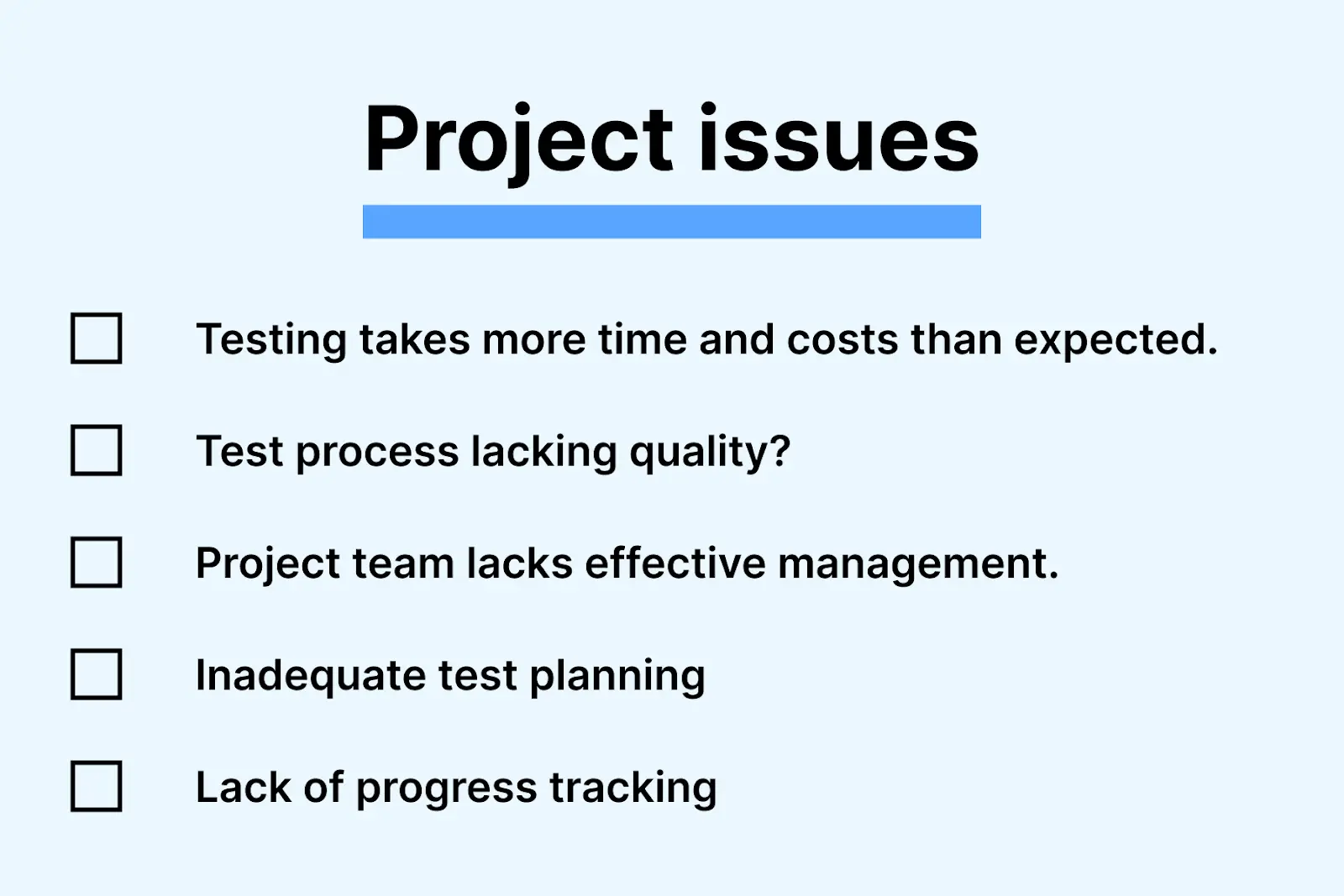
The TPI approach consists of a set of actions that organisations can take to evaluate their present testing practises, assess their strengths and shortcomings, create a personalised improvement plan, and gradually implement changes. Companies are able to improve their testing procedures over time because of this iterative process, which leads to higher-quality software and happier customers.
TPI places a strong emphasis on the necessity of continuous improvement in the testing procedure, acknowledging that testing is not a one-time endeavour but rather an ongoing endeavour to adapt and evolve alongside the increasing requirements and complexity of software development.
By using Test Process Improvement principles, businesses can make sure that their testing procedures stay up to date with industry standards and best practises, which will ultimately result in more dependable and durable software solutions.
Accelerate your Test Process Improvement. Try TestMu AI Now!
What Is the Difference Between TPI NEXT and TMMi?
TPI NEXT assesses maturity key area by key area using a maturity matrix, while TMMi rates the organization on five staged levels, from Initial to Optimization.
Two industry-standard frameworks dominate how organizations measure and benchmark their testing maturity, so improvement is guided by a model rather than guesswork.
TPI NEXT
TPI NEXT, developed by Sogeti, uses a Maturity Matrix built from key areas such as test strategy, metrics, test tools, and defect management. Each key area is assessed against maturity levels (controlled, efficient, and optimizing), so a team can see exactly which areas to improve next and in what order. It is flexible and matrix-driven, which suits incremental, area-by-area improvement.
TMMi (Test Maturity Model integration)
TMMi is a five-level staged model, similar in spirit to CMMI, that moves an organization from ad-hoc testing to a fully optimized process:
- Level 1 - Initial: testing is ad-hoc, unmanaged, and often confused with debugging.
- Level 2 - Managed: test planning, policy, and basic techniques are in place.
- Level 3 - Defined: testing is integrated into development with a defined, organization-wide process.
- Level 4 - Measured: testing is measured and evaluated with metrics and quality data.
- Level 5 - Optimization: the process is continuously optimized through defect prevention and quality control.
Teams use these matrices to benchmark their current maturity and set a roadmap. In short, TPI NEXT is a flexible matrix for incremental gains, while TMMi is a formal, certifiable staged model for organization-wide maturity.
What Should a QA Process Improvement Checklist Cover?
A QA process improvement checklist should cover four phases: requirements and shift-left, test design, test execution, and release and QA sign-off.
Use this actionable checklist across the testing lifecycle. Each phase lists what to verify before moving on, so improvements are consistent and repeatable.
1. Requirements and Shift-Left
| Checklist item | Status |
|---|---|
| Static testing and requirement reviews completed | ☐ |
| Risk analysis done; high-risk areas identified | ☐ |
| Acceptance criteria and Definition of Done agreed | ☐ |
| Requirements confirmed as testable and unambiguous | ☐ |
2. Test Design
| Checklist item | Status |
|---|---|
| Test data prepared, masked where needed, and available | ☐ |
| Boundary value analysis and equivalence partitioning applied | ☐ |
| Test cases traced back to requirements | ☐ |
| Automation candidates identified and prioritized | ☐ |
3. Test Execution
| Checklist item | Status |
|---|---|
| Smoke test passed before deeper testing begins | ☐ |
| Regression suite executed on the target browser/OS matrix | ☐ |
| Defects logged with clear severity and priority | ☐ |
| Escaped defects tracked and root-caused | ☐ |
4. Release and QA Sign-Off
| Checklist item | Status |
|---|---|
| Defect density within the agreed threshold | ☐ |
| All blocker and critical defects resolved or accepted | ☐ |
| Definition of Done verified | ☐ |
| Quality gates passed and QA sign-off recorded | ☐ |
What Are the Objectives of Test Process Improvement?
The objectives of test process improvement are assessing the current process, setting goals, taking improvement actions, monitoring and evaluating results, and improving continuously.
Organizations can better control their costs by implementing TPI objectives. By adopting Test Process Improvement principles, organizations can achieve better control over their testing efforts, enhance collaboration among teams, and ultimately deliver high-quality software products to their customers. The key objectives of TPI include:
- Assessment: TPI starts with an in-depth assessment of the existing testing processes, methodologies, and practices within the organization. This evaluation helps to identify strengths, weaknesses, and areas for improvement.
- Goal Setting: Based on the assessment results, specific improvement goals are set to address the identified weaknesses and enhance the testing process. These goals are usually aligned with the organization's overall software quality objectives.
- Improvement Actions: After defining the improvement goals, actionable plans are developed to implement changes and enhancements to the testing process. This may involve adopting better testing techniques, utilizing advanced testing tools, investing in training and skill development for the testing team, and improving communication and collaboration between development and testing teams.
- Monitoring and Evaluation: TPI is an iterative process, and the implemented improvements need to be continuously monitored and evaluated. This allows organizations to measure progress, identify potential bottlenecks or challenges, and make further adjustments as required.
- Continuous Improvement: TPI is not a one-time effort; it is an ongoing and evolving initiative. Continuous improvement is at the core of TPI, where organizations strive to make iterative enhancements to the testing process to adapt to changing project requirements and industry best practices.

What Are the Benefits of Test Process Improvement?
Test process improvement makes testing more efficient and effective, improves coordination, reduces downtime and mistakes, supports industry standards, cuts costs, and speeds up delivery.
Test Process Improvement (TPI) offers numerous advantages to organizations striving to enhance their software testing practices. By identifying weaknesses and optimizing the testing process, TPI brings significant benefits that lead to improved software quality, increased efficiency, and streamlined project execution. In this section, let’s explore the key benefits of Test Process Improvement and understand how it contributes to the overall success of software development projects.
- Improved Test Efficiency and Effectiveness: By identifying and addressing weaknesses in the testing process, Test Process Improvement leads to more efficient and effective testing activities. This results in better software quality, reduced defects, and improved overall project outcomes.
- Seamless Coordination: Test Process Improvement ensures that testing activities are aligned with organizational priorities and other project activities. This coordination facilitates smoother project execution and better collaboration between teams. Here are 24 top team collaboration tools for software testing teams.
- Enhanced Value of Testing: Implementing Test Process Improvement elevates the value of testing within the organization. It demonstrates the importance of testing in producing high-quality software and contributes to improved customer satisfaction.
- Reduced Downtime and Minimized Mistakes: As the testing process becomes more robust, the likelihood of critical errors and downtime decreases. This leads to more reliable and efficient operations, benefiting both the development team and end-users.
- Adherence to Industry Standards: Test Process Improvement encourages organizations to follow industry norms and best practices. Compliance with recognized standards ensures that testing is conducted in a structured and reliable manner.
- Sustainable Cost Savings: Over time, Test Process Improvement can lead to cost reduction in testing efforts. By optimizing testing practices, organizations can save resources and achieve sustainable cost savings in the long run.
- Accelerated Project Schedules:Streamlining the testing process can shorten testing cycles, allowing for faster project completion. This acceleration can lead to earlier product releases and improved time-to-market.
- Effective Evaluation of Improvement Efforts:Test Process Improvement provides a framework for assessing the impact of improvement efforts. By measuring and analyzing results, organizations can gauge the success of their improvement initiatives and make data-driven decisions for future enhancements.
Which Tools and Techniques Support Test Process Improvement?
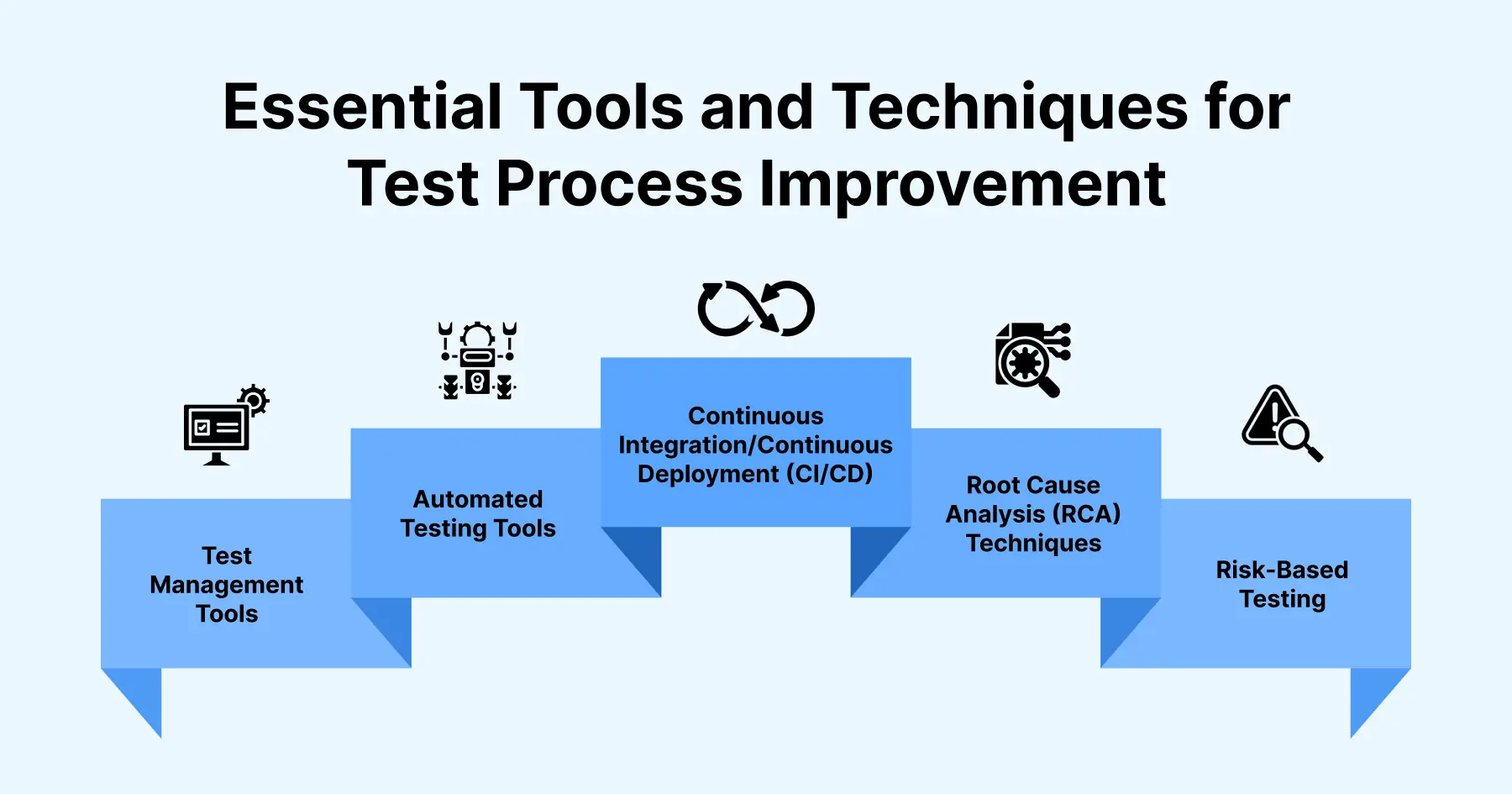
Key tools and techniques for test process improvement are automated testing tools, root cause analysis, risk-based testing, and the 80/20 rule, or Pareto principle.
In the dynamic world of software development, ensuring top-notch software quality is crucial for the success of any product. Test Process Improvement (TPI) is a powerful approach that helps organizations continuously enhance their testing practices, resulting in better software quality and customer satisfaction. To achieve this, various tools and techniques play a pivotal role in streamlining the testing process and identifying areas for improvement. In this blog, we'll explore some essential tools and techniques that can empower your organization to elevate its testing capabilities and deliver exceptional software products.
- Test Management Tools:
To successfully improve the test process, test management must be effective. Teams can effectively plan, carry out, and monitor testing operations using test management solutions like Jira and dedicated ALM (Application Lifecycle Management) platforms. With the help of these technologies, testers and developers may work together more effectively as they have a single location to handle test cases, track defects, and report progress. Teams are better able to decide wisely, spot bottlenecks, and streamline testing efforts using real-time insights and data
- Automated Testing Tools:
The game-changer in test process improvement is automation testing. Teams may automate time-consuming and repetitive test cases using tools like Selenium, Appium, and JUnit, freeing up testers to concentrate on more important scenarios. Automation broadens the scope of tests, quickens the testing process, and improves the accuracy of test results. Additionally, it makes early bug discovery easier, which lowers the expense and work needed to correct flaws.
- Continuous Integration/Continuous Deployment (CI/CD):
Implementing CI/CD pipelines guarantees that software be released more quickly and frequently without sacrificing quality. The processes for building, integrating, and deploying software are automated by tools like Jenkins, GitLab CI/CD, and CircleCI. Organizations may do continuous testing, identify issues early, and establish a smooth and reliable deployment process by integrating automated tests into the CI/CD pipeline.
- Root Cause Analysis (RCA) Techniques:
Effective test process improvement depends on discovering the underlying causes of failures. The 5 Whys, Fishbone Diagrams (Ishikawa Diagrams), and Pareto Analysis are RCA methodologies that aid teams in learning more about the causes of defects and testing difficulties. By addressing the underlying causes, businesses can stop problems from reoccurring and produce software that is more dependable and of high quality.
- Risk-Based Testing:
It is not feasible to test everything thoroughly. The application's essential regions that are most likely to have flaws are where risk-based testing helps concentrate testing efforts. In order to prioritise test cases based on possible impact and likelihood of failure, testers might use tools like Risk Assessment Matrices and Risk-Based Testing Models. This guarantees the best possible use of testing resources and the quick recognition of high-risk problems.
This is where the 80/20 rule (the Pareto Principle) applies to software testing: roughly 80% of defects tend to come from about 20% of the modules. By identifying that high-risk 20% and focusing testing effort there first, teams catch the majority of impactful defects with a fraction of the effort, which is the essence of risk-based prioritization.
To enhance Test Process Improvement (TPI), integrating advanced tools is key. While traditional tools like test management systems, automated testing, CI/CD pipelines, and risk-based testing are crucial, KaneAI, a GenAI native QA Agent-as-a-Service platform, can elevate these efforts further.
KaneAI, offered by TestMu AI, provides precise test generation and comprehensive error analysis, seamlessly integrating with CI/CD pipelines and improving root cause analysis and risk-based testing. By incorporating KaneAI, you can optimize your testing strategy, ensuring more effective and context-aware quality assurance.

What Are the Best Practices for Test Process Improvement?
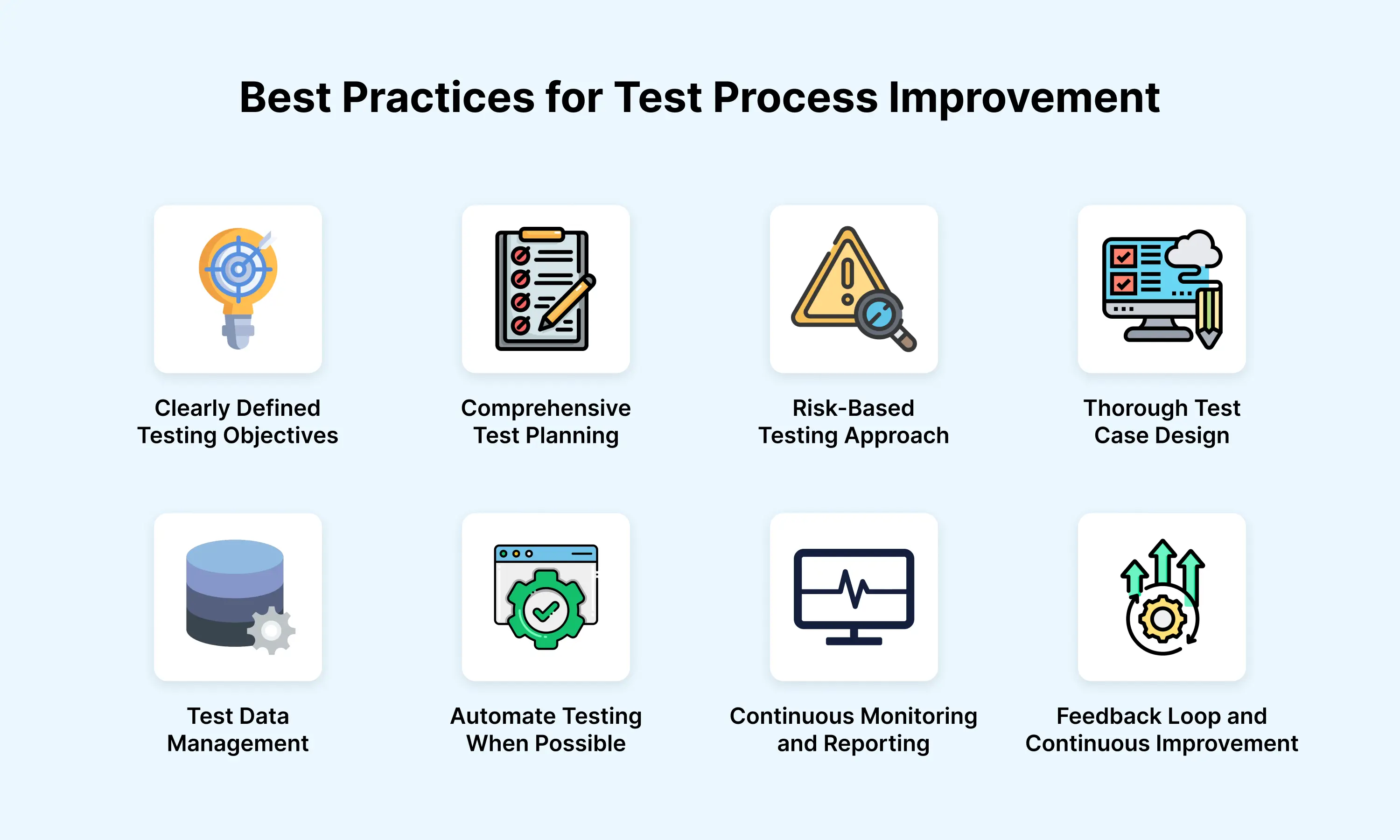
Best practices include clear objectives, thorough planning and test design, a risk-based approach, good test data management, automation where possible, and continuous monitoring.
An essential component of test process improvement (TPI), test process management (TPM) enables businesses to streamline their testing procedures and produce high-quality software. The efficiency and efficacy of testing activities can be greatly increased by implementing best practises in TPM, improving software quality and customer satisfaction. We'll go over a few crucial, simple-to-understand recommended practises in this article that will enable your company to flourish at test process management and software testing.
- Clearly Defined Testing Objectives:
For each project, start by defining clear and detailed testing objectives. The scope, priorities, and test coverage of the software development effort should be based on these objectives, which should also be in line with the project's overall aims. A focused and effective testing process depends on having well defined objectives.
- Comprehensive Test Planning:
Make an extensive test strategy that describes the testing approach, scope, resources, and timeframes. Make sure that all parties are on the same page by incorporating business analysts, testers, and developers in the planning phase. Throughout the project lifetime, a well-organized test plan acts as a roadmap for the testing team and promotes efficient cooperation.
- Risk-Based Testing Approach
Based on a risk analysis, prioritise testing efforts. Testing should be concentrated on the essential components of the programme that are most likely to have flaws. You may optimise resource use and make sure that high-priority functionalities get the attention they need by using a risk-based testing methodology.
- Thorough Test Case Design:
Create thorough, in-depth test cases that cover all possible scenarios, edge cases, and failure spots. Maximising test coverage and increasing the likelihood of finding faults early in the development cycle are both benefits of effective test case design.
- Test Data Management:
Make that the information needed to run test cases successfully is present in your test environment. When test data is managed properly, delays are avoided, and testers may concentrate on testing rather than finding or creating test data.
- Automate Testing When Possible:
Utilise test automation for time-consuming and repeated test cases. Automated testing improves productivity, facilitates quicker test execution, and lowers the possibility of human error. Select the proper test cases for automation, keeping in mind that not all tests can be automated.
- Test Execution Insights
"Test Execution Insights" involve gathering crucial data during software test execution. These insights track progress, identify defects, assess performance, and gauge software quality. They encompass test case statuses, defect details, execution times, coverage analysis, and regression results. Real-time monitoring, data analysis, collaboration, and strategy adjustments based on these insights enhance decision-making and contribute to effective Test Process Improvement (TPI).
- Continuous Monitoring and Reporting:
Keep stakeholders updated through frequent testing activity monitoring and thorough test reporting. Making data-driven decisions for process improvement with effective reporting facilitates trend identification, fault tracking, and trend detection.
- Feedback Loop and Continuous Improvement:
Encourage open discussion and feedback among the testing team members and other stakeholders. Analyse test results, obtain comments and pinpoint areas that need improvement on a regular basis. Adopt a culture of continuous improvement to improve testing procedures and performance as a whole.
How Do You Apply the PDCA Cycle to Test Improvement?
Apply PDCA to test improvement by planning a change with a measurable goal, trying it on a small scope, checking the metrics, and acting to adopt, adjust, or drop it.
The Plan-Do-Check-Act (PDCA) cycle, also known as the Deming Cycle, is the engine of continuous improvement. Mapped onto QA, it turns test process improvement into a repeatable loop rather than a one-off project.
- Plan: define quality metrics, targets, and the test strategy. Decide what "good" looks like (for example, a defect-density threshold or escaped-defect target) before changing anything.
- Do: execute the plan. Run the tests, generate the test data, and carry out the strategy on a small scale first where possible.
- Check: analyze the results. Compare test-execution insights and escaped defects against the metrics you set, and identify where the process fell short. TestMu AI Test Insights helps here by surfacing error trends, flaky tests, and escaped-defect patterns across runs.
- Act: refine and standardize. Update the test suite, adjust automation scripts, and roll the improvement into the standard process, then start the cycle again.
Because each loop feeds the next, PDCA keeps the test process improving continuously instead of stagnating after a single audit.
What Are Real-World Examples of Test Process Improvement?
Real-world test process improvement examples include a trading platform in financial services, an EHR system in healthcare, and retail and e-commerce sites, each tuned to its own risks.
Test process improvement looks different in each domain because the risks differ. A few concrete examples show how the same principles are applied in practice.
- Financial services (trading platform): the priority is latency and security. TPI here focuses on trimming a bloated regression suite down to the highest-risk, revenue-critical paths, adding performance assertions on order-execution latency, and building security and compliance checks into the pipeline so every release is auditable.
- Healthcare (EHR system): the constraint is protected patient data and strict compliance. Improvement often centers on test-data management: using data virtualization and masked, synthetic patient records so teams can test realistic scenarios without exposing real PHI, alongside strong traceability from requirement to test to defect.
- Retail and e-commerce: the challenge is seasonal peak load. TPI concentrates on scaling regression across the full browser and device matrix real shoppers use, and on load testing checkout and payment flows so the site holds up during high-traffic events.
What Are the Challenges of Test Process Improvement?
The main challenges of test process improvement are resistance to automation, integrating new practices with existing processes, and time constraints.
Test Process Improvement (TPI) is a vital initiative for organizations aiming to enhance software quality and optimize testing practices. While TPI promises numerous benefits, it also presents a set of challenges that must be addressed effectively to ensure successful implementation. In this section, we will explore the key challenges that organizations often encounter during Test Process Improvement and discuss strategies to overcome these hurdles for improved testing outcomes.
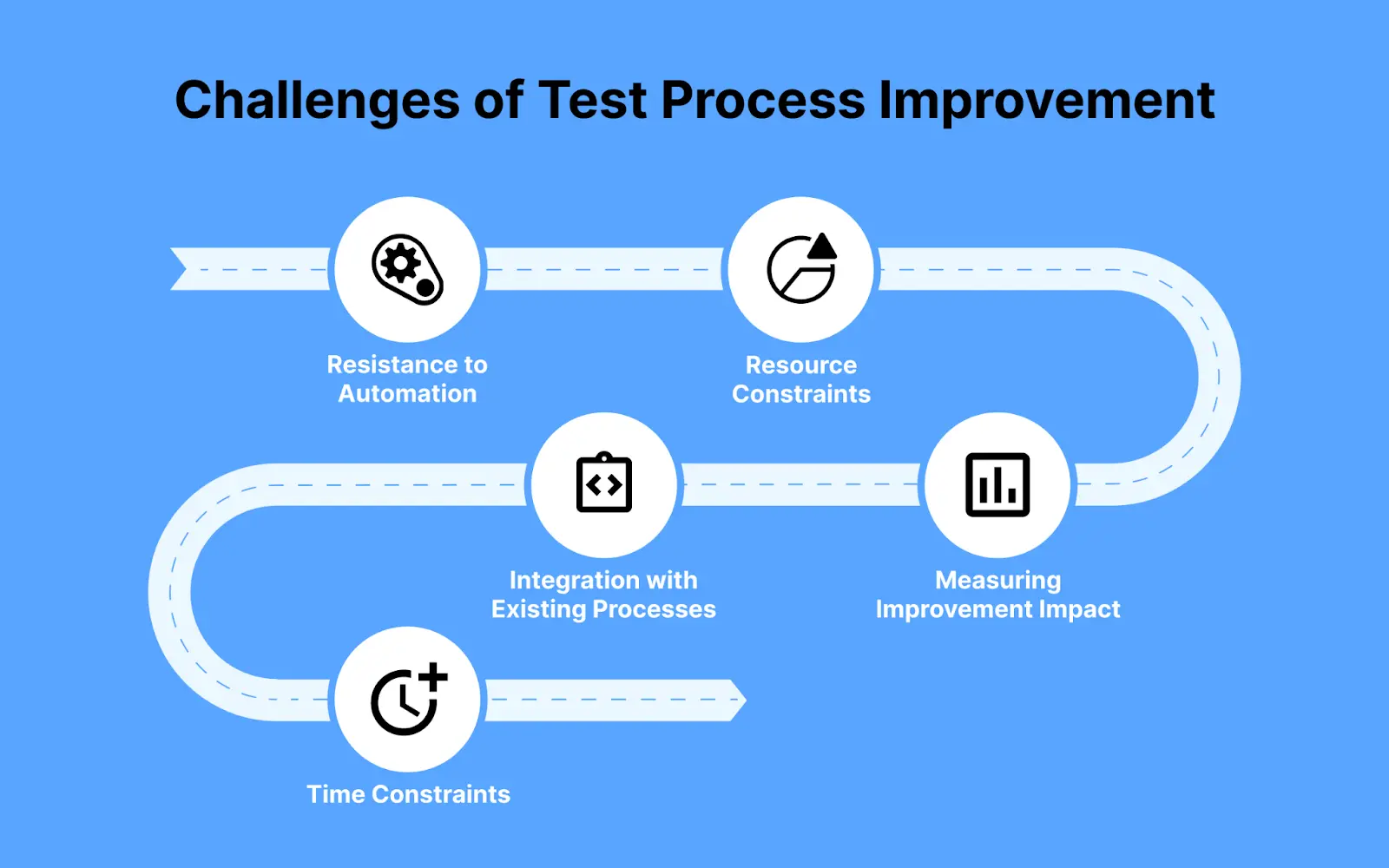
- Resistance to Automation: Embracing automation is crucial for TPI success, but some team members may resist its implementation due to concerns about job security or lack of familiarity with automated tools.
- Integration with Existing Processes: Integrating TPI efforts with pre-existing development and testing processes can be complex, particularly in organizations with well-established workflows.
- Time Constraints: The pressure to deliver projects within tight deadlines may limit the time available for comprehensive TPI efforts, potentially hindering thorough process improvement.
Improvement effort also has to land in the right place to show up in delivery time, since work on a stage that is not the constraint leaves overall throughput unchanged. Our guide to QA bottlenecks covers measuring wait time per stage so the effort goes where the queue actually forms.
What Is the Future of Test Process Improvement?
The future of test process improvement points to AI-driven test automation, shift-left testing inside DevOps, better test data management, and new testing needs from blockchain and IoT.
In today's fast-paced and technology-driven world, software testing plays a pivotal role in ensuring the delivery of high-quality products and exceptional user experiences. As we look to the future, the landscape of test process improvement is evolving rapidly, embracing cutting-edge technologies and innovative methodologies. In this section, let’s explore the exciting developments shaping the future of test process improvement, paving the way for more efficient, accurate, and streamlined testing practices.
AI-Driven Test Automation
Test automation is about to undergo a revolution as a result of artificial intelligence (AI), which will make it smarter and more adaptive than ever. AI-native testing systems can analyse enormous volumes of data, spot trends, and generate test cases on their own. These tools can self-optimize thanks to machine learning algorithms, which lower maintenance requirements and increase test coverage. Testing teams can concentrate on jobs that have a higher economic value as repetitive and time-consuming tests are automated which speeds up the testing process as a whole.
That shift changes the shape of the practice, not just the tooling. In this TestMu Conf 2026 session, Reinventing the QE Practice at Global Scale in Agentic Era, Raghavendra Prasad MG, Khimanand Upreti, Jeba Abraham, Sunie Paul, and Ninad P Shirodkar cover how agentic AI broke the old equation in which more scope meant more testers, and how delivery leaders are rebuilding practices around platforms and IP rather than pyramids.

Shift-Left Testing and DevOps Integration
The future of test process improvement lies in embracing the concept of Shift Left testing, where testing activities start earlier in the software development life cycle. Collaborating closely with development teams, testers can catch defects at the source and provide real-time feedback, fostering a culture of continuous testing and improvement. Integration of testing within the DevOps pipeline further streamlines the process, enabling quicker feedback loops, faster deployment cycles, and enhanced collaboration among cross-functional teams.
Test Data Management Innovation
The future of testing includes advanced test data management solutions that cater to the complexities of modern applications. With the increasing need for realistic and diverse test data, data virtualization and synthetic data generation techniques will become more prevalent. These technologies offer secure and compliant data provisioning, reducing data-related bottlenecks and ensuring faster test execution.
Blockchain in Testing
Blockchain technology is not limited to cryptocurrencies; it also holds great potential for enhancing the integrity and security of software testing processes. With its immutable and decentralized nature, blockchain testing can verify test results, maintain a transparent test history, and prevent unauthorized modifications. This will lead to increased confidence in test outcomes and more reliable auditing capabilities.
IoT and Performance Testing
As the Internet of Things (IoT) spreads, it is essential to guarantee the best functioning of linked devices. Performance testing will focus on scalability, responsiveness, and load handling across multiple connected devices in order to address the problems faced by IoT ecosystems. By simulating real-world circumstances, advanced test frameworks can help organisations find performance bottlenecks and provide flawless IoT experiences.

How Is AI Changing Test Process Improvement?
AI is changing test process improvement by mining test history, defect data, and CI logs to find the bottlenecks worth fixing first, like flaky tests and escaped defects.
This turns maturity assessments from periodic workshops into continuous measurement, because the same data shows whether each change, such as a new review step or more automation, actually moved the metrics.
Data-driven suggestions still need context from the team, since a metric can improve for the wrong reason, for example when failing tests are deleted instead of fixed. Our guide to AI in test automation covers where AI fits in the testing workflow.
Where Should You Start With Test Process Improvement?
Start by measuring where your test process stands today, pick the one bottleneck that costs the most, fix it with a small PDCA cycle, and repeat.
Test Process Improvement (TPI) is a crucial strategy for achieving testing excellence in software development. By placing a strong emphasis on continuous improvement, TPI empowers teams to identify and address flaws in their testing procedures effectively.
Through Test Process Improvement, organizations can streamline testing efforts, reduce project risks, and shorten time-to-market for their software products. As the demand for higher software quality and efficiency continues to rise, adopting the Test Improvement Process becomes essential for organizations striving to deliver exceptional products and stay competitive in the market. By leveraging the objectives of TPI and continually refining their testing practices, businesses can pave the way for a successful and impactful software development journey. Thus, to stay ahead in a landscape that is quickly changing, adopting the Test Improvement Process becomes essential.
Author

Vishal kumar Sahu
Blogs: 8


Vishal Kumar Sahu is a Marketing Executive with over two years of experience in the software testing and QA domain. He holds a TestMu AI Certification in Automation Testing and has hands-on expertise in Selenium, Cypress, and Appium, with a focus on both web and mobile automation. Vishal has authored several technical blogs and specializes in writing about testing tools, best practices, and automation strategies. He blends technical knowledge with content strategy to support product education and engage the QA community through SEO-driven resources.
Reviewer

Sandeep Yadav
Reviewer
Sandeep Yadav is a Senior Software Engineer at TestMu AI (formerly LambdaTest), where he builds the platform's test intelligence and AI-native engineering systems. He has architected autonomous GitHub Apps, vector-search code intelligence, and self-diagnosing QA workflows, and designed distributed platforms that process 2M+ daily test executions and 1B+ events, turning high-volume test, log, and code data into intelligent, self-optimizing systems. He works on embedding reasoning models into production infrastructure to power autonomous review, root-cause analysis, and analytics workflows. He brings over four years of engineering experience with deep expertise in the Elastic Stack, Apache Kafka, and Redis. Earlier he engineered a GDPR-compliant, end-to-end-encrypted secure web-chat application at Mithi. A Facebook Hackercup 2021 Round 2 qualifier and merit-scholarship recipient, Sandeep holds a B.Tech in Electrical Engineering from Delhi Technological University.


Test Process Improvement FAQs
Did you find this page helpful?
More Related Learning Hubs
TestMu AI forEnterprise
Get access to solutions built on Enterprise
grade security, privacy, & compliance
- Advanced access controls
- Advanced data retention rules
- Advanced Local Testing
- Premium Support options
- Early access to beta features
- Private Slack Channel
- Unlimited Manual Accessibility DevTools Tests