

Power Your Software Testing with AI Agents and Cloud
The Native AI-Agentic Cloud Platform to Supercharge Quality Engineering. Test Intelligently and Ship Faster.


- TestMu AI (Formerly LambdaTest)
- /
- Learning Hub
- /
- What is Software Delivery: Tools, Key Metrics and Best Practices
What is Software Delivery: Tools, Key Metrics and Best Practices
Learn what Software Delivery is, the key metrics to track, essential tools, and the best practices for faster, reliable, and high-quality software releases.
Last Updated on:
On This Page
- What Is Software Delivery?
- What are the Core Components of the Software Delivery Lifecycle?
- Software QA vs. Quality Control (QC) vs. Testing
- Software Delivery vs. Software Deployment
- Modern Methodologies in Software Delivery
- Software Delivery Models: SaaS, On-Premise, and Hybrid
- Tools and Technologies Enabling Modern Software Delivery
- Metrics for Measuring Software Delivery Performance
- Challenges in Software Delivery and How to Overcome Them
- The Future of Software Delivery
- Best Practices for Efficient Software Delivery
- Conclusion
Software delivery is the structured process through which software moves from development to end users, balancing speed, reliability, and business impact.
It covers the complete journey of a software artifact, from the initial commit in a repository to production deployment and ongoing improvements.
TL;DR
- Software delivery covers everything between a committed change and a release that users can reach.
- Delivery and deployment are not the same: deployment moves code to an environment, delivery makes it usable.
- SaaS, on-premise and hybrid delivery models change who runs the infrastructure and how often you can release.
- DORA metrics such as deployment frequency and change failure rate are how delivery performance is measured.
- Quality assurance builds the process, quality control inspects the output, and testing executes the checks.
- Validating a release across real browsers and devices is what keeps delivery speed from costing quality.
What Is Software Delivery?
Software delivery is the end-to-end process of developing, testing, deploying, and maintaining software, turning business requirements into working products with continuous support after release.
What are the Core Components of the Software Delivery Lifecycle?
The Software Development Lifecycle (SDLC) covers planning, development, testing, deployment, and maintenance, the stages that ensure software is built, verified, released, and supported efficiently.
The Software Development Lifecycle (SDLC) breaks into several essential stages. Here is what each phase involves:
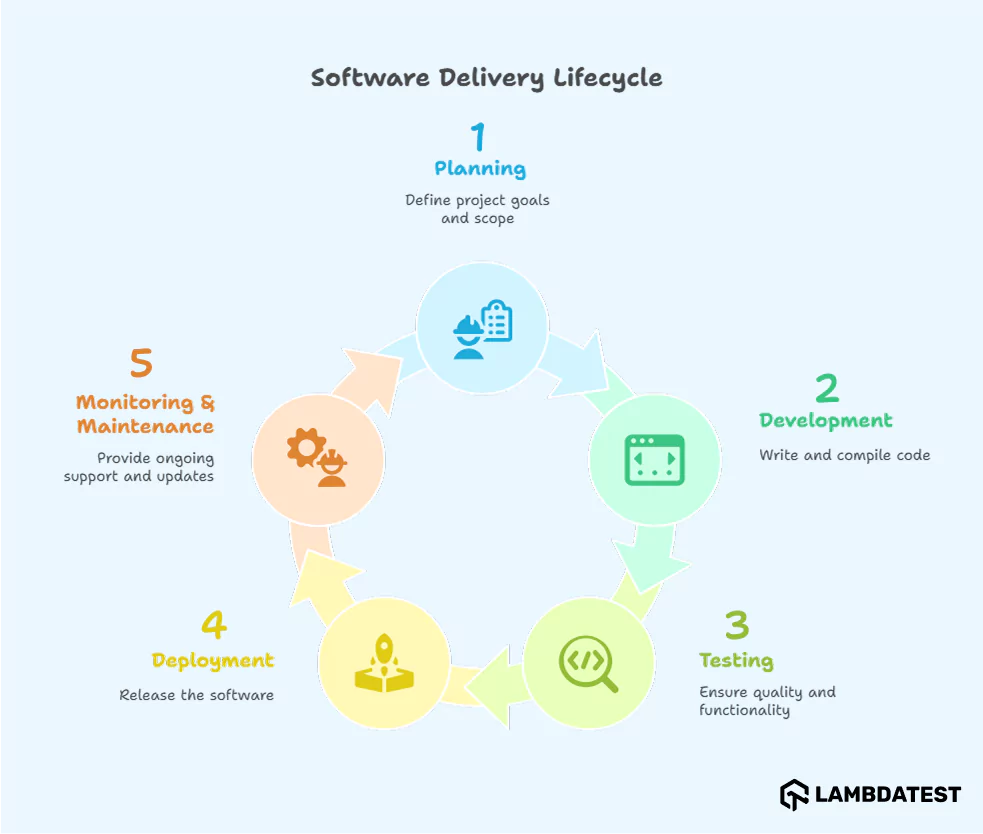
1. Planning: Defining Project Goals, Scope, and Timelines
Planning sets the foundation for the project. This phase involves defining the project’s goals, scope, resources, and timelines. Clear planning ensures alignment with business objectives and sets realistic expectations for the team.
2. Development: Writing and Compiling Code
Developers write and compile the code, transforming business requirements into working software. Version control systems manage code changes, and unit tests confirm correctness.
3. Testing: Ensuring Quality and Functionality
Testing confirms the software meets required standards. Unit, integration, system, and user acceptance testing (UAT) surface bugs, and automated tests speed up the process.
4. Deployment: Releasing the Software
Deployment releases the software to production through a full or staged rollout. Automation tools keep the process consistent and error-free, while monitoring tools track performance afterward.
5. Monitoring & Maintenance: Ongoing Support and Updates
Post-deployment, continuous monitoring ensures the software operates smoothly. Maintenance involves fixing bugs, updating features, and addressing user feedback. This phase ensures the software remains secure, scalable, and relevant over time.
While software delivery groups related activities into these five practical phases, the broader SDLC is commonly described as seven standard steps. Understanding all seven helps teams map delivery work end to end:
- Planning: Define goals, scope, resources, and timelines.
- Feasibility and Analysis: Assess technical viability, gather requirements, and confirm the project is worth building.
- Design: Translate requirements into architecture, data models, and interface specifications.
- Development: Write and compile the code that implements the design.
- Testing: Verify quality and functionality across unit, integration, system, and acceptance testing.
- Deployment: Release the software to production through a full or staged rollout.
- Maintenance: Provide ongoing support, fixes, and updates after release.
Each stage is crucial for delivering reliable and efficient software products.
Software QA vs. Quality Control (QC) vs. Testing
Teams often use quality assurance, quality control, and testing interchangeably, yet each describes a distinct activity in the delivery pipeline.
Software Quality Assurance (SQA) is a proactive, process-oriented discipline focused on preventing defects before they occur. It defines the standards, workflows, and quality attributes a product must meet.
SQA often references frameworks like ISO 25010 for characteristics such as reliability, maintainability, and usability. Quality Control (QC) is product-oriented and reactive, verifying that finished software conforms to those requirements.
Testing is the concrete execution of code, running the application against inputs to find bugs and confirm expected behavior.
In practice, SQA shapes how you build, QC checks what you built, and testing is the hands-on activity that surfaces the defects QC then evaluates.
Software Delivery vs. Software Deployment
Delivery and deployment are frequently conflated, yet they answer different questions.
Deployment is the technical act of moving a build into an environment, pushing a versioned artifact to staging or production so it physically runs on servers.
Delivery is the business decision to release that functionality to users, determining when and to whom new capabilities become available. Code can be deployed to production without being delivered to customers.
Feature flags decouple the two. Teams deploy code behind a flag, then flip it on for specific segments when ready, which reduces release risk and supports progressive rollouts.
Separating deployment from delivery lets engineering ship continuously while the business controls exposure independently.

Note: Shipping behind feature flags still needs solid cross-browser coverage before you flip the switch. Validate each release across 3,000+ browser and OS combinations and 10,000+ real devices with TestMu AI. Start testing free.
Modern Methodologies in Software Delivery
Modern software delivery uses adaptive methodologies to improve speed, collaboration, and reliability. Approaches like Agile, DevOps, and CI/CD help teams deliver continuous value while responding quickly to change.
These methodologies enhance every stage of the software development process, ensuring efficient planning, coding, testing, and deployment.
Agile Development
Agile development methodologies, such as Scrum and Kanban, emphasize iterative development, collaboration, and flexibility. Teams work in short cycles (sprints), delivering incremental improvements and adapting to changing requirements.
DevOps
DevOps is a cultural and technical movement that unifies software development and IT operations. It aims to shorten the development lifecycle, increase deployment frequency, and deliver high-quality software through automation and continuous monitoring.
Continuous Integration and Continuous Deployment (CI/CD)
CI/CD automates integration and deployment. Continuous Integration tests and integrates code changes into the main codebase, while Continuous Deployment pushes those changes to production for rapid delivery and feedback.
There are also various types of SDLC models available, allowing you to choose the one that best aligns with your project’s requirements and goals.
Software Delivery Models: SaaS, On-Premise, and Hybrid
How software reaches users depends heavily on its delivery model, which shapes everything from release cadence to who owns upgrades.
In a SaaS model, the vendor hosts the application in the cloud and pushes continuous updates automatically, so customers always run the latest version without managing infrastructure. That release cadence is why SaaS products are validated with dedicated SaaS testing tools rather than a pre-release test cycle.
On-premise delivery ships packaged software through licensing agreements and installers that customers deploy on their own hardware, giving full control but adding maintenance overhead and slower updates.
Hybrid delivery blends the two, keeping sensitive workloads on-premise while running other components in the cloud to balance control, compliance, and managed updates.
Choosing the right model depends on security requirements, customer expectations, and how quickly the team needs to iterate.
Regardless of the model, embedding automated quality checks keeps releases reliable. A scalable automation cloud from TestMu AI runs cross-browser tests continuously in the delivery flow.
Tools and Technologies Enabling Modern Software Delivery
Modern software delivery relies on tools that streamline processes and ensure reliable releases. They support automation, collaboration, monitoring, and scalability, helping teams deliver value faster and stay consistent across environments.
1. Version Control: Git, SVN
Version control systems are the backbone of modern software development. They track every code change, manage revisions, and enable collaboration among distributed teams.
- Git: A distributed version control system letting multiple developers work in parallel, manage branching and merging, and keep a full change history.
- SVN: A centralized version control system storing revisions in a single repository, common in legacy systems and structured enterprise workflows.
Version control ensures that teams can collaborate efficiently, maintain code integrity, and roll back changes when necessary, forming the foundation for CI/CD and modern workflows.
2. CI/CD Platforms: Jenkins, GitLab CI, CircleCI
Continuous Integration (CI) and Continuous Delivery/Deployment (CD) platforms automate code integration, testing, and release pipelines. They accelerate software delivery while reducing human error.
- Jenkins: An open-source automation server for defining pipelines, running automated tests, and deploying applications reliably through a large plugin ecosystem.
- GitLab CI: Built into GitLab, it automates integration, testing, and deployment workflows, streamlining end-to-end software delivery.
- CircleCI: A cloud-based CI/CD platform that automates building, testing, and deploying applications, enabling fast, repeatable, and consistent software releases.
CI/CD platforms enhance collaboration between developers and operations teams, shorten release cycles, and ensure that high-quality software reaches production consistently.
3. Containerization: Docker, Kubernetes
Containerization allows developers to package applications with all dependencies, ensuring consistent environments across development, testing, and production.
- Docker: Packages applications into lightweight containers, providing portability and eliminating “it works on my machine” issues.
- Kubernetes: Orchestrates containerized applications at scale, automating deployment, scaling, and management while improving resilience and resource utilization.
By using containers, teams achieve faster deployments, predictable environments, and improved scalability, making it easier to adopt microservices and cloud-native architectures.
4. Configuration Management: Ansible, Chef, Puppet
Configuration management tools automate infrastructure provisioning, enforce consistency, and reduce manual administrative tasks.
- Ansible: Agentless automation using YAML playbooks to configure systems, deploy applications, and orchestrate workflows.
- Chef: Uses Ruby-based scripts to automate infrastructure setup and enforce system state across multiple servers.
- Puppet: Provides automated configuration and system administration, helping maintain consistent environments and reduce human errors.
These tools allow teams to treat infrastructure as code, maintain reproducible environments, and scale software delivery efficiently without manual intervention.
5. Monitoring: Prometheus, Grafana, New Relic
Monitoring tools provide visibility into system health, application performance, and user experience, enabling teams to proactively detect and resolve issues.
- Prometheus: Collects and stores metrics with powerful querying capabilities, triggering alerts when issues occur.
- Grafana: Visualizes metrics and logs from various sources, providing dashboards for analysis and insights.
- New Relic: An Application Performance Management (APM) tool giving real-time insight into performance, bottlenecks, and user experience.
Monitoring ensures reliability, supports quick incident response, and provides data-driven insights to optimize software delivery and operational efficiency.
6. Emerging Technologies
Modern software delivery is increasingly influenced by advanced technologies that further optimize workflows and accelerate delivery:
- AI and Machine Learning: Automate testing, deployment, and monitoring while enabling smarter, predictive, and data-driven decisions. Agentic tools such as KaneAI author end-to-end tests from natural language, so coverage can keep pace with release frequency.
- Serverless Architectures: Reduce infrastructure management and scale automatically, lowering costs and speeding up deployments.
- Edge Computing: Processes data closer to users, reducing latency and improving performance, especially for IoT and mobile apps.
- Infrastructure as Code (IaC): Automates provisioning and management of infrastructure, ensuring consistency and reducing deployment errors.
- Blockchain: Enhances security and traceability by maintaining immutable records of software changes.
Used together, these tools help organizations adopt modern practices like DevOps, Agile, and CI/CD effectively, ensuring faster, reliable, and secure software delivery.

Metrics for Measuring Software Delivery Performance
Measuring software delivery performance highlights where to improve and keeps releases fast and reliable. The DORA metrics are key indicators of delivery effectiveness. Here is a breakdown of the essential ones:
- Deployment Frequency: How often code changes reach production. It reflects a team's agility and responsiveness to customer needs.
Why It Matters: More frequent deployments enable faster feedback, quicker bug fixes, and quicker time-to-market. A high deployment frequency shows an efficient release process.
- Lead Time for Changes: How long a code change takes from development to production. Shorter times indicate efficient workflows and faster delivery.
Why It Matters: Shorter lead times mean faster feature delivery and quicker responses to user needs, improving overall productivity.
- Change Failure Rate: The proportion of code changes that cause production failures. A lower rate signals higher stability and effective testing.
Why It Matters: A lower failure rate indicates higher code quality and more stable releases. High failure rates can lead to customer dissatisfaction and higher maintenance costs.
- Mean Time to Recovery (MTTR): The average time to recover from a production incident. Lower MTTR means faster resolution and less disruption.
Why It Matters: Lower MTTR ensures faster incident resolution and minimal downtime, maintaining service availability and user satisfaction.
Note: Metrics like change failure rate improve when tests run consistently across environments. Run your automated suite across 3,000+ browser and OS combinations and 10,000+ real devices with TestMu AI. Start testing free.
Challenges in Software Delivery and How to Overcome Them
Software delivery can be challenging, particularly when integrating new methodologies, tools, and technologies into existing processes. Below, we explore these challenges in detail and offer strategies to overcome them.
Legacy Systems: Integrating New Practices with Existing Infrastructure
Legacy infrastructure is often the biggest barrier to digital transformation. These older systems are deeply embedded in business processes, making modernization complex and risky.
- Challenge: Legacy systems often lack compatibility with modern delivery practices, slowing the adoption of CI/CD, automation, and cloud-native approaches.
- Solution: Adopt a phased migration to modernize systems without disrupting operations. Use containerization tools like Docker and start with pilot projects.
For teams wrestling with legacy systems, TestMu AI offers a cloud-based testing platform that integrates with CI/CD pipelines.
It runs cross-browser and cross-platform tests without heavy infrastructure changes, reducing dependency on outdated systems and speeding the shift to agile delivery.
Cultural Resistance: Shifting to New Methodologies
Beyond tools and processes, the mindset of teams plays a crucial role in successful transformation. Resistance to change can quickly stall even the best-planned initiatives.
- Challenge: Teams may resist Agile, DevOps, or CI/CD practices out of fear of change or comfort with traditional workflows, slowing transformation.
- Solution: Communicate benefits clearly, gain leadership support, involve teams early, and celebrate quick wins to build adoption momentum.
Skill Gaps: Adopting Modern Tools and Practices
Adopting new practices requires more than intention, it demands the right skills. Without adequate expertise, organizations struggle to realize the full potential of modern delivery methods.
- Challenge: Teams often lack the expertise to implement modern tools, automation, and methodologies, leading to errors and slower delivery.
- Solution: Offer structured training, certification, and mentorship. Encourage knowledge sharing and bring in external experts to accelerate learning.
Managing Complexity Across Teams and Tools
As organizations scale, multiple teams and tools can create fragmented workflows. Without alignment, efficiency drops and visibility across the delivery pipeline becomes a challenge.
- Challenge: Different teams using diverse tools create inefficiencies, fragmented workflows, and poor visibility, making coordination and delivery more complex.
- Solution: Integrate tools into a unified workflow, foster cross-team communication, and add centralized dashboards for real-time monitoring and decisions.
Managing the Pace of Change
Technology now shifts faster than many teams can comfortably adapt. Balancing innovation with stability is critical to sustaining long-term success.
- Challenge: Rapid technological change can overwhelm teams, leading to burnout, errors, and difficulty keeping up with evolving tools and practices.
- Solution: Adopt Agile practices for flexibility, dedicate time for continuous learning, and introduce small, incremental changes without disrupting productivity.

The Future of Software Delivery
The future of software delivery is shaped by emerging trends that streamline processes, enhance performance, and improve scalability. Here’s a quick look at the key trends:
1. Artificial Intelligence and Machine Learning
AI and ML will increasingly automate repetitive tasks, predict potential issues before they occur, and support smarter decision-making, accelerating software delivery and improving overall efficiency and reliability.
Impact: AI-driven automation improves testing, deployment, and monitoring. Adopting AI testing approaches enables faster delivery cycles and more data-driven decisions, improving software quality and operational performance.
2. Serverless Architectures
Serverless computing removes the need to manage infrastructure manually by automatically scaling resources based on demand, allowing teams to focus on development rather than maintenance.
Impact: Reduces operational costs, enhances scalability, and accelerates deployments by removing manual infrastructure management, providing developers with more flexibility and faster time-to-market for applications.
3. Edge Computing
Edge computing processes data closer to the end user rather than relying solely on centralized servers, reducing latency and improving overall application responsiveness and performance.
Impact: Supports real-time data processing, faster responses, and decreased bandwidth usage, making it ideal for IoT, mobile applications, and other latency-sensitive software solutions.
4. Continuous Integration and Continuous Delivery (CI/CD) Evolution
CI/CD practices are evolving with AI and advanced automation, enabling more intelligent testing, integration, and deployment pipelines, resulting in faster, more reliable software releases.
Impact: Facilitates continuous delivery with fewer errors, enables efficient rollbacks, and ensures that high-quality software is deployed consistently with improved operational efficiency.
5. Blockchain for Software Integrity and Security
Blockchain provides immutable, tamper-proof records of software changes, enhancing security, traceability, and transparency across the software delivery process.
Impact: Strengthens application security, prevents unauthorized modifications, ensures reliable audit trails, and enables automation through smart contracts to reduce human error in workflows.
6. Automation of Operations with Infrastructure as Code (IaC)
Infrastructure as Code (IaC) automates the provisioning and management of infrastructure, ensuring consistent environments and reducing manual intervention in the software delivery pipeline.
Impact: Speeds up infrastructure setup, maintains consistency across environments, reduces errors, and enables agile, repeatable deployment processes for faster and more reliable software delivery.
Best Practices for Efficient Software Delivery
To optimize software delivery, consider implementing the following best practices. These approaches help teams accelerate releases, improve quality, and ensure software consistently meets evolving business and customer needs.
- Automation: Automate repetitive tasks like building, testing, and deployment to reduce human errors, improve efficiency, and accelerate software delivery.
- Collaboration: Encourage clear communication between development, operations, and business teams to align objectives, share feedback, and improve delivery outcomes.
- Continuous Testing: Embed automated testing throughout the development lifecycle to detect issues early, reduce risks, and ensure software reliability.
- Version Control: Use version control systems to manage code changes, enable collaboration, maintain history, and ensure consistent, trackable development.
- Monitoring: Establish proactive monitoring practices to track system health, identify issues quickly, minimize downtime, and maintain application reliability.
Conclusion
Effective software delivery is critical for teams aiming to ship high-quality products swiftly and reliably. Understanding the delivery lifecycle, adopting modern methodologies, applying best practices, and measuring performance together strengthen how an organization delivers software.
Next, deepen your foundation with the continuous testing guide to see how automated quality checks embed into every stage of the pipeline.
Author

Kavita Joshi
Blogs: 14


Kavita Joshi is a Senior Marketing Specialist at TestMu AI, with over 6 years of experience in B2B SaaS marketing and content strategy. She specializes in creating in-depth, accessible content around test automation, covering tools and frameworks like Selenium, Cypress, Playwright, Nightwatch, WebdriverIO, and programming languages with Java and JavaScript. She has completed her masters in Journalism and Mass Communication. Kavita’s work also explores key topics like CSS, web automation, and cross-browser testing. Her deep domain knowledge and storytelling skills have earned her a place on TestMu AI’s Wall of Fame, recognizing her contributions to both marketing and the QA community.
Reviewer

Anmol Gupta
Reviewer
Anmol Gupta is Vice President of Product Management at TestMu AI (formerly LambdaTest), driving HyperExecute, the test orchestration cloud that runs and accelerates automated test execution. He led the development of the Unified Test Execution Cloud Platform and now leads a 30-member cross-functional product organization across product lines contributing $7M+ in revenue. He brings over nine years of experience and previously co-founded the SaaS company Timble as CTO, where he grew the team from 5 to 40 and launched an AI KYC platform that processed 600K+ applications in five months while cutting verification time from 12 minutes to under 30 seconds. Anmol holds an MTech and BTech from IIT Delhi.


Software Delivery FAQs
Did you find this page helpful?
More Related Learning Hubs
TestMu AI forEnterprise
Get access to solutions built on Enterprise
grade security, privacy, & compliance
- Advanced access controls
- Advanced data retention rules
- Advanced Local Testing
- Premium Support options
- Early access to beta features
- Private Slack Channel
- Unlimited Manual Accessibility DevTools Tests