

Power Your Software Testing with AI Agents and Cloud
The Native AI-Agentic Cloud Platform to Supercharge Quality Engineering. Test Intelligently and Ship Faster.


- TestMu AI (Formerly LambdaTest)
- /
- Learning Hub
- /
- OTT Testing Tutorial: Challenges and Best Practices
OTT Testing Tutorial: Challenges and Best Practices
This guide explores OTT testing, its types, the checklist, the types of apps involved in OTT testing, and how to test OTT applications.
Last Updated on:
On This Page
- Rise of OTT Platforms
- What is OTT Testing?
- OTT vs. CTV: Key Differences
- Why is OTT Testing Important?
- Benefits of OTT Testing
- Apps involved in OTT Testing
- Critical OTT Testing Metrics: QoS vs. QoE
- Types of OTT Testing
- Post-Release Testing for OTT Applications
- OTT Testing Checklist
- How to perform OTT Testing?
- Challenges in OTT Testing
- AI in OTT Testing: Use Cases and Challenges
- OTT Testing and Regulation in India
- Best Practices for OTT Testing
- Top OTT Testing Interview Questions and Answers
OVERVIEW
OTT testing involves evaluating a platform's capabilities to stream video and audio content over the Internet, including its interface, functionality, performance, and security. It is a crucial process that ensures that the streaming content is of the highest quality, free from glitches, and optimized for different devices and operating systems.
Streaming services have dominated the entertainment industry in the current digital era. As over-the-top (OTT) streaming services have transformed how people watch video content, the realm of OTT has evolved.
The rise of streaming services like Netflix, Amazon Prime, Hulu, and Disney+ has enabled people to access their favorite TV programs, movies, and other video content from anywhere, at any time. This sector of the entertainment industry is now one of the fastest-growing ones. As more viewers switch to OTT services, businesses must ensure their customers have a seamless digital experience.
Rise of OTT Platforms
In recent decades, the digitalization of technology has led to unprecedented growth in the entertainment and media industry. People no longer rely solely on traditional television sets for entertainment. A new binge-watching trend has emerged, with OTT platforms becoming the preferred choice for many. Many key factors contribute to this shift, including the affordability of Internet packs, the widespread use of smartphones, laptops, and tablets, etc.
The COVID-19 pandemic has further accelerated this trend. The pandemic forced us to remain indoors and seek out new forms of entertainment. As a result, previously struggling OTT platforms such as Disney+Hotstar, Netflix, and Amazon Prime have become household names.
The OTT platform has been appealing to individuals of all ages since these platforms have something to offer. Rather than visiting movie theaters as a social activity, people are now more inclined to OTT platforms.
OTT platforms are accessible through various devices, from Smart TVs to mobile phones. So, it's imperative to ensure excellent streaming and app performance is imperative regardless of the device, location, or network. This is where OTT testing comes in.
What is OTT Testing?
OTT testing is a process that ensures the streaming content is of high quality and optimized for different devices. It is an essential part of the OTT development cycle that involves testing the platform's functionality, performance, and user experience. It involves testing different parameters such as video quality, audio quality, buffering, streaming speed, and device compatibility.
OTT application testing is a complex process that involves evaluating the platform on multiple devices and networks. It requires a combination of manual and automation testing to ensure the content is of the highest quality. OTT testing is a process that takes time, and it needs to be done regularly to ensure that the platform is always up-to-date with the latest technology and trends.
OTT vs. CTV: Key Differences
OTT and CTV are often used interchangeably, but they describe different things. OTT (Over-the-Top) is the internet-based method of delivering video and audio content directly to viewers, bypassing traditional cable and satellite channels. CTV (Connected TV) is the physical device used to watch that content, such as Smart TVs, Roku, Amazon Fire TV, and Apple TV.
This distinction changes how you test. OTT testing focuses on the streaming pipeline, playback quality, adaptive bitrate, and cross-network behavior. CTV testing adds device-specific concerns such as SDK integrations for each TV platform and remote-control navigation testing, where every action is driven by a directional pad rather than touch or a mouse. Validating focus states, back-button flows, and voice search on real CTV devices is essential to catch issues that never surface on mobile or desktop.
Why is OTT Testing Important?
According to AlliedMarket Research, the global OTT market will grow at a CAGR of 29.4% over the next decade, reaching $1,039.03 billion by 2027.
OTT testing is essential for the success of an OTT platform. The quality of the content is critical in determining the success of an OTT platform. If the content is of low quality, viewers will quickly lose interest and move on to other platforms. OTT testing ensures that the content is of the highest quality and optimized for different devices. It also ensures the platform is user-friendly and provides an excellent user experience.
While the number of streaming platforms continues to grow, it can be more complex and challenging for users to maintain several subscriptions at once due to financial reasons and the lack of time to consume all the available content. This is why the quality of the service is now just as important as the amount and quality of the content on offer. Therefore, OTT testing becomes one of the most effective ways to maintain the quality of the application at the required level and ensure the product can successfully compete with other streaming services.
OTT testing is also essential for detecting and fixing bugs and glitches affecting the platform's performance. Bugs and glitches can cause the platform to crash, leading to a loss of viewers and revenue. OTT testing helps to detect and fix these issues before they can affect the viewers' experience.
Benefits of OTT Testing
With the rise of OTT, end-user expectations are also growing high. Therefore, the OTT experience should be as seamless as possible, and OTT testing can ensure this.
Below are the benefits of OTT testing:
- Improving customer satisfaction: By identifying and fixing issues before they affect customers, OTT testing can help to improve customer satisfaction.
- Detecting and resolving issues: Testing helps to detect and resolve issues related to buffering, lag, video quality, and other technical issues that can potentially impact the user experience.
- Minimizing downtime: Testing OTT apps can help reduce downtime before the bottlenecks are identified well in hand and ensure that the video streaming service is available to users when needed.
- Cross-platform experience quality: OTT testing ensures that the video streaming service works optimally across various devices and platforms, providing a high-quality experience to users.
- Increasing revenue: By delivering a high-quality user experience, OTT testing can help to increase revenue by attracting and retaining customers.
- Evolving with the technology change: As technology evolves, OTT testing can help streaming providers stay up-to-date and ensure that their services work seamlessly across different devices and platforms.
Industries that provide media streaming services must have a robust test strategy to ensure optimum user experience. This can be a demanding request for testers. Testing manually without sufficient testing tools could be overwhelming.
Test automation is the most cost-effective approach to tackle testing for your OTT platform. With the right OTT testing strategy, your team can enjoy these automation testing benefits across development cycles.
Apps involved in OTT Testing
To ensure that the OTT platforms deliver the highest quality content, free from glitches and optimized for different devices, it is important to cover the types of applications on OTT platforms.
Below is the list of applications that must be covered in OTT testing.
- Audio applications: Users can stream audio files using smartphones, desktop computers, Smart TVs, or vehicle stereo systems. The audio recordings could include podcasts, radio programs, music, etc.
The quantity and quality of the available content, the absence of playback issues, the regular addition of new releases, the application's compatibility with various platforms, sharing options, and other elements all play a role in how successful audio streaming applications are. Some examples are Spotify, Deezer, YouTube Music, TuneIn, and Pandora.
- Video applications: The most well-known streaming app category is undoubtedly OTT video. Users can stream movies, TV shows, concerts, sporting events, live video feeds, and other kinds of video material from any location using a video OTT solution.
Users seek high-quality, frequently updated content, a user-friendly interface, stable performance, and consistent operation across various platforms in the age of countless video streaming platforms. Some examples are Netflix, Hulu, Apple TV, HBO Max, and Amazon Prime.
- VoIP applications: VoIP OTT apps let users communicate via text chats, audio or video calls, or both. An effective OTT VoIP application will have a user-friendly interface, consistent functionality even with a poor connection, and strong security via data encryption techniques. Well-known VoIP apps are WhatsApp, Skype, Viber, Facebook Messenger, and Google Duo.
Critical OTT Testing Metrics: QoS vs. QoE
Measuring OTT quality requires two complementary lenses: Quality of Service (QoS) and Quality of Experience (QoE). QoS captures the health of the network delivering the stream, focusing on infrastructure-level indicators such as network latency, packet loss, and jitter. Strong QoS numbers are necessary but not sufficient, because a technically healthy network can still deliver a frustrating experience.
QoE measures what the viewer actually perceives. Key QoE metrics include the buffering ratio (the share of session time spent rebuffering), video start time (how long the stream takes to begin after a play action), and the delivered bitrate. To quantify perceptual video quality, teams rely on standardized metrics such as VMAF and SSIM, which compare the encoded output against a reference to score how close it looks to the original. Tracking both QoS and QoE together lets QA teams pinpoint whether a poor experience stems from the network, the encoding pipeline, or the player itself.
Types of OTT Testing
OTT testing aims to offer a smooth user experience free of bugs, stalls, and delays. Take into account incorporating these types of tests into your test strategy to provide your customers with the best media streaming experience possible.
Functional Testing
The user interface of a software application is the first thing users see when they decide to give it a try, and if they decide to stay with the platform, it's something they'll interact with every day.
From UI design to application navigation, it’s up to your OTT application to verify that your application can provide a similar user experience across devices. Your QA team should test for layout consistency, intuitive navigation throughout the platform, and dashboard functionality. A smooth payment procedure is also crucial to offer the best user experience. When making a payment, a user shouldn't feel burdened or scared.
Some test cases that are applicable to functional testing are as follows:
- Playback
When you click the icon for the movie to play, see if the video starts or stops. Make sure the level and mute buttons are operational as well. Check the audio-video synchronization as well.
Depending on their network setup, the user should be able to choose the video playback quality.
- Replay
Verify that if the user wants to watch the movie again after it is over, they can do so.
- Search
Confirm that the video can be located using the description's appropriate phrases, the movie's title, the artists' names, or other search terms. See if the search has any relevant autosuggestions by looking at the video's thumbnail, title, description, length, and age rating, among other details.
- History
Once users start watching a show or a movie, they must be able to pick up from where they left off and not have to start over again. If it is an OTT platform like YouTube, make sure the history function works well and see if the user can remove a video from the history or clear the history on the whole.
- Payment functionality
- Try making a payment with each available method, such as a credit card, bank card, and so on.
- Examine the consequences if the session stops while the payment is being processed. Find out what occurs if the payment gateway goes offline while processing the transaction. Make sure the account isn't enabled even though a transaction failed. Watch what happens if the transaction or payment is put on hold. Verify whether the session ends within the allotted time.
- Ensure that the price is shown in the local currency and that only the plans for that area are being bought. Additionally, while processing payments, consider changing the language of the payment gateway.
Compatibility Testing
To make sure that the platform functions as designed across a variety of platforms and browsers, compatibility testing is required. It includes evaluating how well the platform works with various devices, operating systems, and browsers.
Some test cases that apply to compatibility testing are as follows:
- Playback
The playback should resume where it left off, and the navigation should be similar if a user switches devices (Smart TV, Mobile, etc.) while still playing content from the first device to another.
- UI Aspects
- Run various functionalities and check the UI aspects on different platforms so that the platform functionality is consistent and stable.
- Segregate and fix platform and device-specific issues and rectify them.
- Check the UI is the same for size, font, background, placement, and other UI aspects across platforms or according to the wireframe designs.
- Issues found in one platform are tested on other platforms to ensure they don't exist on other platforms.
Cross Browser Testing
Perform cross browser testing to check if the content is played on all popular browsers and their latest and legacy versions. Also, test on non-conventional browsers such as UC and Torr.

Performance Testing
Performance testing includes evaluating the platform's responsiveness under various conditions. It involves assessing the platform's capacity for managing a large number of viewers as well as its capacity to stream content without interruption or lag time.
Some test cases that apply to performance testing are as follows:
- Response time in different networks (Wi-Fi/3G/4G/5G)
Perform a thorough test by varying the networks' rates and service providers and look for any playback lag problems. OTT applications depend on the fast Internet. The information may take a long time to buffer if the data transfer rate is low. Users may stop using the product and move to other brands due to slow loading content. Therefore, evaluating the OTT platform's functionality at various network speeds is crucial.
- Traffic overload test
It is common to experience glitches due to traffic overload because of popular events and streaming shows. It becomes necessary to test the situation of the sudden rise of concurrent users for streaming video content.
- App load time/page navigation time tests
Check the App load time and the time it takes to switch between tabs. Make the tabs that use live content load away from the primary tabs.
- Streaming issues/frame rate testing
While a PC or a mobile device can handle 30 frames per second. On a larger TV, 30 FPS will likely result in a negative user experience. To properly test the frame rates on handheld and connected devices, checks should be made to determine the default setting if a specific frame rate is unavailable.
Make the app adjust the frame rate according to the connected device; try it thoroughly on several devices to confirm this.
Security Testing
To ensure that the platform is safe and protected against cyber threats like hacking and data breaches, security testing involves bringing the platform's security features to the test.
Some test cases that are applicable to security testing are as follows:
- Check the application to detect login issues, crashes, cross-site scripting, SQL injection, memory leaks, and other issues with the OTT application.
- Various automation testing frameworks can be utilized to easily integrate with (CI) tools and evaluate the application in a matter of minutes.
- Finding flaws before a software release is made possible by integrating automated tests into CI systems.
- Since OTT applications deal with users' personal information, we should check if the application securely handles the data and adheres to GDPR (General Data Protection Regulation). Verify if all the sensitive information is masked. If you send any transaction email, ensure the content is encrypted.
Geolocation Testing
The OTT platform offers various services based on customer demand in multiple countries. The testing team needs to perform geolocation testing to confirm the consistency of cultural appropriation, linguistic correctness, payment currencies, etc., between countries. On one streaming platform, millions of users can simultaneously stream material from all over the world.
Load Testing
By conducting load testing and simulating high-demand situations, OTT test automation can ensure that your software application still functions as intended, even when under heavy loads.
HLS vs. DASH Streaming Protocol Testing
Most OTT platforms deliver content using adaptive bitrate streaming, and the two dominant protocols are HLS and DASH. Understanding how they differ helps testers design the right playback and compatibility test cases.
| Aspect | HLS (HTTP Live Streaming) | DASH (Dynamic Adaptive Streaming over HTTP) |
|---|---|---|
| Origin | Developed by Apple and widely used across its ecosystem. | An open, vendor-neutral international standard. |
| Codec support | Traditionally tied to H.264 and HEVC, with broadening codec support over time. | Codec-agnostic, so it works with a wider range of codecs. |
| Device reach | Native support on iOS, Safari, and Apple TV, making it essential for Apple devices. | Broad support on Android and many Smart TVs, but not natively on Apple platforms. |
| Testing focus | Validate manifest playlists, segment loading, and playback on Apple devices. | Validate MPD manifests, adaptive switching, and playback across Android and Smart TVs. |
DRM Testing for OTT Content
Digital Rights Management (DRM) protects premium OTT content from unauthorized copying and distribution. Because different platforms rely on different DRM systems, testing must confirm that licensed content plays correctly on the right device while remaining blocked when license checks fail. The three DRM systems you will most often validate are:
- Widevine: Google's DRM, used across Android, Chrome, and many Smart TVs, with multiple security levels that map to hardware and software protection.
- FairPlay: Apple's DRM, required for protected playback on iOS, Safari, and Apple TV.
- PlayReady: Microsoft's DRM, common on Windows, Xbox, and a range of connected TV devices.
DRM test cases should cover successful license acquisition, correct enforcement of output protection (such as blocking screen recording), expiry and renewal of licenses, and graceful error handling when a device is not authorized. Validating this behavior on real devices is critical, because emulators often cannot reproduce hardware-backed DRM checks.
Post-Release Testing for OTT Applications
QA activities for organizations offering media and entertainment services continue once the product is released. Organizations continue developing and updating their product by adding new features, changing the design, adding additional content, etc.
Here are some tests that need to be performed at this stage:
- Regression testing: It is done to uncover issues in new updates or changes to the codebase.
- Smoke testing: It is performed to identify any errors that may arise from bug fixes or updates to a new build.
- QA review: Independent companies perform these systematic tests to evaluate a product's quality and performance.
- Business analysis: It involves analyzing user feedback and industry trends to estimate a product's performance. Through this process, insights can be gathered to enhance the product and make it more scalable.
OTT Testing Checklist
We have several OTT platforms and different testing approaches that are needed to test apps on different types of devices where the OTT content is played. But even though there are variations in how the other OTT platforms operate, they all share a common purpose.
So, a few standard scenarios checklists focus on covering the common functionality & usability aspects. In addition to the defined standards, there could also be specific testing scenarios that vary from device to device.
- UI, UX & Functionality
Providing great content is one of the most effective ways to enhance user experience. However, if the viewing experience is poor, even great content may be useless. It is important to test if the content on the platform has been appropriately indexed, which enables the content to be found when the user searches with the title, names of the genre, and so on.
Below are the following aspects you test:
- Test the video recommendation algorithm by watching content like a regular user.
- Ensure that features such as autoplay and skip intro appear at the appropriate times and function correctly.
- Add videos to the watchlist and test if users can view them later.
- Test if users can resume video playback from where they left off and if they can distinguish between videos they have already watched and new ones.
- If the platform has a trailer autoplay feature, verify that users can pause, mute, or unmute the video as needed.
- Test if users can easily share links to individual videos with their friends.
- Streaming and Performance
- Ensure that the audio and video are synchronized, and the available subtitles are easily switchable and in sync with the content.
- Experiment with changing the stream's language and check if it affects the playback.
- Various devices can connect to the Internet via Wi-Fi, LAN, or Mobile Data. Therefore, ensure that the streaming quality doesn't degrade while using any of these technologies.
- If users have downloaded offline content, verify that they can still play the video without an Internet connection.
- Ensure the video starts streaming as quickly as possible once the user clicks to play it.
- Test the OTT platform's stability by attempting to access the content using many concurrent users.
- Account
- Test if users can access information about their subscription plan, logged-in devices, billing information, and other relevant details.
- Test whether the correct number of parallel users can watch the content based on their plan.
- If multiple user profiles can be created, ensure that each user's watchlist, viewing history, downloads, and recommendations are distinct.
- As plan pricing, content rights, and availability vary across different regions, conduct geolocation-based OTT testing to ensure that the user's account location is appropriately considered.
- Security & Billing
- Verify that the platform supports multiple payment options, such as debit card, credit card, Internet banking, etc., and that the user is directed to a secure channel to complete the payment process.
- Test payment failure scenarios for different reasons and ensure the user receives proper guidance and support to feel secure.
- If a user opts to save their billing information, ensure it is saved correctly and that the user can delete it.
- Ensure that the auto-renewal feature works as expected and that the user is informed of its status.
- Test the ability to download a receipt for the payment.
- Ensure that the Two-Factor Authentication process is enabled and working as expected.
- Cross-Platform Testing
- Testing on Smart TVs & OTT devices: Since Smart TV users may not have access to a keyboard, ensure that the search functionality works well with various voice commands. Additionally, because Smart TV users must use a remote to control everything, test the platform's usability with a remote.
- OTT testing on mobile devices: As the primary objective of smartphones is not viewing OTT content, it is important to test the platform by including different interruptions. Ensure that playback is not affected by notifications from other apps, such as new messages and updates, unless the user clicks the notification to access the app.
- Testing on Desktop: Test the platform by accessing it using a browser and the web application (if available). Ensure that the user experience is not compromised on either platform and verify that playback is not impacted when switching between tabs or windows.
Monitoring the streaming content and its performance is crucial because it is what users expect once they have chosen what to watch. Here are some guidelines to follow.
It is essential to test that users can only access the content they have paid for and nothing less or more. Here are the things you should validate:
Testing an OTT platform's security and payment process is crucial, as most platforms work on a subscription model that requires storing the user's bank information.
It is important to perform device-specific checklists to ensure an OTT platform can be used on various devices and platforms. In addition to the general tests covered in this OTT testing tutorial, the following are some key device-specific tests that can be performed.
How to perform OTT Testing?
Currently, streaming is the preferred method of content consumption for most users over other options like satellite TV, renting, etc. Therefore, offering customers a quality web experience becomes crucial. And testing is critical in providing a smooth experience. OTT testing guarantees that all product features operate without glitches or outside interference.
Reports show that Smart TVs and mobile devices are the most popular video streaming devices, with Smart TVs seeing a 31.4% increase in viewing time.
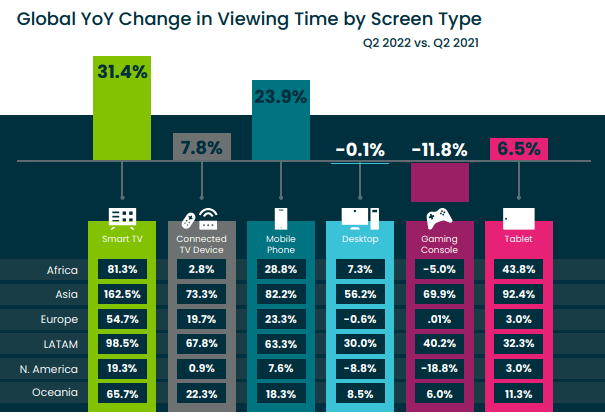
Therefore, testing OTT applications on Smart TVs has become increasingly important. Building an OTT testing infrastructure in-house can drain an organization's budget. In addition, even if you buy hundreds of Smart devices and set them up internally, you'll need to manage the OS updates regularly, which may consume a lot of bandwidth from your IT or DevOps department.
Hence, the feasible approach here will be to test OTT apps on the cloud-based Smart TVs. Digital experience testing platforms like TestMu AI lets you perform OTT app testing on its Smart TV automation testing cloud. It offers a wide range of real Smart TV devices on the cloud, including Amazon Fire TV, Roku TV, and Apple TV. This way, you don’t have to worry about building or maintaining an in-house test infrastructure.

Note: Check our getting started guide on Smart TV Automation using TestMu AI.
Here are some features you can leverage using TestMu AI’s Smart TV testing cloud.
- App automation using Appium on real Apple TV, Fire TV, and Roku TV online.
- Run Smart TV tests in parallel and expedite your test execution cycles.
- Access the application via remote control by using the built-in capability.
- Integrate your testing stack with third-party integrations for project management, codeless automation, CI/CD, and more.
- Test your OTT apps on a scalable real device cloud spanning Android, iOS, and Smart TV platforms.
Catch up on the latest testing tutorials around Selenium automation, Cypress testing,, and more. Subscribe to the TestMu AI YouTube Channel for quick updates.
Challenges in OTT Testing
OTT testing is complex and requires a comprehensive testing strategy that includes testing on multiple platforms, devices, CDNs, network types, browsers, and security and performance testing.
- Cross-platform testing: There are multiple platforms, operating systems, and devices that support OTT services, such as Smart TVs, smartphones, tablets, game consoles, and streaming boxes. Testing on these platforms and devices is important to ensure a seamless user experience.
- Network issues:Testing on different network types (Wi-Fi, 4G, 5G, etc.) and network conditions (low bandwidth, etc.) is essential to ensure optimal performance. The quality of the user's Internet connection can significantly affect the streaming experience.
- Security: OTT services often handle sensitive user information, including payment and personal information. Testing the service's security, including authentication, encryption, and data protection, is crucial to prevent security breaches and data theft.
- Compatibility with different browsers: Users can access OTT services on other web browsers, and testing on each browser is necessary to ensure compatibility and a consistent user experience.
- App performance issues: Issues such as hangs, crashes, ANR, infinite loading, etc., affect app performance.
- User interaction issues: While testing, testers need to keep in mind how the user interacts with the application. Users might not be tech-savvy, and if they observe any network performance issues and stalling is observed, they might give negative feedback for your app. Hence, these scenarios need to be tested.
- Cross-browser issues: Assume you have an application that runs on a browser. Therefore, it is important to ensure its cross browser compatibility. This might be challenging if the testers don’t have devices that support all the browsers.
- Content delivery network: OTT services rely on CDNs to deliver content to users. Testing the performance and compatibility of CDNs with different devices and platforms is critical.
In addition, testers must consider various variables when conducting OTT testing, including the network, browser compatibility, device specifications, hardware, latency, buffering time, etc. The complete system can malfunction with just one component malfunctioning, which poses significant challenges for testers when conducting OTT testing.

AI in OTT Testing: Use Cases and Challenges
AI is increasingly used to tame the scale and fragmentation of OTT testing. One high-value use case is AI visual testing, which compares UI layouts across the fragmented landscape of Smart TV screens and catches misaligned menus, clipped text, and broken focus states that vary by device. Another is automated audio-video sync detection, where AI analyzes frames and audio waveforms to flag lip-sync drift that manual testers can easily miss.
AI also introduces new testing challenges. Recommendation engines are difficult to validate because they are unpredictable, exhibit black-box behavior, and are heavily data-dependent, so the same user action can yield different outputs over time. Testing them requires shifting from exact-match assertions to statistical and behavioral checks, such as verifying that recommendations stay relevant, diverse, and free of inappropriate content.
In this TestMu Conf 2026 session, Eval-First QA Agents: Testing Streaming Platforms at Fox Networks, Gregory Goldshteyn covers why most QA agents ship as demos without evals, and what an eval-first approach looks like on a streaming platform.

OTT Testing and Regulation in India
India is one of the largest OTT markets, and platforms operating there must comply with the IT Rules 2021, formally the Information Technology (Intermediary Guidelines and Digital Media Ethics Code) Rules. These require self-classification of content by age rating, clear content descriptors, parental controls, and a grievance redressal mechanism. Testing must confirm that age gates, content warnings, and parental locks behave correctly for each classification.
Beyond compliance, the Indian market is defined by fragmentation. Testing must cover playback across low-bandwidth 3G, 4G, and 5G networks, since a large audience streams on inconsistent connections, and across a wide range of budget smartphones with limited memory and varied screen sizes. Validating adaptive bitrate behavior and graceful degradation on these devices is essential to reach the broader market.
Best Practices for OTT Testing
Here are a few best practices you can follow while performing OTT application testing.
- Know your audience: Although the best way to increase brand awareness is having constant visibility, understanding their target consumers should be the focus.
- Be consistent: Consistently presented brands are likelier to enjoy excellent brand visibility than those with an inconsistent brand. One way to achieve this is to keep the brand logo and URL present throughout to let viewers know who you are and how they can access your content.
- Target ads using automated content recognition technology (ACR): ACR technology allows us to target mobile device users based on what they view or watch on the big screen. One can use this strategy to implement television advertising or as part of a conquest strategy.
- Time investment: Investment of time for brand-building campaigns usually ranges from 3 months to 6 months. Using OTT ads as the centerpiece of a campaign also enables cross-platform content. This cross-platform content can be created for retail, digital, and experiential, featuring consistent concepts.
- Ensure availability: The rise of streaming services like Netflix, Amazon Prime, Disney+Hotstar and so on has made it possible for people to access their favorite TV programs, movies, and other video content from anywhere in the world.
- Reliable delivery: Consistent content delivery is important for a positive user experience.
- Playback quality: It is very important to have good playback quality because, without that, users lose interest in using the platform, which gives a bad user experience.
To run these practices at scale, TestMu AI lets you validate OTT playback on a real device cloud of Android, iOS, and Smart TV devices without maintaining an in-house device lab.
Top OTT Testing Interview Questions and Answers
These common questions cover the technical depth interviewers expect from OTT and streaming QA engineers.
- How do you test DRM-protected content? Validate license acquisition, output protection (such as blocking screen recording), license expiry and renewal, and correct playback for each DRM system (Widevine, FairPlay, PlayReady) on real devices, since hardware-backed checks often cannot be reproduced on emulators.
- What is the difference between HLS and DASH? HLS is Apple's protocol with native support on iOS and Safari, while DASH is an open, codec-agnostic standard widely supported on Android and Smart TVs. Both are adaptive bitrate protocols, so test cases focus on manifest parsing and quality switching on the target device.
- How do you measure buffering ratio? Buffering ratio is the total rebuffering time divided by the total playback time for a session. A lower ratio means a smoother experience, and it is a core QoE metric tracked alongside video start time and delivered bitrate.
- What is the difference between QoS and QoE? QoS measures network health (latency, packet loss, jitter), while QoE measures the perceived viewer experience (buffering ratio, video start time, and perceptual quality via VMAF and SSIM). Good QoS does not guarantee good QoE.
- How do you test OTT apps on Smart TVs? Test on real CTV devices using remote-control navigation, validate focus states and back-button flows, verify SDK integrations for each platform, and confirm playback quality and adaptive streaming behavior across network profiles.
- How do you validate audio-video synchronization? Compare the audio waveform against video frames to detect lip-sync drift, test across multiple bitrates and networks, and confirm sync holds after seeking, pausing, and switching audio tracks or subtitles.
Conclusion
To sum up, OTT testing is an important step in ensuring the dependability and quality of streaming services. By detecting and resolving problems like buffering, freezing, and compatibility issues, OTT testing can improve user experience and boost customer satisfaction. and also assists in optimizing material for various devices and network configurations and ensuring compliance with industry standards and regulations.
More automation and interaction with AI and machine learning technologies will likely define OTT testing in the future. This will make testing more effective and accurate, speed up problem detection, and enhance user experience. The success of OTT networks will depend even more on OTT testing as the demand for high-quality streaming services rises.
Author

Piyusha Podutwar
Blogs: 4


Piyusha Podutwar is a Senior Software Engineer at DPS with over 12 years of experience in mainframe application and system programming. She has authored 20+ technical tutorials for TestMu AI on API testing, Agile, DevOps automation, software testing, automation testing, and digital transformation. She is skilled in Assembler, COBOL, DB2, and JCL, and has led large-scale modernization and migration projects across banking, finance, retail, and insurance domains. A Certified Scrum Master, Piyusha previously worked with IBM, TCS, BMC Software, and T-Systems.


Frequently asked questions
Did you find this page helpful?
More Related Learning Hubs
TestMu AI forEnterprise
Get access to solutions built on Enterprise
grade security, privacy, & compliance
- Advanced access controls
- Advanced data retention rules
- Advanced Local Testing
- Premium Support options
- Early access to beta features
- Private Slack Channel
- Unlimited Manual Accessibility DevTools Tests