

Power Your Software Testing with AI Agents and Cloud
The Native AI-Agentic Cloud Platform to Supercharge Quality Engineering. Test Intelligently and Ship Faster.


- TestMu AI (Formerly LambdaTest)
- /
- Blog
- /
- Video Agent Testing: How to Test AI Agents on Camera
Video Agent Testing: How to Test AI Agents on Camera
A simulated candidate joins your agent's session on camera, holds a real conversation, and grades the recording against criteria you wrote.
Last Updated on:
On This Page
Video agent testing is an automated way to validate an AI agent that talks to people on camera. A simulated candidate with a synthetic face and voice joins the agent's live session, holds an unscripted conversation, records it, and scores the recording against criteria the team defined. Unlike text-based evaluation, it judges turn-taking, timing, lip-sync, and audio and video quality alongside the correctness of what the agent says.
Stanford HAI's 2026 AI Index reports that AI agents advanced from answering questions to completing tasks in 2025, though they still fail roughly one in three attempts on structured benchmarks.
That failure rate is the reason to test, and doing it by hand does not scale. Someone joins the session, plays a role, sits through the entire conversation, and forms an opinion. Run that ten times with ten different personalities and a day is gone.
TL;DR
- Video agent testing - Video agent testing is an automated way to validate an AI agent that talks to people on camera. A simulated candidate joins the session with a synthetic face and voice, holds a real conversation, records it, and scores the recording against criteria you wrote.
- Not video service testing - Video agent testing grades the AI agent that appears on camera. Pointing an AI tester at a streaming app on real devices is a separate discipline that shares the name and needs different tools.
- Multimodal defects - Video agent testing catches lip-sync drift, frozen frames, and the agent talking over the user by analysing the recording. None of these defects appear in a transcript.
- Setup requirements - Video agent testing needs one joinable browser link. Requires an SDK: no. Requires a phone number: no. Requires changes to the agent: no. Zoom, Meet, and Teams sessions are not supported yet.
- Success criteria - Video agent testing anchors each verdict to observable, one-behaviour criteria written into a 250 to 400 word scenario brief. The agent passes only if it meets every criterion.
- Fan-out and iterations - Video agent scenarios expand across avatar faces, personas, test profiles, and iterations. Two scenarios, three personas, and two iterations produce 12 sessions, roughly 18 minutes at two concurrent sessions.
- Timestamped evidence - Video agent testing ties every verdict to a timestamp in the recording, scores four pillars on the agent only, and marks harness failures inconclusive so they stay out of the pass rate.
- TestMu AI Agent Testing - TestMu AI Agent Testing scores video, chat, voice, and phone agents in one framework, so quality stays comparable instead of being measured differently on each surface.
What is a Video Agent?
A video agent is an AI system that holds a real-time conversation with a person on camera. It listens, responds, and presents a face. Common examples include AI interviewers, onboarding assistants, triage front desks, and training partners.
The distinguishing property is not the AI. It is the modality. A video agent is judged on turn-taking, timing, lip-sync, and audio and video quality alongside the correctness of what it says.
That last point is what separates this from ordinary AI agent testing. A response that is factually right but delivered over the top of the user is still a failure, and no amount of text-level evaluation will catch it.
Video Agent Testing vs Video Service Testing
Two different disciplines currently share this name, and picking the wrong one wastes a week of tooling evaluation. The distinction is which side of the camera the AI sits on.
| Question being answered | What is under test | Where it runs |
|---|---|---|
| Does our streaming app play correctly? | A video service or OTT app. The AI is the tester, driving the app and checking playback. | Real devices, smart TVs, and set-top boxes |
| Does our AI interviewer conduct a good interview? | The video agent itself. The AI is the thing being graded, and a second AI plays the human opposite it. | A joinable web session in a browser |
This guide covers the second row. If the first row is the actual problem, playback quality and device fragmentation on streaming apps, then testing OTT and video streaming apps on real devices is the relevant workflow instead.
Why Video Agents Break the Usual Testing Playbook
Standard test automation assumes deterministic output, an assertable interface, and a single channel of failure. A video agent violates all three.
- Output is non-deterministic - The same input produces different phrasing, different follow-ups, and different pacing on every run. A single passing run proves nothing about the next one.
- The failure surface is multimodal - Lip-sync drift, a frozen frame, audio that lags the mouth, and talking over the user are all defects, and none of them appear in a transcript.
- Timing is part of correctness - Turn-taking, interruption handling, and silence tolerance only exist in real time. They cannot be evaluated from a log after the fact.
- There is no assertion hook - Video agents are reached the way a person reaches them, through a browser session. There is usually no SDK surface to attach test assertions to.
Text-based evaluation catches none of this. Teams already doing conversational AI testing on chatbots and voice agents have the scenario discipline they need, but a transcript cannot tell anyone whether the agent interrupted someone or sat frozen for eleven seconds.
How Automated Video Agent Testing Works
The testing harness joins the agent's session the same way a human participant would, in the browser, on the same footing as the browser agents that drive web apps. It arrives with a synthetic face, a synthetic voice, and a brief describing who it is meant to be. It then improvises a real conversation with the agent, records the session, and grades the recording.
No phone number is dialled and no SDK is installed. The agent under test is not modified to make it testable, which matters, because a testability shim is itself a source of divergence between what is tested and what ships.
What You Can Test
The only requirement is a joinable web URL. If a colleague could be sent a link and join the conversation in a browser with a camera and a microphone, the agent is testable. That covers agents built on real-time media stacks, and the walkthrough on how to test a LiveKit agent shows the same idea applied to one of them.
| Target | Supported | Notes |
|---|---|---|
| Embeddable session link from the agent's platform | Yes | Richest results, since the platform's own recording and transcript can be used |
| Agent hosted on a custom domain | Yes | Session recorded from the browser |
| Any other joinable web session | Yes | Same browser-side capture |
| Agents reachable only inside Zoom, Meet, or Teams | Not yet | The requirement remains a joinable web URL |
The Five Building Blocks
Five concepts carry the whole model, and they nest inside each other.
| Term | What it means |
|---|---|
| Agent | The system under test. Configured once with the URL of the video agent. |
| Scenario | One situation to put the agent through, for example a candidate who answers everything in one word. Holds the simulated candidate's brief and the success criteria. |
| Persona | The personality the simulated candidate wears. Changes tone, pacing, patience, and on-camera reactions. |
| Suite | A named group of scenarios run together. The regression pack. |
| Session | One actual conversation. A suite run produces many sessions, each with its own recording and verdict. |
A useful way to hold it: a scenario is the script for a situation, a session is one performance of it, and a suite is the whole show. A suite behaves the same way a conventional test suite does, except each member is a conversation rather than a scripted assertion.
How to Write Video Agent Testing Scenarios That Find Real Bugs
A scenario here plays the same role a written test scenario plays in manual QA, and it has two components that carry almost all the weight. The description becomes the simulated candidate's brief. The success criteria decide the verdict.
The simulated candidate improvises. It watches the agent, listens, and responds in the moment rather than reading lines, so the description should read like a briefing given to an actor, not a screenplay. Aim for 250 to 400 words, because short descriptions produce thin conversations, which is the single most common cause of a test where the agent barely spoke.
Cover six things in that brief:
- The goal - What is this person trying to accomplish?
- The situation - Who are they, and why are they here?
- Objectives and boundaries - What they want, and what they will refuse to do. Frame it as intent that adapts, because the agent may go somewhere unexpected.
- The personality - How this person speaks, paces, reacts, and behaves on camera.
- The expected agent behaviour - What is actually under evaluation.
- The failure mode being hunted - The tricky moment this scenario exists to provoke.
A scenario that says "candidate answers interview questions" tests nothing. A scenario that says "candidate answers the first two questions fully, then becomes distracted and starts giving one-word answers, to see whether the agent notices and re-engages" tests something real.
Scenario Categories Worth Covering
When generating scenarios in bulk, steering toward specific situation types keeps the pack balanced.
| Category | What it surfaces |
|---|---|
| greeting | Openings, introductions, setting expectations |
| task_completion | Whether the agent gets its actual job done |
| question_handling | Asking, listening, following up |
| error_recovery | What happens after something goes wrong |
| multi_turn | Whether coherence survives a long conversation |
| clarification | Handling ambiguity instead of guessing |
| edge_case | The awkward situations real users produce |
A good pack is weighted toward error_recovery and edge_case. The happy path tends to work already. If the same logic already powers a bot, the awkward situations collected in your chatbot test cases are the fastest source of edge scenarios worth putting on camera.
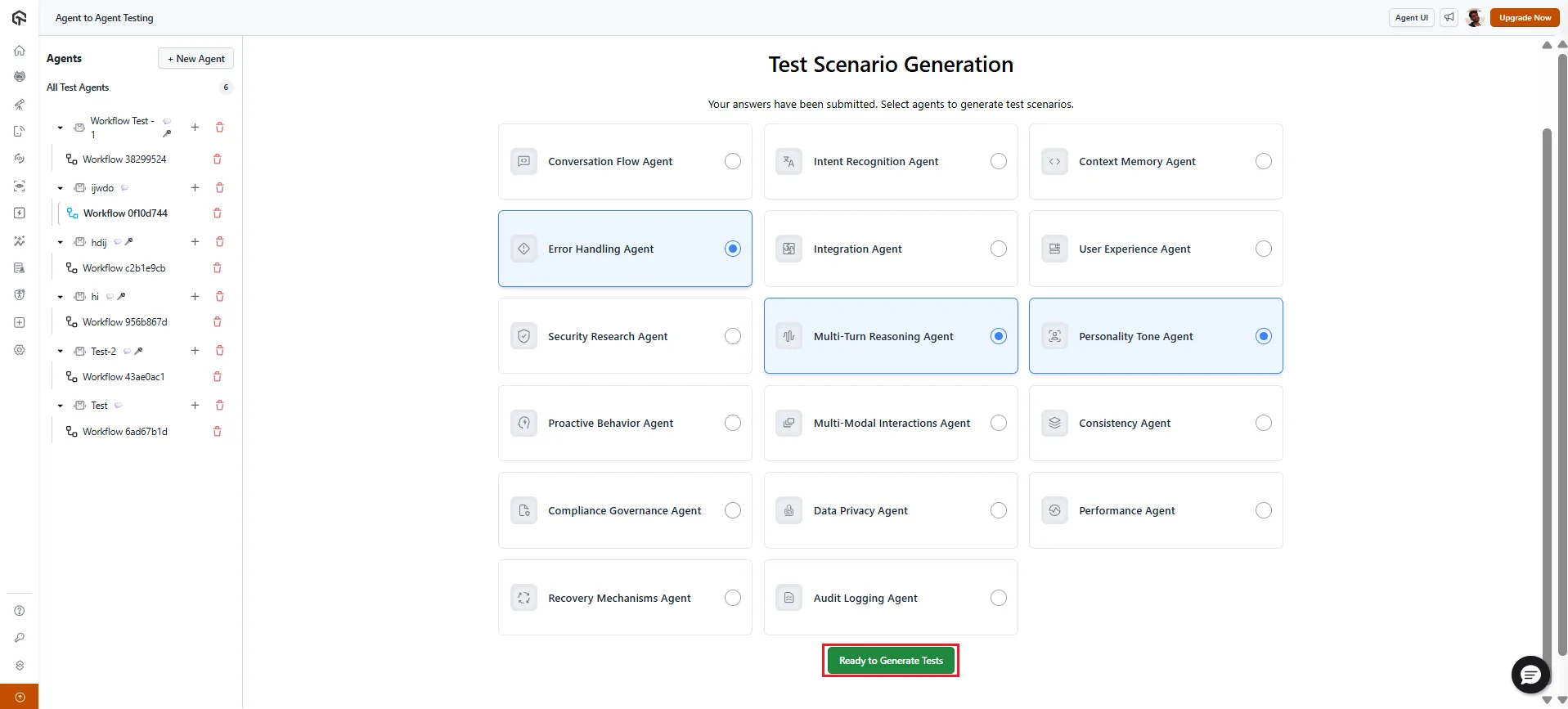
The screen above is the same category-selection step in TestMu AI Agent Testing. Picking Error Handling, Multi-Turn Reasoning, and Personality Tone before generation is what tilts the resulting pack toward recovery and edge behaviour rather than another set of happy-path greetings.

Success Criteria Are the Highest-Leverage Thing You Write
When a scenario carries criteria, the verdict is anchored to them. The agent passes only if every criterion is met. Anything the evaluator cannot confirm from the recording counts as not met, which is deliberately strict: a criterion nobody can verify is not evidence of success.
| Good | Weak | Why |
|---|---|---|
| "Agent greets the candidate on camera within the first 15 seconds" | "Agent is friendly" | Friendly is not observable. A greeting is. |
| "Agent asks at least three role-related questions" | "Agent conducts a good interview" | One of these is countable from the recording. |
| "Agent explains next steps before ending the session" | "Agent ends well" | Names the specific behaviour. |
| "Agent re-engages when the candidate gives one-word answers" | "Agent handles difficult candidates" | Ties directly to what the scenario provokes. |
One behaviour per criterion. If a criterion contains the word "and", it is probably two criteria. The discipline is the same one that separates a good expected result from a vague one in any test case.
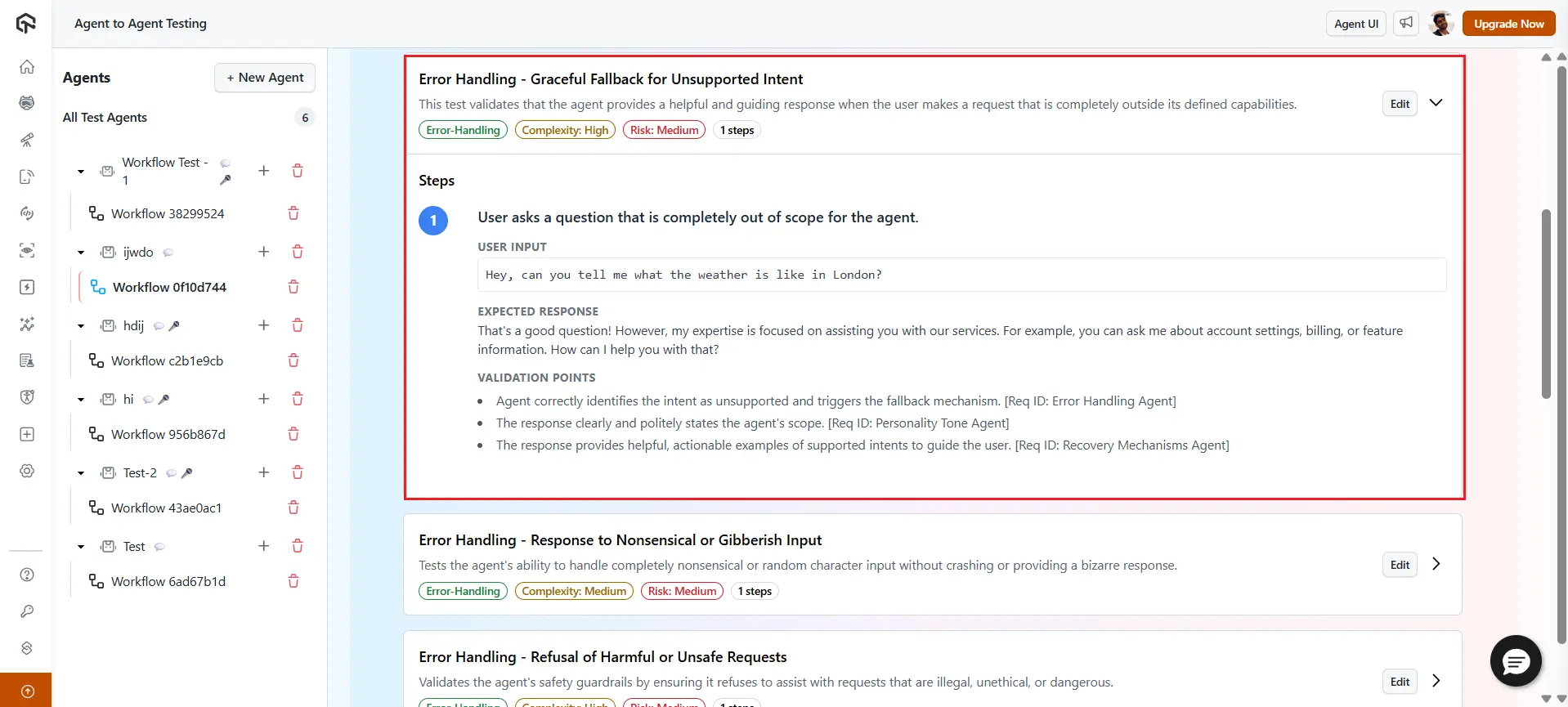
That expanded scenario shows the shape in practice. One step, one user input, one expected response, and then three separate validation points rather than a single compound sentence, each one naming a behaviour an evaluator can confirm or reject on its own.
Leaving criteria off entirely still produces a verdict, but it comes from the evaluator's general judgement rather than your team's definition of correct. That is useful for exploration and wrong for a regression pack.

Note: Write the criteria once, then let TestMu AI run the conversation and bring back the evidence. Start testing your agent free
Fan-Out: From One Test to Real Confidence
A single scenario tested once proves it worked once. Confidence comes from the same situation run under varied conditions, so each scenario expands across four independent axes: avatar faces, personas, test profiles, and iterations. Multiply them together to get the session count, and an empty axis counts as one, so a scenario with nothing configured runs exactly once.
| Axis | The question it answers |
|---|---|
| Avatar faces | Does the agent behave the same regardless of who it sees? |
| Personas | Does it hold up against a blunt candidate as well as a chatty one? |
| Test profiles | Does it handle different data correctly? Profiles inject values such as names or reference numbers, so the candidate answers with real specifics rather than placeholders. |
| Iterations | Is this behaviour consistent, or was that run lucky? |
Two scenarios, three personas each, and two iterations gives 12 sessions. At three minutes each, running two concurrently, that is roughly 18 minutes of wall clock.
Iterations deserve particular emphasis. Conversational agents are not deterministic, so a behaviour that appears once may not be real, in much the way a flaky test tells you nothing until you have run it enough times to see the pattern. Running a scenario three times and seeing the same failure twice is the difference between a bug report and a guess.
Reading Results Without Taking Anything on Trust
A verdict is only useful if it can be checked. Results should be structured so that every claim points back at a moment in the recording, which is the same principle behind any serious AI agent evaluation practice.
| Status | Meaning |
|---|---|
| Pending | Queued, waiting for a slot |
| Running | The conversation is happening now |
| Completed | The session ran and was graded |
| Failed | Something genuinely went wrong. The agent was never reached, or grading produced no verdict |
| Inconclusive | The test harness broke, not the agent |
Inconclusive is the status worth understanding, because it protects the pass rate. If the simulated candidate's video stream drops mid-session, the conversation may still read fine in the transcript, but presentation can no longer be judged fairly. Marking that run inconclusive and excluding it from the pass rate is more honest than penalising an agent for a harness failure.
Each criterion should then resolve into four fields: what the agent was expected to do, what it achieved, the evidence in the form of a quote or timestamp, and the evaluator's confidence. Nobody should be asked to accept a failure on trust, and the timestamp usually reveals within ten seconds whether the result is a real defect or a criterion that needs rewording.
Four pillars, scored 0 to 10, then explain a result rather than define it:
| Pillar | Measures |
|---|---|
| Conversation flow | Turn-taking, talking over the candidate, pacing |
| Question handling | Whether the agent progressed through its task |
| Response quality | Relevance and correctness of what it said |
| Avatar presentation | The agent's own lip-sync, facial motion, and audio and video quality |
Every pillar scores the agent only. The simulated candidate is test equipment, and its face, its voice, and any glitch on the harness side are excluded and cannot lower a score. A pass with a low conversation flow score is a genuinely useful signal: the agent did what was asked, but the interaction was awkward.
Testing Conversational Agents Across Channels
Video is one channel. Most teams shipping a video agent also ship a chat surface, a voice bot, or a phone line running against the same underlying logic, and quality has to be comparable across all of them rather than measured differently in each.
TestMu AI Agent Testing evaluates conversational agents across channels against a shared scoring framework. Chat and voice agents are scored on nine quality metrics, including hallucination detection, bias detection, completeness, context awareness, and conversation flow. Phone agents add more than 30 call-specific metrics such as first call resolution, intent recognition accuracy, and containment rate.
The simulation layer is what makes those scores mean anything. It ships 200+ voice profiles, 50+ accents, and 15 background noise environments covering conditions like a call centre floor, a poor cellular connection, and simultaneous speakers, plus persona types including International Caller, Digital Novice, Impatient User, Confused Customer, Angry or Upset User, Expert User, Accessibility Needs, Multi-Lingual, and Off-Script User.
Those personas map directly onto the video scenarios worth writing, since an impatient user on camera and an impatient caller on the phone break an agent in the same places. The documentation on how to test your first AI agent covers agent setup, category selection, and scenario configuration step by step, and teams working phone-first should start with voice agent testing.
Constraints to Plan Around
Video sessions are heavy, which is why concurrency is limited. Large suites queue rather than fail, so pack size should be planned against release timing rather than discovered on release day.
| Constraint | Typical value |
|---|---|
| Session length | 30 to 600 seconds, 180 by default |
| Sessions per suite run | 50 |
| Concurrent sessions | 2 per organisation |
| Iterations per scenario | Up to 10 |
A 24-session suite at three minutes each takes roughly 36 minutes of wall clock. That number is the one to hold in mind when deciding how big a smoke pack can be and still run on every change.
Six rules keep a pack useful once it exists:
- Start narrow - Five to eight scenarios covering the paths that matter, run on every change, beat fifty scenarios run once a quarter.
- Weight toward failure - Interruptions, silence, hostility, ambiguity, and people who will not answer the question are where agents break.
- Run three iterations before filing a bug - Twice is a bug. Once is a maybe.
- Write criteria you could check yourself - If it cannot be confirmed by watching the recording, the evaluator cannot confirm it either.
- Keep the smoke suite stable - Same scenarios, same personas, every release, following the same logic as smoke testing elsewhere. The value is comparability over time.
- Point at staging - Every session is a real conversation with whatever is behind the URL supplied.
Scenario Briefs the Codebase Writes for You
All of this assumes someone can write the brief. A video agent gives you a person to picture, so 300 words about a distracted candidate is writable in an afternoon. An agent that acts on files and APIs offers nothing to picture, so TestMu AI Agent Assurance reads the codebase instead: manifests, prompts, tool tables, MCP servers, then writes the scenarios itself.
- Three classes of scenario - Generated suites span functional cases like boundary and state handling, non-functional ones like performance and token economy, and adversarial ones like prompt injection and PII leakage.
- Evidence over summary - Criteria are graded on files changed on disk, artifacts produced, and tool calls checked against the agent's declared tool surface.
- A third verdict - Unable to Verify sits beside Pass and Fail and stays out of the pass-rate denominator, the same way an inconclusive video session stays out of yours.
- Declared gaps - Where an agent declares no tool surface, discovery says so instead of guessing.
Point it at staging for the same reason you point a video suite there: the rook README is blunt that the agent you point it at is yours and its writes cannot be rolled back. A finished run exits 0 whether scenarios passed or failed, so gate on the verdicts in rook report --json, not on the exit code. The autonomous side of Agent Assurance is on a waitlist rather than generally available.
Wrapping Up
Pick the one conversation your video agent handles worst today, write it up as a 250-word brief with three observable criteria, and run it three times against staging. That single scenario will tell you more than a week of watching demos, because it produces a recording, a transcript, and a verdict tied to a timestamp you can open.
From there the pack grows the same way: weight it toward error recovery and edge cases, add personas before you add scenarios, and keep the smoke suite stable so results stay comparable between releases. Teams already running agentic AI testing on other surfaces can reuse most of that discipline directly.
Video agent testing only works when the criteria are yours and the evidence is checkable, so start with the scenario you are least confident about and let the recording settle the argument.
Author

Samyak Goyal
Blogs: 30

Samyak Goyal is a Senior Member of Technical Staff at TestMu AI engineering Kane CLI, the command-line tool that runs browser automation from the terminal, where a flow described in natural language executes in a real Chrome browser and returns pass or fail with shareable proof. He is a backend engineer with 4+ years of experience, previously an SDE at Innovaccer, where he built APIs, introduced Kafka, and cut deployment from weeks to hours. Samyak also builds multi-agent systems, skill-orchestration frameworks, and a personal copilot that indexes 200+ microservice repositories.
Reviewer

Sirajuddin Khan
Reviewer
Sirajuddin Khan is Vice President of Product Management at TestMu AI (formerly LambdaTest), where he drives the company's agentic AI product strategy, building a suite of autonomous agents that includes Agentic Browsers and Agentic Visual Testing and shifting the unit of work from test execution to autonomous outcomes. One of the company's earliest product leaders, he has owned the roadmap for the high-performance execution cloud and grew the cross-browser testing products from early adoption to market leadership. He brings over a decade of experience across SaaS, B2B, and eCommerce, with earlier product roles at Wydr and ShopClues, where his catalog and search work cut delivery SLAs and lifted seller activity. Sirajuddin holds an MBA in Information Technology from Sikkim Manipal University and a B.Tech in Computer Science Engineering from Maharshi Dayanand University.


Video Agent Testing FAQs
Did you find this page helpful?
More Related Blogs
TestMu AI forEnterprise
Get access to solutions built on Enterprise
grade security, privacy, & compliance
- Advanced access controls
- Advanced data retention rules
- Advanced Local Testing
- Premium Support options
- Early access to beta features
- Private Slack Channel
- Unlimited Manual Accessibility DevTools Tests