

Power Your Software Testing with AI Agents and Cloud
The Native AI-Agentic Cloud Platform to Supercharge Quality Engineering. Test Intelligently and Ship Faster.


- TestMu AI (Formerly LambdaTest)
- /
- Blog
- /
- Conversational AI Testing: How to Test Chatbots and Voice Agents
Conversational AI Testing: How to Test Chatbots and Voice Agents
Conversational AI testing checks chatbots and voice agents across real scenarios. Learn what to test, the key metrics, and how to test before and after launch.
Last Updated on:
Testing a conversational agent means exercising four layers: functional task flows, multi-turn context retention, safety against prompt injection and bias, and channel-specific behavior, since a reply that reads fine in chat can sound wrong spoken aloud. TestMu AI's Agent Testing simulates this at scale with 200+ voice profiles and 20+ background noise environments.
What Is Conversational AI Testing?
Conversational AI testing validates an agent's behavior across real-world conversations rather than checking a single fixed output. It spans three channels that fail in different ways: web and in-app chat, voice assistants, and phone callers. Agents that meet users on camera add a fourth, with turn-taking and presentation failures that only a recording exposes, covered in our guide to video agent testing.
It is a young, fast-moving discipline. A 2025 academic survey of LLM agent evaluation concluded that "evaluating these agents remains a complex and underdeveloped area," with dynamic, long-horizon interactions and compliance the most overlooked. That immaturity is exactly why a deliberate testing approach is a competitive advantage right now.
At its core, conversational AI testing answers four questions about an agent:
- Does it complete the task? A booking, a return, a balance lookup, or a successful handoff to a human.
- Does it stay coherent across turns? Multi-turn context is where most agents quietly drift or contradict themselves.
- Is it safe and on-policy? No hallucinated facts, no bias or toxicity, no leaked data, no jailbreak compliance.
- Does it hold up per channel? A reply formatted for screen chat can sound wrong spoken aloud or break under phone-line noise.
Purpose-built platforms like TestMu AI's Agent Testing exist to answer all four questions across chat, voice, and phone in one place, and the workflow in this guide follows that approach.
If you are validating a single channel, the channel-specific guides on AI agent testing and writing chatbot test cases go deeper than this overview, and platform-specific guides like Cognigy testing show how to validate agents built on a particular vendor, while teams running on Sierra can see how to test your Sierra agents, teams on Yellow.ai can follow Yellow.ai testing, support teams on Ultimate.ai can follow Ultimate AI testing, and contact centers on Five9 can follow Five9 testing. For the major enterprise stacks, we have step-by-step guides on how to test an Amazon Connect bot, a LangChain or LangGraph agent, a Vertex AI Agent Builder agent, a Copilot Studio agent, a Dialogflow, Lex, or Watson bot, a Botpress chatbot, a Cognigy agent, a Kore.ai bot, a Haptik chatbot, and a Parloa voice agent.
Contact-center and customer-service stacks have their own guides too: Cresta testing for agent-assist and voice agents, Ada testing for reasoning-engine and voice agents, and Replicant testing for automated call handling.
Why Conversational AI Is Hard to Test
Teams are shipping conversational AI faster than they can validate it. In the Stack Overflow 2025 Developer Survey, 84% of developers said they use or plan to use AI tools, up from 76% the prior year, yet only 33% trust the accuracy of AI output while 46% actively distrust it. That trust gap is the testing problem in one statistic.
Conversational agents break the assumptions traditional test automation is built on:
- Non-determinism: The same prompt can produce different valid answers, so an exact-string assertion is meaningless. You must judge whether the behavior was correct, not whether the text matched.
- Errors compound: In a multi-turn conversation, one misread turn corrupts every turn after it, so a small slip becomes a failed outcome.
- Failures are silent: A wrong-but-confident answer returns HTTP 200. Nothing in standard logs flags it, which is why specialized evaluation is required.
- The input space is infinite: Real users mumble, interrupt, switch languages, and go off-script. A handful of happy-path scripts covers almost none of it.
- Channels diverge: The same logic behaves differently when spoken under background noise versus typed in a chat box, so each channel needs its own coverage.
The practical takeaway: testing must shift from matching outputs to scoring behavior across many trials and many user types. That reframing drives everything that follows.
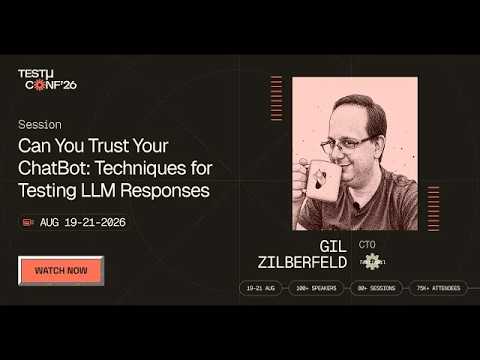
In this TestMu Conf 2026 session, Can You Trust Your ChatBot: Techniques for Testing LLM Responses, Gil Zilberfeld works through that same shift, testing something that gives you a whole lot of text and never the same way twice, using golden datasets for what good answers look like, tone and bias detection, scorecards as the new pass/fail, and an AI judge to settle the argument.
What to Test in a Conversational AI Agent
A complete test plan covers four layers. Skipping any one of them is where production incidents come from.
| Test Layer | What It Checks | Example Failure It Catches |
|---|---|---|
| Functional flows | Can the agent finish the job: book, refund, look up an order, hand off to a human cleanly. | Agent confirms a booking it never actually created. |
| Context and memory | Whether it remembers earlier turns and stays consistent across a long conversation. | Asks for the order number again two turns after it was given. |
| Safety and security | Bias, toxicity, hallucination, prompt injection, and data leakage under adversarial input. | A jailbreak prompt makes it reveal another customer's data. |
| Channel behavior | How the same agent performs on chat versus voice versus phone, including noise and accents. | Reads a long URL aloud that was fine as a clickable chat link. |
Each layer has to be exercised by more than one kind of user. TestMu AI's Agent Testing ships 10+ persona types, including the Impatient User, Confused Customer, Multi-Lingual, Accessibility Needs, and Off-Script User, because agents routinely succeed with a cooperative tester and fail with a frustrated real caller. Persona coverage is what turns a green test run into a trustworthy one.

Note: Hand-writing thousands of varied conversations is impossible, and a few scripted chats prove nothing. TestMu AI's Agent Testing generates and runs them autonomously across chat, voice, and phone, then scores every turn for resolution, hallucination, bias, and compliance. Start testing your AI agent free.
Key Conversational AI Testing Metrics
The arXiv survey of LLM agent evaluation frames quality along four axes: behavior, capabilities, reliability, and safety. Translated into a metric scorecard a QA team can actually track, that looks like this:
| Metric | What It Measures | Why It Matters |
|---|---|---|
| First contact resolution | Share of conversations that resolve the user's issue in one session. | The primary outcome metric; everything else is a means to this end. |
| Intent recognition accuracy | How often the agent correctly identifies what the user actually wants. | A misread intent dooms the rest of the conversation. |
| Containment rate | Share of conversations handled without escalating to a human. | Directly tied to deflection ROI, but only valuable when paired with resolution. |
| Hallucination rate | Frequency of invented facts, policies, or capabilities. | The fastest way to lose customer trust and create liability. |
| Tone and bias score | Consistency of tone and absence of biased or toxic output. | Protects brand voice and meets responsible-AI requirements. |
| Latency and STT accuracy | Response speed and transcription accuracy (voice and phone agents). | Slow or misheard turns make a voice agent feel broken even when logic is correct. |
Two rules keep these numbers honest. Never report a metric from a single run; non-deterministic agents need many trials per scenario before an average means anything. And never read containment without resolution next to it, since an agent that refuses to escalate looks contained while leaving users stuck. For a deeper treatment of scoring methods, see AI agent evaluation.
How to Test Conversational AI Before Launch
Pre-production testing means simulating the conversations real users will have, at a scale no manual QA team can reach, and gating the launch on the results. A practical workflow:
- Define scenarios from real intents: Start with your top support topics and known edge cases, not invented ones.
- Assign personas: Run each scenario as multiple user types, including adversarial and accessibility personas.
- Simulate at scale: Generate hundreds to thousands of conversations across channels, with realistic voice, accent, and noise conditions.
- Score against the scorecard: Evaluate every turn for resolution, hallucination, bias, and policy adherence.
- Gate the go-live: Treat scores below threshold as launch blockers, not advisory notes.
This is the workload TestMu AI's Agent Testing platform is built for. It deploys 15+ specialized AI testing agents (security researchers, compliance validators, persona simulators, hallucination hunters) that autonomously generate and run thousands of scenarios in parallel. For voice and phone agents, it simulates 200+ voice profiles across 50+ accents and 20+ background sound environments, then returns a go-live verdict per scenario. You can follow the platform walkthrough in the docs on testing your first AI agent. If your agent is built on a specific voice stack, the same approach applies when testing an ElevenLabs conversational AI agent.
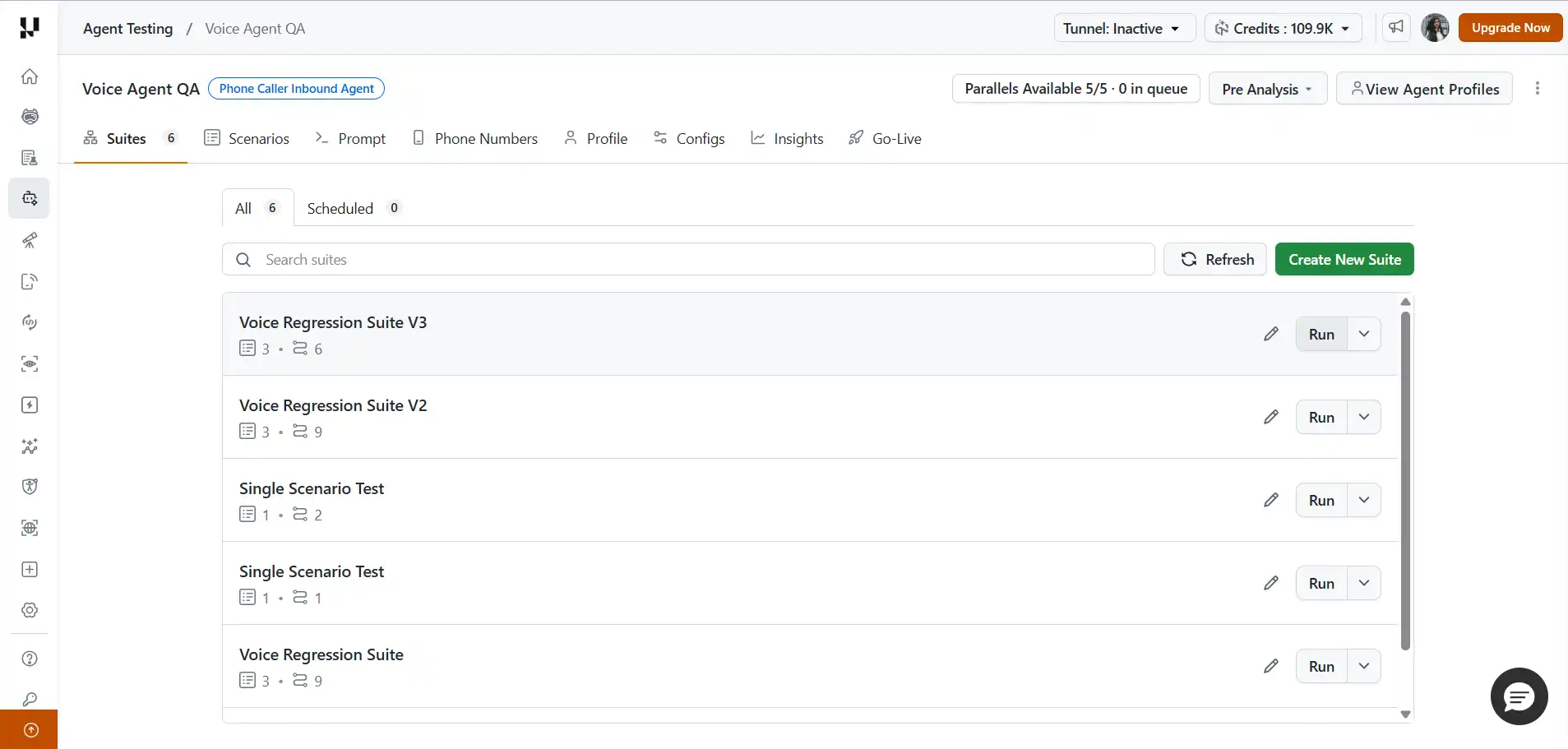
It helps to define each scenario as a small spec so it is reviewable and version-controlled. The illustrative example below pins the goal, persona, channel, expected behavior, and the assertions a judge model scores, including a trial count so the result reflects many runs rather than one lucky pass:
# Conversational AI test scenario (illustrative spec)
scenario: refund_request_angry_caller
channel: voice            # chat | voice | phone
persona: angry_upset_user
goal: caller wants a refund for a duplicate charge
turns:
  - user: "I was charged twice and I want my money back now."
  - expect:
      intent_recognized: refund_request
      tone: calm_and_empathetic
      no_hallucinated_policy: true
  - user: "This is the third time I'm calling."
  - expect:
      retains_context: true
      escalation_offered_if_unresolved: true
assertions:
  first_contact_resolution: true
  toxicity_score: { max: 0.1 }
  pii_leakage: none
trials: 25                # run many times; judge behavior, not one exact string
Monitoring Conversational AI in Production
Pre-production testing catches the failures you can predict. Production catches the ones you cannot, because real traffic brings inputs, slang, and edge cases no test author imagined. A model or prompt update can also silently regress behavior overnight. These are exactly the dynamic, long-horizon interactions the LLM agent evaluation survey flagged as often overlooked before launch.
Live monitoring should track the same scorecard, plus drift signals, on real conversations:
- Resolution and containment trends: A slow decline usually means a prompt or model change quietly broke a flow.
- Hallucination and escalation spikes: Sudden jumps point to a new intent or input the agent was never tested against.
- Sentiment and abandonment: Rising frustration or hang-ups flag conversations that "passed" technically but failed the user.
- Per-channel breakdown: Degradation often hits one channel first, such as phone agents under a specific carrier's audio.
For voice agents specifically, turn-by-turn pipeline tracing is its own discipline; our guide to voice observability covers it in depth, and the broader principles live in AI observability. The point is that pre-production and production are a loop: real failures become new pre-production scenarios.

Austin Siewert
Co-Founder, Steadfast Systems
Discovered @TestMu AI yesterday. Best browser testing tool I've found for my use case. Great pricing model for the limited testing I do 👏
2M+ Devs and QAs rely on TestMu AI
Deliver immersive digital experiences with Next-Generation Mobile Apps and Cross Browser Testing Cloud

Wiring Conversational AI Tests into CI/CD
Conversational quality should be a build gate, not a quarterly review. When prompts, tools, and models change weekly, a behavioral regression suite has to run on every pull request so a regression is caught before it ships.
- Run a core suite on every commit: A focused set of high-value scenarios per channel gives fast feedback without waiting on a full sweep.
- Set go/no-go thresholds: Block the merge when resolution drops or hallucination rises beyond an agreed bar.
- Schedule the full sweep nightly: Run the complete persona and channel matrix off the critical path.
TestMu AI's Agent Testing integrates into CI/CD for exactly this shift-left loop, and executing the suite on HyperExecute keeps wall-clock time down (up to 70% faster than traditional grids) as the scenario count climbs. If the agent lives inside a web or mobile app, pair conversational checks with end-to-end UI tests authored in natural language through KaneAI, so both the interface and the conversation are gated together.
Common Conversational AI Testing Pitfalls
These failures are usually avoidable, and they cluster into a handful of recurring mistakes:
- Testing only happy paths: Cooperative users pass; the impatient, confused, and adversarial ones expose the real gaps.
- Single-run evaluation: Judging a non-deterministic agent on one trial is noise. Run many and look at the distribution, not one result.
- Ignoring voice conditions: An agent tested only in clean chat will stumble on accents, noise, and interruptions on a real phone line.
- No production monitoring: Treating launch as the finish line means drift and new failure modes go unseen until customers complain.
- Testing it like deterministic software: Exact-match assertions and a fixed script miss the behavioral failures that actually matter.
The thread connecting all five: with only a third of developers trusting AI output today, a conversational agent earns trust through varied, repeated, behavior-based testing, not a one-time scripted pass.
Conclusion
If your agent runs on OpenAI's Realtime API, testing OpenAI Realtime agents covers the assertions that surface changes. Start by writing five real scenarios from your top support intents, run each as three personas (cooperative, impatient, adversarial) across the channels you ship, and score them for resolution, hallucination, and policy adherence before you launch. That single exercise will tell you more than weeks of demos. If the channel is voice, the failure modes and the scoring metrics differ from chat, which is covered in voice AI customer service testing. If the agent is on camera, add the visual layer described in video simulation testing.
With 84% of developers now using or planning to use AI tools, the teams that win are the ones whose agents are demonstrably reliable. To put a repeatable process behind that, run your agent through TestMu AI's Agent Testing platform and follow the setup steps in the docs on testing your first AI agent. Test before you ship, monitor after, and feed every production failure back into your pre-production suite. That loop is worth formalising rather than improvising, and continuous AI agent testing lays out the four stages it runs through.
Note: Rohit Mehta, Quality Engineering and Testing Practice Head at TestMu AI with expertise in AI-driven QA and intelligent test generation, reviewed, fact-checked, and approved this article, which was researched and drafted with AI assistance. Every statistic, link, and product claim was verified against primary sources. Our editorial process and AI use policy describes how every claim is verified before publication.
Author

Rohit Mehta
Blogs: 3

Rohit Mehta is the Quality Engineering and Testing Practice Head at Pratham Software (PSI), with 15+ years of experience across enterprise and SaaS platforms. He builds AI-driven QA practices that enable faster releases, lower risk, and predictable quality at scale, leading QA strategy, AI adoption, and governance across programs. His expertise includes intelligent test generation, self-healing automation, regression optimization, predictive analytics, and CI/CD-integrated quality practices. He wrote the book Software Testing Revolution Using AI: The Future of Quality Engineering, and on TestMu AI (formerly LambdaTest) he published a guide on conversational AI testing. He holds an MS in Software Systems from BITS Pilani.


Conversational AI Testing FAQs
Did you find this page helpful?
More Related Blogs
TestMu AI forEnterprise
Get access to solutions built on Enterprise
grade security, privacy, & compliance
- Advanced access controls
- Advanced data retention rules
- Advanced Local Testing
- Premium Support options
- Early access to beta features
- Private Slack Channel
- Unlimited Manual Accessibility DevTools Tests