
AI Agent Testing Statistics From 598 Teams
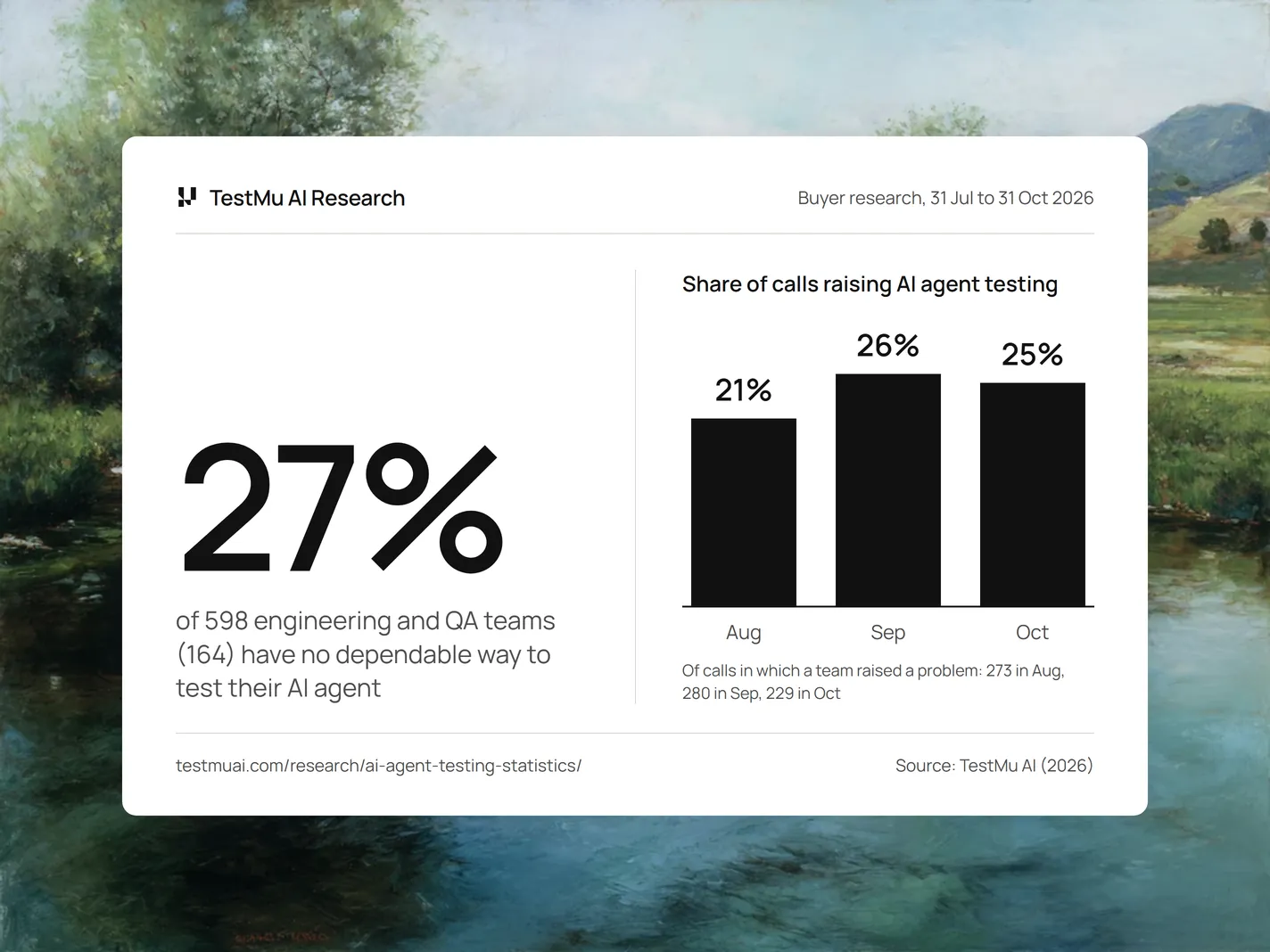
We analyzed 834 recorded calls with engineering and QA teams between 31 July and 31 October 2026. Of the 598 teams that raised a testing problem, 27% had no dependable way to test their AI agent.

Every team was already talking to an AI testing vendor, as a prospect or a customer, so the figures describe that group of buyers.
8 Key Findings on Testing AI Agents in 2026
All figures come from TestMu AI buyer research: 598 engineering and QA teams, 31 July to 31 October 2026.
27%
of 598 teams (164) said they have no dependable way to test their AI agent, the most common problem raised.
77%
of those 164 teams were prospects rather than existing TestMu AI customers.
21%, 26%, 25%
of calls raised AI agent testing in Aug, Sep and Oct, out of 273, 280 and 229 calls with a problem.
22%
of teams (134) said AI-generated tests do not understand their application or what matters in it.
16%
of teams (93) said security and compliance keep their test data and systems locked down.
13%
of teams (78) said they cannot justify the cost of AI testing or prove its return.
About 1 in 10
teams (64) brought up a coding assistant (Claude, Copilot or Cursor) when discussing test generation.
129 and 73
teams named Playwright and Jira, respectively, when they described their current stack.
19 Testing Problems Ranked by Share of 598 Teams
Problems are named the way teams put them. Share is teams raising a problem on at least one call, out of 598; a team can count in several rows.
Teams (share of 598)
We have no dependable way to test our AI agents
164 (27%)
The tests don't know our app or what matters
134 (22%)
Too much of our product is still untested
118 (20%)
We can't test all the platforms and environments we need
116 (19%)
Testing doesn't fit into the tools and release flow we already use
109 (18%)
We can't keep up with all this testing
106 (18%)
Security and compliance keep our test data and systems locked down
93 (16%)
Every UI change breaks our tests
79 (13%)
Getting realistic test data and setup ready is a struggle
79 (13%)
We can't justify the cost or prove the return
78 (13%)
We still can't automate the checks beyond basic functionality
73 (12%)
QA is fragmented and we don't have a consistent approach
73 (12%)
Runs are too slow and we can't scale them
64 (11%)
We can't tell what failed, why, or what to show others
59 (10%)
We can't carry our existing tests forward without painful migration
57 (10%)
Only a few people know how to automate tests
52 (9%)
We need a human in control before AI changes or approves tests
45 (8%)
Our test results are flaky, so we can't trust them
40 (7%)
We run too many tests and still miss the right ones
30 (5%)
Teams (share of 598)
We have no dependable way to test our AI agents
164 (27%)
The tests don't know our app or what matters
134 (22%)
Too much of our product is still untested
118 (20%)
We can't test all the platforms and environments we need
116 (19%)
Testing doesn't fit into the tools and release flow we already use
109 (18%)
We can't keep up with all this testing
106 (18%)
Security and compliance keep our test data and systems locked down
93 (16%)
Every UI change breaks our tests
79 (13%)
Getting realistic test data and setup ready is a struggle
79 (13%)
We can't justify the cost or prove the return
78 (13%)
We still can't automate the checks beyond basic functionality
73 (12%)
QA is fragmented and we don't have a consistent approach
73 (12%)
Runs are too slow and we can't scale them
64 (11%)
We can't tell what failed, why, or what to show others
59 (10%)
We can't carry our existing tests forward without painful migration
57 (10%)
Only a few people know how to automate tests
52 (9%)
We need a human in control before AI changes or approves tests
45 (8%)
Our test results are flaky, so we can't trust them
40 (7%)
We run too many tests and still miss the right ones
30 (5%)
Security, Cost and Coding Assistant Questions
Practices We Recommend for Gaps 164 Teams Named
We drew these from the gaps the 164 teams described; the calls did not measure them. Use them as criteria for any tool, including ours.
Scenarios Before Launch
Happy path, edge cases, hostile prompts, out-of-scope requests and compliance cases, each with a pass criterion.
Repeated Runs per Prompt
One pass proves little for a non-deterministic agent, so compare the spread of answers across many runs.
Real-World Conditions
Voice: accents, interruptions, silence, bad lines and transfers. Chat: long sessions, pasted files, language switches.
Verified Agent Actions
Check that the agent called the tool, updated the record or booked the slot, beyond what its reply says.
Regression on Every Change
The suite re-runs whenever a prompt or model changes, the way code is tested on every commit.
Human-Approved Test Changes
A person reviews every change to a test, including a healed step, before it lands.
Sign-Off Evidence
Transcripts, recordings and a one-page summary that a product owner, security team or client can sign off.
Agent Testing Scenarios
Agent Testing generates scenarios from your documents and tests chat, voice, phone, video and image agents.
Cite or Embed AI Agent Testing Statistics
Copy the citation, two quotable figures or the chart embed code. The embed links back to this page.
Method
How We Analyzed 834 Calls for AI Agent Testing Data
We analyzed 834 recorded sales and customer calls with engineering and QA teams between 31 July and 31 October 2026, each with at least two minutes of discussion about AI-assisted testing. In 782 of those calls the team raised at least one testing problem, and those calls are the base for the monthly shares: 273 in August, 280 in September and 229 in October.
598 teams raised at least one testing problem in their own words. Analysts, with machine assistance, extracted 2,405 problem statements and grouped them into 19 recurring problems. A team counts once per problem, however many calls it raised that problem on.
The sample covers only teams already talking to an AI testing vendor, as prospects or customers, which limits what it says about the wider market. Survey data from testers, developers and QA leaders in the TestMu AI community is in the State of AI in Quality Engineering 2026. The seven practices are our recommendations, drawn from the gaps teams described. Comments are paraphrased for clarity and anonymity and attributed by role and sector only; calls were recorded with notice. To ask about or remove a comment, email press@testmuai.com.
Last updated
2 November 2026
Sample
834 calls and 598 teams, 31 July to 31 October 2026
Reuse
CC BY 4.0, with the citation below
Cite as: TestMu AI (2026). AI Agent Testing Research 2026: buyer research from 834 recorded calls, 31 July to 31 October 2026. https://www.testmuai.com/research/ai-agent-testing-statistics/
Aggregate figures may be reused under CC BY 4.0 with this citation. The same figures are available as a plain-text file.
Changelog: 2 November 2026, first edition, covering calls from 31 July to 31 October 2026. We refresh this research each quarter from the next period of calls, and this page keeps its address.
Asad Khan is Co-Founder & CEO of TestMu AI, with 15+ years in software testing and quality engineering. For voice and chat agents, see voice agent testing and chatbot testing.
TestMu AI for Enterprise
Get access to solutions built on enterprise-grade
security, privacy, & compliance
- Advanced access controls
- Advanced data retention rules
- Advanced Local Testing
- Premium Support options
- Early access to beta features
- Private Slack Channel
- Unlimited Manual Accessibility DevTools Tests
9 Comments From Teams Without AI Agent Tests
Nine paraphrased comments from teams without a dependable way to test their agent, which we grouped into three themes: testing by hand, results teams cannot trust, and hard cases that are not written down. Each is attributed by role and sector.
QA Leader, Consumer Internet
Their team tests the bot by hand: someone calls it and checks whether it picked up and whether it answered.
QA Leader, Consumer Services
Before launch, one QA engineer takes calls from the bot and notes what happened, and that is the test.
AI Practice Lead, Enterprise Software
The team got stuck when it delivered to a customer, because it had no testing for AI agents at all.
Contact Center Tech Lead, Telecom
The same question gets a different answer each time, from an agent that talks to live customers.
QA Leader, Health Insurance
Wants to know how to test the agent, and how to say it works, when its output is not deterministic.
Director of QA, Digital Agency
Some tools keep correcting a test until it passes, which they do not want when the failure is real.
Solutions Architect, Enterprise Software
Their team covers the happy path, while edge cases and red teaming get less attention.
Test Engineer, Manufacturing
The questions a tool generated for their agent were generic enough to fit any agent.
Engineering Lead, Software
A few dozen scenarios do not cover an agent: they need hundreds, and a way to see what is still missing.