
Author End-to-End Tests in Natural Language with KaneAI
Plan, Author, and Evolve E2E Tests for Web and Mobile Apps in Natural Language.

Escaped Defects: How to Measure and Reduce Defect Escape Rate
Escaped defects are bugs users find after release. Get the defect escape rate formula, a worked example, root causes and six steps to catch them earlier.
Published on:
Escaped defects are bugs that reach users after a release instead of being caught before it. Defect escape rate is the share of a release's defects found after release: post-release defects divided by all defects for that release, times 100. Track it per release and fix the stage each escape slipped past.
TL;DR
Defect escape rate = defects found after release ÷ all defects for that release × 100. Track it per release with a 30-day window and a severity split. In our review of 834 recorded calls (31 July-31 October 2026), 118 of 598 teams on those calls said too much of their product was still untested. This guide shows how to measure that gap and close it.
What Is the Difference Between Defect Leakage and Defect Escape Rate?
- Defect escape rate formula: Post-release defects ÷ (pre-release defects + post-release defects) × 100. A release with 46 defects caught before release and 4 found in the 30 days after it has an 8% defect escape rate.
- Defect leakage formula: Defects found in a later phase ÷ defects found in the earlier phase × 100, such as UAT defects ÷ system test defects. Some teams use defect leakage to mean escaped defects instead, so write the formula next to the number.
How Do You Reduce Escaped Defects?
- Stage tags: Tagging every production bug with the stage that should have caught it (unit, integration or API, end-to-end, or no reasonable test) shows which test stage lets escaped defects through.
- Regression test per escape: A regression test written from the ticket's acceptance criteria, and confirmed to fail on the release that shipped the bug, stops that escape from recurring. KaneAI by TestMu AI turns a bug's user flow, written in plain English, into a test you can run on every release.
Is Defect Escape Rate a DORA Metric?
- Change fail rate: No, defect escape rate is not a DORA metric. DORA's related metric is change fail rate, which counts deployments that need immediate intervention, often a rollback or hotfix, so a release can have escapes without being a failed change.
What Are Escaped Defects?
An escaped defect is a bug found after the code it lives in was released, usually by a customer, support, monitoring or an internal user in production. The word "escaped" means every check before release had a chance to catch it and none did.
Three decisions define what counts as escaped. Agree on all three before you report a number:
| Decision | Common choice | Why it matters |
|---|---|---|
| Where it was found | Production (or the first environment real users touch) | A bug found in UAT is a late catch. It only counts as an escape if UAT is your release gate |
| Time window | 30 days after the release date | Without a window, old releases keep collecting escapes forever |
| Which bugs count | Confirmed defects, severity tagged; exclude feature requests and duplicates | Mixing requests into the count inflates the rate and hides real misses |
An escaped defect is not the same as a hotfix. A hotfix is one response to an escape. Many escapes are minor and wait for the next release.
How Do You Calculate Defect Escape Rate?
Defect escape rate is the percentage of a release's confirmed defects that were found after release.
Defect escape rate (%) = defects found after release ÷ (defects found before release + defects found after release) × 100
Count both sides for the same release and the same time window.
Worked example (illustrative numbers). Release 4.2 ships on 1 March. Before release, unit tests, CI, QA and UAT found 46 confirmed defects. In the 30 days after release, users and monitoring reported 4 more.
| Input | Count |
|---|---|
| Found before release | 46 |
| Found after release (30-day window) | 4 |
| Total for release 4.2 | 50 |
| Defect escape rate | 4 ÷ 50 × 100 = 8% |
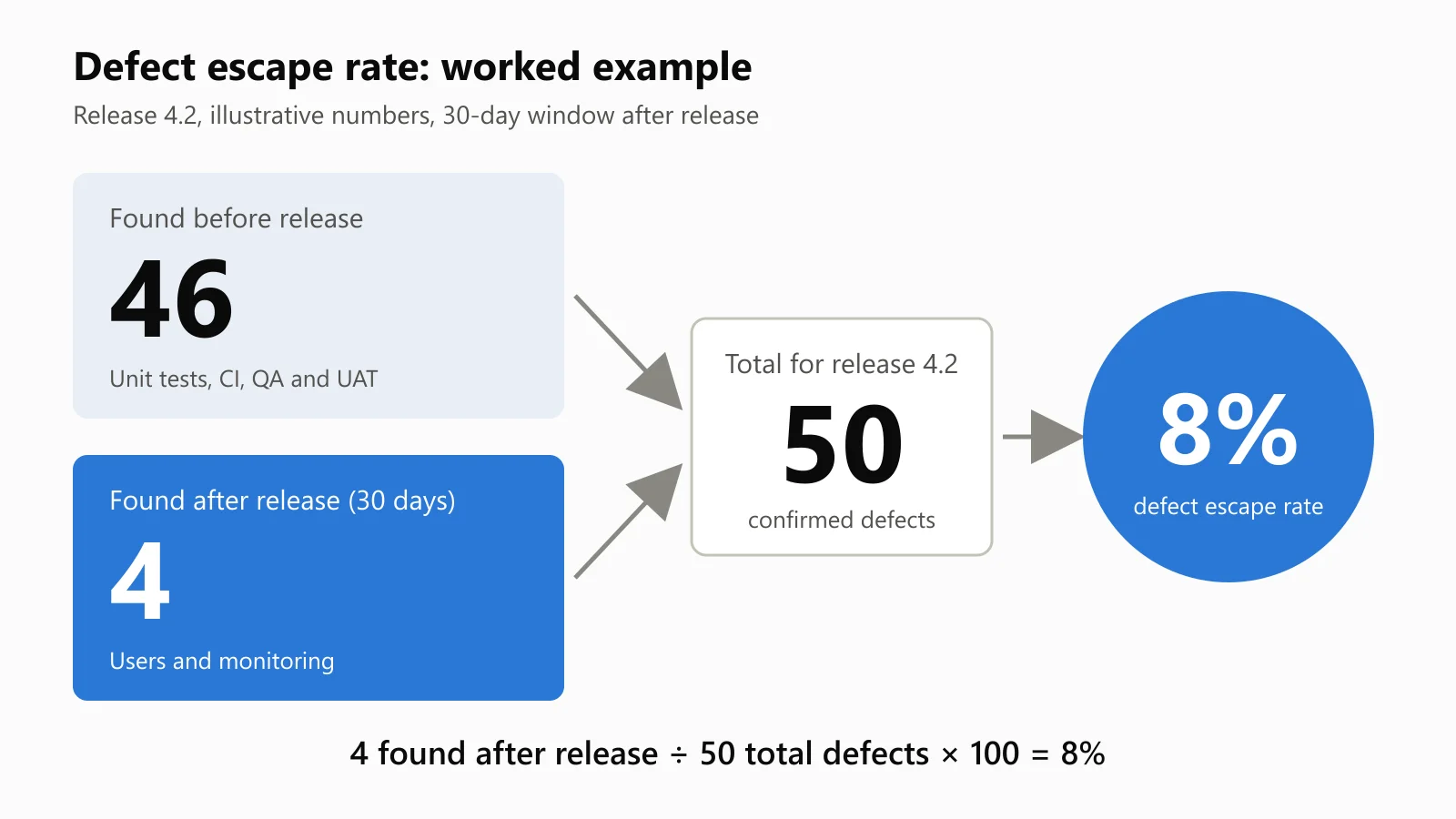
Now split the 4 escapes by severity. One critical escape and three cosmetic ones tell a different story from four critical ones, even though the rate is the same 8%. Report the rate and the severity split together.
Defect Leakage vs Defect Escape Rate
Defect leakage has two common definitions. Some teams use it as a synonym for escaped defects (bugs that reach production). Others use it for bugs that slip from one internal phase to the next, such as system test to UAT.
Defect escape rate always means bugs that reach users. Pick one meaning and write the formula next to the number.
| Metric | Typical formula | Measures | Use it for |
|---|---|---|---|
| Defect escape rate | Post-release defects ÷ all defects for the release × 100 | Misses that reached users | Release quality, trend over time |
| Defect leakage (phase) | Defects found in a later phase (e.g. UAT) ÷ defects found in the earlier phase (e.g. system test) × 100 | Misses between internal phases | Spotting a weak test phase |
| Defect leakage (post-release variant) | Post-release defects ÷ pre-release defects × 100 (can exceed 100%) | Same misses as escape rate, different denominator | Comparing with teams that report it this way |
| Change fail rate (DORA) | Deployments that need immediate intervention ÷ all deployments | Releases that needed a rollback or hotfix | Delivery stability across teams |
Defect escape rate and DORA's change fail rate answer different questions. One release can ship with three minor escapes and no rollback, so its escape rate is above zero while its change fail rate is zero.
What Is a Good Defect Escape Rate?
There is no universal good defect escape rate. Products, release sizes and bug-reporting habits differ too much for a cross-company benchmark to mean anything. Use your own trend instead.
You will see bands such as "under 10% is excellent" on vendor blogs. None we found cite the data behind them, so treat them as rules of thumb, not benchmarks.
- Compare a release with your last six. A rising rate over three releases is a signal; one bad release may be noise.
- Weight by severity. A falling rate with rising critical escapes is getting worse.
- Watch for a suspiciously low rate. If almost nothing escapes, check that support tickets and monitoring alerts are actually being logged as defects.
Why Do Bugs Escape When the Test Suite Is Green?
Bugs escape a green test suite when the tests never exercise the broken path, or when they exercise it but assert the wrong thing. A pass only proves that the checks you wrote passed.
| Root cause | Signal you'll see | Fix |
|---|---|---|
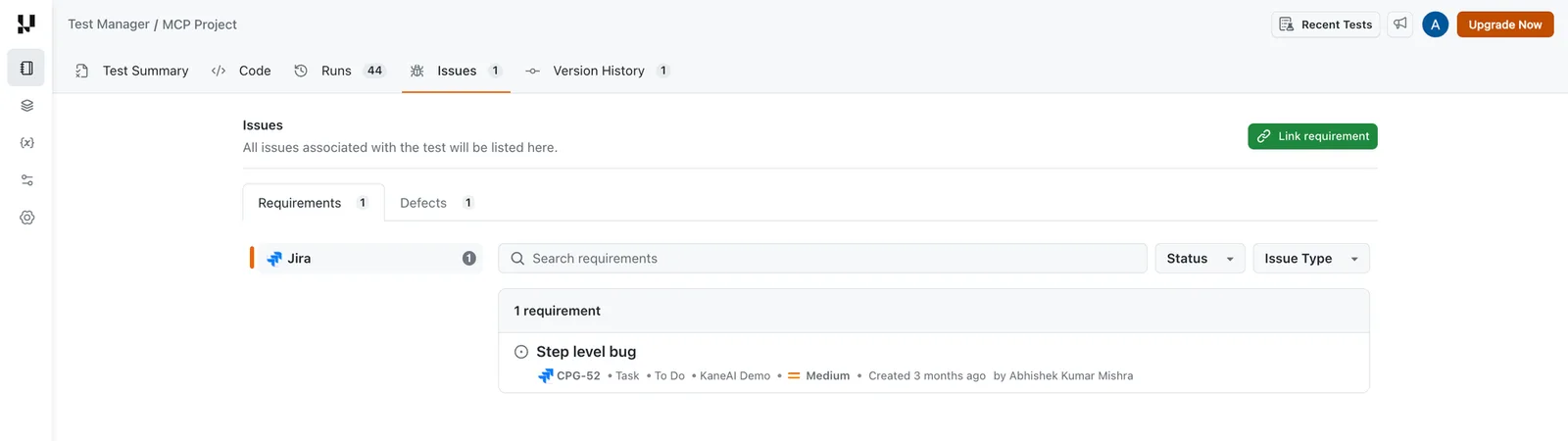
| Untested paths | Escapes cluster in flows no test touches (settings, rare roles, error states) | Map tests to requirements and look for uncovered rows (test coverage); TestMu AI Test Manager shows covered and uncovered requirements per release |
| Tests that encode the bug | A test passes on the buggy code and fails after the fix | Write the test from the spec or acceptance criteria, not from the code. Check with mutation testing |
| Muted or skipped flaky tests | The escaped flow had a test that was quarantined weeks ago | Review the muted list every release; fix or delete, don't leave it silent (flaky tests) |
| Skipped regression runs | Escapes appear in old features after an unrelated change | Run the regression set on every merge, or at least before every release (regression testing) |
| Environment gaps | The bug only happens on one device, browser, OS version or data shape | Add that environment or data shape to the matrix for the affected flow |
| No gate before merge | Code reaches main with no automated check | Add a CI gate on the critical-path suite |
Martin Fowler made the coverage point years ago: a high coverage number says little about how good your tests are, and treating it as a target invites weak tests (Test Coverage, 2012). Escaped defects are the number that tells you whether the tests that exist are the right ones.
AI-Generated Tests Make the "Encode the Bug" Problem Worse
AI-generated tests often copy the behaviour of the code they read, including its bugs. In a TestMu AI experiment with six seeded bugs, 22 of 60 test suites generated from the buggy code (37%) passed on the bug. When the model saw only the documented contract, 0 of 60 suites passed on the bug (full method and results).
Generate tests from the spec, then confirm each new test fails on the broken version.
What Do 834 Customer Calls Say About Escaped Defects?
TestMu AI reviewed 834 recorded sales and customer calls with engineering and QA teams between 31 July and 31 October 2026, each with at least two minutes on AI-assisted testing. In those calls, 598 teams raised at least one testing problem in their own words; the counts below are teams out of those 598, and a team counts once per problem. Every team was already talking to an AI testing vendor, as a prospect or customer, so the figures describe buyers who were already shopping.
- 118 of 598 teams (20%) said too much of their product was still untested. It was the third most common of 19 problems (full ranking).
- Teams without CI tests reported more escapes. In TestMu AI's separate State of AI in Quality Engineering 2026 survey, 49% of teams that rely mainly on a QA hand-off with no CI tests said escaped defects were rising, compared with 38% of teams with CI tests (report). Respondents are TestMu AI community members, and the sample leans towards India-based and SaaS teams, so read this as an association within that group, not proof.
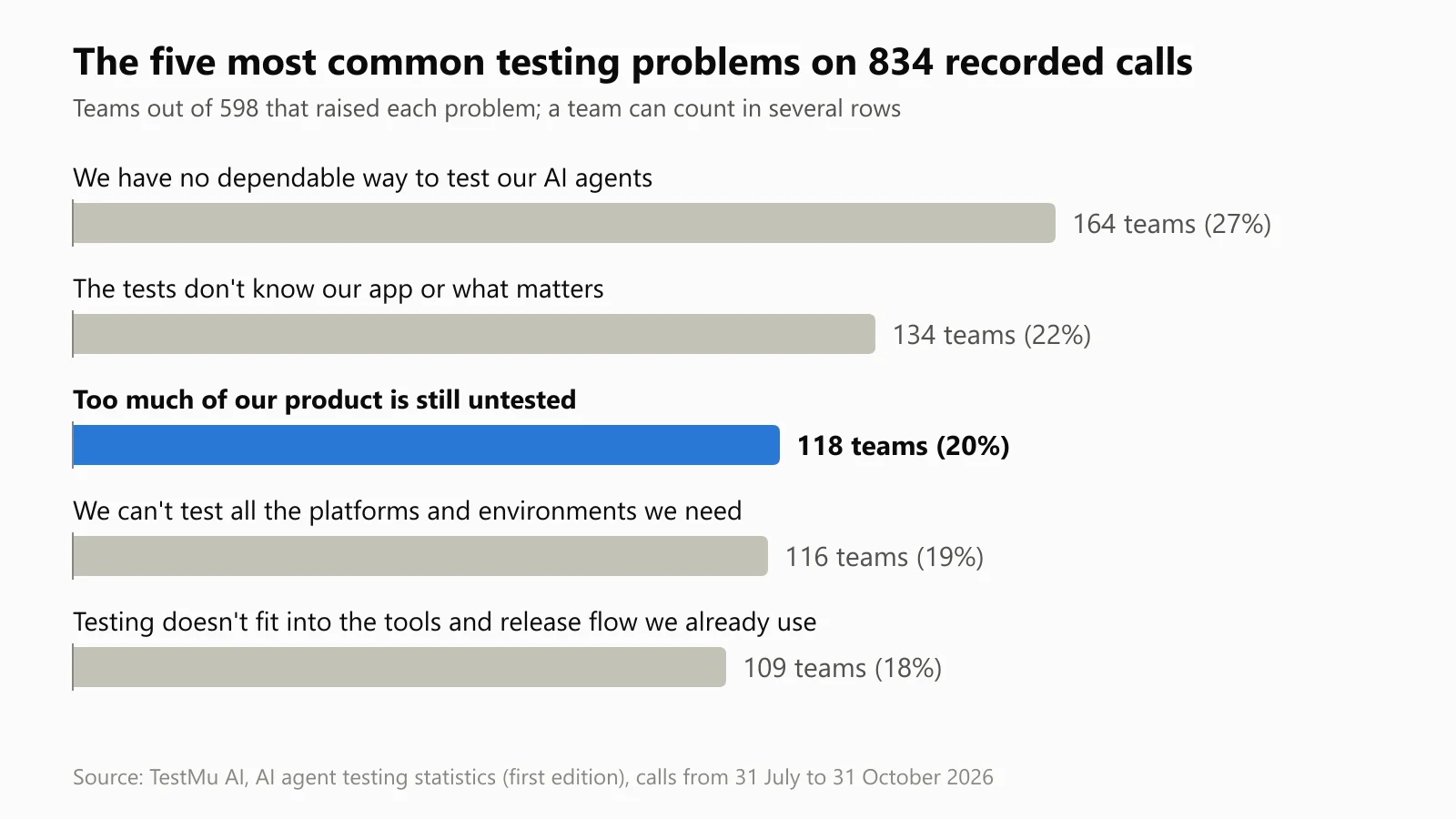
In TestMu AI's call data, the five most common problems were no dependable way to test AI agents (164 teams), tests that don't know the app (134), too much of the product still untested (118), platforms and environments teams can't test (116), and testing that doesn't fit existing tools and release flow (109).
How to Reduce Escaped Defects in 6 Steps
These steps turn each escape into a regression test and a process fix, whatever framework your suite uses.
- Write down your definition. Production only or first user-facing environment; 30-day window; confirmed defects with severity. Put it at the top of the dashboard.
- Tag every production bug with the stage that should have caught it. Use four tags: unit, integration or API, end-to-end, and "no test could reasonably catch this". Decide the tag as a team in triage; it records a gap in the process (defect triage).
- Calculate the rate per release and plot six releases. Show severity next to it. Share it in the release review as well as the QA report.
- Find the root cause of each escape. Was the path untested, the assertion wrong, the test muted, or the environment missing? Use the root-cause table above as your categories.
- Add a regression test for every escape, written from the spec. Start from the ticket's acceptance criteria. Confirm the test fails on the release that shipped the bug, then passes on the fix.
- Gate the next release on those tests. Add the new test to the suite that runs before merge or before release. An escape that recurs after it has a test is a process problem to raise in the retro.

Try it on your next escape
Note: Describe the bug's user flow in plain English and let KaneAI turn it into a test you can run on every release. Turn your last escaped bug into a regression test with KaneAI. Start free.
Tracking Escaped Defects in TestMu AI
The steps above map to these TestMu AI features. The descriptions come from the live product pages and docs.
| Step | TestMu AI feature | What it does (from the product page) |
|---|---|---|
| Find untested requirements | Test Manager | Maps each test case to a requirement, module and priority, and shows which cases are covered, uncovered, manual or automated |
| Tag and file escapes | Test Manager AI bug filing | When a test fails, files a bug with steps, screenshots and the run clip to Jira, Azure DevOps or GitHub; status syncs back |
| Root-cause each failure | AI Root Cause Analysis | Assigns a failure category (for example App Bug or Product Bug) and a root cause, shown alongside the stack trace, logs and screenshots. The doc notes results can be wrong and asks for feedback |
| Write the regression test | KaneAI | Turns a Jira ticket, PRD, PDF, screenshot or spreadsheet into structured test cases; tests are written in natural language and can export to Selenium, Playwright or Appium |
| Catch flaky checks before they hide escapes | HyperExecute | Scores how often each test flips over its last 10 runs (default flake threshold 20%) and mutes tests that fail five times in a row. Review that muted list each release |
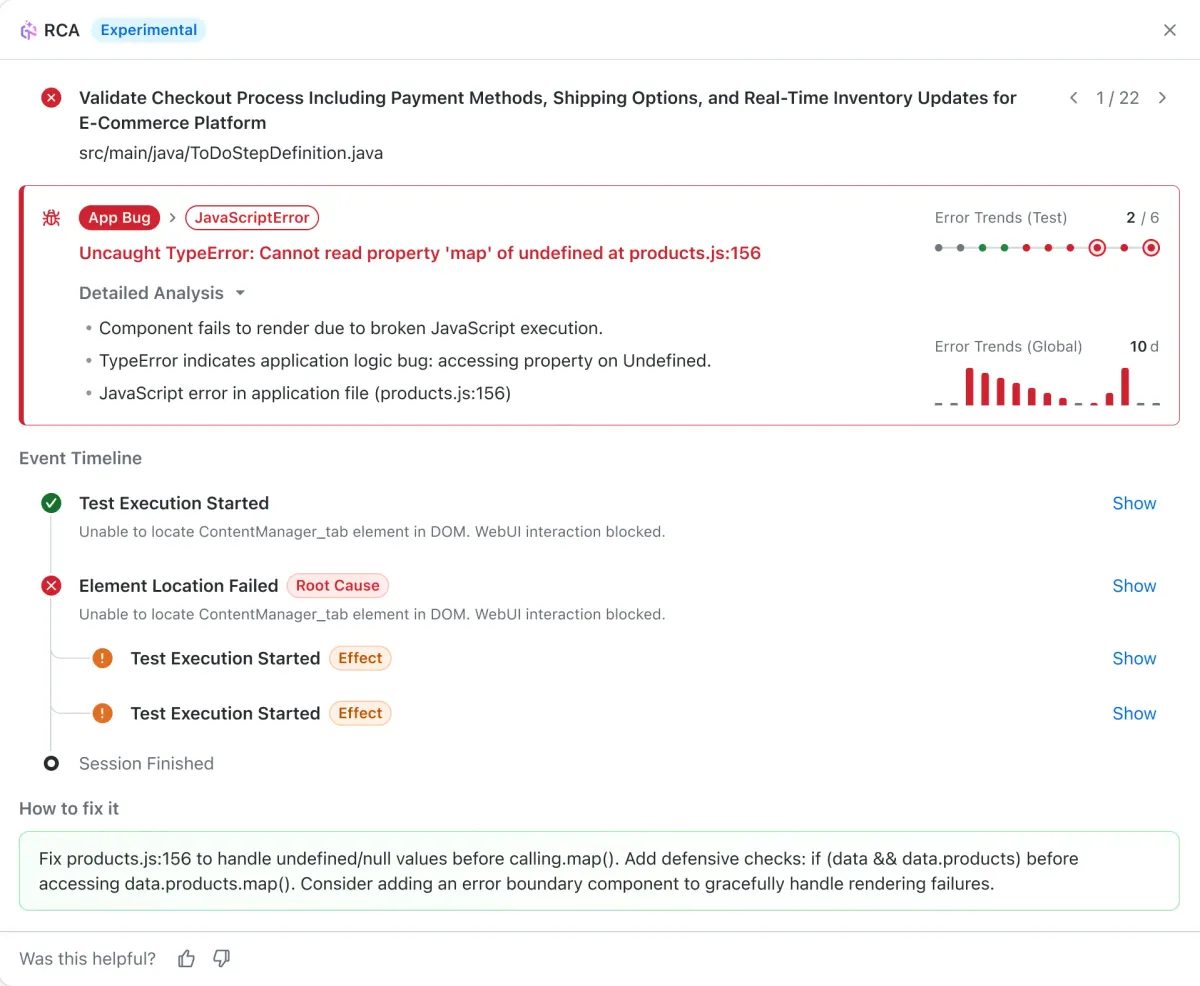
Your bug tracker stays the system of record. TestMu AI files to it and reads from it, and Jira or Azure DevOps stay where they are.

Where Defect Escape Rate Misleads (and When to Use Something Else)
Defect escape rate is a lagging, release-level number. It breaks in a few predictable places:
- Small releases. One escape in a release with five total defects reads as 20%. Use a rolling three-release rate for small teams.
- Reporting incentives. If the rate becomes a target for one team, escapes get relabelled as "feature requests". Keep triage cross-functional.
- Low usage. A new feature with few users will show few escapes. Low usage hides escapes, so a quiet new feature tells you little.
- It doesn't tell you where to look. Pair it with the stage tags from step 2, or the number has no action attached.
- AI agents and chatbots. A wrong answer from a support bot is often not filed as a defect at all. For conversational agents, measure conversation quality before launch instead, for example with AI agent testing.
- Delivery stability. If leadership wants one number across many teams, DORA's change fail rate is the more standard choice. Use escape rate inside QA to direct the work.
Conclusion
Start with your last release: count the confirmed defects found before it shipped and the ones found in the 30 days after, then tag each escape with the stage that should have caught it. Write a regression test for the most severe escape from its ticket's acceptance criteria, and gate your next release on it.
Testing web or mobile apps without writing code? KaneAI by TestMu AI turns plain-English instructions into tests.
Author

Himanshu Sheth
Blogs: 164


Himanshu Sheth is the Director of Marketing (Technical Content) at TestMu AI, with over 8 years of hands-on experience in Selenium, Cypress, and other test automation frameworks. He has authored more than 130 technical blogs for TestMu AI, covering software testing, automation strategy, and CI/CD. At TestMu AI, he leads the technical content efforts across blogs, YouTube, and social media, while closely collaborating with contributors to enhance content quality and product feedback loops. He has done his graduation with a B.E. in Computer Engineering from Mumbai University. Before TestMu AI, Himanshu led engineering teams in embedded software domains at companies like Samsung Research, Motorola, and NXP Semiconductors. He is a core member of DZone and has been a speaker at several unconferences focused on technical writing and software quality.
Reviewer

Harshit Paul
Reviewer
Harshit Paul is Director of Product Marketing at TestMu AI, with over 8 years of experience in product and growth marketing for developer and QA tools, leading the Agentic AI in Quality Engineering space. He has authored 80+ technical articles for TestMu AI on software testing and automation, and hosted webinars on Selenium, automation testing, browser compatibility, DevOps, and continuous testing. He has led go-to-market and technical marketing initiatives across software testing products, contributing to SEO, content strategy, and developer marketing. He began his career as a certified Salesforce developer at Wipro Technologies, where he worked for 2 years before moving into marketing. Harshit holds a degree in computer programming from Vivekananda Institute of Professional Studies.


Escaped Defects FAQs
Did you find this page helpful?
More Related Learning Hubs








TestMu AI forEnterprise
Get access to solutions built on Enterprise
grade security, privacy, & compliance
- Advanced access controls
- Advanced data retention rules
- Advanced Local Testing
- Premium Support options
- Early access to beta features
- Private Slack Channel
- Unlimited Manual Accessibility DevTools Tests