

Power Your Software Testing with AI Agents and Cloud
The Native AI-Agentic Cloud Platform to Supercharge Quality Engineering. Test Intelligently and Ship Faster.


- TestMu AI (Formerly LambdaTest)
- /
- Learning Hub
- /
- What is Agile Transformation? Benefits, Roadmap, and Examples
What is Agile Transformation? Benefits, Roadmap, and Examples
Learn what Agile Transformation is, its benefits, roadmap steps, tools, and real-world examples to help your organization scale agility enterprise-wide.
Last Updated on:
On This Page
- What is Agile Transformation
- What are the Benefits of Agile Transformation
- How to Build an Agile Transformation Roadmap (Step-by-Step)
- Agile Transformation Frameworks and Models
- SAFe & Disciplined Agile Roadmaps
- Role of Leadership
- Realistic Transformation Timeline
- Transformation Checklist
- Agile Transformation vs. Agile Adoption vs. Digital Transformation
- Agile Transformation Strategy
- Agile Transformation Tools and Technologies
- Common Challenges in Agile Transformation (and How to Overcome Them)
Agile transformation is the process of transitioning an entire organization to a nimble, adaptive way of working rooted in Agile principles. In simple terms, it's about shifting a company’s culture, processes, and mindset from traditional top-down methods to more collaborative, flexible, and customer-focused approaches.
This transformation goes far beyond just adopting a new software development process; it involves every department and team, not just IT or development, embracing the values of the Agile Manifesto (e.g., individuals and interactions over processes, responding to change over following a plan).
The goal of an Agile transformation is to infuse agility into the organization’s DNA, enabling quicker responses to change, continuous innovation, and better alignment with customer needs.
TL;DR
- Agile transformation reshapes an organization's culture, structure, and ways of working, spanning the whole enterprise rather than only development teams.
- Short agile sprints and regular feedback loops cut time-to-market and keep products aligned with real user needs.
- SAFe publishes a 13-step Implementation Roadmap, while Disciplined Agile lets teams choose context-fitting practices rather than following one prescribed process.
- Leaders drive agile transformation by moving from command-and-control to servant leadership, decentralizing decisions and modeling agile behaviors themselves.
- Enterprise-wide transformation runs for years, so progression is better tied to maturity milestones and measurable outcomes than to calendar dates.
- Nearly half of agile transformations struggle or fail, commonly because of resistance to change, leadership misalignment, or ceremonies without cultural change.
What is Agile Transformation
Agile transformation is the process of reshaping an organization’s culture, structure, and ways of working so it can become more adaptive, customer-focused, and value-driven.
Unlike simple agile adoption, where only project teams apply Scrum, Kanban, or other agile methods, agile transformation involves the entire enterprise, from leadership to delivery teams.
It changes how decisions are made, how teams collaborate, and how value is delivered to customers. The ultimate goal is to make the organization more resilient, innovative, and fast-moving in a constantly shifting business landscape.
Agile Transformation Examples:
Real-world cases show how diverse organizations apply agile transformation:
- Microsoft: Transitioned from a traditional hierarchical model to an agile approach with smaller, empowered squads. This helped accelerate software delivery and made the company more competitive in the cloud era.
- ING Bank: Adopted agile at scale across its workforce, restructuring into cross-functional squads. This reduced time-to-market for digital products and improved customer experience.
- Salesforce: In 2006, Salesforce shifted its R&D from Waterfall to Scrum, using an “Educate Without Enforcing” approach that aligned agile principles with its core values of trust, innovation, and customer success.
What are the Benefits of Agile Transformation
Agile transformation provides a wide range of business, technical, and cultural benefits:
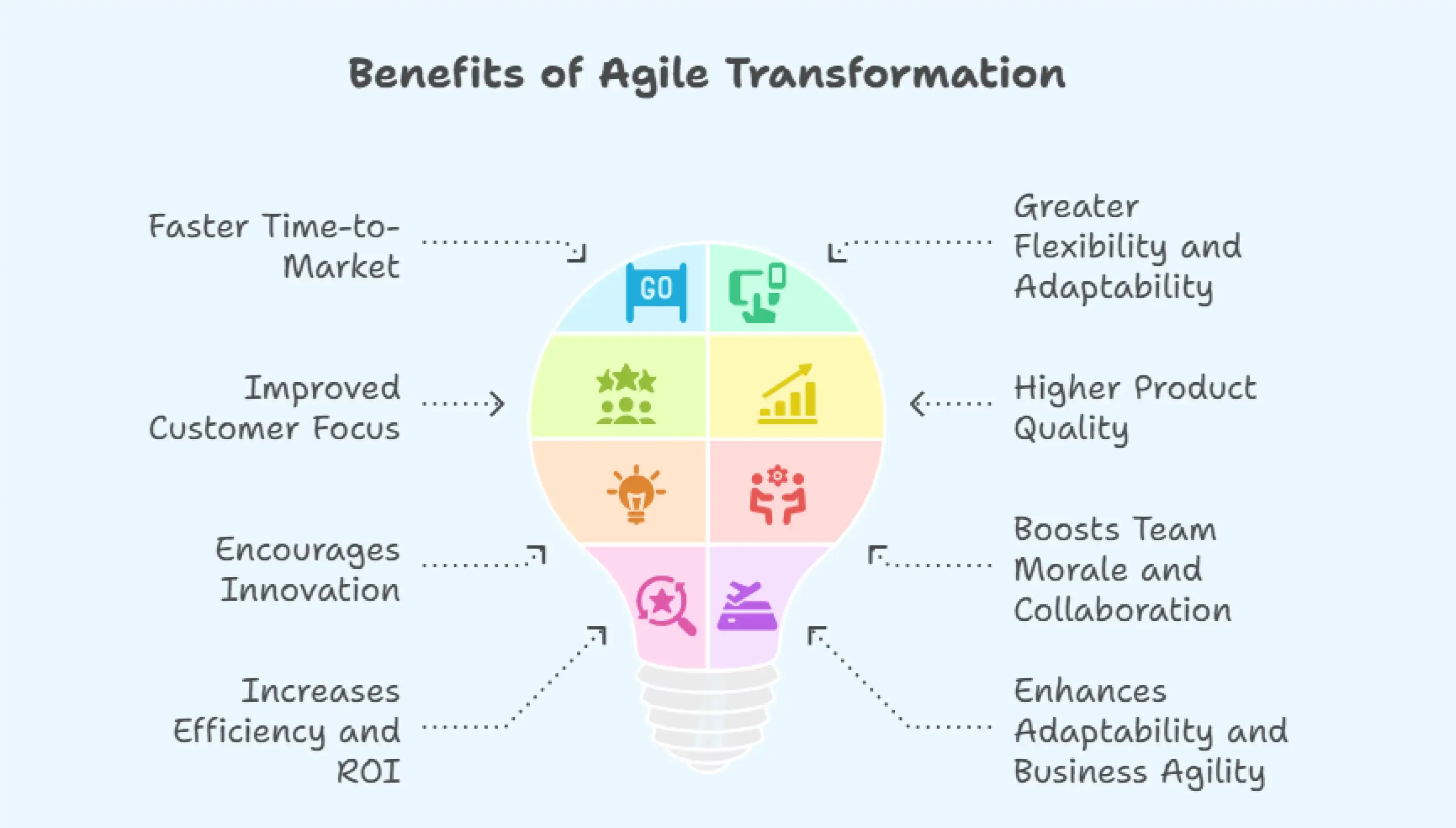
- Faster Time-to-Market: Agile teams deliver value in smaller increments instead of waiting months or years. Short cycles (sprints or iterations) enable quicker releases, faster validation, and early customer feedback.
- Greater Flexibility and Adaptability: Agile organizations can pivot in response to customer feedback, new technologies, or market disruptions without derailing long-term plans. This adaptability ensures continuous relevance.
- Improved Customer Focus: Regular feedback loops keep development aligned with real user needs. By involving customers throughout the process, teams create products that truly match expectations, boosting satisfaction and loyalty.
- Higher Product Quality: Agile emphasizes iterative development, continuous testing, and integration. Issues are caught earlier, rework is reduced, and quality becomes a shared responsibility across teams.
- Encourages Innovation: Agile cultures welcome experimentation. Teams are free to try new ideas, learn quickly from feedback, and adjust continuously, driving both innovation and customer-centric solutions.
- Boosts Team Morale and Collaboration: Agile shifts organizations away from command-and-control structures. Cross-functional teams gain autonomy, share ownership of outcomes, and self-organize, leading to stronger engagement and higher morale.
- Increases Efficiency and ROI: By eliminating wasteful practices and focusing on high-value work, agile organizations maximize returns. Lean principles and outcome-based metrics ensure resources are invested where they create the most impact.
- Enhances Adaptability and Business Agility: Agile transformation extends beyond IT into marketing, HR, and operations. This enterprise-wide agility allows organizations to remain productive and aligned with business goals, even during disruptions.
How to Build an Agile Transformation Roadmap (Step-by-Step)
Starting agile transformation without a roadmap is like sailing without a compass. While plans evolve, a clear roadmap provides alignment, direction, and measurable progress. Here’s a step-by-step guide you can adapt.
1. Outline Your Goals and Vision
Start by defining what you want to achieve with agile transformation. Identify pain points such as long release cycles, inconsistent quality, or slow responses to customer feedback. Then set measurable goals, for example: a company cut release cycles from quarterly to weekly, boosting customer engagement and satisfaction.
Create a vision statement that communicates the “why” and share it widely to build alignment.
2. Design an Evolutionary Roadmap
Map out high-level phases over months or years. Typical phases include:
- Initiation: Form a transformation team, select pilot projects.
- Pilot Execution: Test agile practices with one or two teams.
- Scaling: Expand agile to multiple teams or departments.
- Enterprise Integration: Align HR, finance, and governance with agile ways of working.
Keep it evolutionary, not a big bang. Treat it as a living document that evolves with feedback.
3. Secure Leadership and Build a Transformation Team
Transformation requires leadership commitment. Form a cross-functional leadership team that includes:
- An executive sponsor (C-level or VP) accountable for success.
- An agile transformation leader or coach.
- Influential department heads and product leaders.
Many organizations set up an agile center of excellence to drive best practices, training, and governance. Leadership should also secure resources (time, tools, training) to sustain the change.
4. Communicate the Vision and Educate the Organization
Change succeeds when people understand it. Communicate transparently through town halls, newsletters, and Q&A sessions. Address concerns and highlight early wins.
At the same time, invest in training. Offer leadership workshops, Scrum or Kanban training, and agile coaching. Encourage interactive sessions where teams practice agile ceremonies. Continuous learning, not one-time training, is key.
5. Start with Pilot Teams or Projects
Choose one or two teams as pilots. Support them with an experienced agile coach and let them run a few sprints. Learn from successes and challenges:
- Showcase wins to build credibility.
- Identify blockers (e.g., approvals, dependencies).
- Use retrospectives to refine processes before scaling.
6. Scale the Transformation
Once pilots succeed, expand agile to more teams and departments. Standardize where needed (e.g., sprint length, tools like Jira), but remain flexible to team contexts. Introduce practices like Scrum of Scrums or PI Planning for cross-team alignment.
7. Embed Agile into Organizational Functions
For agile to stick, supporting functions must adapt:
- HR: Shift performance reviews to team outcomes and agile roles.
- Finance: Move from annual fixed budgets to flexible, rolling funding.
- Governance: Simplify approvals and empower teams.
Without these changes, agile teams risk being slowed down by old structures.
8. Continuously Communicate and Manage Change
Keep employees engaged with regular updates, feedback channels, and recognition of milestones. Celebrate progress while being transparent about challenges. Agile transformation is as much about people as processes, supporting them through the change.
9. Measure Success and Iterate
Define metrics aligned with your goals: deployment frequency, lead time, defect rates, CSAT, and employee engagement. Compare pre- and post-transformation data, run retrospectives on the transformation itself, and adjust your approach as you learn.

Note: Use this Agile transformation checklist as your step-by-step guide to drive a successful agile transformation. See the Agile Transformation Checklist!
Agile Transformation Frameworks and Models
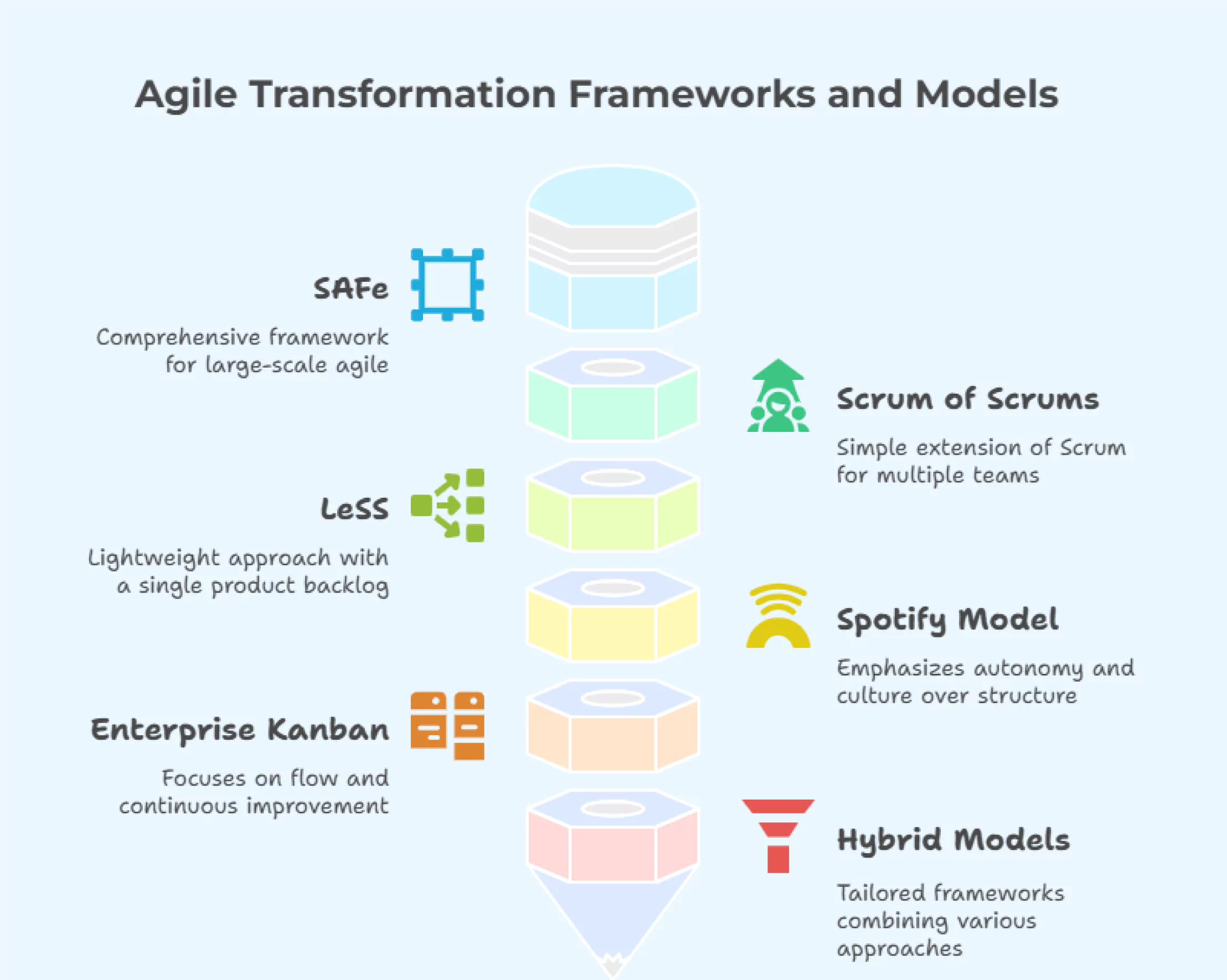
Scaling agile in large enterprises requires frameworks that help multiple teams coordinate while staying aligned with business goals. Here are the most common ones:
1. Scaled Agile Framework (SAFe)
Widely used for enterprise agile, SAFe introduces agile Release Trains (teams-of-teams), Planning Intervals (PIs), and portfolio roles to align large groups. It’s comprehensive but can feel heavy if applied rigidly.
2. Scrum of Scrums / Nexus
Simple extensions of Scrum for multiple teams. Scrum of Scrums uses team representatives to sync regularly, while Nexus adds lightweight structures like a Nexus Integration Team for dependency management.
3. Large-Scale Scrum (LeSS)
LeSS emphasizes “more with less.” It keeps Agile lightweight by using a single product backlog, one Product Owner, and cross-functional feature teams that can deliver end-to-end value. It comes in two variants:
- LeSS: Up to 8 teams.
- LeSS Huge: For larger organizations, introducing Requirement Areas to manage complexity.
4. Spotify Model
Inspired by Spotify’s culture, this model is descriptive rather than prescriptive. Teams are organized into Squads (like Scrum teams), grouped into Tribes, supported by Chapters (cross-squad functional groups), and connected through Guilds (communities of interest).
The model emphasizes autonomy, trust, and culture over rigid structure. Many organizations adopt elements of it, but must remember that Spotify’s success was as much about culture as frameworks.
5. Enterprise Kanban
Scales agile by visualizing work across value streams with portfolio boards, focusing on flow, limiting work in progress, and continuous improvement over strict roles or ceremonies.
6. Hybrid Models
In practice, many enterprises use hybrid approaches, Scrum at the team level, Kanban for support functions, and SAFe or custom governance at the portfolio level. The key is to tailor the framework to the organization’s domain, size, and culture, creating a custom playbook that evolves over time.
Industry-Standard Agile Transformation Roadmaps: SAFe and Disciplined Agile (DA)
Rather than inventing a transformation path from scratch, most enterprises adopt one of two established, structured roadmaps and adapt it to their context.
SAFe Implementation Roadmap
The Scaled Agile Framework (SAFe) publishes a 13-step Implementation Roadmap that sequences the change, running from reaching the tipping point and training lean-agile change agents through launching Agile Release Trains and extending the change to the portfolio. Its value is a defined order of operations for a large organization.
Disciplined Agile (DA) Transformation Roadmap
Disciplined Agile (DA), now part of the Project Management Institute, takes a "choose your way of working" approach. Instead of one prescribed process, its transformation roadmap guides teams through context-driven decisions, selecting practices that fit their situation rather than forcing a single framework. It suits organizations that want structure without the rigidity of a fixed model.
Leaning on an established roadmap like SAFe or DA prevents teams from reinventing the wheel and gives leadership a proven reference for sequencing the change.
The Role of Leadership in Driving Agile Transformation
Agile transformation fails when leaders mandate agile behaviors without changing their own. The shift is from traditional command-and-control management to servant leadership, where executives and middle managers clear obstacles and enable teams rather than direct every decision.
- Foster psychological safety: teams only surface risks, admit failures, and experiment when it is safe to do so. Leaders set that tone by responding to bad news with curiosity instead of blame.
- Decentralize decision-making: push authority down to the teams closest to the work, so decisions are fast and informed rather than queued for approval.
- Model agile behaviors: leaders who attend reviews, respect sprint boundaries, and adapt plans based on feedback signal that agile is real, not a slogan. Actions carry more weight than a mandate.
- Manage the human change: use a structured change model such as ADKAR (Awareness, Desire, Knowledge, Ability, Reinforcement) to move people through the transition deliberately.
What Is a Realistic Agile Transformation Timeline?
Enterprise agile transformation is a multi-year journey, not a project with a fixed end date. A common mistake is treating it as a time-bound program that "finishes." A more resilient approach uses a trigger-event-driven timeline, where progression to the next phase is dictated by reaching specific maturity milestones and measurable outcomes rather than a calendar date.
| Aspect | Fixed-Date Timeline | Trigger-Event-Driven Timeline |
|---|---|---|
| Progression rule | Move to the next phase on a set date | Move when a maturity milestone or outcome is met |
| Risk | Teams advance before they are ready | Slower, but each phase is genuinely embedded |
| Measure of success | Schedule adherence | Objective metrics (lead time, deployment frequency, quality) |
| Best for | Small, well-scoped rollouts | Enterprise-wide, multi-team transformation |
Publicly documented enterprise transformations, such as those at BBVA, PayPal, and Ericsson's Mobile Core organization, played out over multiple years and continuous iteration rather than a single quarter. That long horizon is the norm at scale, not a sign of failure.
The Ultimate Agile Transformation Checklist
Use this phased checklist to assess readiness and track execution across the journey.
Phase 1: Alignment
- Secure visible executive sponsorship and leadership buy-in.
- Define the "why": clear goals, North Star metrics, and a shared vision.
- Choose a roadmap reference (SAFe Implementation Roadmap or Disciplined Agile).
Phase 2: Launch
- Select and support one or two pilot teams with an experienced coach.
- Set up tooling for planning, source control, and CI/CD.
- Run value stream mapping to expose delays and handoffs.
- Establish baseline metrics before you change anything.
Phase 3: Scale
- Align governance, HR, and finance with agile ways of working.
- Build communities of practice and internal champions for continuous learning.
- Track outcomes, not output. TestMu AI's AI-native test analytics aggregate every run into pass/fail trends, flakiness signal, and quality-health reporting, giving transformation leaders data-backed evidence that faster releases are not costing quality.
Agile Transformation vs. Agile Adoption vs. Digital Transformation
These terms are often used interchangeably, but they mean very different things:
| Aspect | Agile Adoption | Agile Transformation | Digital Transformation |
|---|---|---|---|
| Definition | Applying agile practices (Scrum, Kanban, stand-ups, sprints) at the team level. | A cultural and organizational shift to embed agile values, principles, and ways of working across the enterprise. | Using digital technologies (cloud, AI, automation, data platforms) to reinvent business models, processes, and customer experiences. |
| Scope | Narrow, usually limited to individual teams or departments. | Broad, impacts leadership, culture, governance, and enterprise-wide operations. | Enterprise-wide, spanning business strategy, technology modernization, and customer engagement. |
| Focus | Process improvements and team efficiency. | Organizational resilience, adaptability, customer focus, and speed-to-market. | Technology-driven innovation and market competitiveness. |
| Outcome | Teams become more efficient and iterative, but silos often remain. | The organization becomes more adaptive, collaborative, and innovation-driven. | The business becomes more digital, data-driven, and aligned to modern customer expectations. |
| Example | A dev team starts using Scrum for sprint planning. | A bank restructures teams, leadership, and funding models around agile principles. | A retailer moves to e-commerce, uses AI for recommendations, and cloud for scalability. |
Agile Transformation Strategy
A strong agile transformation strategy ties together frameworks, roadmaps, and change management tactics. Key elements include:
- All-in vs Incremental: Most organizations adopt agile incrementally (pilots, phased rollouts) to reduce risk. All-in approaches can align faster but are riskier.
- Coaches and Champions: Use external agile coaches to jump-start adoption while building internal champions for long-term sustainability.
- Tooling Strategy: Standardize on tools (e.g., Jira, Confluence, CI/CD pipelines) and invest in DevOps automation to support speed and transparency.
- Compliance: Address regulatory needs early by defining agile-compatible documentation, audit trails, and risk management.
- Change Management & Training: Provide continuous training, build communities of practice, and onboard new hires into agile culture.
- Metrics & Incentives: Shift from individual output to outcome-based measures. Celebrate learning, collaboration, and team success.
Ultimately, your agile transformation strategy should be a living document, flexible, adaptive, and aligned with both cultural and business goals.
Agile Transformation Tools and Technologies
The right tools can make agile transformation smoother by enabling collaboration, automation, and visibility. Here are the key categories organizations typically consider:
1. Agile Project Management
Tools like Jira, Azure DevOps, Trello, Asana, or Monday.com support backlog management, sprint planning, Kanban/Scrum boards, and reporting. They keep work visible and trackable across teams.
- Why they matter: Track progress, prioritize work, and provide insights through burn-down charts, velocity reports, and dashboards.
2. Source Code Management
Modern version control is essential. Git (via GitHub, GitLab, Bitbucket) enables branching, merging, and integration with agile workflows, linking commits to user stories and triggering builds.
- Why they matter: Integrates with agile workflows, links code to stories, and triggers CI builds automatically.
3. CI/CD and DevOps
Automation speeds delivery; Jenkins, GitLab CI, CircleCI, or Azure DevOps pipelines handle builds and deployments. Paired with tools like Terraform, Ansible, or Kubernetes, they remove manual bottlenecks and enable frequent releases.
- Why they matter: Enable frequent releases with confidence by automating builds, tests, and deployments.
4. Automated Testing
Agile requires continuous quality. Tools like Selenium, Cypress, Playwright, Appium, and Postman cover web, mobile, and API testing. Cloud platforms like TestMu AI let teams run automated and manual tests across 10,000+ real devices and 3,000+ browser and OS combinations.
- Cloud option: TestMu AI, so the same suites run on real browsers and devices without maintaining an in-house grid.
- Why they matter: Catch bugs early, ensure sustainable delivery, and improve quality.

5. Collaboration and Communication
Agile thrives on teamwork. Slack, Microsoft Teams, and Zoom support real-time discussions and ceremonies. Tools like Miro or Mural replicate whiteboarding for retrospectives and workflows in remote setups.
- Why they matter: Enable distributed teams to communicate, brainstorm, and run agile ceremonies effectively.
6. Knowledge Sharing
Documentation is lighter in agile, but still essential. Confluence, Notion, Google Docs, or internal wikis ensure a living knowledge base for requirements, guides, and decisions.
- Why they matter: Provide a single source of truth, support collaborative editing, and keep knowledge transparent.
7. Metrics and Dashboards
Tracking progress is vital. Tools like Jira Align, VersionOne, Rally, or dashboards built with Power BI and Tableau provide insights into cycle time, throughput, and alignment with business goals.
- Why they matter: Show velocity, cycle time, and portfolio-level insights without heavy reporting overhead.
8. Portfolio and Roadmaps
Strategic alignment is supported by tools like Aha!, Advanced Roadmaps (Jira Portfolio), or portfolio Kanban boards. These connect agile execution with long-term business objectives.
- Why they matter: Support scenario planning, prioritization, and big-picture visibility.
Common Challenges in Agile Transformation (and How to Overcome Them)
Agile transformation is rewarding, but not easy. Studies suggest that nearly half of agile transformations struggle or fail. Being aware of common pitfalls can help organizations plan ahead and succeed.
- Resistance to Change: People resist new ways of working, especially when roles or responsibilities shift.
How to overcome: Explain the “why” before the “how,” involve skeptics in designing the new process, retrain people into clearly defined agile roles, and let early pilot wins build support rather than a top-down mandate.
- Leadership Hesitation or Misalignment: Mixed messages from leadership, like calling for agility while enforcing rigid timelines, confuse teams.
How to overcome: Ensure leaders actively participate, align agile goals with business objectives, and provide training for executives. Encourage patience and set interim milestones to show progress.
- Misunderstanding Agile (Doing vs Being Agile): Adopting ceremonies without cultural change creates “Agile theater.” Teams go through motions without gaining benefits.
How to overcome: Focus on agile principles, not just mechanics. Use retrospectives to reflect on values, provide coaching, and avoid metrics that force waterfall-like behavior.
- Silos and Hierarchies: Traditional structures slow collaboration and decision-making.
How to overcome: Create cross-functional teams, adopt DevOps practices, empower decision-making at the team level, and foster communities of practice to share knowledge.
- Scaling and Consistency Issues: As agile spreads, alignment between multiple teams becomes harder.
How to overcome: Use scaling frameworks (SAFe, LeSS, Nexus) or coordination practices (Scrum of Scrums, PI Planning). Standardize definitions of “Done” while allowing flexibility in team practices.
- Resource and Capacity Strain: Training, coaching, and new processes may temporarily slow delivery.
How to overcome: Acknowledge the short-term dip, reduce critical deadlines during transition, and provide just-in-time training. Over time, agile meetings replace less effective reporting methods, balancing workload.
- Maintaining Momentum and Avoiding Fatigue: Initial enthusiasm can fade, especially if results take time.
How to overcome: Share quick wins, keep leadership visible, refresh training, and run periodic maturity assessments. Emphasize a sustainable pace to avoid burnout.
- Combining Agile with Other Work Models: Some projects still require waterfall approaches (e.g., regulatory or vendor-driven work).
How to overcome: Apply agile where possible, minimize splitting people across methodologies, and educate partners. Translate agile data into traditional formats if stakeholders require it.
Conclusion
Agile transformation is more than a methodology shift, it’s an organizational journey that changes how people think, work, and deliver value.
Ultimately, agile transformation is not a one-time project, it’s a continuous journey of improvement. Companies that commit to embedding agility into their DNA are better equipped to thrive in an uncertain, rapidly evolving world.
By focusing on people, culture, and customer value, your organization can turn agile transformation into a lasting competitive advantage.
2M+ Devs and QAs Rely on TestMu AI for Web & App Testing Across 3000 Real Devices
 Sign up with google
Author

Bhavya Hada
Blogs: 29


Bhavya Hada is a Community Contributor at TestMu AI with over three years of experience in software testing and quality assurance. She has authored 20+ articles on software testing, test automation, QA, and other tech topics. She holds certifications in Automation Testing, KaneAI, Selenium, Appium, Playwright, and Cypress. At TestMu AI, Bhavya leads marketing initiatives around AI-driven test automation and develops technical content across blogs, social media, newsletters, and community forums. On LinkedIn, she is followed by 4,000+ QA engineers, testers, and tech professionals.
Reviewer

Harish Rajora
Reviewer
Harish Rajora is a software developer at TestMu AI with over 6 years of hands-on experience in Python and cross-platform application development across Windows, macOS, and Linux. He has authored 800+ technical articles and worked on large-scale projects, including GenAI applications and core engineering features used by millions. Harish has led DevOps initiatives building CI/CD pipelines with Jenkins, AWS, GitLab, and GitHub, and holds an M.Tech in Software Engineering from IIIT Allahabad.


Agile Transformation FAQs
Did you find this page helpful?
More Related Learning Hubs
TestMu AI forEnterprise
Get access to solutions built on Enterprise
grade security, privacy, & compliance
- Advanced access controls
- Advanced data retention rules
- Advanced Local Testing
- Premium Support options
- Early access to beta features
- Private Slack Channel
- Unlimited Manual Accessibility DevTools Tests