

Power Your Software Testing with AI Agents and Cloud
The Native AI-Agentic Cloud Platform to Supercharge Quality Engineering. Test Intelligently and Ship Faster.


- TestMu AI (Formerly LambdaTest)
- /
- Blog
- /
- Predictive Analytics in Software Testing and QA
Predictive Analytics in Software Testing and QA
Predictive analytics in software testing uses historical test and defect data to forecast where bugs appear, so QA teams test the riskiest code first.
Last Updated on:
Predictive analytics in software testing uses historical test, code, and defect data to forecast where defects will occur before release. It applies classification, clustering, forecasting, and outlier-detection models to code repositories, bug reports, and log files to flag risk before a human reviews it. This guide covers what predictive analytics is, the data it needs, the model types behind it, how predictive test selection works in a CI/CD pipeline, and how AI agents are extending it now.
Key Takeaways
Predictive analytics in software testing trains models on past test runs, code changes, and defect records to score which code is most likely to break. QA teams use those scores to prioritize test cases, select a subset of the suite per change, and catch defect-prone modules before release rather than after it.
Which Models Do What?
- Classification: In software testing, supervised classifiers such as Decision Trees, Random Forests, and Naive Bayes answer a yes or no question about a unit of code, such as whether a module is defect-prone or whether a test should run for this change.
- Clustering: In software testing, unsupervised methods such as K-Means and Hierarchical Clustering group similar tests or defects without predefined labels, which is how teams find that forty failures share one root cause.
- Forecasting: ARIMA and other time-series methods project test effort, execution duration, and defect discovery rates across a release window for capacity planning.
- Outlier detection: Isolation Forest and Local Outlier Factor flag runs that deviate from the established pattern, which is the signal behind flaky-test detection.
- Predictive test selection: A model trained on past runs picks which subset of the suite to execute per code change, calibrated against a recall target so a known share of real failures is still caught.
Does It Work Without Historical Data?
No. Predictive models in software testing learn from past test runs, past defects, and past code changes, so a greenfield project has nothing to train on. Teams start by collecting clean, consistently labelled test and defect records, which is the same execution history TestMu AI Test Intelligence aggregates across builds, browsers, and devices.
What Is Predictive Analytics?
Predictive analytics is the practice of using historical and current data to forecast a future outcome. In software testing, the outcome being forecast is usually a defect: which module will fail, which test will catch it, and which change introduced the risk.
It is not the same thing as machine learning, although the two are often conflated. Machine learning is one of the techniques predictive analytics draws on, alongside statistical modeling and data mining. A team running logistic regression on defect counts is doing predictive analytics without touching a neural network.
The raw material is data your pipeline already produces. Every test run writes a record: what passed, what failed, how long it took, which build it belonged to, and which files had changed. Predictive analytics reads across those records rather than at any single one.
Why Do QA Teams Use Predictive Analytics?
Traditional QA finds defects after they exist. Predictive analytics moves the decision earlier by ranking risk before the test cycle starts, which matters most when the suite has grown faster than the time available to run it.
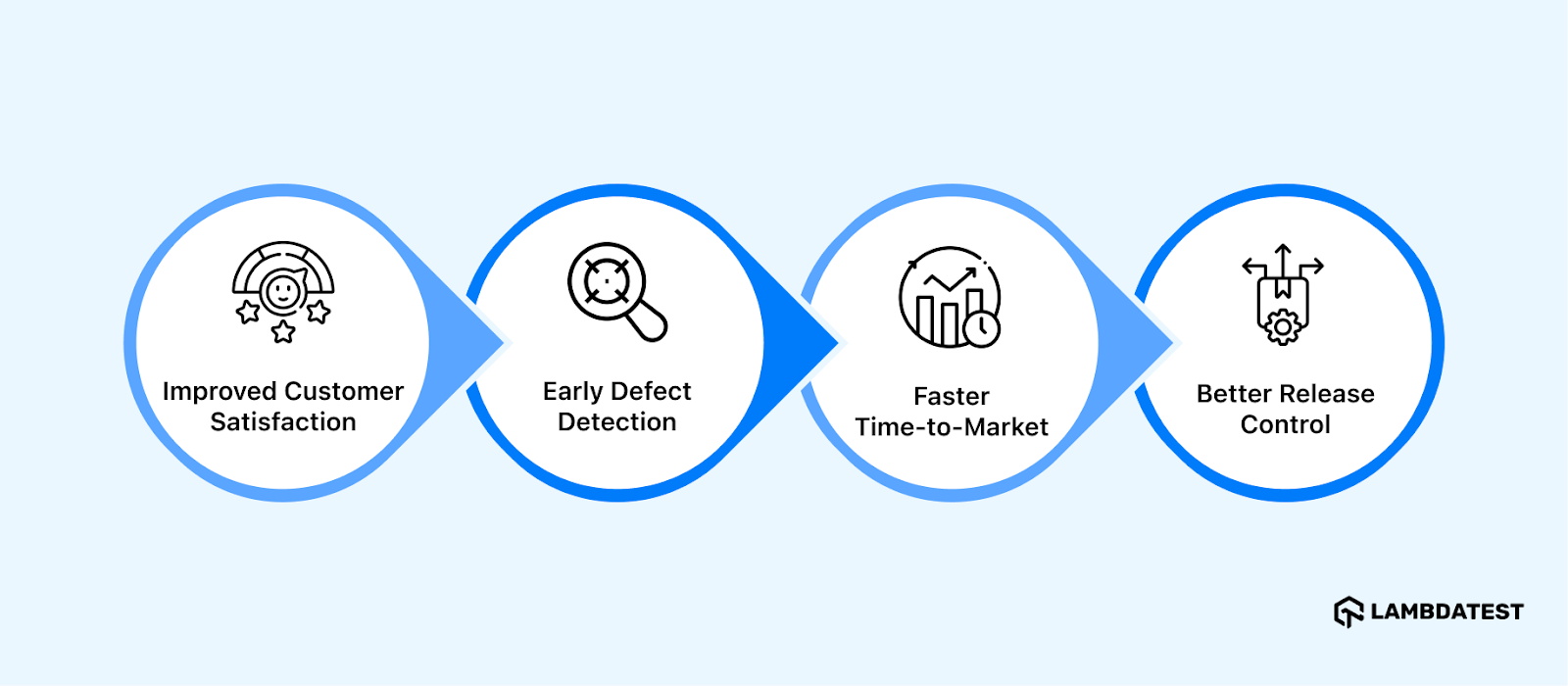
- Early defect detection - Analyzing past production failures lets a model flag the modules most likely to fail again, which is the goal at the center of software defect prediction.
- Shorter test cycles - Ranking test cases by failure probability means the tests most likely to catch something run first, so a broken build fails in minutes instead of at the end of a full overnight run.
- Release risk that is visible before sign-off - Comparing a release's defect rate, churn, and severity profile against previous releases gives a lead something more defensible than a green build at the gate.
- Test effort that matches the change - A small, low-risk change and a rewrite of the payment module do not deserve the same test budget, and a risk score is what makes that distinction explicit.
The catch is that all four depend on the quality of the history behind them. A suite with weak assertions produces a clean record of tests that did not really check anything, and a model trained on that record predicts the wrong thing confidently.

What Data Do Predictive Models Need?
Three sources carry almost all the signal: historical test results, code change history, and defect records. What surprises most teams is how few features they actually need.
In a 2023 study on flaky test prediction, Gruber and colleagues reported that their best model reached an F1 score of 95.5 percent using only three features: the tests' flip rates, the number of changes to source files in the last 54 days, and the number of changed files in the most recent pull request. The paper's own framing is that common code-evolution and test-history data, the kind a CI system already stores, is enough to predict flakiness without specialized instrumentation.
- Test execution history - Pass and fail outcomes per test per build, with timestamps and durations. Flip rate, meaning how often a test changes verdict without a related code change, is the single most useful derived feature here.
- Code change history - Which files changed, how often, how recently, and who touched them. Churn over a recent window is a stronger predictor than total file age.
- Defect records - Linked bug reports with severity, component, and the commit that fixed them. Without the fix link, a model can see that defects happened but not where they came from.
- Consistent identifiers - Stable test names, build names, and tags across runs. Inconsistent labelling splits one test's history into several partial histories and degrades every model trained on it.
This is the same foundation data driven testing is built on, and the same reason risk based testing works better with instrumented history than with expert intuition alone.
How Does Predictive Analytics Improve Software Testing?
It changes what gets tested first, and how much gets tested at all. Instead of running every test with equal priority, the suite is ordered by the probability that each test catches something on this specific change.
The measurable gains show up in research on just-in-time defect prediction, where the model scores a commit at the moment it lands. In a 2023 PLOS ONE study, Bryan and Moriano reported an F1 score as high as 77.55 percent for their XGBoost classifier using graph-based features, up from 30.83 percent for the state-of-the-art baseline, across 14 open-source projects. Their gain came from treating the codebase as a graph and using centrality features, rather than from a larger model.
Read those numbers as a research ceiling, not a promise. Both studies ran on curated datasets with clean labels, and a first model on a real suite with inconsistent test names will score considerably lower before it improves.
Types of Predictive Analytics Models
Four model families cover almost everything QA teams do with predictive analytics. They answer different questions, and most working setups combine two or three.
Classification Model
Classification sorts a unit of code into a category, which in testing is almost always a binary one: defect-prone or not, run this test or skip it, flaky or genuinely failing. It is the workhorse of predictive QA because most testing decisions are yes or no.
- Algorithms - Decision Trees, Random Forests, Naive Bayes, Support Vector Machines, and gradient boosting classifiers such as XGBoost.
- Applications - Flagging high-risk modules, scoring test cases for prioritization, and deciding which tests a given commit should trigger.
Both studies cited above used classifiers, which is a fair indication of where the practical results currently are.
Clustering Model
Clustering groups records by similarity without being told what the groups are. Classification asks whether this item belongs to a known category; clustering asks what categories exist in the first place.
- Algorithms - K-Means, Hierarchical Clustering, and density-based methods such as DBSCAN.
- Applications - Collapsing a long list of failures into a handful of root-cause groups, and finding test cases that always fail together and can be triaged as one.
This is the technique behind error-message categorization in test analytics tooling, where forty red tests turn out to be one broken dependency.
Forecast Model
Forecasting projects a numeric value forward in time from a sequence of past values. In testing, the values being projected are usually execution duration, defect discovery rate, or the test effort a release will need.
- Time series methods - Autoregressive Integrated Moving Average (ARIMA) and exponential smoothing, which model the sequence itself rather than a set of independent features.
- Applications - Predicting how long a suite will take next sprint, estimating test effort for release planning, and catching duration creep before the pipeline feels slow.
Forecast models answer how much and when, where classification answers which. A team that needs both should not try to make one model do the other's job.
Outlier Detection Model
Outlier detection finds records that deviate from an established pattern. In a test suite the deviation is often the interesting part: a run that took four times as long, or a test that fails only on Tuesdays.
- Statistical methods - Z-Score, Modified Z-Score, and boxplot-based thresholds, which work when the underlying distribution is well behaved.
- Machine learning algorithms - Isolation Forest and Local Outlier Factor, which handle many features at once without assuming a distribution.
- Applications - Flaky-test detection, spotting an environment that has drifted, and catching a performance regression that no assertion was written to fail on.
What Is Predictive Test Selection?
Predictive test selection uses a model trained on past test runs to decide which subset of a suite to execute for a given code change. Every test gets a score for how likely this change is to make it fail, and only the tests above a threshold run.
In a 2025 paper on targeted test selection, Plyusnin and colleagues reported that their approach selected roughly 15 percent of tests, reduced execution time by a factor of 5.9 and overall pipeline time by a factor of 5.6, while still detecting over 95 percent of test failures.
The number that matters in that sentence is not the speedup. It is the failure-detection rate Plyusnin and colleagues report, because it names the tradeoff explicitly, since selection is a decision to miss some failures in exchange for time. A team adopting this sets the recall target first and lets the speedup fall out of it, not the other way round.
- Recall target - The share of real failures the selected subset must still catch, agreed before the model ships. This is a product decision about acceptable escape risk, not a tuning parameter for the data team.
- Selection rate - The fraction of the suite that actually runs. It is an output of the recall target, and watching it drift upward is how teams notice a model going stale.
- Safety net - The full suite still runs somewhere, typically on the main branch or nightly, so anything the model skipped on a pull request is caught before release rather than in production.
For a survey of the platforms that implement this in a pipeline, see our roundup of AI test observability platforms for CI/CD pipelines.
How Do You Add Predictive Analytics to a CI/CD Pipeline?
Start by collecting history, not by training a model. Most teams that stall on this jumped to modeling before their test records were consistent enough to learn from.
- Standardize test and build identifiers so the same test is recognizable across runs. Until this holds, every model is training on fragmented histories.
- Retain execution records long enough to cover several release cycles, including durations, verdicts, and the commit each run was triggered by.
- Derive the features that carry signal, meaning flip rate per test, recent churn per source file, and the link between a defect and the commit that fixed it.
- Score in shadow mode first. Run the full suite, record what the model would have selected, and compare its predicted failures against what actually failed. This is how the recall target is validated before anything is skipped.
- Enforce selection only on pull requests, keeping the full suite on the main branch. The asymmetry is deliberate, since a missed failure on a branch is cheap and a missed failure in a release is not.
- Retrain on a schedule and watch the selection rate. A model whose selection rate climbs is losing discrimination, and one whose recall drops is letting failures through unnoticed.
Steps one and two are where the real work sits, and they are ordinary data hygiene rather than data science. A cloud grid helps here because it produces uniform execution records across every browser, OS, and device in one place, which removes the most common source of identifier drift.

Note: Consistent execution history across every browser and device is what predictive models need. Try TestMu AI free!
Use Cases and Examples of Predictive Analytics in Software Testing
Release quality prediction, test case prioritization, and performance bottleneck detection account for most production use of predictive analytics in QA.
Release quality prediction
A model compares the current release against previous ones on defect rate, severity mix, and code churn, and returns a risk estimate for the release as a whole. When the estimate is high, the team adds a test cycle, reassigns reviewers to the flagged components, or delays the launch. The output is a number a release manager can argue with, which is the point: a green build is not evidence that this release resembles the ones that went well.
Test case prioritization
Rather than selecting a subset, prioritization reorders the whole suite so the tests most likely to fail run first. It is the safer sibling of predictive test selection, since nothing is skipped and the only thing at stake is ordering. Teams usually adopt it first for that reason, and the mechanics are covered in the role of analytics in test case prioritization.
Performance bottleneck detection
Forecast and outlier models applied to historical load and response-time data identify which components degrade first under load. An ecommerce team preparing for a seasonal peak uses last year's traffic shape and this year's duration trends to decide which services to load-test, instead of testing all of them equally.
How Do AI Agents Extend Predictive Analytics in Testing?
AI agents now act on a predictive model's risk score directly, generating tests for flagged modules and quarantining flaky tests without waiting for a person to read a dashboard.
- Risk-triggered test generation - An agent reads a classification model's defect-risk score for a module and writes test cases targeting it, instead of a human deciding which areas to cover first.
- Autonomous flaky-test quarantine - Agents combine a flakiness score from an outlier detection model with a fresh run of the failing test to decide whether to quarantine it.
- Root cause drafts before triage - An agent drafts a root cause hypothesis from the stack trace and the model's flagged risk factors, turning triage into a review step instead of an investigation.
- Where a human still decides - A person confirms a quarantine, reviews an agent-written test before it merges, and can override the risk score. An agent acting on a stale model fails silently and at scale, which is exactly the failure mode the review step exists to catch.

How Does TestMu AI Test Intelligence Help With Predictive Analytics?
TestMu AI Test Intelligence is the analytics layer that aggregates execution records across builds, time, browsers, devices, teams, and projects. It supplies the longitudinal history predictive models train on. The boundary matters here: it is observability over testing, not a forecasting engine. It reads the record your tests produced; it does not run tests or decide pass and fail.
- Failure-frequency analysis - Tests are ranked by how often they fail across the whole history, which surfaces the chronic offenders a flip-rate feature would flag. It surfaces them for a human to fix; it does not repair the test.
- Error-message categorization - Similar failures cluster into categories automatically, turning a flat list of red tests into prioritizable buckets. This is the clustering step described earlier, applied to your own runs.
- AI Root Cause Analysis - RCA correlates network, console, and framework logs to localize a likely cause and label which events are probable symptoms. It is a strong, fast lead rather than a verdict, so verify before acting on it. The AI Root Cause Analysis documentation covers how to generate a report.
- RCA Category Trends - Where a single RCA report localizes one failure, this widget aggregates RCA outcomes into recurring failure categories over time, so cleanup goes to the category with the most impact rather than the loudest incident.
- Pass, fail, and duration trends - Cross-run trends across builds and configurations, filterable by project, build, date range, browser, OS, device, status, tag, and team member, and exportable for release sign-off.
One caveat applies to all of it, and to any model you build on top: the output is only as good as the upstream data. A suite with weak assertions produces a green trend that means very little, and a run whose logs were not captured gives RCA less to correlate. The Insights Dashboard documentation covers which records feed each widget.
For teams building these skills, the KaneAI Certification covers hands-on AI testing practice. Related reading on the analytics side sits in data-driven QA with test analytics and, for how accurate these models get, AI's impact on defect prediction accuracy.
Conclusion
Start by auditing your test history for consistent identifiers and linked defect records, because every model in this article depends on that and nothing else will work without it. Once a few release cycles of clean history exist, run a selection model in shadow mode against a recall target before letting it skip anything.
TestMu AI Test Intelligence gives you that history in one place, with failure-frequency, error categorization, and RCA over runs from every browser and device. The TestMu AI documentation is the place to start wiring it into your pipeline.
Author

Devansh Bhardwaj
Blogs: 80


Devansh Bhardwaj is a Community Evangelist at TestMu AI with 4+ years of experience in the tech industry. He has authored 30+ technical blogs on web development and automation testing and holds certifications in Automation Testing, KaneAI, Selenium, Appium, Playwright, and Cypress. Devansh has contributed to end-to-end testing of a major banking application, spanning UI, API, mobile, visual, and cross-browser testing, demonstrating hands-on expertise across modern testing workflows.
Reviewer

Sandeep Yadav
Reviewer
Sandeep Yadav is a Senior Software Engineer at TestMu AI (formerly LambdaTest), where he builds the platform's test intelligence and AI-native engineering systems. He has architected autonomous GitHub Apps, vector-search code intelligence, and self-diagnosing QA workflows, and designed distributed platforms that process 2M+ daily test executions and 1B+ events, turning high-volume test, log, and code data into intelligent, self-optimizing systems. He works on embedding reasoning models into production infrastructure to power autonomous review, root-cause analysis, and analytics workflows. He brings over four years of engineering experience with deep expertise in the Elastic Stack, Apache Kafka, and Redis. Earlier he engineered a GDPR-compliant, end-to-end-encrypted secure web-chat application at Mithi. A Facebook Hackercup 2021 Round 2 qualifier and merit-scholarship recipient, Sandeep holds a B.Tech in Electrical Engineering from Delhi Technological University.


Predictive Analytics in Software Testing FAQs
Did you find this page helpful?
More Related Blogs
TestMu AI forEnterprise
Get access to solutions built on Enterprise
grade security, privacy, & compliance
- Advanced access controls
- Advanced data retention rules
- Advanced Local Testing
- Premium Support options
- Early access to beta features
- Private Slack Channel
- Unlimited Manual Accessibility DevTools Tests