
Power Your Software Testing with AI Agents and Cloud
The Native AI-Agentic Cloud Platform to Supercharge Quality Engineering. Test Intelligently and Ship Faster.

- TestMu AI (Formerly LambdaTest)
- /
- Blog
- /
- 9 Best Agentic Coding CLI Tools for 2026
9 Best Agentic Coding CLI Tools for 2026
A verified comparison of nine agentic coding CLI tools, scored on model support, MCP, open-source licensing, CI fit, and the one thing none of them do on their own.
Last Updated on:
I have had an agentic coding CLI open in a terminal on nearly every workday for the past year. It reads my repository, edits code across files, runs shell commands, and works through a multi-step task from one plain-English instruction. In that year the category moved past autocomplete, and these tools now ship a whole feature from a single prompt.
That speed created the gap I keep running into. The agent writes code fast and tells me the task is done, but its evidence is code-level: the build compiled, the unit tests passed, the types check. None of those signals render the page a user will actually load, so a button I wired to the wrong endpoint or a redirect that 404s ships green, and I only catch it when I open the app myself.
Adoption is not the question anymore. In the Stack Overflow 2025 Developer Survey, 84% of respondents are using or planning to use AI tools in their development process, up from 76% a year earlier, and 50.6% of professional developers use them daily.
Below I compare the nine agentic coding CLI tools I consider worth running in 2026, and I am honest about where each one stops. I pulled the GitHub figures for the open-source entries myself on 22 July 2026.
Key Takeaways
To automate multi-step development tasks directly from your terminal, use Claude Code for standardized workflows across IDEs and command lines, or deploy the open-source Aider to automatically run and fix code against your local test suite. Both tools edit files and run commands autonomously.
- Best for standardized workflows: Claude Code - This closed-source terminal agent from Anthropic excels at multi-file editing, supports Model Context Protocol servers, and spawns parallel subagents to turn issues into pull requests.
- Best for large-context repositories: Gemini CLI - This Apache 2.0 licensed open-source agent from Google leverages a one-million-token context window, supports Model Context Protocol servers, and offers a free tier for personal accounts.
- Best for permission control: OpenAI Codex CLI - This Apache 2.0 licensed terminal agent features a dedicated permissions and sandboxing model to control exactly when the agent can edit files or run commands.
- Best for avoiding model lock-in: OpenCode - This MIT-licensed, provider-agnostic open-source agent connects to over 75 model providers, local models, or existing Copilot and ChatGPT accounts across terminal and desktop interfaces.
- Best for automatic testing loops: Aider - This Apache 2.0 licensed terminal pair-programmer automatically commits changes to git and runs your local test suite by default, using any failures to fix its own code.
- Best for Cursor editor users: Cursor CLI - This closed-source tool brings the Cursor editor's agent into the terminal and CI/CD pipelines, allowing teams to write and modify code using their existing accounts.
- Best for multi-surface orchestration: Amp - This closed-source agent from Sourcegraph runs across web, terminal, and mobile, utilizing remote workers and explicit subagent messaging to execute tasks.
- Best for multi-agent frameworks: Droid - This closed-source terminal agent from Factory uses Missions to coordinate multiple specialized subagents and supports headless execution for CI/CD pipelines.
- Best for browser-based verification: TestMu AI's Kane CLI browser agent - This tool runs from the terminal or CI to validate built features in a real Chrome browser, returning pass or fail signals that coding agents can read.
- While these agentic tools write code effectively, none of the code-generation agents render the finished user interface to confirm it works for a real user without a separate verification tool.
What Is an Agentic Coding CLI Tool?
When I size one of these up, I judge it on autonomy, not on whether it lives in the terminal. It has to take a goal, plan the steps, and execute them, reading files, editing code, running the build, and reacting to what comes back, all without me clicking through at each step. That loop, the agent running agentic workflows end to end, is what separates it from an inline autocomplete assistant.
Terminal tools are one type of AI coding agents; IDE agents, cloud agents, and app builders run the same loop in other places.
Three capabilities decide whether I keep a tool in my rotation:
- Terminal-native execution, so the agent runs commands, reads their output, and composes into shell scripts, CI runners, and other agents that a graphical editor cannot reach.
- Model and tool openness, meaning you can point the agent at a different model provider or extend it through the Model Context Protocol, wiring in the MCP servers that expose browsers, docs, and issue trackers, rather than being locked to one vendor's model and integrations.
- A non-interactive mode that runs headlessly and returns a machine-readable result with an exit code, which is the difference between a demo and a tool you can put in a pipeline.
The category overlaps with the broader wave of vibe coding tools that let people build software by describing it, and the quality of the underlying model matters as much as the CLI wrapper, which our guide to the best LLM for coding covers in depth.
How I Compared These Tools
Tool roundups usually rank the publisher's own product first. I state my criteria up front, and I ordered the list by type rather than crowning a single winner, so you can weigh the trade-offs against your own stack.
- Verified capabilities only. I read every model, feature, and license claim from the tool's own live site or documentation this week, not from memory or a third-party summary.
- Repository health for the open-source entries. I pulled star counts, most recent commit, and license from a single GitHub API call on 22 July 2026, and I state the date so you can re-run it.
- Ordering by category, not quality. Entries one to three are the frontier-lab CLIs, four and five the leading open-source independents, six to eight commercial agents, and I put Kane CLI last because it addresses verification, a different layer from code generation.
- No third-party pricing figures. Pricing shifts weekly, so I describe each pricing model in words rather than quoting a number that would be wrong by the time you read it.
Kane CLI is built by TestMu AI, the company I work for, so treat it as the entry with a vendor interest and weigh it accordingly. I put it last because it verifies what the other eight produce, not because it is the strongest or weakest agent.
9 Best Agentic Coding CLI Tools for 2026
1. Claude Code
Claude Code from Anthropic is the terminal agent I reach for first, and the one most teams I talk to start with. It understands a codebase, edits across files with dependency awareness, runs git workflows, and turns a GitHub or GitLab issue into a pull request, with extensions that surface the same agent inside VS Code, Cursor, and JetBrains IDEs.
Its two differentiators in 2026 are MCP server support and parallel subagents, which the product page describes as spawning tens to hundreds of agents to fan a task out. Routines add scheduled and event-triggered runs. It is a closed-source product billed through Pro and Max subscription tiers or standard API usage.
For a fuller breakdown of the terminal agent and the files that configure it, read our guide to what Claude Code is and how its extension model works.
- Best for teams standardizing on one agent across terminal, IDE, and issue-to-PR workflows.
- Strong tool-calling and multi-file editing make it reliable on large, interconnected changes.
- Closed source, so self-hosting and model choice are off the table.
2. Gemini CLI
Gemini CLI is Google's open-source agent, and it is the most-starred true CLI in this comparison alongside OpenCode. It brings Gemini 2.5 Pro and its 1M-token context window into the terminal, with built-in tools for Google Search grounding, file operations, shell commands, and web fetch, plus MCP support and custom commands.
The million-token window is the practical draw for me: I can hold a large repository in context without the aggressive chunking smaller windows force. A free tier through a personal Google account, with published per-minute and per-day request limits, lowers the barrier to a first run further than any paid competitor. What it cannot do is open a browser and look at the result, so you still need a separate way to test the app Gemini CLI built.
- Best for large-context work and for developers who want a free, open-source starting point.
- Apache 2.0 licensed, so it can be inspected and self-hosted.
- Deepest integration is with Google's own services; third-party tool setup takes more configuration.
3. OpenAI Codex CLI
OpenAI Codex CLI is a lightweight terminal agent that inspects code, makes changes, and runs commands without leaving the shell. It switches models and reasoning effort with a /model command and connects to local or remote MCP servers through codex mcp.
Its standout, and the reason I keep it around for repositories I do not want an agent roaming freely in, is a permissions and sandboxing model: the /permissions command controls exactly when the agent may edit files or run commands, and a dedicated review mode inspects uncommitted changes, commits, or a branch. That makes it a natural fit when you want approval gates rather than an agent with a free hand. Our Codex CLI setup guide covers the exact sandbox_mode and approval_policy values behind those gates.
Its metering is the part people trip over, because a five-hour window and weekly limits are shared with several other OpenAI products. Our guide to Codex usage covers the /usage and /statusline commands, the published limit table by model and plan, and how to read token counts out of a CI run.
- Best for developers already on a ChatGPT plan who want tight control over agent permissions.
- Apache 2.0 licensed and actively developed, with commits landing daily as of the maintenance table below.
- Sign in with a ChatGPT plan or authenticate with an API key billed by usage.
4. OpenCode
OpenCode is the provider-agnostic open-source agent, and it carries the highest star count in this list. It connects to any model, naming 75+ providers plus local models and logins through GitHub Copilot or a ChatGPT account, and runs in the terminal, an IDE extension, or a desktop app.
It is Language Server Protocol aware, supports multiple parallel sessions, and generates shareable session links, and it is the one I point people to when they want one agent decoupled from any single model vendor. The active project lives under the sst/opencode repository; an older opencode-ai/opencode repository is archived, so point tooling at the current one. It also tops the list of OpenHands alternatives, compared there with eight other agents on self-hosting and sandboxing.
- Best for teams that refuse model lock-in and want to swap providers freely.
- MIT licensed, the most permissive license in this comparison.
- Breadth of provider support means more configuration surface to get right up front.
5. Aider
Aider is the terminal pair-programmer that predates the current wave, and to my eye it still has the strongest built-in testing story of the eight. It works across 100+ languages with many model providers, makes an automatic git commit with a sensible message after each change, and accepts voice and image input.
The feature that earns it a place on my list is that it can lint and run your test suite every time it makes a change, then use the failures to fix its own work. That is the closest any tool in this list comes to self-verification, though it still checks code against code, not the rendered result. Its most recent commit at capture time was 22 May 2026, a slower cadence than the frontier CLIs.
- Best for developers who want automatic git hygiene and a lint-and-test loop out of the box.
- Apache 2.0 licensed; you supply your own model keys, so the tool itself has no subscription.
- Commit cadence has slowed, worth a glance at the repository before adopting it for a critical workflow.

Note: These agents write code fast, but a passing build is not a working feature. I close that gap with TestMu AI's Kane CLI, which drives real Chrome from a natural-language objective and returns a pass or fail your coding agent can read, so a broken redirect or a mis-wired button is caught before the pull request. Try TestMu AI free!
6. Cursor CLI
Cursor CLI brings the agent from the Cursor editor to the terminal so you can write, review, and modify code from the command line, including inside CI. It exposes frontier models from Anthropic, OpenAI, Google, and Cursor's own line, and adds slash commands, file references with @files, and shell calls with !shell.
In my workflow its interactive and non-interactive modes are what matter: the headless mode is documented for GitHub Actions and CI/CD, with safety checks on shell commands. Teams already paying for Cursor get terminal and pipeline access without a second subscription, since it draws on the same account and plan.
The CLI reads the same project conventions as the editor, so it is worth setting those up once. Our guide to cursor rules walks through the file format and which rule type fires when.
- Best for teams already on Cursor who want the same agent in the terminal and CI.
- Free Hobby tier plus paid individual, team, and enterprise plans with on-demand overage.
- Closed source, and usage is tied to the Cursor account model.
7. Amp
Amp from Sourcegraph runs across web, terminal, and mobile, with agents executing locally or on remote workers it calls orbs. Its CLI runs interactively or with amp -x for execute mode, and it integrates with VS Code, JetBrains, Neovim, and Zed.
Amp leans into multiple frontier models across effort levels and supports MCP servers, a plugin system, and agent-to-agent messaging between subagents. What I appreciate is that its documentation is explicit about testing, with sample prompts to run the test suite and fix failures, and support for defining test commands in an AGENTS.md file so the agent knows how to validate its own work. Treating that file as a testing contract rather than a style guide is covered in agents md.
- Best for teams that want multi-surface agents and explicit subagent orchestration.
- Usage-based credits with an optional subscription; enterprise plans sit above individual and team tiers.
- Closed source; deeper features assume you buy into the Amp account model.
8. Droid
Droid is Factory's terminal agent, installable through curl, PowerShell, or npm and launched with the droid command. It is model-agnostic across Anthropic, OpenAI, and Google families plus Factory's own Droid Core, and it ships managed model access with opt-in bring-your-own-key.
What stands out to me is orchestration built in: Missions coordinate multi-agent work, Custom Droids act as specialized subagents, and Exec Mode runs headlessly for CI/CD. That makes Droid less a single agent and more a framework for running several, a coordination problem our guide to AI agent orchestration tools digs into, and where I reach for it on larger feature work that fans out into parallel subtasks.
- Best for teams that want multi-agent orchestration and headless CI runs from one terminal tool.
- Tiered subscription across individual Pro and Max plans and seat-based business plans.
- Closed source; the free entry point is limited, so confirm current tier limits before committing.
9. Kane CLI (TestMu AI)
Kane CLI is not a coding agent, and I am not going to pretend it replaces Claude Code or Codex CLI for writing code. It is the verification primitive I found the other eight lack: a deterministic browser agent that runs the feature in real Chrome and confirms it works for a user. My team at TestMu AI builds it, so treat this entry as the one with a vendor interest.
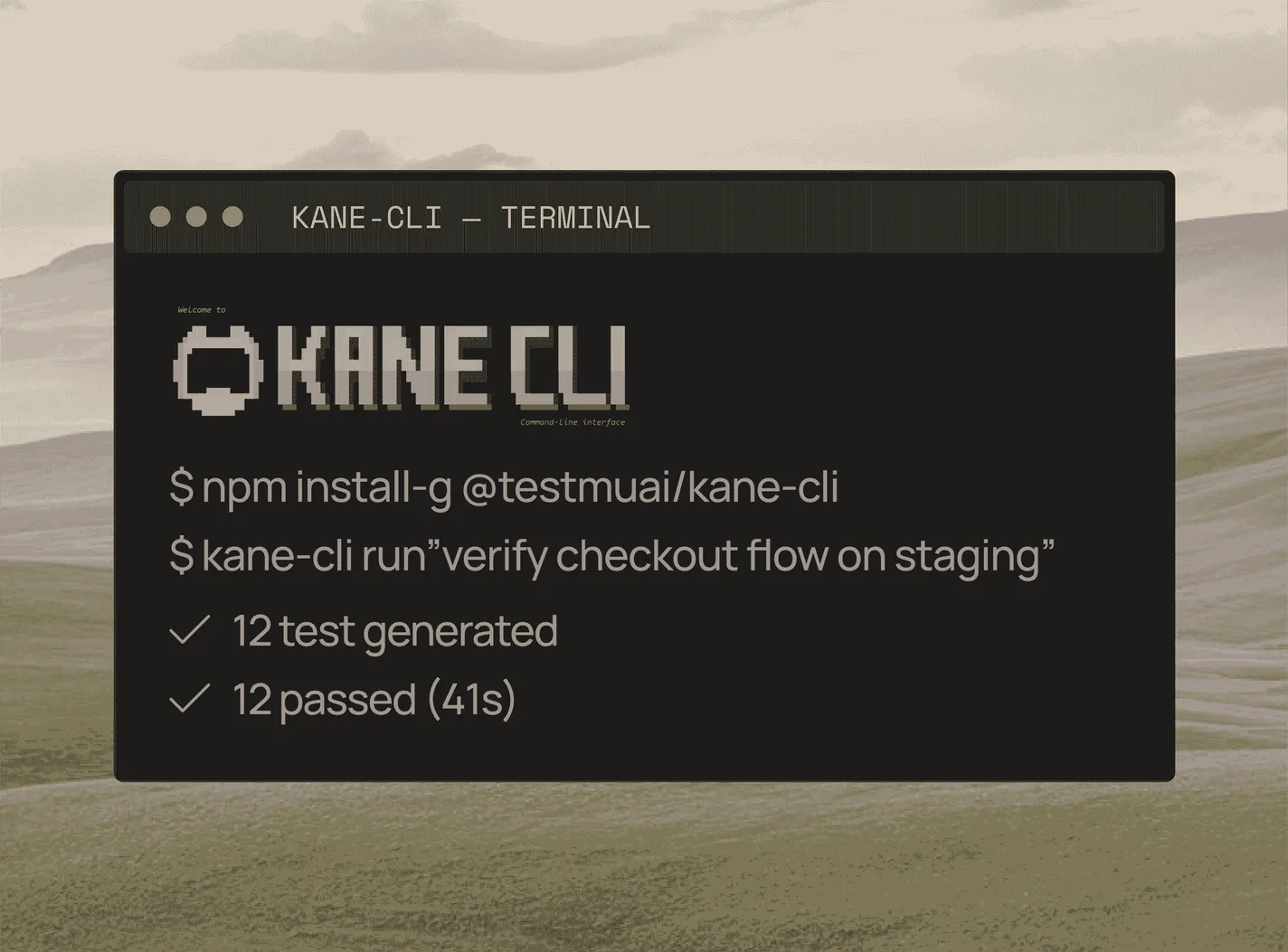
It installs from npm as @testmuai/kane-cli and runs in three modes, the important one here being agent mode. Called with --agent --headless, it drives Chrome from a plain-English objective, emits NDJSON one event per line, and returns a standard exit code, so a coding agent can invoke it as a tool, read the result, and decide whether to continue or fix a bug. The reasoning is non-deterministic; the pass or fail verdict is anchored to explicit evidence such as DOM state, URL changes, and screenshots.
Install its skill once into Claude Code, Codex CLI, or Gemini CLI and the agent gains a real browser to check its own work. The same command runs in CI with standard exit codes, and setup lives in the Kane CLI documentation.
- Best as a verification layer bolted onto whichever coding agent you already run.
- No selectors or framework boilerplate; objectives are written in natural language.
- It verifies rendered UI; it does not generate application code, so it complements rather than replaces the tools above.
Maintenance and Licensing Comparison
Feature lists age badly, and marketing pages rarely tell me whether a project is still moving. Repository health does. I read the figures below from the GitHub repository API on 22 July 2026 for the four open-source entries; the four commercial agents are closed source and publish no comparable source repository.
| Tool | Stars | Last commit | License | Strongest at |
|---|---|---|---|---|
| OpenCode | 188,517 | 22 Jul 2026 | MIT | Provider-agnostic, 75+ models and local models |
| Gemini CLI | 106,124 | 21 Jul 2026 | Apache 2.0 | 1M-token context and a free personal tier |
| OpenAI Codex CLI | 100,619 | 22 Jul 2026 | Apache 2.0 | Permission gates and dedicated code review |
| Aider | 47,614 | 22 May 2026 | Apache 2.0 | Auto git commits and a built-in lint-and-test loop |
Two things I noticed pulling these. OpenCode's own site still cites a lower star figure than the live API returned, so I trust the API number and suggest you re-pull it. Aider's five-week commit gap is not abandonment, but it is a slower pulse than the daily commits on the frontier CLIs, which I would want to know before building a workflow on it.

The Blind Spot I Keep Hitting
Every agent here works on one surface: text. It reads source, writes source, and reasons about source, and its checks, the unit test, the type checker, the linter, all run on that same surface. None open a viewport to see the rendered page, and that is the blind spot that has cost me the most time. That same blind spot decides how far each tool gets with test generation, which I break down in AI code assistants for testing.
The failures are specific. The code is correct, the user-facing result is not. Things I have shipped this way, with the agent reporting a clean pass each time:
- A button wired to the wrong API.
- A redirect that lands on a 404.
- A form whose validation never fired.
- A modal that would not close.
Aider gets furthest by running your lint and test suite after each change, but that is code checking code. A green run says nothing about whether the button renders in the browser a user actually loads, which is why it is worth learning how to test the app Aider built in real Chrome.
Closing it takes a different check: run the built feature in a real browser and assert on what the user sees, not what the source declares. That is the layer Kane CLI works on, and the same idea extends to AI agent evaluation of anything a compiler cannot verify.
There is a second gap one layer up. Kane CLI proves the app your agent built works; proving the agent itself behaves is a different question, and it is the one TestMu AI's Agent Assurance answers for agents that act. Point it at the codebase that defines your agent and it derives the test suite itself, functional, non-functional, and adversarial scenarios covering prompt injection, tool misuse, and instruction override, then invokes the agent for real and grades each criterion against observed evidence such as files changed, artifacts produced, and tool calls made, not the agent's own summary. Criteria it could not check come back as Unable to Verify, with the assurance gap reported beside the pass rate, and in CI its exit codes separate an agent that did something wrong from a run it could not test.
Note: Your coding agent says the task is done. Prove it. Early access is opening in batches. Join the Agent Assurance waitlist
How I Would Choose an Agentic Coding CLI Tool
Start from the constraint that actually binds your team, and let it pick the tool. If the binding constraint is browser verification rather than code generation, the comparison of AI browser testing CLIs covers what each of these agents hands back after a browser run. Here is how I map situations to tools:
- If you want the safest default and one agent everywhere, I pick Claude Code, for its cross-file reliability and IDE, terminal, and issue-to-PR reach.
- If you need a free start and a huge context window, I pick Gemini CLI, for the personal free tier and a 1M-token window.
- If you want approval gates before the agent touches anything, I pick OpenAI Codex CLI, for its permissions model and built-in review.
- If you refuse model lock-in, I pick OpenCode, for provider-agnostic connections across 75+ models under MIT licensing.
- If you want automatic commits and a test loop with no setup, I pick Aider, for its lint-and-test cycle and per-change git hygiene.
- If you already pay for Cursor, I use Cursor CLI; when I want multi-agent orchestration, I reach for Amp or Droid.
- If your agent keeps shipping UI that looks right in code but breaks for users, I add Kane CLI as the browser-verification layer on top of whichever agent I chose.
When I need that verification beyond my laptop, I run the same natural-language tests across browsers and real devices on the TestMu AI test automation cloud, so a check that passed locally runs at full coverage in nightly regression.

Coding agents write the code; a separate set of tools verifies the result in a browser. Those are covered in Playwright CLI alternatives. For cloud agents that take a task in the background and return a pull request, see Devin alternatives.
Conclusion
Pick your agent from the constraints above, install it, and give it a real task this week. Across the nine, what separates them in practice is less raw coding ability than licensing, model choice, permissions, and how far they reach into CI. The frontier CLIs win on polish, the open-source pair on freedom, and the commercial agents on orchestration.
Whichever you choose, close the loop the agents cannot close for themselves. I add TestMu AI's Kane CLI as the browser-verification step and wire it into the pipeline from the setup in the Kane CLI documentation, so my agent stops declaring victory on code that never rendered. If your agent lives in an IDE rather than a terminal, the same step installs as a bundle, as in this walkthrough of the Kane CLI power for Kiro. For the broader set of AI-assisted builders this fits into, our roundup of agentic AI tools maps the wider landscape.
Before the loop closes, decide what each agent is allowed to do at all. We compare the options in pre-action checks for AI coding agents.
Two of the agents above shortlist together more often than any other pair, and we put them side by side in OpenCode vs Claude Code.
Author

Anubhav Singhmaar
Blogs: 46

Anubhav Singhmaar is an AI Product Manager at TestMu AI driving Kane CLI, the command-line tool that brings browser automation to the terminal, turning natural-language flows into runs in a real Chrome browser that return pass or fail with shareable proof. He owns the roadmap and prioritization and works with engineering to ship developer-facing features. Before TestMu AI, he spent over four years at Sprinklr owning enterprise voice AI across APAC and EMEA. A mechanical engineer turned product manager, he grounds guidance in real QA workflows.
Reviewer

Srinivasan Sekar
Reviewer
Srinivasan Sekar is Director of Engineering at TestMu AI, where he leads engineering and open-source initiatives behind the Selenium and Appium automation grid and owns TestMu AI's MCP Server. A committer to Appium and a contributor to Selenium, WebdriverIO, Taiko, and AppiumTestDistribution, he brings over 15 years of experience in quality engineering and open-source technologies. He is the author of the Apress book 'The MCP Standard: A Developer's Guide to Building Universal AI Tools with the Model Context Protocol,' a Certified Kubernetes and Cloud Native Associate, and an international conference speaker. Before TestMu AI he spent over eight years at Thoughtworks as a Principal Consultant and Quality Architect. Srinivasan holds a B.Tech in Information Technology from Anna University.


Agentic Coding CLI FAQs
Did you find this page helpful?
More Related Blogs

TestMu AI forEnterprise
Get access to solutions built on Enterprise
grade security, privacy, & compliance
- Advanced access controls
- Advanced data retention rules
- Advanced Local Testing
- Premium Support options
- Early access to beta features
- Private Slack Channel
- Unlimited Manual Accessibility DevTools Tests