
Power Your Software Testing with AI Agents and Cloud
The Native AI-Agentic Cloud Platform to Supercharge Quality Engineering. Test Intelligently and Ship Faster.

- TestMu AI (Formerly LambdaTest)
- /
- Blog
- /
- 9 Best Playwright CLI Alternatives in September 2026
9 Best Playwright CLI Alternatives in September 2026
Compare 9 Playwright CLI alternatives, from Cypress and WebdriverIO to agentic CLIs like Kane CLI, Shortest, and Hercules. Commands, fit, and tradeoffs.
Published on:
The Playwright CLI is not the bottleneck. Running the suite is the part that already works: one command, parallel workers, an HTML report. The bottleneck sits on either side of that command, in who can write a spec in the first place and who fixes it when a button moves.
That is why teams start looking for a Playwright CLI alternative even when Playwright itself is fine. The nine below split into two groups: framework CLIs that swap one scripted runner for another, and agentic CLIs that change who writes the test. I ran one of them against a live page while writing this, and the output is in the methodology section.
TL;DR
The best Playwright CLI alternative depends on what you are actually replacing. To swap one scripted runner for another, Cypress CLI is the closest match. To replace the writing of tests rather than the running of them, Kane CLI by TestMu AI takes a plain-English objective and returns a verdict CI can parse. Framework CLIs still need an engineer to author the test; agentic CLIs do not.
- Best for a JavaScript team that wants a visual runner: Cypress CLI - cypress open gives an interactive runner and cypress run executes headlessly, with browser and spec selection as flags.
- Best for web and native mobile in one config: WebdriverIO CLI - npx wdio run wdio.conf.js drives browsers and, through Appium, native apps from a single test runner.
- Best for zero driver setup: TestCafe CLI - the whole invocation is testcafe chrome,edge test.js, with no separate browser driver to install or version-match.
- Best for native mobile flows: Maestro CLI - human-readable YAML flows with built-in waiting, covering iOS and Android where the Playwright CLI does not reach at all. Free local CLI: yes. Native mobile: iOS and Android.
- Best for evidence-backed verdicts in CI: Kane CLI by TestMu AI - takes a plain-English objective, drives real Chrome, and its agent mode emits NDJSON so a pipeline parses events instead of scraping console text.
- Best for natural language inside an existing suite: Shortest - natural language steps in .test.ts files, built on Playwright, run with a single shortest command. License: MIT. Bring your own model key: yes.
- Best for interfaces with no usable DOM: Midscene CLI - resolves instructions from a screenshot with a vision model, so it works where selectors do not exist. License: MIT. Self-hosted models supported: yes.
- Best for teams already writing Gherkin: Hercules - reads .feature files and drives Playwright underneath, with a Docker image for CI. License: AGPL-3.0. Bring your own model key: yes.
Every agentic option on this list needs a model, and most ask you to bring your own key. That is a real running cost, and it is the first thing to price before switching.
What Does the Playwright CLI Actually Do?
The Playwright CLI scaffolds a project, installs browser binaries, records interactions into code, runs the suite, and serves the report. Those five jobs are covered by npm init playwright@latest, npx playwright install, npx playwright codegen, npx playwright test, and npx playwright show-report. Every subcommand and flag is listed in the reference of Playwright CLI commands.
The gap it leaves is what every tool below is selling into. The CLI executes specs. It does not decide what to cover, it does not write the assertions, and when a selector stops matching it fails the run rather than repairing it. Codegen records a session into code, which helps with the first draft and does nothing for the second year of maintenance.
If you want the runner itself to go faster rather than to be replaced, that is a different article: the Playwright tutorial covers sharding, fixtures, and parallelism, and none of the nine tools below beat a well-configured Playwright suite at raw execution. If you are replacing Playwright itself rather than its CLI, compare the Playwright alternatives instead.
How I Compared Them
Each tool was checked against its own documentation or repository, and every command in this article is copied from the vendor’s own reference rather than from memory. The write-ups turn on the questions below.
- What do you type - the exact invocation, because a CLI that needs a config file before it runs once has a different adoption curve.
- Who writes the test - an engineer in code, anyone in plain language, or the tool itself from the codebase.
- What it drives - browsers only, native mobile, or any pixels on screen.
- What CI gets back - an exit code, a report artifact, or a structured event stream a machine can read.
- Whether the work is portable - what you keep if you stop paying or stop using the tool.
TestMu AI builds one of the nine, so treat that entry as the interested party it is. To keep it honest I ran Kane CLI against a real page rather than describing it. The objective below is plain English, the run is unedited apart from trimming file paths, and it is the same output any reader gets from the same command.
$ kane-cli run "Open the Simple Form Demo, type 'Playwright CLI alternatives' into the message field, click Get Checked Value, and verify the message appears below" \
    --url "https://www.testmuai.com/selenium-playground/simple-form-demo" --headless

{"step":2,"status":"done","remark":"navigate: Navigate to .../selenium-playground/simple-form-demo"}
{"step":3,"status":"done","remark":"wait: PRIMARY: confirm the Simple Form Demo page is open; role=heading"}
{"step":4,"status":"done","remark":"type: Filled 'Playwright CLI alternatives' via DOM locator: internal:role=textbox"}
{"step":5,"status":"done","remark":"click: Clicked via DOM locator: internal:role=button[name=\"Get Checked Value\"i]"}
{"step":6,"status":"done","remark":"analyze: ANALYZE(textual_visual, \"The message appears below\")"}
{"step":7,"status":"done","remark":"assert: the message appears below after clicking Get Checked Value"}
{"type":"run_end","status":"passed","duration":56,"credits_consumed":16.86,
 "final_state":{"checked_message_appears_below":"Playwright CLI alternatives"},
 "reason_code":"success.complete"}
Two details in that output matter for the comparison. The agent resolved the field and the button on its own, so no selector was written or maintained, and the assertion came back as a typed result with the extracted value attached rather than as a line of console text. The run took 56 seconds and consumed 16.86 credits on a free-to-start account.
What Are the Best Playwright CLI Alternatives?
The table maps each tool to what you type, who writes the test, and what CI receives. The write-ups follow in the same order.
| Tool | Invocation | Test written by | Drives | CI receives |
|---|---|---|---|---|
| Cypress CLI | cypress run | Engineer, JS/TS | Browsers | Exit code + report |
| WebdriverIO CLI | npx wdio run wdio.conf.js | Engineer, JS/TS | Browsers + native mobile | Exit code + reporters |
| TestCafe CLI | testcafe chrome test.js | Engineer, JS/TS | Browsers | Exit code + reporters |
| Maestro CLI | maestro test flow.yaml | Anyone, YAML | iOS, Android, web | Exit code + cloud video |
| Kane CLI | kane-cli run "objective" | Anyone, plain English | Real Chrome | NDJSON event stream |
| Shortest | shortest | Anyone, in .test.ts | Playwright | Exit code |
| Midscene CLI | midscene (YAML runner) | Anyone, YAML | Screenshots, any UI | Exit code |
| Hercules | testzeus-hercules --input-file | Anyone, Gherkin | Playwright | Exit code + output path |
| Autonoma | Planner CLI | The tool, from your code | Playwright + Appium | Pull request review |
1. Cypress CLI
Cypress is the closest like-for-like swap on this list, and the one with the shortest learning curve for a team already writing JavaScript tests. The trade against Playwright is narrower browser reach in exchange for a debugging experience most engineers prefer on first contact.
Key features:
- Two modes, two commands - cypress open launches the interactive runner, cypress run executes headlessly by default.
- Browser selection as a flag - the Cypress command line reference documents chrome, chromium, edge, and firefox as accepted values.
- Targeted runs - cypress run --spec takes an absolute or working-directory-relative path, so CI can shard by spec without a plugin.
- Recording built in - cypress run --record --key uploads results, and the key can move to the CYPRESS_RECORD_KEY environment variable to keep it out of the command.
- Runs inside the browser - test code executes in the same run loop as the application, which is what produces the step-by-step debugging it is known for.
Best fit for: JavaScript teams who want the tightest debugging loop and are willing to trade some browser coverage for it. If you are weighing the runner rather than the CLI, the Cypress CLI and test runner guide goes deeper on the flags.
2. WebdriverIO CLI
WebdriverIO is the answer when the suite has to cover browsers and native mobile apps without maintaining two frameworks. Its CLI is a full test runner rather than a thin wrapper, with configuration, parallelisation, and reporting in the same package.
Key features:
- Guided setup - npx wdio config asks a series of questions and writes a wdio.conf.js for you.
- Config-driven runs - npx wdio run wdio.conf.js is the documented invocation, and the WebdriverIO test runner documentation notes the run keyword can be omitted.
- Slice the suite - --spec, --suite, and --exclude select or drop files at the command line rather than in config.
- Watch mode - wdio run ./wdio.conf.js --watch reruns on change during inner-loop work.
- Native mobile through Appium - the same runner and config reach iOS and Android apps, which is the reason most teams pick it over a browser-only tool.
Best fit for: Teams whose coverage spans web and native mobile and who would rather configure one runner than operate two.
3. TestCafe CLI
TestCafe optimises for the thing that wastes the most time on a new machine: driver setup. There is no WebDriver binary to install, version-match, or debug, and the entire invocation fits on one line with no config file at all.
Key features:
- One-line invocation - the documented form is testcafe [browsers] [test files] [options], as in testcafe chrome,edge test.js.
- Multiple browsers in one run - browsers are a comma-separated first argument, and all runs every installed browser.
- Flexible targets - a file, a folder, or a quoted glob all work as the test-file argument.
- No separate driver - the TestCafe command line interface reference documents no WebDriver dependency, including a native automation mode for Chromium browsers.
- Custom browser paths - a path: prefix points at a specific binary, which matters when testing a beta build.
Best fit for: Teams who want cross-browser runs without owning a driver layer, and anyone who has lost an afternoon to a mismatched driver version.
4. Maestro CLI
Maestro is on this list because of a gap rather than a preference: the Playwright CLI does not drive native mobile apps. Maestro does, and it does it with flows that are readable by someone who has never opened the tool.
Key features:
- YAML flows - a flow names an app id and a sequence of commands such as launchApp, tapOn, inputText, and assertVisible.
- Waiting is built in - commands like waitForAnimationToEnd and conditional visibility guards absorb the timing differences behind most flaky mobile tests.
- iOS, Android, and web - simulators, emulators, and devices on both mobile platforms, with web coverage in the same tool.
- Studio and CLI - a desktop app for building flows and a command-line runner for pipelines.
- Open source with a hosted tier - the CLI is free to run locally; Maestro Cloud adds parallel execution, video playback, and flake detection, priced by concurrency.
Best fit for: Mobile teams, and web teams whose product has an app the Playwright CLI cannot reach.
Let Claude Code write Playwright tests that actually pass.

5. Kane CLI by TestMu AI
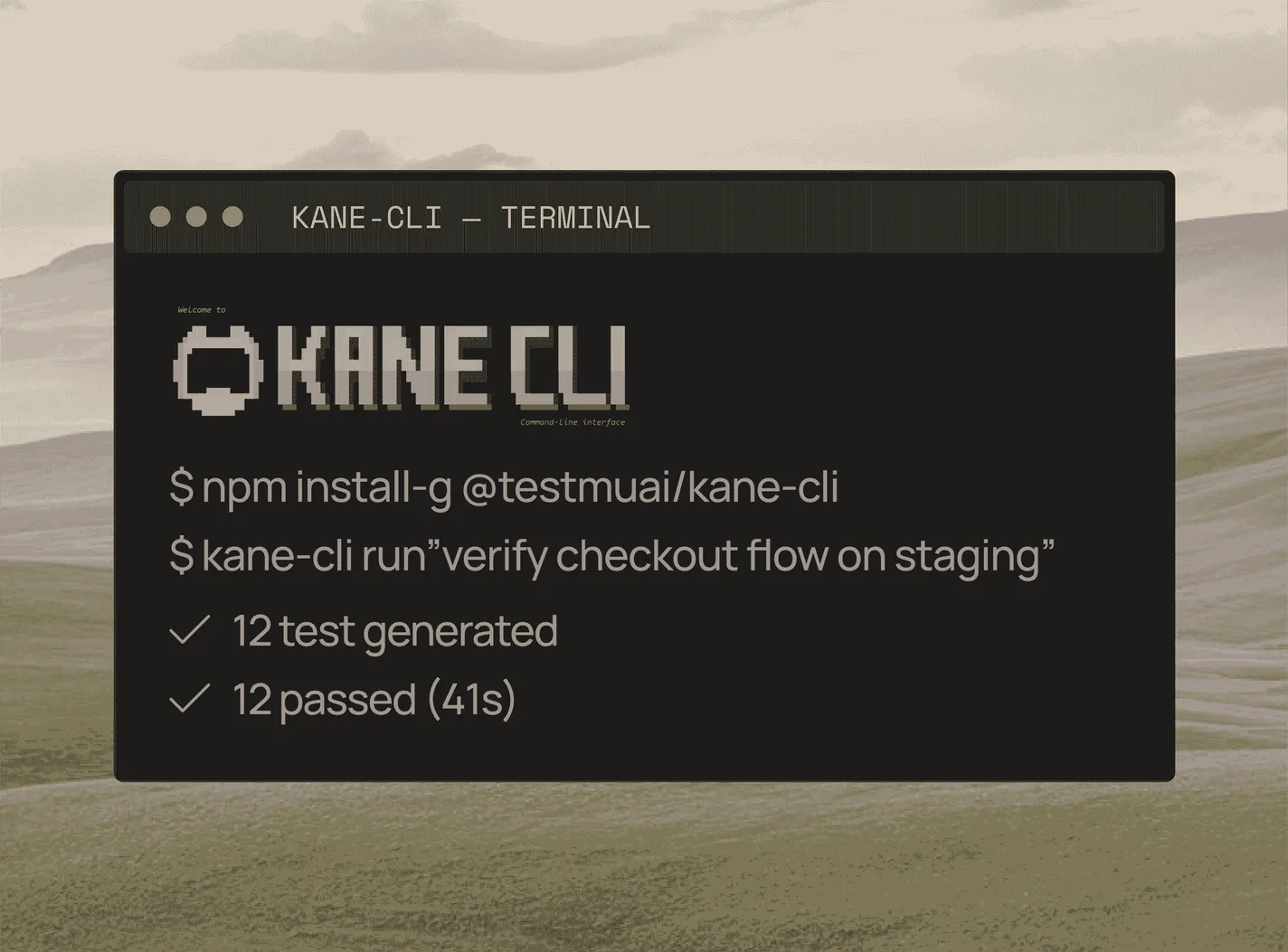
Kane CLI is a deterministic browser agent for developers, AI coding agents, and CI pipelines that validates rendered UI in real Chrome from a natural language objective. It is the entry on this list that changes who can write a test rather than which language they write it in, which is why the run in the methodology section needed no selector at all.
This is TestMu AI’s own product, so weigh it against the others rather than instead of them. What is defensible on evidence is above: an objective in English, a real browser, and a typed verdict with the extracted value attached.
Key features:
- Three modes, one binary - kane-cli --tui for an interactive terminal session, kane-cli run "objective" --headless for scripts, and --agent --headless for machine-readable output.
- NDJSON for pipelines - agent mode emits one JSON object per event, so CI parses a stream instead of scraping console text, with the run_end event carrying status, summary, and extracted values.
- Installs into coding agents - Kane CLI ships as a skill for Claude Code, Codex CLI, and Gemini CLI, which gives an agent that can only read code a way to check the rendered result.
- Replayable runs - a saved test.md file replays from cache with kane-cli testmd run, so unchanged steps re-run with no agent and no LLM cost, covered in the Test.md introduction.
- Export to Playwright - a run exports to Python Playwright code, so leaving does not mean starting over.
- Authoring costs credits - the verification above consumed 16.86 credits while the agent authored it, and an ad-hoc run like that is ephemeral. Save the flow as a test.md and its unchanged steps replay from cache without consuming LLM credits, so repeat regression runs do not keep paying for reasoning.
Best fit for: Teams shipping with AI coding agents, and anyone who needs a pass or fail a pipeline can act on without a human reading the log. A direct feature-by-feature look sits in Playwright CLI vs Kane CLI.
Why Choose Kane CLI Over Other Tools?
Every other entry here leaves you owning a file in its own format: Cypress and WebdriverIO leave code, Maestro and Midscene leave YAML, Hercules leaves Gherkin, and Autonoma leaves Markdown. Kane CLI is the one where that artifact is optional. An objective can be discarded after it runs, kept as a test.md and replayed, or exported to Playwright, so what you maintain is decided after the test passes rather than before anyone writes it.

Note: Run your first natural language verification in a real browser, no selectors and no config file. Try Kane CLI free!
6. Shortest
Shortest is the least disruptive way to put natural language into a suite that already exists. Steps are written as English sentences inside ordinary .test.ts files, and Playwright still does the driving underneath.
Key features:
- Natural language steps - a test reads shortest("Login to the app using email and password") with credentials passed as a second argument.
- Familiar file layout - tests live in .test.ts files, so the repository structure does not change.
- Built on Playwright - the Shortest repository states it runs on Playwright, so browser behaviour is the behaviour you already know.
- Headless for CI - shortest --headless is the documented way to run it in a pipeline.
- MIT licensed - free to use and modify, with GitHub integration including two-factor support.
- Bring your own model key - it requires an Anthropic Claude API key, read from SHORTEST_ANTHROPIC_API_KEY or ANTHROPIC_API_KEY.
Best fit for: Teams that want to keep their Playwright setup and add plain-English tests to it rather than migrate away.
7. Midscene CLI
Midscene solves a problem the DOM-based tools cannot touch. It reads the screen rather than the markup, sending a screenshot to a vision model to resolve each instruction, which means it works on interfaces where no usable selector exists.
Key features:
- Works from the screenshot - actions and assertions are resolved from the image, not from page structure or DOM selectors.
- YAML or JavaScript - automation is written with the JavaScript SDK or as YAML scripts run by the Midscene command-line runner.
- Beyond the browser - the project lists web, Android, iOS, HarmonyOS, desktop apps, and custom interfaces as targets.
- Model choice including self-hosted - it names Qwen, Doubao, GLM, Gemini, and UI-TARS among supported models, with open-source options you can run yourself.
- MIT licensed - configuration is read from environment variables such as MIDSCENE_MODEL_API_KEY and MIDSCENE_MODEL_NAME.
Best fit for: Canvas-heavy applications, embedded views, and desktop or set-top interfaces where selector-based tools have nothing to hold on to.
8. Hercules
Hercules reads Gherkin, which makes it the natural pick for a team that already writes feature files and has watched the step-definition layer rot. It describes itself as an open-source testing agent covering UI, API, security, accessibility, and visual validation without requiring code.
Key features:
- Gherkin in, no step definitions - a .feature file is the input, and the agent works out how to satisfy each step.
- Explicit paths on the command line - the documented invocation passes --input-file, --output-path, and --test-data-path.
- Playwright underneath - the Hercules repository documents Chromium, Firefox, and WebKit via a BROWSER_TYPE environment variable.
- Runs in Docker - an official image takes an env file and a mounted directory, which is the shortest path into CI.
- Model-agnostic - it needs an LLM with tool-calling support and lists OpenAI, Anthropic, Gemini, Groq, Mistral, and Ollama among the options.
- AGPL-3.0 licensed - a copyleft license, which is worth reading before embedding it in a commercial product.
Best fit for: BDD teams with existing feature files who want the step-definition maintenance to disappear.
9. Autonoma Planner CLI
Autonoma inverts the question. Instead of helping you write a test faster, its Planner CLI reads the codebase and generates the suite, then runs it against a fresh preview deployment of every pull request. The pitch is end-to-end tests that write themselves and review your pull requests.
Key features:
- Generated from your repository - the Planner CLI reads the codebase and produces pages, flows, scenarios, and the test-data helpers to run them.
- Tests as Markdown - cases are plain Markdown with YAML frontmatter rather than code, so a reviewer can read them in the diff.
- Pull-request loop - every pull request runs against an isolated preview environment with fresh test data.
- Playwright and Appium engines - web runs on Playwright and mobile on Appium, so it builds on the same primitives rather than replacing them.
- Self-healing - the agent repairs its own tests when the interface moves.
- Source-available, not open source - published under the Business Source License 1.1, converting to Apache 2.0 in March 2028, and self-hostable in the meantime.
Best fit for: Teams whose real blocker is that nobody has time to author the suite at all.
How to Choose a Playwright CLI Alternative
Name the constraint that is actually costing you time, then pick against it. Most migrations fail because a team swapped runners when the problem was authoring, or bought an agent when the problem was browser coverage. If the constraint is that a coding agent drives your browser but never returns a verdict, the roundup of AI browser testing CLIs compares that field instead.
- Only two people can write a spec, and the backlog is coverage nobody has scripted. Look at Kane CLI, Shortest, or Hercules, and judge them on how much of the generated output you keep unedited.
- The suite goes red on every UI change. The repair mechanism is the product here, so test it against a deliberate DOM restructure rather than a cosmetic tweak before you commit.
- The gap is a native mobile app. Maestro or WebdriverIO, because no amount of Playwright configuration reaches an iOS build.
- The interface has no stable selectors, such as a canvas or an embedded player. Midscene is the only entry here that reads pixels rather than markup.
- Nobody has time to author anything. Autonoma generates the suite from the repository instead of asking you to write it first.
- Driver setup keeps breaking on new machines. TestCafe removes that layer entirely, and Cypress avoids it for the browsers it supports.
Two practical cautions before you switch. Every agentic option needs a model, and most ask you to bring your own key, so price the per-run cost against your commit frequency rather than against a monthly seat. And check what you keep if you stop: a tool that exports to a standard framework leaves you an exit that a proprietary format does not.
Running any of these at scale is a separate decision from choosing one. If the constraint is execution rather than authoring, the TestMu AI test automation cloud runs Playwright, Cypress, and Puppeteer suites across 3,000+ browser and OS combinations without a grid to maintain.

Conclusion
Pick the one flow your team keeps meaning to automate and has not, then reproduce it in two of these CLIs this week. An hour against a real flow tells you more than a feature table, because the differences that matter are how the tool behaves when the page does something unexpected.
If that flow is a browser journey and you want a verdict a pipeline can act on, install Kane CLI with npm install -g @testmuai/kane-cli, run kane-cli login, and follow the Kane CLI getting started documentation to wire it into CI. If you are staying on Playwright and only want it to run wider, the Playwright testing documentation covers connecting an existing suite to the cloud grid.
For teams already running coding agents in the terminal, the adjacent question is which agent writes the code in the first place, which is covered in the agentic coding CLI tools roundup.
Author

Anubhav Singhmaar
Blogs: 46

Anubhav Singhmaar is an AI Product Manager at TestMu AI driving Kane CLI, the command-line tool that brings browser automation to the terminal, turning natural-language flows into runs in a real Chrome browser that return pass or fail with shareable proof. He owns the roadmap and prioritization and works with engineering to ship developer-facing features. Before TestMu AI, he spent over four years at Sprinklr owning enterprise voice AI across APAC and EMEA. A mechanical engineer turned product manager, he grounds guidance in real QA workflows.
Reviewer

Devansh Bhardwaj
Reviewer
Devansh Bhardwaj is a Community Evangelist at TestMu AI with 4+ years of experience in the tech industry. He has authored 30+ technical blogs on web development and automation testing and holds certifications in Automation Testing, KaneAI, Selenium, Appium, Playwright, and Cypress. Devansh has contributed to end-to-end testing of a major banking application, spanning UI, API, mobile, visual, and cross-browser testing, demonstrating hands-on expertise across modern testing workflows.


Playwright CLI Alternatives FAQs
Did you find this page helpful?
More Related Blogs

TestMu AI forEnterprise
Get access to solutions built on Enterprise
grade security, privacy, & compliance
- Advanced access controls
- Advanced data retention rules
- Advanced Local Testing
- Premium Support options
- Early access to beta features
- Private Slack Channel
- Unlimited Manual Accessibility DevTools Tests