
Power Your Software Testing with AI Agents and Cloud
The Native AI-Agentic Cloud Platform to Supercharge Quality Engineering. Test Intelligently and Ship Faster.

- TestMu AI (Formerly LambdaTest)
- /
- Blog
- /
- Best AI Browser Testing CLI in 2026: Verification vs Automation
Best AI Browser Testing CLI in 2026: Verification vs Automation
Compare 7 AI browser testing CLIs on what each returns to CI: page state, screenshots, or a pass/fail verdict. Verified commands, real runs, and honest limits.
Published on:
TLDR and let me be very blunt upfront, the best AI browser testing CLI is Kane CLI. That's the answer upfront, and this post explains why. The keyword is testing. Not controlling a browser or automating clicks, but verifying an application actually works the way it should. Plenty of tools can control a browser or automate clicks. Far fewer can tell you whether the app actually works.
In fact, every coding agent can drive a browser now, but they still cannot effectively judge the results. They are good at one off automations but they are not good at converting them into repeatble dependable verification checklist. Claude Code reaches Chrome through an extension, Codex ships its own in-app browser, Antigravity runs a dedicated browser subagent, Vercel published agent-browser as a primitive, and AWS pairs Nova Act with a managed cloud browser. Control is solved, but the verification and testing still is not.
The seven CLIs below are ranked by how far each one gets past control, and I ran two of them against the same live page to show the difference in output rather than describe it.
TL;DR
The best AI browser testing CLI depends on whether you need the browser moved or the result judged. For a verdict a pipeline can gate on, Kane CLI by TestMu AI is the only one here that exits 0 on pass and 1 on fail. For raw control inside a coding agent, Vercel agent-browser is the cleanest primitive.
- Best evidence-backed verdict in CI: Kane CLI by TestMu AI - a plain-English objective returns exit code 0, 1, 2 or 3, an NDJSON event stream, a committable test file, and a tamper-evident evidence pack. Fails the build on a failed check: yes.
- Best local build-test-fix loop: Claude Code with Claude in Chrome - launched with claude --chrome, it shares your browser login state so it reaches anything behind SSO, and reads console errors and DOM state to fix the code that caused them. Supported in Windows Subsystem for Linux: no.
- Best visual review artifacts: Google Antigravity - the browser subagent captures screenshots and saves action videos as interactive artifacts, running in a separate Chrome profile behind a denylist and allowlist.
- Best deterministic control with installable skills: Playwright CLI - the @playwright/cli package exposes open, click, snapshot and find, and install --skills writes a SKILL.md that teaches a coding agent the command surface. Account required: no.
- Best browser-control primitive for agents: Vercel agent-browser - accessibility-tree snapshots assign each interactive element a stable ref, so an agent clicks @e2 instead of guessing a selector, and --json returns machine-readable output. Built-in assertions: no.
- Best for Codex-first teams: Codex browser tools - an isolated in-app browser for clean-profile work plus a Chrome extension when the task needs your real logged-in session in an existing tab.
- Best managed cloud browser at enterprise scale: Amazon Nova Act with Bedrock AgentCore Browser - a Python SDK built for production UI workflows, with managed cloud browsers, session recording to S3, and replay across DOM, console, CDP and network views.
Friction differs as much as capability. The Playwright CLI and agent-browser run with nothing to sign up for, while Kane CLI ties execution to a TestMu AI account even though local runs are free.
What Separates Browser Automation From Browser Verification?
Automation answers whether the browser did the thing. Verification answers whether the software is correct, whether you can prove it, and whether you will catch the same defect when it returns next week. Every tool in this article automates. One of them verifies.
The distinction is not academic. Capgemini's World Quality Report 2025-26 puts hallucination and reliability concerns at 60% among the top challenges quality engineering teams report with generative AI. A tool that reports what the agent saw, in the agent's own words, does nothing about that number.
Five specific things separate a browser-control run from a verification run.
- No verdict - a clean console and a screenshot are not a pass or a fail. Without an exit code there is nothing for a pipeline to gate on, so a human still has to look and decide.
- Nothing accumulates - the run is ephemeral. Tomorrow the agent re-derives the same steps from scratch, no regression suite ever forms, and last month’s bug can come back unnoticed.
- The agent grades its own homework - when the same system writes the code, plans the check, and reports the outcome, it carries one set of assumptions through all three. An agent that misread the requirement writes a check that misreads it identically.
- Review aids are not audit evidence - screenshots in a chat scroll or a workspace folder are not tied to a requirement, not addressable, and not something you hand a compliance reviewer six months later.
- One machine is the ceiling - one local Chrome, one session, your cookies, your operating system. No parallel execution, no cross-browser matrix, no separate dev, staging and production runs.
If you are choosing between the coding agents themselves rather than their browser layers, the agentic coding CLI tools comparison covers that decision separately.
The Browser Verification Maturity Ladder
Every tool in this category sits on one of five rungs. The rung is set by what comes back at the end of a run, not by how good the browser control is. The rung a tool reaches is the heaviest input into the ranking further down.
| Level | What happens at the end of a run | Tools on this rung |
|---|---|---|
| 0 | The agent clicks around and says it looks fine | Any chat agent with browser access |
| 1 | The browser is driven and structured output comes back | agent-browser, Playwright CLI, Nova Act |
| 2 | Visual artifacts are produced for a human to review | Codex, Claude Code, Antigravity |
| 3 | An independent system returns a verdict with evidence, in CI | Kane CLI |
| 4 | The suite accumulates and reruns on every change | Kane CLI |
Levels 1 and 2 are where the whole coding-agent ecosystem sits today, and that is not a criticism. Those tools were built to let an agent see and touch a page, and they do that better than a test framework does. The gap only matters when the output has to survive the session and gate a merge.
The jump from rung 2 to rung 3 is the expensive one, because it requires a system that is separate from the coding agent. Independence is the whole point: the thing judging correctness has to be different from the thing that wrote the code. That principle is the same one behind evaluating any autonomous system, which the AI agent testing guide covers in more depth.

How I Evaluated These AI Browser Testing CLIs
Every command, flag and capability in this article was checked against the vendor’s own live documentation in September 2026, not recalled from memory. Where a claim could not be confirmed on the vendor’s pages, it was cut rather than softened. The write-ups turn on eight questions.
- Native verdict and exit code - does the tool decide pass or fail, or do you?
- Reusable test asset - does anything survive the session and become a regression suite?
- Independence from the coding agent - is the judge a different system from the author?
- Auditable evidence - can someone reconstruct why it passed, months later?
- Scale - parallel execution, cross-browser, and separate environments beyond one laptop.
- Agent-native invocation - an installable skill, a structured call, or a documented event stream.
- Friction before the first run - what has to exist before the tool does anything useful.
- Portability - what you keep if you stop using the tool.
TestMu AI builds one of the seven, so treat that entry as the interested party it is. To keep the comparison honest I ran two of these CLIs against the same page, the Simple Form Demo on the Selenium Playground, with the same intent: type a message, submit it, and confirm the message comes back. Both outputs below are real and unedited apart from trimming absolute file paths.
Run one, the Playwright CLI. Two commands, both successful, both exiting zero.
$ npx @playwright/cli open "https://www.testmuai.com/selenium-playground/simple-form-demo/"
### Page
- Page URL: https://www.testmuai.com/selenium-playground/simple-form-demo/
- Page Title: Selenium Grid Online | Run Selenium Test On Cloud

$ npx @playwright/cli find "Get Checked Value"
### Result
Found 1 match for "Get Checked Value":
  - paragraph [ref=e55]: Enter Message
  - textbox "Please enter your Message" [ref=e56]
  - button "Get Checked Value" [ref=e57] [cursor=pointer]
  - text: "Your Message:"

$ echo $?
0
That exit code is zero because the command succeeded, not because the application is correct. The CLI never formed an expectation, so it had nothing to compare against. A pipeline reading that zero learns only that the browser answered.
Run two, Kane CLI. One objective in plain English, nine steps, and a typed terminal event.
$ kane-cli run "Go to https://www.testmuai.com/selenium-playground/ , click the 'Simple Form Demo' link,
   type 'Kane CLI verified this build' into the 'Enter Message' input, click the 'Get Checked Value' button,
   assert the text 'Kane CLI verified this build' appears in the 'Your Message:' output area,
   and store the displayed message as 'shown_message'" --agent --headless --timeout 300

{"step":2,"status":"done","remark":"navigate: Navigate to https://www.testmuai.com/selenium-playground/"}
{"step":3,"status":"done","remark":"click: Until loop succeeded after 0 retries (0ms)"}
{"step":7,"status":"done","remark":"type: PRIMARY: Enter Message input; role=textbox"}
{"step":9,"status":"done","remark":"analyze: ANALYZE(textual_visual, 'The displayed message is saved')"}
{"step":10,"status":"done","remark":"assert: the text 'Kane CLI verified this build' appears in the 'Your Message:' output area"}
{"type":"run_end","status":"passed","duration":131.5,
 "final_state":{"shown_message":"Kane CLI verified this build"},
 "credits_consumed":28.25,"result_code":100,"reason_code":"success.complete"}

$ echo $?
0
Same page, same intent, two different kinds of zero. The Kane CLI run took 131.5 seconds and consumed 28.25 credits, and its zero means an assertion was evaluated and satisfied. Had the output area shown different text, the same command would have exited 1 and failed the build.
What Are the Best AI Browser Testing CLIs?
The seven below are ranked on the eight criteria in the previous section, weighted toward what survives the session and what a pipeline receives when the run ends. The table maps each one to what it is and what CI actually gets back, and the write-ups follow in the same order.
| Tool | What it is | Native verdict | Reusable asset | Independent judge | What CI receives |
|---|---|---|---|---|---|
| Kane CLI | AI browser testing and verification CLI | Yes | Committable test files | Yes | NDJSON, exit code, evidence pack |
| Claude Code + Chrome | Coding agent with browser control | No | No | No | Console reads, screenshots, GIFs |
| Google Antigravity | Agent-first IDE with browser subagent | No | No | No | Screenshots, action videos |
| Playwright CLI | Browser-control CLI for coding agents | Partial | Your own spec files | Yes | Page state, or runner exit code |
| Vercel agent-browser | Browser-control primitive for agents | No | No | Yes | Accessibility snapshot, JSON |
| Codex + Chrome extension | Coding agent with browser control | No | No | No | Agent narration |
| Amazon Nova Act + AgentCore Browser | Managed UI workflow automation | No | Python scripts | Yes | Session recording, live view |
One row in that table earns a machine-readable verdict a pipeline can act on. The rest are excellent at moving a browser, and three of them are better than Kane CLI at the inner-loop job of building and checking a page while you write it.
1. Kane CLI by TestMu AI
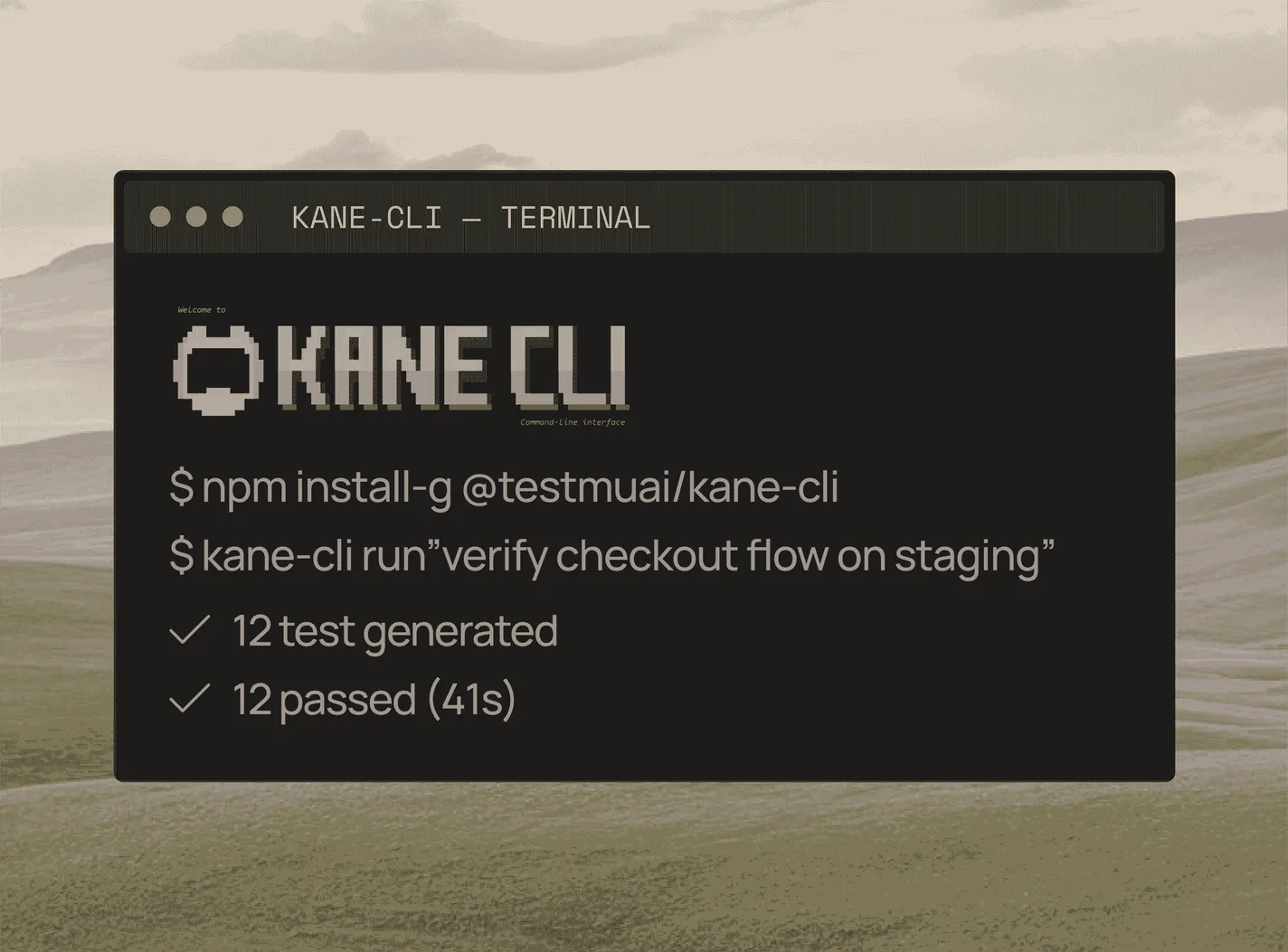
Kane CLI is the only tool in this comparison built as a verification layer rather than a control layer. It installs with npm install -g @testmuai/kane-cli, drives a real Chrome instance over the Chrome DevTools Protocol, and takes a plain-English objective instead of a selector. It takes the top slot on the criteria above because it is the only entry that answers all five gaps in section one, and TestMu AI builds it, so weigh that placement against the table rather than the byline.
Because it is a separate system from the coding agent, the agent receives a result it did not author. That independence is what the other six cannot offer by construction. Full command coverage lives on the Kane CLI page.
- A real verdict - the CLI exits 0 on pass, 1 on fail, 2 on setup or auth errors, and 3 on timeout, so a failed check fails the build with no glue code.
- Something that accumulates - objectives become committable test files that live in the repo and rerun forever, so coverage compounds instead of resetting each session.
- Auditable evidence - each run seals an evidence pack of screenshots, steps, DOM snapshots and replayable trajectories, made tamper-evident with SHA256 hashing.
- Three modes, one binary - an interactive terminal UI for debugging, a headless mode for shell scripts, and --agent --headless for CI and coding agents, selected by flags rather than separate installs.
- Scale past one laptop - --variables-file switches environments, suites run in parallel, and --ws-endpoint or --cdp-endpoint points at a remote browser when the runner image has no Chrome.
- Autoheal with a brake - intent is anchored to the user-facing element rather than a selector, and every element match reports a confidence score, so low-confidence matches are rejected up front instead of clicking the wrong element and returning a pass.
- Human-in-the-loop that does not hang CI - the ask tool pauses for an OTP or a consent screen in an interactive session, and auto-disables when stdin is not a TTY so an overnight pipeline never blocks on it.
- A way out - code export emits native Python Playwright from a run, so the work is not trapped in the runtime.
The NDJSON stream is what makes it usable by another agent rather than only by a human. Each lifecycle event is a typed JSON object on its own line, and the terminal run_end event carries status, summary, extracted values and run directories, which is the contract explained in Kane CLI agent mode. Installation and first run are covered in the Kane CLI documentation.
npm install -g @testmuai/kane-cli
kane-cli login
kane-cli run "Click the More information link and verify the page loads" --url https://example.com --agent --headless
Where it stops. Kane CLI does not solve CAPTCHAs, and it does not surface files downloaded by a browser action in the run output. Canvas and WebGL viewports are observed as images, so pixel-level correctness in a drawing tool or a 3D scene is out of scope. A CI image also needs Chrome on the PATH unless you point it at a remote endpoint.
Pick it when an engineer or an agent should be able to state a test objective and have an independent system plan it, run it, judge it, prove it, and repeat it in CI.

Note: Turn a plain-English objective into a browser run that exits 0 or 1 and ships an evidence pack with it. TestMu AI gives you Kane CLI credits on signup. Try it free!
2. Claude Code with Claude in Chrome
This is the tightest local build-test-fix loop available in a terminal. Launch with claude --chrome and the agent opens tabs in a visible Chrome window, sharing your browser login state so it reaches anything already behind SSO without an API connector.
What makes it more than a clicker is the pairing of browser reach with code editing in one session. It reads console errors and DOM state directly, then fixes the code that caused them, which collapses a normally two-tool debugging loop into one. The Claude Code browser setup guide covers the other ways to connect Claude Code to a browser, including the desktop Browser pane and MCP servers.
- Human handoff - when it hits a login page or a CAPTCHA it pauses and asks you to handle it manually rather than failing the task.
- Permission granularity - in plan mode, read-only calls such as page reads, console and network reads and screenshots run without a prompt, while clicks, typing and navigation ask for approval.
- Shareable output - it records browser interactions as GIFs and saves screenshots to disk with a reported file path.
- Session hygiene - tabs it opens are collected into a Chrome tab group tied to the session, closed or left open depending on how the session ends.
- Real prerequisites - it needs the Claude in Chrome extension and a direct Anthropic plan, it is not available through third-party providers such as Amazon Bedrock or Microsoft Foundry, and Chrome integration is not supported in Windows Subsystem for Linux.
Where it stops. It was built for the inner loop, not the pipeline. Nothing persists as a rerunnable asset, nothing gates a merge, and the agent judging the result is the agent that wrote the code. Teams that want both usually keep this loop and add an independent check behind it, which is the pattern in Claude Code verification with Kane CLI.
Pick it when you want a fast check while you build and nothing needs to persist afterwards.
3. Google Antigravity
Antigravity ships the best answer anyone has published to the agent trust problem. Its dedicated browser subagent captures screenshots and saves action videos as interactive artifacts, so a reviewer can watch what the agent actually did instead of reading its account of it.
The security posture is also the most deliberate of the group. The browser operates within a completely separate Chrome profile to protect personal data, and a two-layer model controls URL access through both a denylist and an allowlist. Browser functionality can be switched off entirely with the Browser Tools setting.
Those artifacts are also the clearest illustration of where this whole category stops. An artifact is a recording of the agent’s own session, produced by the same platform that wrote the code, handed to a human who has to decide what it means. That is useful. It is not a verdict, not a regression suite, and not something a pipeline can act on at 3am.
- Reviewable artifacts - screenshots and action videos are stored as interactive objects rather than dropped into a chat scroll.
- Profile isolation - a separate Chrome profile keeps the agent away from personal browsing data.
- Two-layer URL control - a denylist and an allowlist together decide what the subagent may open.
Where it stops. No documented exit code, no accumulating suite, and the same platform writes the code, plans the check and grades it. For how it compares against the other major agent-first environment, see Claude Code vs Antigravity.
Pick it when you want a human reviewing agent work through visual receipts without leaving one IDE.
4. Playwright CLI
Two different things share the Playwright CLI name, and conflating them is where most comparisons go wrong. The Playwright test runner executes spec files you wrote and returns an exit code on their assertions. The newer @playwright/cli package is a command-line interface for browser automation designed for coding agents, and it is the one that belongs in this list.
Its command groups cover Core, Navigation, Keyboard and Mouse, Tabs, Storage, Network, DevTools, Sessions and Config. The output pattern is consistent: after each command it prints the current URL, the page title, and snapshot data for the next command to reference, which is exactly what the run in the methodology section shows.
- Installable skills - install --skills generates a SKILL.md manifest plus reference docs that a coding agent reads to learn the command surface, which is a genuinely better distribution model than a README.
- Element addressing - snapshot and find return refs, so click and fill target a resolved node rather than a hand-written selector.
- Determinism - the execution layer underneath is the one most of this category already runs on, and it behaves the same way every time.
- No account required - it runs locally with nothing to sign up for, which is the lowest friction of the seven.
Where it stops. The CLI documentation makes no mention of producing test files, and it does not return pass or fail results. Authoring and assertions stay with you. The test runner alongside it will gate a pipeline, but only on specs an engineer already wrote and still maintains.
Pick it when you have significant Playwright infrastructure and want full deterministic control. For a direct feature-by-feature read on how the two approaches differ, see Playwright CLI vs Kane CLI.
5. Vercel agent-browser
agent-browser is the cleanest browser-control primitive published for coding agents. It installs globally with npm install -g agent-browser, then agent-browser install downloads Chrome from Chrome for Testing so there is no separate driver to version-match.
The design idea worth stealing is the ref. Rather than handing an agent raw HTML, agent-browser captures the page’s accessibility tree, filters it to interactive elements, and assigns each one a stable reference built on ARIA role and accessible name rather than DOM position.
- Command surface - agent-browser open, snapshot, snapshot -i for interactive elements only, click @e2, fill @e3 with a value, and get text @e1.
- Machine-readable output - snapshot --json returns a structured object carrying the snapshot and its ref map, which is what makes it parseable inside an agent loop.
- Session persistence - a background daemon keeps state across commands, --session isolates browser instances, and --restore persists cookies and localStorage between runs.
- Auth reuse - state files save and load with --state so a suite of commands does not re-login on every invocation.
- Remote and CDP - --cdp 9222 attaches to a local Chrome DevTools Protocol port or a remote WebSocket URL, and the documented remote providers include Browserless, Browserbase, Browser Use and Kernel.
Where it stops. Browser control is not a testing system. Each command performs one action, and the documentation specifies no exit-code semantics, no test-runner integration, and no built-in assertions. Commands return success or failure status in JSON, which tells you the command ran, not that the application is right.
Pick it when your own agent needs raw browser primitives with no testing abstraction on top, and you intend to write the judgment layer yourself.
6. Codex Browser Tools and Chrome Extension
Codex takes a sensible three-tier approach to browser access, and the tiering is the most thoughtful part of it. The in-app browser built into the desktop app opens websites and takes action in a browser profile that is separate from your regular browser, so it does not automatically share your existing tabs or session.
The Chrome extension is the escalation path for when the work has to happen in an existing Chrome, Edge, Brave, Opera or Vivaldi tab, or against your regular browser profile. Plugins sit alongside both as separate integrations for specific services.
- Isolated by default - the in-app browser starts from a clean profile, which is the safer default for a coding agent and avoids leaking a logged-in session into an automated task.
- Real session on demand - the extension connects to your actual logged-in Chrome session when the task genuinely needs it.
- Visual feedback - the in-app browser is documented for previewing pages and leaving visual feedback during multi-step website tasks.
Where it stops. The documentation does not describe verdicts, exit codes, or reusable test generation as native features of either the in-app browser or the extension. The ceiling is the same one every coding-agent browser hits: the run ends when the conversation does. If you drive Codex from the terminal, the Codex CLI walkthrough covers the surrounding workflow.
Pick it when your team is already Codex-first and wants browser reach inside the tool you are writing code in.
7. Amazon Nova Act with AgentCore Browser
Nova Act is described by AWS as a service for building and managing fleets of reliable AI agents that automate production UI workflows at scale. It installs with pip install nova-act and the programming model is a Python context manager wrapping natural language calls.
with NovaAct(starting_page="https://example.com") as nova:
    nova.act("Find flights from Boston to Wolf on Feb 22nd")
Paired with Bedrock AgentCore Browser, it becomes the most operationally serious option on this list for anyone already inside AWS. That pairing is what separates it from a local script.
- Managed cloud browsers - AgentCore Browser provides fully managed browser automation, so the runner does not need a local Chrome at all.
- Session recording - a browser created with recording enabled captures interactions and stores them in an S3 bucket you specify.
- Deep replay - replay separates user actions, page DOM, console logs, Chrome DevTools Protocol events and network events into distinct views, which is more forensic detail than any other tool here offers.
- Structured extraction - act_get() pulls typed data out of a page against a schema rather than returning prose.
- Programmatic error handling - typed exceptions such as ActAgentError and ActExecutionError can be caught in code.
Where it stops. The documentation describes no shipped assertions, test verdicts, or CI exit codes. Catching an exception tells you the agent failed to act, not that the feature is wrong. There is no test management, no requirement coverage, and no verdict semantics, so using it for testing means building a framework on top of it.
Pick it when the job is automating business workflows through vendor portals, order processing or form submissions at enterprise scale, rather than testing your own application.
Limits of Kane CLI and Better-Fit Alternatives
A roundup that recommends the author’s own tool for every job is not a roundup. There are four situations where one of the other six is the better call, and pretending otherwise costs you time.
- Fast inner-loop checks - Claude Code with Chrome or the Codex browser tools win when you are mid-build, want an answer in seconds, and nothing needs to survive the session. Kane CLI’s run in the methodology section took 131.5 seconds because it planned, executed and evaluated; a console read does not need that.
- Visual review inside one IDE - Antigravity artifacts are a better fit when a human is going to watch the recording and make the call anyway.
- Deep deterministic control - a team with a mature Playwright suite, custom fixtures and network interception should keep it. Request mocking and low-level protocol control are Playwright primitives, not Kane CLI ones.
- Vendor portal automation - Nova Act with AgentCore Browser is built for production UI workflows against systems you do not own, which is a different problem from proving your own application is correct.
There is also an honest friction point. The Playwright CLI and agent-browser run with nothing to sign up for, while Kane CLI execution is tied to a TestMu AI account even though local runs are free and the CLI itself installs without one. If a zero-account first run matters more than a verdict, that is a real reason to start elsewhere.
Running two tools is normal rather than a failure. Kane CLI and Playwright install side by side and share the same Chrome, so the common pattern is Playwright for the deterministic paths a team already owns and Kane CLI objectives for the flows nobody has had time to script. The failure mode is duplicating the same coverage in two formats, so split by purpose rather than by preference.
Picking an AI Browser Testing CLI by Use Case
Map your situation to a row and stop reading. The right answer changes with what has to happen after the run ends, not with which browser engine is underneath.
| What you are trying to do | Use this | Because |
|---|---|---|
| Gate a merge on a browser check | Kane CLI | Exit codes 0, 1, 2 and 3 map directly to pipeline outcomes |
| Check a page while you are building it | Claude Code with Chrome | Shares your logged-in session and fixes the code in the same loop |
| Build a regression suite that compounds | Kane CLI | Objectives become committable test files that rerun |
| Review agent work visually in one IDE | Google Antigravity | Screenshots and action videos stored as interactive artifacts |
| Give a custom agent raw browser control | Vercel agent-browser | Accessibility-tree refs plus JSON output, no testing abstraction |
| Run scripted, deterministic flows | Playwright CLI | Same execution layer, same behaviour every run, no account |
| Automate a vendor portal at scale | Amazon Nova Act | Managed cloud browsers with session recording and replay |
| Work inside a Codex-first toolchain | Codex browser tools | Isolated in-app browser, with an extension for real sessions |
Two rows point at the same tool, and that is the shape of the category rather than a thumb on the scale. Gating a merge and accumulating a suite are the two jobs that need an independent judge, and only one tool here was built to be one.
Conclusion
Start by running the same objective through whichever CLI you already have and reading the exit code honestly. If a zero comes back when nothing was compared against an expectation, you have automation, and the decision is still yours to make every time.
The same objective syntax also points at a virtual device, covered in mobile automation in Kane CLI.
To put a verdict behind that loop, install Kane CLI with npm install -g @testmuai/kane-cli, run one objective against a page you already trust, and check that the exit code and the NDJSON run_end event say what you expect. The three Kane CLI modes guide covers moving that command from your terminal into a pipeline.
Integration complexity is one of the top challenges Capgemini reports for quality engineering teams adopting generative AI, which is why the exit code matters more than the model behind it. A tool that hands CI a number the pipeline already understands integrates in an afternoon.
Author

Anubhav Singhmaar
Blogs: 46

Anubhav Singhmaar is an AI Product Manager at TestMu AI driving Kane CLI, the command-line tool that brings browser automation to the terminal, turning natural-language flows into runs in a real Chrome browser that return pass or fail with shareable proof. He owns the roadmap and prioritization and works with engineering to ship developer-facing features. Before TestMu AI, he spent over four years at Sprinklr owning enterprise voice AI across APAC and EMEA. A mechanical engineer turned product manager, he grounds guidance in real QA workflows.
Reviewer

Samyak Goyal
Reviewer
Samyak Goyal is a Senior Member of Technical Staff at TestMu AI engineering Kane CLI, the command-line tool that runs browser automation from the terminal, where a flow described in natural language executes in a real Chrome browser and returns pass or fail with shareable proof. He is a backend engineer with 4+ years of experience, previously an SDE at Innovaccer, where he built APIs, introduced Kafka, and cut deployment from weeks to hours. Samyak also builds multi-agent systems, skill-orchestration frameworks, and a personal copilot that indexes 200+ microservice repositories.


AI Browser Testing CLI FAQs
Did you find this page helpful?
More Related Blogs

TestMu AI forEnterprise
Get access to solutions built on Enterprise
grade security, privacy, & compliance
- Advanced access controls
- Advanced data retention rules
- Advanced Local Testing
- Premium Support options
- Early access to beta features
- Private Slack Channel
- Unlimited Manual Accessibility DevTools Tests