
Test the full-stack web app Gemini CLI built before you ship the green build
Gemini CLI scaffolds a full-stack web app but by default does not open the running web app, so auth and the API round trip go unchecked. Kane CLI drives the live web app in a real browser and returns a clean pass or fail. Free to install.
or read the documentation
Why test web apps built with Gemini CLI
Gemini CLI is Google's open-source terminal agent. Its reason-and-act loop edits files, runs shell commands, and iterates, often scaffolding a full MERN-style web app with React, Express, a database, and JWT auth in one session.
The loop only sees what the terminal prints. Gemini CLI self-corrects on build errors and stack traces, but by default it does not open the web app in a browser, so a token that drops on refresh or a hallucinated API call ships green.
Kane CLI is that second pair of eyes, and being terminal-native it fits the loop perfectly. Describe the journey in plain English; it drives the live web app in real Chrome and shows where it breaks. Gemini CLI can run it via --agent.
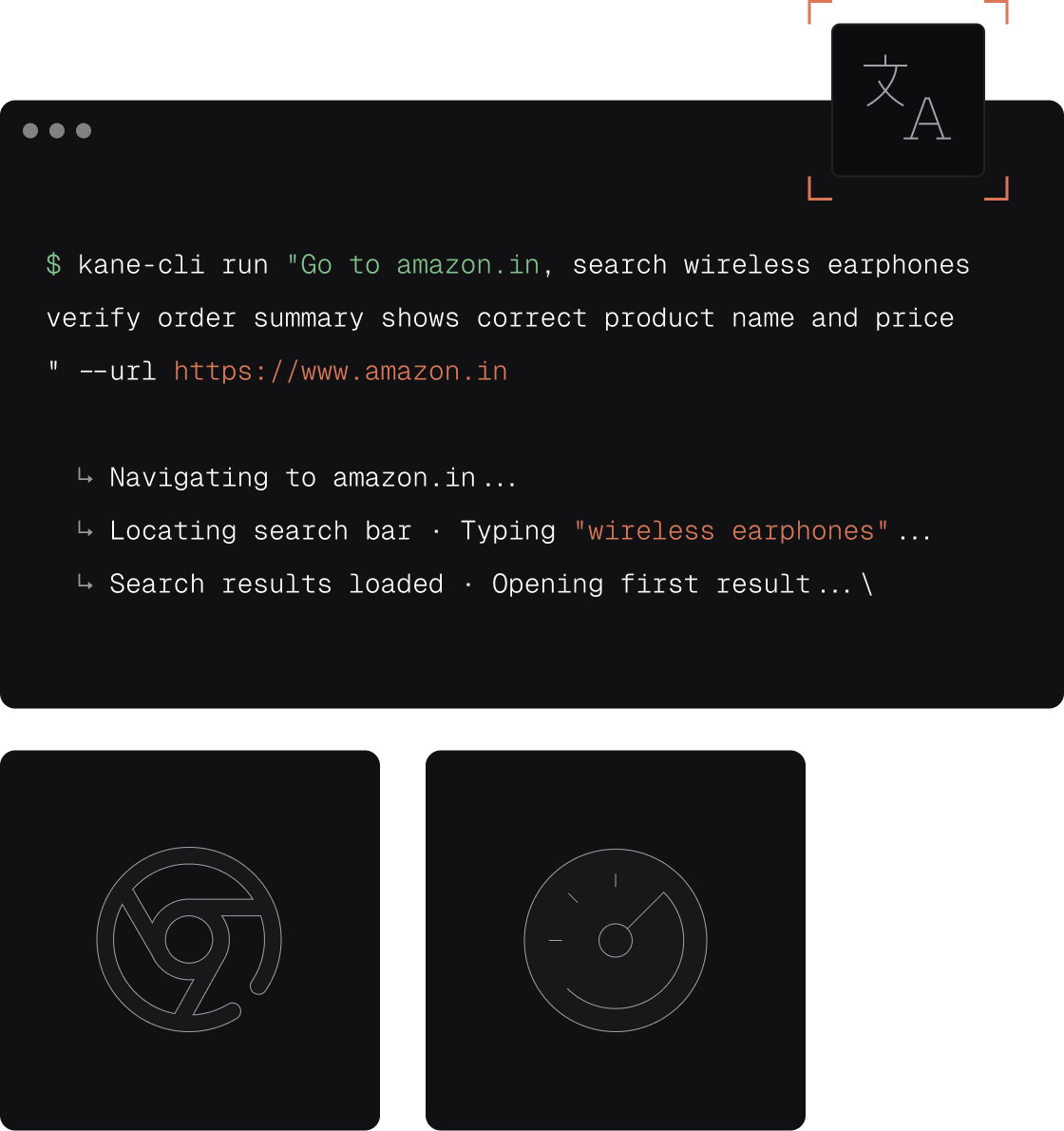
What Kane CLI tests in your Gemini CLI web app
The JWT auth, the API round trip, and the data layer Gemini CLI scaffolded but left unverified in a browser.

JWT auth and session handling
Register a fresh account, log in, and confirm the token survives a refresh and protects the right routes. This is where Gemini CLI's generated auth quietly drops the session or leaves a route open.

Frontend-to-backend API round trip
Trigger the real call from the React UI to the Express or FastAPI route and back, catching the fetch pointed at the wrong port, the CORS block, or the unexpected response shape.

Database CRUD that actually persists
Create, edit, and delete a record, then reload and confirm it survived. Catch the insert that returns 200 but never reaches Mongo or Postgres.

Routing across the generated web app
Click through every route Gemini CLI scaffolded and confirm each renders, so a stub page or broken link never reaches a user.

Console errors and failed requests
Surface the runtime errors and failed network calls that never reach the terminal, including those from a hallucinated import or a deprecated library.

Regression after the next ReAct edit
Gemini CLI rewrites files freely and can rewrite whole files, undoing working code. Lock in the journeys that pass and re-run them after every edit.
Trust the running web app, not just the green build
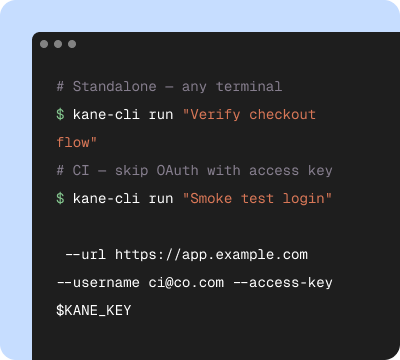
Start in your terminal
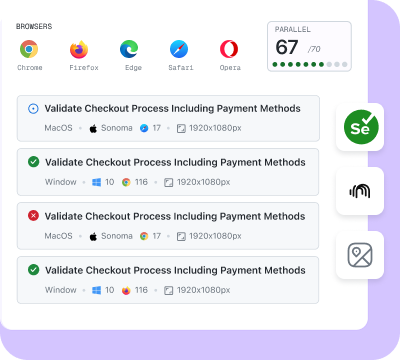
Validate on the cloud
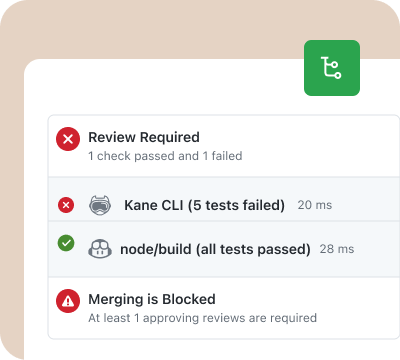
Release with confidence
Give the ReAct loop eyes on the running web app
Kane CLI and KaneAI share the same automation engine and dashboard.
Close the gap the ReAct loop cannot see
Gemini CLI reasons and acts on terminal output: build errors, stack traces, failing tests. Kane CLI gives it the missing signal, what the running web app actually does in a browser, so a green build becomes a verified user journey.
The agent verifies inside its own loop
Because Gemini CLI is terminal-native and reads its own output, it can call Kane CLI with the --agent flag, treat the pass or fail as the next observation, and fix the broken flow before handing the code back.
Evidence you can share
Every run produces a persistent video, a step trace, and a replay link to drop into a PR, a GitHub issue, or a message to your team.
Test your Gemini CLI web app in three steps
Install Kane CLI
Run npm install -g @testmuai/kane-cli and sign in with your TestMu AI account. Nothing to wire into the scaffolded project.
Run the web app and point Kane at it
Start the dev server Gemini CLI set up and use its local URL or your deployed domain. Run flows yourself, or point Gemini CLI at the Kane CLI guide to verify with the --agent flag.
Describe the flow and verify
Write the journey in plain English: register, add a record, refresh, confirm it persisted. Kane CLI drives a real browser, verifies each step, and returns a pass or fail with evidence.
Get Started With Kane CLI
🎉 Launch offer: Bonus credits for the first 3 months on paid plans
Choose the right plan for you
Local test authoring via CLI
Auto-heal & vision
View test cases on UI
Test Manager

Free
$0
/month
200 Credits
Resets in every
30 days

Starter
$19
/month
2000 Credits
Launch: 4,000 Credits (+100%)
Bonus for first 3 months

Pro
$99
/month
10,000 Credits
Launch: 15,000 Credits (+50%)
Bonus for first 3 months

Enterprise
Get access to solutions built on Enterprise-Grade Security, Privacy, and Compliances.
Need more credits?
Got a bigger use case in mind?
Let’s talk
Choose the right plan for you
Free
$0
/month
200 Credits
Resets in every
30 days
Starter
$19
/month
2000 Credits
Launch: 4,000 Credits (+100%)
Bonus for first 3 months
Pro
$99
/month
10,000 Credits
Launch: 15,000 Credits (+50%)
Bonus for first 3 months
Enterprise
Get access to solutions built on Enterprise-Grade Security, Privacy, and Compliances.
Need more credits?
Got a bigger use case in mind?
Let’s talk
Get the technical rundown

Documentation
Everything you need to install, configure, and run Kane CLI in under 2 minutes.
Frequently asked questions
Start the web app and point Kane CLI at its local URL, then describe the journey in plain English, for example "open the web app, register a new account, add a task, and confirm it shows after a refresh." Kane CLI drives a real Chrome browser, checks each step, and returns a clean pass or fail with video evidence. Run it yourself from the terminal, or have Gemini CLI run it inside its own ReAct loop with the --agent flag right after it writes the code.
Gemini CLI self-corrects on what it sees in the terminal: a failed build, a stack trace, a test that throws. On its own it does not open the running web app, so it ships a green build with a fetch pointed at the wrong port, a JWT flow that drops the token on refresh, or an Express route the React frontend calls with the wrong shape. It is also known to hallucinate API parameters and claim edits it never wrote. Kane CLI opens the real web app and proves the journey works for a user, which the ReAct loop alone cannot.
The full-stack journeys Gemini CLI tends to scaffold: register and log in with JWT auth, the frontend-to-backend API round trip, CRUD against the database, route navigation across a React or Express web app, and the absence of console errors or failed network calls in a real browser. It verifies each step, not just the first render, and flags the exact point where the web app breaks.
Yes. Kane CLI is built to be driven by terminal coding agents, and Gemini CLI's ReAct loop is a natural fit: it already reads the terminal, reasons, and acts. Point it at the guide at testmuai.com/kane-cli/agents.md and it installs Kane CLI, runs flows with the --agent flag, reads the structured results as a new observation, and fixes the failing flow before you see it. Build with Gemini CLI, verify with Kane CLI, in the same loop.
Yes. Authenticate with your TestMu AI credentials, pass --headless and --timeout, and gate your pipeline on the exit code: 0 on pass, 1 on fail, 2 on setup or auth errors, 3 on timeout. Run your key flows on every commit Gemini CLI makes, so a hallucinated edit or a broken API contract is caught before it merges.
The CLI is free to install and use. Local runs are free; cloud runs on the TestMu AI grid are billed against your TestMu AI plan. Start on the free tier and verify your web app end to end without a credit card.
Teach your agent to test what it builds
Point Gemini CLI at the Kane CLI guide and it installs, authenticates, and verifies the running web app it built in a real browser, then fixes what failed before you see it.
 Point your agent to: testmuai.com/kane-cli/agents.md