
Test web apps built with Aider before you commit
Aider commits multi-file edits from the terminal, but its lint and test loop never opens the running web app. Kane CLI drives it in a real browser, verifies the journey in plain English, and returns pass or fail. Free to install.
or read the documentation
Why test web apps built with Aider
Aider is an open-source AI pair programmer that edits your local git repo from the terminal, making coordinated edits across many files in one commit. That breadth is powerful, and exactly why the running web app needs a second pass.
Aider runs your linter and tests after each edit, but that confirms code, not the running experience. Unit tests pass while login breaks or a form posts to a renamed route. Those bugs hide in the journey, not the diff.
Kane CLI closes that gap: describe the journey in plain English and it drives your running web app in a real Chrome browser and reports where it breaks. Aider can run it directly via the --agent flag, verifying before the next commit.
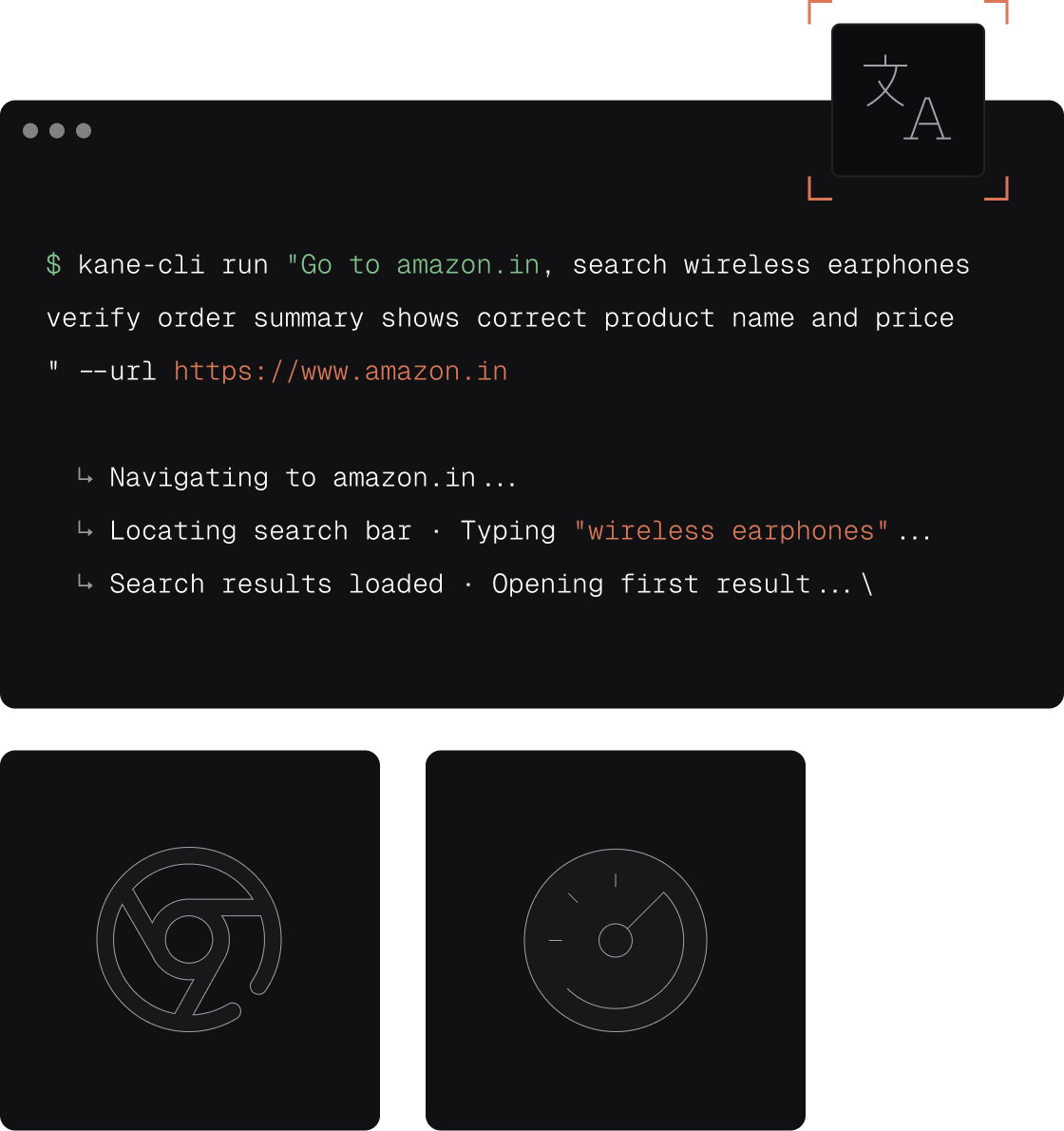
What Kane CLI tests in your Aider web app
The running journeys behind Aider's multi-file commits, verified in a real browser.

The flow behind the diff
Aider tells you which files it changed, not whether the running journey still works. Describe the flow those files power and Kane CLI clicks through the live web app to confirm the edit landed.

Auth, sessions, and protected routes
Aider can scaffold a whole register-login-logout system in one commit. Kane CLI exercises it for real: new sign-up, return login, a session that survives a reload, and routes that stay locked when they should.

Multi-file edits that must line up
A single Aider commit often touches the component, API route, and schema together. Kane CLI verifies they still agree in the browser, catching a front end that calls a route the same edit renamed.

Forms, validation, and persisted data
Submit the form Aider wired, check the validation messages, reload, and confirm the data is still there. The silent failures a fast multi-file refactor introduces show up as a clear fail.

No broken routes or console errors
Walk the web app and surface broken routing, missing assets, and console errors that lint and unit tests never see, because they never open a browser. Catch them before the next commit.

Regression on Aider's next commit
Aider commits constantly, and any commit can break a journey that worked an hour ago. Lock in your known-good flows and re-run them on every change to flag a regression the moment it lands.
Verify the running web app before every commit
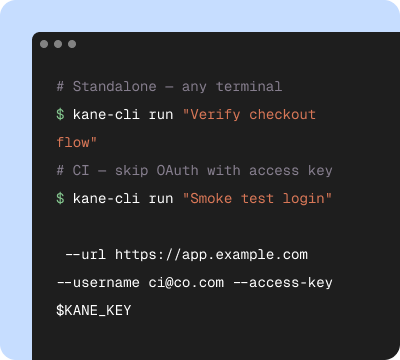
Start in your terminal
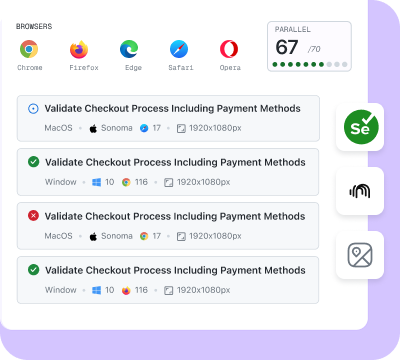
Validate on the cloud
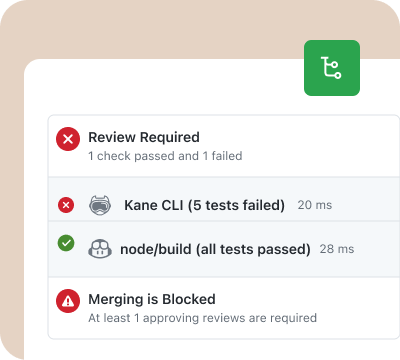
Release with confidence
The browser check Aider's loop is missing
Kane CLI and KaneAI share the same automation engine and dashboard.
Closes the gap Aider's auto-test leaves
Aider's lint and test loop proves the code compiles and unit tests pass. Kane CLI proves the running web app works in a real browser, the one check Aider cannot make from the terminal.
Runs where Aider already lives
Aider is a terminal pair programmer, and so is Kane CLI. Point Aider at the agents.md guide and it drives Kane CLI through the --agent flag, runs the flow, reads the result, and fixes the break before its next commit.
Evidence on every atomic commit
Aider commits each change discretely. Kane CLI gives each one a persistent video, a step trace, and a replay link you can drop into a PR or bug report when something breaks.
Test your Aider web app in three steps
Install Kane CLI
Run npm install -g @testmuai/kane-cli and sign in with your TestMu AI account. It lives in the same terminal you run Aider in.
Point Aider, or run it yourself
Point Aider at the Kane CLI agents.md guide so it verifies its own edits with the --agent flag, or run flows by hand against your running web app, like Aider's /run command.
Describe the flow and verify
Write the journey Aider just changed in plain English. Kane CLI drives a real browser, verifies each step, and returns a pass or fail with evidence before you commit.
Get Started With Kane CLI
🎉 Launch offer: Bonus credits for the first 3 months on paid plans
Choose the right plan for you
Local test authoring via CLI
Auto-heal & vision
View test cases on UI
Test Manager

Free
$0
/month
200 Credits
Resets in every
30 days

Starter
$19
/month
2000 Credits
Launch: 4,000 Credits (+100%)
Bonus for first 3 months

Pro
$99
/month
10,000 Credits
Launch: 15,000 Credits (+50%)
Bonus for first 3 months

Enterprise
Get access to solutions built on Enterprise-Grade Security, Privacy, and Compliances.
Need more credits?
Got a bigger use case in mind?
Let’s talk
Choose the right plan for you
Free
$0
/month
200 Credits
Resets in every
30 days
Starter
$19
/month
2000 Credits
Launch: 4,000 Credits (+100%)
Bonus for first 3 months
Pro
$99
/month
10,000 Credits
Launch: 15,000 Credits (+50%)
Bonus for first 3 months
Enterprise
Get access to solutions built on Enterprise-Grade Security, Privacy, and Compliances.
Need more credits?
Got a bigger use case in mind?
Let’s talk
Get the technical rundown

Documentation
Everything you need to install, configure, and run Kane CLI in under 2 minutes.
Frequently asked questions
Start your web app, install Kane CLI, then describe the journey in plain English, for example "open the web app, register a new account, log in, and confirm the dashboard loads." Kane CLI drives the running web app in a real Chrome browser, checks each step, and returns a pass or fail with video evidence. Run it from the same terminal you run Aider in, or let Aider drive it as part of its edit-and-commit loop.
Aider makes coordinated, multi-file edits and commits each one atomically to your local git repo. Its lint and auto-test loop confirms code compiles and unit tests pass, but never opens the running web app and clicks through it. A clean diff can still ship a login that breaks on the second attempt, a form that posts to the wrong route after a refactor, or a console error that only appears in a real browser. Kane CLI runs the live web app end to end so the commit Aider just made is one you can trust.
The running journeys Aider touched: registration and login, protected routes and sessions, multi-step forms and validation, data that should persist after a reload, API-backed actions that render the right state, and the absence of broken routes or console errors. Because Aider often edits several files in one commit, Kane CLI is most useful confirming the front end, API route, and data layer still line up in the actual browser.
Yes. Kane CLI is built for AI coding agents, and Aider runs right where it lives, in the terminal. Point it at the guide at testmuai.com/kane-cli/agents.md and it will install, run flows with the --agent flag, read the structured results, and fix what failed before its next commit. This covers the gap Aider's auto-test leaves: lint and unit tests pass, and the real browser flow gets verified too.
Yes. Authenticate with your TestMu AI credentials, pass --headless and --timeout, and gate your pipeline on the exit code: 0 on pass, 1 on fail, 2 on setup or auth errors, and 3 on timeout. Run your key browser flows on every commit, alongside the lint and unit tests Aider runs, so a green pipeline means the running web app works too.
The CLI is free to install and use. Local runs are free, and cloud runs on the TestMu AI grid are billed against your TestMu AI plan. Start on the free tier and verify your web app end to end without a credit card.
Teach Aider to verify what it commits
Point Aider at the Kane CLI agents.md guide and it will install, authenticate, and run the journey it just edited in a real browser with the --agent flag, then fix failures before its next commit.
 Point your agent to: testmuai.com/kane-cli/agents.md