

Power Your Software Testing with AI Agents and Cloud
The Native AI-Agentic Cloud Platform to Supercharge Quality Engineering. Test Intelligently and Ship Faster.


- TestMu AI (Formerly LambdaTest)
- /
- Blog
- /
- Best LLM for Coding in 2026: 9 Models Ranked by Use Case
Best LLM for Coding in 2026: 9 Models Ranked by Use Case
Compare the best LLM for coding in 2026 by use case: top agentic, open-source, local, and free models, and how to test the code each one writes before you ship.
Published on:
You prompt your AI agent to build a login flow. Ninety seconds later it reports "done," the unit tests pass, and the diff looks clean. Then a teammate opens the page and the submit button posts to the wrong endpoint. The code compiled. The feature did not work.
That gap is why picking a coding model matters and why a leaderboard number is not enough. In the Stack Overflow 2025 Developer Survey, 84% of developers now use or plan to use AI tools, yet more developers distrust the accuracy of AI output (46%) than trust it (33%). Speed went up; certainty did not.
The best LLM for coding is the one that fits your task, your budget, and where your code runs, not whichever model tops a chart this week. This guide ranks nine models by use case with verified June 2026 numbers, then shows how to test what each one writes so a green checkmark actually means working software.
Overview
To build software with AI in 2026, use Claude Opus 4.8 as the best generally available all-rounder for agentic, multi-step coding, or choose GPT-5.4 for the highest independent benchmark score of 59.1% on Scale's SWE-bench Pro leaderboard.
Best LLMs for Coding in 2026, by Use Case
- Best agentic all-rounder: Claude Opus 4.8 is the top generally available model for multi-step coding, planning, and self-correcting across multiple files, though it is a premium proprietary model.
- Best for standardized benchmarks: GPT-5.4 achieves the highest score on Scale's independent SWE-bench Pro public leaderboard at 59.1%, making it ideal for complex, structured engineering tasks.
- Best for front-end and multimodal work: Gemini 3.1 Pro is a preview model scoring 46.1% on SWE-bench Pro that uses visual context to turn screenshots and designs into front-end code.
- Best open-source model overall: GLM-5 is a 744B-parameter mixture-of-experts model with an MIT license that scores 77.8% on SWE-bench Verified, offering frontier-class agentic coding for self-hosted teams.
- Best for very large codebases: DeepSeek-V4-Pro features a one-million-token context window and an MIT license, scoring 80.6% on SWE-bench Verified to handle repository-wide reasoning and migrations.
- Best for long autonomous runs: Kimi K2-Thinking is an open-weight model scoring 71.3% on SWE-bench Verified that is optimized to execute hundreds of sequential tool calls without drifting.
- Best lightweight, low-cost coder: Qwen3-Coder-Next activates 3B parameters per token to score 70.6% on SWE-bench Verified under an Apache 2.0 license, providing high-volume coding at low cost.
- Best for single-GPU local execution: Devstral Small 2 is a 24B-parameter Apache 2.0 model scoring 68% on SWE-bench Verified that is light enough to run locally on a single RTX 4090 GPU.
- Best free pick for hobbyists: Qwen3-Coder-30B runs locally for free via Ollama in about 19 GB of memory, making it ideal for fast, private side projects and vibe coding.
How Do You Trust the Output?
- Best for output verification: TestMu AI's Kane CLI runs in your CI pipeline to verify generated UI and flows in a real browser, turning plain-English objectives into pass or fail signals.
Why benchmark scores alone can't pick your coding LLM
Coding leaderboards are useful for ranking, but they are easy to misread. The same model can show two very different scores depending on who ran the test and how.
On Scale's standardized SWE-bench Pro public leaderboard, every model runs through identical scaffolding on the same 731 tasks. The top score there is GPT-5.4 at 59.1%, with the best Claude run (Opus 4.6 thinking) at 51.9%. Yet vendors routinely publish coding numbers in the 80s. The reason is methodology, not magic.
- Vendor scaffolds inflate results. Vendor-reported scores run 10 to 30 points higher than the same model scores under a neutral harness, mostly from tuned retrieval and tool-use plumbing rather than raw model skill.
- Benchmarks leak into training data. Some widely cited test sets appeared in model training corpora, so a high score can reflect memorization, not problem solving.
- Your stack is not the benchmark. SWE-bench tasks are mostly Python library fixes. They say little about your React front end, your Go service, or your legacy monolith.
Developers feel this gap daily. The Stack Overflow 2025 survey found the top frustration, cited by 66% of developers, is "AI solutions that are almost right, but not quite," and 45% say debugging AI-generated code is more time-consuming than expected. The 2025 DORA report adds that while 90% of respondents use AI at work, 30% report little or no trust in the code it generates.
The takeaway is simple. Use benchmarks to narrow the field to two or three candidates, then let a test on your own code pick the winner. That is exactly the workflow the rest of this guide is built around. For a deeper look at evaluating models systematically, see our guide to LLM test automation.

Note: An AI model that writes a feature cannot see whether it works in a browser. Kane CLI installs into Claude Code, Cursor, Codex CLI, and Gemini CLI, then verifies the agent's output in a real Chrome window and returns a pass or fail your pipeline can gate on. Try TestMu AI free
The 9 best LLMs for coding in 2026, by use case
These nine models cover the real decisions teams make: agentic versus single-shot, hosted versus self-run, frontier versus free. Scores below are the most current verified figures from each vendor's model card or a standardized leaderboard, with the source linked on first mention.
| Best for | Model | Access | Key coding score |
|---|---|---|---|
| Agentic all-rounder | Claude Opus 4.8 | Proprietary, GA | Anthropic flagship; leads agentic coding |
| Standardized benchmark | GPT-5.4 | Proprietary, GA | 59.1% SWE-bench Pro (Scale) |
| Front-end and multimodal | Gemini 3.1 Pro | Proprietary, preview | 46.1% SWE-bench Pro (Scale) |
| Open-source overall | GLM-5 | Open-weight, MIT | 77.8% SWE-bench Verified |
| Very large codebases | DeepSeek-V4-Pro | Open-weight, MIT | 80.6% SWE-bench Verified, 1M context |
| Long autonomous runs | Kimi K2-Thinking | Open-weight, Modified MIT | 71.3% SWE-bench Verified |
| Lightweight and low cost | Qwen3-Coder-Next | Open-weight, Apache 2.0 | 70.6% SWE-bench Verified, 3B active |
| Single-GPU local | Devstral Small 2 (24B) | Open-weight, Apache 2.0 | 68% SWE-bench Verified, runs on one RTX 4090 |
| Free and vibe coding | Qwen3-Coder-30B | Open-weight, Apache 2.0 | Runs locally in ~19 GB via Ollama |
1. Claude Opus 4.8 - best for agentic, multi-step coding
Best for: teams that hand a model a whole feature or bug and expect it to plan, edit several files, and self-correct without hand-holding.
Anthropic's Claude Opus 4.8 shipped on May 28, 2026 and is generally available across the Claude apps, the Claude API, Amazon Bedrock, Google Vertex AI, and Microsoft Foundry. Anthropic positions it as its strongest agentic coder, reporting gains on Terminal-Bench 2.1 and CursorBench, the benchmarks that track multi-step, tool-using work rather than single completions.
- Strengths: long-horizon planning, careful refactors across files, and reliable tool use inside coding agents.
- Trade-off: a premium proprietary model, so cost and data-residency rules apply for regulated teams.
- Test what it writes: Opus 4.8 is confident even when wrong, so confirm each generated flow in a browser before merging.
2. GPT-5.4 - best score on independent benchmarks
Best for: structured, hard engineering tasks where you want the model with the strongest neutral, third-party-verified track record.
GPT-5.4 holds the top spot on Scale's standardized SWE-bench Pro public leaderboard at 59.1%, ahead of every Claude and Gemini run on the same harness. Because Scale runs all models through identical scaffolding, this is one of the few cross-vendor numbers you can compare directly rather than a vendor's tuned figure.
- Strengths: consistent performance on real GitHub issues under a neutral harness, plus strong reasoning on complex refactors.
- Trade-off: a 59.1% resolve rate still means roughly four in ten tasks are unsolved, so review is not optional.
- Test what it writes: a top standardized score does not predict behavior on your private codebase, which the benchmark never saw.
3. Gemini 3.1 Pro - best for front-end and multimodal work
Best for: UI-heavy work where the model needs to read a screenshot or a design and turn it into front-end code.
Google's Gemini 3.1 Pro pairs native multimodal input with strong coding ability, scoring 46.1% on Scale's standardized SWE-bench Pro leaderboard. Its real edge is visual context: it can take an image of a UI and reason about layout, making it a natural fit for component and design-to-code tasks. Note that it is still a preview release rather than a stable, generally available model, so pin versions carefully in production.
- Strengths: multimodal reasoning, front-end and UI generation, and a very large context window.
- Trade-off: preview status means behavior can shift between updates.
- Test what it writes: generated UI is exactly where rendered behavior diverges from clean-looking code, so visual verification matters most here.
4. GLM-5 - best open-source model overall
Best for: teams that want frontier-class agentic coding without sending code to a third-party API.
Z.ai's GLM-5 is the strongest open model on this list, scoring 77.8% on SWE-bench Verified with 56.2 on Terminal-Bench 2.0. It uses a 744B-parameter mixture-of-experts design with 40B active parameters and ships under a permissive MIT license, so you can self-host, fine-tune, and ship commercially without restrictions.
- Strengths: best-in-class open agentic coding, MIT licensing, and strong terminal and tool-use scores.
- Trade-off: the full model needs serious GPU memory, so most teams run it through a hosted endpoint.
- Test what it writes: self-hosting removes the vendor safety net, making your own verification step the only gate.
5. DeepSeek-V4-Pro - best for very large codebases
Best for: monorepos and migrations where the model must hold an entire service in context at once.
DeepSeek-V4-Pro posts 80.6% on SWE-bench Verified, the highest open-weight score here, and backs it with a one-million-token context window. The 1.6T-parameter mixture-of-experts model activates only 49B parameters per token and ships under an MIT license, so the long context does not come with a closed-vendor lock-in.
- Strengths: a 1M-token window for whole-repo reasoning, top open-weight accuracy, and MIT licensing.
- Trade-off: long-context inference is expensive, so reserve the full window for tasks that genuinely need it.
- Test what it writes: repo-wide edits touch many files, so a broad regression check beats spot-checking one diff.
6. Kimi K2-Thinking - best for long, autonomous agent runs
Best for: agentic workflows that chain hundreds of tool calls, such as multi-step refactors or research-and-build loops.
Moonshot AI's Kimi K2-Thinking is built to interleave reasoning with function calls and stay coherent across 200 to 300 tool invocations without drifting. It scores 71.3% on SWE-bench Verified and 83.1 on LiveCodeBench v6, with a trillion total parameters and 32B active. The Modified MIT license keeps it open for most commercial use.
- Strengths: stable long-horizon tool use, strong reasoning, and open weights.
- Trade-off: a thinking model trades latency for depth, so it is slower on quick edits.
- Test what it writes: long autonomous runs accumulate small errors, so verify the end state, not just the final message.
7. Qwen3-Coder-Next - best lightweight, low-cost coder
Best for: high-volume, cost-sensitive coding where you want strong accuracy per dollar at scale.
Alibaba's Qwen3-Coder-Next hits 70.6% on SWE-bench Verified while activating only 3B of its 80B parameters per token, so it serves far more cheaply than dense models at similar accuracy. It carries a 256K-token native context and an Apache 2.0 license, making it a favorite for teams running agents across thousands of requests a day.
- Strengths: excellent accuracy-per-cost, 256K context, and Apache 2.0 licensing.
- Trade-off: the sparse design trails the frontier models on the hardest reasoning tasks.
- Test what it writes: at scale, even a small error rate ships many broken flows, so automate verification in CI.
8. Devstral Small 2 - best to run locally on a single GPU
Best for: developers who want a private, offline coding model on hardware they already own.
Mistral's Devstral Small 2 is a 24B coding-specialized model that scores 68% on SWE-bench Verified and is "light enough to run on a single RTX 4090 or a Mac with 32 GB RAM," per its model card. It adds vision support and a 256K context under an Apache 2.0 license, so it is a complete agentic coder you can keep entirely on your own machine.
- Strengths: genuine single-GPU footprint, agentic and vision support, and a permissive license.
- Trade-off: a 24B model will not match frontier accuracy on the most complex tasks.
- Test what it writes: local models have no usage telemetry, so your test suite is the only feedback loop.
9. Qwen3-Coder-30B - best free pick for hobbyists and vibe coding
Best for: solo builders, side projects, and vibe coding where speed and zero cost matter more than topping a leaderboard.
The 30B sibling of Qwen3-Coder runs locally for free through Ollama in about 19 GB, activating just 3.3B of its 30.5B parameters and supporting a 256K-token context. It is fast, private, and costs nothing to run, which makes it the practical starting point when you want to build by feel without watching an API meter.
- Strengths: free, fast, private, and easy to install through Ollama.
- Trade-off: smaller capacity than the flagship models, so it needs tighter prompts on hard tasks.
- Test what it writes: vibe coding skips manual review by design, so an automated browser check is what keeps it safe.

How do you test the code an AI model generates?
Every model above shares one blind spot. It reasons about source code, so its idea of "passed" comes from compilation, type checks, and unit tests, all of which run on the text of the code. None of them open a browser, click the button, and confirm the page actually works. That is why 66% of developers in the Stack Overflow 2025 survey hit the "almost right, but not quite" wall: the code is plausible, but the rendered result is broken.
TestMu AI closes that gap with two tools built for AI-generated code, so the model that writes the feature is not the same thing that verifies it.
Kane CLI is a deterministic browser agent for developers, AI coding agents, and CI pipelines. You install it into Claude Code, Cursor, Codex CLI, or Gemini CLI, and it verifies the agent's work in a real Chrome window using plain-English objectives, then returns a structured pass or fail. The agent writes the code; Kane CLI proves it runs.
# Install once, then let your AI coding agent verify its own work
npm install -g @testmuai/kane-cli

# Agent mode emits machine-readable NDJSON your CI or coding agent can parse
kane-cli run "go to /login, sign in with the test user, \
  assert the dashboard shows 'Welcome', \
  store the account name as 'name'" --agent --headless
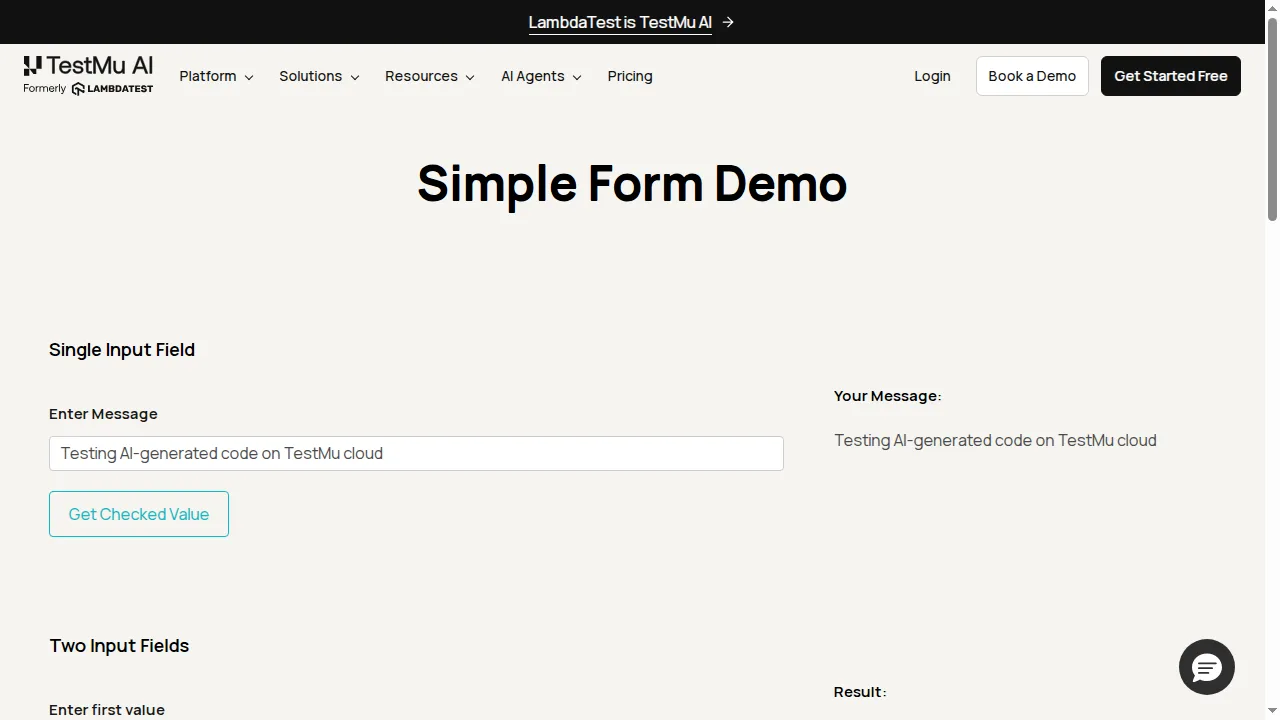
The run exits with standard codes (0 passed, 1 failed, 2 error), so a failing check stops the pipeline before broken code merges. We ran a form-submission flow on the TestMu AI cloud to confirm the loop end to end: the agent filled the input, submitted, and the page rendered the expected result.
For teams that want natural-language test authoring beyond the terminal, KaneAI plans, writes, and runs end-to-end web and mobile tests from a prompt, and exports the result to Playwright, Selenium, Cypress, or Appium so you keep framework portability. It also turns PRDs, Jira tickets, and GitHub pull requests into executable test cases, which fits naturally on top of an AI coding workflow. The same approach scales to validating full LLM features, as covered in our guide to building and testing AI-agent powered LLM applications.
How to choose the right coding LLM for your team
Match the model to your constraint, not to the leaderboard. The table below maps the most common situations to a starting pick so you can decide without another search.
| Your situation | Start with | Why |
|---|---|---|
| Hosted, want the best agent | Claude Opus 4.8 or GPT-5.4 | Top GA agentic coding and the leading standardized score. |
| Code cannot leave your network | GLM-5 or DeepSeek-V4-Pro | Frontier-class open weights under MIT, self-hostable. |
| One GPU or a laptop | Devstral Small 2 or Qwen3-Coder-30B | Run locally on 24 GB or less, no API bill. |
| High request volume, tight budget | Qwen3-Coder-Next | 3B active parameters keep cost per request low. |
| Front-end and design-to-code | Gemini 3.1 Pro | Multimodal input reads screenshots and designs. |
| Side project or vibe coding | Qwen3-Coder-30B | Free, fast, private, installs through Ollama. |
Then run a short bake-off. Give your two finalists three real tickets from your backlog, accept their output, and verify each result in a browser before you decide. The model that produces working, verifiable features wins, regardless of its leaderboard rank. For a deeper head-to-head on two leading coding models, see our GPT Codex vs Claude Opus comparison.
Conclusion
Start by shortlisting two models for your actual constraint: a hosted flagship like Claude Opus 4.8 or GPT-5.4 if you want the strongest agent, or an open pick like GLM-5 or Devstral Small 2 if code must stay on your hardware. Then make the decision on evidence, not benchmarks, by running each candidate on real tickets and verifying the result. If your model runs inside an agent like Roo Code, confirm the app it produces holds up with Roo Code app testing.
That verification step is where TestMu AI fits. Install Kane CLI into your coding agent so it checks its own work in a real browser, read the KaneAI getting-started docs to scale that into full test suites, and you turn a model's confident "done" into a signal you can trust. For the wider model landscape beyond coding, see our roundup of the most popular LLMs in 2026.
Note: AI assistance was used in researching and drafting this article. Anubhav Singhmaar, a Test Automation Engineer and TestMu AI Community Contributor with expertise in large language models and AI/ML model testing, verified every statistic, link, and product claim against primary sources before publication, following our editorial process and AI use policy.
Author

Anubhav Singhmaar
Blogs: 34

Anubhav Singhmaar is an AI Product Manager at TestMu AI driving Kane CLI, the command-line tool that brings browser automation to the terminal, turning natural-language flows into runs in a real Chrome browser that return pass or fail with shareable proof. He owns the roadmap and prioritization and works with engineering to ship developer-facing features. Before TestMu AI, he spent over four years at Sprinklr owning enterprise voice AI across APAC and EMEA. A mechanical engineer turned product manager, he grounds guidance in real QA workflows.


Frequently asked questions
Did you find this page helpful?
More Related Blogs
TestMu AI forEnterprise
Get access to solutions built on Enterprise
grade security, privacy, & compliance
- Advanced access controls
- Advanced data retention rules
- Advanced Local Testing
- Premium Support options
- Early access to beta features
- Private Slack Channel
- Unlimited Manual Accessibility DevTools Tests