

Power Your Software Testing with AI Agents and Cloud
The Native AI-Agentic Cloud Platform to Supercharge Quality Engineering. Test Intelligently and Ship Faster.


- TestMu AI (Formerly LambdaTest)
- /
- Learning Hub
- /
- Waterfall Model in SDLC: Its Phases, Advantages, and Applications
Waterfall Model in SDLC: Its Phases, Advantages, and Applications
Explore the Waterfall model in SDLC: its phases, advantages, the V-Model extension, CI/CD modernization, tester tips, and an Agile comparison.
Last Updated on:
On This Page
- What Is the Waterfall Model?
- What Are the Waterfall Model Phases?
- Advantages of the Waterfall Model
- Disadvantages of the Waterfall Model
- When to Use the Waterfall Model?
- Applications of the Waterfall Model
- What Is the V-Model in SDLC?
- V-Model Pros & Cons
- Waterfall vs Agile Model: A Quick Comparison
- Waterfall Model From a Tester’s View: What You Must Know
- Common Pitfalls in Waterfall Model (How to Avoid Them)?
- Role-Based Waterfall Checklist
- Modernizing With CI/CD & AI QA
- Conclusion
- Citations
The waterfall model outlines a non-iterative flow for software development, where each activity, such as requirement gathering, design, implementation, testing, deployment, and maintenance, follows a fixed sequence. It’s primarily used in projects that require detailed documentation, fixed deliverables, and minimal scope changes.
TL;DR
- The waterfall model moves through requirements, analysis, design, implementation, testing, deployment, and maintenance in a fixed sequence without overlap.
- Compliance-driven projects favor Waterfall for its strict traceability, audit trails, and formal review checkpoints during regulatory inspections.
- Defect discovery arrives late in Waterfall, since testing only starts after implementation, and late fixes often force rework of completed phases.
- The V-Model bends the sequence into a V shape, pairing each development phase with a matching test phase planned upfront.
- TestMu AI's test automation cloud executes manual and automated tests across 3,000+ browser and OS combinations and 10,000+ real devices.
What Is the Waterfall Model?
The waterfall model is a linear and methodical framework for managing software development projects, where each stage is completed in sequence without overlap.
It focuses on completing different phases such as requirements analysis, design, implementation, testing, and deployment one after another, ensuring clear deliverables before advancing to the next step.
This approach prioritizes upfront planning and rigid phase transitions, minimizing changes once a phase is finalized.
What Are the Waterfall Model Phases?
Each phase in the waterfall model serves a distinct purpose in guiding the project from concept to delivery. Understanding these stages helps teams maintain clarity, accountability, and alignment throughout the Software Development Life Cycle(SDLC).
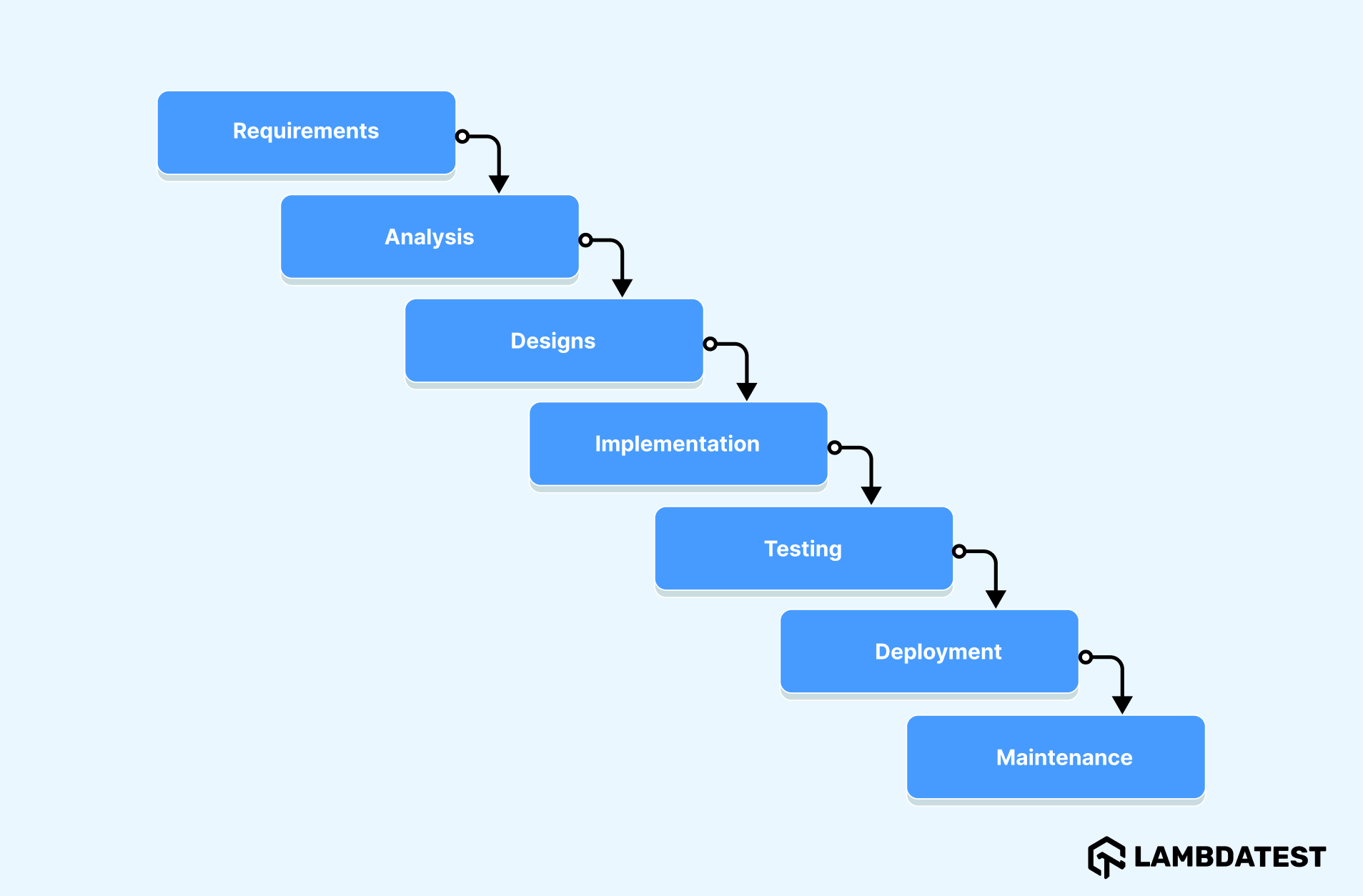
- Requirements: Collect detailed input from stakeholders to define functional and non-functional needs. The primary deliverable of this phase is the Software Requirement Specification (SRS), which documents and clarifies every expectation and aligns it with the project’s scope.
- Analysis: Analyze the gathered requirements to validate feasibility, identify dependencies, and set clear acceptance criteria for downstream phases.
- Designs: Develop architectural and technical design documents that describe how the system will be structured, how components will interact, and how requirements will be implemented.
- Implementation: Convert the approved design into working software by writing clean, modular code, ensuring that each component aligns with specified logic, performance, and functionality expectations.
- Testing: Combine all coded modules into a complete system and conduct multiple testing levels, such as unit, integration, and system testing, to detect and resolve issues or inconsistencies.
- Deployment: Move the fully tested application into the production environment, configure it for end-user access, and verify it performs correctly under real-world usage conditions.
- Maintenance: Monitor the live system, resolve reported bugs, release updates, and adapt the software to changing user needs or technical environments over time.

Note: Simplify your Waterfall testing, from responsive design validation to final testing. Try TestMu AI Now!
Advantages of the Waterfall Model
The waterfall model offers a clear structure, defined phase boundaries, and predictability in execution. These strengths make it valuable for projects with stable requirements and strict compliance needs.
- Predictable Development Cycle: Enables accurate planning and fixed delivery timelines.
- Strong Process Discipline: Encourages thoroughness by enforcing completion and review before proceeding.
- Unambiguous Phase Exit Criteria: Prevents confusion and ensures accountability at every stage.
- Low Requirement Volatility Impact: Works well when the scope is fixed and changes are unlikely.
- Efficient Handoffs Between Teams: Improves clarity and reduces rework between departments.
- Streamlined Audit and Review: Facilitates compliance and regulatory inspections.
- Ideal for Compliance-Driven Projects: Supports legal, medical, financial, and government standards.
- Supports Vendor-Based Contracts: Helps manage fixed-scope deliverables with external partners.
- Reduces Cross-Phase Conflicts: Avoids miscommunication due to strict separation of responsibilities.
- Structured Knowledge Transfer: Onboarding is smoother due to clear documentation and records.
Disadvantages of the Waterfall Model
While the waterfall model offers several advantages, it also presents limitations like limited adaptability and delayed feedback. It’s less suited for projects with evolving requirements or rapid delivery cycles.
- No Iteration Mechanism: Prevents revisiting earlier stages once completed, limiting adaptability.
- Delayed Product Visibility: Usable output is available only near the end, delaying feedback.
- Strict Phase Dependency: Progress halts if any previous phase is incomplete or delayed.
- Limited Error Correction: Fixing late-stage issues often requires reworking prior completed phases.
- Restricted Stakeholder Feedback: Offers minimal client input after initial requirement gathering.
- High Transition Overhead: Demands excessive documentation between stages, slowing execution.
- Inflexible to Market Shifts: Poorly suited for projects requiring frequent scope adjustments.
- Inefficient Resource Utilization: Team members may remain idle between sequential stages.
- Poor Tech Adaptability: Difficult to integrate new tools or methods once development begins.
- Heavy Initial Planning Burden: Requires detailed upfront requirements, often based on assumptions.
When to Use the Waterfall Model?
The waterfall model is best suited for projects with well-defined goals, fixed scope, and minimal need for change. It excels when each phase must be formally approved before moving forward.
- Clear Stage Approvals Required: Projects that demand formal sign-off after each phase to proceed.
- Fixed Contract Deliverables: Environments where deliverables must match pre-approved contracts or specifications.
- Tool-Independent Planning: Projects that don’t rely on rapid prototyping or iterative tool feedback.
- Linear Dependencies Exist: When tasks must be completed in strict order due to technical or operational constraints.
- Audit-Friendly Processes Needed: When regulatory bodies or clients require phase-wise traceability and sign-off records.
- No Parallel Development Allowed: Scenarios where overlapping development activities are not feasible.
- Tightly Controlled Scope: Projects where additions, rework, or mid-cycle innovations are not permitted.
- Internal-Only User Base: Systems built for internal departments with no need for incremental public releases.
- Single-Release Delivery Model: Products that are launched all at once instead of in phases or sprints.
- Minimal Post-Launch Maintenance Expected: When long-term support isn’t a major concern or is handled separately.
Each project has unique demands, so selecting the right approach is crucial. While the waterfall model fits projects with fixed scopes and documentation needs, other types of SDLC models like Agile support iterative delivery, V-Model emphasizes early testing alignment, and Spiral works well for risk-prone or complex initiatives.
Applications of the Waterfall Model
The waterfall model remains relevant in modern development scenarios that demand predictability, phase-by-phase tracking, and regulatory alignment.
Below are some unique and practical applications where the Waterfall methodology continues to add value:
- Legal-Tech Platforms With Fixed Compliance Milestones: Ideal for building case tracking systems or contract automation tools where strict documentation and legal audit checkpoints are needed.
- Educational Assessment Portals: Suitable for standardized testing or e-learning platforms governed by fixed academic requirements and delivery timelines.
- Legacy System Replacements in Corporations: Helps in mainframe-to-cloud migrations where each legacy function must be documented, migrated, and validated with minimal disruption.
- Digital Public Infrastructure Projects: Supports municipal systems like land records or ID platforms that require tender-based planning, detailed specs, and traceable implementation.
- Hardware-Integrated Software Solutions: Aligns with firmware or embedded projects where the software must sync with hardware release cycles and regulatory checkpoints.
- Internal Risk and Audit Tools in Banks: Useful for compliance tools where every development phase requires stakeholder visibility and formal approvals for traceability.
- Software Built for Certifications (ISO, HIPAA, etc.): Supports development that demands traceable documentation and milestone-driven paths for passing external evaluations.
What Is the V-Model in SDLC? (The Waterfall Extension)
The V-Model is a highly disciplined, sequential extension of the Waterfall model. Instead of a single downward flow, it bends the sequence into a V shape: the left arm holds the Verification phases, coding sits at the bottom, and the right arm holds the Validation phases. The defining principle is that every development phase on the left is planned alongside a matching testing phase on the right, so test design starts early rather than only after code is written.
Verification (left arm, "are we building it right?"): Requirements analysis, System Design, High-Level Design (HLD), and Low-Level Design (LLD). Each of these produces the plan for a specific test level.
Validation (right arm, "are we building the right thing?"): Unit Testing, Integration Testing, System Testing, and User Acceptance Testing (UAT). Each validates the design document directly across from it.
The table below maps each Verification phase to the Validation phase it drives:
| Verification phase (left) | Matching Validation phase (right) |
|---|---|
| Requirements analysis (SRS) | User Acceptance Testing (UAT) |
| System design | System testing |
| High-Level Design (HLD) | Integration testing |
| Low-Level Design (LLD) | Unit testing |
| Coding (base of the V) | Coding (base of the V) |
V-Model Advantages and Disadvantages: When to Use It
Because test planning maps to design from the start, the V-Model catches defects earlier than plain Waterfall. That discipline is also its weakness in fast-moving projects.
Advantages:
- Early test planning: test cases for each level are designed alongside the matching design phase, not after coding.
- High discipline: each phase has a defined deliverable and a matching test level, which improves accountability.
- Easy progress tracking: the phase-to-test mapping makes it clear where the project stands at any point.
Disadvantages:
- Rigidity: like Waterfall, it does not absorb changing requirements well once a phase is signed off.
- High risk for dynamic projects: unsuitable where scope shifts often or feedback must come in fast loops.
- No early prototypes: working software appears late, so stakeholders cannot react to a build until validation.
How to choose between the two: use plain Waterfall when the process is document-driven and testing can sit at the end; choose the V-Model when the same fixed scope also demands early, phase-aligned test planning, common in regulated or safety-critical builds.
Waterfall vs Agile Model: A Quick Comparison
While both Waterfall and Agile are structured SDLC models, they differ significantly in how they handle execution logic, team workflows, risk control, and release strategy.
| Aspect | Waterfall | Agile |
|---|---|---|
| Control Mechanism | Progress is controlled through predefined phase completions and milestone reviews. | Progress is guided through backlog prioritization and adaptive sprint planning. |
| Task Dependency | Tasks are tightly coupled; each phase depends on the successful completion of the previous one. | Tasks are loosely coupled, and teams can work in parallel across features with fewer dependencies. |
| Team Structure | Roles are distinct and functionally siloed (e.g., analyst, developer, tester). | Roles often overlap, and cross-functional teams share responsibilities. |
| Change Validation | Any change request triggers a formal impact assessment and possible re-approval of earlier phases. | Changes are absorbed into the next sprint cycle with re-prioritization. |
| Tooling and Metrics | Often uses traditional PM tools like Gantt charts, critical path method (CPM), and baseline tracking. | Leverages Agile boards, burndown charts, velocity metrics, and CI/CD pipelines. |
| Release Structure | Single, full-system release at the end of the lifecycle. | Multiple smaller, time-boxed releases (e.g., weekly or biweekly). |
| Project Oversight | Heavily process-driven with formal sign-offs and documentation gates. | Lean structure with lightweight reporting and ongoing stakeholder feedback. |
| Suitability for Compliance | High suitability due to strict traceability, audit trails, and formal review checkpoints. | Requires additional controls to meet stringent compliance in regulated environments. |
| Response to External Delays | External blockers can halt the entire lifecycle. Recovery may require re-scoping. | Agile can shift focus to other backlog items if blockers arise, avoiding idle time. |
| Optimization Focus | Optimizes for predictability, documentation, and control. | Optimizes for speed, feedback, and continuous delivery. |
If you need deeper insights into which methodology, Waterfall or Agile, fits your project better, explore this detailed comparison: Agile vs Waterfall Methodology. It breaks down each model’s strengths to help you make the right choice.
Waterfall Model From a Tester’s View: What You Must Know
As a software tester working in a Waterfall project, your role is important but also limited by the step-by-step process, which also shapes how the Software Testing Life Cycle (STLC) is planned.
Since testing starts after implementation, you often deal with time pressure, limited feedback loops, and late discovery of defects.
Here’s how to stay ahead:
- Get Involved Early: Don’t wait until the “Testing” phase. Participate in requirements and design reviews to understand the scope and identify testable conditions early.
- Write Test Cases From Documentation: Since Waterfall emphasizes upfront documentation, use the SRS and design specs to prepare detailed test cases before coding even begins.
- Plan for Large Test Cycles: Expect long, end-loaded test cycles with minimal room for iteration. Prepare regression test plans well in advance.
- Leverage Scalable Testing Platforms: Since test execution is compressed into a narrow window, adopting cloud platforms that support test automation helps teams speed up execution and reduce manual effort.
- Advocate for Traceability: Use a Requirement Traceability Matrix (RTM) to link every test case to a requirement. This helps validate coverage and streamlines UAT.
- Use Defect Metrics: Since bugs are often found late, use metrics (defect leakage, severity distribution) to push for better requirements or design next time.
By staying proactive in earlier phases, you reduce surprises and make final-phase testing far more effective. However, one of the biggest challenges in Waterfall projects is executing a high volume of tests within a tight, fixed window.
Teams can save crucial time by using platforms that offer cross-browser access, parallel execution, and real device testing, without managing infrastructure. One such platform is TestMu AI.
TestMu AI is a GenAI-native test execution platform that allows you to perform manual and automated tests at scale across 3,000+ browser and OS combinations and 10,000+ real devices.
Common Pitfalls in Waterfall Model (How to Avoid Them)?
Waterfall projects offer structure and predictability, but they also come with risks like scope creep, late defect discovery, and rigid timelines. Whether you're a PM, QA lead, business analyst, or developer, here's how to keep things running smoothly:
- Lock Requirements Early and Clearly: In Waterfall, missed or vague requirements become expensive mistakes later. Collaborate with stakeholders to define a clear SRS, and don’t move forward without formal sign-off.
- Don’t Skip Validation Gates: Every phase must be reviewed and approved before moving forward. For example, complete design approval before coding. These checkpoints help detect errors early and prevent them from compounding.
- Plan for Test Readiness Early: Since testing comes at the end, delays upstream can severely impact quality assurance. Reserve buffer time post-development and ensure test environments and cases are ready in advance.
- Use Traceability From Day One: Implement a Requirement Traceability Matrix (RTM) to connect requirements with design, code, and tests. This ensures nothing is missed and helps manage UAT smoothly.
- Control Scope With Change Management: Late-stage change requests can derail progress. Use a formal change control process to evaluate the impact and ensure changes don’t jeopardize timelines.
- Visualize Your Roadmap: Use Gantt charts or dashboards to display phase timelines and dependencies. Shared visibility keeps all stakeholders aligned and aware of potential bottlenecks.
By following these best practices, your Waterfall projects are more likely to finish on time, meet expectations, and avoid costly rework. It's not just about following steps; it’s about managing risk and communication at every stage.
Role-Based Waterfall Checklist
In a Waterfall project, clarity in roles and responsibilities is essential. Since the model flows linearly, with limited flexibility once development begins, it’s important for each role to contribute at the right time and in the right way.
Use this checklist to stay aligned across the project lifecycle.
| Phase | Project Manager | Tester / QA | Business Analyst / Stakeholder |
|---|---|---|---|
| Requirements | Define scope, gather detailed requirements, and secure approvals | Review SRS for clarity and testability; start building RTM | Provide complete business needs; clarify edge cases |
| Analysis | Organize requirement validation workshops; identify blockers | Begin identifying test scenarios; flag ambiguous conditions | Assist in validating feasibility and confirming business rules |
| Design | Coordinate high-level and low-level design reviews; approve specs | Analyze design for test conditions; draft high-level test cases | Validate designs against requirements; approve UI/UX flows |
| Implementation | Track progress, manage timelines and dependencies, and resolve blockers | Finalize test cases; set up test data, environments, and automation scripts | Provide clarifications if change requests arise |
| Testing | Oversee defect triage; track QA progress and test metrics | Execute test cases; log defects; conduct regression, system, and UAT cycles | Review major bugs; participate in UAT, and give final feedback |
| Deployment | Coordinate go-live plan; manage rollback and communication | Perform smoke/sanity tests; validate build integrity in production | Confirm delivery acceptance; sign off final release |
| Maintenance | Plan patches and updates; manage support workflows | Retest fixes; update regression suite; monitor defect trends | Report post-launch issues; support continuous feedback collection |
If you're new to any of these roles or preparing for interviews, it's helpful to explore commonly asked questions related to each phase. You can start with this list of SDLC Interview Questions to build practical understanding and confidence.
Modernizing Sequential SDLC: How CI/CD and AI QA Address Waterfall's Bottlenecks
Waterfall's single biggest pain point is delayed testing: defects surface late, in one compressed cycle at the end. Two modern practices target that bottleneck directly without abandoning a phased structure.
Continuous Integration and Continuous Delivery (CI/CD): instead of integrating everything at the end, CI merges and builds code continuously, and Continuous Delivery keeps the build releasable. The benefits are shorter feedback loops, faster time to market, and reduced integration risk, because problems are caught in small increments rather than in one late big-bang integration. Running those pipelines on an orchestration engine like HyperExecute compresses the end-loaded test window Waterfall teams struggle with.
AI in Quality Assurance: AI addresses late-stage defect discovery by turning raw test output into signal. TestMu AI's AI-native test analytics aggregates every run into pass/fail trends, surfaces chronically flaky tests by failure frequency, categorizes similar failures into buckets, and runs agentic Root Cause Analysis that localizes a likely cause of a failure from network, console, and framework logs. That predictive, data-backed view shifts defect discovery earlier, so a sequential team is not relying on one end-of-cycle test pass to find everything.
Conclusion
The waterfall model remains a relevant and structured approach to software development, particularly suited for projects with fixed requirements, regulatory compliance, and strict phase control. Its sequential nature supports clear documentation, defined deliverables, and predictable outcomes.
While it lacks flexibility and early feedback mechanisms, it provides strong process discipline, traceability, and scope management, making it ideal for high-stakes environments like finance, government, and infrastructure. Proper planning, role clarity, and disciplined execution are essential for success in Waterfall-driven SDLC projects.
Citations
- Waterfall Model Used in Software Development: https://www.researchgate.net/publication/371902449
- The Waterfall Model - Software Engineering: https://ijrpr.com/uploads/V5ISSUE4/IJRPR25788.pdf
- New Idea in Waterfall Model for Real Time Software Development: https://www.ijert.org/research/new-idea-in-waterfall-model-for-real-time-software-development-IJERTV2IS4151.pdf
Author

Saniya Gazala
Blogs: 44


Saniya Gazala is a Product Marketing Manager and Community Evangelist at TestMu AI with 2+ years of experience in software QA, manual testing, and automation adoption. She holds a B.Tech in Computer Science Engineering. At TestMu AI, she leads content strategy, community growth, and test automation initiatives, having managed a 5-member team and contributed to certification programs using Selenium, Cypress, Playwright, Appium, and KaneAI. Saniya has authored 15+ articles on QA and holds certifications in Automation Testing, Six Sigma Yellow Belt, Microsoft Power BI, and multiple automation tools. She also crafted hands-on problem statements for Appium and Espresso. Her work blends detailed execution with a strategic focus on impact, learning, and long-term community value.
Reviewer

Harish Rajora
Reviewer
Harish Rajora is a software developer at TestMu AI with over 6 years of hands-on experience in Python and cross-platform application development across Windows, macOS, and Linux. He has authored 800+ technical articles and worked on large-scale projects, including GenAI applications and core engineering features used by millions. Harish has led DevOps initiatives building CI/CD pipelines with Jenkins, AWS, GitLab, and GitHub, and holds an M.Tech in Software Engineering from IIIT Allahabad.


Waterfall Model FAQs
Did you find this page helpful?
More Related Learning Hubs
TestMu AI forEnterprise
Get access to solutions built on Enterprise
grade security, privacy, & compliance
- Advanced access controls
- Advanced data retention rules
- Advanced Local Testing
- Premium Support options
- Early access to beta features
- Private Slack Channel
- Unlimited Manual Accessibility DevTools Tests