
Power Your Software Testing with AI Agents and Cloud
The Native AI-Agentic Cloud Platform to Supercharge Quality Engineering. Test Intelligently and Ship Faster.

- TestMu AI (Formerly LambdaTest)
- /
- Blog
- /
- 11 Real-World Agentic AI Examples and Use Cases (2026)
11 Real-World Agentic AI Examples and Use Cases (2026)
Explore 11 real-world agentic AI examples across testing, customer service, finance, security, and healthcare, with verified results from real deployments.
Last Updated on:
Agentic AI has moved from demos to production. In McKinsey's State of AI 2025 survey, 62% of organizations said they are at least experimenting with AI agents, and 23% are already scaling an agentic system in at least one business function.
The difference from a chatbot is simple. An agentic system pursues a goal, plans the steps, calls tools and APIs to act, then checks its own work. This guide shows 11 real-world agentic AI examples with verified results from production deployments, starting with the one closest to QA teams: autonomous software testing.
TL;DR
Real-world agentic AI examples are production systems that pursue a goal across live tools instead of answering a prompt. TestMu AI's KaneAI writes and self-heals software tests; Klarna's assistant resolves refunds end to end.
- Best for autonomous software testing: TestMu AI's KaneAI - writes and self-heals tests across 10,000+ real devices. Dashlane cut test execution time 50%.
- Best for customer service: Klarna's AI assistant - handled 2.3 million chats in its first month, cutting resolution from 11 minutes to under 2.
- Best for autonomous coding: Cognition's Devin - resolved 13.86% of SWE-bench issues unassisted, roughly seven times the previous best.
- Best for payment fraud: Stripe Radar - scores every transaction in real time and cuts fraud by 32% on average.
- Best for AML investigations: SymphonyAI's Sensa Agents - draft suspicious-activity reports and cut false positives 77% at one bank.
- Best for data analysis: Snyk's internal data agent - answers 2,500 plain-language questions a month, saving about 1,250 hours.
- Best for DevOps incident response: AWS DevOps Agent - correlates telemetry with recent commits, cutting MTTR by up to 75%.
- Best for SOC triage: Microsoft's Security Copilot - closes false-positive phishing alerts, saving St. Luke's nearly 200 hours a month.
- Best for clinical decision support: Penda Health's AI Consult - flags safety issues mid-encounter, producing 16% fewer diagnostic errors.
- Best for CRM management: Salesforce Agentforce - resolved 73% of OpenTable's support cases within three weeks of launch.
- Best for multi-agent orchestration: CrewAI - assigns roles, routes tasks, and shares memory across specialized agents.
What Is Agentic AI?
Agentic AI is a type of artificial intelligence that pursues a goal with limited human supervision. Instead of generating a single response, an agentic system breaks a goal into steps, uses tools and APIs to act on real systems, observes the results, and adapts, repeating this perceive, plan, act, and reflect loop until the task is done. Our guide to what agentic AI is covers the components and architecture patterns in depth.
IBM defines agentic AI as a system that can accomplish a goal with limited supervision, contrasting it with generative AI, which reacts to a prompt and focuses on producing content. Four traits separate an agentic system from a chatbot:
- Goal-directed planning: it decomposes a high-level objective into an ordered set of tasks.
- Tool and API use: it calls external systems, databases, and services to actually do the work.
- Autonomy: it acts across multiple steps without a human prompting each one.
- Memory and reflection: it remembers context and corrects itself based on results.
If you are new to the field, start with this primer on how AI agents work before diving into the examples below.
Agentic vs Generative AI: The Litmus Test
The fastest way to tell whether something is genuinely agentic is to ask what it does after it answers. A generative model stops at the answer. An agentic system takes the next action. This table maps the three approaches teams confuse most often.
| Dimension | Generative AI (chatbot) | RPA | Agentic AI |
|---|---|---|---|
| Core action | Generates content from a single prompt. | Follows fixed, rule-based scripts. | Plans and acts toward a defined goal. |
| Autonomy | Reactive, one response per prompt. | None, every step is pre-programmed. | Proactive, multi-step, limited supervision. |
| Tool and system use | Limited or none. | Fixed, brittle integrations. | Calls APIs and tools dynamically. |
| Adapts to change | No. | Breaks when the UI changes. | Self-corrects and replans. |
| Testing example | Suggests a test snippet. | Replays a recorded script. | KaneAI plans, runs, and self-heals tests. |
Most production agents combine several models and tools behind a reasoning layer. For a full side-by-side breakdown of the two paradigms, see our comparison of agentic AI vs generative AI, and for how agents discover and call those tools, see this explainer on MCP and AI agents.
11 Real-World Agentic AI Examples
Each example below is a pattern in production today, with a named deployment and a verified result. They are ordered to start where engineering and QA teams can act first. For a broader catalog organized by agent type, see our roundup of AI agent examples.
1. Autonomous Software Testing and QA: KaneAI by TestMu AI
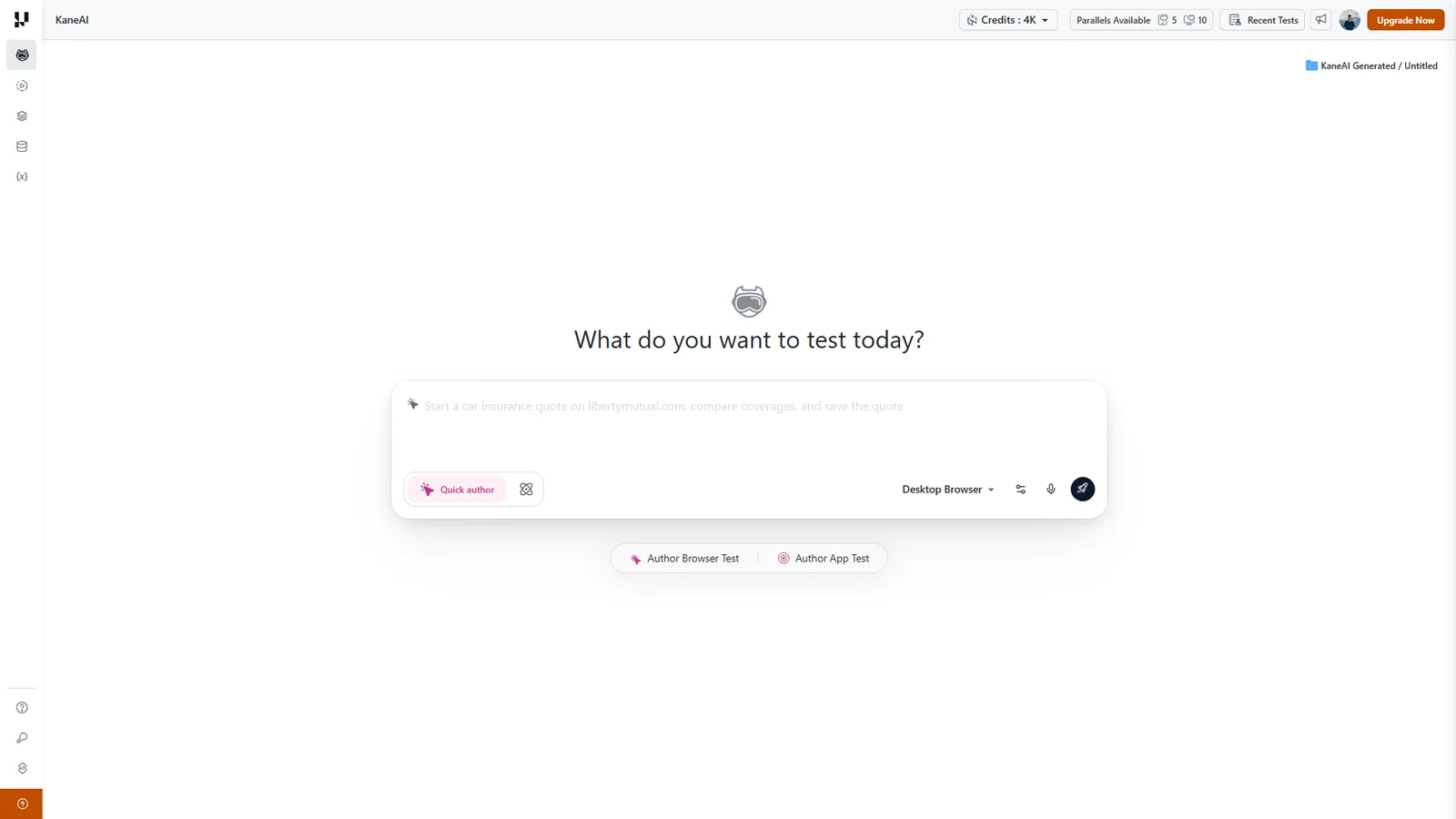
The clearest agentic AI example for engineering teams is autonomous testing. You describe an objective in plain English, and TestMu AI's KaneAI plans the steps, authors the test, runs it across browsers and real devices, and self-heals broken locators when the UI shifts, with no scripting required.
It runs that work across 10,000+ real devices and 3,000+ browsers on the agentic testing infrastructure, executing tests up to 70% faster than traditional cloud setups. One customer, Dashlane, reported a 50% reduction in test execution time after adopting it.
What makes it agentic:
- Plans: a smart test planner turns one objective into detailed, ordered test steps.
- Acts across tools: it covers web, mobile, UI, API, database, network, and accessibility in a single connected flow.
- Self-heals: as locators change, it updates the affected steps and surfaces the diff for review.
- Keeps a human in the loop: you can pause mid-run, correct a step, and hand control back.
Because the test artifacts adapt to a changing app, maintenance work that traditionally consumes QA sprints shrinks. That shrinking maintenance load is the practical case for pointing a QA agent at your own regression suite, since it authors and repairs those tests from natural-language goals and hands your testers back the hours they would rather spend on exploratory scenarios. For a deeper look at the category, read our guide to agentic AI testing.
2. Customer Service Resolution Agents
Customer service is the most visible agentic AI example. Klarna's AI assistant, built with OpenAI, authenticates users, queries live account and transaction systems, and resolves refunds, cancellations, and disputes end to end. In its first month, Klarna reported the assistant handled 2.3 million conversations, two-thirds of its support chats, doing the work of 700 full-time agents.
Klarna's assistant also cut average resolution time from 11 minutes to under 2 minutes, reduced repeat inquiries by 25%, and was estimated to drive about $40 million in 2024 profit improvement across 23 markets. A separate deployment of Intercom's Fin agent at Anthropic reached a 50.8% resolution rate while saving over 1,700 support hours in a month. For the phone side of support, our article on the voice AI revolution makes the case for AI voice agents that answer missed calls.
Why it is agentic: the agent takes real account actions and decides when to escalate, rather than serving scripted answers. Because they act on live customer accounts, these agents are validated before launch with chatbot automation testing tools.
3. Autonomous Coding Agents
Coding agents read a repository, plan changes, write and run code, and fix failures to close real issues. Cognition's Devin was a landmark: on the SWE-bench benchmark, it resolved 13.86% of issues (79 of 570) end to end and unassisted, a roughly sevenfold jump over the previous best unassisted result of 1.96%, rising to 23% when given the final unit tests. The HumanEval benchmark tests a narrower skill, scoring a model's completions of single programming problems against unit tests rather than whole repository issues.
Today, GitHub's Copilot coding agent boots its own environment, researches the codebase, makes changes on a branch, runs tests, and opens a draft pull request for review. The same agentic loop powers test generation, as shown in our walkthrough of using an AI agent to generate Selenium Java tests.
Why it is agentic: the agent navigates the repo, runs and tests its own code, and self-corrects across a long-horizon task. For testing agent-powered apps, see building and testing AI agent-powered LLM applications.
4. Fraud Detection and Payment-Risk Agents
Payment fraud is a natural fit for autonomous agents that scan network-scale data and act in real time. Mastercard's generative-AI system doubled the detection rate of compromised cards and increased the speed of identifying at-risk merchants by 300%.
Stripe Radar scores every payment using hundreds of signals and automatically blocks high-risk transactions. Stripe reports Radar reduces fraud by 32% on average, trained on over $1 trillion in annual payment volume.
Why it is agentic: the system decides per transaction, at machine speed, without a human initiating each scan.
5. Financial-Crime and AML Investigation Agents
Anti-money-laundering work is slow, multi-step investigation, exactly what agents do well. SymphonyAI's Sensa Agents summarize cases, run automated background research, and draft suspicious-activity-report narratives for human review. At one bank, SymphonyAI reported a 77% reduction in false positives, and a European bank saw savings of about EUR 3.5 million per year.
Why it is agentic: unlike a prompt-only assistant, the agents plan investigations, make scoped decisions, and collaborate to complete the workflow.
6. Data Analysis and Business-Intelligence Agents
Data agents let employees ask business questions in plain language and get analyzed answers without writing SQL. Snyk built an internal data agent on Snowflake Cortex that, per the Snowflake case study, answers about 2,500 questions a month and saves an estimated 1,250 business hours monthly, returning answers in under a minute.
In finance, VentureBeat reported that Moody's modular agents cut credit-memo preparation from over 40 hours to about 2 minutes. The same pattern powers QA analytics: TestMu AI's Test Intelligence surfaces flaky-test root causes from test data automatically.
Why it is agentic: the agent translates a question into retrieval and analysis over governed data, then synthesizes the answer.

Note: Manual test maintenance is the repetitive, multi-step work agentic AI removes. TestMu AI's KaneAI plans, writes, and self-heals tests from plain-English goals across 10,000+ real devices and 3,000+ browsers. Try TestMu AI for free
7. IT Operations and DevOps Incident-Response Agents
Incident response is a multi-tool investigation that agents now run autonomously, a leading example of AI in DevOps. The AWS DevOps Agent is triggered by an alarm, forms root-cause hypotheses, queries telemetry, correlates anomalies with recent commits, and posts findings to Slack and ServiceNow. AWS reports up to 75% lower MTTR and 94% root-cause accuracy, and Western Governors University cut one resolution from 2 hours to 28 minutes.
Why it is agentic: it chooses which data sources to query and reasons across signals rather than running a fixed runbook.
8. Cybersecurity and SOC Triage Agents
Security operations centers drown in alerts, so triage is one of the highest-impact places agentic AI now operates. Microsoft's Security Copilot phishing-triage agent analyzes a reported email with multiple tools, renders a verdict, and resolves false positives on its own. St. Luke's University Health Network reported saving nearly 200 hours a month by autonomously closing thousands of false-positive alerts, with triage dropping from hours to minutes.
Why it is agentic: a planner-executor loop decides which tools to call, acts on alerts, and learns from analyst feedback held in memory.
9. Healthcare Clinical and Administrative Agents
In a real-world study with OpenAI, Penda Health embedded an AI Consult agent that monitors a clinical encounter and flags safety issues before a clinician proceeds. Across 39,849 patient visits in 15 clinics, the study found 16% fewer diagnostic errors and 13% fewer treatment errors for clinicians using the agent.
On the administrative side, Cohere Health reports its prior-authorization agent approves 85% of requests in real time with up to 47% administrative savings, in use by more than 600,000 providers. Patient-facing assistants that handle triage, scheduling, and medication questions are a third group, covered in our guide to conversational AI in healthcare.
Why it is agentic: the agent continuously evaluates live context against guidelines and decides when to escalate to a human. For how autonomous quality engineering applies to regulated healthcare software, see agentic QE for healthcare.
10. Sales and CRM Agents
Sales and service agents grounded in CRM data resolve inquiries and take actions like creating tickets. After deploying Salesforce Agentforce on its Contact Us page, OpenTable reported the restaurant agent reached 73% case resolution within three weeks of launch, a 40% improvement over its previous chatbot. Its restaurant and diner agents together handle about 11,000 conversations a week.
Why it is agentic: it resolves inquiries and takes CRM actions autonomously, escalating only what it cannot complete.
11. Multi-Agent Frameworks and Computer-Use Agents
The final example is the toolkit teams use to build their own agents. Frameworks like CrewAI, Microsoft AutoGen, and Google's Agent Development Kit orchestrate multiple specialized agents that assign roles, route tasks, and share memory, while computer-use agents act directly in a browser. The market reflects the momentum: Grand View Research values the enterprise agentic AI market at $2.58 billion in 2024, projected to reach $24.50 billion by 2030 at a 46.2% CAGR.
If you are evaluating tools, compare options in our roundup of the best AI agents and learn how agents coordinate in this guide to multi-agent AI systems.
Why it is agentic: these frameworks add planning, tool use, and collaboration on top of base models so the system acts, not just answers.
How to Choose Where to Start
Start where the work is repetitive, multi-step, and measurable, since those are the tasks an agent can own and you can score. Match your function to the proven pattern below:
- QA and engineering teams: begin with autonomous testing agents like KaneAI, where self-healing directly cuts maintenance. Single-purpose AI test agents, such as a test case generator or a visual testing agent, make a smaller first step.
- Support teams: deploy a resolution agent on a high-volume, low-risk ticket type first.
- Security and IT ops: start with alert triage and incident investigation, where false positives are costly.
- Data and finance teams: pilot a natural-language analytics or fraud agent against a single governed data source.
Whatever you pick, scope it tightly, keep a human in the loop, and define one KPI up front. Then treat the agent like any other system: see real-world patterns in our AI agent use cases guide, and learn how to measure quality with AI agent evaluation. Our roundup of AI agent evaluation tools compares the platforms and open-source frameworks that run those measurements.

Agentic AI Reality Check
Agentic AI is powerful, but it is not magic. Gartner predicts that over 40% of agentic AI projects will be canceled by the end of 2027, citing escalating costs, unclear business value, and inadequate risk controls. Context and memory limits are a frequent culprit, as explained in why AI agents forget.
The same forecast expects 33% of enterprise software to include agentic AI by 2028, up from less than 1% in 2024, and at least 15% of day-to-day work decisions to be made autonomously. The teams that succeed pick measurable use cases, keep humans in the loop, and evaluate agents continuously, which is why agentic systems need their own AI agent testing discipline.
TestMu AI engineers walk through testing AI agent-powered applications in this session:
Conclusion
Pick one repetitive, multi-step workflow you can measure, and put an agent on it this quarter. For QA teams, that workflow is test creation and maintenance, and the fastest start is TestMu AI's KaneAI: describe a test in plain English and watch it plan, run, and self-heal across real devices.
From customer service to fraud, security, and healthcare, these 11 examples show agentic AI already delivering verified results, and the market is set to grow nearly tenfold by 2030. If you are choosing a platform to build one, compare the best agentic AI tools. To get hands-on, follow the steps for getting started with KaneAI.
This came up at Testμ 2026 as well, in Transforming Sales with AI.
Note: This article was researched and drafted with AI assistance, then reviewed, fact-checked, and published by Swapnil Biswas, Product Marketing Manager at TestMu AI, whose listed expertise includes AI and automation testing. Every statistic, link, and product claim was verified against primary sources. Read our editorial process and AI use policy for details.
Author

Swapnil Biswas
Blogs: 8


Swapnil Biswas is a Product Marketing Manager at TestMu AI, leading product marketing for KaneAI and HyperExecute while orchestrating GTM campaigns and product launches. With 5+ years of experience in product marketing and growth strategy, he specializes in AI, SEO, and content marketing. Certified in Selenium, Cypress, Playwright, Appium, KaneAI, and Automation Testing, Swapnil brings hands-on expertise across web and mobile automation. He has authored 20+ technical blogs and 10+ high-ranking articles on CI/CD, API testing, and defect management, enabling 70K+ testers to improve automation maturity. His work earned him multiple awards, including Top Performer, Value of Agility, and Wall of Fame. Swapnil holds a PG Certificate in Digital Marketing & Growth Strategy from IIM Visakhapatnam and a BBA in Marketing from Amity University.
Reviewer

Himanshu Sheth
Reviewer
Himanshu Sheth is the Director of Marketing (Technical Content) at TestMu AI, with over 8 years of hands-on experience in Selenium, Cypress, and other test automation frameworks. He has authored more than 130 technical blogs for TestMu AI, covering software testing, automation strategy, and CI/CD. At TestMu AI, he leads the technical content efforts across blogs, YouTube, and social media, while closely collaborating with contributors to enhance content quality and product feedback loops. He has done his graduation with a B.E. in Computer Engineering from Mumbai University. Before TestMu AI, Himanshu led engineering teams in embedded software domains at companies like Samsung Research, Motorola, and NXP Semiconductors. He is a core member of DZone and has been a speaker at several unconferences focused on technical writing and software quality.


Frequently asked questions on agentic AI examples
Did you find this page helpful?
More Related Blogs

TestMu AI forEnterprise
Get access to solutions built on Enterprise
grade security, privacy, & compliance
- Advanced access controls
- Advanced data retention rules
- Advanced Local Testing
- Premium Support options
- Early access to beta features
- Private Slack Channel
- Unlimited Manual Accessibility DevTools Tests