

Power Your Software Testing with AI Agents and Cloud
The Native AI-Agentic Cloud Platform to Supercharge Quality Engineering. Test Intelligently and Ship Faster.


- TestMu AI (Formerly LambdaTest)
- /
- Blog
- /
- 9 Agentic Design Patterns for Software Testing in 2026
9 Agentic Design Patterns for Software Testing in 2026
A practical guide to 9 agentic design patterns for software testing: how ReAct, planning, self-healing, and guardrail layering map to QA workflows in 2026.
Last Updated on:
According to McKinsey's State of AI 2025, 23% of organizations are already scaling agentic AI systems, with an additional 39% actively experimenting. Yet the same report finds fewer than one-third have clear architecture discipline around how their agents make decisions. That gap is where most agentic testing projects fail: not at the idea stage, but at the architecture stage.
Agentic design patterns solve this by giving QA teams a vocabulary and blueprint for how a testing agent should reason, act, self-correct, coordinate, and fail safely. Without patterns, every agent is a one-off experiment. With patterns, agent behavior becomes repeatable infrastructure you can audit, debug, and hand to a new team member.
This guide covers 9 agentic design patterns mapped specifically to testing workflows, with examples from how agentic AI testing tools like KaneAI implement each one in production.
Overview
QA teams can build reliable, automated AI-powered testing pipelines by adopting agentic design patterns like ReAct for step-by-step reasoning, or by using TestMu AI's KaneAI to deploy pre-built planning, self-healing, and human-in-the-loop testing architectures natively without building agent infrastructure from scratch.
What Are the 9 Agentic Design Patterns?
- ReAct: The ReAct pattern alternates reasoning and action in a tight observe-reason-act loop, providing an explicit, auditable log of the agent's decision-making process at each step.
- Reflection: The Reflection pattern uses a self-evaluation loop where a critic instance reviews the agent's draft test plans, generated steps, or failure analyses to catch gaps and brittle selectors before execution.
- Planning: The Planning pattern produces an explicit execution strategy and task decomposition before taking action, mapping affected modules and prioritizing tests by customer-facing impact.
- Tool Use: The Tool Use pattern extends an agent's capabilities by allowing it to call external APIs, query databases, and interact with live systems like browser automation tools or Jira.
- Multi-Agent Collaboration: The Multi-Agent Collaboration pattern distributes specialized testing tasks across coordinated sub-agents, such as routing web UI tests to a browser agent and API tests to an API agent.
- Human-in-the-Loop: The Human-in-the-Loop pattern pauses execution at high-consequence decision points, such as ambiguous defects or pre-production gates, to wait for explicit human review and confirmation.
- Sequential Pipeline: The Sequential Pipeline pattern organizes repeatable testing workflows into a fixed-order, deterministic chain of steps, passing the output of each step directly to the next without dynamic routing.
- Self-Healing: The Self-Healing pattern automatically detects and repairs test failures caused by application changes, such as broken CSS selectors or renamed UI elements, before retrying the test.
- Guardrail Layering: The Guardrail Layering pattern applies multi-point validation controls at distinct execution stages to prevent errors from propagating and to stop catastrophic agent failures.
How Does TestMu AI Help With Agentic Testing?
- TestMu AI's KaneAI: TestMu AI's KaneAI platform natively implements planning, ReAct execution, self-healing, and human-in-the-loop review gates, allowing QA teams to adopt agentic testing patterns without building custom infrastructure.
What Are Agentic Design Patterns?
An agentic design pattern is a reusable architectural blueprint that specifies how an autonomous AI agent reasons, takes action, evaluates its own output, coordinates with other agents, and handles failures. Unlike traditional software design patterns (Factory, Observer, Singleton) that govern object structure and creation, agentic patterns govern behavioral loops: what the agent does next, when it checks itself, and when it stops. For the classical layer that agentic approaches build on, our guide to testing patterns breaks down 11 unit, automation, and strategy patterns with code examples, along with the anti-patterns that make test suites brittle.
For QA teams building AI-powered testing pipelines, patterns answer three questions that every agent eventually hits:
- How does the agent decide what to do next? ReAct, Planning, and Sequential Pipeline answer this.
- How does it verify its own output? Reflection and Guardrail Layering answer this.
- What happens when something breaks? Self-Healing and Human-in-the-Loop answer this.
A testing agent without a named pattern is a prompt that works in demos. A testing agent built on the right pattern runs reliably in CI/CD at 2 AM when no one is watching.
9 Agentic Design Patterns for Software Testing
Patterns are ordered from foundational (start here) to infrastructure-hardening (add these before going to production). Each entry covers what the pattern is, how a testing agent uses it, and what breaks when you skip it.
1. ReAct (Reasoning + Acting)
ReAct structures agent behavior as an alternating loop: Reason about what to do next, Act by calling a tool or API, Observe the result, then repeat. Each reasoning step is explicit and logged. When the agent fails, you can read exactly where its logic broke down rather than getting a black-box result.
How a testing agent uses it:
- Reasons about the next assertion, then calls the browser API to verify an element's state.
- Observes a 404 response, reasons that the endpoint path changed, and updates the test target before retrying.
- Reasons that three consecutive timeouts indicate environment instability rather than a product defect, and escalates rather than filing false bugs.
What breaks without it: Agents that act without explicit reasoning steps produce outputs that are hard to debug and impossible to audit. When a test fails, there is no trace to explain why the agent took the path it did.
ReAct is the default starting pattern for most AI agents in software testing because it provides the minimum viable audit trail without requiring complex orchestration.
2. Reflection / Self-Critique
The reflection pattern adds a self-evaluation loop after the agent's initial output: a critic instance, implemented as a separate system prompt or a second model call, reviews the draft test plan, generated test steps, or failure analysis for gaps, contradictions, and missed edge cases before the output is returned to the caller.
The evidence for this pattern is concrete. In the Reflexion paper (Shinn et al., 2023), adding verbal self-reflection improved pass@1 accuracy on the HumanEval coding benchmark from 80% (GPT-4 baseline) to 91% with no model change, only an added critique loop.
How a testing agent uses it:
- After generating a test suite, the critic checks whether every acceptance criterion from the ticket appears in at least one assertion.
- After analyzing a failure, reflection reviews whether the identified root cause is consistent with the application's known architecture.
- After writing locators, a critic agent flags brittle selectors (absolute XPaths, text-content matches) and rewrites them before execution begins.
What breaks without it: Agent-generated test suites inherit the systematic blind spots of the generator. A critic with a different prompt breaks those patterns. Each reflection cycle costs additional tokens, but the debugging time saved from catching a blind spot before CI runs is always worth it.
3. Planning / Task Decomposition
The planning pattern requires the agent to produce an explicit test strategy, broken into subtasks with identified dependencies and sequenced work, before executing any action. The plan is a first-class artifact: visible to the team, editable before execution, and referenced in the final report to explain why specific tests ran in a given order.
How a testing agent uses it:
- Given a feature ticket, the agent maps affected modules, identifies regression risk areas, and prioritizes tests by customer-facing impact before writing a single test step.
- Plans execution order so dependent tests run in the correct sequence: authentication before cart, login before checkout, role creation before permission checks.
- Identifies which tests can run in parallel versus sequentially, maximizing throughput across a real-device cloud without creating test data conflicts.
What breaks without it: Agents run tests in arbitrary order, repeat low-priority smoke checks, and miss entire regression areas because no one told the agent where risk concentrates. The planning step is what separates test generation from test strategy.
TestMu AI applies the planning pattern directly: when you give KaneAI a requirements document or ticket, it generates test coverage mapped to modules and risk priority before authoring any step.
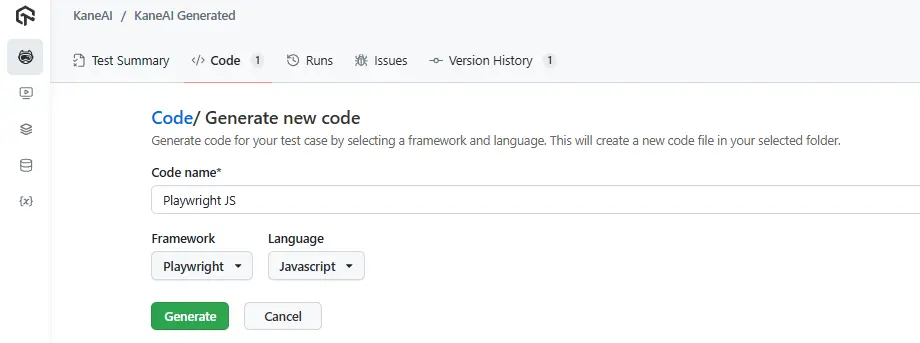

Note: TestMu AI's agentic testing platform handles planning, ReAct execution, and self-healing automatically. Start for free and run your first agentic test in minutes.
4. Tool Use
The tool use pattern extends an agent's capabilities beyond its training data by giving it the ability to call external APIs, query databases, read file systems, and interact with services at runtime. Without tool use, an agent can only reason about what it already knows. With tool use, it can observe the actual state of a live application.
How a testing agent uses it:
- Calls the browser automation API to interact with real web pages on a cloud grid instead of simulating what the page might look like.
- Queries Jira or Azure DevOps to retrieve acceptance criteria directly from the linked ticket rather than waiting for a human to copy-paste them.
- Triggers CI/CD pipelines via GitHub Actions or Jenkins API based on test results, closing the feedback loop without a human handoff step.
- Calls an accessibility scanning tool at each test step to catch WCAG violations as a side effect of the functional test run.
What breaks without it: The agent becomes a sophisticated text generator with no feedback from reality. Test plans look correct on paper and fail at runtime because the agent never observed actual application state. See the MCP and AI agents guide for how tool-calling protocols connect testing agents to live systems.
5. Multi-Agent Collaboration
The multi-agent pattern distributes work across specialized agents coordinated by an orchestrator. Each sub-agent has a narrower scope and deeper focus than a generalist agent. The orchestrator handles routing, result aggregation, and conflict resolution, and the way it sequences those handoffs is covered in depth in our guide to agentic AI orchestration. This is the AI equivalent of a microservices architecture applied to testing workflows.
How a testing team uses it:
- An orchestrator agent receives a release candidate and routes work: web UI tests to the browser-test agent, API contract tests to the API-test agent, accessibility checks to the a11y agent, performance benchmarks to the load agent.
- Sub-agents run in parallel on separate real-device sessions, reducing total wall-clock time from hours to minutes without increasing test data conflicts.
- Orchestrator merges results, deduplicates failures that appear across multiple agents, and produces a unified coverage report tied back to the release ticket.
What breaks without it: A single generalist agent running web plus API plus mobile testing sequentially is slow and shallow in each domain. Specialization is what lets agents reach human-expert depth in narrow areas like accessibility or security testing. Which specialist gets to declare the work finished is a separate decision, covered in planner, generator, and evaluator roles in agentic AI architecture.
6. Human-in-the-Loop
Human-in-the-loop (HITL) is a deliberate design choice, not a fallback. The pattern defines specific checkpoints where the agent pauses execution, surfaces its reasoning and proposed action, and waits for human confirmation before continuing. Gartner predicts more than 40% of enterprise applications will embed task-specific AI agents by end of 2026 - teams that skip HITL design upfront add it reactively after the first production incident.
The checkpoints that matter most in testing:
- Pre-production gate: Agent surfaced three high-severity failures. Human confirms whether to block the release or accept the risk before the agent files Jira tickets and notifies the team.
- Ambiguous defect: Agent is 60% confident a visual difference is a real regression. Human reviews the screenshot comparison before the bug is assigned to a developer, saving an engineering team false-bug investigation time.
- Security-sensitive scope: Agent proposes running penetration-style tests against a staging environment. Human approves the exact scope before any execution begins.
What breaks without it: Fully autonomous agents make wrong calls in high-consequence situations. The cost of a false bug filed to a developer is recoverable. The cost of a false pass that reaches production is not.

7. Sequential Pipeline
The sequential pipeline organizes agent work as a fixed-order chain: each step receives the output of the previous step, transforms it, and passes it forward. There is no dynamic routing, no backtracking, no conditional branching. This makes it the most debuggable pattern and the right choice for well-understood, repeatable test workflows where the path is known in advance.
A standard agentic test pipeline built as a sequential chain:
- Requirement parsing: Extract acceptance criteria from the linked ticket.
- Test generation: Produce executable test steps from parsed criteria.
- Environment setup: Provision real-device or browser sessions via the cloud API.
- Execution: Run tests, capture logs, screenshots, and video.
- Result analysis: Classify passes, failures, and flaky tests by root cause.
- Reporting: Push results to the CI/CD dashboard and linked ticket.
What breaks without it: Teams apply dynamic patterns like ReAct or multi-agent to workflows that don't need them, adding cost and failure surface for no gain. Use sequential pipelines for deterministic test flows. Add dynamic patterns only where the workflow genuinely requires adaptability.
To see the test-generation step built as an agentic component, the AI agent for generating Selenium tests guide walks through the pipeline in working code.
8. Self-Healing / Adaptive Recovery
Self-healing is an adaptive recovery pattern where the agent detects a test failure caused by an environmental change, a broken locator, a moved API endpoint, or a renamed UI element, and automatically repairs its own test configuration before retrying. The key distinction: it separates failures caused by real product defects (which should be reported and escalated) from failures caused by test brittleness (which should be silently fixed and flagged).
How a testing agent implements it:
- Detects that a CSS selector no longer matches any element. Uses semantic search against the current DOM to find the element's new identifier. Updates the test locator and retries before marking the test as failed.
- Detects that an API response schema changed with a new required field. Updates the test payload and assertion, flags the schema diff for the team's review rather than silently suppressing it.
- Differentiates self-healed tests from genuine failures in the report, so developers see only real regressions and QA engineers see only the locator maintenance that happened automatically.
What breaks without it: UI changes cause entire test suites to fail. Engineers spend sprint time updating selectors instead of writing new tests. KaneAI's self-healing detects and presents healed test steps for team review automatically. See the KaneAI getting started guide to configure self-healing in your first test run.
9. Guardrail Layering
Guardrail layering places validation controls at four distinct execution points to prevent one category of failure from propagating to the next stage. A single guardrail catches one class of error. Layered guardrails catch the errors each other misses. This pattern separates production-grade agents from demo-grade ones.
| Layer | What It Catches | Example Check |
|---|---|---|
| Input validation | Malformed or out-of-scope instructions before the agent processes them | Reject test plans that reference production databases or live customer data |
| Pre-execution check | Environment health issues before tests start | Confirm staging URL returns 200 and auth service is healthy before launching sessions |
| Post-execution check | Suspiciously clean results that signal the agent tested the wrong scope | Alert if 100% of tests pass on the first run of a completely new feature |
| Output sanitization | Sensitive data leaking into test logs or reports | Strip authentication tokens and PII from execution logs before storing or sharing |
What breaks without it: Agents test against the wrong environment and never know it, pass 100% on a broken test suite, and leak credentials into CI logs. Each guardrail layer is cheap to add at design time and expensive to retrofit after an incident.
How to Choose the Right Pattern
Start with the simplest pattern that solves the problem. Add patterns only when the simpler option genuinely fails, not because the architecture looks more impressive. The table below maps common testing scenarios to a starting pattern and the logical upgrade when complexity grows.
| Testing Scenario | Start With | Upgrade When |
|---|---|---|
| Smoke tests on every PR | Sequential Pipeline | Tests break on UI changes → add Self-Healing |
| Test suite from a ticket | Planning + ReAct | Coverage gaps persist → add Reflection |
| Full regression before release | Multi-Agent + Sequential | False passes risk shipping → add Guardrail Layering |
| Security or compliance testing | Human-in-the-Loop + Guardrail | Depth needed per domain → add Multi-Agent |
| Cross-browser and device matrix | Tool Use + Multi-Agent | Tests become brittle across OS versions → add Self-Healing |
For the conceptual foundation behind these patterns in a QA career context, the agentic AI interview questions hub covers how these patterns appear in system design interviews and technical QA roles.
Conclusion
Start with ReAct for traceability, add Planning when you need test strategy before execution, and layer in Reflection when agent-generated suites keep missing the same edge cases. Self-Healing and Guardrail Layering are the two patterns most QA teams add too late: the maintenance cost of not having them compounds fast as the application evolves.
The concrete next step: open a feature ticket your team already has and map it through the Planning pattern to generate a test strategy before writing any code. If you use TestMu AI's agentic testing platform, KaneAI does this natively from a natural language description of the ticket. Start with the KaneAI getting started guide to see Planning, ReAct, and Self-Healing working together in a live test run.
Note: This article was researched and drafted with AI assistance, then reviewed, fact-checked, and published by Samyak Goyal, Community Contributor at TestMu AI, whose listed expertise includes AI Agents and Multi-Agent Systems. Every statistic, link, and product claim was verified against primary sources. Read our editorial process and AI use policy for details.
Author

Samyak Goyal
Blogs: 21

Samyak Goyal is a Senior Member of Technical Staff at TestMu AI engineering Kane CLI, the command-line tool that runs browser automation from the terminal, where a flow described in natural language executes in a real Chrome browser and returns pass or fail with shareable proof. He is a backend engineer with 4+ years of experience, previously an SDE at Innovaccer, where he built APIs, introduced Kafka, and cut deployment from weeks to hours. Samyak also builds multi-agent systems, skill-orchestration frameworks, and a personal copilot that indexes 200+ microservice repositories.


Frequently asked questions
Did you find this page helpful?
More Related Blogs
TestMu AI forEnterprise
Get access to solutions built on Enterprise
grade security, privacy, & compliance
- Advanced access controls
- Advanced data retention rules
- Advanced Local Testing
- Premium Support options
- Early access to beta features
- Private Slack Channel
- Unlimited Manual Accessibility DevTools Tests