

Power Your Software Testing with AI Agents and Cloud
The Native AI-Agentic Cloud Platform to Supercharge Quality Engineering. Test Intelligently and Ship Faster.


- TestMu AI (Formerly LambdaTest)
- /
- Blog
- /
- Agentic Test Management: The Fastest Way to Know If Your Build Is Ready to Ship With TestMu AI
Agentic Test Management: The Fastest Way to Know If Your Build Is Ready to Ship With TestMu AI
A coordinated stack of test management agents with a shared memory layer, so every test case, run, and result lives in one place and stays current.
Last Updated on:
Your release cycle moves every week. Your test cases do not. They sit in a spreadsheet that one person maintains, disconnected from the tickets that created them and the automation that should be validating them. TestMu AI's Test Management Platform replaces that with an agent-native workspace where planning, authoring, execution, and reporting happen in one place.
When test data is scattered, the cost is immediate: duplicate suites, stale Jira tickets, coverage nobody can prove, and release decisions made on a QA lead's best guess.
Nobody ships confidently from a spreadsheet. They ship hopefully.
What Is Agentic Test Management?
Conventional test management tools store test cases. A person still writes each one, links it to a requirement, updates it after every scope change, and reconciles automation results somewhere else. The tool is a filing cabinet with a reporting tab.
TestMu AI Test Management runs a coordinated agent stack instead, each agent purpose-built for a specific job in the test cycle, all sharing one memory layer that learns your repository. The Test Planner Agent structures the run. The Test Authoring Agent turns requirements into cases. The Test Orchestration Agent decides what executes when. The Test Insights Agent tells you what the results actually mean.
Because the agents share context, authoring knows what already exists. Your suite stops accumulating duplicates and starts closing gaps. The agentic approach is a departure from how most test management tools have worked until now.
Why Spreadsheets and Legacy Tools Do Not Stand a Chance
Spreadsheets start instantly and cost nothing. They also give you no version history, no traceability, no execution record, and no way for anyone outside QA to see status without asking. Legacy platforms fix storage and add long setup cycles, steep learning curves, and sync that goes stale by lunchtime.
Both fall behind the pace of your releases. Here are the main challenges:
- Test cases drifting out of sync with requirements
- Manual and automated coverage tracked in separate systems
- Duplicate test cases accumulating across teams
- One-way Jira sync requiring manual status updates
- No audit trail for test case changes
- Coverage gaps discovered after release, not before
- Reporting that needs an export and a pivot table
- Migration risk keeping teams on tools they have outgrown
TestMu AI Test Management gives you instant setup, zero learning curve, and a repository that maintains itself between sprints. For the duplicates already sitting in your suite, the Test Deduplication Agent scores every match so you can clear them without losing coverage. Every case, run, result, and bug lives in one searchable, versioned workspace that both your team and your agents can reason over.

Note: See what your test suite looks like when agents maintain it. Try TestMu AI now
How TestMu AI Instantly Solves the Biggest Test Management Challenges
The platform covers every stage modern QA teams work through, from planning to release readiness.
Core Test Management Capabilities
Agent-Native Test Case Generation
Hand the agent a Jira ticket, PRD, image, video, audio file, or Figma flow. Every test case lands in a structured workspace with steps and expected results auto-filled, organized by module, type, and scenario, ready to run. Our documentation covers how to generate test cases with AI, including every supported input format and the conversation layer used to refine output.
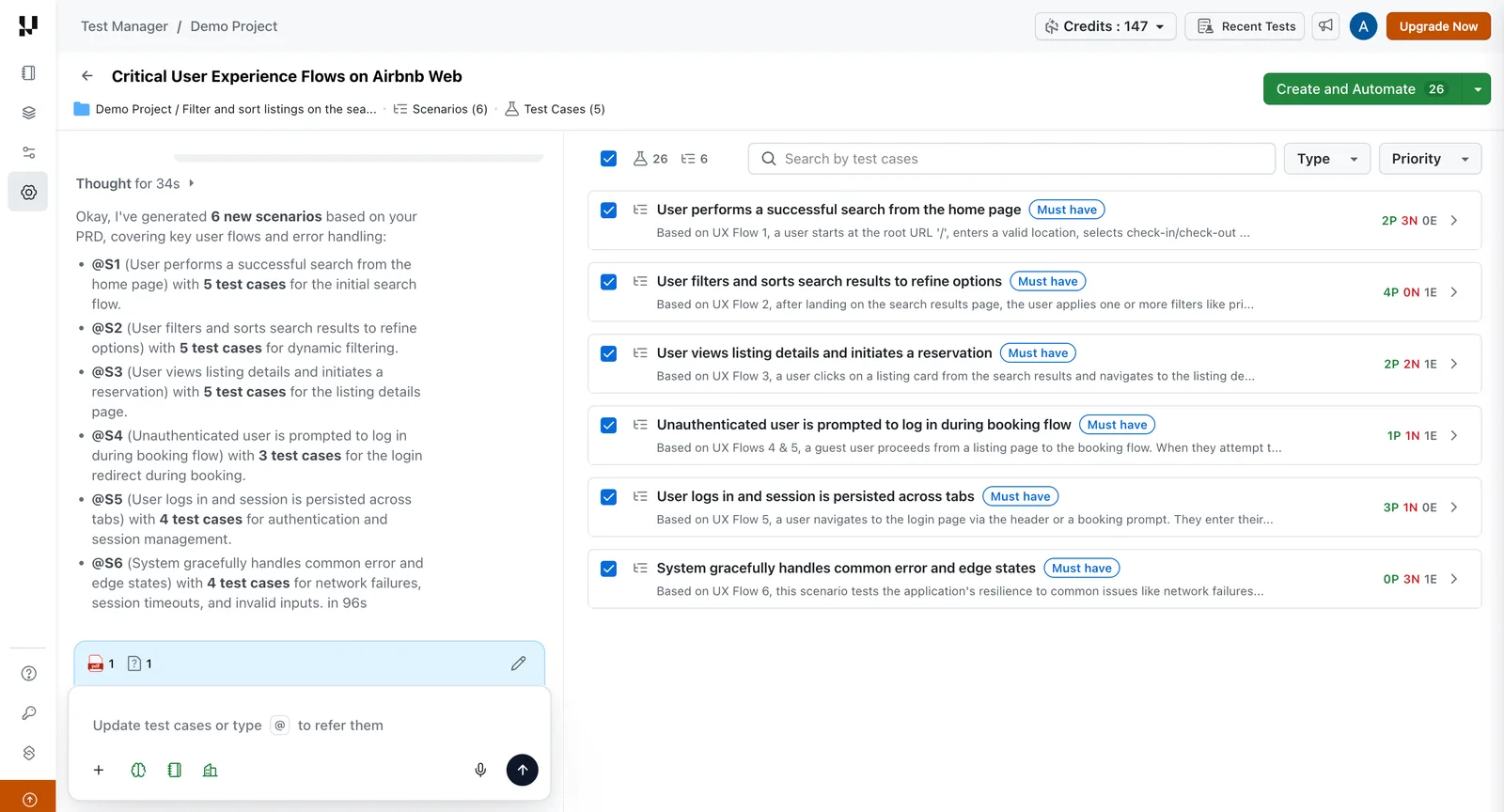
The run above is a good illustration of what "structured" means in practice. One attached PRD produced 6 scenarios and 26 test cases in 96 seconds, each scenario carrying its own positive, negative, and edge counts, and each one tagged with a priority before anybody opened it.
Smart Context Memory Layer
- Scans your existing repository before every session
- New test cases build on what exists and close coverage gaps
- Eliminates duplication across test suites automatically
AI Edge Case Generation
Expand any happy-path case into edge cases, negative scenarios, and boundary conditions automatically. Boundary conditions and error paths get covered without a separate brainstorming session.
Conversational Refinement
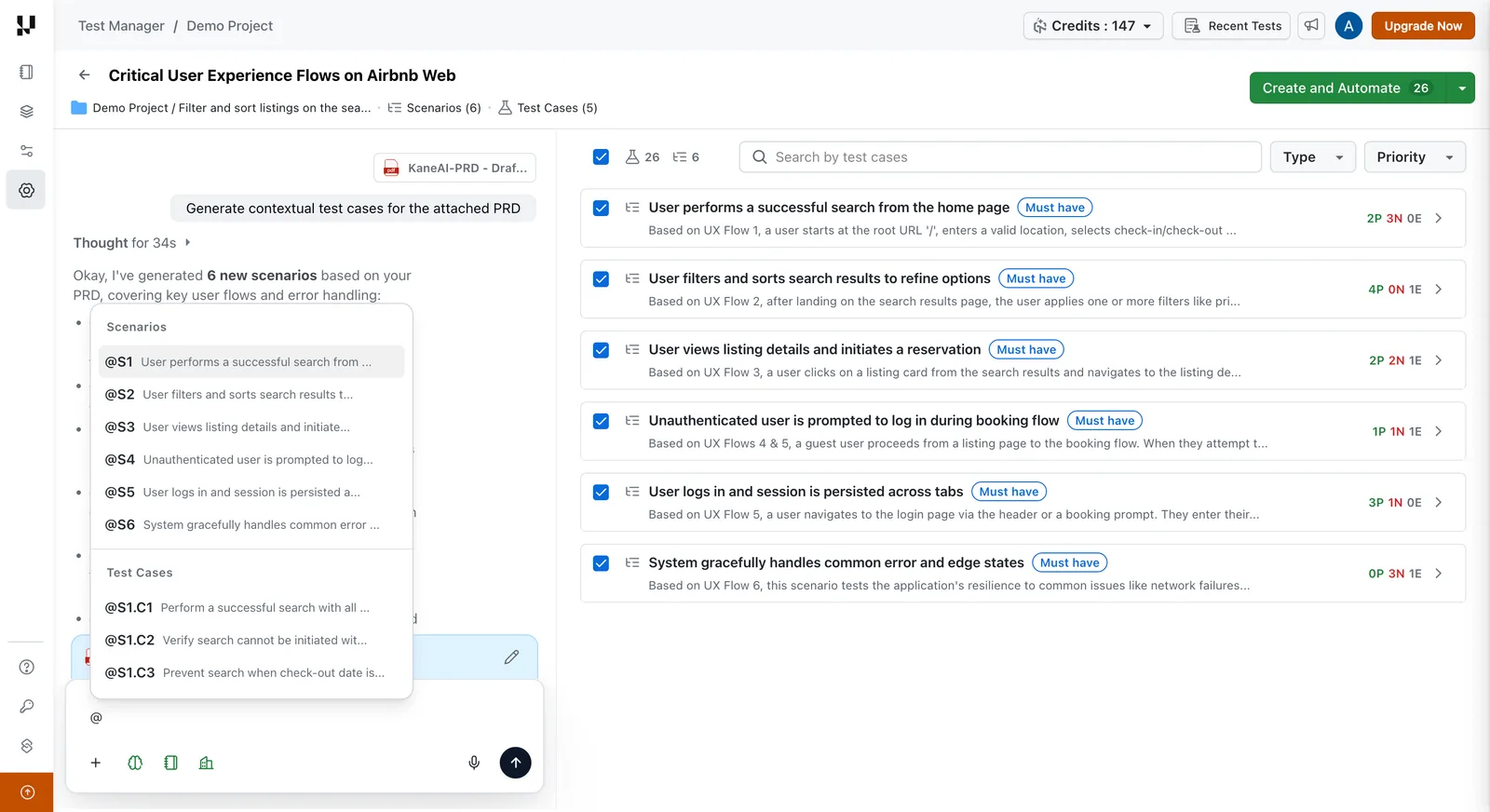
Edit specific scenarios using @references, attach files, and change one flow without regenerating the entire set. Scenarios are addressed as @S1 or @S3 and individual cases as @S1.C1, so a correction lands on exactly the case you meant.
Scenario-Based Prioritization
Test cases group into Must Have, Should Have, and Could Have, so regression scope becomes a decision about impact and risk rather than a scroll through an alphabetical list.
Test Planning by Module and Priority
Structure your plan before testing begins, prioritize coverage by risk, module, or deadline, and give the whole team visibility from day one. QA stops lagging weeks behind development.
One Central Test Case Repository
One searchable, versioned repository for every manual and automated test case, run, result, and bug. Folder hierarchies, custom fields, reusable test modules, and full edit history, built to scale across every sprint and release. Our guide on creating and managing test cases shows how versioning, system fields, and folder hierarchies work in practice.
Execution and Bug Reporting in One Place
Run automated tests directly from your test management workspace with live step-by-step logs, using reusable test run configurations for platform, browser, OS, and device combinations. Automated runs can be linked to specific test cases using the tms.tc_id capability, so traceability holds across manual and automated coverage. File bugs to any connected tracker with steps, screenshots, and run context attached the moment a test fails, across 25+ bug tracking tools.
Two-Way Jira and Azure DevOps Sync
Manage test cases through Jira or Azure DevOps or directly in TestMu AI, with agent-generated cases available inside both. Real-time sync runs in both directions, so status is never something you update by hand. Teams already running QA inside the tracker can see how that plays out in practice in our guide to Jira test management.
1-Click Migration
Move from TestRail, Zephyr, qTest, or Xray with automatic field mapping and zero data loss. Import via CSV or API and keep your full test history, traceability, and integrations intact. Our guide to importing test cases from CSV covers field mapping, single-row versus multi-row layouts, and re-importing an edited file to update existing cases in place rather than duplicating them.
Comprehensive Insights and Reports
Real-time dashboards for flake rates, build stability, defect trends, and cycle time analytics, exportable as PDF, CSV, or shareable links. End-to-end traceability from requirement to result, with a coverage matrix showing covered, uncovered, manual, and automated cases.
Business Impact
Teams using TestMu AI Test Management spend less time authoring and maintaining cases, catch coverage gaps before release instead of after, and stop reconciling test data across four tools. The result: faster test design, less duplication, clearer release readiness signals, and a repository that scales with the team rather than against it.
bet365 offers a useful reference point. Hillside Technology, bet365's technology business, was managing two separate testing platforms, one for browsers and one for mobile devices, while pushing hundreds of releases weekly across sports betting, casino, and gaming platforms. After consolidating onto TestMu AI, adoption spread past the original scope, and the case study notes that some teams now use the test management functions for internal applications as well.
"Having everything in one place suits us better. Otherwise, you're constantly switching between tools and products which naturally creates inefficiencies."
Joanna Ward, Head of Software Testing, bet365
Read the full story of how bet365 consolidated its testing systems.
Legacy Test Management vs. Agentic Test Management
The difference is easiest to see when you put the two models side by side across the work QA actually does every sprint.
| What changes | Legacy test management | Agentic test management |
|---|---|---|
| Test case authoring | Written by hand, one case at a time | Generated from tickets, PRDs, Figma flows, images, or video, then refined conversationally |
| Coverage gaps | Found in retros, or in production | Surfaced by the memory layer before the run is built |
| Duplicate cases | Accumulate silently across teams | Detected against the existing repository at authoring time |
| Edge cases | Depend on whoever is writing that day | Expanded automatically from any happy-path case |
| Regression scope | A judgment call under deadline pressure | Prioritized by impact into Must Have, Should Have, Could Have |
| Manual and automated coverage | Two systems, linked by hand | One repository, linked by test case ID |
| Jira and Azure DevOps status | Updated manually, stale within a day | Two-way real-time sync |
| Migration | A project nobody wants to own | 1-click import from TestRail, Zephyr, qTest, or Xray with field mapping |
| Reporting | An export, a pivot table, and an hour | Live dashboards for flake rate, build stability, and cycle time |
| Release readiness | Reconstructed for the review meeting | Visible continuously in the coverage matrix |
The pattern across every row is the same. Legacy tools ask a person to maintain the connection between requirements, cases, runs, and results. An agentic workspace maintains it as a side effect of the work, which is why the gap widens as the suite grows rather than staying constant.
Turning an Agent Run Into a Regression Signal
A coverage matrix works because every case carries an expected result someone can check against what happened. An AI agent under test breaks that assumption, since the thing reporting the outcome is the thing being tested. TestMu AI Agent Assurance reads your codebase, writes the scenario suite, runs your agent for real, and grades every criterion against observed evidence.
- Delta tracking - each run reports newly failing, newly fixed, and flaky scenarios since the last one, which turns a one-off score into a regression signal
- Evidence over summaries - verdicts quote files changed on disk and tool calls checked against the agent's declared tool surface
- Three verdicts - Pass, Fail, and Unable to Verify, with the unverified share kept out of the pass-rate denominator and reported next to the pass rate as the assurance gap
- 18 scenario categories - functional, non-functional, and adversarial classes, from boundary conditions to prompt injection and PII leakage
The same loop runs headless in CI through rook, the pre-alpha Apache 2.0 CLI, where explore, generate, run, and report execute in sequence and the JSON report drives the gate. A finished run exits 0 whether scenarios passed or failed, so the gate has to read the verdicts in that report. Exit 1 means the run never started, from a signed-out session, a refused target, an unreachable endpoint, or bad flags.
The Autonomous Agent category, for agents that call tools and write files, is on a waitlist. Those runs act on the agent you point them at and cannot be rolled back, so keep them on staging rather than production.
Wrapping Up
Release cycles are compressing. Manual test management cannot keep up. TestMu AI Test Manager delivers the agent stack, the memory layer, and the unified workspace to keep your test coverage current with the code it validates, and it connects directly to KaneAI when you want those cases authored and executed end to end.
For teams serious about shipping quality software at speed, agentic test management is not an upgrade. It is the new baseline. If you are still mapping the category before you commit, the test management fundamentals cover the process side that tooling alone does not solve.
Note: Import your existing suite and start running in minutes, whether it lives in TestRail, Zephyr, Xray, or qTest. See how one-click migration works
Author

Bhavya Hada
Blogs: 28


Bhavya Hada is a Community Contributor at TestMu AI with over three years of experience in software testing and quality assurance. She has authored 20+ articles on software testing, test automation, QA, and other tech topics. She holds certifications in Automation Testing, KaneAI, Selenium, Appium, Playwright, and Cypress. At TestMu AI, Bhavya leads marketing initiatives around AI-driven test automation and develops technical content across blogs, social media, newsletters, and community forums. On LinkedIn, she is followed by 4,000+ QA engineers, testers, and tech professionals.
Reviewer

Abhishek Mishra
Reviewer
Abhishek Mishra is a Technical Product Manager at TestMu AI, where he owns Test Manager, the test management product. He has over 8 years of experience in product management and market analysis. His expertise spans across AI-native software testing, product strategy, and analytics. Previously, Abhishek served as the Product Lead at IndiaClan and co-founded Gartley618 Technologies, where he led innovative projects in quantitative trading and blockchain. He holds a B.Tech degree.


Agentic Test Management FAQs
Did you find this page helpful?
More Related Blogs
TestMu AI forEnterprise
Get access to solutions built on Enterprise
grade security, privacy, & compliance
- Advanced access controls
- Advanced data retention rules
- Advanced Local Testing
- Premium Support options
- Early access to beta features
- Private Slack Channel
- Unlimited Manual Accessibility DevTools Tests