

Power Your Software Testing with AI Agents and Cloud
The Native AI-Agentic Cloud Platform to Supercharge Quality Engineering. Test Intelligently and Ship Faster.


- TestMu AI (Formerly LambdaTest)
- /
- Blog
- /
- What Is Oracle EPM? Modules, Migration, and Testing
What Is Oracle EPM? Modules, Migration, and Testing
Learn what Oracle EPM is, how it differs from ERP, the eight modules inside EPM Cloud, Hyperion support timelines, and how to test monthly EPM Cloud updates.
Published on:
The global enterprise performance management market was valued at $6.30 billion in 2025 and is projected to reach $14.55 billion by 2034, a 9.9% CAGR, according to Fortune Business Insights. Oracle competes in that market with Oracle Fusion Cloud EPM, the successor to its on-premises Hyperion line.
Oracle ships EPM Cloud updates on a fixed monthly schedule, which puts a validation window on the finance calendar twelve times a year. That cadence, the module list, and the real Hyperion support dates are what most teams need before they can plan around the suite.
TL;DR
Oracle EPM (Enterprise Performance Management) is Oracle's software suite for planning, budgeting, financial consolidation, close, and reporting. Sold today as Oracle Fusion Cloud EPM, it complements ERP systems that record daily transactions, updates on a fixed monthly schedule, and now ships named AI agents for planning, reconciliation, and cost management.
- Core function: Oracle EPM handles the management side of finance for the CFO's office, covering planning, budgeting, forecasting, consolidation, account reconciliation, and narrative reporting.
- EPM vs ERP: Oracle frames ERP as operating the business through day-to-day transactions and EPM as managing the business through planning, analysis, and reporting.
- Modules: Oracle Fusion Cloud EPM bundles eight business processes spanning planning, financial close, account reconciliation, master data, narrative reporting, tax, and cost allocations.
- Hyperion support: Oracle's Lifetime Support Policy lists Hyperion 11.2 with Premier Support through at least December 2037, so on-premises customers face no forced migration to EPM Cloud.
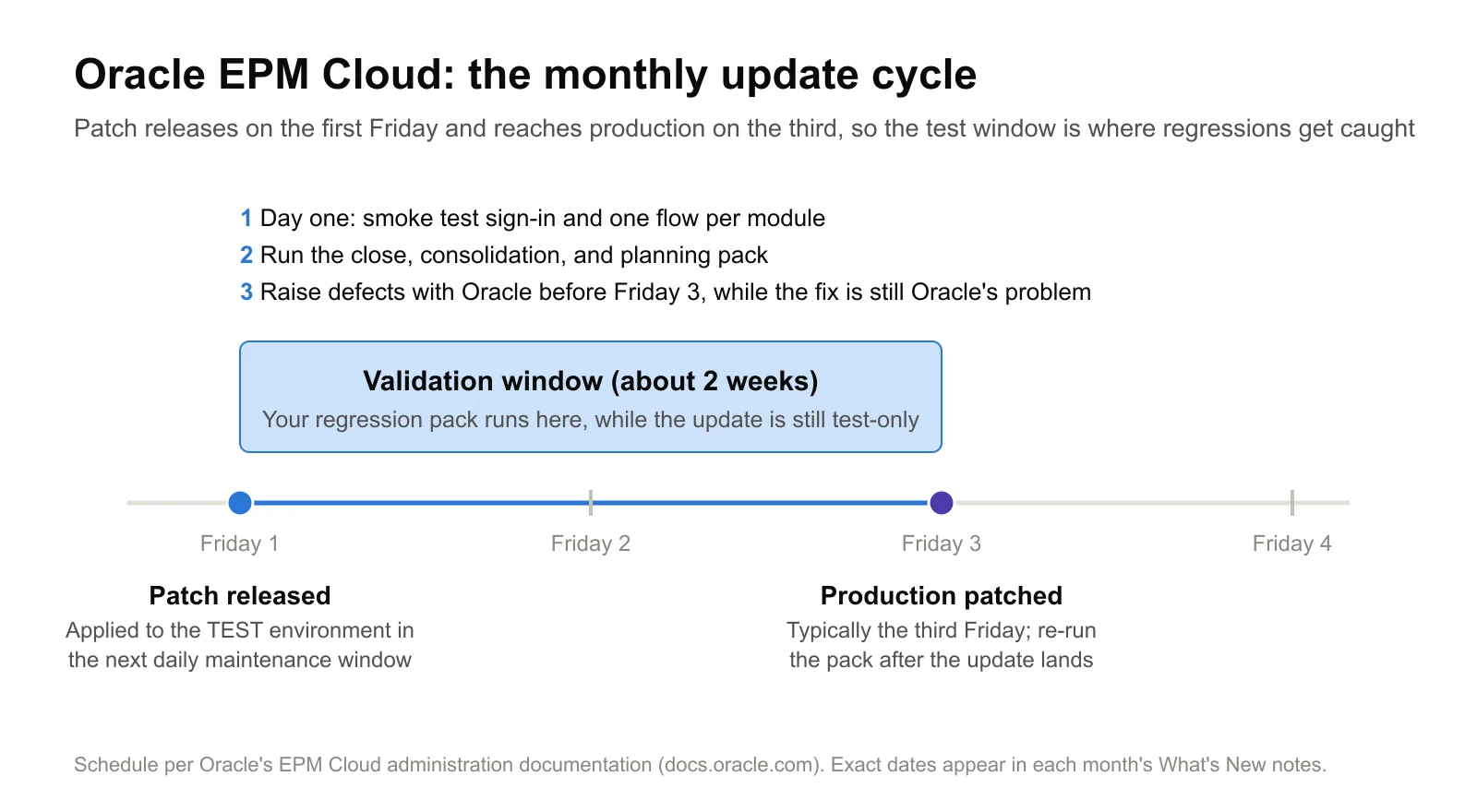
- Update cadence: Oracle releases the EPM Cloud patch on the first Friday, applies it to test in the next daily maintenance window, and patches production typically on the third Friday.
How do teams test Oracle EPM after monthly updates?
Most teams keep a fixed pack of close, consolidation, and planning checks and run it while the patch is still test-only, so defects are Oracle's to fix. TestMu AI supports that cycle with natural-language authoring, which spares finance systems teams from maintaining selector-based scripts.
What Is Oracle EPM and Who Uses It?
Oracle EPM is Oracle's application suite for the management side of finance, covering planning, budgeting, forecasting, consolidation, close, and reporting. Oracle's EPM explainer states that EPM solutions are primarily used by CFOs and the office of finance, while HR, sales, marketing, and IT use them for operational planning and budgeting.
Oracle sells the suite today as Oracle Fusion Cloud EPM and groups its work into five business processes:
- Strategic modeling handles long-range and what-if planning ahead of the annual budget.
- Planning connects financial budgets and forecasts to operational drivers such as headcount.
- Consolidate and close turns subsidiary ledgers into signed-off group results.
- Reporting produces the management, narrative, and regulatory outputs.
- Performance analysis compares actuals against plans to steer the next decision.
How Is Oracle EPM Different From Oracle ERP?
ERP operates the business and EPM manages it. EPM pulls its actuals from the ERP ledger and adds the planning, consolidation, and reporting layer on top.
| Dimension | Oracle ERP | Oracle EPM |
|---|---|---|
| Primary job | Records and processes daily transactions such as invoices, payments, procurement, and the general ledger. | Plans, budgets, consolidates, closes, and reports on aggregate performance across entities. |
| Core users | Accounts payable and receivable, procurement, supply chain, and operations staff working in the ledger daily. | CFO, controllers, and FP&A analysts, plus HR, sales, and IT for operational planning. |
| Data shape | Granular transactional records that must balance to the penny at all times. | Aggregated actuals combined with budgets, forecasts, and scenario models across entities. |
| Typical cycle | Continuous, transaction by transaction, every business day of the year. | Rhythmic: monthly close, quarterly forecasts, and the annual budget and tax cycles. |
| Oracle product | Oracle Fusion Cloud ERP. | Oracle Fusion Cloud EPM. |
"What did we invoice today" is an ERP question. "Why did margin drop in Q2, and what happens to cash if we delay hiring" is an EPM question. The split also decides test ownership: the ERP side validates posting, interfaces, and ledger balances, which our guide to ERP testing tools covers, while the EPM side validates the close, the consolidation, and the forecast built on those numbers.
Which Modules Make Up Oracle EPM Cloud?
Eight business processes make up Oracle EPM Cloud: Planning, FreeForm, Financial Consolidation and Close, Account Reconciliation, Enterprise Data Management, Narrative Reporting, Tax Reporting, and Profitability and Cost Management, as named on the Oracle Fusion Cloud EPM product page.
Oracle now positions those modules around embedded AI, naming a Planning Agent, a Reconciliation Agent, and a Profitability and Cost Management Agent.
| Module | What it handles |
|---|---|
| Planning | Connected financial and operational planning, budgeting, forecasting, and scenario modeling. |
| FreeForm | Flexible planning and analysis applications without a prescribed business process structure. |
| Financial Consolidation and Close | Consolidating entity results and orchestrating the period-end close. |
| Account Reconciliation | Automating balance-sheet reconciliations, which Oracle calls the top cause of non-data-related close delays. |
| Enterprise Data Management | Governing master data and hierarchies, such as the chart of accounts, across applications. |
| Narrative Reporting | Combining numbers and commentary for management and regulatory report packages. |
| Tax Reporting | Accounting for income tax, including provision and country-by-country reporting. |
| Profitability and Cost Management | Allocating shared costs and analyzing profitability by product, customer, or channel. |
You will still meet older shorthand such as EPBCS, FCCS, and ARCS in job posts and legacy material. Those acronyms refer to the earlier packaging of today's Planning, Financial Consolidation and Close, and Account Reconciliation services.
Is Oracle Hyperion Being Discontinued?
No. Oracle's current Lifetime Support Policy for Oracle Applications lists Hyperion 11.2 products, including Hyperion Planning and Hyperion Financial Management, with Premier Support through at least December 2037 and indefinite Sustaining Support after that.
The widely repeated 2033 end date is simply out of date. It came from Oracle's 2022 Hyperion announcement, and the policy document has since extended it. That document also states Oracle currently has no plans to end Premier Support for the Hyperion continuous innovation releases, with one-year extensions reviewed annually, and lists 11.2.26 as the latest release, generally available in April 2026.
That support timeline shapes the migration plan:
- No support deadline forces a Hyperion exit, so time the move to a capability you actually need.
- The functional gap still grows monthly, because AI agents and new features land only in EPM Cloud.
- Moving means reimplementing processes in the cloud services rather than upgrading in place, so budget for data migration, rebuilt integrations, and a full user acceptance testing cycle with the finance owners who sign off the close.
How Often Does Oracle Update EPM Cloud?
Oracle updates EPM Cloud monthly, and customers cannot opt out of the cadence. Oracle generally releases a patch on the first Friday of the month and applies it to test environments in the next daily maintenance window, while production environments are typically patched on the third Friday, according to Oracle's EPM Cloud administration documentation.
That gives every customer roughly two weeks to validate each update in test before it reaches production, twelve times a year. It also means the test environment sits on a newer build than production for about half of every month, so test environment management decides whether a defect you find is reproducible. Within that window, prioritize the checks that protect the close calendar as part of a standing regression testing cadence:
- Consolidation and close tasks still run end to end with correct eliminations and translations.
- Planning forms, business rules, and approvals behave as they did before the patch.
- Data feeds from the ERP source complete on schedule with totals that match, the finance version of integration testing.
- Security roles and approval workflows are unchanged for finance users.

Note: Author the close and consolidation checks in natural language once with KaneAI, then re-run them on every Oracle EPM Cloud update. Sign up free!
How Do You Test Oracle EPM After Each Update?
Run a focused regression pack against your close, consolidation, and planning flows inside the two-week test window, then re-run it after the production patch. Scope the pack to the flows on the close calendar; everything else can wait for a quarterly pass.
Ordinary enterprise application testing assumes you control the release calendar. Here you do not: finance systems teams own the application but are rarely automation engineers, and script-based suites break when Oracle changes the web UI underneath them. The same vendor-controlled churn drives the approach in our Oracle testing and SAP testing tools guides, where the vendor also sets the release dates.
KaneAI, TestMu AI's GenAI-native testing agent, closes that gap by letting teams author end-to-end checks in plain English. It turns a Jira ticket or a close runbook into an executable test, so the analyst who knows the process can build coverage without writing Selenium. When a monthly patch shifts the EPM interface, self-healing re-anchors the steps instead of failing on a brittle selector. A single flow can also span the web UI, an API validation, and a database check, and generated tests export to Selenium, Playwright, Cypress, or Appium.
TestMu AI's Test Manager gives that pack a system of record, grouping the cases into reusable test cycles and tracing each requirement to its tests, runs, and defects, with two-way Jira sync so a failed close check becomes a tracked ticket. The loop, keyed to Oracle's two Fridays:
- Read the What's New notes when the patch hits the test environment on the first Friday.
- Run smoke testing on sign-in, navigation, and one critical flow per module the same day.
- Execute the full natural-language regression pack across close, planning, and integration flows.
- Raise any defect with Oracle before the third Friday, while the update is still test-only.
- Re-run the pack after the production update.
Where Should You Start With Oracle EPM?
List the EPM flows that would hurt most if they broke on a third Friday: the close checklist, the consolidation run, the forecast submission, the ERP data feed. That list is your regression pack.
Put a recurring calendar invite on the first Friday of each month so the pack runs while the update is still test-only. To automate it in natural language, the KaneAI documentation walks through authoring your first test.
Author

Salman Khan
Blogs: 139


Salman is a Test Automation Evangelist and Community Contributor at TestMu AI, with over 6 years of hands-on experience in software testing and automation. He has completed his Master of Technology in Computer Science and Engineering, demonstrating strong technical expertise in software development, testing, AI agents and LLMs. He is certified in KaneAI, Automation Testing, Selenium, Cypress, Playwright, and Appium, with deep experience in CI/CD pipelines, cross-browser testing, AI in testing, and mobile automation. Salman works closely with engineering teams to convert complex testing concepts into actionable, developer-first content. Salman has authored 120+ technical tutorials, guides, and documentation on test automation, web development, and related domains, making him a strong voice in the QA and testing community.
Reviewer

Sri Harsha
Reviewer
Sri Harsha is Engineering Manager of the Open Source Program Office at TestMu AI (formerly LambdaTest), where he leads open-source engineering behind the Selenium and Appium automation grid and builds agentic AI systems for quality engineering. He is a member of the Selenium Technical Leadership Committee and a committer to WebdriverIO and Appium, and was recognized with the LambdaTest Delta Award 2023 for Best Contributor in open-source testing. He brings over 10 years of experience in software testing and automation, with earlier roles at EPAM Systems and ZenQ. Sri Harsha holds a B.Tech in Computer Science from Jawaharlal Nehru Technological University.


Oracle EPM FAQs
Did you find this page helpful?
More Related Blogs
TestMu AI forEnterprise
Get access to solutions built on Enterprise
grade security, privacy, & compliance
- Advanced access controls
- Advanced data retention rules
- Advanced Local Testing
- Premium Support options
- Early access to beta features
- Private Slack Channel
- Unlimited Manual Accessibility DevTools Tests