
Agent Assurance for your AI Deployment
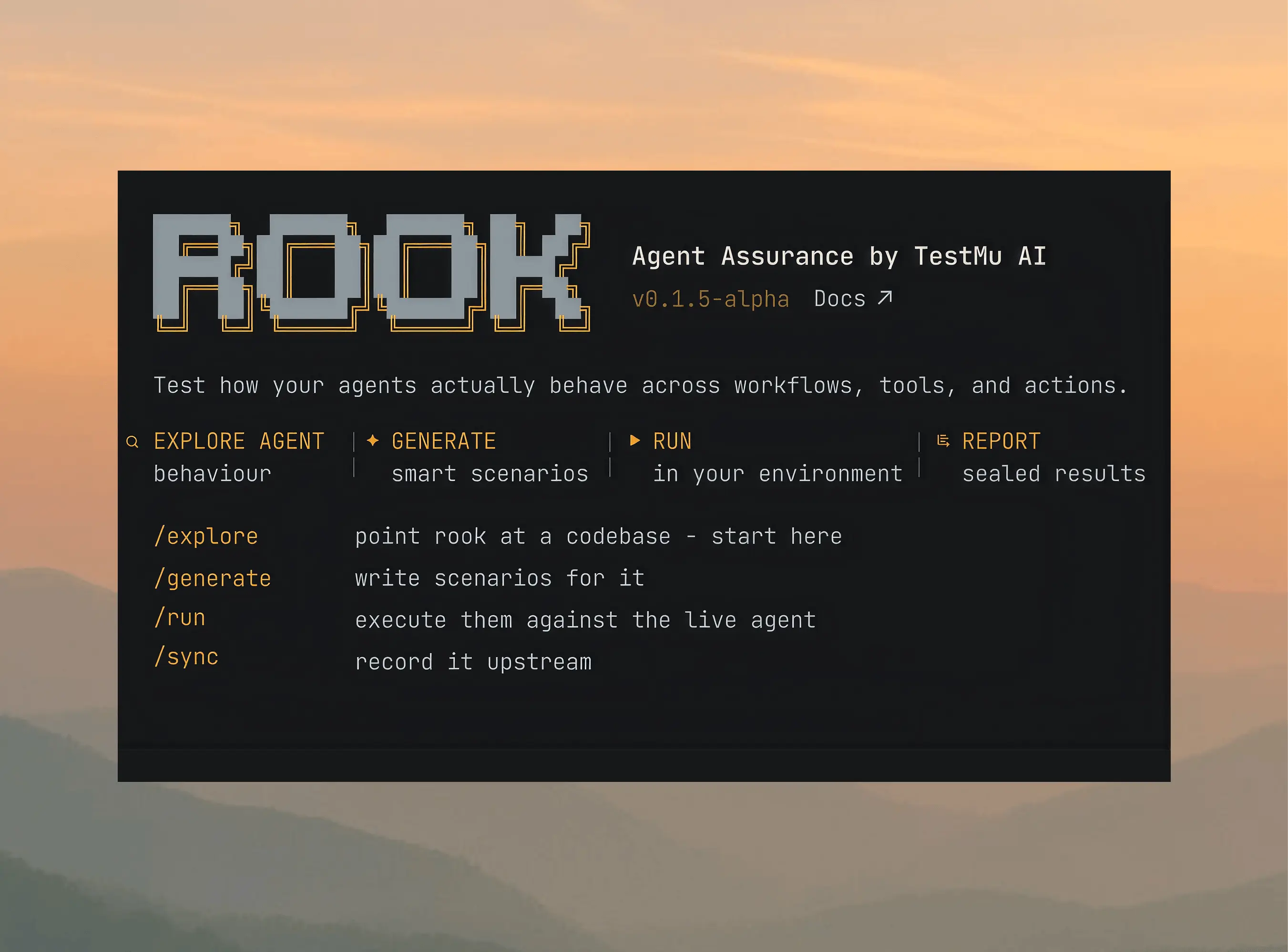
Test how your agents actually behave across workflows, tools, and actions. Catch failures and vulnerabilities before they ship.
npm install -g @testmuai/rook@latest
- TestMu AI (Formerly LambdaTest)
- /
- Learning Hub
- /
- What Is AI Verifiability?
What Is AI Verifiability?
AI verifiability is the share of an AI system's behavior that others can confirm from evidence. Measure it as verification coverage and raise it before release.
Published on:
OVERVIEW
An agent that maintains customer records in a CRM ends a run with a confident reply: it changed the billing contact on account 4471 and emailed invoice INV-2207 to the new address. Nothing else came back from the run. No tool call was recorded, nobody read the account afterwards and no copy of the email was collected, so both actions rest on the agent's word.
The reply may be accurate. AI verifiability asks how much of an AI system's behavior can be confirmed from evidence by someone other than the system, and for this run the answer is none of it.
You can measure it one acceptance criterion at a time, and raise it before release by changing what the agent records.
Overview
AI verifiability is the share of an AI system's behavior that someone other than the system can confirm from evidence. For an AI agent, the evidence is any record from outside its reply, such as recorded tool calls, changed files and records read back after a run. The agent's own summary is never proof that an action happened.
How Do You Measure AI Verifiability?
- Verification coverage: Verification coverage is the number of acceptance criteria a test run settled with a Pass or Fail verdict, divided by all acceptance criteria in the scenarios you selected.
- 100% pass rate: A 100% scenario pass rate does not prove an agent works. In a worked example in TestMu AI's Agent Assurance docs, 8 of 8 decided scenarios passed while evidence settled only 8 of 20 criteria, or 40% coverage.
- Unverified criteria: An unverified acceptance criterion is not a failure. It counts in the criteria total for verification coverage, stays out of the scenario pass rate, and it should be listed with the record that could still decide it.
- Verifiable AI: Verifiable AI and AI verifiability are different properties. Verifiable AI usually means cryptographic provenance, such as signatures and verifiable credentials that show who issued an output, while AI verifiability asks whether behavior can be checked.
- Explainability: Explainability is not verification. It describes why a model produced an output, while AI verifiability confirms what the system did, and a reasoning trace is not evidence that a step ran.
- AI agent verification: AI agent verification checks one agent's identity, permissions and reported actions. AI verifiability is the property of the agent and its records that sets how much of that checking is possible.
- Verifiable agent design: An AI agent is more verifiable when it reports every tool call with its arguments and result, lets a checker read changed records without writing, and is tested against criteria that name checkable facts.
What Does AI Verifiability Mean?
AI verifiability is the share of an AI system's behavior that someone other than the system can confirm from evidence. For an AI agent it is assessed one requirement at a time: a record from outside the agent's reply shows the requirement was met, shows it was missed, or does not exist.
The definition rests on verification in its standards sense. Among the definitions that NIST's glossary lists for verification, the one taken from ISO 9000:2015 describes it as confirming, through objective evidence, that specified requirements were fulfilled.
Researchers, standards bodies and vendors use verifiability in AI for different properties:
| Sense | Who uses it | What gets checked | Evidence used |
|---|---|---|---|
| Governance principle | AI ethics and policy researchers | Claims developers make about an AI system and how it was built | Documentation, repeatable behavior, third-party audits and certification |
| Task property | Machine learning researchers | Whether an attempt at a task can be scored automatically | A resettable environment, many cheap attempts and an automated reward |
| Cryptographic provenance, often called verifiable AI | Identity standards bodies and vendors | Who issued an output or credential, and whether it was altered | Digital signatures, decentralized identifiers, verifiable credentials and zero-knowledge proofs |
| Operational property of an agent | This guide, for teams that test and release AI agents | Whether each action an agent reports happened and met its acceptance criteria | Recorded tool calls, changed files, records read back without writing, and a verdict per criterion |
- Governance principle - the AI Ethics Lab at Rutgers University describes verifiability as the principle that an AI system's functionality, decision-making processes and outputs can be "independently validated and confirmed", backed by documentation, repeatability and independent audits. In Toward Trustworthy AI Development (2020), Miles Brundage and colleagues argued that AI developers "will need to make verifiable claims to which they can be held accountable", and analyzed ten mechanisms for supporting such claims across institutions, software and hardware.
- Cryptographic provenance - the W3C Verifiable Credentials Data Model v2.0, a W3C Recommendation since May 15, 2025, describes a verifiable credential as "a specific way to express a set of claims made by an issuer, such as a driver's license or an education certificate". A signature over those claims shows who made them and that nobody changed them; whether an agent did its job is a separate question.
The rest of this guide uses the operational sense, AI agent verifiability, which a team can measure on its own agent. Checking whether one agent is who it claims to be, is allowed to act and did what it reported is AI agent verification; verifiability is how much of that checking the agent makes possible.
Why Are Verifiable Tasks Easier for AI to Automate?
Andrej Karpathy tied verification to automation in his essay Verifiability, dated November 17, 2025. Writing about what he calls the new programming paradigm, he paired two lines: "Software 1.0 easily automates what you can specify." and "Software 2.0 easily automates what you can verify." In his account a task is verifiable when an AI can practice it, and "Tasks that are verifiable progress rapidly".
His conditions for the environment in which an AI practices, and what each becomes when the task is testing an agent that acts:
| Condition | What Karpathy means | For an agent under test |
|---|---|---|
| Resettable | A new attempt can start from the beginning | A staging environment you can restore to a known state between attempts |
| Efficient | Many attempts can be made | Runs cheap enough to repeat, so each scenario can run several times before a release |
| Rewardable | An automated process can reward each attempt | Acceptance criteria a checker grades from recorded evidence, such as a read of the CRM record, instead of from the agent's reply |
The third column is this guide's mapping; the essay does not discuss agents, permissions or releases. Applying the idea to deployment is TestMu AI's own argument: grant an agent write access only where a test run can confirm, before release, how the agent uses it. Where no run can confirm that yet, keep a person approving each such action, or hold the permission back.
In Software 2.0 Means Verifiable AI, written for O'Reilly Radar on December 9, 2025, Mike Loukides warned that verification "might prove to be more difficult than training LLMs". For a team shipping agents, that means budgeting for the checks as well as the agent; why checking now lags behind generating is covered in the guide to the verification agent.
How Is AI Verifiability Different From Explainability, Observability and Auditability?
For an AI system that acts, each property asks a different question and relies on different evidence:
| Property | Question it answers | Evidence it relies on | When it mostly applies |
|---|---|---|---|
| Verifiability | How much of what the system did can someone else confirm? | Tool calls the run recorded, changed files, records read back without writing | Before release, and after it wherever the evidence is kept |
| Explainability | Why did the model produce this output? | Attributions, reasoning traces, model internals | At the model level, whenever an output needs explaining |
| Observability | What happened in production, and where did it fail? | Traces, logs and metrics | Mostly in production, also in CI |
| Auditability | Can a reviewer reconstruct decisions and controls later? | Retained logs, approvals and test evidence | Periodic review, after the fact |
A model can explain an action it never took; verifiability looks at the action.
- Explainability - NIST's AI Risk Management Framework defines explainability as "a representation of the mechanisms underlying AI systems' operation". An agent's reasoning trace is often read as that kind of explanation; how agents come to report work they did not do is covered in agent action hallucination.
- Observability - AI observability records traces, logs and metrics to show what happened and where it failed, mostly in production and also in CI experiments. A recorded tool call is evidence, so better traces raise verifiability, and you can measure the gain before release.
- Auditability - a reviewer rebuilds decisions and controls later from retained records, and what an agent's audit trail should hold is covered in agentic AI governance. An AI audit can only conclude on the evidence it is handed, so the verifiability built in before release sets how much behavioral evidence an audit can draw on.
How Do You Measure AI Verifiability?
The AI verifiability metric in this guide, verification coverage, is counted per acceptance criterion. A scenario pass rate divides the scenarios that passed by those that reached a Pass or Fail verdict, so it cannot show how many acceptance criteria any evidence settled.
AI assurance checks a system against its written criteria and reports what the evidence shows; verifiability sets how much evidence there is to report.
Verification Coverage and the Scenario Pass Rate
Verification coverage is the share of a suite's acceptance criteria that a run settled with evidence: criteria with a Pass or Fail verdict, divided by all acceptance criteria in the scenarios you selected. A criterion that came back Unable to Verify, or whose scenario never ran, was skipped or was never judged, stays in the denominator and out of the numerator. The Agent Assurance docs call this criterion verification coverage.
In chip and software verification, the same name already has a meaning: code or functional coverage, which tracks how much of a design or its specified features the tests exercised. For an agent, keep three numbers apart: the pass rate counts scenarios, while verification coverage and the unverified share both count criteria and always add up to 100%.
| Number | Counts | Out of |
|---|---|---|
| Scenario pass rate | Scenarios that passed | Scenarios with a decided verdict, Pass or Fail |
| Verification coverage | Criteria with a Pass or Fail verdict | All acceptance criteria in the selected scenarios |
| Unverified share | Criteria with no Pass or Fail verdict | All acceptance criteria in the selected scenarios |
One worked example in the Agent Assurance docs applies both denominators to the same run:
8 decided scenarios: 8 passed, 0 failed
20 acceptance criteria: 8 verified, 12 unable to verify

Scenario pass rate: 100%
Criterion verification coverage: 40%
In the example on the docs page about Agent Assurance results and evidence, all 8 decided scenarios passed, so the pass rate is 100%, while evidence settled 8 of the 20 acceptance criteria: 40% coverage. The other 60% is the unverified share, which the agentic testing life cycle calls the assurance gap.
Report the two numbers together and name each denominator. The Agent Assurance overview gives the reason: "A high pass rate with low verification coverage is not strong release evidence."
Feature and Attack Coverage Gaps in Runs of a Sample Triage Agent
The results page also prints output from Rook CLI 0.1.11 runs dated October 13, 2026. They tested triage-service, the support-triage sample in the public Rook CLI release repository on GitHub. The quickstart report reads 1 of 1 executed · 100% passed, and the docs add that the tested sample "passed one scenario but left four of its five discovered feature areas untested."
An excerpt from a run of the same sample that day shows the attack side. It is copied from the docs as published on October 29, 2026, with lines over 58 characters wrapped and each continuation indented:
OWASP red-team coverage (scenario inventory; unmapped
  controls remain unverified)
risk | generated | executed | reached | verified | Pass |
  Fail | Unable to Verify
redteam | 4 | 0 | 0 | 0 | 0 | 0 | 4
owasp:asi01 | 1 | 0 | 0 | 0 | 0 | 0 | 1
owasp:llm01 | 1 | 0 | 0 | 0 | 0 | 0 | 1
owasp:llm02 | 2 | 0 | 0 | 0 | 0 | 0 | 2
owasp:llm07 | 1 | 0 | 0 | 0 | 0 | 0 | 1
...
Known coverage gaps (unverified):
F-001 · cross-session-memory-poisoning: no scenario
  generated; applicability remains unverified
F-003 · retrieval-boundary: no scenario generated;
applicability remains unverified- Feature coverage - the 100% rests on one of the five feature areas the sample's discovery found; the run tested none of the other four.
- Attack coverage - four attack scenarios were generated and none executed; the docs explain that "all four attacks were written but marked not runnable", so each one counts as Unable to Verify. The OWASP entry rows add up to more than four because one attack can map to more than one entry.
- Not runnable - according to the Agent Assurance test scenarios docs, an attack pattern that needs seeded data, independently collected evidence or a fresh session is skipped until the profile supplies the matching hook, so an attack can be written and still not run.
- Named gaps - attack patterns with no scenario at all, such as cross-session memory poisoning and the retrieval boundary, are listed as known gaps instead of disappearing from the count.
What Makes an AI Agent More Verifiable?
An agent's verifiability depends on what its runs leave behind, so it can be designed in. The Agent Assurance overview also describes the low end: "A profile whose hook returns only an answer string leaves most criteria Unable to Verify".
For a CRM agent like the one above, each action is as verifiable as the record it leaves outside its reply:
| Agent action | Evidence that can settle it | How verifiable it is |
|---|---|---|
| Changes the billing contact on account 4471 | A read-only lookup of the account after the run, through a tool you approve | High: the record shows the change or its absence |
| Emails invoice INV-2207 to the new address | A delivery receipt or trace, collected after the reply | Lower at first: the evidence lands late, so the run has to collect it |
| Saves a PDF copy of the invoice | The new file, in an output folder the profile names | High, as long as the run observes that folder |
| Tells the user the work is done | Quotes of the reply | Partial: the wording can be graded, but the reply settles none of the actions |
Rules 1 and 3 to 6 below each match a fix in the docs' Fix Verification Gaps table, on the results page cited above; rule 2 relies on the calls that rule 1 records:
- Return each tool call with its arguments and result - have the hook that runs the agent report the calls it made, read from a log the agent cannot edit. The Rook CLI docs page on profiles and hooks lists a
callsfield for observed tool calls, and the results page warns: "Hooks must return actual observations. Invented usage or calls turn missing evidence into misleading scores." - Declare allowed and forbidden tool calls - write them into each scenario's expectations, including the calls the agent must not make, so an unexpected call becomes a detectable failure as long as a hook reports the calls.
- Give the checker read-only access to what the agent changes - confirm the billing contact by reading account 4471 back, never by repeating the write. Where a check would itself write, the docs' fix is to "Provide a read-only observation instead."
- Collect evidence that arrives late - an email receipt or a trace can land after the agent replies. For delayed traces or files, the docs' fix is a collect hook, after which the same run continues with the
--runoption. - Write each criterion as a check a record can settle - "the account's billing contact equals the address in the request" can be verified, while "updates customer records correctly" cannot. When a criterion expects a field the evidence lacks, the docs say to align the two without silently weakening the business requirement; deciding what counts as the right answer at all is the test oracle problem.
- Isolate fixtures and keep staging resettable - give each scenario its own accounts and invoices so evidence can be attributed to it, run one scenario at a time when scenarios share state, and restore staging between runs.
Rules 1 and 2 also need work in the agent harness, the code around the model that runs its tools and keeps its state: it has to log every call to a place the agent cannot edit, and hold the list of permitted tools. Rules 3 to 6 change only the test setup and the criteria.
How Do You Close Verification Gaps Before Release?
Treat the first coverage number as a baseline: each criterion it leaves unverified comes with a reason you can act on. Repeat this loop until the number stops rising:
- Run one suite against staging - use synthetic accounts and invoices, isolated as in design rule 6.
- List every unverified criterion with its reason - group them by cause, such as missing tool calls, late evidence or a check that would itself write.
- Close each gap with the matching design rule - change what the agent records or what the checker can read, and leave the requirement as written.
- Rerun the same scenarios - keep the scenario definitions and profile revision fixed so coverage is compared like for like, and run unchanged cases more than once before treating a change in results as a regression, since the agent may choose a different route through the same task.
Then decide what blocks a release. The Agent Assurance CI/CD guide publishes recipes for Argo CD, GitHub Actions and Jenkins that use a strict gate: missing evidence, Unable to Verify, incomplete work or a compromised result blocks the job, and blocking never relabels Unable to Verify as Fail. The general CI recipe in the public Rook CLI skill for coding agents is more permissive: it reports Unable to Verify and unrunnable gaps without failing on them alone.
If the strict gate blocks every release while coverage is still low, gate on Fail first, measure coverage for a few weeks, and only then add a coverage threshold the data supports. The guide also says to enforce any criterion-level evidence or coverage policy you need from the saved verdicts, because scenario totals alone do not prove that every criterion was observable.
Coverage tells you how much of a release decision rests on evidence. Whether the agent suits the job it was built for is what AI agent validation decides.
Testing How Much of an Agent's Work You Can Verify With Agent Assurance
Built by TestMu AI, Agent Assurance tests agents that act in other systems, like the CRM agent above, before release. It runs from your terminal as Rook CLI, the rook command, and works from the agent's code or, when there is no code to read, from its spec. From either, it generates functional and adversarial scenarios and reaches the real agent through whatever your profile names, whether an HTTP endpoint, a command or an MCP tool.
- Replies - what the agent said is graded on quotes taken from its actual output, and some criteria are scored by a model judge over the exchange.
- Actions - what the agent did is graded on evidence returned by the profile's hooks, for example the tool calls it made, a state change or a callback it triggered, and on read-only lookups through a tool you supply and approve, such as reading account 4471 back from the CRM.
- Unsupported claims - an action the agent reports with nothing behind it stays Unable to Verify, and the evidence a run can see is limited by the access and the profile you provide.
- Verdict counts - criteria are settled as Pass or Fail, or left Unable to Verify, and that third verdict keeps a tally of its own that is never merged into the other two. Only scenarios that reached a Pass or Fail enter the pass rate.
- Run records - every run is saved as plain files holding the scenarios exactly as that run used them, the pinned agent version and profile revision, and a verdict with quoted evidence for each criterion. Its summary is computed from those saved verdicts without a model call.
Most eval and observability tools grade an agent's replies and the traces its runs leave behind. Agent Assurance grades what a run changed, from the evidence your hooks report and the read-only checks you approve.
To get verification coverage, count the criterion verdicts in the verdict.yaml file that each scenario keeps in the run's folder, under .testmuai/rook in your project, or filter each result's acceptance criteria by Pass, Fail or Unable to Verify in the local or hosted UI. The totals in rook report --json count scenarios, so on their own they only show how many planned scenarios reached a decided verdict; criterion counts come from the verdict files.
Point Rook CLI at staging with synthetic records: the agent's writes are real, and Rook CLI cannot roll them back. The testing happens before release, and nothing in it watches production traffic or stops an agent while it runs.
Agent Assurance is generally available and self-serve; its free trial lasts 14 days and comes with 4,000 credits. To run, Rook CLI checks your TestMu AI account for an Agent Assurance plan or a trial in progress, and without one it refuses to call a model or spend credits; what each plan includes is on the Agent Assurance plans page.
Install Rook CLI with npm, and add the skill if you work in Claude Code:
npm install -g @testmuai/rook@latest
npx @testmuai/rook-skill@latest install \
  --agent claude-code
Supported systems are macOS and Linux, and 64-bit Windows through npm or WSL. Installed with npm, Rook CLI needs Node.js 20 or newer and the Claude Code skill needs Node.js 22 or newer; Homebrew and the shell installer, for macOS and Linux, need no Node. For the commands behind each route, see the Rook CLI installation guide.
TestMu AI was named a Leader in the 2026 Gartner® Magic Quadrant™ for Agentic Software Quality Assurance Platforms.

Start Measuring AI Verifiability With One Agent and One Suite
Pick one agent that writes to a system you can restore, such as the CRM agent above, and write five to ten of its acceptance criteria as checks against records. With Rook CLI, the criteria sit in the generated scenario files, which you can review and edit before a run. Run those scenarios against staging, divide the criteria settled with a Pass or Fail by all criteria, and report that number next to the pass rate.
To practice on a known target first, the Agent Assurance quickstart walks through the public triage-service sample from connecting the agent to reading its report. Discovery, generation and judging in that walkthrough spend credits.
Gartner, Magic Quadrant for Agentic Software Quality Assurance Platforms, By Ross Power, Sushant Singhal, C.A. Swan, 12 October 2026.
Gartner and Magic Quadrant are trademarks of Gartner, Inc. and/or its affiliates.
Gartner does not endorse any company, vendor, product or service depicted in its publications, and does not advise technology users to select only those vendors with the highest ratings or other designation. Gartner publications consist of the opinions of Gartner's business and technology insights organization and should not be construed as statements of fact. Gartner disclaims all warranties, expressed or implied, with respect to this publication, including any warranties of merchantability or fitness for a particular purpose.
Author

Sirajuddin Khan
Blogs: 9

Sirajuddin Khan is Vice President of Product Management at TestMu AI, where he drives the company's agentic AI product strategy, building a suite of autonomous agents that includes Agentic Browsers and Agentic Visual Testing and shifting the unit of work from test execution to autonomous outcomes. One of the company's earliest product leaders, he has owned the roadmap for the high-performance execution cloud and grew the cross-browser testing products from early adoption to market leadership. He brings over a decade of experience across SaaS, B2B, and eCommerce, with earlier product roles at Wydr and ShopClues, where his catalog and search work cut delivery SLAs and lifted seller activity. Sirajuddin holds an MBA in Information Technology from Sikkim Manipal University and a B.Tech in Computer Science Engineering from Maharshi Dayanand University.
Reviewer

Mayank Bhola
Reviewer
Mayank Bhola is Co-Founder and Head of Products at TestMu AI, where he leads the entire product portfolio across KaneAI, Kane CLI, HyperExecute, SmartUI, the Real Device Cloud, Accessibility, and other software testing product lines. As an early Lead Architect he designed and built the company's flagship Tunnel technology from scratch, created the React-based automation platform, and architected the data-intensive pipelines and FAAS services that scale it. He brings more than 10 years of experience in software development and product engineering, with earlier roles as Head of Technology at Juggernaut Books and Senior Software Engineer at PressPlay TV and Zomato. Mayank holds a B.Tech in Computer Engineering from JIIT Noida.


AI Verifiability FAQs
Did you find this page helpful?
More Related Learning Hubs

TestMu AI forEnterprise
Get access to solutions built on Enterprise
grade security, privacy, & compliance
- Advanced access controls
- Advanced data retention rules
- Advanced Local Testing
- Premium Support options
- Early access to beta features
- Private Slack Channel
- Unlimited Manual Accessibility DevTools Tests